Expert Workshop on NAMAs:
National mitigation planning and
 implementation in agriculture
             16-17 July 2012
               FAO, Rome
    Christina Seeberg-Elverfeldt and
             Lini Wollenberg
FAO
Mitigation of Climate Change in Agriculture (MICCA) Programme
  at FAO
   • Launched January 2010
   • Outcome: Developing countries are contributing to climate change
     mitigation in agriculture by moving towards climate smart agricultural
     practices
   • Knowledge generation
   • Synergies and Trade-offs
   • Pilot Projects
   • Support to UNFCCC and Capacity Development
   • Monitoring and Assessment of GHG Emissions and Mitigation
     Potential in Agriculture
CCAFS
Climate Change Agriculture and Food Security Research
Program of the CGIAR (CCAFS)

•   Adaptation, risk management, mitigation and
    integrated decision making themes

•   Partnership of the CGIAR (15 centers) and Earth
    Systems Science Program

•   Regional focus: E and W, Africa, S. Asia, SE Asia, Lat
    Am, 30 benchmark sites
Proposed workshop outcomes
• Information for a review of NAMA
  experiences
• Steps and decision trees for planning and
  implementing NAMAs
• Enhanced knowledge on tools and resources
• Action steps for effective NAMA planning
• Research and capacity development needs
Workshop Purpose: Support the development of
 national mitigation planning to advance climate
 smart agriculture


Objectives
Advance understanding and practice on
• The nature and role of NAMAs: how can national and
  subnational policy best advance climate smart agriculture?
• Planning NAMAs: identifying, assessing and prioritizing
  options
• Implementing NAMAs: what is needed to secure investments
  and finance, policies, technical support & MRV?
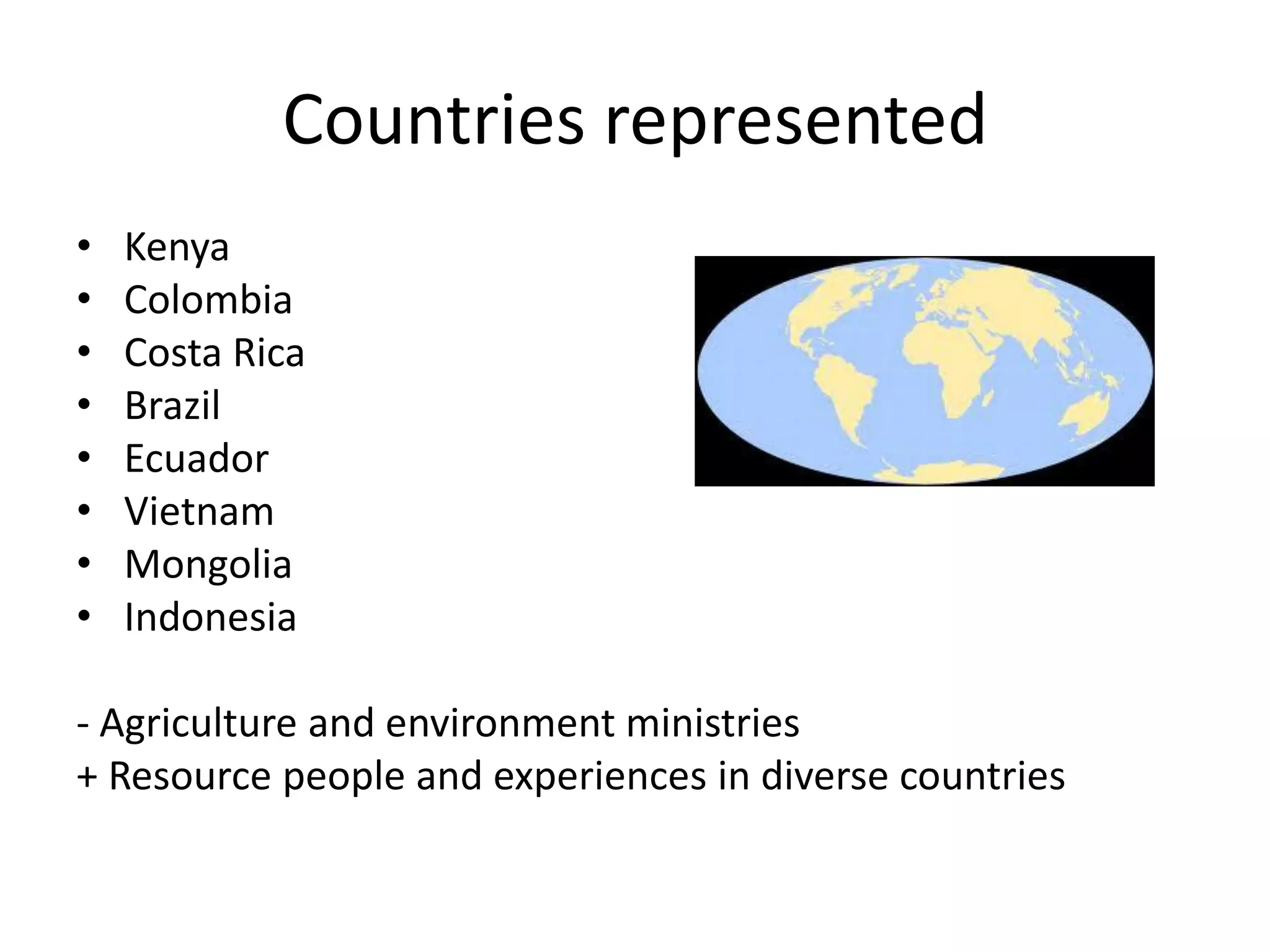
Countries represented
•   Kenya
•   Colombia
•   Costa Rica
•   Brazil
•   Ecuador
•   Vietnam
•   Mongolia
•   Indonesia

- Agriculture and environment ministries
+ Resource people and experiences in diverse countries
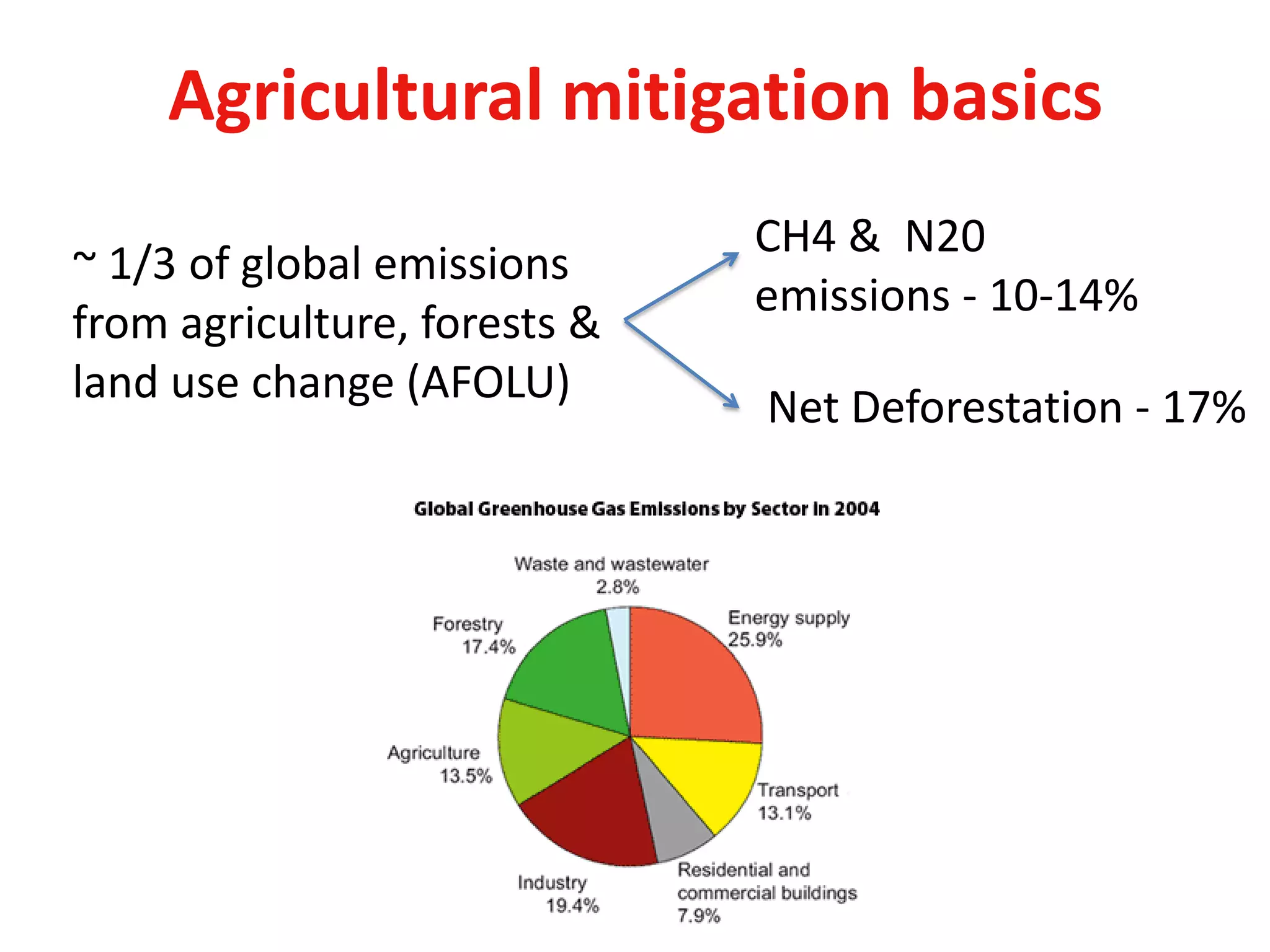
Agricultural mitigation basics
                              CH4 & N20
~ 1/3 of global emissions
                              emissions - 10-14%
from agriculture, forests &
land use change (AFOLU)
                              Net Deforestation - 17%
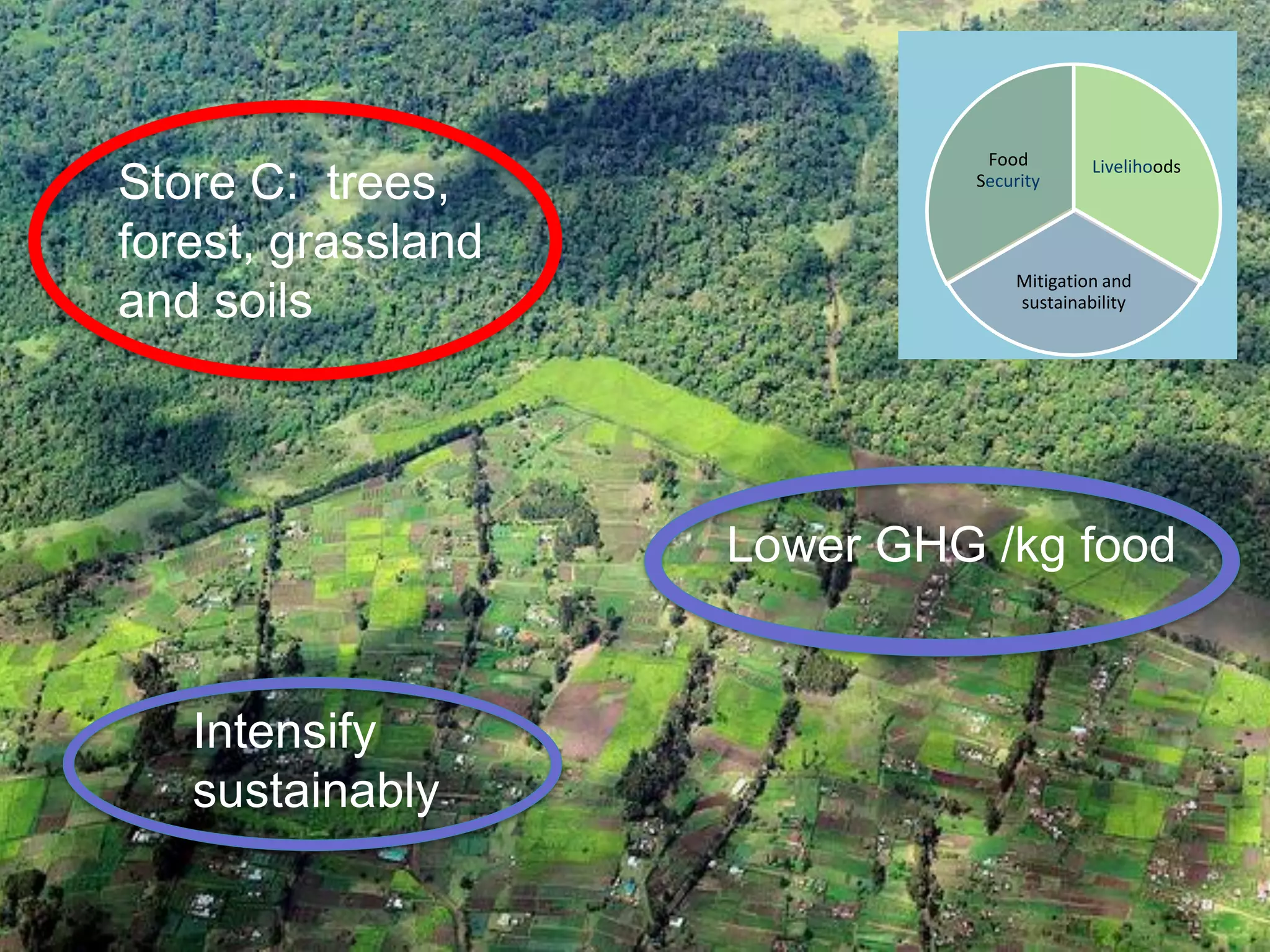
Food        Livelihoods
Store C: trees,              Security


forest, grassland
                                 Mitigation and
and soils                        sustainability


                    Lower GHG /kg food


   Intensify
   sustainably
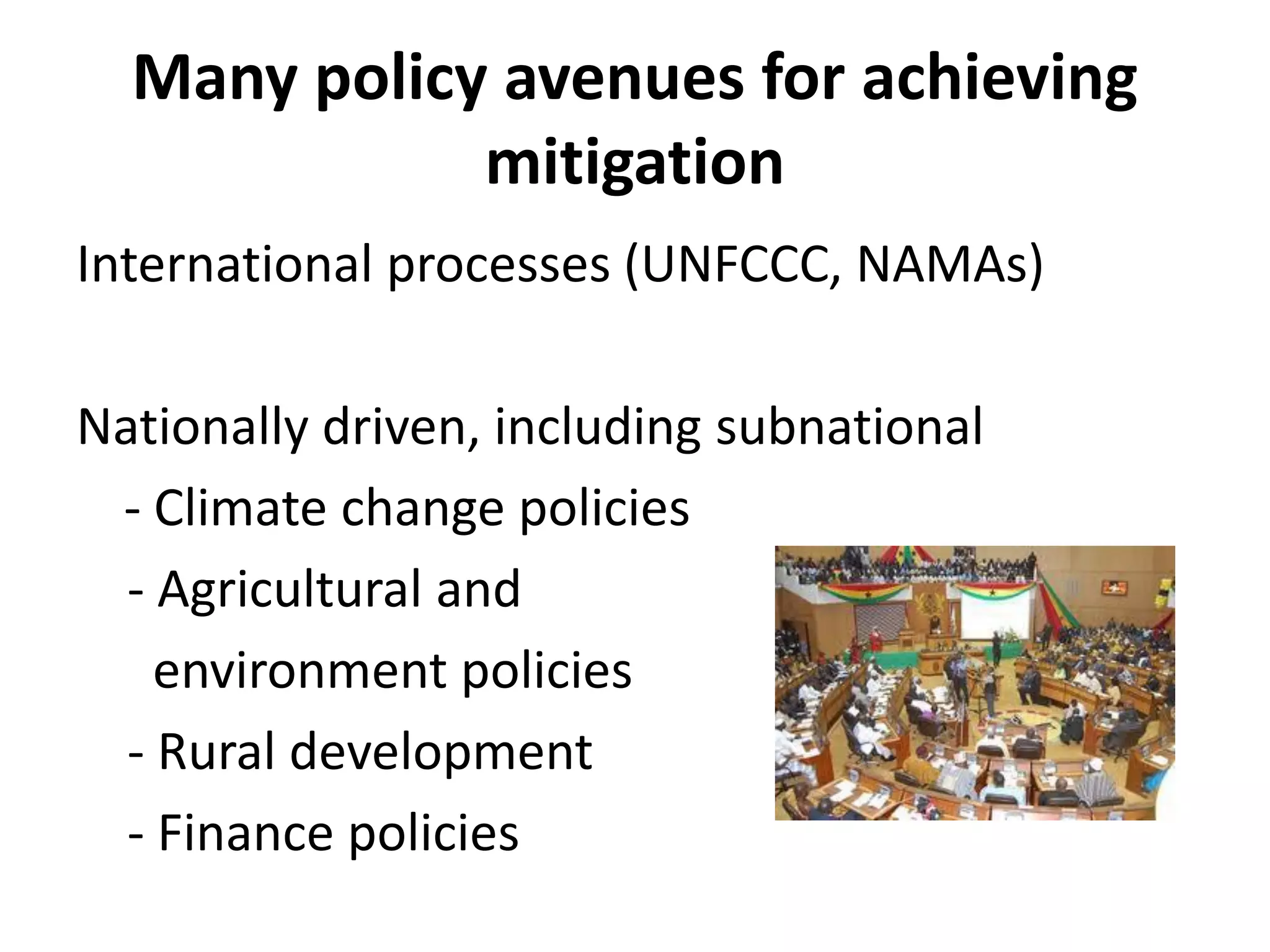
Many policy avenues for achieving
             mitigation
International processes (UNFCCC, NAMAs)

Nationally driven, including subnational
 - Climate change policies
  - Agricultural and
    environment policies
  - Rural development
  - Finance policies
Why National Mitigation Policy for
             Agriculture?
Mitigation as agricultural best practice
• Productive and resilient agriculture with mitigation as co-benefit
• Increased efficiencies

Meet targets
• Meet national emissions reductions targets
• Non Annex 1 committed to “substantially deviate “ from baselines
        -2020 in selected regions (including LA), 2050 all regions

Vehicle for coordination
• Align national agricultural policy and investment
• NAMAS can help operationalize mitigation action plans
• NAMAS can help access to Green Climate Fund and climate finance (USD
   97 billion of climate finance globally in 2010 , 56% from private sector)
NAMAs: One tool
Nationally Appropriate Mitigation Actions (Bali Action
  Plan 2007)

No formal definition
 “Any kind of action by government that reduces GHG
  emissions” (Situmeang et al, 2012)
  - Main vehicle for mitigation in developing countries
  - Broad scope: policies to technical interventions

NAMAs are only one tool for mitigation planning; use
  here as shorthand.
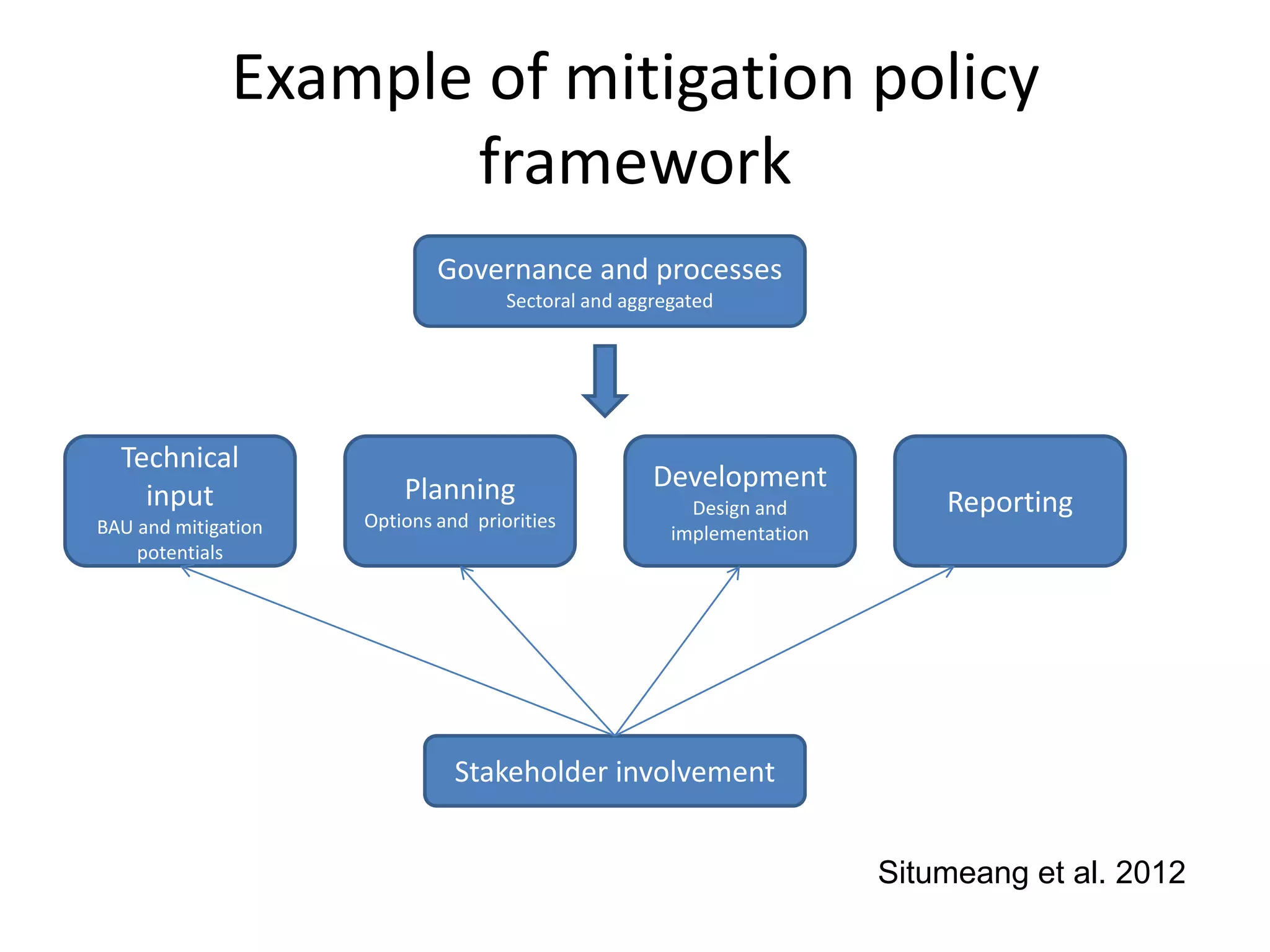
Example of mitigation policy
                     framework
                             Governance and processes
                                     Sectoral and aggregated


  Technical
                         Planning                    Development
    input                                                Design and         Reporting
BAU and mitigation   Options and priorities
                                                       implementation
    potentials


                               Stakeholder involvement


                                                                        Situmeang et al. 2012
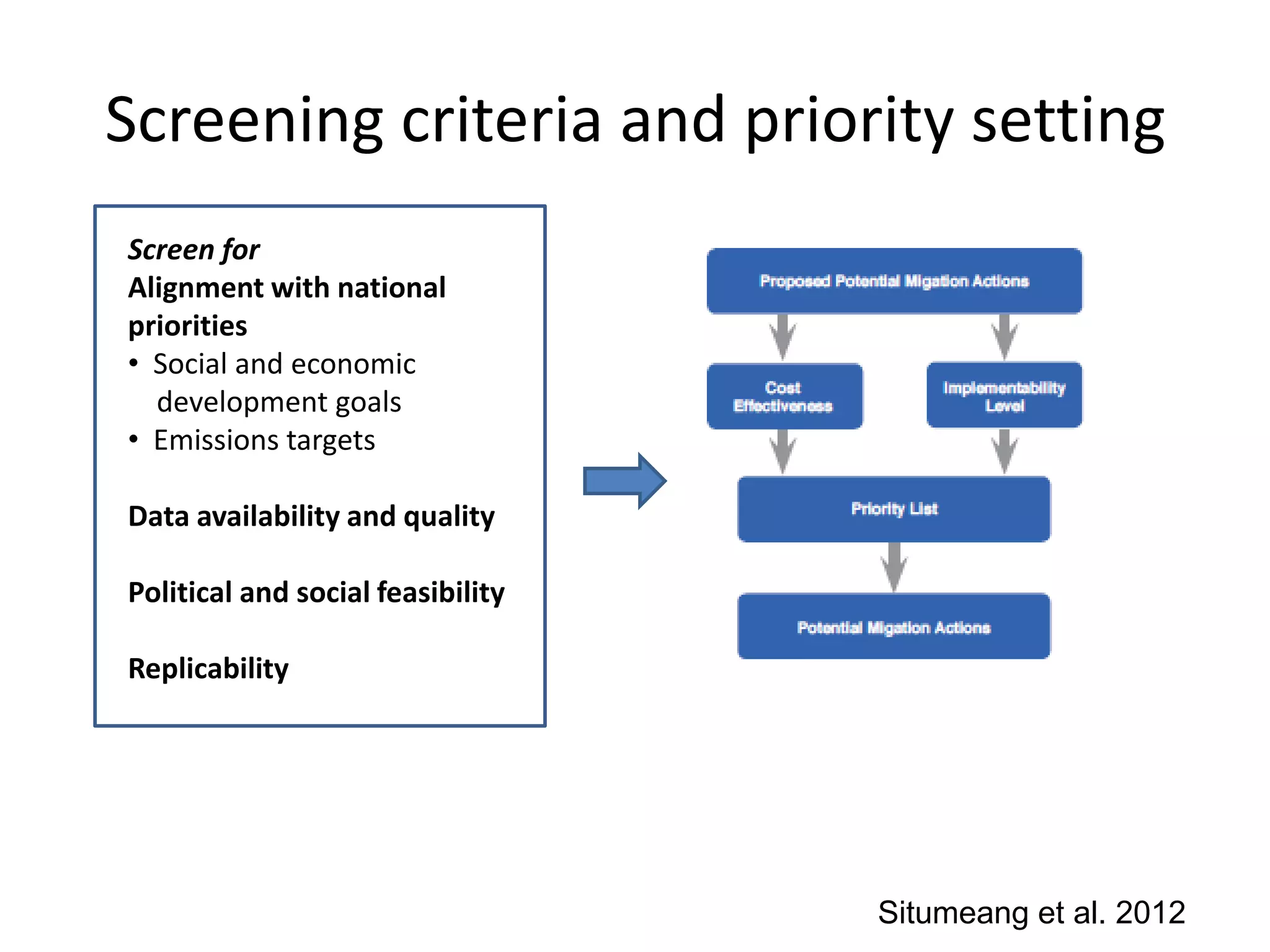
Screening criteria and priority setting
Screen for
Alignment with national
priorities
• Social and economic
  development goals
• Emissions targets

Data availability and quality

Political and social feasibility

Replicability


                                   Situmeang et al. 2012
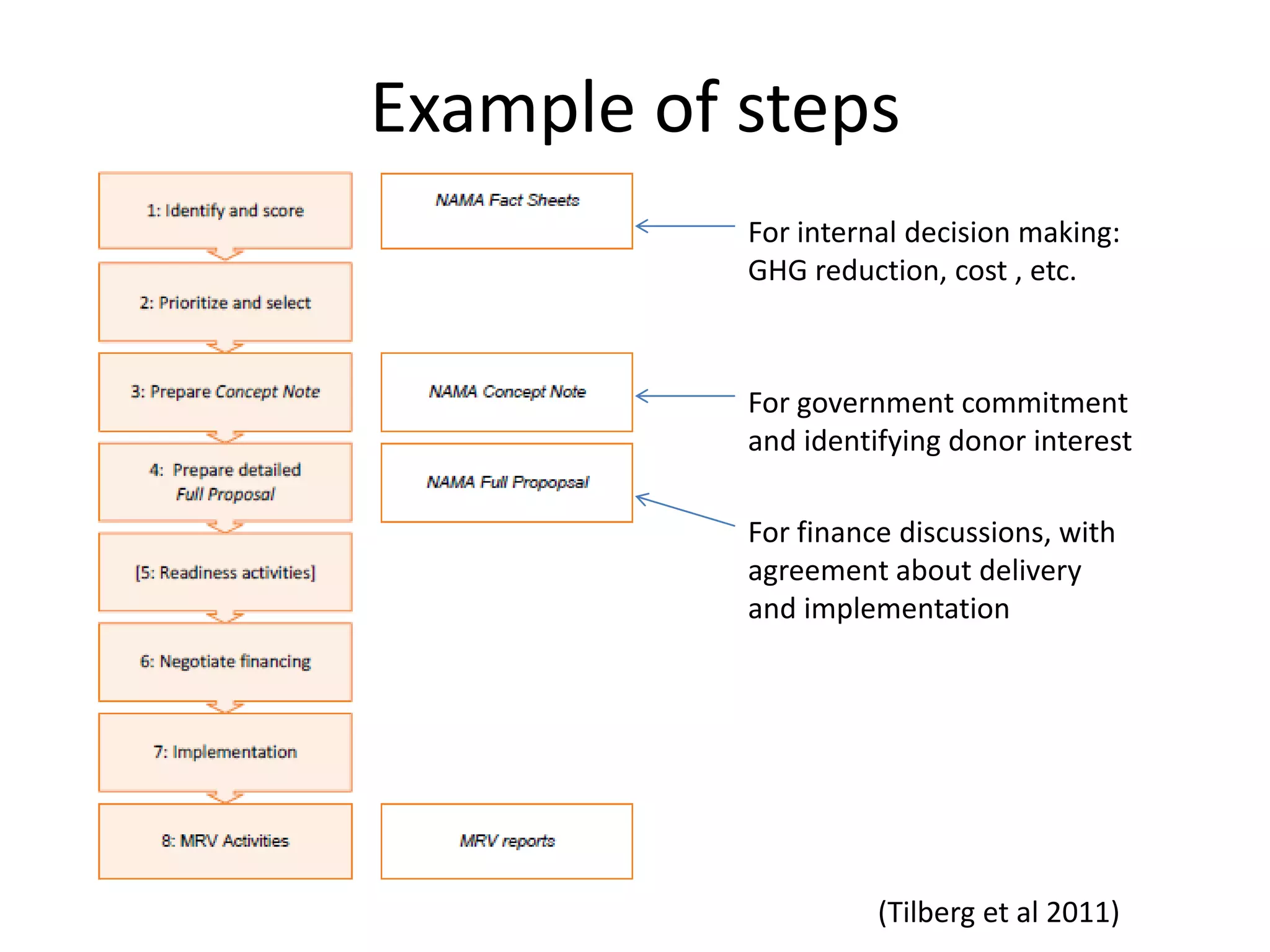
Example of steps
           For internal decision making:
           GHG reduction, cost , etc.


           For government commitment
           and identifying donor interest

           For finance discussions, with
           agreement about delivery
           and implementation


                     (Tilberg et al 2011)
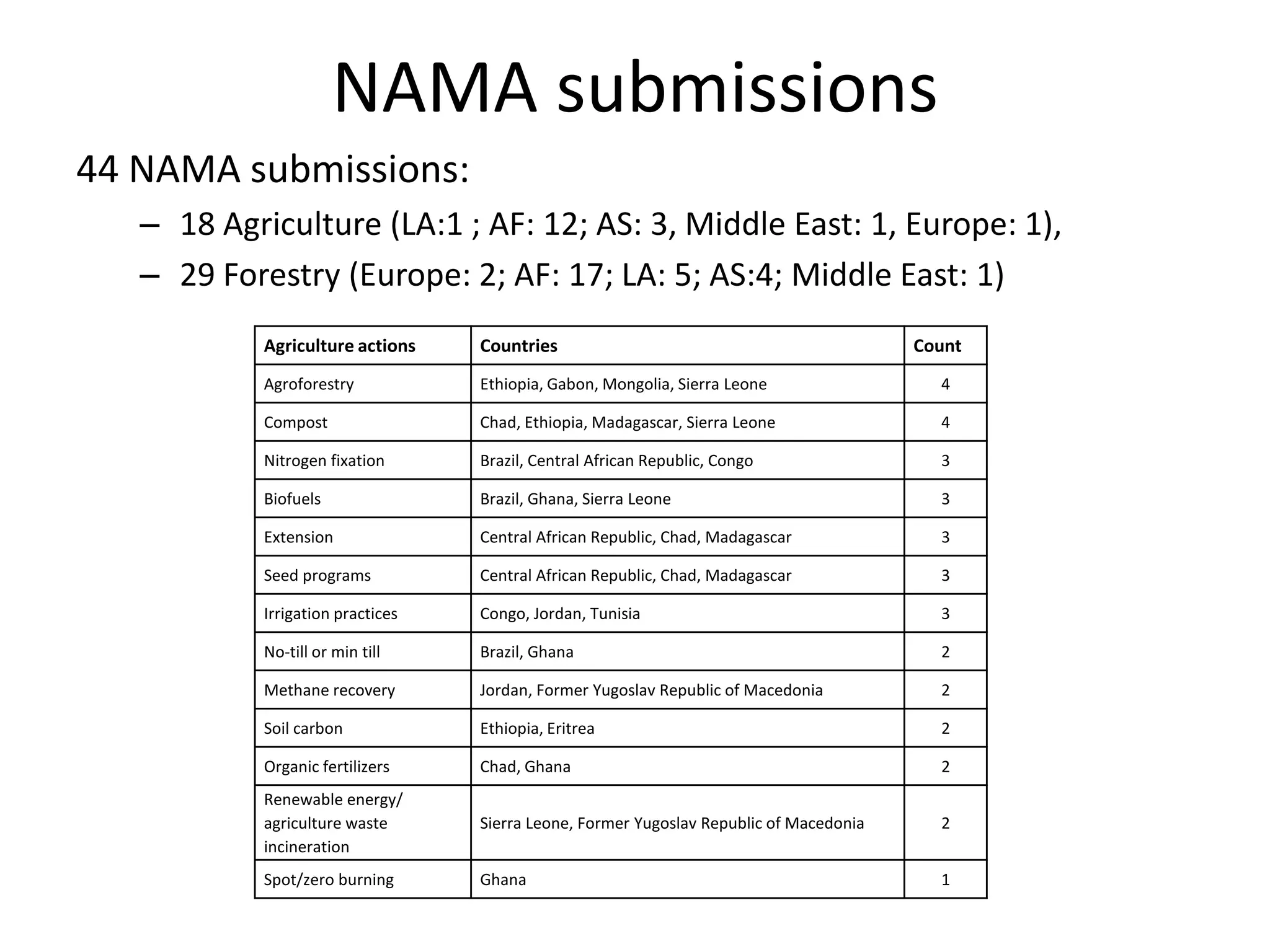
NAMA submissions
44 NAMA submissions:
   – 18 Agriculture (LA:1 ; AF: 12; AS: 3, Middle East: 1, Europe: 1),
   – 29 Forestry (Europe: 2; AF: 17; LA: 5; AS:4; Middle East: 1)
            Agriculture actions    Countries                                             Count
            Agroforestry           Ethiopia, Gabon, Mongolia, Sierra Leone                 4

            Compost                Chad, Ethiopia, Madagascar, Sierra Leone                4

            Nitrogen fixation      Brazil, Central African Republic, Congo                 3

            Biofuels               Brazil, Ghana, Sierra Leone                             3

            Extension              Central African Republic, Chad, Madagascar              3

            Seed programs          Central African Republic, Chad, Madagascar              3

            Irrigation practices   Congo, Jordan, Tunisia                                  3

            No-till or min till    Brazil, Ghana                                           2

            Methane recovery       Jordan, Former Yugoslav Republic of Macedonia           2

            Soil carbon            Ethiopia, Eritrea                                       2

            Organic fertilizers    Chad, Ghana                                             2
            Renewable energy/
            agriculture waste      Sierra Leone, Former Yugoslav Republic of Macedonia     2
            incineration
            Spot/zero burning      Ghana                                                   1
Considerations for agricultural
              NAMAs
• Potential to upscale climate-smart agriculture
• How to estimate mitigation potentials,
  emission reductions & conduct MRV: data
  requirements
• Institutional requirements
• Tools, resources & planning required within
  national climate policy processes
Questions
• Input to a review of NAMA experiences
    => What are your experiences on NAMA developments?
• Decision trees for planning and implementing NAMAs
    => Which steps are required for planning NAMAs?
• Enhanced knowledge on tools and resources
    => Which tools/resources are needed and already
      available?
• Ways forward for effective NAMA planning and implementation
    => What actions are required at country/international level
      to advance agriculture NAMA planning and
      implementation?
Questions (cont.)
• Identification of research and capacity development
    => Where do we need more research and capacity building
      for countries to plan mitigation policies and actions?
EXTRA MATERIAL
Why agriculture and climate change
 mitigation?
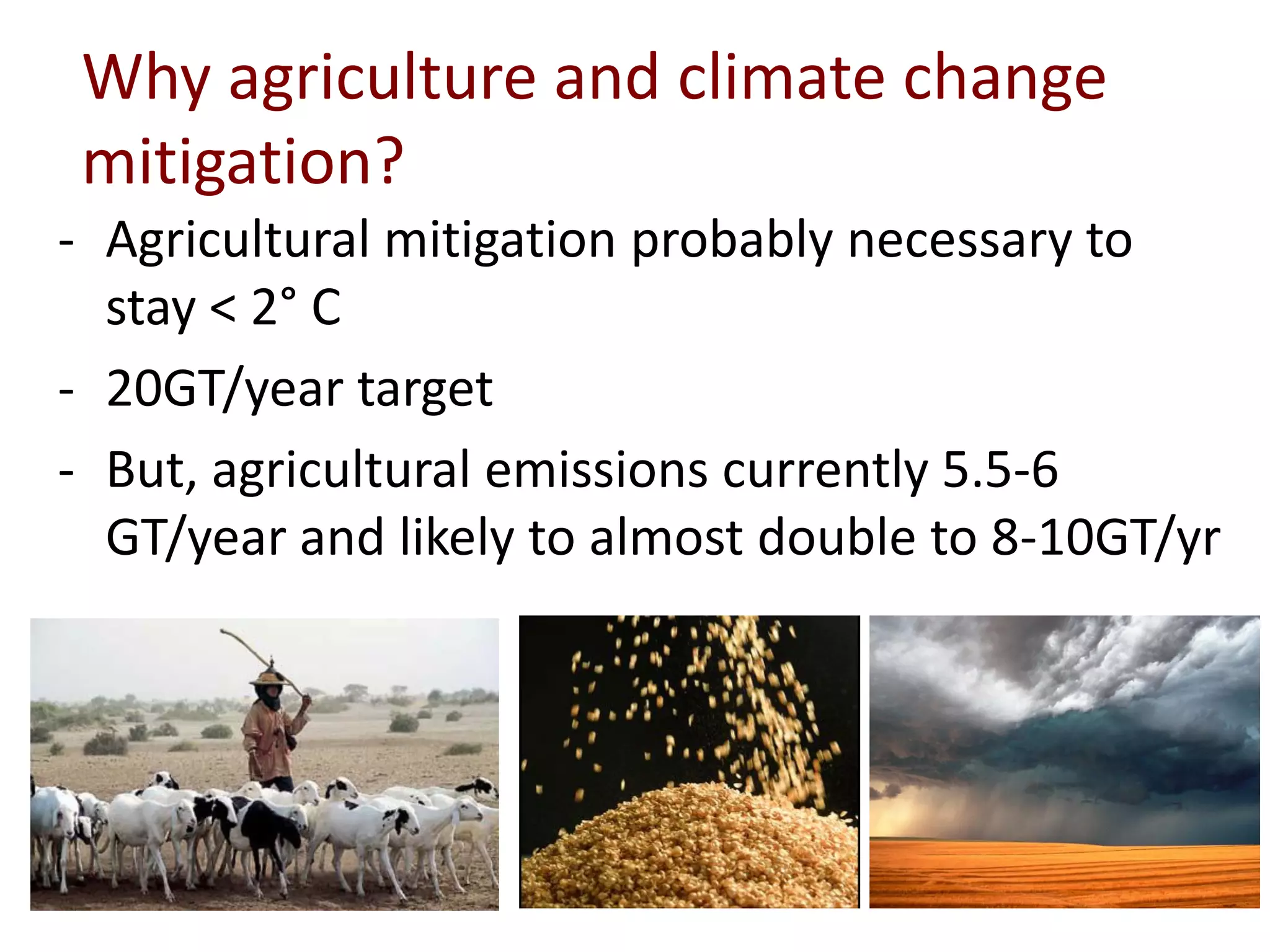
- Agricultural mitigation probably necessary to
  stay < 2° C
- 20GT/year target
- But, agricultural emissions currently 5.5-6
  GT/year and likely to almost double to 8-10GT/yr
Mitigation strategies in agriculture
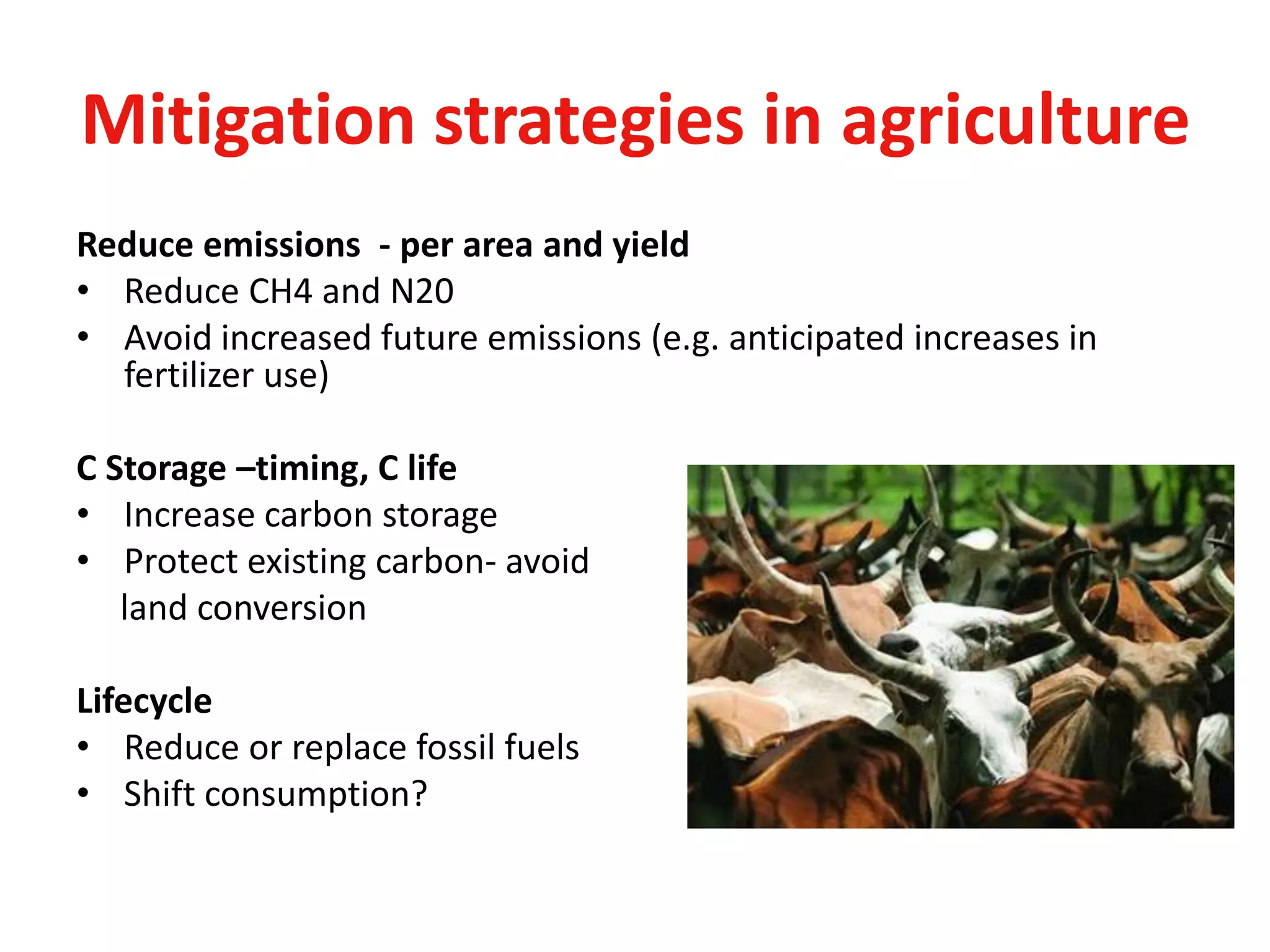
Reduce emissions - per area and yield
• Reduce CH4 and N20
• Avoid increased future emissions (e.g. anticipated increases in
  fertilizer use)

C Storage –timing, C life
• Increase carbon storage
• Protect existing carbon- avoid
   land conversion

Lifecycle
• Reduce or replace fossil fuels
• Shift consumption?
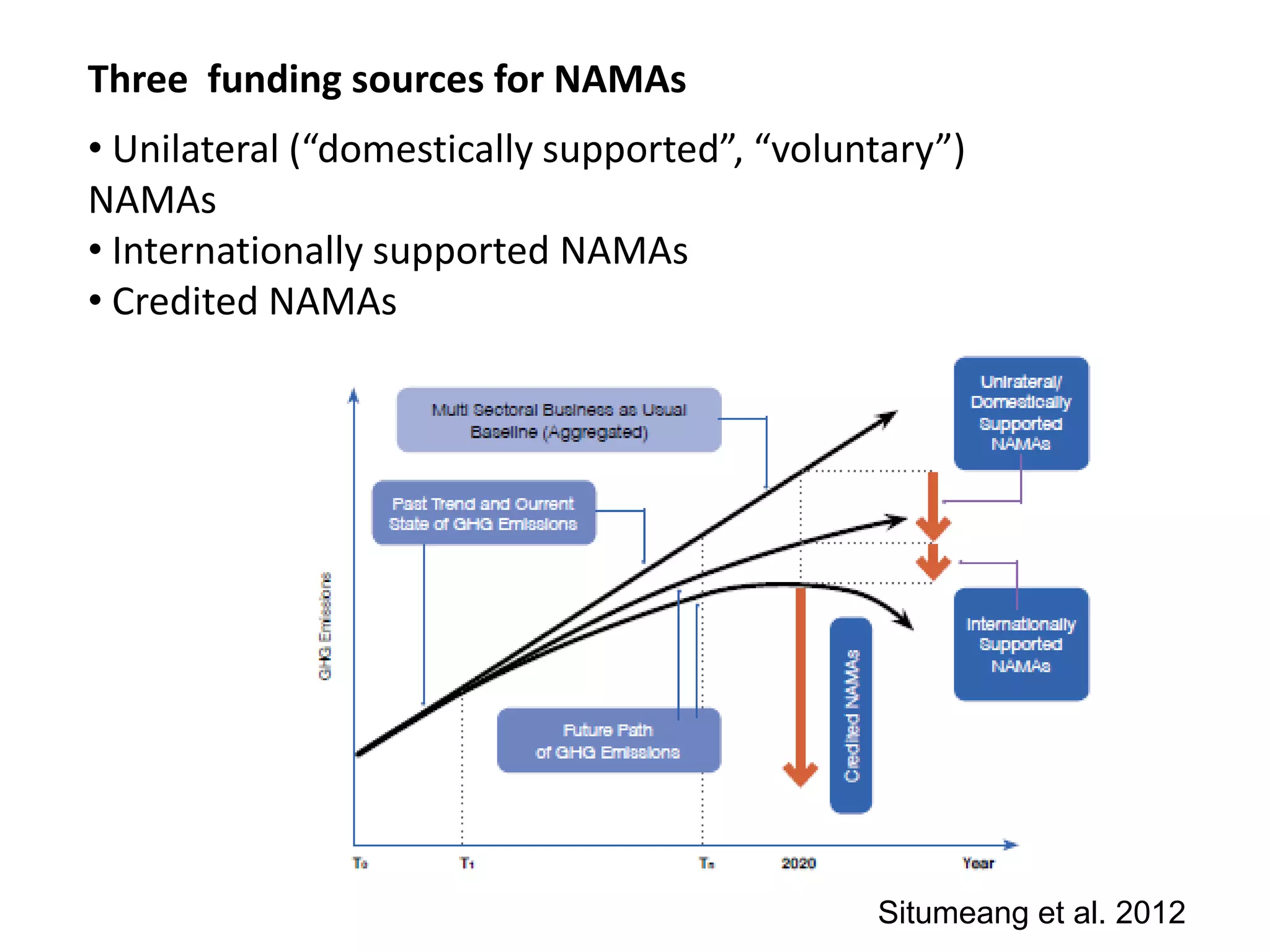
Three funding sources for NAMAs
• Unilateral (“domestically supported”, “voluntary”)
NAMAs
• Internationally supported NAMAs
• Credited NAMAs


                                              Situmeang et al. 2012
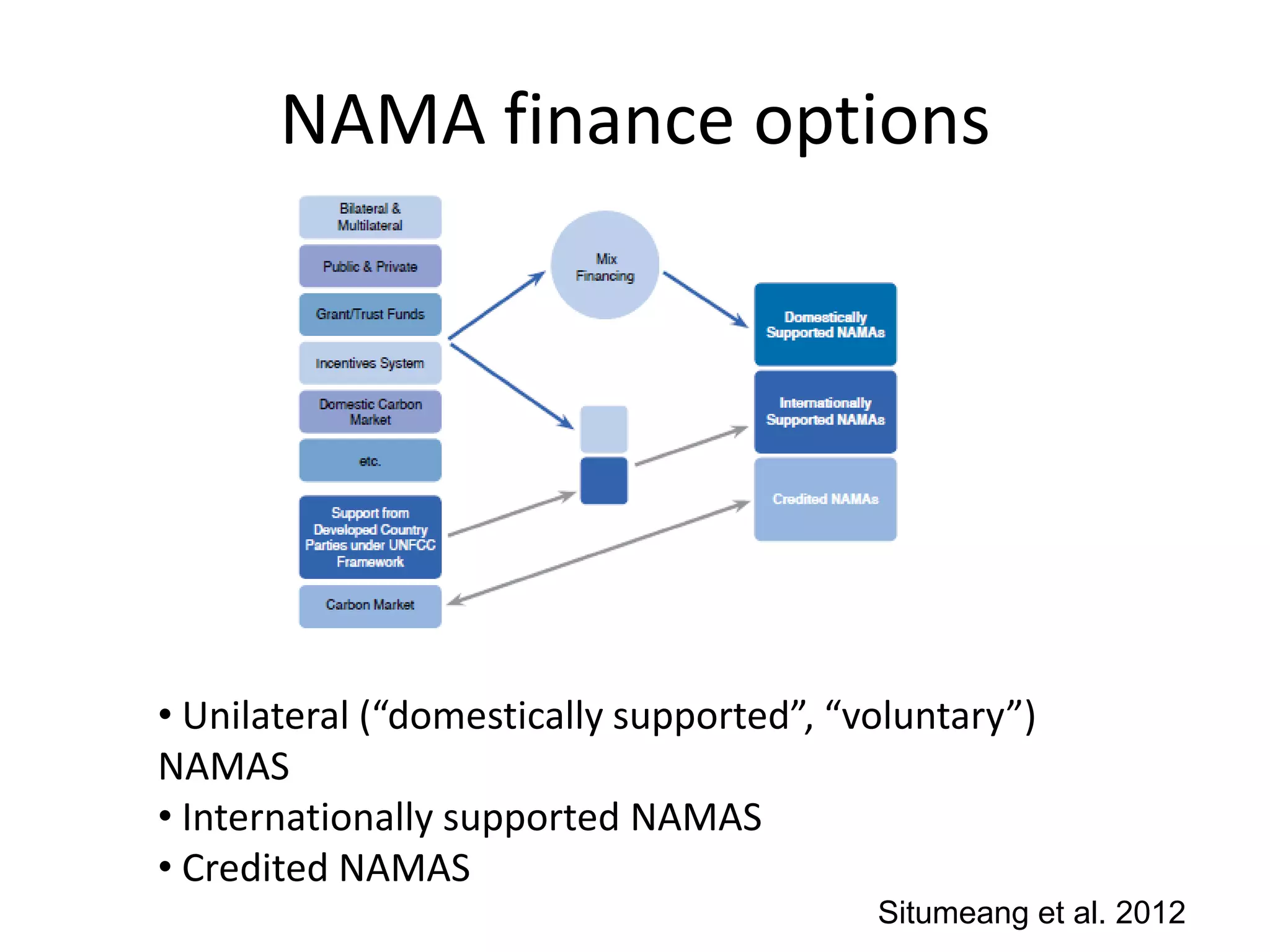
NAMA finance options


• Unilateral (“domestically supported”, “voluntary”)
NAMAS
• Internationally supported NAMAS
• Credited NAMAS
                                          Situmeang et al. 2012
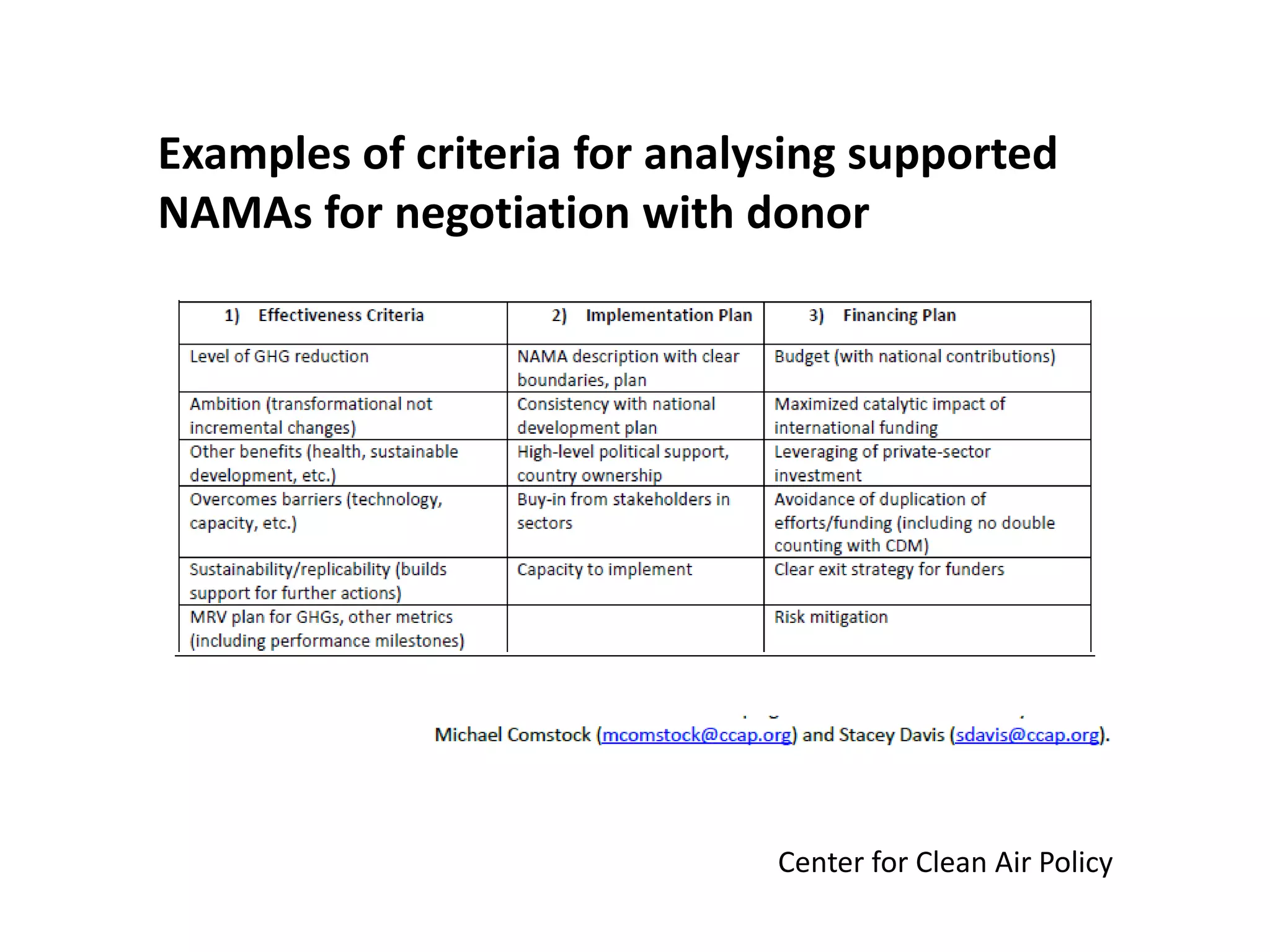
Examples of criteria for analysing supported
NAMAs for negotiation with donor


                              Center for Clean Air Policy

Expert Workshop on NAMAs by Wollenberg Lini

  • 1.
    Expert Workshop onNAMAs: National mitigation planning and implementation in agriculture 16-17 July 2012 FAO, Rome Christina Seeberg-Elverfeldt and Lini Wollenberg
  • 2.
    FAO Mitigation of ClimateChange in Agriculture (MICCA) Programme at FAO • Launched January 2010 • Outcome: Developing countries are contributing to climate change mitigation in agriculture by moving towards climate smart agricultural practices • Knowledge generation • Synergies and Trade-offs • Pilot Projects • Support to UNFCCC and Capacity Development • Monitoring and Assessment of GHG Emissions and Mitigation Potential in Agriculture
  • 3.
    CCAFS Climate Change Agricultureand Food Security Research Program of the CGIAR (CCAFS) • Adaptation, risk management, mitigation and integrated decision making themes • Partnership of the CGIAR (15 centers) and Earth Systems Science Program • Regional focus: E and W, Africa, S. Asia, SE Asia, Lat Am, 30 benchmark sites
  • 4.
    Proposed workshop outcomes •Information for a review of NAMA experiences • Steps and decision trees for planning and implementing NAMAs • Enhanced knowledge on tools and resources • Action steps for effective NAMA planning • Research and capacity development needs
  • 5.
    Workshop Purpose: Supportthe development of national mitigation planning to advance climate smart agriculture Objectives Advance understanding and practice on • The nature and role of NAMAs: how can national and subnational policy best advance climate smart agriculture? • Planning NAMAs: identifying, assessing and prioritizing options • Implementing NAMAs: what is needed to secure investments and finance, policies, technical support & MRV?
  • 6.
    Countries represented • Kenya • Colombia • Costa Rica • Brazil • Ecuador • Vietnam • Mongolia • Indonesia - Agriculture and environment ministries + Resource people and experiences in diverse countries
  • 7.
    Agricultural mitigation basics CH4 & N20 ~ 1/3 of global emissions emissions - 10-14% from agriculture, forests & land use change (AFOLU) Net Deforestation - 17%
  • 8.
    Food Livelihoods Store C: trees, Security forest, grassland Mitigation and and soils sustainability Lower GHG /kg food Intensify sustainably
  • 9.
    Many policy avenuesfor achieving mitigation International processes (UNFCCC, NAMAs) Nationally driven, including subnational - Climate change policies - Agricultural and environment policies - Rural development - Finance policies
  • 10.
    Why National MitigationPolicy for Agriculture? Mitigation as agricultural best practice • Productive and resilient agriculture with mitigation as co-benefit • Increased efficiencies Meet targets • Meet national emissions reductions targets • Non Annex 1 committed to “substantially deviate “ from baselines -2020 in selected regions (including LA), 2050 all regions Vehicle for coordination • Align national agricultural policy and investment • NAMAS can help operationalize mitigation action plans • NAMAS can help access to Green Climate Fund and climate finance (USD 97 billion of climate finance globally in 2010 , 56% from private sector)
  • 11.
    NAMAs: One tool NationallyAppropriate Mitigation Actions (Bali Action Plan 2007) No formal definition “Any kind of action by government that reduces GHG emissions” (Situmeang et al, 2012) - Main vehicle for mitigation in developing countries - Broad scope: policies to technical interventions NAMAs are only one tool for mitigation planning; use here as shorthand.
  • 12.
    Example of mitigationpolicy framework Governance and processes Sectoral and aggregated Technical Planning Development input Design and Reporting BAU and mitigation Options and priorities implementation potentials Stakeholder involvement Situmeang et al. 2012
  • 13.
    Screening criteria andpriority setting Screen for Alignment with national priorities • Social and economic development goals • Emissions targets Data availability and quality Political and social feasibility Replicability Situmeang et al. 2012
  • 14.
    Example of steps For internal decision making: GHG reduction, cost , etc. For government commitment and identifying donor interest For finance discussions, with agreement about delivery and implementation (Tilberg et al 2011)
  • 15.
    NAMA submissions 44 NAMAsubmissions: – 18 Agriculture (LA:1 ; AF: 12; AS: 3, Middle East: 1, Europe: 1), – 29 Forestry (Europe: 2; AF: 17; LA: 5; AS:4; Middle East: 1) Agriculture actions Countries Count Agroforestry Ethiopia, Gabon, Mongolia, Sierra Leone 4 Compost Chad, Ethiopia, Madagascar, Sierra Leone 4 Nitrogen fixation Brazil, Central African Republic, Congo 3 Biofuels Brazil, Ghana, Sierra Leone 3 Extension Central African Republic, Chad, Madagascar 3 Seed programs Central African Republic, Chad, Madagascar 3 Irrigation practices Congo, Jordan, Tunisia 3 No-till or min till Brazil, Ghana 2 Methane recovery Jordan, Former Yugoslav Republic of Macedonia 2 Soil carbon Ethiopia, Eritrea 2 Organic fertilizers Chad, Ghana 2 Renewable energy/ agriculture waste Sierra Leone, Former Yugoslav Republic of Macedonia 2 incineration Spot/zero burning Ghana 1
  • 16.
    Considerations for agricultural NAMAs • Potential to upscale climate-smart agriculture • How to estimate mitigation potentials, emission reductions & conduct MRV: data requirements • Institutional requirements • Tools, resources & planning required within national climate policy processes
  • 17.
    Questions • Input toa review of NAMA experiences => What are your experiences on NAMA developments? • Decision trees for planning and implementing NAMAs => Which steps are required for planning NAMAs? • Enhanced knowledge on tools and resources => Which tools/resources are needed and already available? • Ways forward for effective NAMA planning and implementation => What actions are required at country/international level to advance agriculture NAMA planning and implementation?
  • 18.
    Questions (cont.) • Identificationof research and capacity development => Where do we need more research and capacity building for countries to plan mitigation policies and actions?
  • 19.
  • 20.
    Why agriculture andclimate change mitigation? - Agricultural mitigation probably necessary to stay < 2° C - 20GT/year target - But, agricultural emissions currently 5.5-6 GT/year and likely to almost double to 8-10GT/yr
  • 21.
    Mitigation strategies inagriculture Reduce emissions - per area and yield • Reduce CH4 and N20 • Avoid increased future emissions (e.g. anticipated increases in fertilizer use) C Storage –timing, C life • Increase carbon storage • Protect existing carbon- avoid land conversion Lifecycle • Reduce or replace fossil fuels • Shift consumption?
  • 22.
    Three funding sourcesfor NAMAs • Unilateral (“domestically supported”, “voluntary”) NAMAs • Internationally supported NAMAs • Credited NAMAs Situmeang et al. 2012
  • 23.
    NAMA finance options •Unilateral (“domestically supported”, “voluntary”) NAMAS • Internationally supported NAMAS • Credited NAMAS Situmeang et al. 2012
  • 24.
    Examples of criteriafor analysing supported NAMAs for negotiation with donor Center for Clean Air Policy