Strategic Planning for Mitigation Programs in Agriculture: Learning from Recent Experiences 
Pablo Benitez, Ph.D. 
Senior Economist 
World Bank Institute, World Bank 
CCAFS/FAO Expert Workshop on NAMAs: National mitigation planning and implementation in agriculture 
Rome, 16-17 July 2012
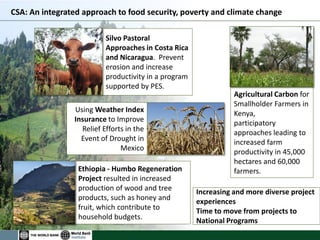
CSA: An integrated approach to food security, poverty and climate change 
Agricultural Carbon for 
Smallholder Farmers in Kenya, 
participatory approaches leading to increased farm productivity in 45,000 hectares and 60,000 farmers. 
Ethiopia - Humbo Regeneration Project resulted in increased production of wood and tree products, such as honey and fruit, which contribute to household budgets. 
Silvo Pastoral Approaches in Costa Rica and Nicaragua. Prevent erosion and increase productivity in a program supported by PES. 
Using Weather Index Insurance to Improve Relief Efforts in the Event of Drought in Mexico 
Increasing and more diverse project experiences 
Time to move from projects to National Programs
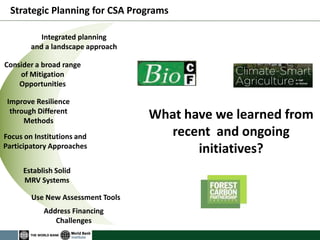
Integrated planning 
and a landscape approach 
Consider a broad range of Mitigation Opportunities 
Improve Resilience through Different Methods 
Focus on Institutions and Participatory Approaches 
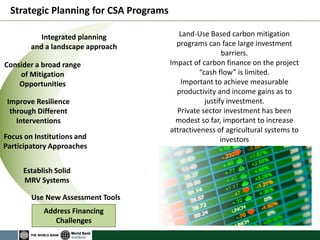
Strategic Planning for CSA Programs 
Establish Solid MRV Systems 
Use New Assessment Tools 
Address Financing Challenges 
What have we learned from recent and ongoing initiatives?
Integrated planning 
and a landscape approach 
Consider a broad range of Mitigation Opportunities 
Improve Resilience through Different Methods 
Focus on Institutions and Participatory Approaches 
Strategic Planning for CSA Programs 
Establish Solid MRV Systems 
Use New Assessment Tools 
Address Financing Challenges 
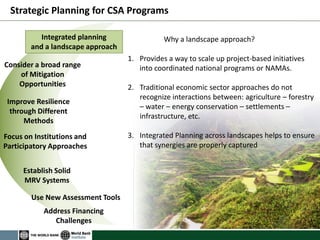
Why a landscape approach? 
1.Provides a way to scale up project-based initiatives into coordinated national programs or NAMAs. 
2.Traditional economic sector approaches do not recognize interactions between: agriculture – forestry – water – energy conservation – settlements – infrastructure, etc. 
3.Integrated Planning across landscapes helps to ensure that synergies are properly captured
Integrated planning 
and a landscape approach 
Consider a broad range of Mitigation Opportunities 
Improve Resilience through Different Methods 
Focus on Institutions and Participatory Approaches 
Strategic Planning for CSA Programs 
Establish Solid MRV Systems 
Use New Assessment Tools 
Address Financing Challenges 
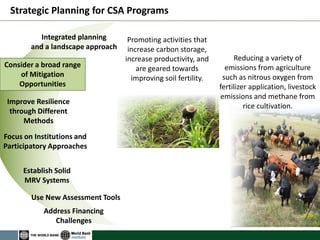
Promoting activities that increase carbon storage, increase productivity, and are geared towards improving soil fertility. 
Reducing a variety of emissions from agriculture such as nitrous oxygen from fertilizer application, livestock emissions and methane from rice cultivation.
Integrated planning 
and a landscape approach 
Consider a broad range of Mitigation Opportunities 
Improve Resilience through Different Interventions 
Focus on Institutions and Participatory Approaches 
Strategic Planning for CSA Programs 
Establish Solid MRV Systems 
Use New Assessment Tools 
Address Financing Challenges 
Diversifying income sources and genetic traits of crops to help farmers hedge against an uncertain climate. 
Developing sound risk insurance and risk management strategies as well as resilience building strategies including safety nets that reach the poorest farmers. 
Promoting adaptive management that disseminates timely climate information to farmers and tailors techniques to shifting climatic conditions.
Integrated planning 
and a landscape approach 
Consider a broad range of Mitigation Opportunities 
Improve Resilience through Different Interventions 
Focus on Institutions and Participatory Approaches 
Strategic Planning for CSA Programs 
Establish Solid MRV Systems 
Use New Assessment Tools 
Address Financing Challenges 
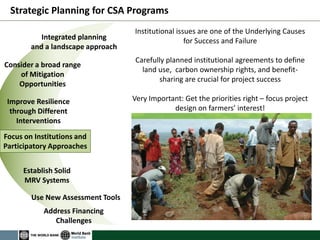
Institutional issues are one of the Underlying Causes for Success and Failure 
Carefully planned institutional agreements to define land use, carbon ownership rights, and benefit- sharing are crucial for project success 
Very Important: Get the priorities right – focus project design on farmers’ interest!
Integrated planning 
and a landscape approach 
Consider a broad range of Mitigation Opportunities 
Improve Resilience through Different Interventions 
Focus on Institutions and Participatory Approaches 
Strategic Planning for CSA Programs 
Establish Solid MRV Systems 
Use New Assessment Tools 
Address Financing Challenges 
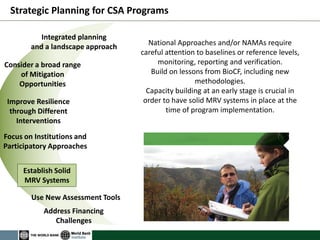
National Approaches and/or NAMAs require careful attention to baselines or reference levels, monitoring, reporting and verification. 
Build on lessons from BioCF, including new methodologies. 
Capacity building at an early stage is crucial in order to have solid MRV systems in place at the time of program implementation.
Integrated planning 
and a landscape approach 
Consider a broad range of Mitigation Opportunities 
Improve Resilience through Different Interventions 
Focus on Institutions and Participatory Approaches 
Strategic Planning for CSA Programs 
Establish Solid MRV Systems 
Use New Assessment Tools 
Address Financing Challenges 
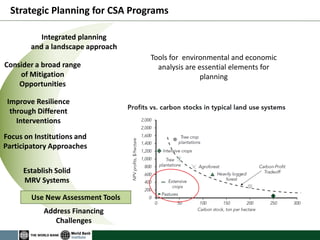
Tools for environmental and economic analysis are essential elements for planning
Integrated planning 
and a landscape approach 
Consider a broad range of Mitigation Opportunities 
Improve Resilience through Different Interventions 
Focus on Institutions and Participatory Approaches 
Strategic Planning for CSA Programs 
Establish Solid MRV Systems 
Use New Assessment Tools 
Address Financing Challenges 
Land-Use Based carbon mitigation programs can face large investment barriers. 
Impact of carbon finance on the project “cash flow” is limited. 
Important to achieve measurable productivity and income gains as to justify investment. 
Private sector investment has been modest so far, important to increase attractiveness of agricultural systems to investors
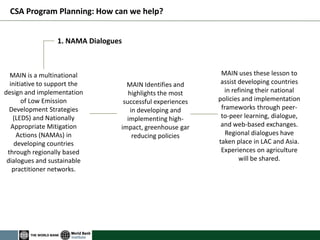
CSA Program Planning: How can we help? 
MAIN is a multinational initiative to support the design and implementation of Low Emission Development Strategies (LEDS) and Nationally Appropriate Mitigation Actions (NAMAs) in developing countries through regionally based dialogues and sustainable practitioner networks. 
MAIN Identifies and highlights the most successful experiences in developing and implementing high- impact, greenhouse gar reducing policies 
MAIN uses these lesson to assist developing countries in refining their national policies and implementation frameworks through peer- to-peer learning, dialogue, and web-based exchanges. Regional dialogues have taken place in LAC and Asia. Experiences on agriculture will be shared. 
1. NAMA Dialogues
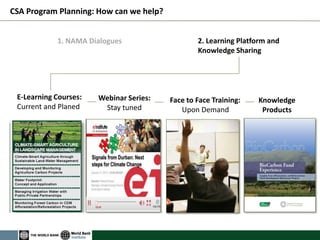
CSA Program Planning: How can we help? 
2. Learning Platform and 
Knowledge Sharing 
E-Learning Courses: 
Current and Planed 
Webinar Series: 
Stay tuned 
Face to Face Training: 
Upon Demand 
1. NAMA Dialogues 
Knowledge 
Products
CSA Planning: How can we help? 
What are your capacity building needs?

Benitez CSA planning at the World Bank july 2012

  • 1.
    Strategic Planning forMitigation Programs in Agriculture: Learning from Recent Experiences Pablo Benitez, Ph.D. Senior Economist World Bank Institute, World Bank CCAFS/FAO Expert Workshop on NAMAs: National mitigation planning and implementation in agriculture Rome, 16-17 July 2012
  • 2.
    CSA: An integratedapproach to food security, poverty and climate change Agricultural Carbon for Smallholder Farmers in Kenya, participatory approaches leading to increased farm productivity in 45,000 hectares and 60,000 farmers. Ethiopia - Humbo Regeneration Project resulted in increased production of wood and tree products, such as honey and fruit, which contribute to household budgets. Silvo Pastoral Approaches in Costa Rica and Nicaragua. Prevent erosion and increase productivity in a program supported by PES. Using Weather Index Insurance to Improve Relief Efforts in the Event of Drought in Mexico Increasing and more diverse project experiences Time to move from projects to National Programs
  • 3.
    Integrated planning anda landscape approach Consider a broad range of Mitigation Opportunities Improve Resilience through Different Methods Focus on Institutions and Participatory Approaches Strategic Planning for CSA Programs Establish Solid MRV Systems Use New Assessment Tools Address Financing Challenges What have we learned from recent and ongoing initiatives?
  • 4.
    Integrated planning anda landscape approach Consider a broad range of Mitigation Opportunities Improve Resilience through Different Methods Focus on Institutions and Participatory Approaches Strategic Planning for CSA Programs Establish Solid MRV Systems Use New Assessment Tools Address Financing Challenges Why a landscape approach? 1.Provides a way to scale up project-based initiatives into coordinated national programs or NAMAs. 2.Traditional economic sector approaches do not recognize interactions between: agriculture – forestry – water – energy conservation – settlements – infrastructure, etc. 3.Integrated Planning across landscapes helps to ensure that synergies are properly captured
  • 5.
    Integrated planning anda landscape approach Consider a broad range of Mitigation Opportunities Improve Resilience through Different Methods Focus on Institutions and Participatory Approaches Strategic Planning for CSA Programs Establish Solid MRV Systems Use New Assessment Tools Address Financing Challenges Promoting activities that increase carbon storage, increase productivity, and are geared towards improving soil fertility. Reducing a variety of emissions from agriculture such as nitrous oxygen from fertilizer application, livestock emissions and methane from rice cultivation.
  • 6.
    Integrated planning anda landscape approach Consider a broad range of Mitigation Opportunities Improve Resilience through Different Interventions Focus on Institutions and Participatory Approaches Strategic Planning for CSA Programs Establish Solid MRV Systems Use New Assessment Tools Address Financing Challenges Diversifying income sources and genetic traits of crops to help farmers hedge against an uncertain climate. Developing sound risk insurance and risk management strategies as well as resilience building strategies including safety nets that reach the poorest farmers. Promoting adaptive management that disseminates timely climate information to farmers and tailors techniques to shifting climatic conditions.
  • 7.
    Integrated planning anda landscape approach Consider a broad range of Mitigation Opportunities Improve Resilience through Different Interventions Focus on Institutions and Participatory Approaches Strategic Planning for CSA Programs Establish Solid MRV Systems Use New Assessment Tools Address Financing Challenges Institutional issues are one of the Underlying Causes for Success and Failure Carefully planned institutional agreements to define land use, carbon ownership rights, and benefit- sharing are crucial for project success Very Important: Get the priorities right – focus project design on farmers’ interest!
  • 8.
    Integrated planning anda landscape approach Consider a broad range of Mitigation Opportunities Improve Resilience through Different Interventions Focus on Institutions and Participatory Approaches Strategic Planning for CSA Programs Establish Solid MRV Systems Use New Assessment Tools Address Financing Challenges National Approaches and/or NAMAs require careful attention to baselines or reference levels, monitoring, reporting and verification. Build on lessons from BioCF, including new methodologies. Capacity building at an early stage is crucial in order to have solid MRV systems in place at the time of program implementation.
  • 9.
    Integrated planning anda landscape approach Consider a broad range of Mitigation Opportunities Improve Resilience through Different Interventions Focus on Institutions and Participatory Approaches Strategic Planning for CSA Programs Establish Solid MRV Systems Use New Assessment Tools Address Financing Challenges Tools for environmental and economic analysis are essential elements for planning
  • 10.
    Integrated planning anda landscape approach Consider a broad range of Mitigation Opportunities Improve Resilience through Different Interventions Focus on Institutions and Participatory Approaches Strategic Planning for CSA Programs Establish Solid MRV Systems Use New Assessment Tools Address Financing Challenges Land-Use Based carbon mitigation programs can face large investment barriers. Impact of carbon finance on the project “cash flow” is limited. Important to achieve measurable productivity and income gains as to justify investment. Private sector investment has been modest so far, important to increase attractiveness of agricultural systems to investors
  • 11.
    CSA Program Planning:How can we help? MAIN is a multinational initiative to support the design and implementation of Low Emission Development Strategies (LEDS) and Nationally Appropriate Mitigation Actions (NAMAs) in developing countries through regionally based dialogues and sustainable practitioner networks. MAIN Identifies and highlights the most successful experiences in developing and implementing high- impact, greenhouse gar reducing policies MAIN uses these lesson to assist developing countries in refining their national policies and implementation frameworks through peer- to-peer learning, dialogue, and web-based exchanges. Regional dialogues have taken place in LAC and Asia. Experiences on agriculture will be shared. 1. NAMA Dialogues
  • 12.
    CSA Program Planning:How can we help? 2. Learning Platform and Knowledge Sharing E-Learning Courses: Current and Planed Webinar Series: Stay tuned Face to Face Training: Upon Demand 1. NAMA Dialogues Knowledge Products
  • 13.
    CSA Planning: Howcan we help? What are your capacity building needs?