Welcome!   Session 3 – July 20, 2004 Instructor - Kevin Hawley [email_address]
The Wharton SBDC is part of Wharton Entrepreneurial Programs and the Sol C. Snider Entrepreneurial Research Center. The Wharton Small Business Development Center is in part financed by a grant from the Commonwealth of Pennsylvania, Department of Community and Economic Development. The Wharton SBDC is funded under Cooperative Agreement No. 4-603001-2-0040-24 by the U.S. Small Business Administration.  The support given by the U.S. Small Business Administration through such funding does not an expressed or implied endorsement of any of the co-sponsors’ or participants’ opinions, findings, conclusions, recommendations, products, or services.  All SBDC programs are non-discriminatory and open to the public.  Reasonable arrangements for persons with disabilities will be made if requested at least two (2) weeks in advance.  Please contact Dr. M. Therese Flaherty, Director, Wharton Small Business Development Center, University of Pennsylvania, 433 Vance Hall, Philadelphia, PA 19104, (215) 898-8635.
Agenda – Session 3 Recap from Session 2  Where We Are and What’s Left Financial Plans Cash Flow Tying It All Together Preparation for Next Session
Recap – Session 2 Industry Analysis Were you able to identify your NAICS code? Research? Sources? Surprises? Competitor Analysis Number and types? Business performance data? Sales Projections Were you able to define your sales unit(s)? Can you describe the reasoning behind your projections? Marketing Plans Do they closely tie in to sales projections? How did you select your “marketing mix”?
Session 2 Homework Review Develop a draft Operating Plan Develop draft Sales Projections Develop a draft Marketing Plan How did you do? Trouble spots? How to move forward
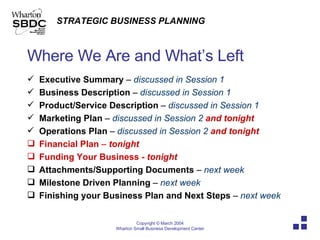
Where We Are and What’s Left Executive Summary  –  discussed in Session 1 Business Description  –  discussed in Session 1 Product/Service Description  –  discussed in Session 1 Marketing Plan  –  discussed in Session 2  and tonight Operations Plan  –  discussed in Session 2  and tonight Financial Plan  –   tonight Funding Your Business  - tonight Attachments/Supporting Documents  –  next week Milestone Driven Planning  –  next week Finishing your Business Plan and Next Steps  –  next week
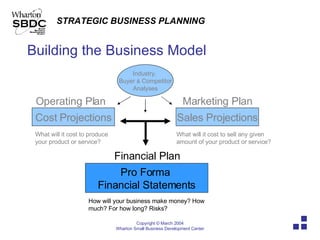
Building the Business Model Cost Projections Sales Projections Pro Forma  Financial Statements Operating Plan Marketing Plan Financial Plan What will it cost to produce your product or service? What will it cost to sell any given amount of your product or service? How will your business make money? How much? For how long? Risks? Industry,  Buyer  &  Competitor Analyses
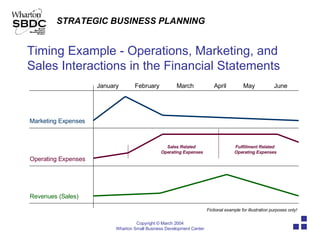
Timing Example - Operations, Marketing, and Sales Interactions in the Financial Statements Operating Expenses Marketing Expenses Revenues (Sales) January February March April May June Fictional example for illustration purposes only! Sales Related  Operating Expenses Fulfillment Related  Operating Expenses
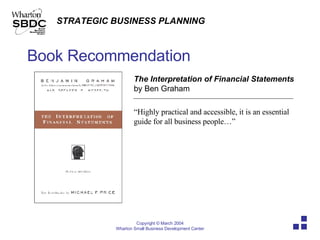
Book Recommendation The Interpretation of Financial Statements  by Ben Graham “ Highly practical and accessible, it is an essential guide for all business people…”
The “Big Three” - Financial Statements Income Statement (aka “P&L”) Lists your income, expenses, and net income (or loss) for a given period, usually one year. Balance Sheet A “snapshot” of the net worth of your company, listing assets and liabilities.  Important to note that balance sheets don’t tell you about the ups and downs of the year, only how things were as of a certain date, usually December 31. Cash Flow Statement/Plan Outlines the regular inflow and outflow of cash in your business on a month-to-month basis.  These sections make up your “pro forma” financial statements.
Other Areas of the Financial Statement Break Even Analysis Shows at what point your company begins to make money. Online calculator at “ http:// dinkytown.com/java/BreakEven.html ” Sensitivity Analysis Shows the impact of unplanned results on your business (higher or lower costs, sales, etc.) Funding Schedule Details the amounts of money you expect to need and when Staffing Plans Details the titles, salaries/benefits, and timing of hiring for people you’ll be adding to the company.
Financial  Assumptions Key sales and cost drivers Basic information about the market and  opportunities in the environment Start with: Unit sales projections Prices Cost projections – fixed and variable Key drivers for each
Financial  Projections “ Pro Forma” financial statements Income Statement – revenue minus expenses Balance Sheet – assets and liabilities Cash Flow Statement – actual cash on hand Critical to you, essential to others Predictions of business performance Financing requirements Sources and uses of cash
Constructing Credible Financial Statements Important first step:  educated assumptions What are the key revenue drivers? What are the key cost & expense drivers?
Assumptions – Revenue Market size and opportunity Number of potential customers Your particular business cycle Product/service pricing Sales growth curve Avoid the “moving hockey stick”!!!
Assumptions –  Cost of Sales/Goods Sold Direct inputs to delivery of service Direct inputs to delivery of product Examples: materials, parts, labor, shipping a/k/a – variable costs Not your expenses
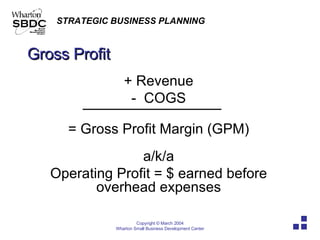
Gross Profit + Revenue -  COGS = Gross Profit Margin (GPM) a/k/a Operating Profit = $ earned before overhead expenses
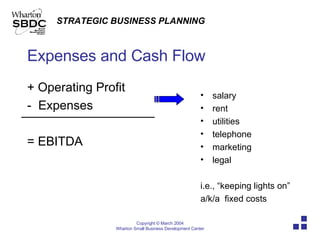
Expenses and Cash Flow + Operating Profit -  Expenses = EBITDA salary  rent  utilities telephone marketing legal i.e., “keeping lights on” a/k/a  fixed costs
EBITDA E arnings  B efore  I nterest  T axes D epreciation  A mortization a/k/a Free Cash Flow Businesses valued as a multiple of EBITDA
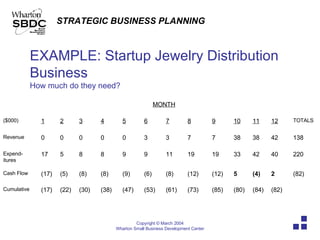
How Much Money Do I Need? Prepare detailed Income Statement Then Balance Sheet Then Cash Flow Statement Monthly negative Cash Flow = operating cash Cumulative negative Cash Flow = total needed
Balance Sheet A “snapshot” of the net worth of your company, listing assets and liabilities.  Important to note that balance sheets don’t tell you about the ups and downs of the year, only how things were as of a certain date, usually the end of the month or the end of the year. Spreadsheet Exercise
Cash Flow Statement/Plan Outlines the regular inflow and outflow of cash in your business on a month-to-month basis. Spreadsheet Exercise
EXAMPLE: Startup Jewelry Distribution Business How much do they need? MONTH (82) (84) (80) (85) (73) (61) (53) (47) (38) (30) (22) (17) Cumulative (82) 2 (4) 5 (12) (12) (8) (6) (9) (8) (8) (5) (17) Cash Flow 220 40 42 33 19 19 11 9 9 8 8 5 17 Expend-itures 138 42 38 38 7 7 3 3 0 0 0 0 0 Revenue TOTALS 12 11 10 9 8 7 6 5 4 3 2 1 ($000)
Income Statement (aka “P&L”) Lists your income, expenses, and net income (or loss) for a given period, usually one year. Spreadsheet Exercise
Break Even Analysis Shows at what point your company begins to make money. Online calculator at “ http://dinkytown.com/java/BreakEven.html ” Spreadsheet Exercise
Sensitivity Analysis Shows the impact of unplanned results on your business (higher or lower costs, sales, etc.) Spreadsheet Exercise
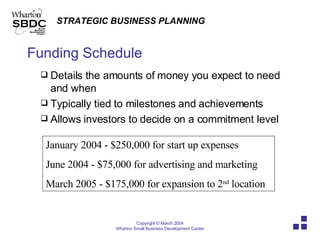
Funding Schedule Details the amounts of money you expect to need and when Typically tied to milestones and achievements Allows investors to decide on a commitment level January 2004 - $250,000 for start up expenses June 2004 - $75,000 for advertising and marketing  March 2005 - $175,000 for expansion to 2 nd  location
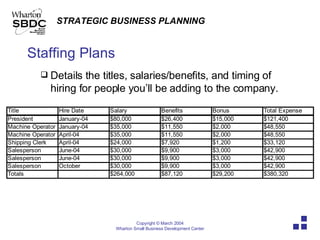
Staffing Plans Details the titles, salaries/benefits, and timing of hiring for people you’ll be adding to the company.
- 10 Minute Break -
Funding Your Business Types of Investors Venture Capital and Angel Investors Valuation of Early Stage Companies What You Give for What You Get - Examples Alternative Sources of Funding for Your Business
Getting to the Investment Requirements and Pre-Start Valuation Draft the business plan narrative sections – tell your story! Run the numbers – does the story hold up? Income Statement Balance Sheet  Cash Flow Statement/Plan Determine funding needs from the Cash Flow Projections Examine “pro-forma” EBIDTA projections at 5 years Determine if the ROI fits the Angel Investor targets If so, begin “pitching your plan” to prospective investors! If not, you can either rework the plan, or… Go to alternative funding sources and/or self-fund the plan
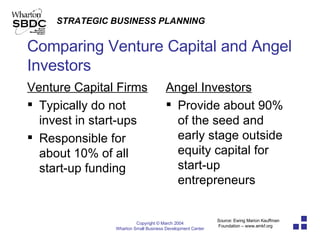
Comparing Venture Capital and Angel Investors Venture Capital Firms Typically do not invest in start-ups Responsible for about 10% of all start-up funding Angel Investors Provide about 90% of the seed and early stage outside equity capital for start-up entrepreneurs Source: Ewing Marion Kauffman Foundation – www.emkf.org
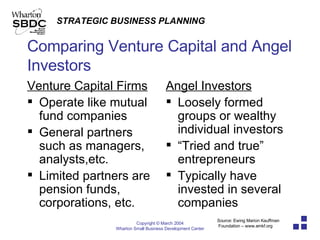
Comparing Venture Capital and Angel Investors Venture Capital Firms Operate like mutual fund companies General partners such as managers, analysts,etc. Limited partners are pension funds, corporations, etc.  Angel Investors Loosely formed groups or wealthy individual investors “ Tried and true” entrepreneurs Typically have invested in several companies Source: Ewing Marion Kauffman Foundation – www.emkf.org
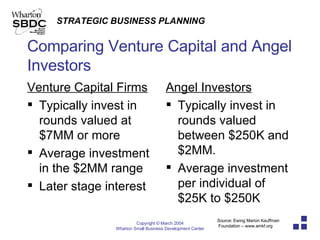
Comparing Venture Capital and Angel Investors Venture Capital Firms Typically invest in rounds valued at $7MM or more  Average investment in the $2MM range Later stage interest Angel Investors Typically invest in rounds valued between $250K and $2MM. Average investment per individual of $25K to $250K Source: Ewing Marion Kauffman Foundation – www.emkf.org
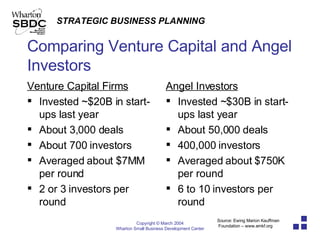
Comparing Venture Capital and Angel Investors Venture Capital Firms Invested ~$20B in start-ups last year About 3,000 deals About 700 investors Averaged about $7MM per round 2 or 3 investors per round Angel Investors Invested ~$30B in start-ups last year About 50,000 deals 400,000 investors Averaged about $750K per round 6 to 10 investors per round Source: Ewing Marion Kauffman Foundation – www.emkf.org
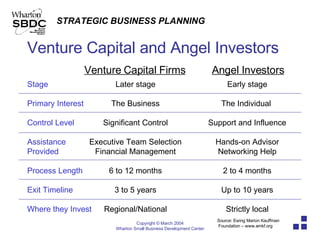
Venture Capital and Angel Investors Stage Primary Interest Control Level Assistance Provided Process Length Exit Timeline Where they Invest Later stage The Business Significant Control Executive Team Selection Financial Management 6 to 12 months 3 to 5 years Regional/National Early stage The Individual  Support and Influence Hands-on Advisor Networking Help 2 to 4 months Up to 10 years Strictly local Venture Capital Firms Angel Investors Source: Ewing Marion Kauffman Foundation – www.emkf.org
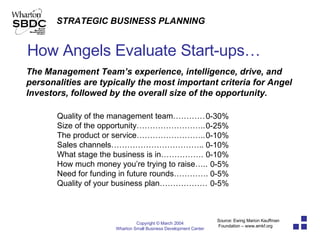
How Angels Evaluate Start-ups…  Quality of the management team………… Size of the opportunity…………………….. The product or service…………………….. Sales channels…………………………….. What stage the business is in……………. How much money you’re trying to raise….. Need for funding in future rounds…………. Quality of your business plan……………… 0-30% 0-25% 0-10% 0-10% 0-10% 0-5% 0-5% 0-5% The Management Team’s experience, intelligence, drive, and  personalities are typically the most important criteria for Angel Investors, followed by the overall size of the opportunity. Source: Ewing Marion Kauffman Foundation – www.emkf.org
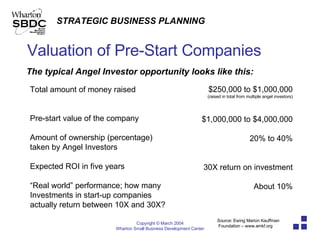
Valuation of Pre-Start Companies  Total amount of money raised Pre-start value of the company Amount of ownership (percentage) taken by Angel Investors Expected ROI in five years “ Real world” performance; how many  Investments in start-up companies actually return between 10X and 30X? $250,000 to $1,000,000 (raised in total from multiple angel investors) $1,000,000 to $4,000,000 20% to 40% 30X return on investment About 10% The typical Angel Investor opportunity looks like this: Source: Ewing Marion Kauffman Foundation – www.emkf.org
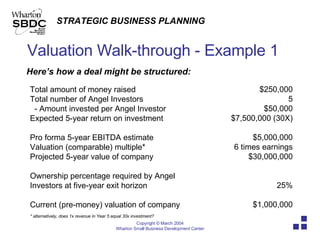
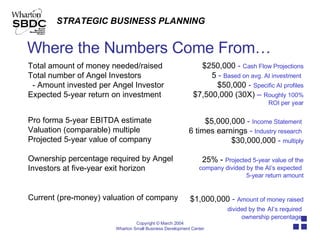
Valuation Walk-through - Example 1 Total amount of money raised Total number of Angel Investors - Amount invested per Angel Investor Expected 5-year return on investment Pro forma 5-year EBITDA estimate Valuation (comparable) multiple* Projected 5-year value of company Ownership percentage required by Angel  Investors at five-year exit horizon Current (pre-money) valuation of company * alternatively, does 1x revenue in Year 5 equal 30x investment? $250,000 5 $50,000 $7,500,000 (30X) $5,000,000 6 times earnings $30,000,000 25% $1,000,000 Here’s how a deal might be structured:
Where the Numbers Come From… Total amount of money needed/raised Total number of Angel Investors - Amount invested per Angel Investor Expected 5-year return on investment Pro forma 5-year EBITDA estimate Valuation (comparable) multiple Projected 5-year value of company Ownership percentage required by Angel  Investors at five-year exit horizon Current (pre-money) valuation of company $250,000  -  Cash Flow Projections 5  -  Based on avg. AI investment   $50,000  -  Specific AI profiles $7,500,000 (30X)  –  Roughly 100% ROI per year $5,000,000  -  Income Statement   6 times earnings  -  Industry research   $30,000,000  -  multiply 25% -  Projected 5-year value of the company divided by the AI’s expected  5-year return amount $1,000,000  -  Amount of money raised divided by the   AI’s required  ownership percentage
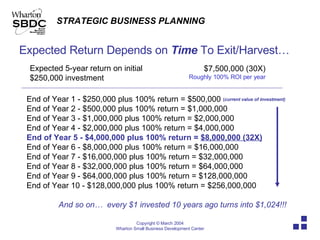
Expected Return Depends on  Time  To Exit/Harvest… Expected 5-year return on initial $250,000 investment $7,500,000 (30X)   Roughly 100% ROI per year End of Year 1 - $250,000 plus 100% return = $500,000  ( current value of investment) End of Year 2 - $500,000 plus 100% return = $1,000,000 End of Year 3 - $1,000,000 plus 100% return = $2,000,000 End of Year 4 - $2,000,000 plus 100% return = $4,000,000 End of Year 5 - $4,000,000 plus 100% return =  $8,000,000 (32X) End of Year 6 - $8,000,000 plus 100% return = $16,000,000 End of Year 7 - $16,000,000 plus 100% return = $32,000,000 End of Year 8 - $32,000,000 plus 100% return = $64,000,000 End of Year 9 - $64,000,000 plus 100% return = $128,000,000 End of Year 10 - $128,000,000 plus 100% return = $256,000,000 And so on…  every $1 invested 10 years ago turns into $1,024!!!
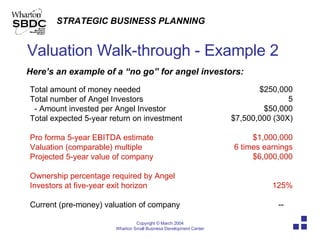
Valuation Walk-through - Example 2 Total amount of money needed Total number of Angel Investors - Amount invested per Angel Investor Total expected 5-year return on investment Pro forma 5-year EBITDA estimate Valuation (comparable) multiple Projected 5-year value of company Ownership percentage required by Angel  Investors at five-year exit horizon Current (pre-money) valuation of company $250,000 5 $50,000 $7,500,000 (30X) $1,000,000 6 times earnings $6,000,000 125% --  Here’s an example of a “no go” for angel investors:
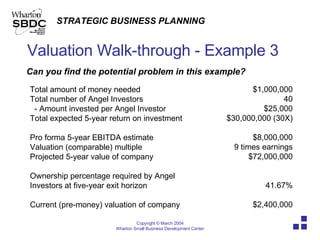
Valuation Walk-through - Example 3 Total amount of money needed Total number of Angel Investors - Amount invested per Angel Investor Total expected 5-year return on investment Pro forma 5-year EBITDA estimate Valuation (comparable) multiple Projected 5-year value of company Ownership percentage required by Angel  Investors at five-year exit horizon Current (pre-money) valuation of company $1,000,000 40 $25,000 $30,000,000 (30X) $8,000,000 9 times earnings $72,000,000 41.67% $2,400,000 Can you find the potential problem in this example?
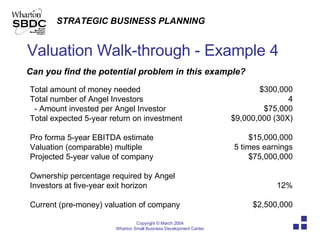
Valuation Walk-through - Example 4 Total amount of money needed Total number of Angel Investors - Amount invested per Angel Investor Total expected 5-year return on investment Pro forma 5-year EBITDA estimate Valuation (comparable) multiple Projected 5-year value of company Ownership percentage required by Angel  Investors at five-year exit horizon Current (pre-money) valuation of company $300,000 4 $75,000 $9,000,000 (30X) $15,000,000 5 times earnings $75,000,000 12% $2,500,000 Can you find the potential problem in this example?
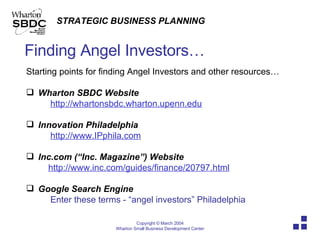
Finding Angel Investors… Starting points for finding Angel Investors and other resources… Wharton SBDC Website http://whartonsbdc.wharton.upenn.edu Innovation Philadelphia http://www.IPphila.com Inc.com (“Inc. Magazine”) Website http://www.inc.com/guides/finance/20797.html Google Search Engine Enter these terms - “angel investors” Philadelphia
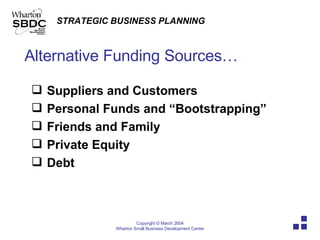
Alternative Funding Sources… Suppliers and Customers Personal Funds and “Bootstrapping”  Friends and Family Private Equity Debt
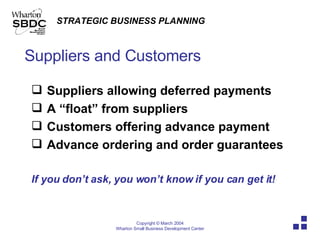
Suppliers and Customers Suppliers allowing deferred payments A “float” from suppliers  Customers offering advance payment  Advance ordering and order guarantees If you don’t ask, you won’t know if you can get it!
Personal Funds and “Bootstrapping” Cash savings Converting assets  “ Sweat equity”  The “apple cart” approach Try to think like an impartial investor even when  ESPECIALLY when  using your own money!
Friends and Family Traditional startup funding sources The investment they make is in  YOU! Business metrics usually less important Usually a higher tolerance for problems Written agreements still very important!  Consider the potential impact on relationships if the business is not successful and the investment is lost!
Private Equity Sophisticated “Angel Investors” Professional investors – typically take a sole investor position in startups Minimal margin for error and a low tolerance for underperformance Generally reserve the right to replace the management team if projections aren’t met! Contracts tend to be complex with lots of strings attached to investment Talk with other companies they’ve invested in!
Debt Financing Local banks Small Business Administration loans Credit cards Borrowing against home equity Borrowing against insurance policies Borrowing against your retirement IRA Be aware of the risks and consequences!
Rules for External Financing Rule # 1 – Try to use other people’s money (OPM) Rule # 2 – Let your customers and suppliers finance the business to the greatest extent possible Rule # 3 – Use money you can afford to lose or can emotionally handle losing  Rule # 4 – Get money as inexpensively as possible Rule # 5 – A smaller percentage of something big is worth more than 100% of nothing! Rule # 6 – Seek advice from advisors, i.e. lawyer, accountant, consultants, family, etc.
Homework Assignments Develop a draft Financial Plan Use the discussions from this evening to build a integrated financial plan for your business. Revise and refine Financial Projections Based on your operating, marketing, and sales expenses, how much money will the company need to get started, what are your cash flow projections, and how much money will the business make and when? Complete the Operating Plan  Go back into your narrative plan and adjust your story based on the realities of your financial plan. Questions about the assignments?
Next Session (Session 4) Attachments and Supporting Documents  Other things to include in your blockbuster plan Milestone Driven Planning How to stay on track and build confidence among investors Bringing It All Together We’ll walk through plans from participants in our class, discuss strength’s and weaknesses, try to highlight areas that need additional work.  We’ll use the templates from Sessions 1-3 to evaluate the plan. Next Steps Staying focused, accessing additional SBDC resources, finding and using an expert advisory board.  See You Next Week!

Strategic Business Planning Part 3

  • 1.
    Welcome! Session 3 – July 20, 2004 Instructor - Kevin Hawley [email_address]
  • 2.
    The Wharton SBDCis part of Wharton Entrepreneurial Programs and the Sol C. Snider Entrepreneurial Research Center. The Wharton Small Business Development Center is in part financed by a grant from the Commonwealth of Pennsylvania, Department of Community and Economic Development. The Wharton SBDC is funded under Cooperative Agreement No. 4-603001-2-0040-24 by the U.S. Small Business Administration. The support given by the U.S. Small Business Administration through such funding does not an expressed or implied endorsement of any of the co-sponsors’ or participants’ opinions, findings, conclusions, recommendations, products, or services. All SBDC programs are non-discriminatory and open to the public. Reasonable arrangements for persons with disabilities will be made if requested at least two (2) weeks in advance. Please contact Dr. M. Therese Flaherty, Director, Wharton Small Business Development Center, University of Pennsylvania, 433 Vance Hall, Philadelphia, PA 19104, (215) 898-8635.
  • 3.
    Agenda – Session3 Recap from Session 2 Where We Are and What’s Left Financial Plans Cash Flow Tying It All Together Preparation for Next Session
  • 4.
    Recap – Session2 Industry Analysis Were you able to identify your NAICS code? Research? Sources? Surprises? Competitor Analysis Number and types? Business performance data? Sales Projections Were you able to define your sales unit(s)? Can you describe the reasoning behind your projections? Marketing Plans Do they closely tie in to sales projections? How did you select your “marketing mix”?
  • 5.
    Session 2 HomeworkReview Develop a draft Operating Plan Develop draft Sales Projections Develop a draft Marketing Plan How did you do? Trouble spots? How to move forward
  • 6.
    Where We Areand What’s Left Executive Summary – discussed in Session 1 Business Description – discussed in Session 1 Product/Service Description – discussed in Session 1 Marketing Plan – discussed in Session 2 and tonight Operations Plan – discussed in Session 2 and tonight Financial Plan – tonight Funding Your Business - tonight Attachments/Supporting Documents – next week Milestone Driven Planning – next week Finishing your Business Plan and Next Steps – next week
  • 7.
    Building the BusinessModel Cost Projections Sales Projections Pro Forma Financial Statements Operating Plan Marketing Plan Financial Plan What will it cost to produce your product or service? What will it cost to sell any given amount of your product or service? How will your business make money? How much? For how long? Risks? Industry, Buyer & Competitor Analyses
  • 8.
    Timing Example -Operations, Marketing, and Sales Interactions in the Financial Statements Operating Expenses Marketing Expenses Revenues (Sales) January February March April May June Fictional example for illustration purposes only! Sales Related Operating Expenses Fulfillment Related Operating Expenses
  • 9.
    Book Recommendation TheInterpretation of Financial Statements by Ben Graham “ Highly practical and accessible, it is an essential guide for all business people…”
  • 10.
    The “Big Three”- Financial Statements Income Statement (aka “P&L”) Lists your income, expenses, and net income (or loss) for a given period, usually one year. Balance Sheet A “snapshot” of the net worth of your company, listing assets and liabilities. Important to note that balance sheets don’t tell you about the ups and downs of the year, only how things were as of a certain date, usually December 31. Cash Flow Statement/Plan Outlines the regular inflow and outflow of cash in your business on a month-to-month basis. These sections make up your “pro forma” financial statements.
  • 11.
    Other Areas ofthe Financial Statement Break Even Analysis Shows at what point your company begins to make money. Online calculator at “ http:// dinkytown.com/java/BreakEven.html ” Sensitivity Analysis Shows the impact of unplanned results on your business (higher or lower costs, sales, etc.) Funding Schedule Details the amounts of money you expect to need and when Staffing Plans Details the titles, salaries/benefits, and timing of hiring for people you’ll be adding to the company.
  • 12.
    Financial AssumptionsKey sales and cost drivers Basic information about the market and opportunities in the environment Start with: Unit sales projections Prices Cost projections – fixed and variable Key drivers for each
  • 13.
    Financial Projections“ Pro Forma” financial statements Income Statement – revenue minus expenses Balance Sheet – assets and liabilities Cash Flow Statement – actual cash on hand Critical to you, essential to others Predictions of business performance Financing requirements Sources and uses of cash
  • 14.
    Constructing Credible FinancialStatements Important first step: educated assumptions What are the key revenue drivers? What are the key cost & expense drivers?
  • 15.
    Assumptions – RevenueMarket size and opportunity Number of potential customers Your particular business cycle Product/service pricing Sales growth curve Avoid the “moving hockey stick”!!!
  • 16.
    Assumptions – Cost of Sales/Goods Sold Direct inputs to delivery of service Direct inputs to delivery of product Examples: materials, parts, labor, shipping a/k/a – variable costs Not your expenses
  • 17.
    Gross Profit +Revenue - COGS = Gross Profit Margin (GPM) a/k/a Operating Profit = $ earned before overhead expenses
  • 18.
    Expenses and CashFlow + Operating Profit - Expenses = EBITDA salary rent utilities telephone marketing legal i.e., “keeping lights on” a/k/a fixed costs
  • 19.
    EBITDA E arnings B efore I nterest T axes D epreciation A mortization a/k/a Free Cash Flow Businesses valued as a multiple of EBITDA
  • 20.
    How Much MoneyDo I Need? Prepare detailed Income Statement Then Balance Sheet Then Cash Flow Statement Monthly negative Cash Flow = operating cash Cumulative negative Cash Flow = total needed
  • 21.
    Balance Sheet A“snapshot” of the net worth of your company, listing assets and liabilities. Important to note that balance sheets don’t tell you about the ups and downs of the year, only how things were as of a certain date, usually the end of the month or the end of the year. Spreadsheet Exercise
  • 22.
    Cash Flow Statement/PlanOutlines the regular inflow and outflow of cash in your business on a month-to-month basis. Spreadsheet Exercise
  • 23.
    EXAMPLE: Startup JewelryDistribution Business How much do they need? MONTH (82) (84) (80) (85) (73) (61) (53) (47) (38) (30) (22) (17) Cumulative (82) 2 (4) 5 (12) (12) (8) (6) (9) (8) (8) (5) (17) Cash Flow 220 40 42 33 19 19 11 9 9 8 8 5 17 Expend-itures 138 42 38 38 7 7 3 3 0 0 0 0 0 Revenue TOTALS 12 11 10 9 8 7 6 5 4 3 2 1 ($000)
  • 24.
    Income Statement (aka“P&L”) Lists your income, expenses, and net income (or loss) for a given period, usually one year. Spreadsheet Exercise
  • 25.
    Break Even AnalysisShows at what point your company begins to make money. Online calculator at “ http://dinkytown.com/java/BreakEven.html ” Spreadsheet Exercise
  • 26.
    Sensitivity Analysis Showsthe impact of unplanned results on your business (higher or lower costs, sales, etc.) Spreadsheet Exercise
  • 27.
    Funding Schedule Detailsthe amounts of money you expect to need and when Typically tied to milestones and achievements Allows investors to decide on a commitment level January 2004 - $250,000 for start up expenses June 2004 - $75,000 for advertising and marketing March 2005 - $175,000 for expansion to 2 nd location
  • 28.
    Staffing Plans Detailsthe titles, salaries/benefits, and timing of hiring for people you’ll be adding to the company.
  • 29.
    - 10 MinuteBreak -
  • 30.
    Funding Your BusinessTypes of Investors Venture Capital and Angel Investors Valuation of Early Stage Companies What You Give for What You Get - Examples Alternative Sources of Funding for Your Business
  • 31.
    Getting to theInvestment Requirements and Pre-Start Valuation Draft the business plan narrative sections – tell your story! Run the numbers – does the story hold up? Income Statement Balance Sheet Cash Flow Statement/Plan Determine funding needs from the Cash Flow Projections Examine “pro-forma” EBIDTA projections at 5 years Determine if the ROI fits the Angel Investor targets If so, begin “pitching your plan” to prospective investors! If not, you can either rework the plan, or… Go to alternative funding sources and/or self-fund the plan
  • 32.
    Comparing Venture Capitaland Angel Investors Venture Capital Firms Typically do not invest in start-ups Responsible for about 10% of all start-up funding Angel Investors Provide about 90% of the seed and early stage outside equity capital for start-up entrepreneurs Source: Ewing Marion Kauffman Foundation – www.emkf.org
  • 33.
    Comparing Venture Capitaland Angel Investors Venture Capital Firms Operate like mutual fund companies General partners such as managers, analysts,etc. Limited partners are pension funds, corporations, etc. Angel Investors Loosely formed groups or wealthy individual investors “ Tried and true” entrepreneurs Typically have invested in several companies Source: Ewing Marion Kauffman Foundation – www.emkf.org
  • 34.
    Comparing Venture Capitaland Angel Investors Venture Capital Firms Typically invest in rounds valued at $7MM or more Average investment in the $2MM range Later stage interest Angel Investors Typically invest in rounds valued between $250K and $2MM. Average investment per individual of $25K to $250K Source: Ewing Marion Kauffman Foundation – www.emkf.org
  • 35.
    Comparing Venture Capitaland Angel Investors Venture Capital Firms Invested ~$20B in start-ups last year About 3,000 deals About 700 investors Averaged about $7MM per round 2 or 3 investors per round Angel Investors Invested ~$30B in start-ups last year About 50,000 deals 400,000 investors Averaged about $750K per round 6 to 10 investors per round Source: Ewing Marion Kauffman Foundation – www.emkf.org
  • 36.
    Venture Capital andAngel Investors Stage Primary Interest Control Level Assistance Provided Process Length Exit Timeline Where they Invest Later stage The Business Significant Control Executive Team Selection Financial Management 6 to 12 months 3 to 5 years Regional/National Early stage The Individual Support and Influence Hands-on Advisor Networking Help 2 to 4 months Up to 10 years Strictly local Venture Capital Firms Angel Investors Source: Ewing Marion Kauffman Foundation – www.emkf.org
  • 37.
    How Angels EvaluateStart-ups… Quality of the management team………… Size of the opportunity…………………….. The product or service…………………….. Sales channels…………………………….. What stage the business is in……………. How much money you’re trying to raise….. Need for funding in future rounds…………. Quality of your business plan……………… 0-30% 0-25% 0-10% 0-10% 0-10% 0-5% 0-5% 0-5% The Management Team’s experience, intelligence, drive, and personalities are typically the most important criteria for Angel Investors, followed by the overall size of the opportunity. Source: Ewing Marion Kauffman Foundation – www.emkf.org
  • 38.
    Valuation of Pre-StartCompanies Total amount of money raised Pre-start value of the company Amount of ownership (percentage) taken by Angel Investors Expected ROI in five years “ Real world” performance; how many Investments in start-up companies actually return between 10X and 30X? $250,000 to $1,000,000 (raised in total from multiple angel investors) $1,000,000 to $4,000,000 20% to 40% 30X return on investment About 10% The typical Angel Investor opportunity looks like this: Source: Ewing Marion Kauffman Foundation – www.emkf.org
  • 39.
    Valuation Walk-through -Example 1 Total amount of money raised Total number of Angel Investors - Amount invested per Angel Investor Expected 5-year return on investment Pro forma 5-year EBITDA estimate Valuation (comparable) multiple* Projected 5-year value of company Ownership percentage required by Angel Investors at five-year exit horizon Current (pre-money) valuation of company * alternatively, does 1x revenue in Year 5 equal 30x investment? $250,000 5 $50,000 $7,500,000 (30X) $5,000,000 6 times earnings $30,000,000 25% $1,000,000 Here’s how a deal might be structured:
  • 40.
    Where the NumbersCome From… Total amount of money needed/raised Total number of Angel Investors - Amount invested per Angel Investor Expected 5-year return on investment Pro forma 5-year EBITDA estimate Valuation (comparable) multiple Projected 5-year value of company Ownership percentage required by Angel Investors at five-year exit horizon Current (pre-money) valuation of company $250,000 - Cash Flow Projections 5 - Based on avg. AI investment $50,000 - Specific AI profiles $7,500,000 (30X) – Roughly 100% ROI per year $5,000,000 - Income Statement 6 times earnings - Industry research $30,000,000 - multiply 25% - Projected 5-year value of the company divided by the AI’s expected 5-year return amount $1,000,000 - Amount of money raised divided by the AI’s required ownership percentage
  • 41.
    Expected Return Dependson Time To Exit/Harvest… Expected 5-year return on initial $250,000 investment $7,500,000 (30X) Roughly 100% ROI per year End of Year 1 - $250,000 plus 100% return = $500,000 ( current value of investment) End of Year 2 - $500,000 plus 100% return = $1,000,000 End of Year 3 - $1,000,000 plus 100% return = $2,000,000 End of Year 4 - $2,000,000 plus 100% return = $4,000,000 End of Year 5 - $4,000,000 plus 100% return = $8,000,000 (32X) End of Year 6 - $8,000,000 plus 100% return = $16,000,000 End of Year 7 - $16,000,000 plus 100% return = $32,000,000 End of Year 8 - $32,000,000 plus 100% return = $64,000,000 End of Year 9 - $64,000,000 plus 100% return = $128,000,000 End of Year 10 - $128,000,000 plus 100% return = $256,000,000 And so on… every $1 invested 10 years ago turns into $1,024!!!
  • 42.
    Valuation Walk-through -Example 2 Total amount of money needed Total number of Angel Investors - Amount invested per Angel Investor Total expected 5-year return on investment Pro forma 5-year EBITDA estimate Valuation (comparable) multiple Projected 5-year value of company Ownership percentage required by Angel Investors at five-year exit horizon Current (pre-money) valuation of company $250,000 5 $50,000 $7,500,000 (30X) $1,000,000 6 times earnings $6,000,000 125% -- Here’s an example of a “no go” for angel investors:
  • 43.
    Valuation Walk-through -Example 3 Total amount of money needed Total number of Angel Investors - Amount invested per Angel Investor Total expected 5-year return on investment Pro forma 5-year EBITDA estimate Valuation (comparable) multiple Projected 5-year value of company Ownership percentage required by Angel Investors at five-year exit horizon Current (pre-money) valuation of company $1,000,000 40 $25,000 $30,000,000 (30X) $8,000,000 9 times earnings $72,000,000 41.67% $2,400,000 Can you find the potential problem in this example?
  • 44.
    Valuation Walk-through -Example 4 Total amount of money needed Total number of Angel Investors - Amount invested per Angel Investor Total expected 5-year return on investment Pro forma 5-year EBITDA estimate Valuation (comparable) multiple Projected 5-year value of company Ownership percentage required by Angel Investors at five-year exit horizon Current (pre-money) valuation of company $300,000 4 $75,000 $9,000,000 (30X) $15,000,000 5 times earnings $75,000,000 12% $2,500,000 Can you find the potential problem in this example?
  • 45.
    Finding Angel Investors…Starting points for finding Angel Investors and other resources… Wharton SBDC Website http://whartonsbdc.wharton.upenn.edu Innovation Philadelphia http://www.IPphila.com Inc.com (“Inc. Magazine”) Website http://www.inc.com/guides/finance/20797.html Google Search Engine Enter these terms - “angel investors” Philadelphia
  • 46.
    Alternative Funding Sources…Suppliers and Customers Personal Funds and “Bootstrapping” Friends and Family Private Equity Debt
  • 47.
    Suppliers and CustomersSuppliers allowing deferred payments A “float” from suppliers Customers offering advance payment Advance ordering and order guarantees If you don’t ask, you won’t know if you can get it!
  • 48.
    Personal Funds and“Bootstrapping” Cash savings Converting assets “ Sweat equity” The “apple cart” approach Try to think like an impartial investor even when ESPECIALLY when using your own money!
  • 49.
    Friends and FamilyTraditional startup funding sources The investment they make is in YOU! Business metrics usually less important Usually a higher tolerance for problems Written agreements still very important! Consider the potential impact on relationships if the business is not successful and the investment is lost!
  • 50.
    Private Equity Sophisticated“Angel Investors” Professional investors – typically take a sole investor position in startups Minimal margin for error and a low tolerance for underperformance Generally reserve the right to replace the management team if projections aren’t met! Contracts tend to be complex with lots of strings attached to investment Talk with other companies they’ve invested in!
  • 51.
    Debt Financing Localbanks Small Business Administration loans Credit cards Borrowing against home equity Borrowing against insurance policies Borrowing against your retirement IRA Be aware of the risks and consequences!
  • 52.
    Rules for ExternalFinancing Rule # 1 – Try to use other people’s money (OPM) Rule # 2 – Let your customers and suppliers finance the business to the greatest extent possible Rule # 3 – Use money you can afford to lose or can emotionally handle losing Rule # 4 – Get money as inexpensively as possible Rule # 5 – A smaller percentage of something big is worth more than 100% of nothing! Rule # 6 – Seek advice from advisors, i.e. lawyer, accountant, consultants, family, etc.
  • 53.
    Homework Assignments Developa draft Financial Plan Use the discussions from this evening to build a integrated financial plan for your business. Revise and refine Financial Projections Based on your operating, marketing, and sales expenses, how much money will the company need to get started, what are your cash flow projections, and how much money will the business make and when? Complete the Operating Plan Go back into your narrative plan and adjust your story based on the realities of your financial plan. Questions about the assignments?
  • 54.
    Next Session (Session4) Attachments and Supporting Documents Other things to include in your blockbuster plan Milestone Driven Planning How to stay on track and build confidence among investors Bringing It All Together We’ll walk through plans from participants in our class, discuss strength’s and weaknesses, try to highlight areas that need additional work. We’ll use the templates from Sessions 1-3 to evaluate the plan. Next Steps Staying focused, accessing additional SBDC resources, finding and using an expert advisory board. See You Next Week!