Content
CHAPTER 3: FINANCIALANALYSISAND PROJECTION
o Cost of project
o Means of finance (project financing)
o Estimation of sales and production
o The cost of production
o Cash flows in financial analysis
3.
Objectives
At theend of this lesson, students will be able to:
• Define and identify financial cost of a project
• Identify the different means of financing a project
• Identify the important points that should be considered in estimation of
sales and production of projects/ Businesses
• Identify the different components of cost of production of a project
• Identify the main components of cash flow and calculate related problems
4.
What is FinancialAnalysis?
What is financial Analysis?
• Financial Analysis is the assessment of the Viability, Stability and Profitability of a
project or business.
• Financial analysis is the process of evaluating businesses or projects budgets and
other finance-related transactions to determine their performance and suitability.
Typically, financial analysis is used to analyse whether an entity is stable, solvent,
liquid, or profitable enough to warrant a monetary investment
• A financial analysis will not only help to understand project’s (company’s) financial
condition, but it also helps to determine its creditworthiness, profitability and ability
to generate wealth. It will also provide a more in-depth look at how well it operates
internally.
5.
Important Aspect ofFinancial Analysis
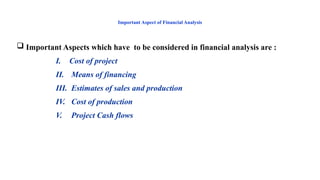
Important Aspects which have to be considered in financial analysis are :
I. Cost of project
II. Means of financing
III. Estimates of sales and production
IV. Cost of production
V. Project Cash flows
Cost of aProject
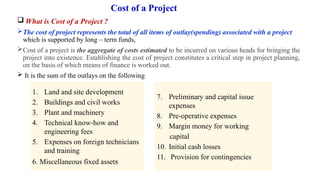
What is Cost of a Project ?
The cost of project represents the total of all items of outlay(spending) associated with a project
which is supported by long – term funds,
Cost of a project is the aggregate of costs estimated to be incurred on various heads for bringing the
project into existence. Establishing the cost of project constitutes a critical step in project planning,
on the basis of which means of finance is worked out.
It is the sum of the outlays on the following
1. Land and site development
2. Buildings and civil works
3. Plant and machinery
4. Technical know-how and
engineering fees
5. Expenses on foreign technicians
and training
6. Miscellaneous fixed assets
7. Preliminary and capital issue
expenses
8. Pre-operative expenses
9. Margin money for working
capital
10. Initial cash losses
11. Provision for contingencies
8.
Cost of aProject…
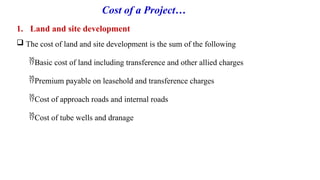
1. Land and site development
The cost of land and site development is the sum of the following
Basic cost of land including transference and other allied charges
Premium payable on leasehold and transference charges
Cost of approach roads and internal roads
Cost of tube wells and dranage
9.
Cost of aProject…
2. Buildings and Civil Works
Buildings and civil works cover the following:
Buildings for the main plant and equipment
Buildings for auxiliary services like steam supply, workshops, laboratory, water
supply, etc.
Non-factory buildings like canteen, guest houses, time office, excise house, etc.
10.
Cost of aProject…
3. Plant and machinery: The most significant component of project cost, consists of
the following:
A. Cost of Imported machinery: This is the sum of
(i) FOB (free on board) value,
(ii) CIF (cost of Insurance and freight)
(iii) import duty, and
(iv) clearing, loading, unloading, and transportation charges.
B. Cost of Indigenous machinery: This consists of
(i) FOB (free on rail) cost,
(ii) Sales tax, and other taxes, if any, and
(iii) railway freight and transport charges to site.
C. Cost of stores and spares
D. Foundation and installation charges
11.
Cost of aProject…
4. Technical know-how and engineering fees
• It is necessary to engage technical consultants for advice and help in various
technical matters like preparation of project report, choice of technology,
selection of plant and machinery, detailed engineering, and so on.
5. Expenses on foreign technicians and training :
• Services of foreign technicians may be required for setting up the project
and supervising the trial runs.
12.
Cost of aProject…
6. Miscellaneous fixed assets:
• Fixed assets and machinery which are not part of the direct manufacturing
process may be referred to as miscellaneous fixed assets.
• They include items like
• furniture,
• office machinery and equipment,
• tools, vehicles,
• laboratory equipment and so on.
• Expenses incurred for procurement or use of patents, licenses, trademarks,
copyrights, etc
13.
Cost of aProject…
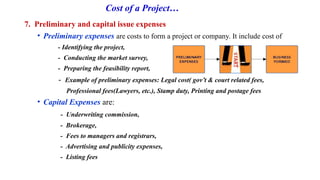
7. Preliminary and capital issue expenses
• Preliminary expenses are costs to form a project or company. It include cost of
- Identifying the project,
- Conducting the market survey,
- Preparing the feasibility report,
- Example of preliminary expenses: Legal cost( gov’t & court related fees,
Professional fees(Lawyers, etc.), Stamp duty, Printing and postage fees
• Capital Expenses are:
- Underwriting commission,
- Brokerage,
- Fees to managers and registrars,
- Advertising and publicity expenses,
- Listing fees
14.
Cost of aProject…
8. Pre-operative expenses:
• Pre-operative expenses are those expenses incurred by a project before commencement/beginning/ of
commercial operations; or before starting to earn income.
• Pre-operating Expenses means the investigative fees, costs and expenses incidental to the creation of the Company
and the fees, costs and expenses incurred in connection with the commencement of operations of the project
• Note that: Pre-operative are distinct from preliminary expenses or formation expenses.
• Common examples of pre-operating expenses include:
• Recruitment and training of staff before opening
• Market research
• Site visits
• Regulatory expenses (e.g. permits, licenses)
• Administrative expenses (e.g. office rental, stationery)
• Tuition for training programs, seminars, and other educational services
• Minor, pre-opening repair work on buildings for rent
15.
Cost of aProject…
Pre-operative expenses Include
(i) Establishment expenses,
(ii) Rent rates, and taxes,
(iii) Travelling expenses,
(iv) Insurance charges
(v) Interest on differed payments
(vi) Start up expenses,
(vii) Miscellaneous expenses and
(viii) Interest and commitment charges on borrowings
16.
Cost of aProject…
9. Margin Money for working capital
• Working capital margin refers to the additional amount that a business must maintain
over and above its regular working capital required to meet unforeseen expenses.
• The banks and financial institutions maintain a margin while financing the project cost by
asking the borrower to bring a certain amount say 20% of the cost of project cost as
margin money to safeguard from the changes in the value of assets that are being financed
and provided as a security. The amount of margin money depends on the creditworthiness
of the borrower and the nature of security provided to the institution
17.
Cost of aProject…
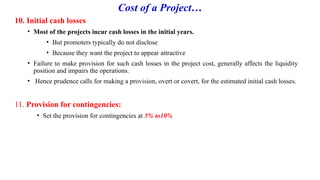
10. Initial cash losses
• Most of the projects incur cash losses in the initial years.
• But promoters typically do not disclose
• Because they want the project to appear attractive
• Failure to make provision for such cash losses in the project cost, generally affects the liquidity
position and impairs the operations.
• Hence prudence calls for making a provision, overt or covert, for the estimated initial cash losses.
11. Provision for contingencies:
• Set the provision for contingencies at 5% to10%
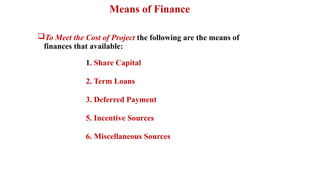
Means of Finance
ToMeet the Cost of Project the following are the means of
finances that available:
1. Share Capital
2. Term Loans
3. Deferred Payment
5. Incentive Sources
6. Miscellaneous Sources
20.
To Meet theCost of Project…
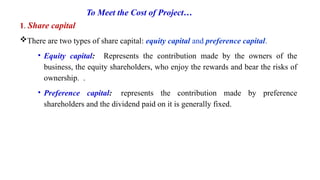
1. Share capital
There are two types of share capital: equity capital and preference capital.
• Equity capital: Represents the contribution made by the owners of the
business, the equity shareholders, who enjoy the rewards and bear the risks of
ownership. .
• Preference capital: represents the contribution made by preference
shareholders and the dividend paid on it is generally fixed.
21.
To Meet theCost of Project…
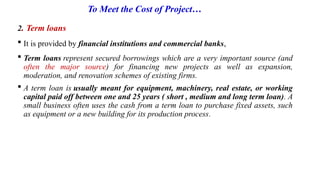
2. Term loans
It is provided by financial institutions and commercial banks,
Term loans represent secured borrowings which are a very important source (and
often the major source) for financing new projects as well as expansion,
moderation, and renovation schemes of existing firms.
A term loan is usually meant for equipment, machinery, real estate, or working
capital paid off between one and 25 years ( short , medium and long term loan). A
small business often uses the cash from a term loan to purchase fixed assets, such
as equipment or a new building for its production process.
22.
To Meet theCost of Project…
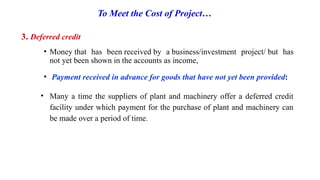
3. Deferred credit
• Money that has been received by a business/investment project/ but has
not yet been shown in the accounts as income,
• Payment received in advance for goods that have not yet been provided:
• Many a time the suppliers of plant and machinery offer a deferred credit
facility under which payment for the purchase of plant and machinery can
be made over a period of time.
23.
To Meet theCost of Project…
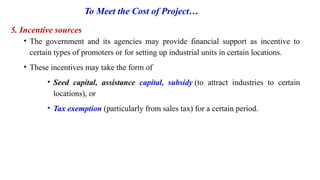
5. Incentive sources
• The government and its agencies may provide financial support as incentive to
certain types of promoters or for setting up industrial units in certain locations.
• These incentives may take the form of
• Seed capital, assistance capital, subsidy (to attract industries to certain
locations), or
• Tax exemption (particularly from sales tax) for a certain period.
24.
To Meet theCost of Project…
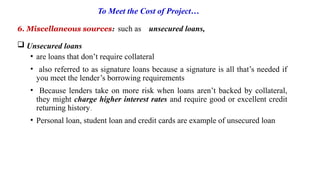
6. Miscellaneous sources: such as unsecured loans,
Unsecured loans
• are loans that don’t require collateral
• also referred to as signature loans because a signature is all that’s needed if
you meet the lender’s borrowing requirements
• Because lenders take on more risk when loans aren’t backed by collateral,
they might charge higher interest rates and require good or excellent credit
returning history..
• Personal loan, student loan and credit cards are example of unsecured loan
Estimates of salesand production
Considerations while Estimating Sales Revenue and Production
While estimating sales revenue the following considerations must be kept in mind-
(i) It is not advisable to assume a high capacity utilization level in the first year of
operation, even if the technology is simple and the company may not face technical
problems.
• Due to constraints like raw material shortage, limited power, marketing problems, etc.
it is sensible to assume low capacity utilization in the first year.
• A reasonable assumption would be
• 40%- 50% of installed capacity in first year,
• 50%- 80% of installed capacity in 2nd
year,
• 80%- 90% of installed capacity in 3rd
year onward
27.
Estimates of salesand production…
ii. It is not necessary to make adjustment for stocks of finished goods. For practical
purposes, it may be assumed that production would be equal to sales.
Sales = Production
iii. The selling price considered should be the price realizable by the company net of
excise duty. It shall, however, include dealers’ commission which is shown as an
item of expense as part of sales expenses.
iv. The selling price used may be the present selling price:
• it is generally assumed that changes in selling price will be matched by
proportionate changes in cost of production. Sales and production are closely
interred –related. Hence they may be estimated together.
28.
Estimates of salesand production…
In order to make estimates of Sales and Production the following details must be
furnished for each product and until the maximum capacity utilization of the plant:
1.Installed Capacity
2.Number of working days
3.Number of shifts
4.Estimated production per day
5.Estimated annual production
6.Estimated output as a percentage of plant capacity
7.Sales after adjusting stocks
8.Value of sales
Cost of production
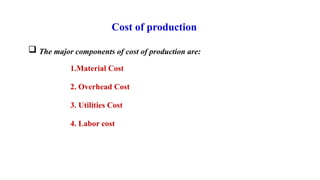
The major components of cost of production are:
1.Material Cost
2. Overhead Cost
3. Utilities Cost
4. Labor cost
31.
Cost of production
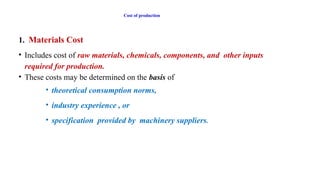
1.Materials Cost
• Includes cost of raw materials, chemicals, components, and other inputs
required for production.
• These costs may be determined on the basis of
• theoretical consumption norms,
• industry experience , or
• specification provided by machinery suppliers.
32.
Cost of production
Materials Cost…
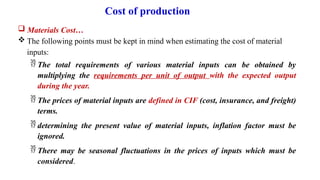
The following points must be kept in mind when estimating the cost of material
inputs:
The total requirements of various material inputs can be obtained by
multiplying the requirements per unit of output with the expected output
during the year.
The prices of material inputs are defined in CIF (cost, insurance, and freight)
terms.
determining the present value of material inputs, inflation factor must be
ignored.
There may be seasonal fluctuations in the prices of inputs which must be
considered.
33.
Cost of production
2.Overheads Cost
• Often referred to as overhead or operating expenses,
• Refer to those expenses associated with running a business that can not be linked
to creating or producing a product or service.
• are the expenses the business incurs to stay in business, regardless of its success
level.
• The expenses on repairs and maintenance, rent, taxes, insurance on factory assets,
and so on are collectively referred to as factory overheads
34.
Cost of production…
3.Utilities Cost
Includes cost of power, water, fuel , etc.
The cost of power includes bought out power estimated on the basis of charges of the
concerned electricity board.
The cost of water include chares paid to local authorities
Cost of fuel consists of cost involved in buying coal, fire, wood, bio gas, etc.
35.
Cost of production…
4.Labor cost
Includes cost of all manpower employed .
It is a function of the number of employees and the rate of remuneration.
Manpower includes the number of operators for operating various machines,
services, number supervisory and administrative staff
Introduction to FinancialAnalysis
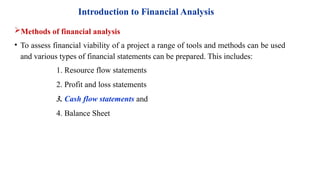
Methods of financial analysis
• To assess financial viability of a project a range of tools and methods can be used
and various types of financial statements can be prepared. This includes:
1. Resource flow statements
2. Profit and loss statements
3. Cash flow statements and
4. Balance Sheet
38.
Statement of CashFlow
What is Statement of Cash flow or cash flow Statement?
The statement of cash flow :
• Describe how a company spends its money (cash outflows) and from where a
company receives its money (cash inflows).
• Includes all cash inflows a company receives from its (1) ongoing operations and
(2) external investment sources, as well as (3) all cash outflows that pay
for business activities and investments during a given period ( annually,semi-
annually, or quarterly).
39.
Statement of CashFlow
Cash flow statements are prepared for two reasons:
First, it is prepared for financial planning purpose: in this case, the purpose is
• to know the liquidity position of the project.
• to helps project planners to identify potential periods of cash shortages and enables them
to plan appropriate responses designed to remove such shortages or how to utilize excess
amount of fund during the life of the project.
Secondly, cash flow statement may be prepared for the purpose of Net Present Value (NPV),
Benefit Cost Ratio (BCR) and Internal Rate of Return (IRR) calculation. The purpose here is
to measure the overall profitability of the project.
40.
Cash Flow Statement
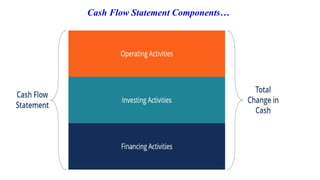
Components of Cash Flow Statement
There are three main components of a cash flow statement. These are:
1. Cash flow from operations,
2. Cash flow from investing, and
3. Cash flow from financing.
Cash Flow Statement
Components of Cash Flow Statement…
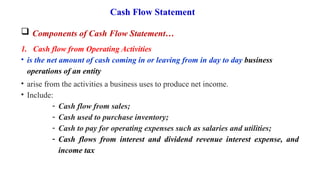
1. Cash flow from Operating Activities
• is the net amount of cash coming in or leaving from in day to day business
operations of an entity
• arise from the activities a business uses to produce net income.
• Include:
- Cash flow from sales;
- Cash used to purchase inventory;
- Cash to pay for operating expenses such as salaries and utilities;
- Cash flows from interest and dividend revenue interest expense, and
income tax
43.
Cash Flow Statement
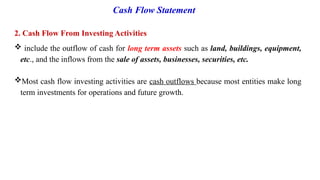
2.Cash Flow From Investing Activities
include the outflow of cash for long term assets such as land, buildings, equipment,
etc., and the inflows from the sale of assets, businesses, securities, etc.
Most cash flow investing activities are cash outflows because most entities make long
term investments for operations and future growth.
44.
Cash Flow Statement
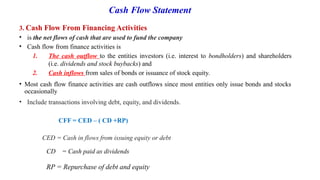
3.Cash Flow From Financing Activities
• is the net flows of cash that are used to fund the company
• Cash flow from finance activities is
1. The cash outflow to the entities investors (i.e. interest to bondholders) and shareholders
(i.e. dividends and stock buybacks) and
2. Cash inflows from sales of bonds or issuance of stock equity.
• Most cash flow finance activities are cash outflows since most entities only issue bonds and stocks
occasionally
• Include transactions involving debt, equity, and dividends.
CFF = CED – ( CD +RP)
CED = Cash in flows from issuing equity or debt
CD = Cash paid as dividends
RP = Repurchase of debt and equity
45.
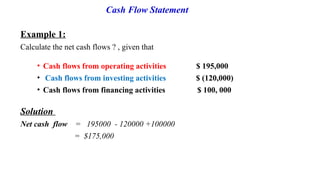
Example 1:
Calculate thenet cash flows ? , given that
• Cash flows from operating activities $ 195,000
• Cash flows from investing activities $ (120,000)
• Cash flows from financing activities $ 100, 000
Solution
Net cash flow = 195000 - 120000 +100000
= $175,000
Cash Flow Statement
46.
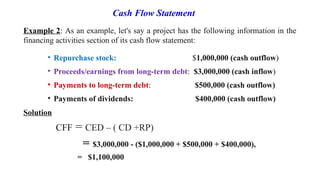
Example 2: Asan example, let's say a project has the following information in the
financing activities section of its cash flow statement:
• Repurchase stock: $1,000,000 (cash outflow)
• Proceeds/earnings from long-term debt: $3,000,000 (cash inflow)
• Payments to long-term debt: $500,000 (cash outflow)
• Payments of dividends: $400,000 (cash outflow)
Solution
CFF = CED – ( CD +RP)
= $3,000,000 - ($1,000,000 + $500,000 + $400,000),
= $1,100,000
Cash Flow Statement
47.
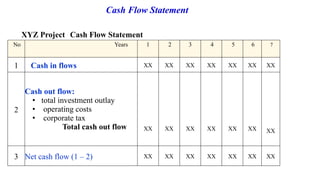
Cash Flow Statement
NoYears 1 2 3 4 5 6 7
1 Cash in flows XX XX XX XX XX XX XX
2
Cash out flow:
• total investment outlay
• operating costs
• corporate tax
Total cash out flow XX XX XX XX XX XX XX
3 Net cash flow (1 – 2) XX XX XX XX XX XX XX
XYZ Project Cash Flow Statement
48.
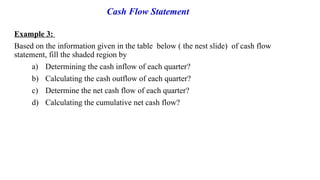
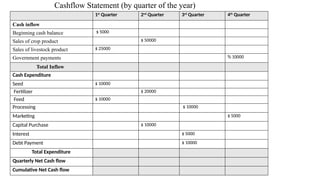
Example 3:
Based onthe information given in the table below ( the nest slide) of cash flow
statement, fill the shaded region by
a) Determining the cash inflow of each quarter?
b) Calculating the cash outflow of each quarter?
c) Determine the net cash flow of each quarter?
d) Calculating the cumulative net cash flow?
Cash Flow Statement
49.
Cashflow Statement (byquarter of the year)
1st
Quarter 2nd
Quarter 3rd
Quarter 4th
Quarter
Cash inflow
Beginning cash balance $ 5000
Sales of crop product $ 50000
Sales of livestock product $ 25000
Government payments % 10000
Total Inflow
Cash Expenditure
Seed $ 10000
Fertilizer $ 20000
Feed $ 10000
Processing $ 10000
Marketing $ 5000
Capital Purchase $ 10000
Interest $ 5000
Debt Payment $ 10000
Total Expenditure
Quarterly Net Cash flow
Cumulative Net Cash flow