What are Derivatives?
 A derivative is a financial instrument whose value is derived
from the value of another asset, which is known as the
underlying.
 When the price of the underlying changes, the value of the
derivative also changes.
 A Derivative is not a product. It is a contract that derives its
value from changes in the price of the underlying.
Example :
The value of a gold futures contract is derived from the
value of the underlying asset i.e. Gold.
What is a Forward?
 A forward is a contract in which one party commits to buy
and the other party commits to sell a specified quantity
of an agreed upon asset for a pre-determined price at a
specific date in the future.
 It is a customised contract, in the sense that the terms of
the contract are agreed upon by the individual parties.
What are Futures?
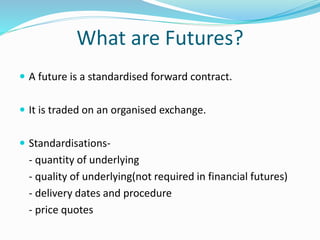
 A future is a standardised forward contract.
 It is traded on an organised exchange.
 Standardisations-
- quantity of underlying
- quality of underlying(not required in financial futures)
- delivery dates and procedure
- price quotes
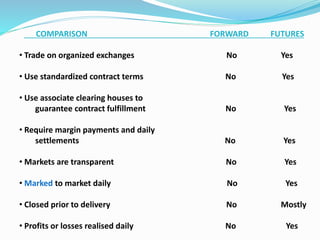
COMPARISON FORWARD FUTURES
• Trade on organized exchanges No Yes
• Use standardized contract terms No Yes
• Use associate clearing houses to
guarantee contract fulfillment No Yes
• Require margin payments and daily
settlements No Yes
• Markets are transparent No Yes
• Marked to market daily No Yes
• Closed prior to delivery No Mostly
• Profits or losses realised daily No Yes
What are Options?
 Contracts that give the holder the option to buy/sell
specified quantity of the underlying assets at a
particular price on or before a specified time period.
 The word “option” means that the holder has the
right but not the obligation to buy/sell underlying
assets.
Types of Options
 Options are of two types – call and put.
 Call option give the buyer the right but not the
obligation to buy a given quantity of the underlying
asset, at a given price on or before a particular date
by paying a premium.
 Puts give the buyer the right, but not obligation to
sell a given quantity of the underlying asset at a given
price on or before a particular date by paying a
premium.
Thank You

Derivatives.pptx

  • 2.
    What are Derivatives? A derivative is a financial instrument whose value is derived from the value of another asset, which is known as the underlying.  When the price of the underlying changes, the value of the derivative also changes.  A Derivative is not a product. It is a contract that derives its value from changes in the price of the underlying. Example : The value of a gold futures contract is derived from the value of the underlying asset i.e. Gold.
  • 3.
    What is aForward?  A forward is a contract in which one party commits to buy and the other party commits to sell a specified quantity of an agreed upon asset for a pre-determined price at a specific date in the future.  It is a customised contract, in the sense that the terms of the contract are agreed upon by the individual parties.
  • 4.
    What are Futures? A future is a standardised forward contract.  It is traded on an organised exchange.  Standardisations- - quantity of underlying - quality of underlying(not required in financial futures) - delivery dates and procedure - price quotes
  • 5.
    COMPARISON FORWARD FUTURES •Trade on organized exchanges No Yes • Use standardized contract terms No Yes • Use associate clearing houses to guarantee contract fulfillment No Yes • Require margin payments and daily settlements No Yes • Markets are transparent No Yes • Marked to market daily No Yes • Closed prior to delivery No Mostly • Profits or losses realised daily No Yes
  • 6.
    What are Options? Contracts that give the holder the option to buy/sell specified quantity of the underlying assets at a particular price on or before a specified time period.  The word “option” means that the holder has the right but not the obligation to buy/sell underlying assets.
  • 7.
    Types of Options Options are of two types – call and put.  Call option give the buyer the right but not the obligation to buy a given quantity of the underlying asset, at a given price on or before a particular date by paying a premium.  Puts give the buyer the right, but not obligation to sell a given quantity of the underlying asset at a given price on or before a particular date by paying a premium.
  • 8.