Financial Assets (Instruments)
Chapter 2
Requests for permission to make
copies of any part of the work
should be mailed to:
Thomson/South-Western
5191 Natorp Blvd.
Mason, OH 45040
Assets
Real asset
 a physically observable, or touchable, item
Assets
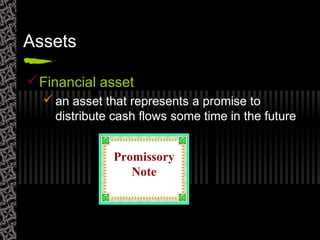
Financial asset
 an asset that represents a promise to
distribute cash flows some time in the future
Promissory
Note
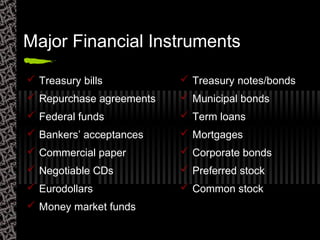
Major Financial Instruments
 Treasury bills
 Repurchase agreements
 Federal funds
 Bankers’ acceptances
 Commercial paper
 Negotiable CDs
 Eurodollars
 Money market funds
 Treasury notes/bonds
 Municipal bonds
 Term loans
 Mortgages
 Corporate bonds
 Preferred stock
 Common stock
Financial Instruments and the
Firm’s Balance Sheet
Firm issues financial instruments so it
can purchase the tangible assets
necessary to produce income
Balance Sheet - Equity
 Common equity
 stockholder’s total investment in the firm
 Par value
 nominal or face value of a stock or bond
 Retained earnings
 earnings the firm has not paid out as dividends
throughout its history
 Additional paid-in capital
 difference between the value of newly issued
stock and its par value
Debt - A loan to an individual,
company, or government
Debt features
Priority to assets and earnings
Principal value, Face value, Maturity
value, and Par value
Interest payments or discounted
securities
Maturity date
Control of the firm (voting rights)
Short-Term Debt
 Treasury Bill (T-bill)
 Repurchase Agreement (Repo)
 Federal Funds
 Banker’s Acceptance
 Commercial Paper
 Certificate of Deposit
 Eurodollar Deposit
 Money Market Mutual Fund
Long-Term Debt
Term Loans
Bonds
Government Bonds
Treasury notes or bonds - issued by US
government
Municipal bonds - issued by state or
local governments
Revenue bonds
General obligation bonds
Corporate Bonds
 Mortgage bonds
 Debenture
 Subordinated debenture
 Income bond
 Putable bond
 Indexed (purchasing power) bond
 Floating rate bond
 Zero coupon bond
 Junk bond
Bond Contract Features
 Bond Indenture
 Trustee
 Restrictive covenant
 Call provision
 Sinking fund
 call for redemption by annual lottery
 buy bonds on the open market
 Convertible
Bond Ratings
 Moody’s Investors Service (Moody’s)
 Standard & Poor’s Corporation (S&P)
 Investment grade bonds
 triple B or better
 Criteria for rating bonds
 Importance of bond ratings
 Changes in ratings
Yields on Selected Long-Term
Bonds, 1965-2005
Stock (Equity)
 Preferred stock has preference over common
stock in distribution of dividends and assets;
dividend payments are fixed
 Preferred stock may provide for cumulative
dividends, conversion into common stock,
voting rights, dividend participation, sinking
funds, call provisions, and even maturity
Stock (Equity)
Common stock
 represents ownership in a corporation
 common stockholders vote for members of
the board of directors
 has last claim on distribution of earnings
and assets
 may have preemptive rights to purchase
any additional shares sold by the firm
Stock (Equity)
Classified stock
 special purpose stock
Closely held corporations
Publicly owned corporations
Derivatives
Value depends on some underlying
asset such as a stock or bond
Option - contract that gives the right to
buy or sell an asset at a set price within
a specified period of time
 Call: holder has the right to buy
 Put: holder has the right to sell
 Striking price: exercise price of the option
Derivatives
 Convertibles - bonds or preferred stocks that
can be exchanged for common stock at the
option of the holder
 Conversion ratio defines the number of shares of
stock the convertible holder receives upon
conversion
 Futures - arrangement for delivery of an item
at a set future date at a set price
Derivatives
Swaps - an agreement to exchange
cash flows or assets
at a set time
in the future
Rationale for Using Different Types of
Securities
Differences in trade-off between risk
and expected after tax return
Appeal to broad market and
different investment needs
Differences in popularity through
time
Which Financial Instrument is Best?
Issuer’s or investor’s viewpoint ?
Bonds
 fixed interest payments
 does not represent ownership
 may have restrictions on dividends
 interest expense is deductible
Preferred stock
 fixed payment - but not obligated
 no voting rights
 higher after-tax cost since dividends are not
deductible expenses
Which Financial Instrument is Best?
 Common Stock
 no obligation of dividend payments
 no maturity date for “repayment”
 sales increases creditworthiness
 prospects affect terms
 gives control to stockholders
 shares the income of the firm
 higher costs of distribution than debt
 dividends are not deductible
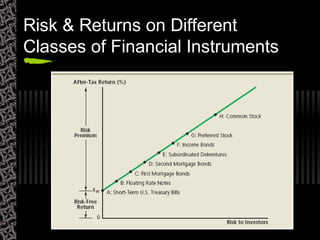
Risk & Returns on Different
Classes of Financial Instruments
Financial Instruments in
International Markets
American Depository Receipts (ADRs)
 represent ownership in stocks of foreign
countries that are held in trust by a bank
located in the country the stock is traded
Foreign debt
 sold by a foreign borrower but denominated
in the currency of the country in which it is
sold
Financial Instruments in
International Markets
Eurodebt
 debt sold in a country other than the one in
whose currency the debt is denominated
 Eurobonds
 Eurocredits: usually tied to London
InterBank Offer Rate (LIBOR)
 Euro-commercial paper (Euro-CP)
 Euronotes
Financial Instruments in
International Markets
Equity instruments
 Euro stock is traded in countries other than
the “home” country of the company, not
including the United States
 Yankee stock is stock issued for foreign
companies that is traded in the United
States
End of Chapter 2
Financial
Assets
(Instruments)

Financial assets ch02

  • 1.
    Financial Assets (Instruments) Chapter2 Requests for permission to make copies of any part of the work should be mailed to: Thomson/South-Western 5191 Natorp Blvd. Mason, OH 45040
  • 2.
    Assets Real asset  aphysically observable, or touchable, item
  • 3.
    Assets Financial asset  anasset that represents a promise to distribute cash flows some time in the future Promissory Note
  • 4.
    Major Financial Instruments Treasury bills  Repurchase agreements  Federal funds  Bankers’ acceptances  Commercial paper  Negotiable CDs  Eurodollars  Money market funds  Treasury notes/bonds  Municipal bonds  Term loans  Mortgages  Corporate bonds  Preferred stock  Common stock
  • 5.
    Financial Instruments andthe Firm’s Balance Sheet Firm issues financial instruments so it can purchase the tangible assets necessary to produce income
  • 6.
    Balance Sheet -Equity  Common equity  stockholder’s total investment in the firm  Par value  nominal or face value of a stock or bond  Retained earnings  earnings the firm has not paid out as dividends throughout its history  Additional paid-in capital  difference between the value of newly issued stock and its par value
  • 7.
    Debt - Aloan to an individual, company, or government Debt features Priority to assets and earnings Principal value, Face value, Maturity value, and Par value Interest payments or discounted securities Maturity date Control of the firm (voting rights)
  • 8.
    Short-Term Debt  TreasuryBill (T-bill)  Repurchase Agreement (Repo)  Federal Funds  Banker’s Acceptance  Commercial Paper  Certificate of Deposit  Eurodollar Deposit  Money Market Mutual Fund
  • 9.
  • 10.
    Government Bonds Treasury notesor bonds - issued by US government Municipal bonds - issued by state or local governments Revenue bonds General obligation bonds
  • 11.
    Corporate Bonds  Mortgagebonds  Debenture  Subordinated debenture  Income bond  Putable bond  Indexed (purchasing power) bond  Floating rate bond  Zero coupon bond  Junk bond
  • 12.
    Bond Contract Features Bond Indenture  Trustee  Restrictive covenant  Call provision  Sinking fund  call for redemption by annual lottery  buy bonds on the open market  Convertible
  • 13.
    Bond Ratings  Moody’sInvestors Service (Moody’s)  Standard & Poor’s Corporation (S&P)  Investment grade bonds  triple B or better  Criteria for rating bonds  Importance of bond ratings  Changes in ratings
  • 14.
    Yields on SelectedLong-Term Bonds, 1965-2005
  • 15.
    Stock (Equity)  Preferredstock has preference over common stock in distribution of dividends and assets; dividend payments are fixed  Preferred stock may provide for cumulative dividends, conversion into common stock, voting rights, dividend participation, sinking funds, call provisions, and even maturity
  • 16.
    Stock (Equity) Common stock represents ownership in a corporation  common stockholders vote for members of the board of directors  has last claim on distribution of earnings and assets  may have preemptive rights to purchase any additional shares sold by the firm
  • 17.
    Stock (Equity) Classified stock special purpose stock Closely held corporations Publicly owned corporations
  • 18.
    Derivatives Value depends onsome underlying asset such as a stock or bond Option - contract that gives the right to buy or sell an asset at a set price within a specified period of time  Call: holder has the right to buy  Put: holder has the right to sell  Striking price: exercise price of the option
  • 19.
    Derivatives  Convertibles -bonds or preferred stocks that can be exchanged for common stock at the option of the holder  Conversion ratio defines the number of shares of stock the convertible holder receives upon conversion  Futures - arrangement for delivery of an item at a set future date at a set price
  • 20.
    Derivatives Swaps - anagreement to exchange cash flows or assets at a set time in the future
  • 21.
    Rationale for UsingDifferent Types of Securities Differences in trade-off between risk and expected after tax return Appeal to broad market and different investment needs Differences in popularity through time
  • 22.
    Which Financial Instrumentis Best? Issuer’s or investor’s viewpoint ? Bonds  fixed interest payments  does not represent ownership  may have restrictions on dividends  interest expense is deductible
  • 23.
    Preferred stock  fixedpayment - but not obligated  no voting rights  higher after-tax cost since dividends are not deductible expenses Which Financial Instrument is Best?
  • 24.
    Which Financial Instrumentis Best?  Common Stock  no obligation of dividend payments  no maturity date for “repayment”  sales increases creditworthiness  prospects affect terms  gives control to stockholders  shares the income of the firm  higher costs of distribution than debt  dividends are not deductible
  • 25.
    Risk & Returnson Different Classes of Financial Instruments
  • 26.
    Financial Instruments in InternationalMarkets American Depository Receipts (ADRs)  represent ownership in stocks of foreign countries that are held in trust by a bank located in the country the stock is traded Foreign debt  sold by a foreign borrower but denominated in the currency of the country in which it is sold
  • 27.
    Financial Instruments in InternationalMarkets Eurodebt  debt sold in a country other than the one in whose currency the debt is denominated  Eurobonds  Eurocredits: usually tied to London InterBank Offer Rate (LIBOR)  Euro-commercial paper (Euro-CP)  Euronotes
  • 28.
    Financial Instruments in InternationalMarkets Equity instruments  Euro stock is traded in countries other than the “home” country of the company, not including the United States  Yankee stock is stock issued for foreign companies that is traded in the United States
  • 29.
    End of Chapter2 Financial Assets (Instruments)