RADIUS (REMOTE AUTHENTICATION DIAL-IN USER SERVICE) PRESENTED BY: AMOGH UBALE CMPE-208 NETWORK ARCHITECTURE AND PROTOCOLS
OUTLINE Introduction to RADIUS AAA Radius Packet Format Properties of Radius Radius Security Experimentation Conclusion
RADIUS REMOTE AUTHENTICATION DIAL-IN USER SERVICE Developed for authentication and accounting by Livingston Enterprises in 1991 Bought by IETF  RFC 2865 (RADIUS) RFC 2866 (RADIUS Accounting)
WHY RADIUS ? Thousands of servers located which provide different services. Different users access services provided by server. Authentication required. Authorization & Accounting also required RADIUS provides AAA functionality
AAA AAA stands for authentication, authorization and accounting. Authentication : verify user Authorization : services provided to the specific user Accounting : billing for service used by the user
FEATURES OF RADIUS Client/Server Model Network Security Flexible Authentication Mechanism Extensible Protocol
PACKET FORMAT OF RADIUS CODE : identifies the type of packet.  Ex : 1 Access-Request , 2 Access-Accept ID : used for matching the response with the request LENGTH : identifies the length of packet including attributes AUTHENTICATOR : random value is generated in case of request and response both ATTRIBUTES : variable length and contains specific information regarding packet 1 byte CODE 1 byte ID 2 bytes LENGTH 16 bytes AUTHENTICATOR VARIABLE  LENGTH ATTRIBUTES
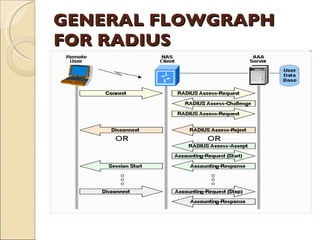
GENERAL FLOWGRAPH FOR RADIUS
RADIUS DETAILS RADIUS uses UDP and not TCP Following are some reasons : User cannot wait for several minutes, so retransmission algorithm of TCP and ACK not required. No special handling for offline clients and servers Stateless Protocol Easy to implement multi-threaded server and provide service to multiple client requests.
RADIUS AND SECURITY  Security is rather primitive  Two main function are provided Attribute (mainly password ) hiding  Authentication  of messages  Both of this function are performed by hash function MD5 and the shared secret
RADIUS MESSAGE INTEGRITY   PROTECTION Access request message  Request  Authenticator It is a 16 byte random number that is generated by the client and added to the request authenticator field It should have global uniqueness Weak security provision  Addition of message authentication
MESSAGE AUTHENTICATION   FIELD For protection of the access request message the client calculate MD5 over the entire message using the shared secret  For access request  Message authenticator value =MD5(code ,length,id,request authentiactor,attributes, shared secret) For accounting request  Message authenticator value =MD5(code, length, id, request,  authenticator,  attributes, shared secret )
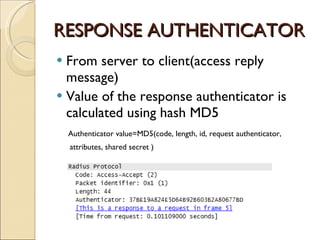
RESPONSE AUTHENTICATOR From server to client(access reply message) Value of the response authenticator is calculated using hash MD5 Authenticator value=MD5(code, length, id, request authenticator,  attributes, shared secret )
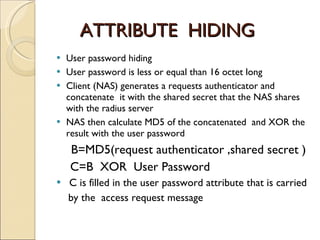
ATTRIBUTE  HIDING User password hiding User password is less or equal than 16 octet long  Client (NAS) generates a requests authenticator and concatenate  it with the shared secret that the NAS shares with the radius server NAS then calculate MD5 of the concatenated  and XOR the  result with the user password  B=MD5(request authenticator ,shared secret ) C=B  XOR  User Password C is filled in the user password attribute that is carried by the  access request message
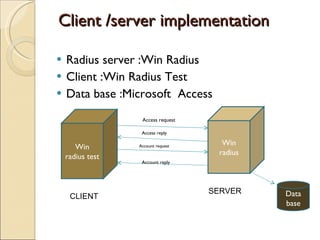
Client /server implementation Radius server :Win Radius  Client :Win Radius Test  Data base :Microsoft  Access Win radius test Win radius Data base Access request  Access reply  Account request  Account reply  CLIENT SERVER
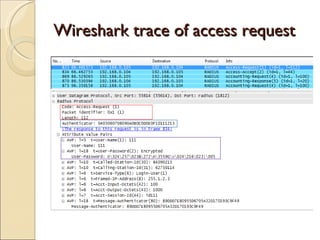
Wireshark trace of access request
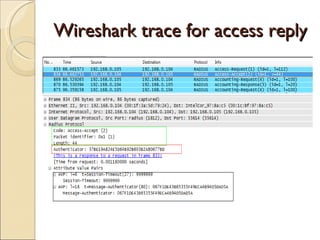
Wireshark trace for access reply
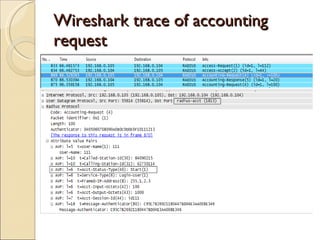
Wireshark trace of accounting request
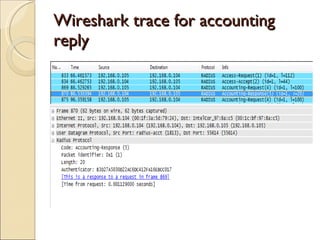
Wireshark trace for accounting reply
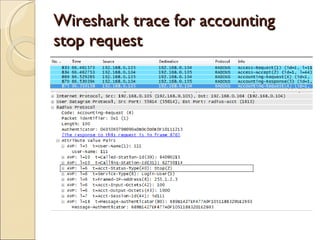
Wireshark trace for accounting stop request
VULNERABLITY OF RADIUS  Static manually configured shared secret  MD5 hashing method has  known vulnerabilities In proxy changing there is chain of trust Transport  layer protection  does not exit  Use of poor random generator for generation of request authenticator
CONCLUSION Radius is commonly used in embedded system (routers, switches, etc),which cannot handle large number of user with distinct authentication information RADIUS facilitates centralized user administration RADIUS provide certain level of protection against sniffing active attack Widely implemented by hardware vendor Diameter is an improvement over radius
REFERENCES 1] http://www.faqs.org/rfcs/rfc2865.html 2] BOOK: AAA network security and mobile access radius, diameter, EAP and IP mobility by Madjid Nakhjri and Mahsa Nakhjri 3] BOOK:RADIUS by Johanathan  Hassell 4] http://en.wikipedia.org/wiki/RADIUS 5] http://www.itconsult2000.com/en/product/WinRadius.html
THANK YOU QUESTIONS ? ?

RADIUS

  • 1.
    RADIUS (REMOTE AUTHENTICATIONDIAL-IN USER SERVICE) PRESENTED BY: AMOGH UBALE CMPE-208 NETWORK ARCHITECTURE AND PROTOCOLS
  • 2.
    OUTLINE Introduction toRADIUS AAA Radius Packet Format Properties of Radius Radius Security Experimentation Conclusion
  • 3.
    RADIUS REMOTE AUTHENTICATIONDIAL-IN USER SERVICE Developed for authentication and accounting by Livingston Enterprises in 1991 Bought by IETF RFC 2865 (RADIUS) RFC 2866 (RADIUS Accounting)
  • 4.
    WHY RADIUS ?Thousands of servers located which provide different services. Different users access services provided by server. Authentication required. Authorization & Accounting also required RADIUS provides AAA functionality
  • 5.
    AAA AAA standsfor authentication, authorization and accounting. Authentication : verify user Authorization : services provided to the specific user Accounting : billing for service used by the user
  • 6.
    FEATURES OF RADIUSClient/Server Model Network Security Flexible Authentication Mechanism Extensible Protocol
  • 7.
    PACKET FORMAT OFRADIUS CODE : identifies the type of packet. Ex : 1 Access-Request , 2 Access-Accept ID : used for matching the response with the request LENGTH : identifies the length of packet including attributes AUTHENTICATOR : random value is generated in case of request and response both ATTRIBUTES : variable length and contains specific information regarding packet 1 byte CODE 1 byte ID 2 bytes LENGTH 16 bytes AUTHENTICATOR VARIABLE LENGTH ATTRIBUTES
  • 8.
  • 9.
    RADIUS DETAILS RADIUSuses UDP and not TCP Following are some reasons : User cannot wait for several minutes, so retransmission algorithm of TCP and ACK not required. No special handling for offline clients and servers Stateless Protocol Easy to implement multi-threaded server and provide service to multiple client requests.
  • 10.
    RADIUS AND SECURITY Security is rather primitive Two main function are provided Attribute (mainly password ) hiding Authentication of messages Both of this function are performed by hash function MD5 and the shared secret
  • 11.
    RADIUS MESSAGE INTEGRITY PROTECTION Access request message Request Authenticator It is a 16 byte random number that is generated by the client and added to the request authenticator field It should have global uniqueness Weak security provision Addition of message authentication
  • 12.
    MESSAGE AUTHENTICATION FIELD For protection of the access request message the client calculate MD5 over the entire message using the shared secret For access request Message authenticator value =MD5(code ,length,id,request authentiactor,attributes, shared secret) For accounting request Message authenticator value =MD5(code, length, id, request, authenticator, attributes, shared secret )
  • 13.
    RESPONSE AUTHENTICATOR Fromserver to client(access reply message) Value of the response authenticator is calculated using hash MD5 Authenticator value=MD5(code, length, id, request authenticator, attributes, shared secret )
  • 14.
    ATTRIBUTE HIDINGUser password hiding User password is less or equal than 16 octet long Client (NAS) generates a requests authenticator and concatenate it with the shared secret that the NAS shares with the radius server NAS then calculate MD5 of the concatenated and XOR the result with the user password B=MD5(request authenticator ,shared secret ) C=B XOR User Password C is filled in the user password attribute that is carried by the access request message
  • 15.
    Client /server implementationRadius server :Win Radius Client :Win Radius Test Data base :Microsoft Access Win radius test Win radius Data base Access request Access reply Account request Account reply CLIENT SERVER
  • 16.
    Wireshark trace ofaccess request
  • 17.
    Wireshark trace foraccess reply
  • 18.
    Wireshark trace ofaccounting request
  • 19.
    Wireshark trace foraccounting reply
  • 20.
    Wireshark trace foraccounting stop request
  • 21.
    VULNERABLITY OF RADIUS Static manually configured shared secret MD5 hashing method has known vulnerabilities In proxy changing there is chain of trust Transport layer protection does not exit Use of poor random generator for generation of request authenticator
  • 22.
    CONCLUSION Radius iscommonly used in embedded system (routers, switches, etc),which cannot handle large number of user with distinct authentication information RADIUS facilitates centralized user administration RADIUS provide certain level of protection against sniffing active attack Widely implemented by hardware vendor Diameter is an improvement over radius
  • 23.
    REFERENCES 1] http://www.faqs.org/rfcs/rfc2865.html2] BOOK: AAA network security and mobile access radius, diameter, EAP and IP mobility by Madjid Nakhjri and Mahsa Nakhjri 3] BOOK:RADIUS by Johanathan Hassell 4] http://en.wikipedia.org/wiki/RADIUS 5] http://www.itconsult2000.com/en/product/WinRadius.html
  • 24.