All Hands on Deck: Creating
Action Around Your Cause
A Nonprofit Workshop on Advocacy
Tuesday, November 18, 2014
Presented by:
ADVOCACY: What is it?
Advocacy vs. Lobbying:
• Advocacy is the process of stakeholders making their
voices heard on issues that affect their lives and the
lives of others at the local, state and national level.
• Lobbying involves activities that are in direct support
of or opposition to specific legislation, executive
orders, or an agency’s rules, regulations & rates.
ADVOCACY: What is it?
Definition of Lobbying:
• Any attempt to influence:
– (i) the passage or defeat of any legislation by either house of the state
legislature or approval or disapproval of any legislation by the
governor;
– (ii) the adoption, issuance, rescission, modification or terms of a
gubernatorial executive order;
– (iii) the adoption or rejection of any rule or regulation having the force
and effect of law by a state agency;
– (iv) the outcome of any rate making proceeding by a state agency;
• Source: NYS Joint Commission on Public Ethics (JCOPE)
ADVOCACY: What is it?
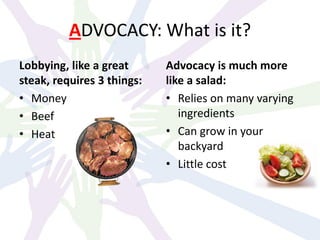
Lobbying, like a great
steak, requires 3 things:
• Money
• Beef
• Heat
Advocacy is much more
like a salad:
• Relies on many varying
ingredients
• Can grow in your
backyard
• Little cost
DO’S AND DON’TS
Please Do:
• Advocate for your cause.
• Lobby.
• Build relationships with and engage lawmakers.
• Engage the community and the public.
• Encourage people to register to vote, get involved.
• Organize communities.
• Build coalitions and alliances.
DO’S AND DON’TS
Please Don’t:
• Use government funds to lobby.
– Your organization can receive government funds for other purposes,
just don’t use them for this.
• Engage in any partisan activities or activities that
simply appear to be partisan.
• Lie and damage your credibility.
• Be late for meetings.
– Elected officials often have tight schedules that can change at a
moments notice.
• Offer gifts in exchange for favorable action.
DO’S AND DON’TS
Resources:
• NYS JCOPE Website: www.jcope.ny.gov
• The Alliance for Justice: www.afj.org
• The IRS:
– http://www.irs.gov/Charities-&-Non-Profits/Lobbying
– http://www.irs.gov/Charities-&-Non-Profits/Measuring-
Lobbying:-Substantial-Part-Test
– http://www.irs.gov/Charities-&-Non-Profits/Measuring-
Lobbying-Activity:-Expenditure-Test
VISION: Know what you want
Help elected officials help you:
• Make it clear what your priorities are
– Rank your legislative agenda in order of importance
• Don’t make more work for them
– Provide supportive facts
– Elected officials and staff face information overload with numerous
issues
• Be personal, don’t make it personal
– Show how their constituents are affected
– Be prepared for disagreement
VISION: Know what you want
Telling elected officials what you want is not
enough, you need to ask them to do something:
• Ask elected officials to take a specific action
– Set reasonable expectations
– Support/cosponsor a bill, secure funding, issue a public statement,
write to an agency, etc.
• Ask elected officials to respond to the request
– Get a written response and follow up
– Be patient but also persistent
OPPORTUNITY: Know the playing field
Effective advocacy requires some research
before you get started:
• What level of government should I target?
• What legislative/regulatory process is involved?
• Who’s who among decision-makers?
• When is the best time to advocate?
• Who are your allies and opposition?
OPPORTUNITY: Know the playing field
Get to know your elected officials:
• Personal history
– Hometown, family, education, career
• Significant accomplishments
– Laws passed, funding secured
• Record (statements, votes, bill sponsorship)
– Votes, statements, bills sponsored and authored
• Supporters
– Institutional support, campaign contributors
• Political philosophy
– Go beyond party enrollment
OPPORTUNITY: Know the playing field
Elected officials are like the media:
• Establish relationships early
– The best time to start is when you don’t need anything.
• Upgrade to the Platinum Rule
– Treat people the way they want to be treated, not the way you think
they should be treated.
• You must be timely, interesting, and to the point
– Be aware of schedules and deadlines, such as budget and legislative
calendars.
• Strong relationships yield more attention and greater
accessibility
– Get them to come to you as a resource too.
OPPORTUNITY: Know the playing field
Meeting and building relationships with staff is
well worth your time:
• Staff are the gatekeepers to lawmakers and should be your
primary target for building relationships.
• They help lawmakers balance their responsibilities and
provide counsel and advice that helps with important
decisions.
• Staff also do much of the important behind-the-scenes work
on legislation and policy issues.
• In many instances, people at the staff level are the policy
experts, not the lawmakers.
OPPORTUNITY: Know the playing field
Meetings are just one way to engage with
elected officials and staff:
• Invite them to visit/tour your office/operation.
• Host a legislative breakfast or roundtable discussion.
• Invite them to speak at or attend a conference or workshop
• Ask them to contribute an article for your newsletter.
• Look for volunteer opportunities they can participate in.
• Ask for proclamations, resolutions, citations, certificates, etc.
COMMUNICATE EFFECTIVELY
Prepare for the meeting:
• Think of it as a presentation:
– An opportunity to make a presentation about what you want to say.
• Develop 3 key messages:
– What are the three most important points you want to make?
– Support them with facts, anecdotes, and examples.
– Talk backwards.
• Rehearse delivering the messages:
– Practice delivering your messages out loud, to an audience if possible.
– Use your own words.
– Practice telling background stories, examples, etc.
– Practice answering difficult questions so they don’t trip you up.
COMMUNICATE EFFECTIVELY
Prepare for the meeting:
• Have realistic expectations:
– Don’t expect to get what you ask for on the spot.
– Advocacy is a process that requires patience, flexibility and
persistence.
• Bring people with you:
– If you have people whose stories speak to the importance of the effort
and can effectively humanize it, bring them with you.
– Putting faces to issues is a powerful way to tell your story and make
the case for what you’re trying to achieve.
– In the give-take world of advocacy, lawmakers want access to people
(voters).
COMMUNICATE EFFECTIVELY
During the meeting:
• Get to the point (“the ask”) quickly:
– Whatever you want from the lawmaker, be sure to clearly articulate it
at the beginning of the meeting.
• Provide a one pager on the issue:
– Don’t count on the lawmaker or staffer to remember everything you
say.
– Provide a document that summarizes the issue, the role of your
organization, what you’re trying to achieve, and what you are asking of
the lawmaker.
– Be concise.
COMMUNICATE EFFECTIVELY
During the meeting:
• Bring it back to your issue:
– Let the lawmaker ask questions, but don’t let those questions derail
your presentation.
– When rehearsing, have someone ask tough questions designed to get
you off topic or frustrate you.
– Focus on acknowledging the question and then returning to your
messages.
• Expect the unexpected:
– Your 15 minute meeting could change to a 3 minute meeting.
– Your meeting with a lawmaker could change to a meeting with staff.
– Your meeting in an office could happen while walking down a hall.
ASSETS
Local government
• www.monroecounty.gov
• www.cityofrochester.com
• www.lwv-rma.org
New York State government
• www.ny.gov
• www.assembly.state.ny.us
• www.nysenate.gov
• http://public.leginfo.state.ny.us/
ASSETS
Federal government
• www.congress.gov
• www.house.gov
• www.senate.gov
• www.whitehouse.gov
COLLABORATE
Building coalitions can improve your chances for
success by:
• Building your membership and creating new
partnership opportunities
• Enhancing your branding and credibility
• Raising awareness and improving visibility
• Maximizing resources and dividing labor
• Increasing political clout
• Neutralizing the opposition
COLLABORATE
Coalitions can be like “herding cats” and have
challenges:
• Coalitions require time and money
– Be sure that it is adequately funded
– Members need to be in it for the long haul
• Specific interests can lead to conflict among groups
– Members need to respect each other
– Build consensus among members, even if it’s time consuming
• Coalition management is cumbersome
– Utilize an effective and deliberate leadership structure
YOUR VOICE MATTERS
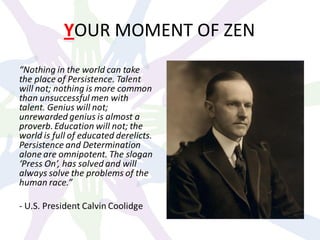
YOUR MOMENT OF ZEN
Contact Us
Mike Kennerknecht
PR Supervisor
Tipping Point Communications
585-340-1119
mike@tippingpointcomm.com
www.tippingpointcomm.com
@Kennerknecht
Tom Brede
Sr. Content Manager, Counselor
Eric Mower + Associates
585-389-1870
tbrede@mower.com
www.mowerpr.com
@TomBrede

All Hands on Deck: Creating Action Around Your Cause

  • 1.
    All Hands onDeck: Creating Action Around Your Cause A Nonprofit Workshop on Advocacy Tuesday, November 18, 2014 Presented by:
  • 2.
    ADVOCACY: What isit? Advocacy vs. Lobbying: • Advocacy is the process of stakeholders making their voices heard on issues that affect their lives and the lives of others at the local, state and national level. • Lobbying involves activities that are in direct support of or opposition to specific legislation, executive orders, or an agency’s rules, regulations & rates.
  • 3.
    ADVOCACY: What isit? Definition of Lobbying: • Any attempt to influence: – (i) the passage or defeat of any legislation by either house of the state legislature or approval or disapproval of any legislation by the governor; – (ii) the adoption, issuance, rescission, modification or terms of a gubernatorial executive order; – (iii) the adoption or rejection of any rule or regulation having the force and effect of law by a state agency; – (iv) the outcome of any rate making proceeding by a state agency; • Source: NYS Joint Commission on Public Ethics (JCOPE)
  • 4.
    ADVOCACY: What isit? Lobbying, like a great steak, requires 3 things: • Money • Beef • Heat Advocacy is much more like a salad: • Relies on many varying ingredients • Can grow in your backyard • Little cost
  • 5.
    DO’S AND DON’TS PleaseDo: • Advocate for your cause. • Lobby. • Build relationships with and engage lawmakers. • Engage the community and the public. • Encourage people to register to vote, get involved. • Organize communities. • Build coalitions and alliances.
  • 6.
    DO’S AND DON’TS PleaseDon’t: • Use government funds to lobby. – Your organization can receive government funds for other purposes, just don’t use them for this. • Engage in any partisan activities or activities that simply appear to be partisan. • Lie and damage your credibility. • Be late for meetings. – Elected officials often have tight schedules that can change at a moments notice. • Offer gifts in exchange for favorable action.
  • 7.
    DO’S AND DON’TS Resources: •NYS JCOPE Website: www.jcope.ny.gov • The Alliance for Justice: www.afj.org • The IRS: – http://www.irs.gov/Charities-&-Non-Profits/Lobbying – http://www.irs.gov/Charities-&-Non-Profits/Measuring- Lobbying:-Substantial-Part-Test – http://www.irs.gov/Charities-&-Non-Profits/Measuring- Lobbying-Activity:-Expenditure-Test
  • 8.
    VISION: Know whatyou want Help elected officials help you: • Make it clear what your priorities are – Rank your legislative agenda in order of importance • Don’t make more work for them – Provide supportive facts – Elected officials and staff face information overload with numerous issues • Be personal, don’t make it personal – Show how their constituents are affected – Be prepared for disagreement
  • 9.
    VISION: Know whatyou want Telling elected officials what you want is not enough, you need to ask them to do something: • Ask elected officials to take a specific action – Set reasonable expectations – Support/cosponsor a bill, secure funding, issue a public statement, write to an agency, etc. • Ask elected officials to respond to the request – Get a written response and follow up – Be patient but also persistent
  • 10.
    OPPORTUNITY: Know theplaying field Effective advocacy requires some research before you get started: • What level of government should I target? • What legislative/regulatory process is involved? • Who’s who among decision-makers? • When is the best time to advocate? • Who are your allies and opposition?
  • 11.
    OPPORTUNITY: Know theplaying field Get to know your elected officials: • Personal history – Hometown, family, education, career • Significant accomplishments – Laws passed, funding secured • Record (statements, votes, bill sponsorship) – Votes, statements, bills sponsored and authored • Supporters – Institutional support, campaign contributors • Political philosophy – Go beyond party enrollment
  • 12.
    OPPORTUNITY: Know theplaying field Elected officials are like the media: • Establish relationships early – The best time to start is when you don’t need anything. • Upgrade to the Platinum Rule – Treat people the way they want to be treated, not the way you think they should be treated. • You must be timely, interesting, and to the point – Be aware of schedules and deadlines, such as budget and legislative calendars. • Strong relationships yield more attention and greater accessibility – Get them to come to you as a resource too.
  • 13.
    OPPORTUNITY: Know theplaying field Meeting and building relationships with staff is well worth your time: • Staff are the gatekeepers to lawmakers and should be your primary target for building relationships. • They help lawmakers balance their responsibilities and provide counsel and advice that helps with important decisions. • Staff also do much of the important behind-the-scenes work on legislation and policy issues. • In many instances, people at the staff level are the policy experts, not the lawmakers.
  • 14.
    OPPORTUNITY: Know theplaying field Meetings are just one way to engage with elected officials and staff: • Invite them to visit/tour your office/operation. • Host a legislative breakfast or roundtable discussion. • Invite them to speak at or attend a conference or workshop • Ask them to contribute an article for your newsletter. • Look for volunteer opportunities they can participate in. • Ask for proclamations, resolutions, citations, certificates, etc.
  • 15.
    COMMUNICATE EFFECTIVELY Prepare forthe meeting: • Think of it as a presentation: – An opportunity to make a presentation about what you want to say. • Develop 3 key messages: – What are the three most important points you want to make? – Support them with facts, anecdotes, and examples. – Talk backwards. • Rehearse delivering the messages: – Practice delivering your messages out loud, to an audience if possible. – Use your own words. – Practice telling background stories, examples, etc. – Practice answering difficult questions so they don’t trip you up.
  • 16.
    COMMUNICATE EFFECTIVELY Prepare forthe meeting: • Have realistic expectations: – Don’t expect to get what you ask for on the spot. – Advocacy is a process that requires patience, flexibility and persistence. • Bring people with you: – If you have people whose stories speak to the importance of the effort and can effectively humanize it, bring them with you. – Putting faces to issues is a powerful way to tell your story and make the case for what you’re trying to achieve. – In the give-take world of advocacy, lawmakers want access to people (voters).
  • 17.
    COMMUNICATE EFFECTIVELY During themeeting: • Get to the point (“the ask”) quickly: – Whatever you want from the lawmaker, be sure to clearly articulate it at the beginning of the meeting. • Provide a one pager on the issue: – Don’t count on the lawmaker or staffer to remember everything you say. – Provide a document that summarizes the issue, the role of your organization, what you’re trying to achieve, and what you are asking of the lawmaker. – Be concise.
  • 18.
    COMMUNICATE EFFECTIVELY During themeeting: • Bring it back to your issue: – Let the lawmaker ask questions, but don’t let those questions derail your presentation. – When rehearsing, have someone ask tough questions designed to get you off topic or frustrate you. – Focus on acknowledging the question and then returning to your messages. • Expect the unexpected: – Your 15 minute meeting could change to a 3 minute meeting. – Your meeting with a lawmaker could change to a meeting with staff. – Your meeting in an office could happen while walking down a hall.
  • 19.
    ASSETS Local government • www.monroecounty.gov •www.cityofrochester.com • www.lwv-rma.org New York State government • www.ny.gov • www.assembly.state.ny.us • www.nysenate.gov • http://public.leginfo.state.ny.us/
  • 20.
    ASSETS Federal government • www.congress.gov •www.house.gov • www.senate.gov • www.whitehouse.gov
  • 21.
    COLLABORATE Building coalitions canimprove your chances for success by: • Building your membership and creating new partnership opportunities • Enhancing your branding and credibility • Raising awareness and improving visibility • Maximizing resources and dividing labor • Increasing political clout • Neutralizing the opposition
  • 22.
    COLLABORATE Coalitions can belike “herding cats” and have challenges: • Coalitions require time and money – Be sure that it is adequately funded – Members need to be in it for the long haul • Specific interests can lead to conflict among groups – Members need to respect each other – Build consensus among members, even if it’s time consuming • Coalition management is cumbersome – Utilize an effective and deliberate leadership structure
  • 23.
  • 24.
  • 25.
    Contact Us Mike Kennerknecht PRSupervisor Tipping Point Communications 585-340-1119 mike@tippingpointcomm.com www.tippingpointcomm.com @Kennerknecht Tom Brede Sr. Content Manager, Counselor Eric Mower + Associates 585-389-1870 tbrede@mower.com www.mowerpr.com @TomBrede