Building a better
grants strategy
post-COVID
Presented by:
Rachel Werner
JULY 21, 2021
1
2
Rachel Werner
Rachel Werner is the Owner and CEO of RBW Strategy, LLC. She and her team provide
customized grants, fundraising and project management support and solutions to
clients primarily in the Greater Washington, DC and Maryland region. She has over 17
years of grants experience. She and her team members have collectively garnered
over $160 million for nonprofits and have managed nearly $2 billion in grant funding.
She is an active member of the Grant Professionals Association and is a Certified
Grants Professional (since 2014) and a Project Management Professional (since 2010).
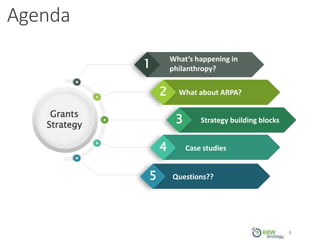
Agenda
1
4
2
3
What’s happening in
philanthropy?
Resources and Takeaways
What about ARPA?
Case studies
Strategy building blocks
Grants
Strategy
5 Questions??
3
Part I: What’s
happening in
philanthropy?
4
Nonprofit
Pivots
5
Chat Question:
What are your
biggest funding
needs now versus
pre-COVID?
5
Nonprofit
Challenges
 Nonprofit professionals trying to
avoid burnout
 Many changes/pivots/planning
efforts to modify organization’s
priorities
 One person with multiple jobs
 Revenue shortfalls – how to make
up the funding gap(s)?
6
7
 More of a focus on
COVID-19 support and
racial equity
 Changes in scope of
type of organizations
to support
 Increased competition
for funding
Changes in the
philanthropic sector
7
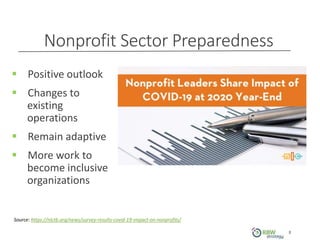
Nonprofit Sector Preparedness
8
Source: https://nlctb.org/news/survey-results-covid-19-impact-on-nonprofits/
 Positive outlook
 Changes to
existing
operations
 Remain adaptive
 More work to
become inclusive
organizations
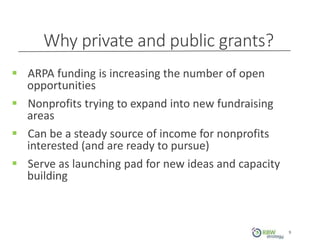
Why private and public grants?
9
 ARPA funding is increasing the number of open
opportunities
 Nonprofits trying to expand into new fundraising
areas
 Can be a steady source of income for nonprofits
interested (and are ready to pursue)
 Serve as launching pad for new ideas and capacity
building
Part II: What’s
Happening with
ARPA?
10
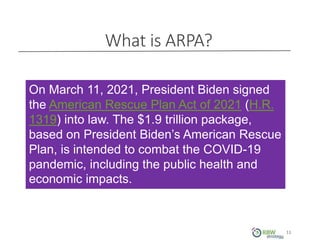
What is ARPA?
11
On March 11, 2021, President Biden signed
the American Rescue Plan Act of 2021 (H.R.
1319) into law. The $1.9 trillion package,
based on President Biden’s American Rescue
Plan, is intended to combat the COVID-19
pandemic, including the public health and
economic impacts.
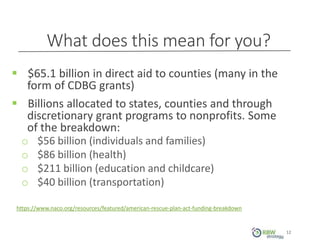
What does this mean for you?
12
 $65.1 billion in direct aid to counties (many in the
form of CDBG grants)
 Billions allocated to states, counties and through
discretionary grant programs to nonprofits. Some
of the breakdown:
o $56 billion (individuals and families)
o $86 billion (health)
o $211 billion (education and childcare)
o $40 billion (transportation)
https://www.naco.org/resources/featured/american-rescue-plan-act-funding-breakdown
How should you prepare?
13
 Make sure you are registered with SAM.gov,
Grants.gov
 Check Grants.gov on a regular basis, as well as
agency websites
 Update your key attachments – resumes, bios, job
descriptions, budget info, concept info
 Connect with potential collaborative partners
Part III: Grants
Planning Building
Blocks
14
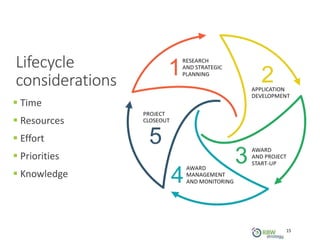
Lifecycle
considerations
 Time
 Resources
 Effort
 Priorities
 Knowledge
15
15
Step 1: Needs Assessment
16
 Conduct needs
assessment of
organization
(internal) and
target population
(external)
 How are you
gathering this info?
 How is this shared
with the right
team?
16
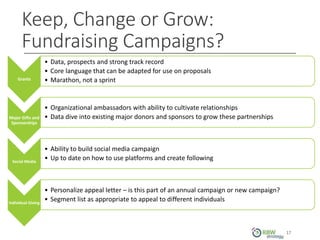
Keep, Change or Grow:
Fundraising Campaigns?
17
Grants
• Data, prospects and strong track record
• Core language that can be adapted for use on proposals
• Marathon, not a sprint
Major Gifts and
Sponsorships
• Organizational ambassadors with ability to cultivate relationships
• Data dive into existing major donors and sponsors to grow these partnerships
Social Media
• Ability to build social media campaign
• Up to date on how to use platforms and create following
Individual Giving
• Personalize appeal letter – is this part of an annual campaign or new campaign?
• Segment list as appropriate to appeal to different individuals
17
Keep, Change, or
Grow?
If there are major organizational or
programmatic changes, how are you
thinking about next steps?
 Resource capacity
 Personnel
 Funding tied to programming
 Are pivots required or part of
revised vision/focus?
18
Step 2: Planning Tools
19
 Map out greatest
priorities
 Changes to existing
plan?
 Align priorities
with organization
and client needs
 Think about a logic
model
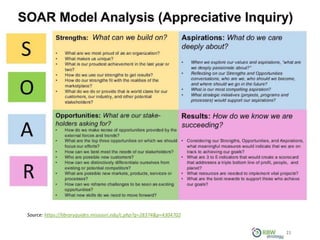
 SOAR
19
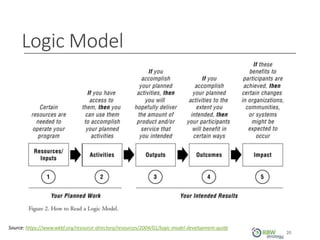
Logic Model
20
20
Source: https://www.wkkf.org/resource-directory/resources/2004/01/logic-model-development-guide
21
21
Source: https://libraryguides.missouri.edu/c.php?g=28374&p=4304702
22
Chat Question:
If you were to
do a SOAR
analysis for your
organization,
what would be
your greatest
strengths?
22
Establish
criteria to
determine
high priority
prospects
23
Step 3: Prospect research
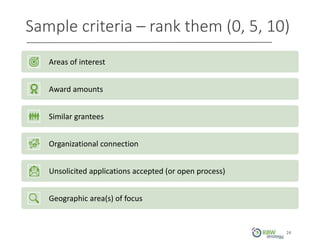
Sample criteria – rank them (0, 5, 10)
Areas of interest
Award amounts
Similar grantees
Organizational connection
Unsolicited applications accepted (or open process)
Geographic area(s) of focus
24
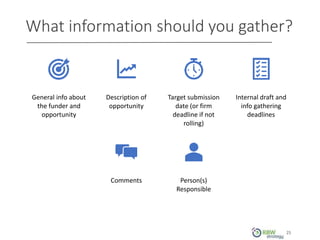
What information should you gather?
General info about
the funder and
opportunity
Description of
opportunity
Target submission
date (or firm
deadline if not
rolling)
Internal draft and
info gathering
deadlines
Comments Person(s)
Responsible
25
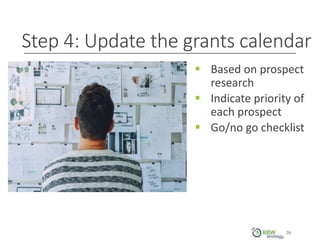
Step 4: Update the grants calendar
26
 Based on prospect
research
 Indicate priority of
each prospect
 Go/no go checklist
26
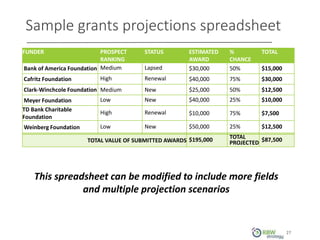
Sample grants projections spreadsheet
27
FUNDER PROSPECT
RANKING
STATUS ESTIMATED
AWARD
%
CHANCE
TOTAL
Bank of America Foundation Medium Lapsed $30,000 50% $15,000
Cafritz Foundation High Renewal $40,000 75% $30,000
Clark-Winchcole Foundation Medium New $25,000 50% $12,500
Meyer Foundation Low New $40,000 25% $10,000
TD Bank Charitable
Foundation
High Renewal $10,000 75% $7,500
Weinberg Foundation Low New $50,000 25% $12,500
TOTAL VALUE OF SUBMITTED AWARDS $195,000 TOTAL
PROJECTED $87,500
This spreadsheet can be modified to include more fields
and multiple projection scenarios
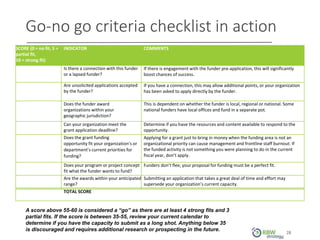
Go-no go criteria checklist in action
28
SCORE (0 = no fit, 5 =
partial fit,
10 = strong fit)
INDICATOR COMMENTS
Is there a connection with this funder
or a lapsed funder?
If there is engagement with the funder pre-application, this will significantly
boost chances of success.
Are unsolicited applications accepted
by the funder?
If you have a connection, this may allow additional points, or your organization
has been asked to apply directly by the funder.
Does the funder award
organizations within your
geographic jurisdiction?
This is dependent on whether the funder is local, regional or national. Some
national funders have local offices and fund in a separate pot.
Can your organization meet the
grant application deadline?
Determine if you have the resources and content available to respond to the
opportunity.
Does the grant funding
opportunity fit your organization’s or
department’s current priorities for
funding?
Applying for a grant just to bring in money when the funding area is not an
organizational priority can cause management and frontline staff burnout. If
the funded activity is not something you were planning to do in the current
fiscal year, don’t apply.
Does your program or project concept
fit what the funder wants to fund?
Funders don’t flex; your proposal for funding must be a perfect fit.
Are the awards within your anticipated
range?
Submitting an application that takes a great deal of time and effort may
supersede your organization’s current capacity.
TOTAL SCORE
A score above 55-60 is considered a “go” as there are at least 4 strong fits and 3
partial fits. If the score is between 35-55, review your current calendar to
determine if you have the capacity to submit as a long shot. Anything below 35
is discouraged and requires additional research or prospecting in the future.
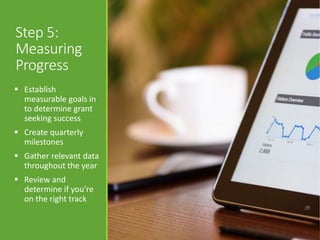
Step 5:
Measuring
Progress
 Establish
measurable goals in
to determine grant
seeking success
 Create quarterly
milestones
 Gather relevant data
throughout the year
 Review and
determine if you’re
on the right track
Part IV: Case
Studies
30
Organization 1: Basic Needs Support
31
Local organization enhanced its scope
to address the growing needs of the
people they serve. Taking advantage of
contract and larger opportunities given
the increased demand for services.
Organization 2: Leveraging Funds
32
Client received a million-dollar gift from
MacKenzie Scott. They can now focus
on the innovative ideas as they can
maintain operations. Taking advantage
of opportunity to build a stronger grants
pipeline.
Organization 3: New to grants
33
Large membership organization wants
to branch out into grants. Focus on the
strategy and concept before grant
submissions.
Strategy Considerations
34
 Be proactive in your prospect research and
planning
 Be ready for new ARPA opportunities
 Your grants calendar is your guide
 Change your grant targets accordingly
 Identify and connect with your key stakeholders
 Use a consistent system to track and measure
progress
34
Questions?
35
COVID-19
Funding
and
Educational
Resources
36
Candid: https://candid.org/explore-
issues/coronavirus/funds
Chronicle of Philanthropy:
https://www.philanthropy.com/article/Responding-
to-the-Coronavirus/248231
Council on Foundations:
https://www.cof.org/news/call-action-
philanthropys-commitment-during-covid-19
Foundant Technologies:
https://resources.foundant.com/covid-19-response
The Nonprofit Times:
https://www.thenonprofittimes.com/
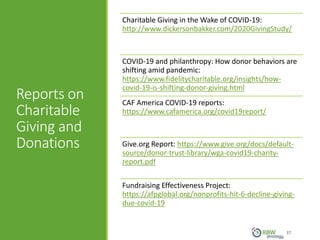
Reports on
Charitable
Giving and
Donations
37
Charitable Giving in the Wake of COVID-19:
http://www.dickersonbakker.com/2020GivingStudy/
COVID-19 and philanthropy: How donor behaviors are
shifting amid pandemic:
https://www.fidelitycharitable.org/insights/how-
covid-19-is-shifting-donor-giving.html
CAF America COVID-19 reports:
https://www.cafamerica.org/covid19report/
Give.org Report: https://www.give.org/docs/default-
source/donor-trust-library/wga-covid19-charity-
report.pdf
Fundraising Effectiveness Project:
https://afpglobal.org/nonprofits-hit-6-decline-giving-
due-covid-19
Thank you!
Contact RBW Strategy if you need consulting and/or general coaching support
to maintain and build your organization’s charitable investments through
fundraising and project management.
38
RACHEL WERNER
Ph: (301) 325-8552
Email: rachel@rbwstrategy.com
LinkedIn: www.linkedin.com/in/rabwerner
Twitter: @rbwstrategy
Website: www.rbwstrategy.com
38
39
The content of this presentation is
proprietary and RBW Strategy retains
ownership of the contents herein. It is not
intended to be distributed to any third
party without the written consent of RBW
Strategy.

Building a Better Grants Strategy Post-COVID

  • 1.
    Building a better grantsstrategy post-COVID Presented by: Rachel Werner JULY 21, 2021 1
  • 2.
    2 Rachel Werner Rachel Werneris the Owner and CEO of RBW Strategy, LLC. She and her team provide customized grants, fundraising and project management support and solutions to clients primarily in the Greater Washington, DC and Maryland region. She has over 17 years of grants experience. She and her team members have collectively garnered over $160 million for nonprofits and have managed nearly $2 billion in grant funding. She is an active member of the Grant Professionals Association and is a Certified Grants Professional (since 2014) and a Project Management Professional (since 2010).
  • 3.
    Agenda 1 4 2 3 What’s happening in philanthropy? Resourcesand Takeaways What about ARPA? Case studies Strategy building blocks Grants Strategy 5 Questions?? 3
  • 4.
    Part I: What’s happeningin philanthropy? 4
  • 5.
    Nonprofit Pivots 5 Chat Question: What areyour biggest funding needs now versus pre-COVID? 5
  • 6.
    Nonprofit Challenges  Nonprofit professionalstrying to avoid burnout  Many changes/pivots/planning efforts to modify organization’s priorities  One person with multiple jobs  Revenue shortfalls – how to make up the funding gap(s)? 6
  • 7.
    7  More ofa focus on COVID-19 support and racial equity  Changes in scope of type of organizations to support  Increased competition for funding Changes in the philanthropic sector 7
  • 8.
    Nonprofit Sector Preparedness 8 Source:https://nlctb.org/news/survey-results-covid-19-impact-on-nonprofits/  Positive outlook  Changes to existing operations  Remain adaptive  More work to become inclusive organizations
  • 9.
    Why private andpublic grants? 9  ARPA funding is increasing the number of open opportunities  Nonprofits trying to expand into new fundraising areas  Can be a steady source of income for nonprofits interested (and are ready to pursue)  Serve as launching pad for new ideas and capacity building
  • 10.
  • 11.
    What is ARPA? 11 OnMarch 11, 2021, President Biden signed the American Rescue Plan Act of 2021 (H.R. 1319) into law. The $1.9 trillion package, based on President Biden’s American Rescue Plan, is intended to combat the COVID-19 pandemic, including the public health and economic impacts.
  • 12.
    What does thismean for you? 12  $65.1 billion in direct aid to counties (many in the form of CDBG grants)  Billions allocated to states, counties and through discretionary grant programs to nonprofits. Some of the breakdown: o $56 billion (individuals and families) o $86 billion (health) o $211 billion (education and childcare) o $40 billion (transportation) https://www.naco.org/resources/featured/american-rescue-plan-act-funding-breakdown
  • 13.
    How should youprepare? 13  Make sure you are registered with SAM.gov, Grants.gov  Check Grants.gov on a regular basis, as well as agency websites  Update your key attachments – resumes, bios, job descriptions, budget info, concept info  Connect with potential collaborative partners
  • 14.
    Part III: Grants PlanningBuilding Blocks 14
  • 15.
    Lifecycle considerations  Time  Resources Effort  Priorities  Knowledge 15 15
  • 16.
    Step 1: NeedsAssessment 16  Conduct needs assessment of organization (internal) and target population (external)  How are you gathering this info?  How is this shared with the right team? 16
  • 17.
    Keep, Change orGrow: Fundraising Campaigns? 17 Grants • Data, prospects and strong track record • Core language that can be adapted for use on proposals • Marathon, not a sprint Major Gifts and Sponsorships • Organizational ambassadors with ability to cultivate relationships • Data dive into existing major donors and sponsors to grow these partnerships Social Media • Ability to build social media campaign • Up to date on how to use platforms and create following Individual Giving • Personalize appeal letter – is this part of an annual campaign or new campaign? • Segment list as appropriate to appeal to different individuals 17
  • 18.
    Keep, Change, or Grow? Ifthere are major organizational or programmatic changes, how are you thinking about next steps?  Resource capacity  Personnel  Funding tied to programming  Are pivots required or part of revised vision/focus? 18
  • 19.
    Step 2: PlanningTools 19  Map out greatest priorities  Changes to existing plan?  Align priorities with organization and client needs  Think about a logic model  SOAR 19
  • 20.
  • 21.
  • 22.
    22 Chat Question: If youwere to do a SOAR analysis for your organization, what would be your greatest strengths? 22
  • 23.
  • 24.
    Sample criteria –rank them (0, 5, 10) Areas of interest Award amounts Similar grantees Organizational connection Unsolicited applications accepted (or open process) Geographic area(s) of focus 24
  • 25.
    What information shouldyou gather? General info about the funder and opportunity Description of opportunity Target submission date (or firm deadline if not rolling) Internal draft and info gathering deadlines Comments Person(s) Responsible 25
  • 26.
    Step 4: Updatethe grants calendar 26  Based on prospect research  Indicate priority of each prospect  Go/no go checklist 26
  • 27.
    Sample grants projectionsspreadsheet 27 FUNDER PROSPECT RANKING STATUS ESTIMATED AWARD % CHANCE TOTAL Bank of America Foundation Medium Lapsed $30,000 50% $15,000 Cafritz Foundation High Renewal $40,000 75% $30,000 Clark-Winchcole Foundation Medium New $25,000 50% $12,500 Meyer Foundation Low New $40,000 25% $10,000 TD Bank Charitable Foundation High Renewal $10,000 75% $7,500 Weinberg Foundation Low New $50,000 25% $12,500 TOTAL VALUE OF SUBMITTED AWARDS $195,000 TOTAL PROJECTED $87,500 This spreadsheet can be modified to include more fields and multiple projection scenarios
  • 28.
    Go-no go criteriachecklist in action 28 SCORE (0 = no fit, 5 = partial fit, 10 = strong fit) INDICATOR COMMENTS Is there a connection with this funder or a lapsed funder? If there is engagement with the funder pre-application, this will significantly boost chances of success. Are unsolicited applications accepted by the funder? If you have a connection, this may allow additional points, or your organization has been asked to apply directly by the funder. Does the funder award organizations within your geographic jurisdiction? This is dependent on whether the funder is local, regional or national. Some national funders have local offices and fund in a separate pot. Can your organization meet the grant application deadline? Determine if you have the resources and content available to respond to the opportunity. Does the grant funding opportunity fit your organization’s or department’s current priorities for funding? Applying for a grant just to bring in money when the funding area is not an organizational priority can cause management and frontline staff burnout. If the funded activity is not something you were planning to do in the current fiscal year, don’t apply. Does your program or project concept fit what the funder wants to fund? Funders don’t flex; your proposal for funding must be a perfect fit. Are the awards within your anticipated range? Submitting an application that takes a great deal of time and effort may supersede your organization’s current capacity. TOTAL SCORE A score above 55-60 is considered a “go” as there are at least 4 strong fits and 3 partial fits. If the score is between 35-55, review your current calendar to determine if you have the capacity to submit as a long shot. Anything below 35 is discouraged and requires additional research or prospecting in the future.
  • 29.
    Step 5: Measuring Progress  Establish measurablegoals in to determine grant seeking success  Create quarterly milestones  Gather relevant data throughout the year  Review and determine if you’re on the right track
  • 30.
  • 31.
    Organization 1: BasicNeeds Support 31 Local organization enhanced its scope to address the growing needs of the people they serve. Taking advantage of contract and larger opportunities given the increased demand for services.
  • 32.
    Organization 2: LeveragingFunds 32 Client received a million-dollar gift from MacKenzie Scott. They can now focus on the innovative ideas as they can maintain operations. Taking advantage of opportunity to build a stronger grants pipeline.
  • 33.
    Organization 3: Newto grants 33 Large membership organization wants to branch out into grants. Focus on the strategy and concept before grant submissions.
  • 34.
    Strategy Considerations 34  Beproactive in your prospect research and planning  Be ready for new ARPA opportunities  Your grants calendar is your guide  Change your grant targets accordingly  Identify and connect with your key stakeholders  Use a consistent system to track and measure progress 34
  • 35.
  • 36.
    COVID-19 Funding and Educational Resources 36 Candid: https://candid.org/explore- issues/coronavirus/funds Chronicle ofPhilanthropy: https://www.philanthropy.com/article/Responding- to-the-Coronavirus/248231 Council on Foundations: https://www.cof.org/news/call-action- philanthropys-commitment-during-covid-19 Foundant Technologies: https://resources.foundant.com/covid-19-response The Nonprofit Times: https://www.thenonprofittimes.com/
  • 37.
    Reports on Charitable Giving and Donations 37 CharitableGiving in the Wake of COVID-19: http://www.dickersonbakker.com/2020GivingStudy/ COVID-19 and philanthropy: How donor behaviors are shifting amid pandemic: https://www.fidelitycharitable.org/insights/how- covid-19-is-shifting-donor-giving.html CAF America COVID-19 reports: https://www.cafamerica.org/covid19report/ Give.org Report: https://www.give.org/docs/default- source/donor-trust-library/wga-covid19-charity- report.pdf Fundraising Effectiveness Project: https://afpglobal.org/nonprofits-hit-6-decline-giving- due-covid-19
  • 38.
    Thank you! Contact RBWStrategy if you need consulting and/or general coaching support to maintain and build your organization’s charitable investments through fundraising and project management. 38 RACHEL WERNER Ph: (301) 325-8552 Email: rachel@rbwstrategy.com LinkedIn: www.linkedin.com/in/rabwerner Twitter: @rbwstrategy Website: www.rbwstrategy.com 38
  • 39.
    39 The content ofthis presentation is proprietary and RBW Strategy retains ownership of the contents herein. It is not intended to be distributed to any third party without the written consent of RBW Strategy.