UNIVERSIDAD TECNOLÓGICA DE PEREIRA
                             LICENCIATURA EN LENGUA INGLESA
                                  PRONUNCIATION COURSE I
                               Claudia Andrea Cárdenas Jiménez

Student’s Full Name: ___________________________________________ Date: ______________


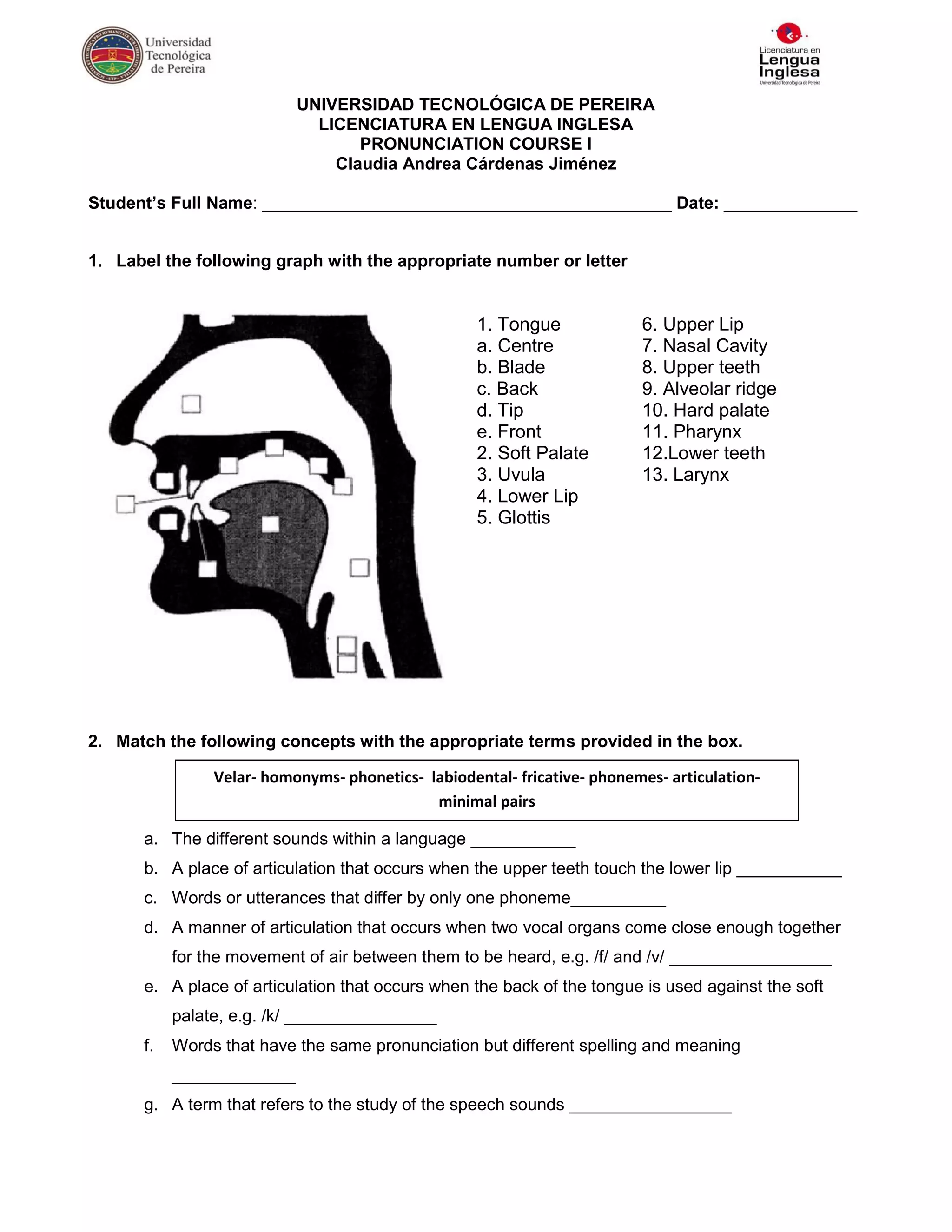
1. Label the following graph with the appropriate number or letter


                                                    1. Tongue             6. Upper Lip
                                                    a. Centre             7. Nasal Cavity
                                                    b. Blade              8. Upper teeth
                                                    c. Back               9. Alveolar ridge
                                                    d. Tip                10. Hard palate
                                                    e. Front              11. Pharynx
                                                    2. Soft Palate        12.Lower teeth
                                                    3. Uvula              13. Larynx
                                                    4. Lower Lip
                                                    5. Glottis


2. Match the following concepts with the appropriate terms provided in the box.

                Velar- homonyms- phonetics- labiodental- fricative- phonemes- articulation-
                                             minimal pairs

      a. The different sounds within a language ___________
      b. A place of articulation that occurs when the upper teeth touch the lower lip ___________
      c. Words or utterances that differ by only one phoneme__________
      d. A manner of articulation that occurs when two vocal organs come close enough together
           for the movement of air between them to be heard, e.g. /f/ and /v/ _________________
      e. A place of articulation that occurs when the back of the tongue is used against the soft
           palate, e.g. /k/ ________________
      f.   Words that have the same pronunciation but different spelling and meaning
           _____________
      g. A term that refers to the study of the speech sounds _________________
3.      Write the phonemic symbols for the underlined parts of the words.

                        Vowels                                          Consonants
seat                          Cake                    treasure                  schedule
call                          Toy                     yacht                     usually
want                          High                    hero                      diphthong
food                          Beer                    machine                   award
step                          Sure                    thigh                     answered
about                         where                   enough                    Sing
shirt                         Go                      education                 Anger
hit                           house                   charity                   coherence
took                                                  option                    Critical
hat                                                   music                     Giant
run                                                   clothes                   clocks
far                                                   arrives                   ridge


4. Read the description of the sounds and choose the one that matches the description.

a. Alveolar, nasal and voiced sound. The tongue blade closes against the alveolar ridge and the rims
       of the tongue against the side teeth.
                                                                                  /ñ/      /ŋ/    /n/

b. This is a close vowel; the back of the tongue is raised to just below the close position. Lips are
       rounded, but loosely so, the tongue is tense

                                                                                  /ɔ:/     /u:/   /ʊ/

c. Alveolar, voiceless and fricative sound. The tongue blade makes light contact with the alveolar
       ridge
                                                                                  /s/      /ʃ/    /z/

d. This is an open vowel; the front of the tongue is raised to just below the half-open position. Lips
       are neutrally open

                                                                                  /ə/      /æ/    /ʌ/

e. Velar, plosive and voiceless sound; closure is made by the back of the tongue against the soft
       palate.
                                                                                  /ŋ/      /k/    /g/

f. This is a close vowel; the part of the tongue slightly nearer the center is raised to just above the
       half close position. The lips are spread loosely and the tongue is more relaxed. The sides of the
       tongue may just touch the upper molars.
                                                                                   /ʊ/   /i:/   /ɪ/

g. Fricative, dental, voiced sound; the tongue tip makes light contact the upper and lower teeth.
/t/     /θ/    /ð/

h. A diphthong that moves from a close spread relaxed vowel towards the schwa.

                                                                                       /əʊ/    /ɪə/   /eə/

i. A palate- alveolar, approximant and voiced sound; the tongue tip is held just behind the alveolar
       ridge. The soft palate is raised.
                                                                                       /r/     /w/    /h/

j. This is a long mid vowel; the center of the tongue is between the half-close and half-open position.
       Lips are relaxed and neutrally spread.

                                                                                       /ə/     /ʌ/    /ɜ:/


5. Say if the next statements are true (t) or false (f)

       a.   Vowels can be produced alone and may be short or long.                            ( )
       b.   In English there are two affricates.                                              ( )
       c.   /j/ and /w/ are semivowels.                                                       ( )
       d.   Vowels are classified into close and open vowels.                                 ( )
       e.   There are three nasal alveolar consonants in English.                             ( )
       f.   Vowels are differentiated from the consonants by their position of the tongue and the lips. (    )
       g.   The IPA has 24 consonant sounds and 20 vowel sounds.                              ( )
       h.   Fricative sounds result from the combination of a plosive and an affricate sound. ( )
       i.   The IPA has eighteen diphthongs.                                                  ( )


6. Write a word for each sound.

/i:/                                       /ə/                           /ɑ:/
/ŋ/                                        /ʒ/                           /h/
/ɜ:/                                       /ʊ/                           /j/
/dʒ/                                       /tʃ/                          /ð/
/u:/                                       /ɔ:/                          /ʌ/
/ʃ/                                        /θ/                           /æ/


7. Correct the following phonetic transcriptions

1.     charm               /kɑ:rm/                           6. Boxing              /ˈbɑːxɪŋ/
2.     Riding              /ˈrɪdɪŋ/                          7. Manage               /'mænɪʃ/
3.     Mechanism           /ˈmetʃənɪzəm/                     8. Edge                /edtʃ/
4.     Church              / tʃʌrtʃ /                        9. Special             /ˈspeʒəl/
5.     Machine             /məˈtʃiːn/ /                      10. Conclusion         / kənˈkluːʃən /
8. Underline the word that has a different pronunciation pattern.

        1. a. Coat                b. Mope                    c. Hop                d. Stole
        2. a. Cleared             b. heard                   c. beard              d. feared
        3. a. Loose               b. Goose                   c. Choose             d. Cook
        4. a. Great               b. seat                    c. reach              d. Peach
        5. a. Among               b. wrong                   c. sung               d. begun
        6. a. Hope                b. Note                    c. Done               d. Tone
        7. a. Confusion           b. Division                c. Occasion           e. Admission
        8. a. first               b. bird                    c. girl               d. dear
        9. a. Thousand            b. think                   c. bother             d. both
        10. a. chaos              b. charity                 c. mechanic           d. character


9. Put these words into the columns below.

           Answered- Walked- Planned- Wasted- Laughed- Mended- Watched- Showed- Tried-
            Washed- Believed- Started- Carried- Invited- Called- Stopped- Decided- Ordered

                 /t/                                       / ɪd/                              /d/


10. Rewrite the next paragraph into English alphabet.


               Phonetic Alphabet                                               English Alphabet
| ðə ˈhjuːmən ˈbɑːdi ɪz ˈmeɪd ˈəp əv ə ˈhed | ˈnek
| ˈtɔːrˌsoʊ | ˈtuː ˈɑːrmz ənd ˈtuː ˈleɡz | ði ˈævərɪdʒ
ˈhaɪt əv ən əˈdəlt ˈhjuːmən ɪz əˈbaʊt ˈfaɪv tə ˈsɪks
ˈfiːt ˈtɔːl | ðə ˈhjuːmən ˈbɑːdi ɪz ˈmeɪd tə ˈstænd
ɪˈrekt | ˈwɑːk ɑːn ˈtuː ˈfiːt | ˈjuːs ði ˈɑːrmz tə ˈkæri
ənd ˈlɪft | ənd həz əˈpəʊzəbl ˈθəmz ˈeɪbl tə
ˈɡræsp |


                                                                   /ɡʊd lʌk/

Final test

  • 1.
    UNIVERSIDAD TECNOLÓGICA DEPEREIRA LICENCIATURA EN LENGUA INGLESA PRONUNCIATION COURSE I Claudia Andrea Cárdenas Jiménez Student’s Full Name: ___________________________________________ Date: ______________ 1. Label the following graph with the appropriate number or letter 1. Tongue 6. Upper Lip a. Centre 7. Nasal Cavity b. Blade 8. Upper teeth c. Back 9. Alveolar ridge d. Tip 10. Hard palate e. Front 11. Pharynx 2. Soft Palate 12.Lower teeth 3. Uvula 13. Larynx 4. Lower Lip 5. Glottis 2. Match the following concepts with the appropriate terms provided in the box. Velar- homonyms- phonetics- labiodental- fricative- phonemes- articulation- minimal pairs a. The different sounds within a language ___________ b. A place of articulation that occurs when the upper teeth touch the lower lip ___________ c. Words or utterances that differ by only one phoneme__________ d. A manner of articulation that occurs when two vocal organs come close enough together for the movement of air between them to be heard, e.g. /f/ and /v/ _________________ e. A place of articulation that occurs when the back of the tongue is used against the soft palate, e.g. /k/ ________________ f. Words that have the same pronunciation but different spelling and meaning _____________ g. A term that refers to the study of the speech sounds _________________
  • 2.
    3. Write the phonemic symbols for the underlined parts of the words. Vowels Consonants seat Cake treasure schedule call Toy yacht usually want High hero diphthong food Beer machine award step Sure thigh answered about where enough Sing shirt Go education Anger hit house charity coherence took option Critical hat music Giant run clothes clocks far arrives ridge 4. Read the description of the sounds and choose the one that matches the description. a. Alveolar, nasal and voiced sound. The tongue blade closes against the alveolar ridge and the rims of the tongue against the side teeth. /ñ/ /ŋ/ /n/ b. This is a close vowel; the back of the tongue is raised to just below the close position. Lips are rounded, but loosely so, the tongue is tense /ɔ:/ /u:/ /ʊ/ c. Alveolar, voiceless and fricative sound. The tongue blade makes light contact with the alveolar ridge /s/ /ʃ/ /z/ d. This is an open vowel; the front of the tongue is raised to just below the half-open position. Lips are neutrally open /ə/ /æ/ /ʌ/ e. Velar, plosive and voiceless sound; closure is made by the back of the tongue against the soft palate. /ŋ/ /k/ /g/ f. This is a close vowel; the part of the tongue slightly nearer the center is raised to just above the half close position. The lips are spread loosely and the tongue is more relaxed. The sides of the tongue may just touch the upper molars. /ʊ/ /i:/ /ɪ/ g. Fricative, dental, voiced sound; the tongue tip makes light contact the upper and lower teeth.
  • 3.
    /t/ /θ/ /ð/ h. A diphthong that moves from a close spread relaxed vowel towards the schwa. /əʊ/ /ɪə/ /eə/ i. A palate- alveolar, approximant and voiced sound; the tongue tip is held just behind the alveolar ridge. The soft palate is raised. /r/ /w/ /h/ j. This is a long mid vowel; the center of the tongue is between the half-close and half-open position. Lips are relaxed and neutrally spread. /ə/ /ʌ/ /ɜ:/ 5. Say if the next statements are true (t) or false (f) a. Vowels can be produced alone and may be short or long. ( ) b. In English there are two affricates. ( ) c. /j/ and /w/ are semivowels. ( ) d. Vowels are classified into close and open vowels. ( ) e. There are three nasal alveolar consonants in English. ( ) f. Vowels are differentiated from the consonants by their position of the tongue and the lips. ( ) g. The IPA has 24 consonant sounds and 20 vowel sounds. ( ) h. Fricative sounds result from the combination of a plosive and an affricate sound. ( ) i. The IPA has eighteen diphthongs. ( ) 6. Write a word for each sound. /i:/ /ə/ /ɑ:/ /ŋ/ /ʒ/ /h/ /ɜ:/ /ʊ/ /j/ /dʒ/ /tʃ/ /ð/ /u:/ /ɔ:/ /ʌ/ /ʃ/ /θ/ /æ/ 7. Correct the following phonetic transcriptions 1. charm /kɑ:rm/ 6. Boxing /ˈbɑːxɪŋ/ 2. Riding /ˈrɪdɪŋ/ 7. Manage /'mænɪʃ/ 3. Mechanism /ˈmetʃənɪzəm/ 8. Edge /edtʃ/ 4. Church / tʃʌrtʃ / 9. Special /ˈspeʒəl/ 5. Machine /məˈtʃiːn/ / 10. Conclusion / kənˈkluːʃən /
  • 4.
    8. Underline theword that has a different pronunciation pattern. 1. a. Coat b. Mope c. Hop d. Stole 2. a. Cleared b. heard c. beard d. feared 3. a. Loose b. Goose c. Choose d. Cook 4. a. Great b. seat c. reach d. Peach 5. a. Among b. wrong c. sung d. begun 6. a. Hope b. Note c. Done d. Tone 7. a. Confusion b. Division c. Occasion e. Admission 8. a. first b. bird c. girl d. dear 9. a. Thousand b. think c. bother d. both 10. a. chaos b. charity c. mechanic d. character 9. Put these words into the columns below. Answered- Walked- Planned- Wasted- Laughed- Mended- Watched- Showed- Tried- Washed- Believed- Started- Carried- Invited- Called- Stopped- Decided- Ordered /t/ / ɪd/ /d/ 10. Rewrite the next paragraph into English alphabet. Phonetic Alphabet English Alphabet | ðə ˈhjuːmən ˈbɑːdi ɪz ˈmeɪd ˈəp əv ə ˈhed | ˈnek | ˈtɔːrˌsoʊ | ˈtuː ˈɑːrmz ənd ˈtuː ˈleɡz | ði ˈævərɪdʒ ˈhaɪt əv ən əˈdəlt ˈhjuːmən ɪz əˈbaʊt ˈfaɪv tə ˈsɪks ˈfiːt ˈtɔːl | ðə ˈhjuːmən ˈbɑːdi ɪz ˈmeɪd tə ˈstænd ɪˈrekt | ˈwɑːk ɑːn ˈtuː ˈfiːt | ˈjuːs ði ˈɑːrmz tə ˈkæri ənd ˈlɪft | ənd həz əˈpəʊzəbl ˈθəmz ˈeɪbl tə ˈɡræsp | /ɡʊd lʌk/