Solid-State Synthesis of Mixed-
Metal OxidesPaola G. Caballero León
Anthony Hernández Rivera
Dr. Lukasz Koscielski
RISE Program
University of Puerto Rico at Cayey
Introduction
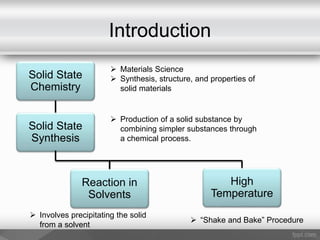
Solid State
Chemistry
 Materials Science
 Synthesis, structure, and properties of
solid materials
Solid State
Synthesis
 Production of a solid substance by
combining simpler substances through
a chemical process.
High
Temperature
Reaction in
Solvents
 “Shake and Bake” Procedure
 Involves precipitating the solid
from a solvent
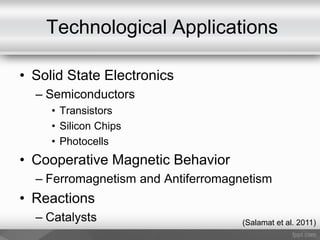
Technological Applications
• Solid State Electronics
– Semiconductors
• Transistors
• Silicon Chips
• Photocells
• Cooperative Magnetic Behavior
– Ferromagnetism and Antiferromagnetism
• Reactions
– Catalysts (Salamat et al. 2011)
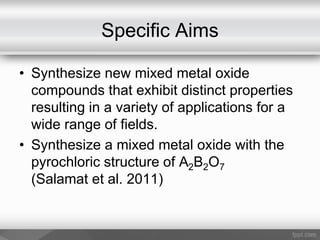
Specific Aims
• Synthesize new mixed metal oxide
compounds that exhibit distinct properties
resulting in a variety of applications for a
wide range of fields.
• Synthesize a mixed metal oxide with the
pyrochloric structure of A2B2O7
(Salamat et al. 2011)
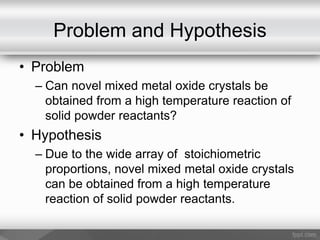
Problem and Hypothesis
• Problem
– Can novel mixed metal oxide crystals be
obtained from a high temperature reaction of
solid powder reactants?
• Hypothesis
– Due to the wide array of stoichiometric
proportions, novel mixed metal oxide crystals
can be obtained from a high temperature
reaction of solid powder reactants.
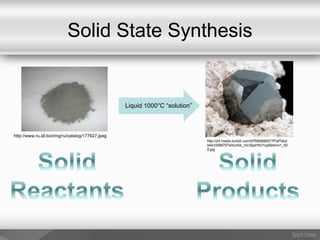
Solid State Synthesis
http://www.ru.all.biz/img/ru/catalog/177627.jpeg
http://24.media.tumblr.com/97f580680077f7af7abd
b4a10066707a/tumblr_mir3lqoHhO1qa5bbmo1_50
0.jpg
Liquid 1000°C “solution”
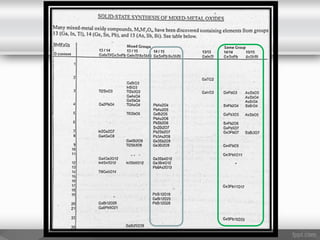
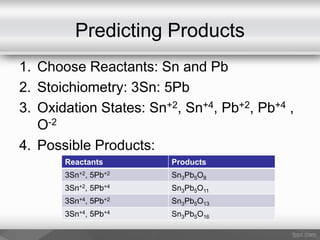
Predicting Products
1. Choose Reactants: Sn and Pb
2. Stoichiometry: 3Sn: 5Pb
3. Oxidation States: Sn+2, Sn+4, Pb+2, Pb+4 ,
O-2
4. Possible Products:
Reactants Products
3Sn+2, 5Pb+2 Sn3Pb5O8
3Sn+2, 5Pb+4 Sn3Pb5O11
3Sn+4, 5Pb+2 Sn3Pb5O13
3Sn+4, 5Pb+4 Sn3Pb5O16
MIXED METAL OXIDE
REACTIONS
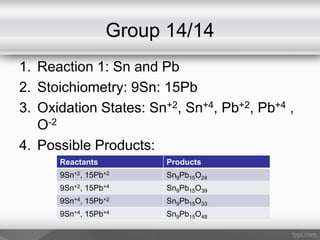
Group 14/14
1. Reaction 1: Sn and Pb
2. Stoichiometry: 9Sn: 15Pb
3. Oxidation States: Sn+2, Sn+4, Pb+2, Pb+4 ,
O-2
4. Possible Products:
Reactants Products
9Sn+2, 15Pb+2 Sn9Pb15O24
9Sn+2, 15Pb+4 Sn9Pb15O39
9Sn+4, 15Pb+2 Sn9Pb15O33
9Sn+4, 15Pb+4 Sn9Pb15O48
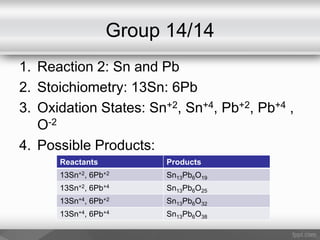
Group 14/14
1. Reaction 2: Sn and Pb
2. Stoichiometry: 13Sn: 6Pb
3. Oxidation States: Sn+2, Sn+4, Pb+2, Pb+4 ,
O-2
4. Possible Products:
Reactants Products
13Sn+2, 6Pb+2 Sn13Pb6O19
13Sn+2, 6Pb+4 Sn13Pb6O25
13Sn+4, 6Pb+2 Sn13Pb6O32
13Sn+4, 6Pb+4 Sn13Pb6O38
Group 15/15
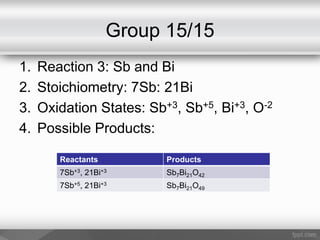
1. Reaction 3: Sb and Bi
2. Stoichiometry: 7Sb: 21Bi
3. Oxidation States: Sb+3, Sb+5, Bi+3, O-2
4. Possible Products:
Reactants Products
7Sb+3, 21Bi+3 Sb7Bi21O42
7Sb+5, 21Bi+3 Sb7Bi21O49
Group 15/15
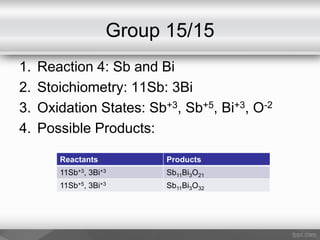
1. Reaction 4: Sb and Bi
2. Stoichiometry: 11Sb: 3Bi
3. Oxidation States: Sb+3, Sb+5, Bi+3, O-2
4. Possible Products:
Reactants Products
11Sb+3, 3Bi+3 Sb11Bi3O21
11Sb+5, 3Bi+3 Sb11Bi3O32
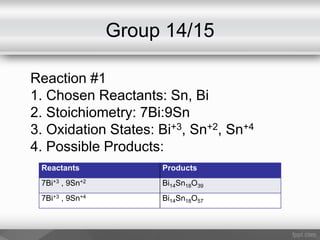
Group 14/15
Reactants Products
7Bi+3 , 9Sn+2 Bi14Sn18O39
7Bi+3 , 9Sn+4 Bi14Sn18O57
Reaction #1
1. Chosen Reactants: Sn, Bi
2. Stoichiometry: 7Bi:9Sn
3. Oxidation States: Bi+3, Sn+2, Sn+4
4. Possible Products:
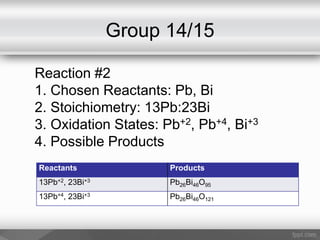
Group 14/15
Reactants Products
13Pb+2, 23Bi+3 Pb26Bi46O95
13Pb+4, 23Bi+3 Pb26Bi46O121
Reaction #2
1. Chosen Reactants: Pb, Bi
2. Stoichiometry: 13Pb:23Bi
3. Oxidation States: Pb+2, Pb+4, Bi+3
4. Possible Products
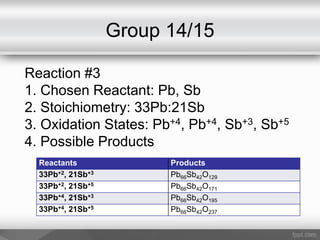
Group 14/15
Reactants Products
33Pb+2, 21Sb+3 Pb66Sb42O129
33Pb+2, 21Sb+5 Pb66Sb42O171
33Pb+4, 21Sb+3 Pb66Sb42O195
33Pb+4, 21Sb+5 Pb66Sb42O237
Reaction #3
1. Chosen Reactant: Pb, Sb
2. Stoichiometry: 33Pb:21Sb
3. Oxidation States: Pb+4, Pb+4, Sb+3, Sb+5
4. Possible Products
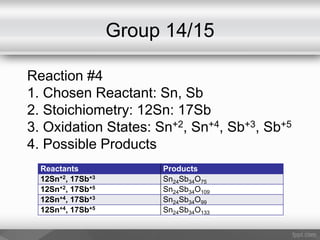
Group 14/15
Reactants Products
12Sn+2, 17Sb+3 Sn24Sb34O75
12Sn+2, 17Sb+5 Sn24Sb34O109
12Sn+4, 17Sb+3 Sn24Sb34O99
12Sn+4, 17Sb+5 Sn24Sb34O133
Reaction #4
1. Chosen Reactant: Sn, Sb
2. Stoichiometry: 12Sn: 17Sb
3. Oxidation States: Sn+2, Sn+4, Sb+3, Sb+5
4. Possible Products
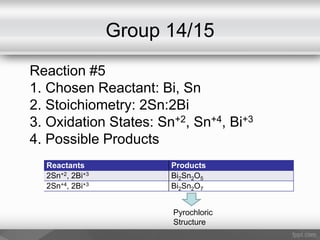
Group 14/15
Reactants Products
2Sn+2, 2Bi+3 Bi2Sn2O5
2Sn+4, 2Bi+3 Bi2Sn2O7
Reaction #5
1. Chosen Reactant: Bi, Sn
2. Stoichiometry: 2Sn:2Bi
3. Oxidation States: Sn+2, Sn+4, Bi+3
4. Possible Products
Pyrochloric
Structure
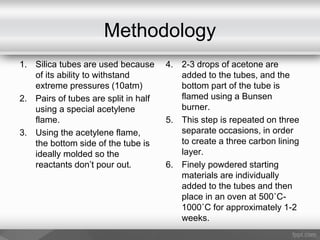
Methodology
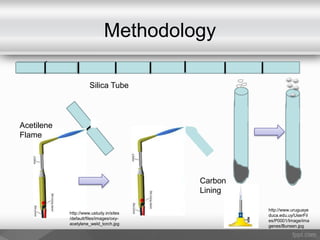
1. Silica tubes are used because
of its ability to withstand
extreme pressures (10atm)
2. Pairs of tubes are split in half
using a special acetylene
flame.
3. Using the acetylene flame,
the bottom side of the tube is
ideally molded so the
reactants don’t pour out.
4. 2-3 drops of acetone are
added to the tubes, and the
bottom part of the tube is
flamed using a Bunsen
burner.
5. This step is repeated on three
separate occasions, in order
to create a three carbon lining
layer.
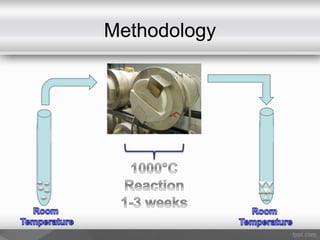
6. Finely powdered starting
materials are individually
added to the tubes and then
place in an oven at 500˚C-
1000˚C for approximately 1-2
weeks.
Methodology
Silica Tube
Acetilene
Flame
Carbon
Lining
http://www.uruguaye
duca.edu.uy/UserFil
es/P0001/Image/ima
genes/Bunsen.jpg
http://www.ustudy.in/sites
/default/files/images/oxy-
acetylene_weld_torch.jpg
Methodology
Limitations
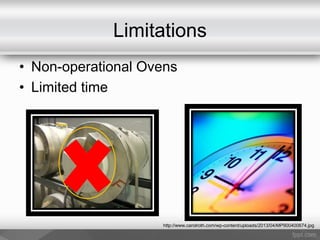
• Non-operational Ovens
• Limited time
http://www.carolroth.com/wp-content/uploads/2013/04/MP900400674.jpg
Future Work
• Load our respective reactions using finely
powdered starting materials available at
the laboratory, elements: Sn, Pb, Sb, and
Bi (groups 14/15, 14/14, and 15/15).
• Synthesize new mixed-metal oxide
compounds according to the established
reactions.
Acknowledgements
• Dr. Lukasz Koscielski
• Gerardo Ramos
• RISE Program
• University of Puerto Rico at Cayey
Solid-State Synthesis of Mixed-
Metal OxidesPaola G. Caballero León
Anthony Hernández Rivera
Dr. Lukasz Koscielski
RISE Program
University of Puerto Rico at Cayey

Final solid state synthesis paola and anthony

  • 1.
    Solid-State Synthesis ofMixed- Metal OxidesPaola G. Caballero León Anthony Hernández Rivera Dr. Lukasz Koscielski RISE Program University of Puerto Rico at Cayey
  • 2.
    Introduction Solid State Chemistry  MaterialsScience  Synthesis, structure, and properties of solid materials Solid State Synthesis  Production of a solid substance by combining simpler substances through a chemical process. High Temperature Reaction in Solvents  “Shake and Bake” Procedure  Involves precipitating the solid from a solvent
  • 3.
    Technological Applications • SolidState Electronics – Semiconductors • Transistors • Silicon Chips • Photocells • Cooperative Magnetic Behavior – Ferromagnetism and Antiferromagnetism • Reactions – Catalysts (Salamat et al. 2011)
  • 4.
    Specific Aims • Synthesizenew mixed metal oxide compounds that exhibit distinct properties resulting in a variety of applications for a wide range of fields. • Synthesize a mixed metal oxide with the pyrochloric structure of A2B2O7 (Salamat et al. 2011)
  • 5.
    Problem and Hypothesis •Problem – Can novel mixed metal oxide crystals be obtained from a high temperature reaction of solid powder reactants? • Hypothesis – Due to the wide array of stoichiometric proportions, novel mixed metal oxide crystals can be obtained from a high temperature reaction of solid powder reactants.
  • 6.
  • 8.
    Predicting Products 1. ChooseReactants: Sn and Pb 2. Stoichiometry: 3Sn: 5Pb 3. Oxidation States: Sn+2, Sn+4, Pb+2, Pb+4 , O-2 4. Possible Products: Reactants Products 3Sn+2, 5Pb+2 Sn3Pb5O8 3Sn+2, 5Pb+4 Sn3Pb5O11 3Sn+4, 5Pb+2 Sn3Pb5O13 3Sn+4, 5Pb+4 Sn3Pb5O16
  • 9.
  • 10.
    Group 14/14 1. Reaction1: Sn and Pb 2. Stoichiometry: 9Sn: 15Pb 3. Oxidation States: Sn+2, Sn+4, Pb+2, Pb+4 , O-2 4. Possible Products: Reactants Products 9Sn+2, 15Pb+2 Sn9Pb15O24 9Sn+2, 15Pb+4 Sn9Pb15O39 9Sn+4, 15Pb+2 Sn9Pb15O33 9Sn+4, 15Pb+4 Sn9Pb15O48
  • 11.
    Group 14/14 1. Reaction2: Sn and Pb 2. Stoichiometry: 13Sn: 6Pb 3. Oxidation States: Sn+2, Sn+4, Pb+2, Pb+4 , O-2 4. Possible Products: Reactants Products 13Sn+2, 6Pb+2 Sn13Pb6O19 13Sn+2, 6Pb+4 Sn13Pb6O25 13Sn+4, 6Pb+2 Sn13Pb6O32 13Sn+4, 6Pb+4 Sn13Pb6O38
  • 12.
    Group 15/15 1. Reaction3: Sb and Bi 2. Stoichiometry: 7Sb: 21Bi 3. Oxidation States: Sb+3, Sb+5, Bi+3, O-2 4. Possible Products: Reactants Products 7Sb+3, 21Bi+3 Sb7Bi21O42 7Sb+5, 21Bi+3 Sb7Bi21O49
  • 13.
    Group 15/15 1. Reaction4: Sb and Bi 2. Stoichiometry: 11Sb: 3Bi 3. Oxidation States: Sb+3, Sb+5, Bi+3, O-2 4. Possible Products: Reactants Products 11Sb+3, 3Bi+3 Sb11Bi3O21 11Sb+5, 3Bi+3 Sb11Bi3O32
  • 14.
    Group 14/15 Reactants Products 7Bi+3, 9Sn+2 Bi14Sn18O39 7Bi+3 , 9Sn+4 Bi14Sn18O57 Reaction #1 1. Chosen Reactants: Sn, Bi 2. Stoichiometry: 7Bi:9Sn 3. Oxidation States: Bi+3, Sn+2, Sn+4 4. Possible Products:
  • 15.
    Group 14/15 Reactants Products 13Pb+2,23Bi+3 Pb26Bi46O95 13Pb+4, 23Bi+3 Pb26Bi46O121 Reaction #2 1. Chosen Reactants: Pb, Bi 2. Stoichiometry: 13Pb:23Bi 3. Oxidation States: Pb+2, Pb+4, Bi+3 4. Possible Products
  • 16.
    Group 14/15 Reactants Products 33Pb+2,21Sb+3 Pb66Sb42O129 33Pb+2, 21Sb+5 Pb66Sb42O171 33Pb+4, 21Sb+3 Pb66Sb42O195 33Pb+4, 21Sb+5 Pb66Sb42O237 Reaction #3 1. Chosen Reactant: Pb, Sb 2. Stoichiometry: 33Pb:21Sb 3. Oxidation States: Pb+4, Pb+4, Sb+3, Sb+5 4. Possible Products
  • 17.
    Group 14/15 Reactants Products 12Sn+2,17Sb+3 Sn24Sb34O75 12Sn+2, 17Sb+5 Sn24Sb34O109 12Sn+4, 17Sb+3 Sn24Sb34O99 12Sn+4, 17Sb+5 Sn24Sb34O133 Reaction #4 1. Chosen Reactant: Sn, Sb 2. Stoichiometry: 12Sn: 17Sb 3. Oxidation States: Sn+2, Sn+4, Sb+3, Sb+5 4. Possible Products
  • 18.
    Group 14/15 Reactants Products 2Sn+2,2Bi+3 Bi2Sn2O5 2Sn+4, 2Bi+3 Bi2Sn2O7 Reaction #5 1. Chosen Reactant: Bi, Sn 2. Stoichiometry: 2Sn:2Bi 3. Oxidation States: Sn+2, Sn+4, Bi+3 4. Possible Products Pyrochloric Structure
  • 19.
    Methodology 1. Silica tubesare used because of its ability to withstand extreme pressures (10atm) 2. Pairs of tubes are split in half using a special acetylene flame. 3. Using the acetylene flame, the bottom side of the tube is ideally molded so the reactants don’t pour out. 4. 2-3 drops of acetone are added to the tubes, and the bottom part of the tube is flamed using a Bunsen burner. 5. This step is repeated on three separate occasions, in order to create a three carbon lining layer. 6. Finely powdered starting materials are individually added to the tubes and then place in an oven at 500˚C- 1000˚C for approximately 1-2 weeks.
  • 20.
  • 21.
  • 22.
    Limitations • Non-operational Ovens •Limited time http://www.carolroth.com/wp-content/uploads/2013/04/MP900400674.jpg
  • 23.
    Future Work • Loadour respective reactions using finely powdered starting materials available at the laboratory, elements: Sn, Pb, Sb, and Bi (groups 14/15, 14/14, and 15/15). • Synthesize new mixed-metal oxide compounds according to the established reactions.
  • 24.
    Acknowledgements • Dr. LukaszKoscielski • Gerardo Ramos • RISE Program • University of Puerto Rico at Cayey
  • 25.
    Solid-State Synthesis ofMixed- Metal OxidesPaola G. Caballero León Anthony Hernández Rivera Dr. Lukasz Koscielski RISE Program University of Puerto Rico at Cayey

Editor's Notes

  • #4 Cooperative Magnetic Behavior- this more complicated phenomenon occurs only in the solid state where interactions between the magnetic moments of adjacent metal ions in the infinite non-molecular structure can occur. Ferromagnetic- are not only able to develop very large magnetization in a magnetic field, but they remain permanently magnetized when removed from the field Antiferromagnetic- behave in a manner opposite
  • #6 One of the shortcomings of this procedure is that it is often difficult to predict the stoichiometry of the product. For this reason, solid state synthesis is considered an exploratory field of science.
  • #22 A large number of the most interesting inorganic compounds in the solid state , and especially in crystalline form, are prepared at high temperatures (>500C) One of the most widely used procedures (“shake and bake”) involves mixing two or more finely powdered starting materials, placing the mixture in a sealed inert container, and heating the entire container in an oven.