Chemistry
Session Objectives
1. Chemical properties of group 14 elements
2. Extraction and properties of silicon
3. Extraction of tin
4. Extraction of lead
5. Silicates and silicones
6. Glass
7. General properties of group 14 elements
8. Oxoacids of phosphorous
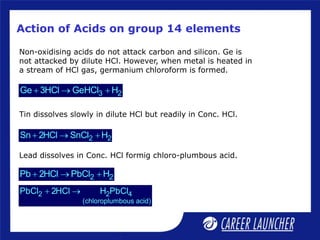
Action of Acids on group 14 elements
Non-oxidising acids do not attack carbon and silicon. Ge is
not attacked by dilute HCl. However, when metal is heated in
a stream of HCl gas, germanium chloroform is formed.
3 2
Ge 3HCl GeHCl H
  
2 2
Sn 2HCl SnCl H
  
2 2
Pb 2HCl PbCl H
  
2 2 4
(chloroplumbous acid)
PbCl 2HCl H PbCl
 
Lead dissolves in Conc. HCl formig chloro-plumbous acid.
Tin dissolves slowly in dilute HCl but readily in Conc. HCl.
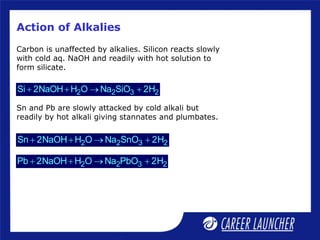
Action of Alkalies
Carbon is unaffected by alkalies. Silicon reacts slowly
with cold aq. NaOH and readily with hot solution to
form silicate.
2 2 3 2
Si 2NaOH H O Na SiO 2H
   
Sn and Pb are slowly attacked by cold alkali but
readily by hot alkali giving stannates and plumbates.
2 2 3 2
Sn 2NaOH H O Na SnO 2H
   
2 2 3 2
Pb 2NaOH H O Na PbO 2H
   
Oxides of group 14 elements
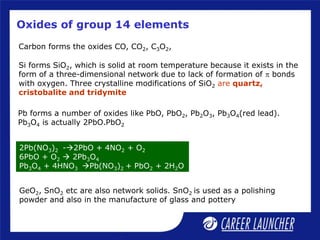
Carbon forms the oxides CO, CO2, C3O2,
Si forms SiO2, which is solid at room temperature because it exists in the
form of a three-dimensional network due to lack of formation of p bonds
with oxygen. Three crystalline modifications of SiO2 are quartz,
cristobalite and tridymite
Pb forms a number of oxides like PbO, PbO2, Pb2O3, Pb3O4(red lead).
Pb3O4 is actually 2PbO.PbO2
GeO2, SnO2 etc are also network solids. SnO2 is used as a polishing
powder and also in the manufacture of glass and pottery
2Pb(NO3)2 -2PbO + 4NO2 + O2
6PbO + O2  2Pb3O4
Pb3O4 + 4HNO3 Pb(NO3)2 + PbO2 + 2H2O
Halides of group 14 elements
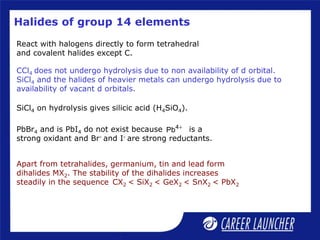
React with halogens directly to form tetrahedral
and covalent halides except C.
CCl4 does not undergo hydrolysis due to non availability of d orbital.
SiCl4 and the halides of heavier metals can undergo hydrolysis due to
availability of vacant d orbitals.
SiCl4 on hydrolysis gives silicic acid (H4SiO4).
Apart from tetrahalides, germanium, tin and lead form
dihalides MX2. The stability of the dihalides increases
steadily in the sequence CX2 < SiX2 < GeX2 < SnX2 < PbX2
PbBr4 and is PbI4 do not exist because is a
strong oxidant and Br- and I- are strong reductants.
4
Pb 
Illustrative Example
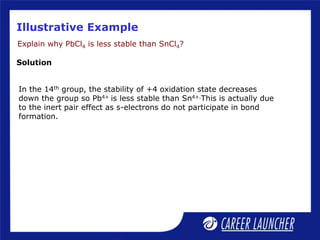
Explain why PbCl4 is less stable than SnCl4?
In the 14th group, the stability of +4 oxidation state decreases
down the group so Pb4+ is less stable than Sn4+.This is actually due
to the inert pair effect as s-electrons do not participate in bond
formation.
Solution
Extraction and properties of Si
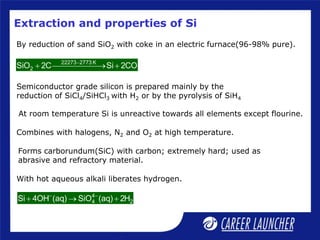
By reduction of sand SiO2 with coke in an electric furnace(96-98% pure).
22273 2773 K
2
SiO 2C Si 2CO

 
 
Semiconductor grade silicon is prepared mainly by the
reduction of SiCl4/SiHCl3 with H2 or by the pyrolysis of SiH4
At room temperature Si is unreactive towards all elements except flourine.
Combines with halogens, N2 and O2 at high temperature.
Forms carborundum(SiC) with carbon; extremely hard; used as
abrasive and refractory material.
With hot aqueous alkali liberates hydrogen.
4
4 2
Si 4OH (aq) SiO (aq) 2H
 
  
Extraction of tin
Tin is commonly available as the mineral cassiterite, SnO2.
SnO2 + 2C  Sn + 2CO
The roasted ore is heated with coal in a reverberatory furnace at 1500 K.
Ore is crushed and washed with water to remove
impurities such as arsenic and sulphur as volatile
oxides.
Tin is remelted on inclined surface to remove the
impurities having higher melting point.
Properties of tin
Tin is a soft, silvery white metal. It is ductile and can
be rolled into thin foils.
Tin is not attacked by air or water at ordinary temperatures:
Heating with air or oxygen results in the formation of SnO2.
Tin is used as a coating on metals and in making various
alloys like solder, bronze. It is also used for electroplating
steel to make tin-plate. Tin –plate is extensively used for
making cans for food and drinks.
Lead
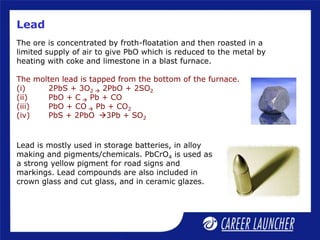
Lead is mostly used in storage batteries, in alloy
making and pigments/chemicals. PbCrO4 is used as
a strong yellow pigment for road signs and
markings. Lead compounds are also included in
crown glass and cut glass, and in ceramic glazes.
The ore is concentrated by froth-floatation and then roasted in a
limited supply of air to give PbO which is reduced to the metal by
heating with coke and limestone in a blast furnace.
The molten lead is tapped from the bottom of the furnace.
(i) 2PbS + 3O2  2PbO + 2SO2
(ii) PbO + C  Pb + CO
(iii) PbO + CO  Pb + CO2
(iv) PbS + 2PbO 3Pb + SO2
Toxicity of Lead
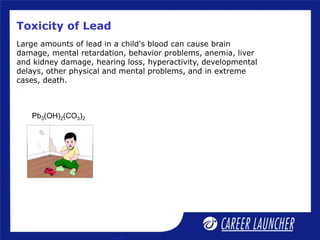
Pb3(OH)2(CO3)2
Large amounts of lead in a child's blood can cause brain
damage, mental retardation, behavior problems, anemia, liver
and kidney damage, hearing loss, hyperactivity, developmental
delays, other physical and mental problems, and in extreme
cases, death.
O
O
–
O
–
–
O
–
O
Silicates
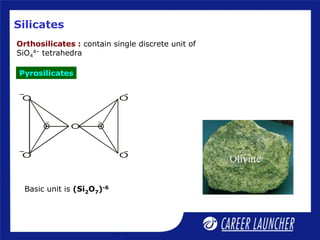
Orthosilicates : contain single discrete unit of
SiO4
4– tetrahedra
Pyrosilicates
Basic unit is (Si2O7)-6
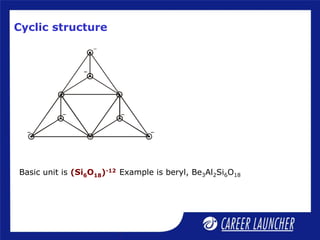
Cyclic structure
Basic unit is (Si6O18)-12 Example is beryl, Be3Al2Si6O18
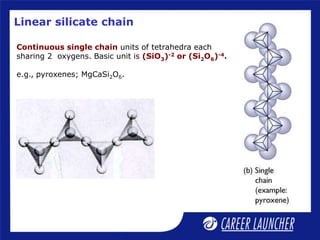
Linear silicate chain
Continuous single chain units of tetrahedra each
sharing 2 oxygens. Basic unit is (SiO3)-2 or (Si2O6)-4.
e.g., pyroxenes; MgCaSi2O6.
Amphiboles
Continuous double chain units of tetrahedra
each sharing 2 and 3 oxygens alternately.
Basic unit is (Si4O11)-6 or (Si8O22)-12
e.g., asbestos; [Mg3(Si2O5)(OH)4]
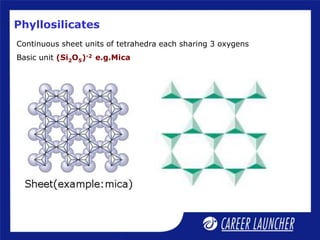
Phyllosilicates
Continuous sheet units of tetrahedra each sharing 3 oxygens
Basic unit (Si2O5)-2 e.g.Mica
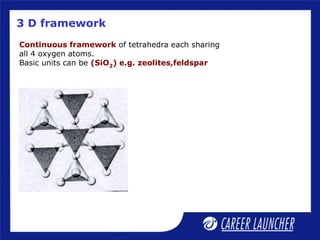
3 D framework
Continuous framework of tetrahedra each sharing
all 4 oxygen atoms.
Basic units can be (SiO2) e.g. zeolites,feldspar
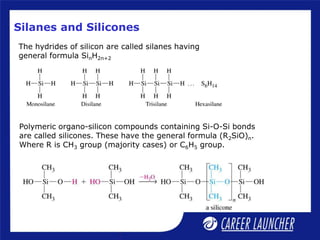
Silanes and Silicones
The hydrides of silicon are called silanes having
general formula SinH2n+2
Polymeric organo-silicon compounds containing Si-O-Si bonds
are called silicones. These have the general formula (R2SiO)n.
Where R is CH3 group (majority cases) or C6H5 group.
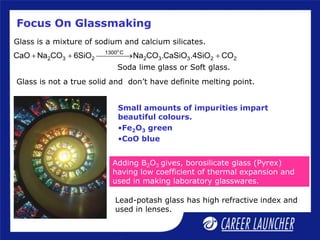
Focus On Glassmaking
Small amounts of impurities impart
beautiful colours.
•Fe2O3 green
•CoO blue
Glass is a mixture of sodium and calcium silicates.
Lead-potash glass has high refractive index and
used in lenses.
Adding B2O3 gives, borosilicate glass (Pyrex)
having low coefficient of thermal expansion and
used in making laboratory glasswares.
Soda lime glass or Soft glass.
o
1300 C
2 3 2 2 3 3 2 2
CaO Na CO 6SiO Na CO .CaSiO .4SiO CO
  
 
Glass is not a true solid and don’t have definite melting point.
Group 15 elements
Nitrogen N [He] 2s2p3
Phosphorus P [Ne] 3s23p3
Arsenic As [Ar]3d104s24p3
Antimony Sb [Kr]4d105s25p3
Bismuth Bi [Xe]4f145d106s26p3
General trends of group 15 elements
The covalent radius increases down the group.
All elements have nearly same and low
electronegativity except nitrogen.
P, As, Sb and Bi are solids under normal conditions.
The value of ionization energy is quite high for the members of
group 15 than the corresponding members of group 14. This is
due to smaller atomic radii, increased nuclear charge and
stable electronic configuration of half filled orbitals.
Ionisation energy
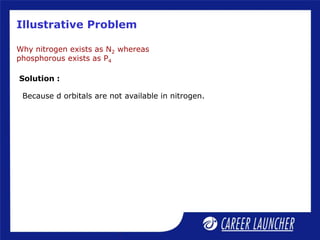
Illustrative Problem
Why nitrogen exists as N2 whereas
phosphorous exists as P4
Because d orbitals are not available in nitrogen.
Solution :
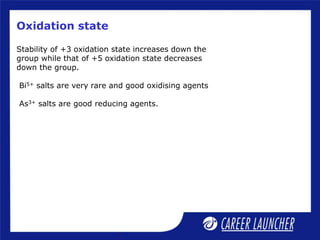
Oxidation state
Stability of +3 oxidation state increases down the
group while that of +5 oxidation state decreases
down the group.
Bi5+ salts are very rare and good oxidising agents
As3+ salts are good reducing agents.
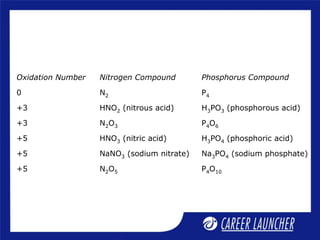
Oxidation Number Nitrogen Compound Phosphorus Compound
0 N2 P4
+3 HNO2 (nitrous acid) H3PO3 (phosphorous acid)
+3 N2O3 P4O6
+5 HNO3 (nitric acid) H3PO4 (phosphoric acid)
+5 NaNO3 (sodium nitrate) Na3PO4 (sodium phosphate)
+5 N2O5 P4O10
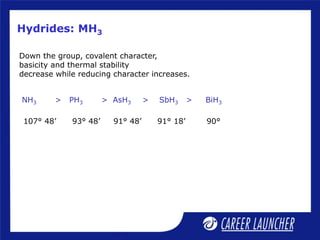
Down the group, covalent character,
basicity and thermal stability
decrease while reducing character increases.
NH3 > PH3 > AsH3 > SbH3 > BiH3
107° 48’ 93° 48’ 91° 48’ 91° 18’ 90°
Hydrides: MH3
Illustrative Problem
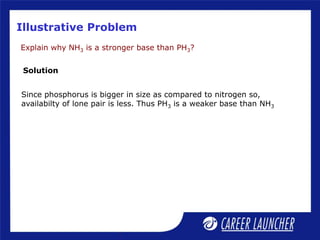
Explain why NH3 is a stronger base than PH3?
Solution
Since phosphorus is bigger in size as compared to nitrogen so,
availabilty of lone pair is less. Thus PH3 is a weaker base than NH3
Illustrative Problem
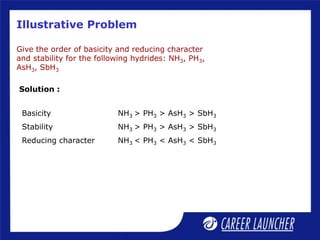
Give the order of basicity and reducing character
and stability for the following hydrides: NH3, PH3,
AsH3, SbH3
Solution :
Basicity NH3 > PH3 > AsH3 > SbH3
Stability NH3 > PH3 > AsH3 > SbH3
Reducing character NH3 < PH3 < AsH3 < SbH3
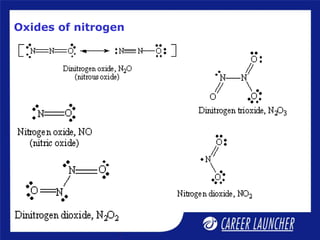
Oxides of nitrogen
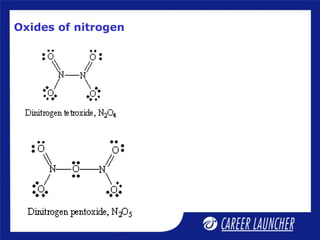
Oxides of nitrogen
Illustrative Problem
Which oxide of nitrogen is coloured ?
NO2 has unpaired electrons,so it is coloured.
Solution :
Oxides
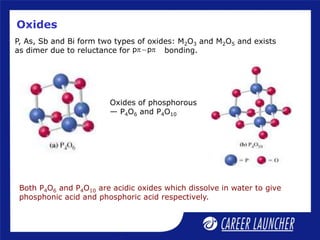
Oxides of phosphorous
— P4O6 and P4O10
P, As, Sb and Bi form two types of oxides: M2O3 and M2O5 and exists
as dimer due to reluctance for bonding.
p p
p  p
Both P4O6 and P4O10 are acidic oxides which dissolve in water to give
phosphonic acid and phosphoric acid respectively.
Halides
Forms two series of halides;
MX3 (pyramidal)
MX5 (trigonal bipyramidal)
Trihalides readily hydrolyse with water.
3 2 4
NCl 4H O NH OH HOCl
  
3 2 3 3
PCl 3H O H PO 3HCl
  
3 2 3 3
AsCl 3H O H AsO 3HCl
  
3 2
SbCl H O SbO 3Cl 2H
  
   
3 2
BiCl H O BiO 3Cl 2H
  
   
PCl5 is molecular in gas and liquid phases but exists
as [PCl4]+[PCl6]- in the solid state .
Illustrative Example
Explain why PCl5 exists but NCl5 does not?
Solution
NCl5 is not formed because nitrogen does
not have d-orbitals.
Illustrative Example
Solid phosphorous-pentachloride exhibits some
ionic character, why?
Solution
This is because PCl5 exists as [PCl4]+ [PCl6]- in solid
phase and hence exhibits ionic character.
Allotropy of P
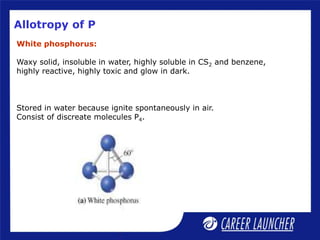
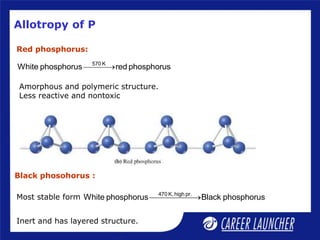
White phosphorus:
Waxy solid, insoluble in water, highly soluble in CS2 and benzene,
highly reactive, highly toxic and glow in dark.
Stored in water because ignite spontaneously in air.
Consist of discreate molecules P4.
Allotropy of P
Black phosohorus :
Inert and has layered structure.
470 K,high pr.
White phosphorus Black phosphorus


Most stable form
Red phosphorus:
570 K
White phosphorus red phosphorus

Amorphous and polymeric structure.
Less reactive and nontoxic
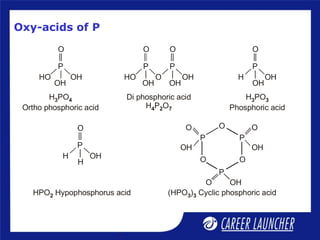
Oxy-acids of P
P P
O O
O
P
O
OH
OH
O
O
OH
(HPO ) Cyclic phosphoric acid
3 3
P
H
OH
H
O
HPO Hypophosphorus acid
2
P
OH
OH
HO
O
H PO
Ortho phosphoric acid
3 4
P
OH
O
HO
O
P
OH
OH
O
Di phosphoric acid
H P O
4 2 7
P
OH
OH
H
O
H PO
Phosphoric acid
3 3
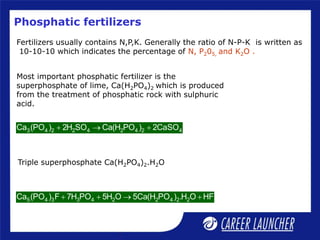
Phosphatic fertilizers
Fertilizers usually contains N,P,K. Generally the ratio of N-P-K is written as
10-10-10 which indicates the percentage of N, P205, and K2O .
Most important phosphatic fertilizer is the
superphosphate of lime, Ca(H2PO4)2 which is produced
from the treatment of phosphatic rock with sulphuric
acid.
3 4 2 2 4 2 4 2 4
Ca (PO ) 2H SO Ca(H PO ) 2CaSO
  
Triple superphosphate Ca(H2PO4)2.H2O
5 4 3 3 4 2 2 4 2 2
Ca (PO ) F 7H PO 5H O 5Ca(H PO ) .H O HF
   
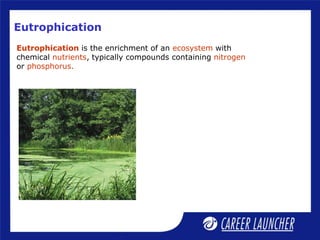
Eutrophication
Eutrophication is the enrichment of an ecosystem with
chemical nutrients, typically compounds containing nitrogen
or phosphorus.
Thank you

dokumen.tips_51-p-block-elements-2.ppt..

  • 1.
  • 2.
    Session Objectives 1. Chemicalproperties of group 14 elements 2. Extraction and properties of silicon 3. Extraction of tin 4. Extraction of lead 5. Silicates and silicones 6. Glass 7. General properties of group 14 elements 8. Oxoacids of phosphorous
  • 3.
    Action of Acidson group 14 elements Non-oxidising acids do not attack carbon and silicon. Ge is not attacked by dilute HCl. However, when metal is heated in a stream of HCl gas, germanium chloroform is formed. 3 2 Ge 3HCl GeHCl H    2 2 Sn 2HCl SnCl H    2 2 Pb 2HCl PbCl H    2 2 4 (chloroplumbous acid) PbCl 2HCl H PbCl   Lead dissolves in Conc. HCl formig chloro-plumbous acid. Tin dissolves slowly in dilute HCl but readily in Conc. HCl.
  • 4.
    Action of Alkalies Carbonis unaffected by alkalies. Silicon reacts slowly with cold aq. NaOH and readily with hot solution to form silicate. 2 2 3 2 Si 2NaOH H O Na SiO 2H     Sn and Pb are slowly attacked by cold alkali but readily by hot alkali giving stannates and plumbates. 2 2 3 2 Sn 2NaOH H O Na SnO 2H     2 2 3 2 Pb 2NaOH H O Na PbO 2H    
  • 5.
    Oxides of group14 elements Carbon forms the oxides CO, CO2, C3O2, Si forms SiO2, which is solid at room temperature because it exists in the form of a three-dimensional network due to lack of formation of p bonds with oxygen. Three crystalline modifications of SiO2 are quartz, cristobalite and tridymite Pb forms a number of oxides like PbO, PbO2, Pb2O3, Pb3O4(red lead). Pb3O4 is actually 2PbO.PbO2 GeO2, SnO2 etc are also network solids. SnO2 is used as a polishing powder and also in the manufacture of glass and pottery 2Pb(NO3)2 -2PbO + 4NO2 + O2 6PbO + O2  2Pb3O4 Pb3O4 + 4HNO3 Pb(NO3)2 + PbO2 + 2H2O
  • 6.
    Halides of group14 elements React with halogens directly to form tetrahedral and covalent halides except C. CCl4 does not undergo hydrolysis due to non availability of d orbital. SiCl4 and the halides of heavier metals can undergo hydrolysis due to availability of vacant d orbitals. SiCl4 on hydrolysis gives silicic acid (H4SiO4). Apart from tetrahalides, germanium, tin and lead form dihalides MX2. The stability of the dihalides increases steadily in the sequence CX2 < SiX2 < GeX2 < SnX2 < PbX2 PbBr4 and is PbI4 do not exist because is a strong oxidant and Br- and I- are strong reductants. 4 Pb 
  • 7.
    Illustrative Example Explain whyPbCl4 is less stable than SnCl4? In the 14th group, the stability of +4 oxidation state decreases down the group so Pb4+ is less stable than Sn4+.This is actually due to the inert pair effect as s-electrons do not participate in bond formation. Solution
  • 8.
    Extraction and propertiesof Si By reduction of sand SiO2 with coke in an electric furnace(96-98% pure). 22273 2773 K 2 SiO 2C Si 2CO      Semiconductor grade silicon is prepared mainly by the reduction of SiCl4/SiHCl3 with H2 or by the pyrolysis of SiH4 At room temperature Si is unreactive towards all elements except flourine. Combines with halogens, N2 and O2 at high temperature. Forms carborundum(SiC) with carbon; extremely hard; used as abrasive and refractory material. With hot aqueous alkali liberates hydrogen. 4 4 2 Si 4OH (aq) SiO (aq) 2H     
  • 9.
    Extraction of tin Tinis commonly available as the mineral cassiterite, SnO2. SnO2 + 2C  Sn + 2CO The roasted ore is heated with coal in a reverberatory furnace at 1500 K. Ore is crushed and washed with water to remove impurities such as arsenic and sulphur as volatile oxides. Tin is remelted on inclined surface to remove the impurities having higher melting point.
  • 10.
    Properties of tin Tinis a soft, silvery white metal. It is ductile and can be rolled into thin foils. Tin is not attacked by air or water at ordinary temperatures: Heating with air or oxygen results in the formation of SnO2. Tin is used as a coating on metals and in making various alloys like solder, bronze. It is also used for electroplating steel to make tin-plate. Tin –plate is extensively used for making cans for food and drinks.
  • 11.
    Lead Lead is mostlyused in storage batteries, in alloy making and pigments/chemicals. PbCrO4 is used as a strong yellow pigment for road signs and markings. Lead compounds are also included in crown glass and cut glass, and in ceramic glazes. The ore is concentrated by froth-floatation and then roasted in a limited supply of air to give PbO which is reduced to the metal by heating with coke and limestone in a blast furnace. The molten lead is tapped from the bottom of the furnace. (i) 2PbS + 3O2  2PbO + 2SO2 (ii) PbO + C  Pb + CO (iii) PbO + CO  Pb + CO2 (iv) PbS + 2PbO 3Pb + SO2
  • 12.
    Toxicity of Lead Pb3(OH)2(CO3)2 Largeamounts of lead in a child's blood can cause brain damage, mental retardation, behavior problems, anemia, liver and kidney damage, hearing loss, hyperactivity, developmental delays, other physical and mental problems, and in extreme cases, death.
  • 13.
    O O – O – – O – O Silicates Orthosilicates : containsingle discrete unit of SiO4 4– tetrahedra Pyrosilicates Basic unit is (Si2O7)-6
  • 14.
    Cyclic structure Basic unitis (Si6O18)-12 Example is beryl, Be3Al2Si6O18
  • 15.
    Linear silicate chain Continuoussingle chain units of tetrahedra each sharing 2 oxygens. Basic unit is (SiO3)-2 or (Si2O6)-4. e.g., pyroxenes; MgCaSi2O6.
  • 16.
    Amphiboles Continuous double chainunits of tetrahedra each sharing 2 and 3 oxygens alternately. Basic unit is (Si4O11)-6 or (Si8O22)-12 e.g., asbestos; [Mg3(Si2O5)(OH)4]
  • 17.
    Phyllosilicates Continuous sheet unitsof tetrahedra each sharing 3 oxygens Basic unit (Si2O5)-2 e.g.Mica
  • 18.
    3 D framework Continuousframework of tetrahedra each sharing all 4 oxygen atoms. Basic units can be (SiO2) e.g. zeolites,feldspar
  • 19.
    Silanes and Silicones Thehydrides of silicon are called silanes having general formula SinH2n+2 Polymeric organo-silicon compounds containing Si-O-Si bonds are called silicones. These have the general formula (R2SiO)n. Where R is CH3 group (majority cases) or C6H5 group.
  • 20.
    Focus On Glassmaking Smallamounts of impurities impart beautiful colours. •Fe2O3 green •CoO blue Glass is a mixture of sodium and calcium silicates. Lead-potash glass has high refractive index and used in lenses. Adding B2O3 gives, borosilicate glass (Pyrex) having low coefficient of thermal expansion and used in making laboratory glasswares. Soda lime glass or Soft glass. o 1300 C 2 3 2 2 3 3 2 2 CaO Na CO 6SiO Na CO .CaSiO .4SiO CO      Glass is not a true solid and don’t have definite melting point.
  • 21.
    Group 15 elements NitrogenN [He] 2s2p3 Phosphorus P [Ne] 3s23p3 Arsenic As [Ar]3d104s24p3 Antimony Sb [Kr]4d105s25p3 Bismuth Bi [Xe]4f145d106s26p3
  • 22.
    General trends ofgroup 15 elements The covalent radius increases down the group. All elements have nearly same and low electronegativity except nitrogen. P, As, Sb and Bi are solids under normal conditions. The value of ionization energy is quite high for the members of group 15 than the corresponding members of group 14. This is due to smaller atomic radii, increased nuclear charge and stable electronic configuration of half filled orbitals. Ionisation energy
  • 23.
    Illustrative Problem Why nitrogenexists as N2 whereas phosphorous exists as P4 Because d orbitals are not available in nitrogen. Solution :
  • 24.
    Oxidation state Stability of+3 oxidation state increases down the group while that of +5 oxidation state decreases down the group. Bi5+ salts are very rare and good oxidising agents As3+ salts are good reducing agents.
  • 25.
    Oxidation Number NitrogenCompound Phosphorus Compound 0 N2 P4 +3 HNO2 (nitrous acid) H3PO3 (phosphorous acid) +3 N2O3 P4O6 +5 HNO3 (nitric acid) H3PO4 (phosphoric acid) +5 NaNO3 (sodium nitrate) Na3PO4 (sodium phosphate) +5 N2O5 P4O10
  • 26.
    Down the group,covalent character, basicity and thermal stability decrease while reducing character increases. NH3 > PH3 > AsH3 > SbH3 > BiH3 107° 48’ 93° 48’ 91° 48’ 91° 18’ 90° Hydrides: MH3
  • 27.
    Illustrative Problem Explain whyNH3 is a stronger base than PH3? Solution Since phosphorus is bigger in size as compared to nitrogen so, availabilty of lone pair is less. Thus PH3 is a weaker base than NH3
  • 28.
    Illustrative Problem Give theorder of basicity and reducing character and stability for the following hydrides: NH3, PH3, AsH3, SbH3 Solution : Basicity NH3 > PH3 > AsH3 > SbH3 Stability NH3 > PH3 > AsH3 > SbH3 Reducing character NH3 < PH3 < AsH3 < SbH3
  • 29.
  • 30.
  • 31.
    Illustrative Problem Which oxideof nitrogen is coloured ? NO2 has unpaired electrons,so it is coloured. Solution :
  • 32.
    Oxides Oxides of phosphorous —P4O6 and P4O10 P, As, Sb and Bi form two types of oxides: M2O3 and M2O5 and exists as dimer due to reluctance for bonding. p p p  p Both P4O6 and P4O10 are acidic oxides which dissolve in water to give phosphonic acid and phosphoric acid respectively.
  • 33.
    Halides Forms two seriesof halides; MX3 (pyramidal) MX5 (trigonal bipyramidal) Trihalides readily hydrolyse with water. 3 2 4 NCl 4H O NH OH HOCl    3 2 3 3 PCl 3H O H PO 3HCl    3 2 3 3 AsCl 3H O H AsO 3HCl    3 2 SbCl H O SbO 3Cl 2H        3 2 BiCl H O BiO 3Cl 2H        PCl5 is molecular in gas and liquid phases but exists as [PCl4]+[PCl6]- in the solid state .
  • 34.
    Illustrative Example Explain whyPCl5 exists but NCl5 does not? Solution NCl5 is not formed because nitrogen does not have d-orbitals.
  • 35.
    Illustrative Example Solid phosphorous-pentachlorideexhibits some ionic character, why? Solution This is because PCl5 exists as [PCl4]+ [PCl6]- in solid phase and hence exhibits ionic character.
  • 36.
    Allotropy of P Whitephosphorus: Waxy solid, insoluble in water, highly soluble in CS2 and benzene, highly reactive, highly toxic and glow in dark. Stored in water because ignite spontaneously in air. Consist of discreate molecules P4.
  • 37.
    Allotropy of P Blackphosohorus : Inert and has layered structure. 470 K,high pr. White phosphorus Black phosphorus   Most stable form Red phosphorus: 570 K White phosphorus red phosphorus  Amorphous and polymeric structure. Less reactive and nontoxic
  • 38.
    Oxy-acids of P PP O O O P O OH OH O O OH (HPO ) Cyclic phosphoric acid 3 3 P H OH H O HPO Hypophosphorus acid 2 P OH OH HO O H PO Ortho phosphoric acid 3 4 P OH O HO O P OH OH O Di phosphoric acid H P O 4 2 7 P OH OH H O H PO Phosphoric acid 3 3
  • 39.
    Phosphatic fertilizers Fertilizers usuallycontains N,P,K. Generally the ratio of N-P-K is written as 10-10-10 which indicates the percentage of N, P205, and K2O . Most important phosphatic fertilizer is the superphosphate of lime, Ca(H2PO4)2 which is produced from the treatment of phosphatic rock with sulphuric acid. 3 4 2 2 4 2 4 2 4 Ca (PO ) 2H SO Ca(H PO ) 2CaSO    Triple superphosphate Ca(H2PO4)2.H2O 5 4 3 3 4 2 2 4 2 2 Ca (PO ) F 7H PO 5H O 5Ca(H PO ) .H O HF    
  • 40.
    Eutrophication Eutrophication is theenrichment of an ecosystem with chemical nutrients, typically compounds containing nitrogen or phosphorus.
  • 41.