Revision Year 1 POSSESSIVE ADJECTIVES  POSSESSIVE PRONOUNS PREPOSITIONS OF TIME  CAN / CAN’T,  OBJECT PRONOUNS LIKE + ING WOULD LIKE TO + INF THERE IS / THERE ARE THERE WAS / THERE WERE PRESENT CONTINUOUS / PRESENT SIMPLE COUNTABLE / UNCOUNTABLE NOUNS HOW MUCH / HOW MANY BE GOING TO + INF COMPARATIVES / SUPERLATIVES
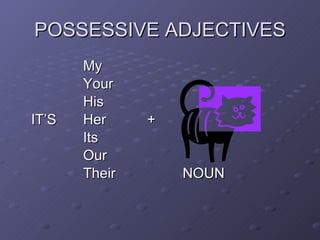
POSSESSIVE ADJECTIVES My Your His IT’S Her + Its Our Their   NOUN
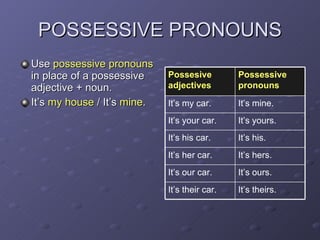
POSSESSIVE PRONOUNS Use  possessive pronouns  in place of a possessive adjective + noun. It’s  my house  / It’s  mine . It’s theirs. It’s their car.  It’s ours. It’s our car. It’s hers. It’s her car. It’s his. It’s his car. It’s yours. It’s your car. It’s mine. It’s my car. Possessive pronouns Possesive adjectives
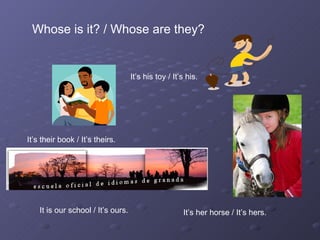
It is our school / It’s ours. It’s her horse / It’s hers. Whose is it? / Whose are they? It’s their book / It’s theirs. It’s his toy / It’s his.
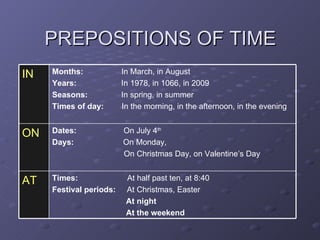
PREPOSITIONS OF TIME Times:   At half past ten, at 8:40 Festival periods:   At Christmas, Easter At night  At the weekend AT Dates:   On July 4 th Days:  On Monday,  On Christmas Day, on Valentine’s Day ON Months:   In March, in August Years:   In 1978, in 1066, in 2009 Seasons:   In spring, in summer Times of day:   In the morning, in the afternoon, in the evening  IN
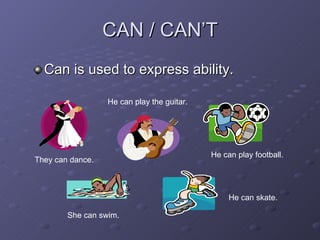
CAN / CAN’T Can is used to express ability. They can dance. He can play the guitar. He can play football. She can swim. He can skate.
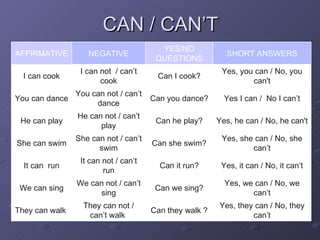
CAN / CAN’T Can they walk ? Can we sing? Can it run? Can she swim? Can he play? Can you dance? Can I cook? YES/NO QUESTIONS Yes, they can / No, they can’t Yes, we can / No, we can’t Yes, it can / No, it can’t Yes, she can / No, she can’t Yes, he can / No, he can't Yes I can /  No I can’t Yes, you can / No, you can't SHORT ANSWERS They can not / can’t walk  We can not / can’t sing It can not / can’t run She can not / can’t swim He can not / can’t play You can not / can’t dance I can not  / can’t cook NEGATIVE They can walk  We can sing It can  run She can swim He can play You can dance I can cook AFFIRMATIVE
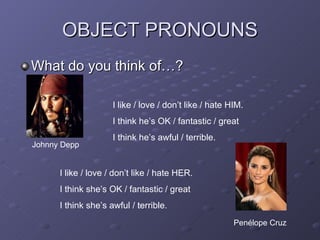
OBJECT PRONOUNS What do you think of…? Johnny Depp I like / love / don’t like / hate HIM. I think he’s OK / fantastic / great I think he’s awful / terrible. Penélope Cruz I like / love / don’t like / hate HER. I think she’s OK / fantastic / great I think she’s awful / terrible.
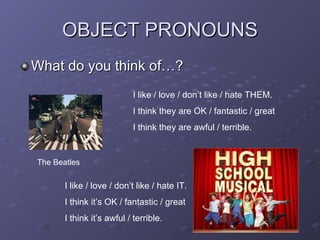
OBJECT PRONOUNS What do you think of…? The Beatles I like / love / don’t like / hate THEM. I think they are OK / fantastic / great I think they are awful / terrible. I like / love / don’t like / hate IT. I think it’s OK / fantastic / great I think it’s awful / terrible.
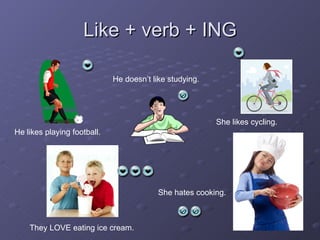
Like + verb + ING He likes playing football. He doesn’t like studying. She likes cycling. They LOVE eating ice cream. She hates cooking.
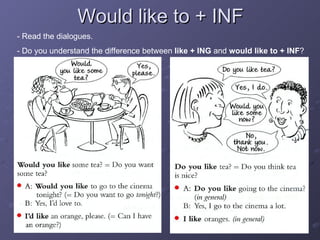
Would like to + INF - Read the dialogues. - Do you understand the difference between  like + ING  and  would like to + INF ?
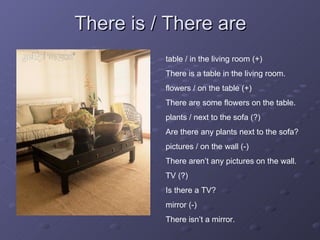
There is / There are table / in the living room (+) There is a table in the living room. flowers / on the table (+) There are some flowers on the table.  plants / next to the sofa (?) Are there any plants next to the sofa? pictures / on the wall (-) There aren’t any pictures on the wall. TV (?) Is there a TV? mirror (-) There isn’t a mirror.
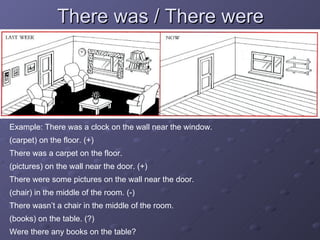
There was / There were Example: There was a clock on the wall near the window. (carpet) on the floor. (+) There was a carpet on the floor. (pictures) on the wall near the door. (+) There were some pictures on the wall near the door. (chair) in the middle of the room. (-) There wasn’t a chair in the middle of the room. (books) on the table. (?) Were there any books on the table?
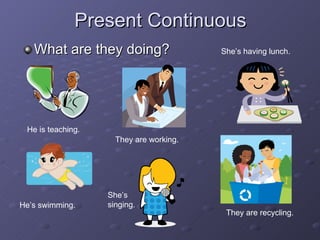
Present Continuous What are they doing? He is teaching. She’s singing. She’s having lunch. He’s swimming. They are working. They are recycling.
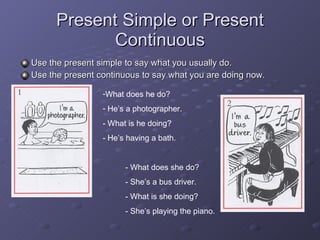
Present Simple or Present Continuous Use the present simple to say what you usually do. Use the present continuous to say what you are doing now. What does he do? He’s a photographer. - What is he doing? - He’s having a bath. - What does she do? - She’s a bus driver. - What is she doing? - She’s playing the piano.
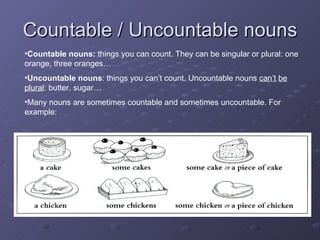
Countable / Uncountable nouns Countable nouns:  things you can count. They can be singular or plural: one orange, three oranges… Uncountable nouns : things you can’t count. Uncountable nouns  can’t   be plural : butter, sugar… Many nouns are sometimes countable and sometimes uncountable. For example:
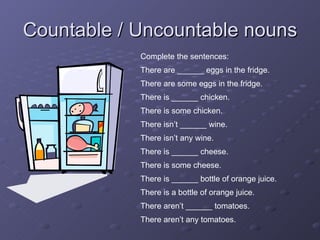
Countable / Uncountable nouns Complete the sentences: There are ______ eggs in the fridge. There are some eggs in the fridge. There is ______ chicken. There is some chicken. There isn’t ______ wine. There isn’t any wine. There is ______ cheese. There is some cheese. There is ______ bottle of orange juice. There is a bottle of orange juice. There aren’t ______ tomatoes. There aren’t any tomatoes.
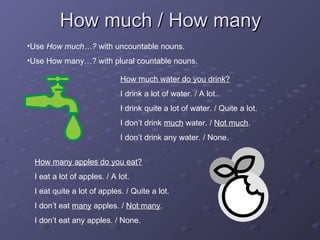
How much / How many Use  How much…?  with uncountable nouns. Use How many…? with plural countable nouns. How much water do you drink? I drink a lot of water. / A lot. I drink quite a lot of water. / Quite a lot. I don’t drink  much  water. /  Not much . I don’t drink any water. / None. How many apples do you eat? I eat a lot of apples. / A lot. I eat quite a lot of apples. / Quite a lot. I don’t eat  many  apples. /  Not many . I don’t eat any apples. / None.
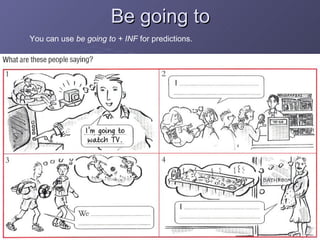
Be going to You can use  be going to + INF  for predictions.
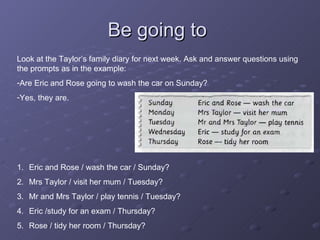
Be going to  Look at the Taylor’s family diary for next week. Ask and answer questions using the prompts as in the example: Are Eric and Rose going to wash the car on Sunday? Yes, they are. Eric and Rose / wash the car / Sunday? Mrs Taylor / visit her mum / Tuesday? Mr and Mrs Taylor / play tennis / Tuesday? Eric /study for an exam / Thursday? Rose / tidy her room / Thursday?
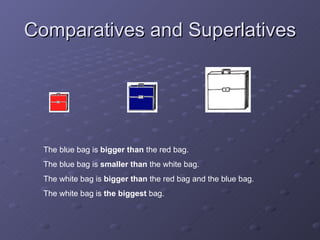
Comparatives and Superlatives The blue bag is  bigger than  the red bag.  The blue bag is  smaller than  the white bag.  The white bag is  bigger than  the red bag and the blue bag.  The white bag is  the biggest  bag.
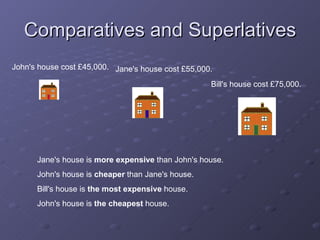
Comparatives and Superlatives John's house cost £45,000.              Jane's house cost £55,000.                Bill's house cost £75,000.                  Jane's house is  more expensive  than John's house. John's house is  cheaper  than Jane's house.  Bill's house is  the most expensive  house.  John's house is  the cheapest  house.

Final Revision Primero

  • 1.
    Revision Year 1POSSESSIVE ADJECTIVES POSSESSIVE PRONOUNS PREPOSITIONS OF TIME CAN / CAN’T, OBJECT PRONOUNS LIKE + ING WOULD LIKE TO + INF THERE IS / THERE ARE THERE WAS / THERE WERE PRESENT CONTINUOUS / PRESENT SIMPLE COUNTABLE / UNCOUNTABLE NOUNS HOW MUCH / HOW MANY BE GOING TO + INF COMPARATIVES / SUPERLATIVES
  • 2.
    POSSESSIVE ADJECTIVES MyYour His IT’S Her + Its Our Their NOUN
  • 3.
    POSSESSIVE PRONOUNS Use possessive pronouns in place of a possessive adjective + noun. It’s my house / It’s mine . It’s theirs. It’s their car. It’s ours. It’s our car. It’s hers. It’s her car. It’s his. It’s his car. It’s yours. It’s your car. It’s mine. It’s my car. Possessive pronouns Possesive adjectives
  • 4.
    It is ourschool / It’s ours. It’s her horse / It’s hers. Whose is it? / Whose are they? It’s their book / It’s theirs. It’s his toy / It’s his.
  • 5.
    PREPOSITIONS OF TIMETimes: At half past ten, at 8:40 Festival periods: At Christmas, Easter At night At the weekend AT Dates: On July 4 th Days: On Monday, On Christmas Day, on Valentine’s Day ON Months: In March, in August Years: In 1978, in 1066, in 2009 Seasons: In spring, in summer Times of day: In the morning, in the afternoon, in the evening IN
  • 6.
    CAN / CAN’TCan is used to express ability. They can dance. He can play the guitar. He can play football. She can swim. He can skate.
  • 7.
    CAN / CAN’TCan they walk ? Can we sing? Can it run? Can she swim? Can he play? Can you dance? Can I cook? YES/NO QUESTIONS Yes, they can / No, they can’t Yes, we can / No, we can’t Yes, it can / No, it can’t Yes, she can / No, she can’t Yes, he can / No, he can't Yes I can / No I can’t Yes, you can / No, you can't SHORT ANSWERS They can not / can’t walk We can not / can’t sing It can not / can’t run She can not / can’t swim He can not / can’t play You can not / can’t dance I can not / can’t cook NEGATIVE They can walk We can sing It can run She can swim He can play You can dance I can cook AFFIRMATIVE
  • 8.
    OBJECT PRONOUNS Whatdo you think of…? Johnny Depp I like / love / don’t like / hate HIM. I think he’s OK / fantastic / great I think he’s awful / terrible. Penélope Cruz I like / love / don’t like / hate HER. I think she’s OK / fantastic / great I think she’s awful / terrible.
  • 9.
    OBJECT PRONOUNS Whatdo you think of…? The Beatles I like / love / don’t like / hate THEM. I think they are OK / fantastic / great I think they are awful / terrible. I like / love / don’t like / hate IT. I think it’s OK / fantastic / great I think it’s awful / terrible.
  • 10.
    Like + verb+ ING He likes playing football. He doesn’t like studying. She likes cycling. They LOVE eating ice cream. She hates cooking.
  • 11.
    Would like to+ INF - Read the dialogues. - Do you understand the difference between like + ING and would like to + INF ?
  • 12.
    There is /There are table / in the living room (+) There is a table in the living room. flowers / on the table (+) There are some flowers on the table. plants / next to the sofa (?) Are there any plants next to the sofa? pictures / on the wall (-) There aren’t any pictures on the wall. TV (?) Is there a TV? mirror (-) There isn’t a mirror.
  • 13.
    There was /There were Example: There was a clock on the wall near the window. (carpet) on the floor. (+) There was a carpet on the floor. (pictures) on the wall near the door. (+) There were some pictures on the wall near the door. (chair) in the middle of the room. (-) There wasn’t a chair in the middle of the room. (books) on the table. (?) Were there any books on the table?
  • 14.
    Present Continuous Whatare they doing? He is teaching. She’s singing. She’s having lunch. He’s swimming. They are working. They are recycling.
  • 15.
    Present Simple orPresent Continuous Use the present simple to say what you usually do. Use the present continuous to say what you are doing now. What does he do? He’s a photographer. - What is he doing? - He’s having a bath. - What does she do? - She’s a bus driver. - What is she doing? - She’s playing the piano.
  • 16.
    Countable / Uncountablenouns Countable nouns: things you can count. They can be singular or plural: one orange, three oranges… Uncountable nouns : things you can’t count. Uncountable nouns can’t be plural : butter, sugar… Many nouns are sometimes countable and sometimes uncountable. For example:
  • 17.
    Countable / Uncountablenouns Complete the sentences: There are ______ eggs in the fridge. There are some eggs in the fridge. There is ______ chicken. There is some chicken. There isn’t ______ wine. There isn’t any wine. There is ______ cheese. There is some cheese. There is ______ bottle of orange juice. There is a bottle of orange juice. There aren’t ______ tomatoes. There aren’t any tomatoes.
  • 18.
    How much /How many Use How much…? with uncountable nouns. Use How many…? with plural countable nouns. How much water do you drink? I drink a lot of water. / A lot. I drink quite a lot of water. / Quite a lot. I don’t drink much water. / Not much . I don’t drink any water. / None. How many apples do you eat? I eat a lot of apples. / A lot. I eat quite a lot of apples. / Quite a lot. I don’t eat many apples. / Not many . I don’t eat any apples. / None.
  • 19.
    Be going toYou can use be going to + INF for predictions.
  • 20.
    Be going to Look at the Taylor’s family diary for next week. Ask and answer questions using the prompts as in the example: Are Eric and Rose going to wash the car on Sunday? Yes, they are. Eric and Rose / wash the car / Sunday? Mrs Taylor / visit her mum / Tuesday? Mr and Mrs Taylor / play tennis / Tuesday? Eric /study for an exam / Thursday? Rose / tidy her room / Thursday?
  • 21.
    Comparatives and SuperlativesThe blue bag is bigger than the red bag. The blue bag is smaller than the white bag. The white bag is bigger than the red bag and the blue bag. The white bag is the biggest bag.
  • 22.
    Comparatives and SuperlativesJohn's house cost £45,000.            Jane's house cost £55,000.             Bill's house cost £75,000.               Jane's house is more expensive than John's house. John's house is cheaper than Jane's house. Bill's house is the most expensive house. John's house is the cheapest house.