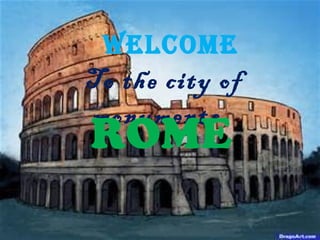
WELCOME
To the city of
monuments
ROME
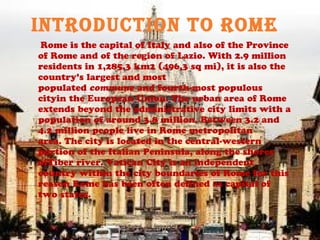
INTRODUCTION TO ROME
Rome is the capital of Italy and also of the Province
of Rome and of the region of Lazio. With 2.9 million
residents in 1,285.3 km2 (496.3 sq mi), it is also the
country's largest and most
populated commune and fourth-most populous
cityin the European Union. The urban area of Rome
extends beyond the administrative city limits with a
population of around 3.8 million. Between 3.2 and
4.2 million people live in Rome metropolitan
area. The city is located in the central-western
portion of the Italian Peninsula, along the shores
ofTiber river. Vatican City is an independent
country within the city boundaries of Rome for this
reason Rome has been often defined as capital of
two states.
History of rOME
Rome is one of the oldest named cities in the
world. Its political power was eventually
replaced by that of peoples of
mostly Germanic origin, marking the
beginning of the Middle Ages. Rome became
the seat of the Roman Catholic Church and the
home of a sovereign state, the Vatican City,
within its walls. Today it is the capital of
Italy, an international worldwide political and
cultural center, a major global city, and is
regarded as one of the most beautiful cities of
the ancient world.
Rome Education
School attendance is compulsory from ages six to
14 in Italy. Classes may be held six days a
week, and education is a serious matter. There
are many universities, educational centers, and
degrees available in higher education. Italy's
largest institution, the University of Rome, has
an enrollment of 190,000 students. Founded in
1303, the university confers many degrees in
international relations and communications. Due
to an extraordinary wealth of art, Rome is a
major center for studies in creative dance,
dramatic arts, music, and art restoration
ROME
TRANSPORTATION
1. Metro-Bus-traM
Such as in any big cities
metro station in Rome is
easy to use and faster
Metro is the easiest way to
get around in the city, for
1.50 euro it'll take you to
your destination around
the center
2. Bicycle
“Enjoy Rome” are an
English speaking company
that provide useful help
and tips for visitors to
Rome. They also organize
an exceedingly good bicycle
tour of the city.
3. Boats
In September 2008 I traveled with
Grimaldi Prestige Ferries from
Barcelona to Civitavecchia, near Rome.
The crossing time was twenty one
hour. It was a nice experience, the food
was ok and the cabin.
4. air Plane
We flew with the air company named
air europa. The flight was not direct,
first we flew from Malaga to Madrid
airport and from madrid to rome.
5. Horse carriage
Besides all the mode
transport in Rome, the
horse carriage is also one
of the easiest way to go
around the city. We
didn't take the ride is too
expensive, I have ask
some information for the
price
6.train
To travel The train
services are provided
by Trinitarian in Italy.
The rail network
connects all major
cities in Italy together.
Also, the train is the
easiest and cheapest
means of transport
Now let us
know about
ROMEThe Colosseum, Rome's second and
the world's 39th most popular tourist
attraction, with 4 million tourists a
year.
Rome is regarded the world's most
beautiful ancient cities, and contains
vast amounts of priceless works of
art, palaces, museums, parks,
churches, gardens, basilicas, temples,
villas, piazzas, theatres etc.
ITS PRIDE
ITS
MONUMENTS
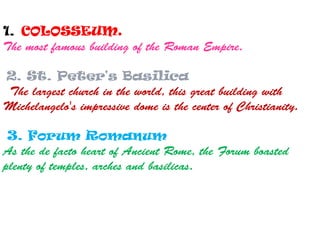
1. COLOSSEUM.
The most famous building of the Roman Empire.
2. St. Peter's Basilica
The largest church in the world, this great building with
Michelangelo's impressive dome is the center of Christianity.
3. Forum Romanum
As the de facto heart of Ancient Rome, the Forum boasted
plenty of temples, arches and basilicas.
4. Circus Maximus
The Circus Maximus was an arena specially built for
the wildly popular chariot races. The largest stadium
in ancient Rome, it had a seating capacity of over
250,000 people.
5. Mosque
Mosque of Rome built in traditional middle-eastern
Islamic style. Finished in 1995, the Mosque of Rome
is the biggest in Europe, even surpassing the Great
Mosque of Paris, and is an important centre amongst
Rome's growing Muslim community.
6. Synagogue
Great Synagogue of Rome. eclectic architecture
with slight neo-classical and Jewish influence.
The biggest and main synagogue of Rome, it
provided a place of worship to the city's Jewish
community ever since 1901-1904, when the
current eclectic edifice was constructed
Rome CuiSineS
Though present day
Italians are known
for pizza and pasta,
they were not part of
the traditional Roman
diet. In early Rome,
food consisted of
mostly soup and
boiled meats, and they
did not bake bread.
Later with influence
from cultures they
had conquered, the
Romans adapted to a
new menu.
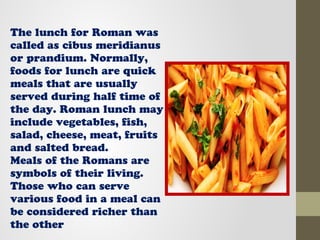
The lunch for Roman was
called as cibus meridianus
or prandium. Normally,
foods for lunch are quick
meals that are usually
served during half time of
the day. Roman lunch may
include vegetables, fish,
salad, cheese, meat, fruits
and salted bread.
Meals of the Romans are
symbols of their living.
Those who can serve
various food in a meal can
be considered richer than
the other
CONTRIBUTED BY
1.Pr iyank a jain VI I -F
2.Tejas War e VI I -F
3.H ar sh B othr a VI I - D
4.H imani M adan VI I -
A
5.Nupur Gulati VI I -A
6.Pr er na Yadav VI I -A

Welcome to the city of Rome

  • 1.
    WELCOME To the cityof monuments ROME
  • 2.
    INTRODUCTION TO ROME Romeis the capital of Italy and also of the Province of Rome and of the region of Lazio. With 2.9 million residents in 1,285.3 km2 (496.3 sq mi), it is also the country's largest and most populated commune and fourth-most populous cityin the European Union. The urban area of Rome extends beyond the administrative city limits with a population of around 3.8 million. Between 3.2 and 4.2 million people live in Rome metropolitan area. The city is located in the central-western portion of the Italian Peninsula, along the shores ofTiber river. Vatican City is an independent country within the city boundaries of Rome for this reason Rome has been often defined as capital of two states.
  • 3.
    History of rOME Romeis one of the oldest named cities in the world. Its political power was eventually replaced by that of peoples of mostly Germanic origin, marking the beginning of the Middle Ages. Rome became the seat of the Roman Catholic Church and the home of a sovereign state, the Vatican City, within its walls. Today it is the capital of Italy, an international worldwide political and cultural center, a major global city, and is regarded as one of the most beautiful cities of the ancient world.
  • 4.
    Rome Education School attendanceis compulsory from ages six to 14 in Italy. Classes may be held six days a week, and education is a serious matter. There are many universities, educational centers, and degrees available in higher education. Italy's largest institution, the University of Rome, has an enrollment of 190,000 students. Founded in 1303, the university confers many degrees in international relations and communications. Due to an extraordinary wealth of art, Rome is a major center for studies in creative dance, dramatic arts, music, and art restoration
  • 5.
  • 6.
    1. Metro-Bus-traM Such asin any big cities metro station in Rome is easy to use and faster Metro is the easiest way to get around in the city, for 1.50 euro it'll take you to your destination around the center 2. Bicycle “Enjoy Rome” are an English speaking company that provide useful help and tips for visitors to Rome. They also organize an exceedingly good bicycle tour of the city.
  • 7.
    3. Boats In September2008 I traveled with Grimaldi Prestige Ferries from Barcelona to Civitavecchia, near Rome. The crossing time was twenty one hour. It was a nice experience, the food was ok and the cabin. 4. air Plane We flew with the air company named air europa. The flight was not direct, first we flew from Malaga to Madrid airport and from madrid to rome.
  • 8.
    5. Horse carriage Besidesall the mode transport in Rome, the horse carriage is also one of the easiest way to go around the city. We didn't take the ride is too expensive, I have ask some information for the price
  • 9.
    6.train To travel Thetrain services are provided by Trinitarian in Italy. The rail network connects all major cities in Italy together. Also, the train is the easiest and cheapest means of transport
  • 10.
    Now let us knowabout ROMEThe Colosseum, Rome's second and the world's 39th most popular tourist attraction, with 4 million tourists a year. Rome is regarded the world's most beautiful ancient cities, and contains vast amounts of priceless works of art, palaces, museums, parks, churches, gardens, basilicas, temples, villas, piazzas, theatres etc.
  • 11.
  • 12.
    1. COLOSSEUM. The mostfamous building of the Roman Empire. 2. St. Peter's Basilica The largest church in the world, this great building with Michelangelo's impressive dome is the center of Christianity. 3. Forum Romanum As the de facto heart of Ancient Rome, the Forum boasted plenty of temples, arches and basilicas.
  • 13.
    4. Circus Maximus TheCircus Maximus was an arena specially built for the wildly popular chariot races. The largest stadium in ancient Rome, it had a seating capacity of over 250,000 people. 5. Mosque Mosque of Rome built in traditional middle-eastern Islamic style. Finished in 1995, the Mosque of Rome is the biggest in Europe, even surpassing the Great Mosque of Paris, and is an important centre amongst Rome's growing Muslim community.
  • 14.
    6. Synagogue Great Synagogueof Rome. eclectic architecture with slight neo-classical and Jewish influence. The biggest and main synagogue of Rome, it provided a place of worship to the city's Jewish community ever since 1901-1904, when the current eclectic edifice was constructed
  • 15.
  • 16.
    Though present day Italiansare known for pizza and pasta, they were not part of the traditional Roman diet. In early Rome, food consisted of mostly soup and boiled meats, and they did not bake bread. Later with influence from cultures they had conquered, the Romans adapted to a new menu.
  • 17.
    The lunch forRoman was called as cibus meridianus or prandium. Normally, foods for lunch are quick meals that are usually served during half time of the day. Roman lunch may include vegetables, fish, salad, cheese, meat, fruits and salted bread. Meals of the Romans are symbols of their living. Those who can serve various food in a meal can be considered richer than the other
  • 18.
    CONTRIBUTED BY 1.Pr iyanka jain VI I -F 2.Tejas War e VI I -F 3.H ar sh B othr a VI I - D 4.H imani M adan VI I - A 5.Nupur Gulati VI I -A 6.Pr er na Yadav VI I -A

Editor's Notes

  • #5 <number>