Sustainable Urban
Design
Alla Jaber Essa P81573
Abdullah Hayal Khalaf P81460
Ameer Abdul Adheem Hussein P81466 PROF. DATO' IR. DR RIZA ATIQ ABDULLAH BIN O.K. RAHMAT
Task 4: EU Best Practices
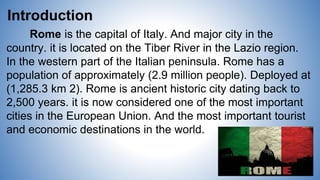
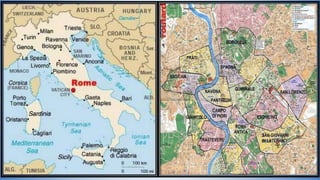
Rome is the capital of Italy. And major city in the
country. it is located on the Tiber River in the Lazio region.
In the western part of the Italian peninsula. Rome has a
population of approximately (2.9 million people). Deployed at
(1,285.3 km 2). Rome is ancient historic city dating back to
2,500 years. it is now considered one of the most important
cities in the European Union. And the most important tourist
and economic destinations in the world.
Introduction
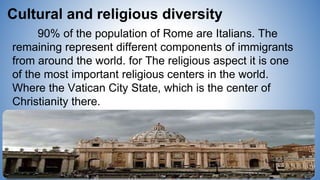
90% of the population of Rome are Italians. The
remaining represent different components of immigrants
from around the world. for The religious aspect it is one
of the most important religious centers in the world.
Where the Vatican City State, which is the center of
Christianity there.
Cultural and religious diversity
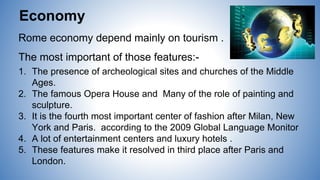
Rome economy depend mainly on tourism .
The most important of those features:-
1. The presence of archeological sites and churches of the Middle
Ages.
2. The famous Opera House and Many of the role of painting and
sculpture.
3. It is the fourth most important center of fashion after Milan, New
York and Paris. according to the 2009 Global Language Monitor
4. A lot of entertainment centers and luxury hotels .
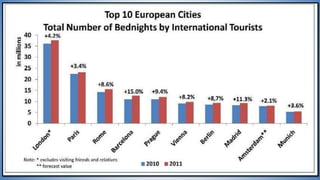
5. These features make it resolved in third place after Paris and
London.
Economy
Continue economy
And Rome consider headquarters to many multinational
corporations, including the United Nations Food and
Agriculture Organization (FAO), International Fund for
Agricultural Development (IFAD), and several World Food
programs. Service accounts for 48 percent of the gross
domestic product (GDP), industry for 35 percent, public
administration for 13 percent, and agriculture for four
percent. Most raw materials needed by Italian industry are
imported, including over 75 percent of energy
requirements.
Methods of transportation in Rome
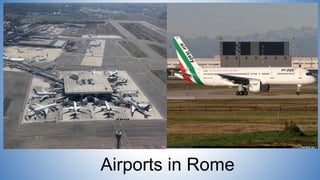
Airports in Rome
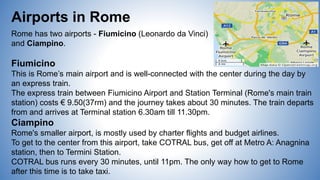
Rome has two airports - Fiumicino (Leonardo da Vinci)
and Ciampino.
Fiumicino
This is Rome’s main airport and is well-connected with the center during the day by
an express train.
The express train between Fiumicino Airport and Station Terminal (Rome's main train
station) costs € 9.50(37rm) and the journey takes about 30 minutes. The train departs
from and arrives at Terminal station 6.30am till 11.30pm.
Ciampino
Rome's smaller airport, is mostly used by charter flights and budget airlines.
To get to the center from this airport, take COTRAL bus, get off at Metro A: Anagnina
station, then to Termini Station.
COTRAL bus runs every 30 minutes, until 11pm. The only way how to get to Rome
after this time is to take taxi.
Airports in Rome
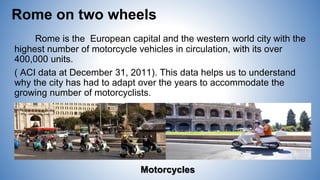
Rome on two wheels
Rome is the European capital and the western world city with the
highest number of motorcycle vehicles in circulation, with its over
400,000 units.
( ACI data at December 31, 2011). This data helps us to understand
why the city has had to adapt over the years to accommodate the
growing number of motorcyclists.
Motorcycles
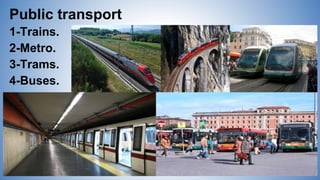
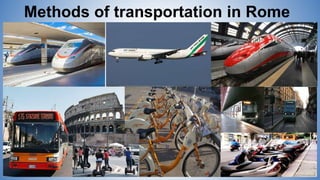
Public transport
1-Trains.
2-Metro.
3-Trams.
4-Buses.
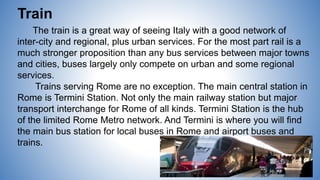
Train
The train is a great way of seeing Italy with a good network of
inter-city and regional, plus urban services. For the most part rail is a
much stronger proposition than any bus services between major towns
and cities, buses largely only compete on urban and some regional
services.
Trains serving Rome are no exception. The main central station in
Rome is Termini Station. Not only the main railway station but major
transport interchange for Rome of all kinds. Termini Station is the hub
of the limited Rome Metro network. And Termini is where you will find
the main bus station for local buses in Rome and airport buses and
trains.
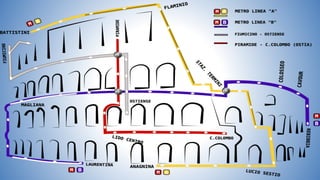
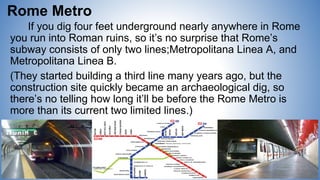
Rome Metro
If you dig four feet underground nearly anywhere in Rome
you run into Roman ruins, so it’s no surprise that Rome’s
subway consists of only two lines;Metropolitana Linea A, and
Metropolitana Linea B.
(They started building a third line many years ago, but the
construction site quickly became an archaeological dig, so
there’s no telling how long it’ll be before the Rome Metro is
more than its current two limited lines.)
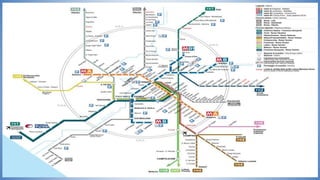
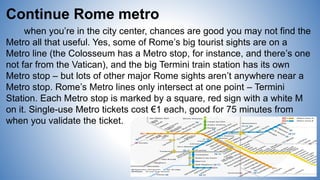
Continue Rome metro
when you’re in the city center, chances are good you may not find the
Metro all that useful. Yes, some of Rome’s big tourist sights are on a
Metro line (the Colosseum has a Metro stop, for instance, and there’s one
not far from the Vatican), and the big Termini train station has its own
Metro stop – but lots of other major Rome sights aren’t anywhere near a
Metro stop. Rome’s Metro lines only intersect at one point – Termini
Station. Each Metro stop is marked by a square, red sign with a white M
on it. Single-use Metro tickets cost €1 each, good for 75 minutes from
when you validate the ticket.
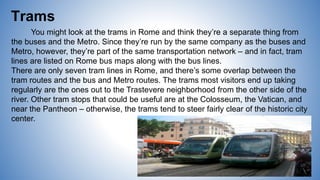
Trams
You might look at the trams in Rome and think they’re a separate thing from
the buses and the Metro. Since they’re run by the same company as the buses and
Metro, however, they’re part of the same transportation network – and in fact, tram
lines are listed on Rome bus maps along with the bus lines.
There are only seven tram lines in Rome, and there’s some overlap between the
tram routes and the bus and Metro routes. The trams most visitors end up taking
regularly are the ones out to the Trastevere neighborhood from the other side of the
river. Other tram stops that could be useful are at the Colosseum, the Vatican, and
near the Pantheon – otherwise, the trams tend to steer fairly clear of the historic city
center.
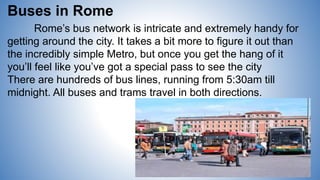
Buses in Rome
Rome’s bus network is intricate and extremely handy for
getting around the city. It takes a bit more to figure it out than
the incredibly simple Metro, but once you get the hang of it
you’ll feel like you’ve got a special pass to see the city
There are hundreds of bus lines, running from 5:30am till
midnight. All buses and trams travel in both directions.
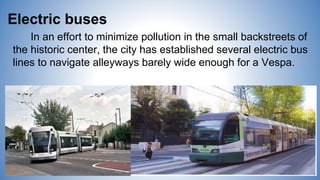
Electric buses
In an effort to minimize pollution in the small backstreets of
the historic center, the city has established several electric bus
lines to navigate alleyways barely wide enough for a Vespa.
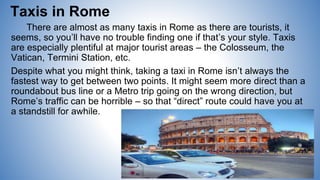
Taxis in Rome
There are almost as many taxis in Rome as there are tourists, it
seems, so you’ll have no trouble finding one if that’s your style. Taxis
are especially plentiful at major tourist areas – the Colosseum, the
Vatican, Termini Station, etc.
Despite what you might think, taking a taxi in Rome isn’t always the
fastest way to get between two points. It might seem more direct than a
roundabout bus line or a Metro trip going on the wrong direction, but
Rome’s traffic can be horrible – so that “direct” route could have you at
a standstill for awhile.
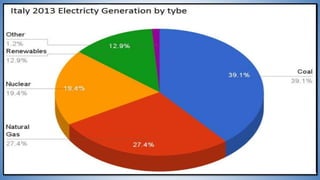
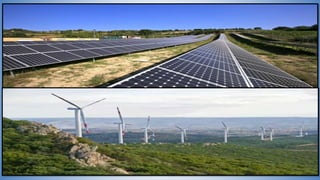
Renewal Energy
Italy tended in recent years to rely on alternative
and renewable energy sources. Where it doubled to
take advantage of those sources of 3-fold from(6.5%)
in 2004 to (16.7%) in 2014. The sources varied such as
solar and wind power and energy generated from water
flowing. Each of these sources contributed to reduce
pollution and climate change as well as benefit from
them economically.
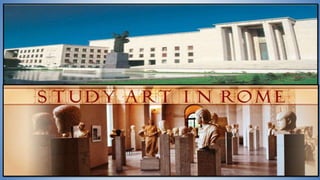
Education
School attendance is compulsory from ages six to 14 in
Italy. and education is a serious matter. There are many
universities, educational centers, and degrees available in
higher education. Italy's largest institution, the University of
Rome, has an enrollment of 190,000 students. Founded in
1303, the university confers many degrees in international
relations and communications. Due to an extraordinary wealth
of art, Rome is a major center for studies in creative dance,
dramatic arts, music, and art restoration.
The most important educational institutions
in Rome:
1- Sapienza University of Rome.
2- University of Rome "Tor Vergata.
3- University of Roma Three.
4- University of Nicholas.
5- Italian Academy.
All of the above makes Italy's capital Rome at the forefront
of European Union countries in the quality of educational
institutions.
Sustainable assignmen eu best-practice

Sustainable assignmen eu best-practice

  • 1.
    Sustainable Urban Design Alla JaberEssa P81573 Abdullah Hayal Khalaf P81460 Ameer Abdul Adheem Hussein P81466 PROF. DATO' IR. DR RIZA ATIQ ABDULLAH BIN O.K. RAHMAT Task 4: EU Best Practices
  • 2.
    Rome is thecapital of Italy. And major city in the country. it is located on the Tiber River in the Lazio region. In the western part of the Italian peninsula. Rome has a population of approximately (2.9 million people). Deployed at (1,285.3 km 2). Rome is ancient historic city dating back to 2,500 years. it is now considered one of the most important cities in the European Union. And the most important tourist and economic destinations in the world. Introduction
  • 5.
    90% of thepopulation of Rome are Italians. The remaining represent different components of immigrants from around the world. for The religious aspect it is one of the most important religious centers in the world. Where the Vatican City State, which is the center of Christianity there. Cultural and religious diversity
  • 6.
    Rome economy dependmainly on tourism . The most important of those features:- 1. The presence of archeological sites and churches of the Middle Ages. 2. The famous Opera House and Many of the role of painting and sculpture. 3. It is the fourth most important center of fashion after Milan, New York and Paris. according to the 2009 Global Language Monitor 4. A lot of entertainment centers and luxury hotels . 5. These features make it resolved in third place after Paris and London. Economy
  • 10.
    Continue economy And Romeconsider headquarters to many multinational corporations, including the United Nations Food and Agriculture Organization (FAO), International Fund for Agricultural Development (IFAD), and several World Food programs. Service accounts for 48 percent of the gross domestic product (GDP), industry for 35 percent, public administration for 13 percent, and agriculture for four percent. Most raw materials needed by Italian industry are imported, including over 75 percent of energy requirements.
  • 11.
  • 12.
    Airports in Rome Romehas two airports - Fiumicino (Leonardo da Vinci) and Ciampino. Fiumicino This is Rome’s main airport and is well-connected with the center during the day by an express train. The express train between Fiumicino Airport and Station Terminal (Rome's main train station) costs € 9.50(37rm) and the journey takes about 30 minutes. The train departs from and arrives at Terminal station 6.30am till 11.30pm. Ciampino Rome's smaller airport, is mostly used by charter flights and budget airlines. To get to the center from this airport, take COTRAL bus, get off at Metro A: Anagnina station, then to Termini Station. COTRAL bus runs every 30 minutes, until 11pm. The only way how to get to Rome after this time is to take taxi.
  • 13.
  • 14.
    Rome on twowheels Rome is the European capital and the western world city with the highest number of motorcycle vehicles in circulation, with its over 400,000 units. ( ACI data at December 31, 2011). This data helps us to understand why the city has had to adapt over the years to accommodate the growing number of motorcyclists. Motorcycles
  • 15.
  • 18.
    Train The train isa great way of seeing Italy with a good network of inter-city and regional, plus urban services. For the most part rail is a much stronger proposition than any bus services between major towns and cities, buses largely only compete on urban and some regional services. Trains serving Rome are no exception. The main central station in Rome is Termini Station. Not only the main railway station but major transport interchange for Rome of all kinds. Termini Station is the hub of the limited Rome Metro network. And Termini is where you will find the main bus station for local buses in Rome and airport buses and trains.
  • 19.
    Rome Metro If youdig four feet underground nearly anywhere in Rome you run into Roman ruins, so it’s no surprise that Rome’s subway consists of only two lines;Metropolitana Linea A, and Metropolitana Linea B. (They started building a third line many years ago, but the construction site quickly became an archaeological dig, so there’s no telling how long it’ll be before the Rome Metro is more than its current two limited lines.)
  • 20.
    Continue Rome metro whenyou’re in the city center, chances are good you may not find the Metro all that useful. Yes, some of Rome’s big tourist sights are on a Metro line (the Colosseum has a Metro stop, for instance, and there’s one not far from the Vatican), and the big Termini train station has its own Metro stop – but lots of other major Rome sights aren’t anywhere near a Metro stop. Rome’s Metro lines only intersect at one point – Termini Station. Each Metro stop is marked by a square, red sign with a white M on it. Single-use Metro tickets cost €1 each, good for 75 minutes from when you validate the ticket.
  • 21.
    Trams You might lookat the trams in Rome and think they’re a separate thing from the buses and the Metro. Since they’re run by the same company as the buses and Metro, however, they’re part of the same transportation network – and in fact, tram lines are listed on Rome bus maps along with the bus lines. There are only seven tram lines in Rome, and there’s some overlap between the tram routes and the bus and Metro routes. The trams most visitors end up taking regularly are the ones out to the Trastevere neighborhood from the other side of the river. Other tram stops that could be useful are at the Colosseum, the Vatican, and near the Pantheon – otherwise, the trams tend to steer fairly clear of the historic city center.
  • 22.
    Buses in Rome Rome’sbus network is intricate and extremely handy for getting around the city. It takes a bit more to figure it out than the incredibly simple Metro, but once you get the hang of it you’ll feel like you’ve got a special pass to see the city There are hundreds of bus lines, running from 5:30am till midnight. All buses and trams travel in both directions.
  • 23.
    Electric buses In aneffort to minimize pollution in the small backstreets of the historic center, the city has established several electric bus lines to navigate alleyways barely wide enough for a Vespa.
  • 24.
    Taxis in Rome Thereare almost as many taxis in Rome as there are tourists, it seems, so you’ll have no trouble finding one if that’s your style. Taxis are especially plentiful at major tourist areas – the Colosseum, the Vatican, Termini Station, etc. Despite what you might think, taking a taxi in Rome isn’t always the fastest way to get between two points. It might seem more direct than a roundabout bus line or a Metro trip going on the wrong direction, but Rome’s traffic can be horrible – so that “direct” route could have you at a standstill for awhile.
  • 25.
    Renewal Energy Italy tendedin recent years to rely on alternative and renewable energy sources. Where it doubled to take advantage of those sources of 3-fold from(6.5%) in 2004 to (16.7%) in 2014. The sources varied such as solar and wind power and energy generated from water flowing. Each of these sources contributed to reduce pollution and climate change as well as benefit from them economically.
  • 28.
    Education School attendance iscompulsory from ages six to 14 in Italy. and education is a serious matter. There are many universities, educational centers, and degrees available in higher education. Italy's largest institution, the University of Rome, has an enrollment of 190,000 students. Founded in 1303, the university confers many degrees in international relations and communications. Due to an extraordinary wealth of art, Rome is a major center for studies in creative dance, dramatic arts, music, and art restoration.
  • 30.
    The most importanteducational institutions in Rome: 1- Sapienza University of Rome. 2- University of Rome "Tor Vergata. 3- University of Roma Three. 4- University of Nicholas. 5- Italian Academy. All of the above makes Italy's capital Rome at the forefront of European Union countries in the quality of educational institutions.