1
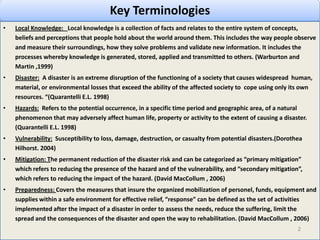
Local Knowledge:   Local knowledge is a collection of facts and relates to the entire system of concepts, beliefs and perceptions that people hold about the world around them. This includes the way people observe and measure their surroundings, how they solve problems and validate new information. It includes the processes whereby knowledge is generated, stored, applied and transmitted to others. (Warburton and Martin ,1999)
Disaster:  A disaster is an extreme disruption of the functioning of a society that causes widespread  human, material, or environmental losses that exceed the ability of the affected society to  cope using only its own resources. “(Quarantelli E.L. 1998)
Hazards:  Refers to the potential occurrence, in a specific time period and geographic area, of a natural phenomenon that may adversely affect human life, property or activity to the extent of causing a disaster. (Quarantelli E.L. 1998)
Vulnerability:  Susceptibility to loss, damage, destruction, or casualty from potential disasters.(Dorothea Hilhorst. 2004)
Mitigation: The permanent reduction of the disaster risk and can be categorized as “primary mitigation” which refers to reducing the presence of the hazard and of the vulnerability, and “secondary mitigation”, which refers to reducing the impact of the hazard. (David MacCollum , 2006)
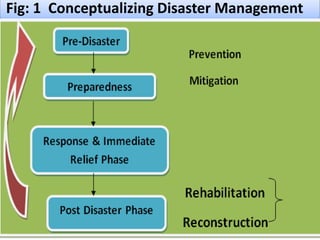
Preparedness: Covers the measures that insure the organized mobilization of personel, funds, equipment and supplies within a safe environment for effective relief, “response” can be defined as the set of activities implemented after the impact of a disaster in order to assess the needs, reduce the suffering, limit the spread and the consequences of the disaster and open the way to rehabilitation. (David MacCollum , 2006) 2
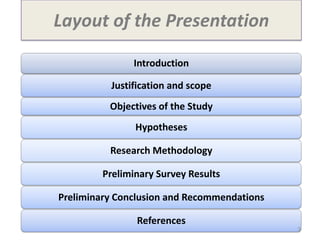
Layout of the Presentation3
4
5
6
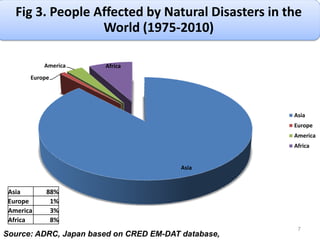
7Source: ADRC, Japan based on CRED EM-DAT database,
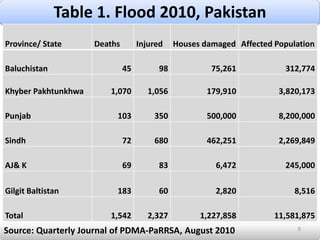
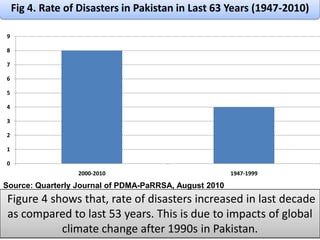
8Source: Quarterly Journal of PDMA-PaRRSA, August 2010 Figure 4 shows that, rate of disasters increased in last decade as compared to last 53 years. This is due to impacts of global climate change after 1990s in Pakistan.
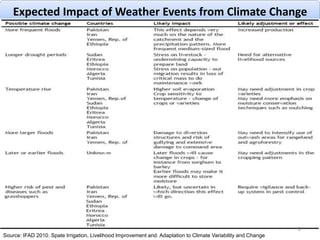
9Source: IFAD 2010. Spate Irrigation, Livelihood Improvement and. Adaptation to Climate Variability and Change
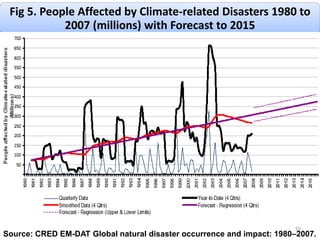
10Source: CRED EM-DAT Global natural disaster occurrence and impact: 1980–2007.
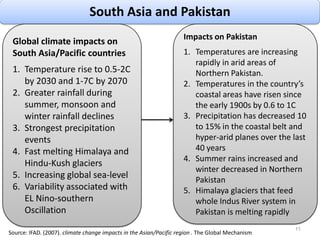
11Global climate impacts on South Asia/Pacific countriesTemperature rise to 0.5-2C by 2030 and 1-7C by 2070Greater rainfall during summer, monsoon and winter rainfall declinesStrongest precipitation eventsFast melting Himalaya and Hindu-Kush glaciersIncreasing global sea-levelVariability associated with EL Nino-southern OscillationImpacts on PakistanTemperatures are increasing rapidly in arid areas of Northern Pakistan.Temperatures in the country’s coastal areas have risen since the early 1900s by 0.6 to 1CPrecipitation has decreased 10 to 15% in the coastal belt and hyper-arid planes over the last 40 yearsSummer rains increased and winter decreased in Northern PakistanHimalaya glaciers that feed whole Indus River system in Pakistan is melting rapidlySource: IFAD. (2007). climate change impacts in the Asian/Pacific region . The Global Mechanism
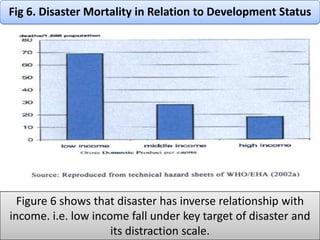
12Figure 6 shows that disaster has inverse relationship with income. i.e. low income fall under key target of disaster and its distraction scale.
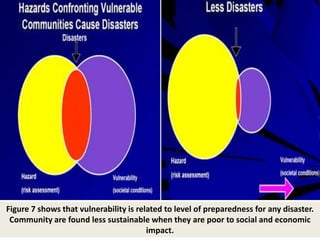
13Figure 7 shows that vulnerability is related to level of preparedness for any disaster. Community are found less sustainable when they are poor to social and economic impact.
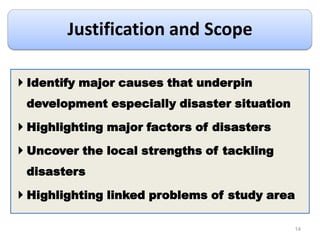
Identify major causes that underpin development especially disaster situation
Highlighting major factors of disasters
Uncover the local strengths of tackling disasters
Highlighting linked problems of study area14
There is no research in the past or limited in the form of studies conducted by public & private sectors. It is important that in academic frame work Disaster Management should be studied for sustainable policy formulation.
Disaster situation has not being studied through casual linkages in the past. This study would explore these linkages especially in the context of  Pre-Post Disaster situation in coastal areas of sindh15
To assess the role of local knowledge, skills and resources for preparedness and mitigation measures in reduction of  vulnerability in coastal communities against disaster in Sindh province of Pakistan16
Major causes of disaster in coastal belt of developing countries and relevance with Pakistan and specific in Sindh.
Extent of damages caused by various natural disasters in past 20 years in coastal area of Sindh
Accumulate local knowledge in handling and forecasting the disaster and the use of that knowledge towards preparedness of natural disasters
To analyze public initiatives in disaster management- both pre and post disaster.
To develop policy and suggestions17
The disaster in coastal belt of Sindh are same in nature that of developing countries of south Asia. I.e. India, Bangladesh etc.
There is no significant plan, preparing strategy to minimize the scale of disaster, both man-made and natural.
The scale of disaster and losses in terms of human, property and ecology are significantly high in Sindh to that of elsewhere in Pakistan.
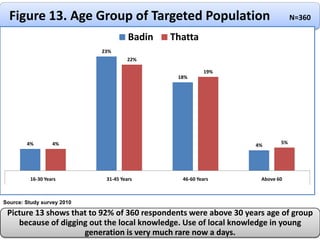
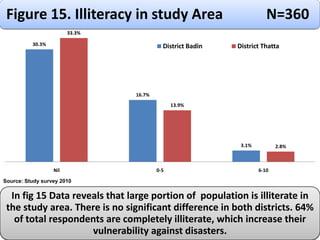
The local knowledge that includes preparedness and minimizes the scale of damages caused by disaster is significant that could be used as public policy levels. Geared towards preparing notional policy for contingency, mitigation and preparatory plans. 18
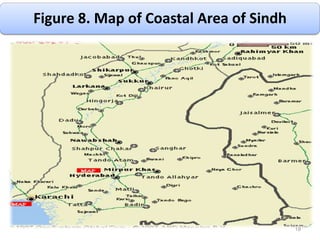
19
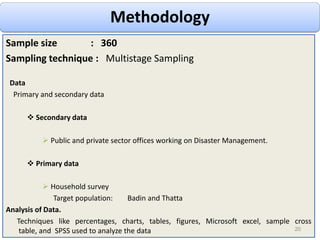
Sample size              :  360Sampling technique :   Multistage SamplingDataPrimary and secondary dataSecondary data
Public and private sector offices working on Disaster Management.
Primary data
Household survey      Target population:        Badin and ThattaAnalysis of Data.Techniques like percentages, charts, tables, figures, Microsoft excel, sample cross table, and  SPSS used to analyze the data20
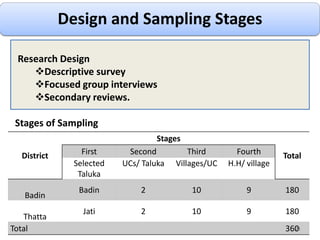
Research DesignDescriptive survey
Focused group interviews
Secondary reviews.21Stages of Sampling

Final presentation raza[1]

  • 1.
  • 2.
    Local Knowledge: Local knowledge is a collection of facts and relates to the entire system of concepts, beliefs and perceptions that people hold about the world around them. This includes the way people observe and measure their surroundings, how they solve problems and validate new information. It includes the processes whereby knowledge is generated, stored, applied and transmitted to others. (Warburton and Martin ,1999)
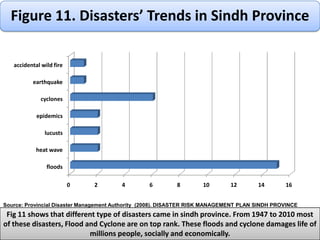
  • 3.
    Disaster: Adisaster is an extreme disruption of the functioning of a society that causes widespread human, material, or environmental losses that exceed the ability of the affected society to cope using only its own resources. “(Quarantelli E.L. 1998)
  • 4.
    Hazards: Refersto the potential occurrence, in a specific time period and geographic area, of a natural phenomenon that may adversely affect human life, property or activity to the extent of causing a disaster. (Quarantelli E.L. 1998)
  • 5.
    Vulnerability: Susceptibilityto loss, damage, destruction, or casualty from potential disasters.(Dorothea Hilhorst. 2004)
  • 6.
    Mitigation: The permanentreduction of the disaster risk and can be categorized as “primary mitigation” which refers to reducing the presence of the hazard and of the vulnerability, and “secondary mitigation”, which refers to reducing the impact of the hazard. (David MacCollum , 2006)
  • 7.
    Preparedness: Covers themeasures that insure the organized mobilization of personel, funds, equipment and supplies within a safe environment for effective relief, “response” can be defined as the set of activities implemented after the impact of a disaster in order to assess the needs, reduce the suffering, limit the spread and the consequences of the disaster and open the way to rehabilitation. (David MacCollum , 2006) 2
  • 8.
    Layout of thePresentation3
  • 9.
  • 10.
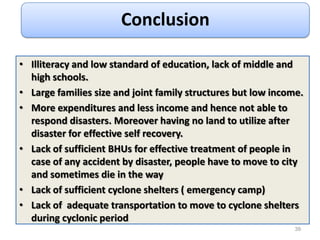
  • 11.
  • 12.
    7Source: ADRC, Japanbased on CRED EM-DAT database,
  • 13.
    8Source: Quarterly Journalof PDMA-PaRRSA, August 2010 Figure 4 shows that, rate of disasters increased in last decade as compared to last 53 years. This is due to impacts of global climate change after 1990s in Pakistan.
  • 14.
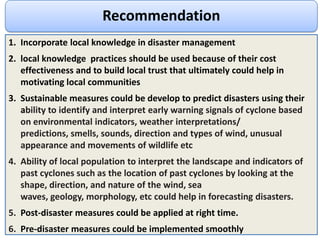
    9Source: IFAD 2010.Spate Irrigation, Livelihood Improvement and. Adaptation to Climate Variability and Change
  • 15.
    10Source: CRED EM-DATGlobal natural disaster occurrence and impact: 1980–2007.
  • 16.
    11Global climate impactson South Asia/Pacific countriesTemperature rise to 0.5-2C by 2030 and 1-7C by 2070Greater rainfall during summer, monsoon and winter rainfall declinesStrongest precipitation eventsFast melting Himalaya and Hindu-Kush glaciersIncreasing global sea-levelVariability associated with EL Nino-southern OscillationImpacts on PakistanTemperatures are increasing rapidly in arid areas of Northern Pakistan.Temperatures in the country’s coastal areas have risen since the early 1900s by 0.6 to 1CPrecipitation has decreased 10 to 15% in the coastal belt and hyper-arid planes over the last 40 yearsSummer rains increased and winter decreased in Northern PakistanHimalaya glaciers that feed whole Indus River system in Pakistan is melting rapidlySource: IFAD. (2007). climate change impacts in the Asian/Pacific region . The Global Mechanism
  • 17.
    12Figure 6 showsthat disaster has inverse relationship with income. i.e. low income fall under key target of disaster and its distraction scale.
  • 18.
    13Figure 7 showsthat vulnerability is related to level of preparedness for any disaster. Community are found less sustainable when they are poor to social and economic impact.
  • 19.
    Identify major causesthat underpin development especially disaster situation
  • 20.
  • 21.
    Uncover the localstrengths of tackling disasters
  • 22.
  • 23.
    There is noresearch in the past or limited in the form of studies conducted by public & private sectors. It is important that in academic frame work Disaster Management should be studied for sustainable policy formulation.
  • 24.
    Disaster situation hasnot being studied through casual linkages in the past. This study would explore these linkages especially in the context of Pre-Post Disaster situation in coastal areas of sindh15
  • 25.
    To assess therole of local knowledge, skills and resources for preparedness and mitigation measures in reduction of vulnerability in coastal communities against disaster in Sindh province of Pakistan16
  • 26.
    Major causes ofdisaster in coastal belt of developing countries and relevance with Pakistan and specific in Sindh.
  • 27.
    Extent of damagescaused by various natural disasters in past 20 years in coastal area of Sindh
  • 28.
    Accumulate local knowledgein handling and forecasting the disaster and the use of that knowledge towards preparedness of natural disasters
  • 29.
    To analyze publicinitiatives in disaster management- both pre and post disaster.
  • 30.
    To develop policyand suggestions17
  • 31.
    The disaster incoastal belt of Sindh are same in nature that of developing countries of south Asia. I.e. India, Bangladesh etc.
  • 32.
    There is nosignificant plan, preparing strategy to minimize the scale of disaster, both man-made and natural.
  • 33.
    The scale ofdisaster and losses in terms of human, property and ecology are significantly high in Sindh to that of elsewhere in Pakistan.
  • 34.
    The local knowledgethat includes preparedness and minimizes the scale of damages caused by disaster is significant that could be used as public policy levels. Geared towards preparing notional policy for contingency, mitigation and preparatory plans. 18
  • 35.
  • 36.
    Sample size : 360Sampling technique : Multistage SamplingDataPrimary and secondary dataSecondary data
  • 37.
    Public and privatesector offices working on Disaster Management.
  • 38.
  • 39.
    Household survey Target population: Badin and ThattaAnalysis of Data.Techniques like percentages, charts, tables, figures, Microsoft excel, sample cross table, and SPSS used to analyze the data20
  • 40.
  • 41.
  • 42.
  • 43.
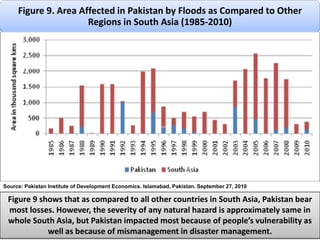
    22Source: Pakistan Instituteof Development Economics. Islamabad, Pakistan. September 27, 2010Figure 9 shows that as compared to all other countries in South Asia, Pakistan bear most losses. However, the severity of any natural hazard is approximately same in whole South Asia, but Pakistan impacted most because of people’s vulnerability as well as because of mismanagement in disaster management.
  • 44.
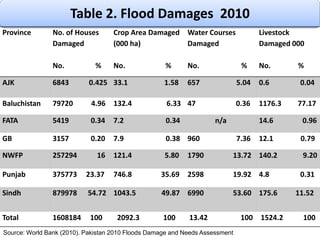
    Source: World Bank(2010). Pakistan 2010 Floods Damage and Needs Assessment
  • 45.
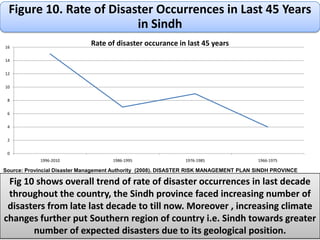
    24Source: Provincial DisasterManagement Authority (2008). DISASTER RISK MANAGEMENT PLAN SINDH PROVINCEFig 10 shows overall trend of rate of disaster occurrences in last decade throughout the country, the Sindh province faced increasing number of disasters from late last decade to till now. Moreover , increasing climate changes further put Southern region of country i.e. Sindh towards greater number of expected disasters due to its geological position.
  • 46.
    25Source: Provincial DisasterManagement Authority (2008). DISASTER RISK MANAGEMENT PLAN SINDH PROVINCEFig 11 shows that different type of disasters came in sindh province. From 1947 to 2010 most of these disasters, Flood and Cyclone are on top rank. These floods and cyclone damages life of millions people, socially and economically.
  • 47.
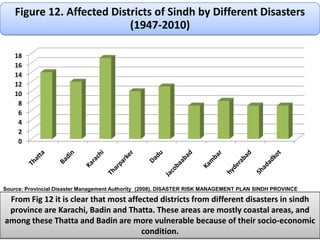
    26Source: Provincial DisasterManagement Authority (2008). DISASTER RISK MANAGEMENT PLAN SINDH PROVINCEFrom Fig 12 it is clear that most affected districts from different disasters in sindh province are Karachi, Badin and Thatta. These areas are mostly coastal areas, and among these Thatta and Badin are more vulnerable because of their socio-economic condition.
  • 48.
  • 49.
  • 50.
  • 51.
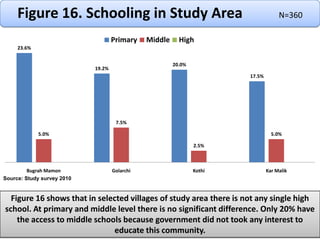
    30Source: Study survey2010Figure 16 shows that in selected villages of study area there is not any single high school. At primary and middle level there is no significant difference. Only 20% have the access to middle schools because government did not took any interest to educate this community.
  • 52.
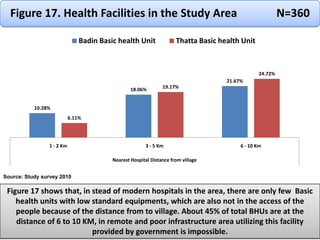
    31Source: Study survey2010Figure 17 shows that, in stead of modern hospitals in the area, there are only few Basic health units with low standard equipments, which are also not in the access of the people because of the distance from to village. About 45% of total BHUs are at the distance of 6 to 10 KM, in remote and poor infrastructure area utilizing this facility provided by government is impossible.
  • 53.
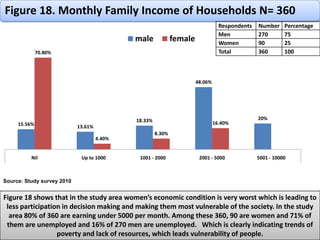
    32Source: Study survey2010Figure 18 shows that in the study area women’s economic condition is very worst which is leading to less participation in decision making and making them most vulnerable of the society. In the study area 80% of 360 are earning under 5000 per month. Among these 360, 90 are women and 71% of them are unemployed and 16% of 270 men are unemployed. Which is clearly indicating trends of poverty and lack of resources, which leads vulnerability of people.
  • 54.
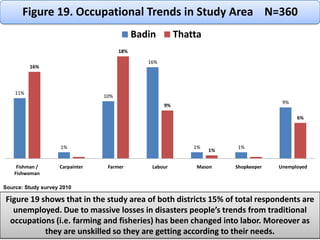
    33Source: Study survey2010Figure 19 shows that in the study area of both districts 15% of total respondents are unemployed. Due to massive losses in disasters people’s trends from traditional occupations (i.e. farming and fisheries) has been changed into labor. Moreover as they are unskilled so they are getting according to their needs.
  • 55.
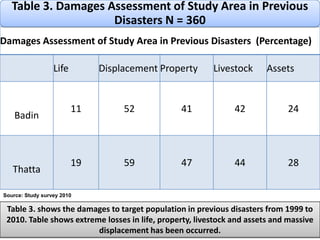
    34Source: Study survey2010Table 3. shows the damages to target population in previous disasters from 1999 to 2010. Table shows extreme losses in life, property, livestock and assets and massive displacement has been occurred.
  • 56.
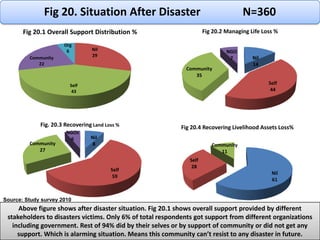
    35Source: Study survey2010Above figure shows after disaster situation. Fig 20.1 shows overall support provided by different stakeholders to disasters victims. Only 6% of total respondents got support from different organizations including government. Rest of 94% did by their selves or by support of community or did not get any support. Which is alarming situation. Means this community can’t resist to any disaster in future.
  • 57.
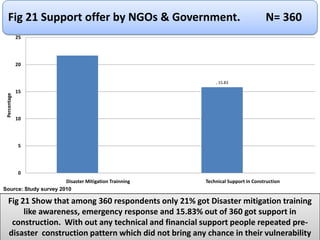
    36Source: Study survey2010Fig 21 Show that among 360 respondents only 21% got Disaster mitigation training like awareness, emergency response and 15.83% out of 360 got support in construction. With out any technical and financial support people repeated pre-disaster construction pattern which did not bring any chance in their vulnerability against disasters.
  • 58.
  • 59.
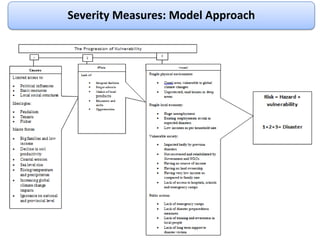
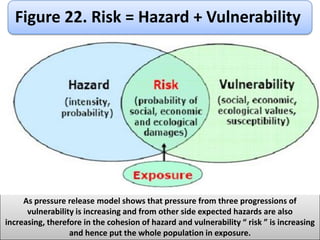
    38As pressure releasemodel shows that pressure from three progressions of vulnerability is increasing and from other side expected hazards are also increasing, therefore in the cohesion of hazard and vulnerability “ risk ” is increasing and hence put the whole population in exposure.
  • 60.
    Illiteracy and lowstandard of education, lack of middle and high schools.
  • 61.
    Large families sizeand joint family structures but low income.
  • 62.
    More expenditures andless income and hence not able to respond disasters. Moreover having no land to utilize after disaster for effective self recovery.
  • 63.
    Lack of sufficientBHUs for effective treatment of people in case of any accident by disaster, people have to move to city and sometimes die in the way
  • 64.
    Lack of sufficientcyclone shelters ( emergency camp)
  • 65.
    Lack of adequate transportation to move to cyclone shelters during cyclonic period39
  • 66.
    40Incorporate local knowledgein disaster managementlocal knowledge practices should be used because of their cost effectiveness and to build local trust that ultimately could help in motivating local communitiesSustainable measures could be develop to predict disasters using their ability to identify and interpret early warning signals of cyclone based on environmental indicators, weather interpretations/ predictions, smells, sounds, direction and types of wind, unusual appearance and movements of wildlife etcAbility of local population to interpret the landscape and indicators of past cyclones such as the location of past cyclones by looking at the shape, direction, and nature of the wind, sea waves, geology, morphology, etc could help in forecasting disasters.Post-disaster measures could be applied at right time. Pre-disaster measures could be implemented smoothly
  • 67.
    Agrawal, A. (1995).Dismantling the Divide between Indigenous and Scientific Knowledge., Development and Change, Vol. 26. Hague: Institute of Social Studies 1995
  • 68.
    Anderson, M. andWoodrow, P. (1989) Rising from the Ashes : Development Strategies in Times of Disaster. Paris:UNESCO.
  • 69.
    Bankoff, G. (2001).Rendering the World Unsafe: Vulnerability. as Western Discourse., Disasters, 2001, 25(1): 19-35. Oxford: Blackwell.
  • 70.
    Central Board ofSecondary Education (CBSE), (2006), Natural Hazards and Disaster Management. Delhi: PreetVihar.
  • 71.
    Dekens, J. (2007).local knowledge on desaster preparedness in chitral district, Pakistan. Kathmandu: ICIMOD.
  • 72.
    Dorothea Hilhorst. 2004.Mapping Vulnerability. Sterling: Earthscan
  • 73.
    David MacCollum (December18, 2006). Construction Safety Engineering Principles: Designing and Managing Safer Job Sites
  • 74.
    DRA Workshop, 24July, 2003. Asian Disaster Reduction Center.
  • 75.
    EM-DAT: Emergency EventsDatabase. (online database, accessed in August 2008).
  • 76.
    Grenier, L. (1998).working with indegenous knowledge, Aguide for researchers. Ottawa: IDRC.
  • 77.
    IFAD 2010.Spate Irrigation, Livelihood Improvement and. Adaptation to Climate Variability and Change.
  • 78.
    IFAD. (2007). climatechange impacts in the Asian/Pacific region . The Global Mechanism
  • 79.
    Larson, R.C.,M.D. Metzger, and M.F. Cahn.”Responding to emergencies: lesson learned and need for analysis”. Interfaces 37(6)(2006): 486-501.
  • 80.
    Pakistan Institute ofDevelopment Economics. Islamabad, Pakistan. September 27, 2010.
  • 81.
    Provincial Disaster ManagementAuthority (2008). DISASTER RISK MANAGEMENT PLAN SINDH PROVINCE
  • 82.
    Quarterly Journal ofPDMA-PaRRSA, August 2010.
  • 83.
    Quarantelli E.L. (1998).Where We Have Been and Where We Might Go. In: Quarantelli E.L. (ed). What Is A Disaster? London: Routledge. pp146-159
  • 84.
    Warburton and Martin(1999) and FAO Web site for Gender, Agrobiodiversity and Local Knowledge.
  • 85.
    World Bank (2010).Pakistan 2010 Floods Damage and Needs Assessment.
  • 86.
    World International StudiesConference (WISC) at BilgiUniversity.Istambul, Turkey, 24- 27 August 2005
  • 87.
    Young, E. (1997).Dealing with hazards and disasters: risk perceptions and community participation in manaement. Australian Journal of Emergency Management .41
  • 88.