
University Of Wisconsin – StoutCapstone 2: Robotic Welding CellBenjamin FerronRyan SchleisJustin ProkashRichard PikeJonathan ErlMatthew Henderson Nicholas TomsyckRobert IhrkeRolf SevertsonJacob Stephany
Overview:Bauer Welding and Metal FabricatorsFounded in 1946 by Donald K. BauerSpecializes in tube bending, fabrication, and weldingUtilizes Gas Metal Arc Welding (GMAW), Gas Tungsten Arc Welding (GTAW), laser cutting, plasma cutting, and multiple GMAW robotic welding cells to provide a diverse array of customers with high quality weldmentsCustomers include: Kawasaki, Arctic Cat, Toro, Cummins, Kubota, New Flyer, and Winnebago
Project ScopeDesign and build a demonstrable semi-automatic robotic welding cell and showcase a common industrial robot application in the UW-Stout robotics labSubstantiate repeatability of the pulsed Gas Metal Arc Welding (GMAW-P) process developed in Capstone I for production use by manufacturing representative weldments in the constructed cell
Welding Considerations Welding aluminized steel to mild steel has been a nagging manufacturability issue at BauerCurrent process uses expensive consumables (stainless steel wire, Helistar GV blended shielding gas)Current process yield is poor and joint leaks are commonPulsed Gas Metal Arc Welding (GMAW-P) process developed on test pieces in Capstone IWelding process needed to be substantiated on parts with dimensional variability typical of multiple bend tubes
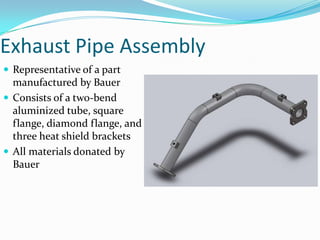
Exhaust Pipe AssemblyRepresentative of a part manufactured by BauerConsists of a two-bend aluminized tube, square flange, diamond flange, and three heat shield bracketsAll materials donated by Bauer
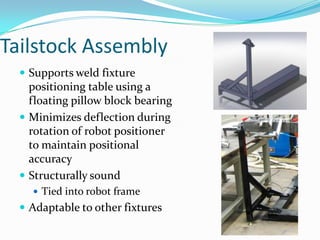
Tailstock AssemblySupports weld fixture positioning table using a floating pillow block bearingMinimizes deflection during rotation of robot positioner to maintain positional accuracyStructurally soundTied into robot frame  Adaptable to other fixtures
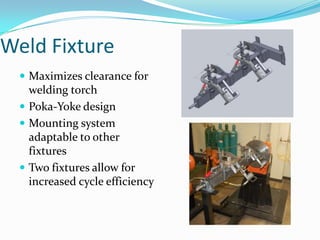
Weld FixtureMaximizes clearance for welding torchPoka-Yoke designMounting system adaptable to other fixturesTwo fixtures allow for increased cycle efficiency
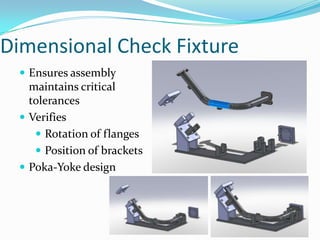
Dimensional Check FixtureEnsures assembly maintains critical tolerances
Verifies
Rotation of flanges
Position of brackets
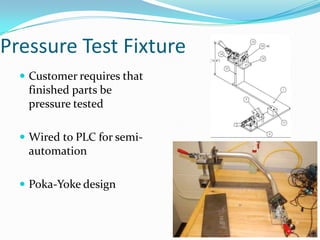
Poka-Yoke designPressure Test FixtureCustomer requires that finished parts be pressure testedWired to PLC for semi-automationPoka-Yoke design
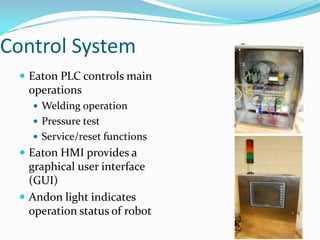
Control SystemEaton PLC controls main operationsWelding operationPressure testService/reset functionsEaton HMI provides a graphical user interface (GUI)Andon light indicates operation status of robot
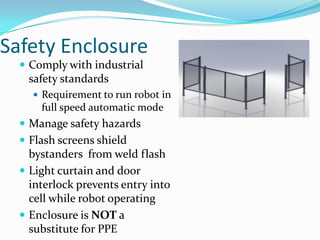
Safety EnclosureComply with industrial safety standardsRequirement to run robot in full speed automatic modeManage safety hazardsFlash screens shield bystanders  from weld flashLight curtain and door interlock prevents entry into cell while robot operatingEnclosure is NOT a substitute for PPE
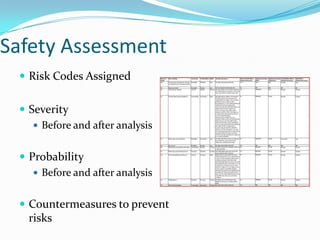
Safety AssessmentRisk Codes Assigned Severity Before and after analysis Probability Before and after analysisCountermeasures to prevent risks
Cost AssessmentRobot/positioner/welder$125,000PLC Automation$7,000Safety Enclosure$2,000Weld Fixture$3275Tailstock$335Pressure Test Fixture$890Dimensional Check Fixture$2,700Total cost for entire cell:	$141,200
Cost AssessmentStarting Budget - $1000Light Curtain Transmitter/Emitter -                            $158.00Steel for Fixtures -                                                           $43.22Toggle Clamps -                                                               $56.82Pressure Sensor Heads -                                                 $87.94Sensor Amplifiers -                                                          $222.60Steel for Enclosure -                                                        $239.14Cable for Control System-                                              $72.80Safety Signs -                                                                   $59.6										Total -            $940.12
ConclusionsSubstantiated that welding process developed in Capstone I is repeatable for production use on parts with typical dimensional variability found in multiple plane bent tubesProduced representative parts with excellent visual and sealing weld qualityConstructed a semi-automated welding cell in the UW-Stout robotics lab around the ABB IRB-1400 robot that is safe and straightforward to operate

Final presentation

  • 1.
    University Of Wisconsin– StoutCapstone 2: Robotic Welding CellBenjamin FerronRyan SchleisJustin ProkashRichard PikeJonathan ErlMatthew Henderson Nicholas TomsyckRobert IhrkeRolf SevertsonJacob Stephany
  • 2.
    Overview:Bauer Welding andMetal FabricatorsFounded in 1946 by Donald K. BauerSpecializes in tube bending, fabrication, and weldingUtilizes Gas Metal Arc Welding (GMAW), Gas Tungsten Arc Welding (GTAW), laser cutting, plasma cutting, and multiple GMAW robotic welding cells to provide a diverse array of customers with high quality weldmentsCustomers include: Kawasaki, Arctic Cat, Toro, Cummins, Kubota, New Flyer, and Winnebago
  • 3.
    Project ScopeDesign andbuild a demonstrable semi-automatic robotic welding cell and showcase a common industrial robot application in the UW-Stout robotics labSubstantiate repeatability of the pulsed Gas Metal Arc Welding (GMAW-P) process developed in Capstone I for production use by manufacturing representative weldments in the constructed cell
  • 4.
    Welding Considerations Weldingaluminized steel to mild steel has been a nagging manufacturability issue at BauerCurrent process uses expensive consumables (stainless steel wire, Helistar GV blended shielding gas)Current process yield is poor and joint leaks are commonPulsed Gas Metal Arc Welding (GMAW-P) process developed on test pieces in Capstone IWelding process needed to be substantiated on parts with dimensional variability typical of multiple bend tubes
  • 5.
    Exhaust Pipe AssemblyRepresentativeof a part manufactured by BauerConsists of a two-bend aluminized tube, square flange, diamond flange, and three heat shield bracketsAll materials donated by Bauer
  • 6.
    Tailstock AssemblySupports weldfixture positioning table using a floating pillow block bearingMinimizes deflection during rotation of robot positioner to maintain positional accuracyStructurally soundTied into robot frame Adaptable to other fixtures
  • 7.
    Weld FixtureMaximizes clearancefor welding torchPoka-Yoke designMounting system adaptable to other fixturesTwo fixtures allow for increased cycle efficiency
  • 8.
    Dimensional Check FixtureEnsuresassembly maintains critical tolerances
  • 9.
  • 10.
  • 11.
  • 12.
    Poka-Yoke designPressure TestFixtureCustomer requires that finished parts be pressure testedWired to PLC for semi-automationPoka-Yoke design
  • 13.
    Control SystemEaton PLCcontrols main operationsWelding operationPressure testService/reset functionsEaton HMI provides a graphical user interface (GUI)Andon light indicates operation status of robot
  • 14.
    Safety EnclosureComply withindustrial safety standardsRequirement to run robot in full speed automatic modeManage safety hazardsFlash screens shield bystanders from weld flashLight curtain and door interlock prevents entry into cell while robot operatingEnclosure is NOT a substitute for PPE
  • 15.
    Safety AssessmentRisk CodesAssigned Severity Before and after analysis Probability Before and after analysisCountermeasures to prevent risks
  • 16.
    Cost AssessmentRobot/positioner/welder$125,000PLC Automation$7,000SafetyEnclosure$2,000Weld Fixture$3275Tailstock$335Pressure Test Fixture$890Dimensional Check Fixture$2,700Total cost for entire cell: $141,200
  • 17.
    Cost AssessmentStarting Budget- $1000Light Curtain Transmitter/Emitter - $158.00Steel for Fixtures - $43.22Toggle Clamps - $56.82Pressure Sensor Heads - $87.94Sensor Amplifiers - $222.60Steel for Enclosure - $239.14Cable for Control System- $72.80Safety Signs - $59.6 Total - $940.12
  • 18.
    ConclusionsSubstantiated that weldingprocess developed in Capstone I is repeatable for production use on parts with typical dimensional variability found in multiple plane bent tubesProduced representative parts with excellent visual and sealing weld qualityConstructed a semi-automated welding cell in the UW-Stout robotics lab around the ABB IRB-1400 robot that is safe and straightforward to operate

Editor's Notes