External Secondary Data & Data Analysis Week 2 (3) Dr. Kelly Page Cardiff Business School E: pagekl@cardiff.ac.uk T: @drkellypage T: @caseinsights FB: kelly@caseinsights.com
Lecture Objectives Review internal & external types of secondary data sources Compare & contrast the different types of published external data sources Compare & contrast the differing types of ‘computerised databases’ available that store secondary data Understand the role & services offered by syndicated ‘secondary data’ services Understand the differing methods used to collect and merge data for the provision of syndicated data services Understand how to analyse secondary data
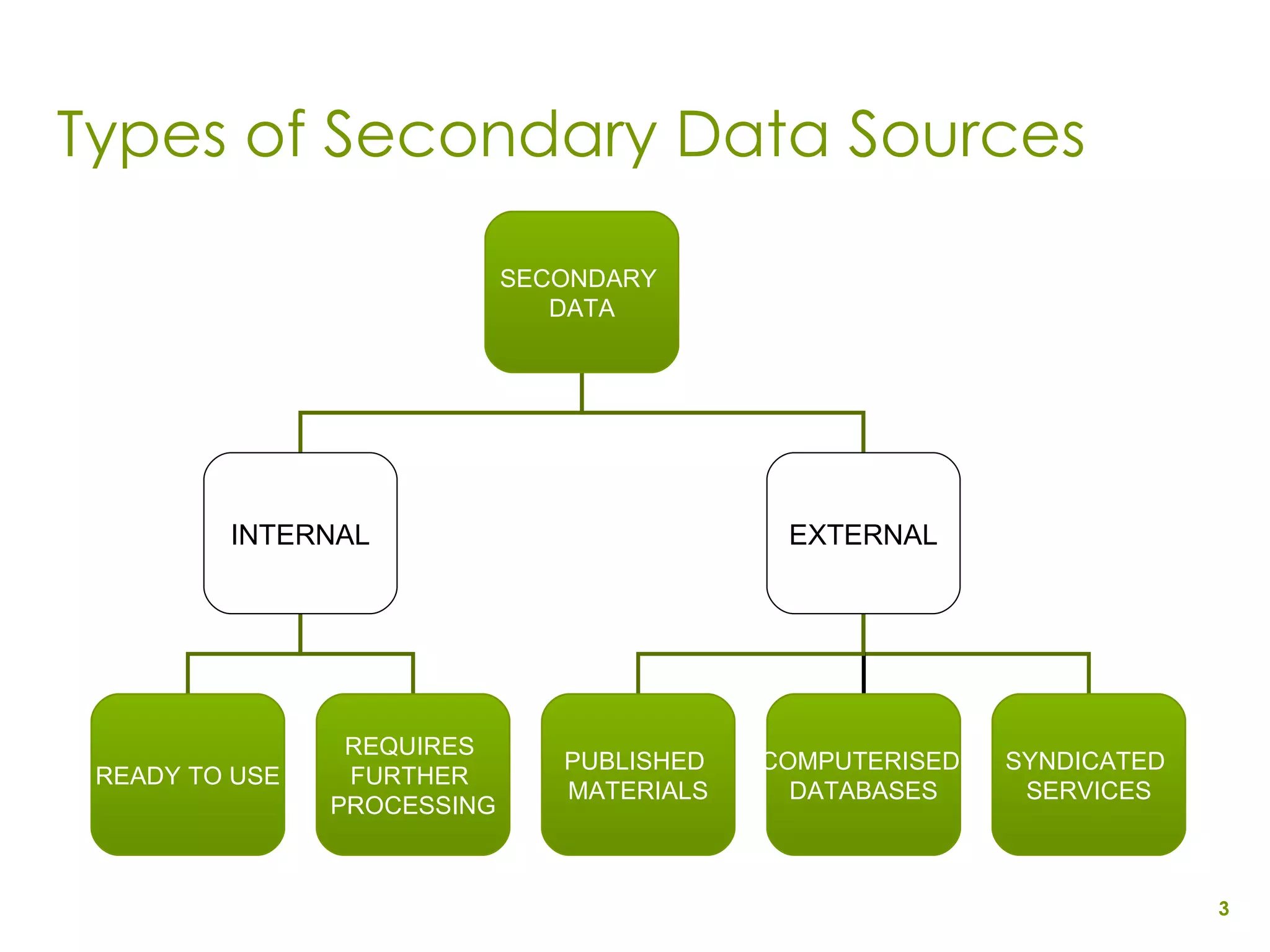
Types of Secondary Data Sources SECONDARY  DATA INTERNAL EXTERNAL READY TO USE REQUIRES  FURTHER  PROCESSING PUBLISHED  MATERIALS COMPUTERISED  DATABASES SYNDICATED  SERVICES
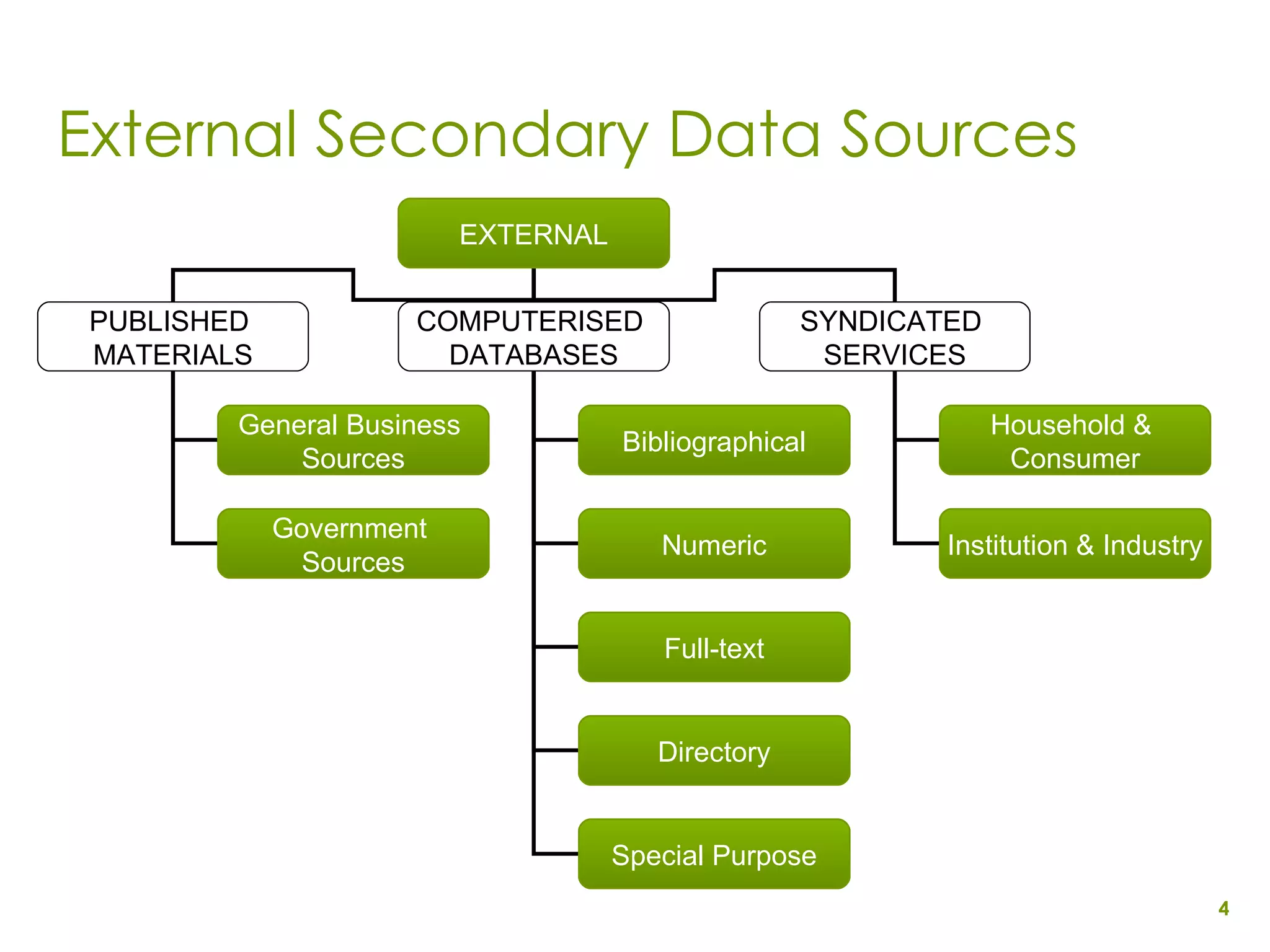
External Secondary Data Sources EXTERNAL PUBLISHED  MATERIALS COMPUTERISED  DATABASES SYNDICATED  SERVICES General Business  Sources Government  Sources Bibliographical Numeric Full-text Household &  Consumer Institution & Industry Directory Special Purpose
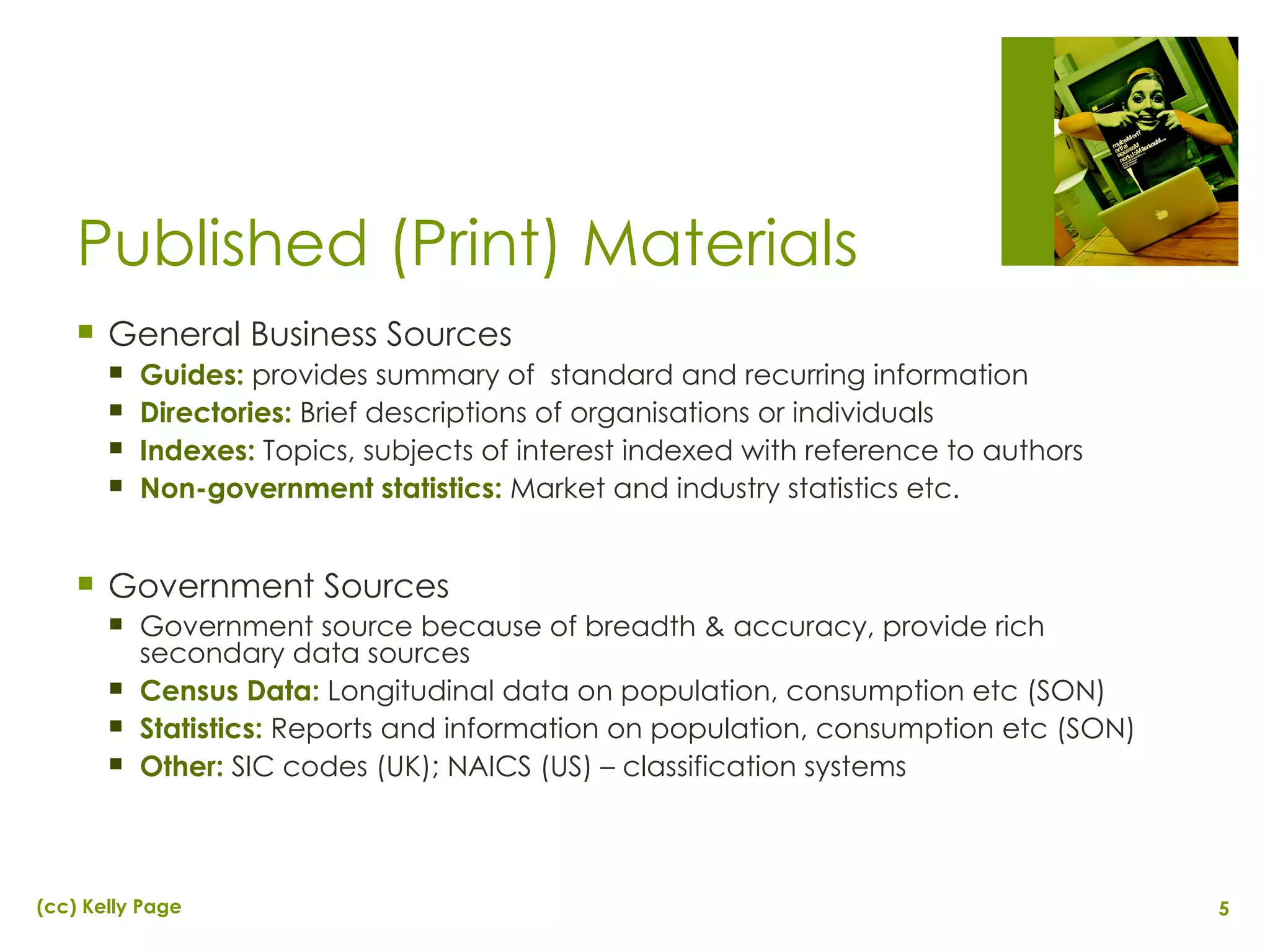
Published (Print) Materials General Business Sources Guides:   provides summary of  standard and recurring information  Directories:   Brief descriptions of organisations or individuals Indexes:   Topics, subjects of interest indexed with reference to authors Non-government statistics:   Market and industry statistics etc. Government Sources Government source because of breadth & accuracy, provide rich secondary data sources Census Data:   Longitudinal data on population, consumption etc (SON)  Statistics:   Reports and information on population, consumption etc (SON) Other:   SIC codes (UK); NAICS (US) – classification systems
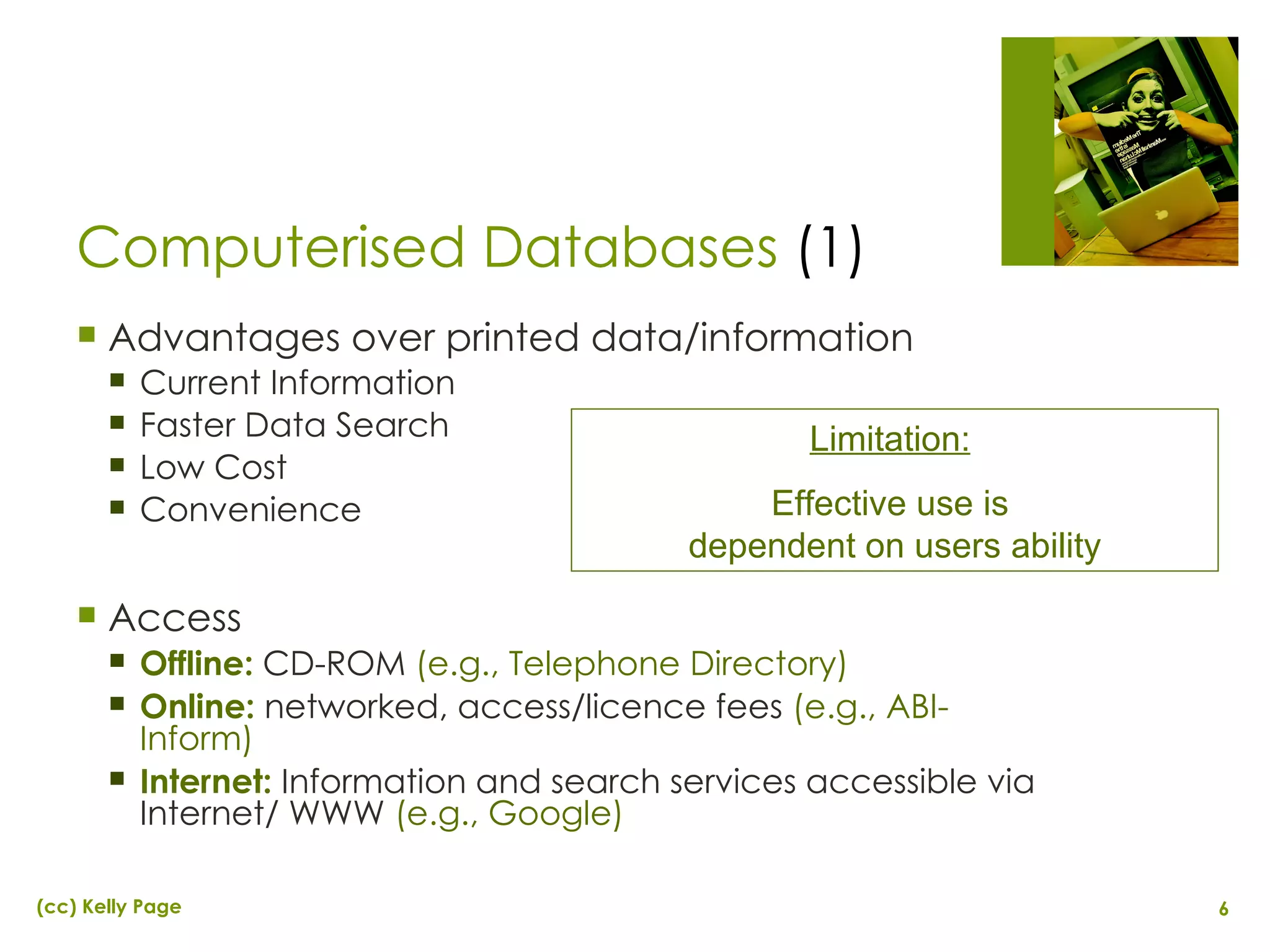
Computerised Databases  (1) Advantages over printed data/information Current Information Faster Data Search Low Cost Convenience Access Offline:   CD-ROM  (e.g., Telephone Directory) Online:   networked, access/licence fees  (e.g., ABI-Inform) Internet:   Information and search services accessible via Internet/ WWW  (e.g., Google) Limitation:   Effective use is  dependent on users ability
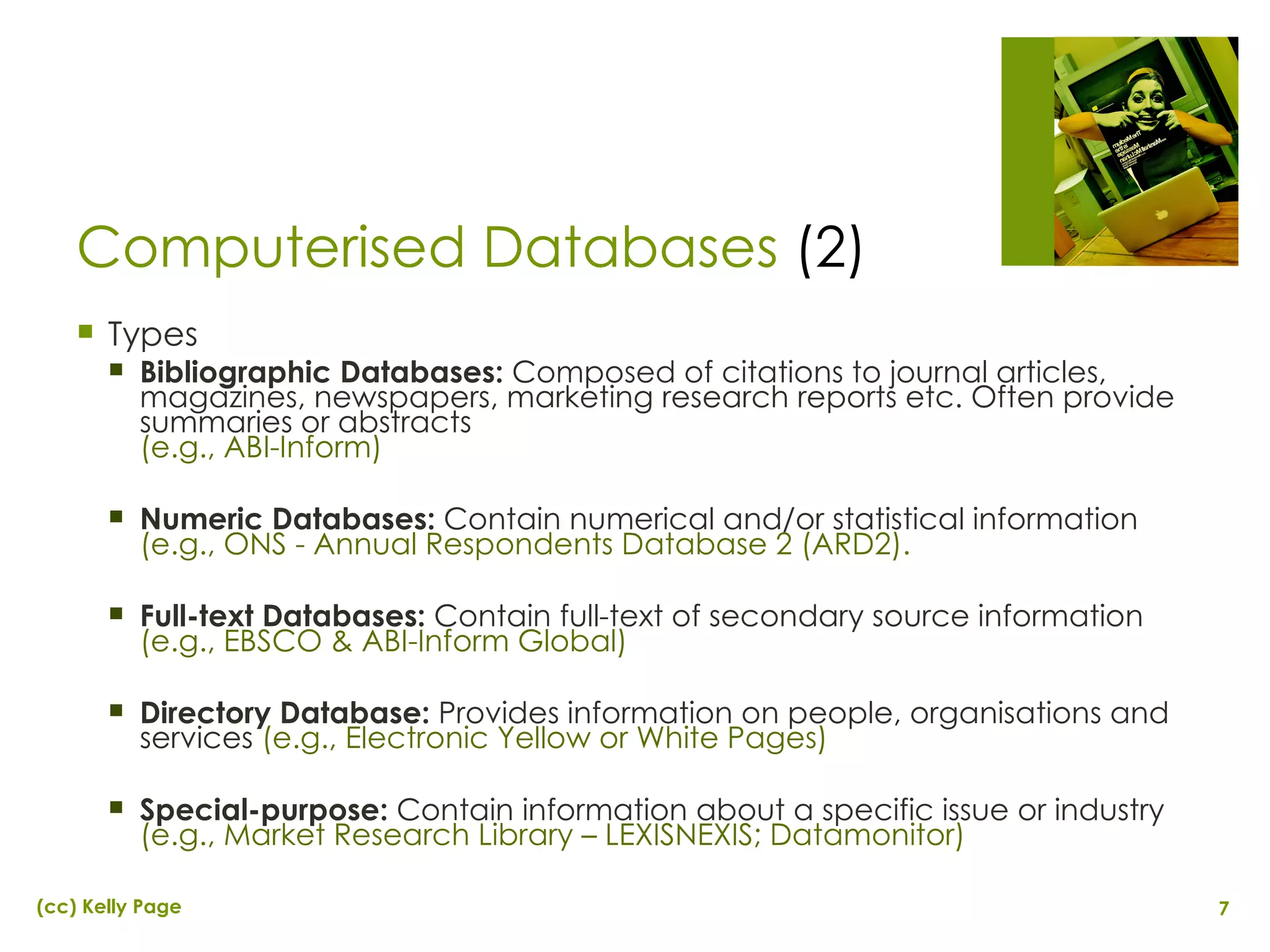
Computerised Databases  (2) Types Bibliographic Databases:   Composed of citations to journal articles, magazines, newspapers, marketing research reports etc. Often provide summaries or abstracts  (e.g., ABI-Inform) Numeric Databases:  Contain numerical and/or statistical information  (e.g., ONS - Annual Respondents Database 2 (ARD2). Full-text Databases:  Contain full-text of secondary source information  (e.g., EBSCO & ABI-Inform Global) Directory Database:  Provides information on people, organisations and services  (e.g., Electronic Yellow or White Pages)  Special-purpose:  Contain information about a specific issue or industry  (e.g., Market Research Library – LEXISNEXIS; Datamonitor)
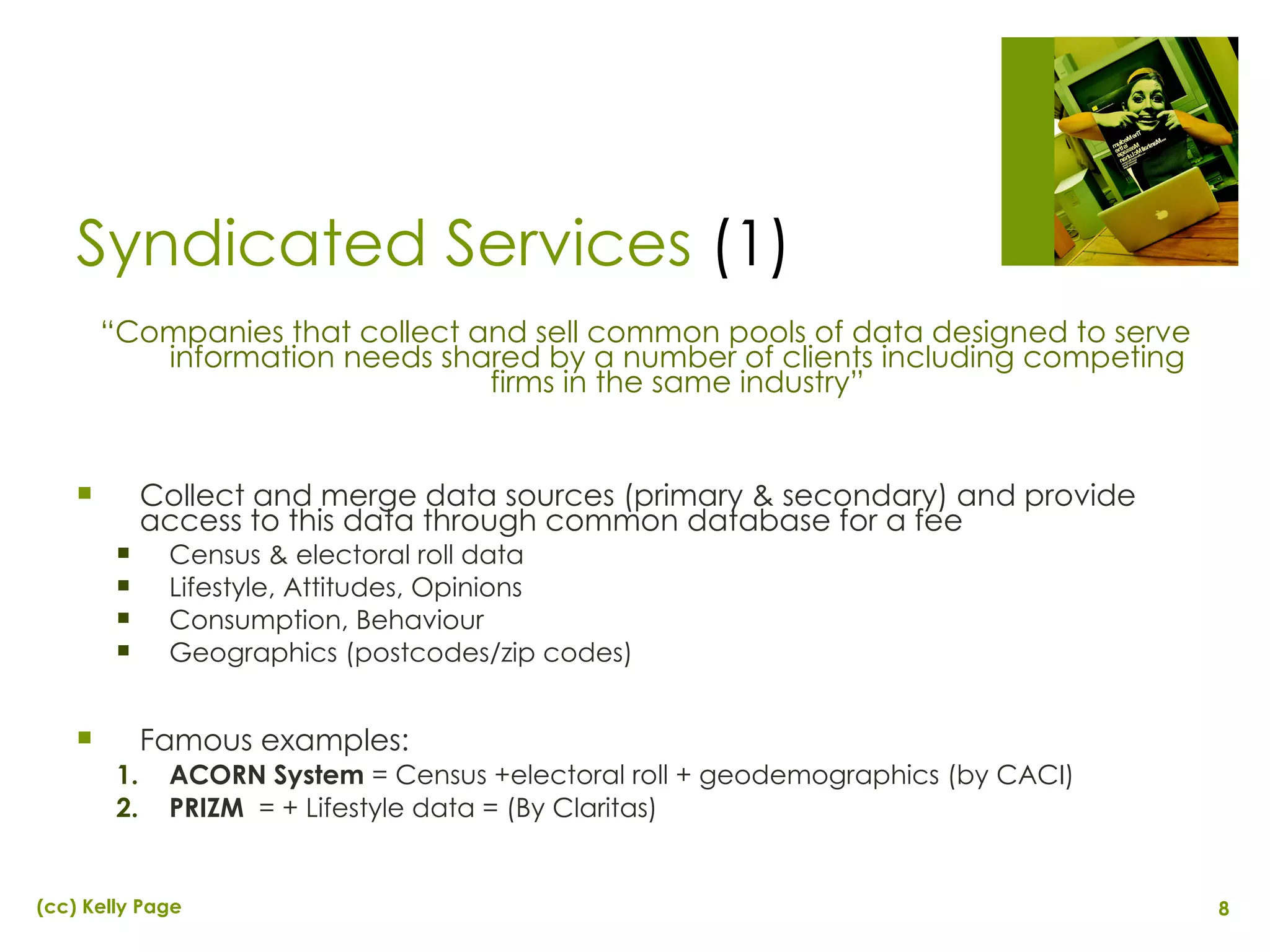
Syndicated Services  (1) “ Companies that collect and sell common pools of data designed to serve information needs shared by a number of clients including competing firms in the same industry” Collect and merge data sources (primary & secondary) and provide access to this data through common database for a fee Census & electoral roll data Lifestyle, Attitudes, Opinions Consumption, Behaviour Geographics (postcodes/zip codes) Famous examples: ACORN System  = Census +electoral roll + geodemographics (by CACI)  PRIZM   = + Lifestyle data = (By Claritas)
Syndicated Services  (2) Unit of  Measurement Household  &  Consumers Institutions Surveys Panels Retailers Wholesalers Industrial  Firms Electronic  Scanner  Services
Household / Consumers  (1) General values & lifestyles, media use, product purchase patterns.  Collection Methods include Surveys, Panels & Scanner Surveys:  General:  periodic  (different sample over time) , panel  (same sample over time)  & shared  (omnibus – Gfk NOP) Psychographic & lifestyles:  Psychological profiles of consumers activities, interest & opinions  (VALS – www.sric-bi.com; Claritas PRIZM System)   Advertising Evaluation:  Measure size & profile of audiences  (TV, Print etc) Polls:  Key issues of currency/relevance  (e.g., election polls)
Household / Consumers  (2) Panels:  Groups of individuals, households or organisations that record their  behaviour   over time  (e.g., diary, Internet) Purchase:  Respondents record purchases in diary or on Internet  (e.g., TNS purchase panels)   Media Usage:  Electronic devices  (e.g., peoplemeter)  record viewing behaviour  (Arbitron, Nielsen Media Research & NetRatings) Other:  Product usage etc.  Electronic Scanner Panels Data obtained from electronic scanning of universal product codes (UPC) purchased by panel members AcNielsen  (www.acnielsen.com)  & Information Resources  (www.infores.com)
Institutions  (1) Syndicated data collected from Institutions, companies by industry. Data Collection Method: Audits Data derived from physical records or inventory analysis Data based on counts of physical objects (as opposed to people).  Retailer & Wholesaler Audits Product movement throughout supply chain Track inventory flow, current inventory levels, and impact of promotional & pricing programs on inventory levels  (electronic data collection).  E.g., ACNielsen Convenience Track (www.acnielsen.com) retail audit of convenience stores Industry Services Syndicated data about firms, businesses etc. such as financial, operating and employment data by industry category (SIC)
Secondary data analysis Secondary data analysis lends itself to trend & issue analysis – looking at changes over time or at current point in time. Type of analysis is dependent on secondary data acquired:  Raw Data  =  Datamining & quantitative analysis Script Data  =  Content analysis Content Analysis Unit of Analysis:  words, figures/graphs, pictures, sounds etc  Coding:  Two types: Latent coding: subjective assessment about content context & meaning Manifest coding: quantitative account of unit of analysis Reporting:  Summarise into meaningful structure
Summary Slide Lecture Objectives Types of Secondary Data Sources External Secondary Data Sources Published (Print) Materials Computerised Databases Syndicated Services Secondary data analysis
The content of this work is of shared interest between the author, Kelly Page and other parties who have contributed and/or provided support for the generation of the content detailed within.  This work is licensed under a Creative Commons  Attribution-NonCommercial-Share Alike 2.0 UK: England & Wales.  http://creativecommons.org/ Kelly Page (cc)

External Secondary Data Sources

  • 1.
    External Secondary Data& Data Analysis Week 2 (3) Dr. Kelly Page Cardiff Business School E: pagekl@cardiff.ac.uk T: @drkellypage T: @caseinsights FB: kelly@caseinsights.com
  • 2.
    Lecture Objectives Reviewinternal & external types of secondary data sources Compare & contrast the different types of published external data sources Compare & contrast the differing types of ‘computerised databases’ available that store secondary data Understand the role & services offered by syndicated ‘secondary data’ services Understand the differing methods used to collect and merge data for the provision of syndicated data services Understand how to analyse secondary data
  • 3.
    Types of SecondaryData Sources SECONDARY DATA INTERNAL EXTERNAL READY TO USE REQUIRES FURTHER PROCESSING PUBLISHED MATERIALS COMPUTERISED DATABASES SYNDICATED SERVICES
  • 4.
    External Secondary DataSources EXTERNAL PUBLISHED MATERIALS COMPUTERISED DATABASES SYNDICATED SERVICES General Business Sources Government Sources Bibliographical Numeric Full-text Household & Consumer Institution & Industry Directory Special Purpose
  • 5.
    Published (Print) MaterialsGeneral Business Sources Guides: provides summary of standard and recurring information Directories: Brief descriptions of organisations or individuals Indexes: Topics, subjects of interest indexed with reference to authors Non-government statistics: Market and industry statistics etc. Government Sources Government source because of breadth & accuracy, provide rich secondary data sources Census Data: Longitudinal data on population, consumption etc (SON) Statistics: Reports and information on population, consumption etc (SON) Other: SIC codes (UK); NAICS (US) – classification systems
  • 6.
    Computerised Databases (1) Advantages over printed data/information Current Information Faster Data Search Low Cost Convenience Access Offline: CD-ROM (e.g., Telephone Directory) Online: networked, access/licence fees (e.g., ABI-Inform) Internet: Information and search services accessible via Internet/ WWW (e.g., Google) Limitation: Effective use is dependent on users ability
  • 7.
    Computerised Databases (2) Types Bibliographic Databases: Composed of citations to journal articles, magazines, newspapers, marketing research reports etc. Often provide summaries or abstracts (e.g., ABI-Inform) Numeric Databases: Contain numerical and/or statistical information (e.g., ONS - Annual Respondents Database 2 (ARD2). Full-text Databases: Contain full-text of secondary source information (e.g., EBSCO & ABI-Inform Global) Directory Database: Provides information on people, organisations and services (e.g., Electronic Yellow or White Pages) Special-purpose: Contain information about a specific issue or industry (e.g., Market Research Library – LEXISNEXIS; Datamonitor)
  • 8.
    Syndicated Services (1) “ Companies that collect and sell common pools of data designed to serve information needs shared by a number of clients including competing firms in the same industry” Collect and merge data sources (primary & secondary) and provide access to this data through common database for a fee Census & electoral roll data Lifestyle, Attitudes, Opinions Consumption, Behaviour Geographics (postcodes/zip codes) Famous examples: ACORN System = Census +electoral roll + geodemographics (by CACI) PRIZM = + Lifestyle data = (By Claritas)
  • 9.
    Syndicated Services (2) Unit of Measurement Household & Consumers Institutions Surveys Panels Retailers Wholesalers Industrial Firms Electronic Scanner Services
  • 10.
    Household / Consumers (1) General values & lifestyles, media use, product purchase patterns. Collection Methods include Surveys, Panels & Scanner Surveys: General: periodic (different sample over time) , panel (same sample over time) & shared (omnibus – Gfk NOP) Psychographic & lifestyles: Psychological profiles of consumers activities, interest & opinions (VALS – www.sric-bi.com; Claritas PRIZM System) Advertising Evaluation: Measure size & profile of audiences (TV, Print etc) Polls: Key issues of currency/relevance (e.g., election polls)
  • 11.
    Household / Consumers (2) Panels: Groups of individuals, households or organisations that record their behaviour over time (e.g., diary, Internet) Purchase: Respondents record purchases in diary or on Internet (e.g., TNS purchase panels) Media Usage: Electronic devices (e.g., peoplemeter) record viewing behaviour (Arbitron, Nielsen Media Research & NetRatings) Other: Product usage etc. Electronic Scanner Panels Data obtained from electronic scanning of universal product codes (UPC) purchased by panel members AcNielsen (www.acnielsen.com) & Information Resources (www.infores.com)
  • 12.
    Institutions (1)Syndicated data collected from Institutions, companies by industry. Data Collection Method: Audits Data derived from physical records or inventory analysis Data based on counts of physical objects (as opposed to people). Retailer & Wholesaler Audits Product movement throughout supply chain Track inventory flow, current inventory levels, and impact of promotional & pricing programs on inventory levels (electronic data collection). E.g., ACNielsen Convenience Track (www.acnielsen.com) retail audit of convenience stores Industry Services Syndicated data about firms, businesses etc. such as financial, operating and employment data by industry category (SIC)
  • 13.
    Secondary data analysisSecondary data analysis lends itself to trend & issue analysis – looking at changes over time or at current point in time. Type of analysis is dependent on secondary data acquired: Raw Data = Datamining & quantitative analysis Script Data = Content analysis Content Analysis Unit of Analysis: words, figures/graphs, pictures, sounds etc Coding: Two types: Latent coding: subjective assessment about content context & meaning Manifest coding: quantitative account of unit of analysis Reporting: Summarise into meaningful structure
  • 14.
    Summary Slide LectureObjectives Types of Secondary Data Sources External Secondary Data Sources Published (Print) Materials Computerised Databases Syndicated Services Secondary data analysis
  • 15.
    The content ofthis work is of shared interest between the author, Kelly Page and other parties who have contributed and/or provided support for the generation of the content detailed within. This work is licensed under a Creative Commons Attribution-NonCommercial-Share Alike 2.0 UK: England & Wales. http://creativecommons.org/ Kelly Page (cc)