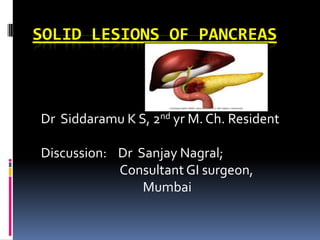
SOLID LESIONS OF PANCREAS


Dr Siddaramu K S, 2nd yr M. Ch. Resident

Discussion: Dr Sanjay Nagral;
            Consultant GI surgeon,
                Mumbai
Case history

 67 yr/ M
 Progressive weight loss( 15 kg/ 6 months)
 Progressive jaundice
 No Health related problem in the past,
 No H/o tobacco in any form, nor alcohol.
 Exercised daily , Vegetarian .
 1st seen by Physician -- found to be healthy
    and Fit
   Vitals Stable , Systemic exam Unremarkable.
   Hb - 13.5, TC - 6,500 , ESR - 13 mm at one
    hour.
   Blood sugar was 481mg on fasting state.
   Diagnosed to have MOD, on Gliclazide 160
    mg/d.
   Week later FBS 116mg and PPBS 174 mg .
 Continued to lose weight, slower rate.
 CBC -No change.
 Diabetes reasonably well controlled ,
 General examination again unremarkable.
 Thyroid Function- euthyroid status.
 US Abdomen
          Mass 1.9 * 3.1 cms in head of pancreas,
          Atrophic pancreas and mildly dilated PD.
   CBD 9 mm dilated , smooth tapering lower end.
 LFT -
         TB 4.3 mg- 70% conjugated,
           SGPT- 75 i.u ALP -841 I.U.
 CA 19-9 was 14.5
 Chest X-ray was normal.
 CECT - similar finding to US.
  Mass located within the pancreas.
  Fat plane b/t pancreas and stomach
  maintained.
 No involvement of major blood vessels.
 No metastatic disease detected .

 Clinical diagnosis -- Pancreatic head mass, most
  probably neoplasm in back ground of chronic
  pancreatitis.
Hmmmm………

 Q: What is your Analysis?


 What will you do next?
 Endoscopic Ultra sonography - carried out .
 Ill defined mass lesion in the head
 Pancreas atrophied and slightly hypo-
  echoic,
 Mild MPD dilatation ,no stricture or stone .
 CBD appeared compressed inside the mass
  but no stone
 Mass did not appear to involve major vessels
 Fat plane between the pancreas and stomach
  intact.

FNA was obtained.
 Showed inflammatory cells only.
What should I do now?

 Refer to oncosurgeon?


 Repeat EUS?


 Review the FNA sample?
Evaluating Solid lesions of
Pancreas

 Epidemiology
 Most common presentations
 Imaging
 Serology
 Histology
Solid lesions -

Neoplastic
 Ductal adenocarcinoma( 85-90%)
 Neuroendocrine tumor (upto 5%)
 Solid psedopapillary neoplasm (1-2%)
 Pancreatoblastoma( 0.2%)
 Lymphoma(0.5%)
 Metastatic tumors (2-5%)
 Miscellaneous neoplasms
Non Neoplastic

 Focal Pancreatits, Autoimmune Pancreatitis, (
  5-10%)
 Lipomatous       pseudo     hypertrophy(fatty
  infiltration)
 Congenital anomalies (Bifid Pancreas,
  Pancreatic Divisum, Prominent lobulation)
 Intra pancreatic accessory spleen
 Miscellaneous: Tuberculosis, Sarcoidosis,
  Castleman
Epidemiology of Solid lesions

 1-10 yrs – Pancreatoblastoma,Congenital
    anomalies.
   20-30 yrs -- Solid psedopapillary tumor(F:M
    9:1)
   30-40 yrs -- Chronic Pancreatitis
   50-60 yrs -- NET,Metastasis, Lymphoma
   More than 60yrs - Ductal Adenocarcinoma,
    Autoimmune pancreatitis (M:F 2:1)
Clinical Presentation of
solid lesions
 Nonspecific in Majority
 Abdominal pain , weight loss,progressive
  obstructive Jaundice. – PDA
 Recurrent pain.--CP
 H/o RCC,Sarcoidosis,TB, Immuno deficiency
 Symptoms of lymphoma( fever,chills,night
  sweats)
Imaging

 Trans Abd USG:
         Accuracy is 50-70%
Contrast Enhanced Doppler US

Major limitations of US
           Detection of small tumors (< 2 cm)

           Lesions in the left side of the pancreatic gland,
After   USG what?????

EUS or CECT ?
EUS
Advantages
 Detect masses as small as 0.2–0.3 cm.
 Clarify equivocal findings at CT or MR
 Allows biopsy of suspect lesions.
 More sensitive than CT (98% vs 86%)
 Accurate in local tumor staging (67% vs 47%).
 Pitfalls
 It is highly operator dependent
 Presence of SA calcification, Billroth II,large Hiatus hernia,
   varices
 Availability
 Narrow field of view
CECT VS EUS
Advantages of CECT:
   1. Availability – widely used.
   2. Resectability ,Distant Mets better tool
   3. Vascular Anatomy -3D Reconstruction
   4. Low cost
Limitations :
     1.Difficulty in small lesions <1-2cm
     2.Inflammtory mass- False appearance
     3. Radiation.
     4.Needle tract seeding (cutaneous & Peritoneal)
CECT Abdomen

 Investigation of choice in Majority(85-97%
  sensitivity)
 Dual Phase Multi Detector CT
 Hypodense , irregular border,
     Peripancreatic vessel involvement,    PDA
        Double duct sign
    Upstream MPD Dilatation
Adenocarcinoma
NET

 Hypervascular tumor


 Calcification 20% vs 2% in PDA


 Vascular infiltration vs Encasement in PDA


 Less ductal involvement
Solid Pseudopapillary Tumor

 MC in Tail region
 Tendency to displace rather than invade
  surrounding structures
 Rarely causes obstruction of the bile duct or
  pancreatic duct.
 Pseudocapsule has low attenuation at CT
 Internal hemorragic & cystic degeneration
Solid Pseudopapillary Tumor
Lymphoma

 More CBD Dilatation than MPD


 Enlarged lymph nodes below Renal vein


 Invasive; No respect of Anatomic boundaries


 Vascular invasion less common
Metastasis

 Most common from Renal Cell Carcinoma, Ca
  Lung, Ca Breast, CRC

 Hypervascular Mets--- Renal Cell Carcinoma


 Hypovascular Mets--- lung ,Breast, Colon


 Equivocal cases Require Biopsy.
RCC Mets
Focal Pancreatitis

Similar to Adenocarcinoma
 Hypo-attenuating
 Double Duct Sign
 Duct Stricture,
 Infiltration of fat, Vessels
 Duct Penetrating Sign
 PD irregularity              Focal Pancreatitis
 Pancreatic Calcification.
MRI in solid lesions
 Fatty infiltration of pancreas & SPT- Inv of
  Choice

 Mangafodipir Trisodium enhanced MRI –PDA

 Better for local extent,vascular involvement
  than for Lymph node

 Not Superior to CECT in other lesions.
FDG-PET

 Preoperatively suspected distant metastasis.


 Differentiate benign vs malignant


 Investigate the response to neoadjuvant Rx


 Currently not a Preop Diagnostic Standard.
Role of ERCP           ?

 Double duct sign in Adenocarcinoma, focal
  Pancreatitis

 Biopsy & Brush Cytology- (less sensitive)


 Pre op Biliary Stenting
SEROLOGY: CA 19-9

 Most commonly valued marker (0-37 u/ml)
 Not specific, high levels seen in benign disease
 Normalization after resection improved
  outcome
 Rising level after resection is a marker of relapse
 Levels > 1500 correlate with unresectable
  tumors
 Not cost effective for screening
Serology
 Raised Ig G4, ANA

 Anti smooth muscle, Antihuman lactoferrin

 Functional Pan NET – Glucagon, Gastrin,VIP….

 Pancreatic Lipase – Acinar Cell Ca

 CEA,CA 242,CA 72-4.-PDA
Histology

 Difficult to differentiate b/t Ca and CP
  More stroma and less of cells
 Small nests, scattered, round ,well delineated
  units in exocrine back ground (NET)
 Lymphoplasmacytic infiltration in AIP
Coming back to our patient…

 IgG-4, grossly elevated


 Final diagnosis- Autoimmune pancreatitis,
  with focal inflammatory Mass lesion.

 Patient was put on 30 mg of prednisolone


 At 4 wks of Rx, the Mass disappeared.
ERCP
AIP

 Classification:
 Two types
1. Type 1     Involves Adults or elderly
                  Idiopathic
Secondary to generalized autoimmune process.

2. Type 2     Seen in younger children.
AIP

Japanese Pancreas Society diagnostic
  criteria(2002)
 I. Imaging studies show diffuse narrowing of
  MPD with irregular wall (>1/3 of length ).
 II. Lab -abnormally elevated level ( IgG4), or the
  presence of Auto Antibodies
 III. Histology shows fibrotic changes with
  lymphocyte and plasma cell infiltrate.
 For diagnosis, criterion I must be present with
  criterion II and/or III .
Take Home Message

 Accurate diagnosis can be challenging

 Multimodality imaging approach needed

 Not all Solid lesions are Malignant

 Knowledge of relevant clinical information

 Key radiologic features & Histology Helpful.
References
 Multimodality Imaging of and Non neoplastic Solid
  lesionsof the pancreas, Radiographics journal,RSNA,2011.
  993-1013
 Winter JM, Cameron JL, Lillemoe KD, et al. Periampullary
  and pancreatic incidentaloma: a single institution’s
  experience with an increasingly common diagnosis. Ann
  Surg 2006;243(5):673–680; discussion 680–683.
 Ros PR, Mortelé KJ. Imaging features of pancreatic
  neoplasms. JBR-BTR 2001;84(6):239–249.
 Blumgart’s Surgery of the liver,biliary tract,and Pancreas.
Solid lesions of the Pancreas

Solid lesions of the Pancreas

  • 1.
    SOLID LESIONS OFPANCREAS Dr Siddaramu K S, 2nd yr M. Ch. Resident Discussion: Dr Sanjay Nagral; Consultant GI surgeon, Mumbai
  • 2.
    Case history  67yr/ M  Progressive weight loss( 15 kg/ 6 months)  Progressive jaundice  No Health related problem in the past,  No H/o tobacco in any form, nor alcohol.  Exercised daily , Vegetarian .
  • 3.
     1st seenby Physician -- found to be healthy and Fit  Vitals Stable , Systemic exam Unremarkable.  Hb - 13.5, TC - 6,500 , ESR - 13 mm at one hour.  Blood sugar was 481mg on fasting state.  Diagnosed to have MOD, on Gliclazide 160 mg/d.  Week later FBS 116mg and PPBS 174 mg .
  • 4.
     Continued tolose weight, slower rate.  CBC -No change.  Diabetes reasonably well controlled ,  General examination again unremarkable.  Thyroid Function- euthyroid status.
  • 5.
     US Abdomen Mass 1.9 * 3.1 cms in head of pancreas, Atrophic pancreas and mildly dilated PD. CBD 9 mm dilated , smooth tapering lower end.  LFT - TB 4.3 mg- 70% conjugated, SGPT- 75 i.u ALP -841 I.U.  CA 19-9 was 14.5  Chest X-ray was normal.
  • 6.
     CECT -similar finding to US. Mass located within the pancreas. Fat plane b/t pancreas and stomach maintained.  No involvement of major blood vessels.  No metastatic disease detected .  Clinical diagnosis -- Pancreatic head mass, most probably neoplasm in back ground of chronic pancreatitis.
  • 7.
    Hmmmm………  Q: Whatis your Analysis?  What will you do next?
  • 8.
     Endoscopic Ultrasonography - carried out .  Ill defined mass lesion in the head  Pancreas atrophied and slightly hypo- echoic,  Mild MPD dilatation ,no stricture or stone .  CBD appeared compressed inside the mass but no stone
  • 9.
     Mass didnot appear to involve major vessels  Fat plane between the pancreas and stomach intact. FNA was obtained.  Showed inflammatory cells only.
  • 10.
    What should Ido now?  Refer to oncosurgeon?  Repeat EUS?  Review the FNA sample?
  • 11.
    Evaluating Solid lesionsof Pancreas  Epidemiology  Most common presentations  Imaging  Serology  Histology
  • 12.
    Solid lesions - Neoplastic Ductal adenocarcinoma( 85-90%)  Neuroendocrine tumor (upto 5%)  Solid psedopapillary neoplasm (1-2%)  Pancreatoblastoma( 0.2%)  Lymphoma(0.5%)  Metastatic tumors (2-5%)  Miscellaneous neoplasms
  • 13.
    Non Neoplastic  FocalPancreatits, Autoimmune Pancreatitis, ( 5-10%)  Lipomatous pseudo hypertrophy(fatty infiltration)  Congenital anomalies (Bifid Pancreas, Pancreatic Divisum, Prominent lobulation)  Intra pancreatic accessory spleen  Miscellaneous: Tuberculosis, Sarcoidosis, Castleman
  • 14.
    Epidemiology of Solidlesions  1-10 yrs – Pancreatoblastoma,Congenital anomalies.  20-30 yrs -- Solid psedopapillary tumor(F:M 9:1)  30-40 yrs -- Chronic Pancreatitis  50-60 yrs -- NET,Metastasis, Lymphoma  More than 60yrs - Ductal Adenocarcinoma, Autoimmune pancreatitis (M:F 2:1)
  • 15.
    Clinical Presentation of solidlesions  Nonspecific in Majority  Abdominal pain , weight loss,progressive obstructive Jaundice. – PDA  Recurrent pain.--CP  H/o RCC,Sarcoidosis,TB, Immuno deficiency  Symptoms of lymphoma( fever,chills,night sweats)
  • 16.
    Imaging  Trans AbdUSG: Accuracy is 50-70% Contrast Enhanced Doppler US Major limitations of US Detection of small tumors (< 2 cm) Lesions in the left side of the pancreatic gland,
  • 17.
    After USG what????? EUS or CECT ?
  • 18.
    EUS Advantages  Detect massesas small as 0.2–0.3 cm.  Clarify equivocal findings at CT or MR  Allows biopsy of suspect lesions.  More sensitive than CT (98% vs 86%)  Accurate in local tumor staging (67% vs 47%). Pitfalls  It is highly operator dependent  Presence of SA calcification, Billroth II,large Hiatus hernia, varices  Availability  Narrow field of view
  • 19.
    CECT VS EUS Advantagesof CECT: 1. Availability – widely used. 2. Resectability ,Distant Mets better tool 3. Vascular Anatomy -3D Reconstruction 4. Low cost Limitations : 1.Difficulty in small lesions <1-2cm 2.Inflammtory mass- False appearance 3. Radiation. 4.Needle tract seeding (cutaneous & Peritoneal)
  • 20.
    CECT Abdomen  Investigationof choice in Majority(85-97% sensitivity)  Dual Phase Multi Detector CT  Hypodense , irregular border, Peripancreatic vessel involvement, PDA Double duct sign Upstream MPD Dilatation
  • 21.
  • 22.
    NET  Hypervascular tumor Calcification 20% vs 2% in PDA  Vascular infiltration vs Encasement in PDA  Less ductal involvement
  • 23.
    Solid Pseudopapillary Tumor MC in Tail region  Tendency to displace rather than invade surrounding structures  Rarely causes obstruction of the bile duct or pancreatic duct.  Pseudocapsule has low attenuation at CT  Internal hemorragic & cystic degeneration
  • 24.
  • 25.
    Lymphoma  More CBDDilatation than MPD  Enlarged lymph nodes below Renal vein  Invasive; No respect of Anatomic boundaries  Vascular invasion less common
  • 26.
    Metastasis  Most commonfrom Renal Cell Carcinoma, Ca Lung, Ca Breast, CRC  Hypervascular Mets--- Renal Cell Carcinoma  Hypovascular Mets--- lung ,Breast, Colon  Equivocal cases Require Biopsy.
  • 27.
  • 28.
    Focal Pancreatitis Similar toAdenocarcinoma  Hypo-attenuating  Double Duct Sign  Duct Stricture,  Infiltration of fat, Vessels  Duct Penetrating Sign  PD irregularity Focal Pancreatitis  Pancreatic Calcification.
  • 29.
    MRI in solidlesions  Fatty infiltration of pancreas & SPT- Inv of Choice  Mangafodipir Trisodium enhanced MRI –PDA  Better for local extent,vascular involvement than for Lymph node  Not Superior to CECT in other lesions.
  • 30.
    FDG-PET  Preoperatively suspecteddistant metastasis.  Differentiate benign vs malignant  Investigate the response to neoadjuvant Rx  Currently not a Preop Diagnostic Standard.
  • 31.
    Role of ERCP ?  Double duct sign in Adenocarcinoma, focal Pancreatitis  Biopsy & Brush Cytology- (less sensitive)  Pre op Biliary Stenting
  • 32.
    SEROLOGY: CA 19-9 Most commonly valued marker (0-37 u/ml)  Not specific, high levels seen in benign disease  Normalization after resection improved outcome  Rising level after resection is a marker of relapse  Levels > 1500 correlate with unresectable tumors  Not cost effective for screening
  • 33.
    Serology  Raised IgG4, ANA  Anti smooth muscle, Antihuman lactoferrin  Functional Pan NET – Glucagon, Gastrin,VIP….  Pancreatic Lipase – Acinar Cell Ca  CEA,CA 242,CA 72-4.-PDA
  • 34.
    Histology  Difficult todifferentiate b/t Ca and CP More stroma and less of cells  Small nests, scattered, round ,well delineated units in exocrine back ground (NET)  Lymphoplasmacytic infiltration in AIP
  • 35.
    Coming back toour patient…  IgG-4, grossly elevated  Final diagnosis- Autoimmune pancreatitis, with focal inflammatory Mass lesion.  Patient was put on 30 mg of prednisolone  At 4 wks of Rx, the Mass disappeared.
  • 36.
  • 37.
    AIP  Classification:  Twotypes 1. Type 1 Involves Adults or elderly Idiopathic Secondary to generalized autoimmune process. 2. Type 2 Seen in younger children.
  • 38.
    AIP Japanese Pancreas Societydiagnostic criteria(2002)  I. Imaging studies show diffuse narrowing of MPD with irregular wall (>1/3 of length ).  II. Lab -abnormally elevated level ( IgG4), or the presence of Auto Antibodies  III. Histology shows fibrotic changes with lymphocyte and plasma cell infiltrate.  For diagnosis, criterion I must be present with criterion II and/or III .
  • 39.
    Take Home Message Accurate diagnosis can be challenging  Multimodality imaging approach needed  Not all Solid lesions are Malignant  Knowledge of relevant clinical information  Key radiologic features & Histology Helpful.
  • 40.
    References  Multimodality Imagingof and Non neoplastic Solid lesionsof the pancreas, Radiographics journal,RSNA,2011. 993-1013  Winter JM, Cameron JL, Lillemoe KD, et al. Periampullary and pancreatic incidentaloma: a single institution’s experience with an increasingly common diagnosis. Ann Surg 2006;243(5):673–680; discussion 680–683.  Ros PR, Mortelé KJ. Imaging features of pancreatic neoplasms. JBR-BTR 2001;84(6):239–249.  Blumgart’s Surgery of the liver,biliary tract,and Pancreas.