Introduction Scalable Computation Informative Priors Conclusion
Bayesian Computational Methods
for Spatial Analysis of Images
Matthew Moores
Mathematical Sciences School
Science & Engineering Faculty, QUT
PhD final seminar
August 1, 2014
Introduction Scalable Computation Informative Priors Conclusion
Acknowledgements
Principal supervisor: Kerrie Mengersen
Associate supervisor: Fiona Harden
Members of the Volume Analysis Tool project team at the
Radiation Oncology Mater Centre (ROMC), Queensland Health:
Cathy Hargrave
Mike Poulsen
Tim Deegan
QHealth ethics HREC/12/QPAH/475 and QUT ethics 1200000724
Other co-authors:
Chris Drovandi
Clair Alston
Christian Robert
Introduction Scalable Computation Informative Priors Conclusion
Outline
1 Introduction
Image-Guided Radiotherapy
Cone-Beam Computed Tomography
Aims & Objectives of the Thesis
2 Scalable Computation
Doubly-Intractable Likelihoods
Pre-computation for ABC-SMC
R package bayesImageS
3 Informative Priors
Informative Prior for µj and σ2
j
External Field
Experimental Results
4 Conclusion
Introduction Scalable Computation Informative Priors Conclusion
Objectives
The overall objectives of the research are:
to develop a generative model of a digital image that
incorporates prior information,
to produce a computationally efficient implementation of this
model, and
to apply the model to real world data in image-guided
radiotherapy and satellite remote sensing.
This reflects the parallel perspectives of statistical methods,
computational algorithms, and applied bio- and geo-statistics.
Introduction Scalable Computation Informative Priors Conclusion
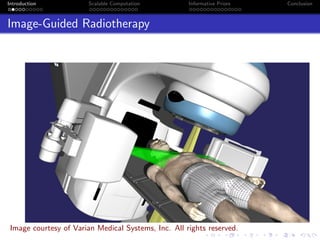
Image-Guided Radiotherapy
Image courtesy of Varian Medical Systems, Inc. All rights reserved.
Introduction Scalable Computation Informative Priors Conclusion
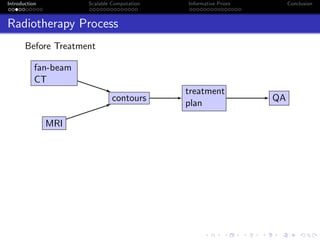
Radiotherapy Process
Before Treatment
fan-beam
CT
MRI
contours
treatment
plan
QA
Introduction Scalable Computation Informative Priors Conclusion
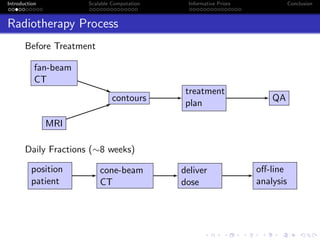
Radiotherapy Process
Before Treatment
fan-beam
CT
MRI
contours
treatment
plan
QA
Daily Fractions (∼8 weeks)
position
patient
cone-beam
CT
deliver
dose
off-line
analysis
Introduction Scalable Computation Informative Priors Conclusion
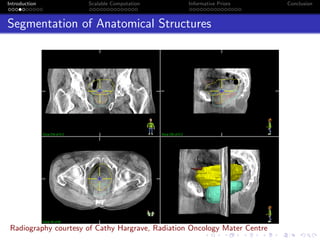
Segmentation of Anatomical Structures
Radiography courtesy of Cathy Hargrave, Radiation Oncology Mater Centre
Introduction Scalable Computation Informative Priors Conclusion
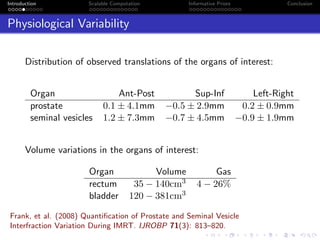
Physiological Variability
Distribution of observed translations of the organs of interest:
Organ Ant-Post Sup-Inf Left-Right
prostate 0.1 ± 4.1mm −0.5 ± 2.9mm 0.2 ± 0.9mm
seminal vesicles 1.2 ± 7.3mm −0.7 ± 4.5mm −0.9 ± 1.9mm
Volume variations in the organs of interest:
Organ Volume Gas
rectum 35 − 140cm3 4 − 26%
bladder 120 − 381cm3
Frank, et al. (2008) Quantification of Prostate and Seminal Vesicle
Interfraction Variation During IMRT. IJROBP 71(3): 813–820.
Introduction Scalable Computation Informative Priors Conclusion
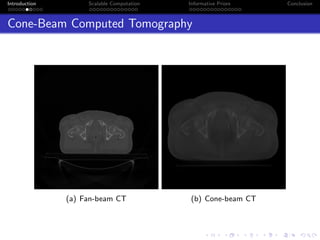
Cone-Beam Computed Tomography
(a) Fan-beam CT (b) Cone-beam CT
Introduction Scalable Computation Informative Priors Conclusion
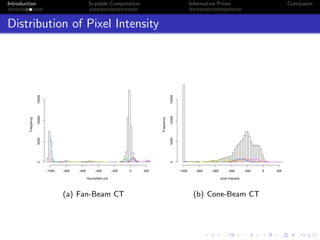
Distribution of Pixel Intensity
Hounsfield unit
Frequency
−1000 −800 −600 −400 −200 0 200
050001000015000
(a) Fan-Beam CT
pixel intensity
Frequency
−1000 −800 −600 −400 −200 0 200050001000015000
(b) Cone-Beam CT
Introduction Scalable Computation Informative Priors Conclusion
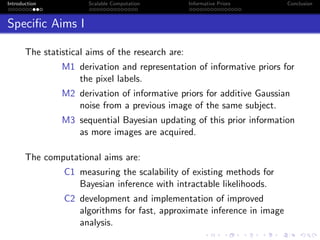
Specific Aims I
The statistical aims of the research are:
M1 derivation and representation of informative priors for
the pixel labels.
M2 derivation of informative priors for additive Gaussian
noise from a previous image of the same subject.
M3 sequential Bayesian updating of this prior information
as more images are acquired.
The computational aims are:
C1 measuring the scalability of existing methods for
Bayesian inference with intractable likelihoods.
C2 development and implementation of improved
algorithms for fast, approximate inference in image
analysis.
Introduction Scalable Computation Informative Priors Conclusion
Specific Aims II
The applied aims are:
A1 To classify pixels in cone-beam CT scans of
radiotherapy patients according to tissue type.
A2 To demonstrate the broad applicability of these
methods by classifying pixels in satellite imagery
according to land use or abundance of phytoplankton.
Introduction Scalable Computation Informative Priors Conclusion
Research Progress
1 Moores, Hargrave, Harden & Mengersen (2014). Segmentation of
cone-beam CT using a hidden Markov random field with informative
priors. Journal of Physics: Conference Series 489:012076.
2 Moores & Mengersen (2014). Bayesian approaches to spatial inference:
modelling and computational challenges and solutions. To appear in AIP
Conference Proceedings.
3 Moores, Drovandi, Mengersen & Robert. Pre-processing for approximate
Bayesian computation in image analysis. Statistics & Computing
(Submitted: March 2014, Revised: June 2014).
4 Moores, Hargrave, Harden & Mengersen. An external field prior for the
hidden Potts model with application to cone-beam computed tomography.
Computational Statistics & Data Analysis (currently in revision).
5 Moores, Alston & Mengersen. Scalable Bayesian inference for the inverse
temperature of a hidden Potts model. (In Prep).
6 Moores, Hargrave, Deegan, Poulsen, Harden & Mengersen. Multi-object
segmentation of cone-beam CT using a hidden MRF with external field
prior. (In Prep).
Introduction Scalable Computation Informative Priors Conclusion
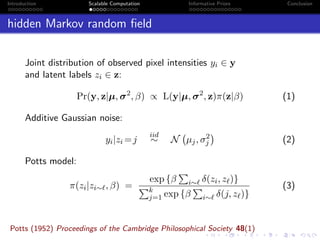
hidden Markov random field
Joint distribution of observed pixel intensities yi ∈ y
and latent labels zi ∈ z:
Pr(y, z|µ, σ2
, β) ∝ L(y|µ, σ2
, z)π(z|β) (1)
Additive Gaussian noise:
yi|zi =j
iid
∼ N µj, σ2
j (2)
Potts model:
π(zi|zi∼ , β) =
exp {β i∼ δ(zi, z )}
k
j=1 exp {β i∼ δ(j, z )}
(3)
Potts (1952) Proceedings of the Cambridge Philosophical Society 48(1)
Introduction Scalable Computation Informative Priors Conclusion
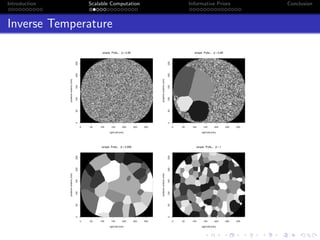
Inverse Temperature
Introduction Scalable Computation Informative Priors Conclusion
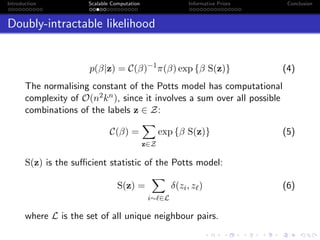
Doubly-intractable likelihood
p(β|z) = C(β)−1
π(β) exp {β S(z)} (4)
The normalising constant of the Potts model has computational
complexity of O(n2kn), since it involves a sum over all possible
combinations of the labels z ∈ Z:
C(β) =
z∈Z
exp {β S(z)} (5)
S(z) is the sufficient statistic of the Potts model:
S(z) =
i∼ ∈L
δ(zi, z ) (6)
where L is the set of all unique neighbour pairs.
Introduction Scalable Computation Informative Priors Conclusion
Expectation of S(z)
exact expectation of S(z) for n=12 and k=
β
E(S(z))
5
10
15
1 2 3 4
2
3
4
(a) n = 12 & k ∈ 2, 3, 4
exact expectation of S(z) for k=3 and n=
β
E(S(z))
5
10
15
1 2 3 4
4
6
9
12
(b) k = 3 & n ∈ 4, 6, 9, 12
Figure: Distribution of Ez|β[S(z)]
Introduction Scalable Computation Informative Priors Conclusion
Standard deviation of S(z)
exact standard deviation of S(z) for n=12 and k=
β
σ(S(z))
0.0
0.5
1.0
1.5
2.0
2.5
3.0
1 2 3 4
2
3
4
(a) n = 12 & k ∈ 2, 3, 4
exact standard deviation of S(z) for k=3 and n=
β
σ(S(z))
0.0
0.5
1.0
1.5
2.0
2.5
1 2 3 4
4
6
9
12
(b) k = 3 & n ∈ 4, 6, 9, 12
Figure: Distribution of σz|β[S(z)]
Introduction Scalable Computation Informative Priors Conclusion
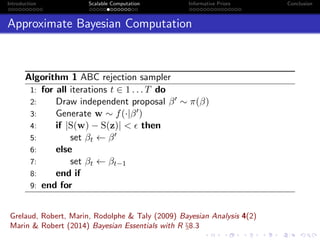
Approximate Bayesian Computation
Algorithm 1 ABC rejection sampler
1: for all iterations t ∈ 1 . . . T do
2: Draw independent proposal β ∼ π(β)
3: Generate w ∼ f(·|β )
4: if |S(w) − S(z)| < then
5: set βt ← β
6: else
7: set βt ← βt−1
8: end if
9: end for
Grelaud, Robert, Marin, Rodolphe & Taly (2009) Bayesian Analysis 4(2)
Marin & Robert (2014) Bayesian Essentials with R §8.3
Introduction Scalable Computation Informative Priors Conclusion
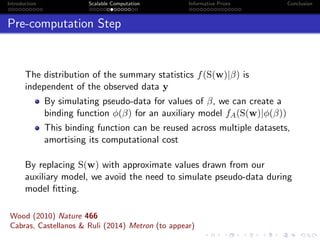
Pre-computation Step
The distribution of the summary statistics f(S(w)|β) is
independent of the observed data y
By simulating pseudo-data for values of β, we can create a
binding function φ(β) for an auxiliary model fA(S(w)|φ(β))
This binding function can be reused across multiple datasets,
amortising its computational cost
By replacing S(w) with approximate values drawn from our
auxiliary model, we avoid the need to simulate pseudo-data during
model fitting.
Wood (2010) Nature 466
Cabras, Castellanos & Ruli (2014) Metron (to appear)
Introduction Scalable Computation Informative Priors Conclusion
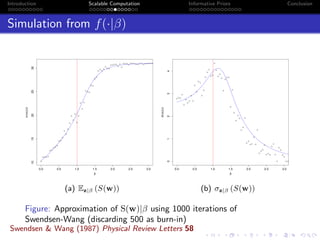
Simulation from f(·|β)
0.0 0.5 1.0 1.5 2.0 2.5 3.0
1015202530
β
E(S(z))
(a) Ez|β (S(w))
0.0 0.5 1.0 1.5 2.0 2.5 3.001234
β
σ(S(z))
(b) σz|β (S(w))
Figure: Approximation of S(w)|β using 1000 iterations of
Swendsen-Wang (discarding 500 as burn-in)
Swendsen & Wang (1987) Physical Review Letters 58
Introduction Scalable Computation Informative Priors Conclusion
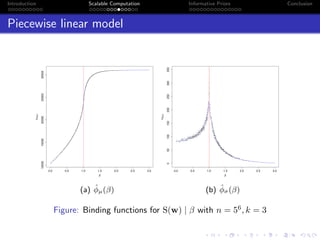
Piecewise linear model
0.0 0.5 1.0 1.5 2.0 2.5 3.0
1000015000200002500030000
β
ES(z)
(a) ˆφµ(β)
0.0 0.5 1.0 1.5 2.0 2.5 3.0
050100150200250300350
β
σS(z)
(b) ˆφσ(β)
Figure: Binding functions for S(w) | β with n = 56
, k = 3
Introduction Scalable Computation Informative Priors Conclusion
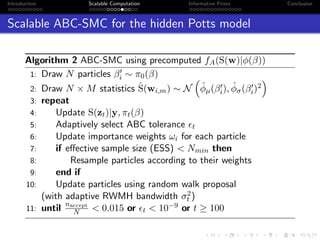
Scalable ABC-SMC for the hidden Potts model
Algorithm 2 ABC-SMC using precomputed fA(S(w)|φ(β))
1: Draw N particles βi ∼ π0(β)
2: Draw N × M statistics ˆS(wi,m) ∼ N ˆφµ(βi), ˆφσ(βi)2
3: repeat
4: Update S(zt)|y, πt(β)
5: Adaptively select ABC tolerance t
6: Update importance weights ωi for each particle
7: if effective sample size (ESS) < Nmin then
8: Resample particles according to their weights
9: end if
10: Update particles using random walk proposal
(with adaptive RWMH bandwidth σ2
t )
11: until
naccept
N < 0.015 or t < 10−9 or t ≥ 100
Introduction Scalable Computation Informative Priors Conclusion
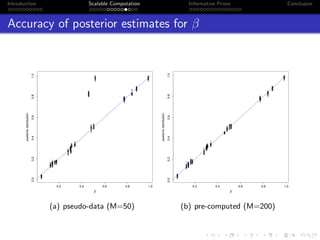
Accuracy of posterior estimates for β
0.2 0.4 0.6 0.8 1.0
0.00.20.40.60.81.0
β
posteriordistribution
(a) pseudo-data (M=50)
0.2 0.4 0.6 0.8 1.0
0.00.20.40.60.81.0
β
posteriordistribution
(b) pre-computed (M=200)
Introduction Scalable Computation Informative Priors Conclusion
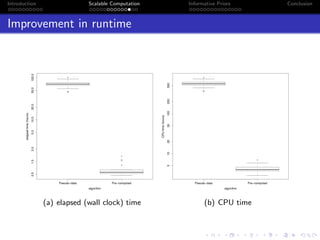
Improvement in runtime
Pseudo−data Pre−computed
0.51.02.05.010.020.050.0100.0
algorithm
elapsedtime(hours)
(a) elapsed (wall clock) time
Pseudo−data Pre−computed
5102050100200500
algorithm
CPUtime(hours)
(b) CPU time
Introduction Scalable Computation Informative Priors Conclusion
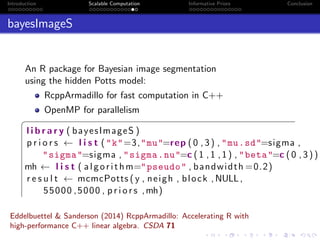
bayesImageS
An R package for Bayesian image segmentation
using the hidden Potts model:
RcppArmadillo for fast computation in C++
OpenMP for parallelism
§
l i b r a r y ( bayesImageS )
p r i o r s ← l i s t ("k"=3,"mu"=rep (0 ,3) , "mu.sd"=sigma ,
"sigma"=sigma , "sigma.nu"=c (1 ,1 ,1) , "beta"=c (0 ,3))
mh ← l i s t ( algorithm="pseudo" , bandwidth =0.2)
r e s u l t ← mcmcPotts ( y , neigh , block ,NULL,
55000 ,5000 , p r i o r s ,mh)
Eddelbuettel & Sanderson (2014) RcppArmadillo: Accelerating R with
high-performance C++ linear algebra. CSDA 71
Introduction Scalable Computation Informative Priors Conclusion
Bayesian computational methods
bayesImageS supports methods for updating the latent labels z:
Chequerboard updating (Winkler 2003)
Swendsen-Wang (1987)
and also methods for updating the inverse temperature β:
Pseudolikelihood (Ryd´en & Titterington 1998)
Path Sampling (Gelman & Meng 1998)
Exchange Algorithm (Murray, Ghahramani & MacKay 2006)
Approximate Bayesian Computation (Grelaud et al. 2009)
Sequential Monte Carlo (ABC-SMC) with pre-computation
(Del Moral, Doucet & Jasra 2012; Moores et al. 2014)
Introduction Scalable Computation Informative Priors Conclusion
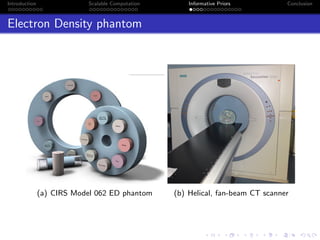
Electron Density phantom
(a) CIRS Model 062 ED phantom (b) Helical, fan-beam CT scanner
Introduction Scalable Computation Informative Priors Conclusion
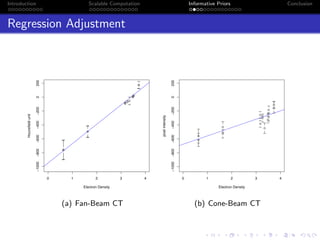
Regression Adjustment
0 1 2 3 4
−1000−800−600−400−2000200
Electron Density
Hounsfieldunit
(a) Fan-Beam CT
0 1 2 3 4
−1000−800−600−400−2000200
Electron Density
pixelintensity
(b) Cone-Beam CT
Introduction Scalable Computation Informative Priors Conclusion
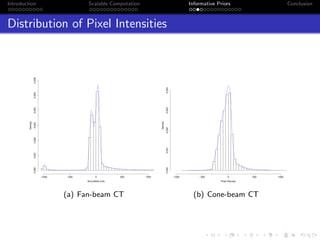
Distribution of Pixel Intensities
Hounsfield units
Density
−1000 −500 0 500 1000
0.0000.0010.0020.0030.0040.0050.006
(a) Fan-beam CT
Pixel intensity
Density
−1000 −500 0 500 1000
0.0000.0010.0020.0030.004
(b) Cone-beam CT
Introduction Scalable Computation Informative Priors Conclusion
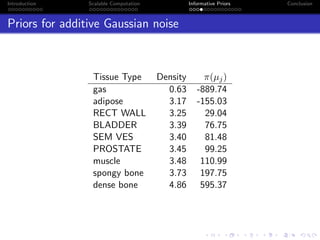
Priors for additive Gaussian noise
Tissue Type Density π(µj)
gas 0.63 -889.74
adipose 3.17 -155.03
RECT WALL 3.25 29.04
BLADDER 3.39 76.75
SEM VES 3.40 81.48
PROSTATE 3.45 99.25
muscle 3.48 110.99
spongy bone 3.73 197.75
dense bone 4.86 595.37
Introduction Scalable Computation Informative Priors Conclusion
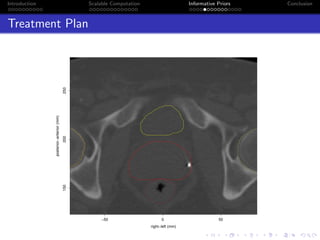
Treatment Plan
−50 0 50
150200250
right−left (mm)
posterior−anterior(mm)
Introduction Scalable Computation Informative Priors Conclusion
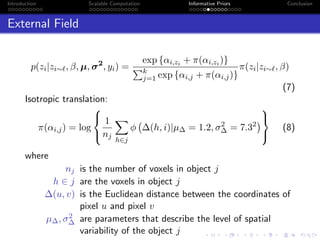
External Field
p(zi|zi∼ , β, µ, σ2
, yi) =
exp {αi,zi + π(αi,zi )}
k
j=1 exp {αi,j + π(αi,j)}
π(zi|zi∼ , β)
(7)
Isotropic translation:
π(αi,j) = log



1
nj
h∈j
φ ∆(h, i)|µ∆ = 1.2, σ2
∆ = 7.32



(8)
where
nj is the number of voxels in object j
h ∈ j are the voxels in object j
∆(u, v) is the Euclidean distance between the coordinates of
pixel u and pixel v
µ∆, σ2
∆ are parameters that describe the level of spatial
variability of the object j
Introduction Scalable Computation Informative Priors Conclusion
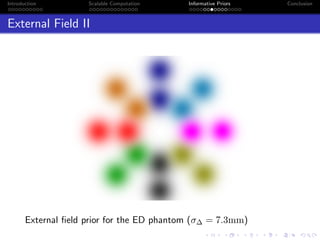
External Field II
External field prior for the ED phantom (σ∆ = 7.3mm)
Introduction Scalable Computation Informative Priors Conclusion
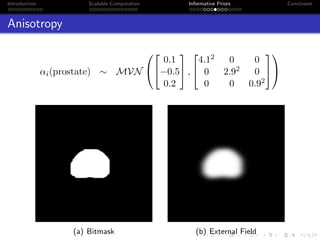
Anisotropy
αi(prostate) ∼ MVN




0.1
−0.5
0.2

 ,


4.12 0 0
0 2.92 0
0 0 0.92




(a) Bitmask (b) External Field
Introduction Scalable Computation Informative Priors Conclusion
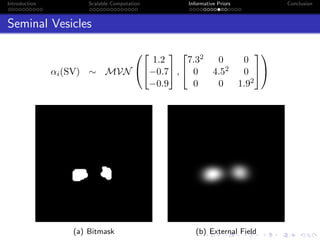
Seminal Vesicles
αi(SV) ∼ MVN




1.2
−0.7
−0.9

 ,


7.32 0 0
0 4.52 0
0 0 1.92




(a) Bitmask (b) External Field
Introduction Scalable Computation Informative Priors Conclusion
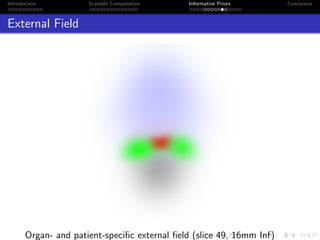
External Field
Organ- and patient-specific external field (slice 49, 16mm Inf)
Introduction Scalable Computation Informative Priors Conclusion
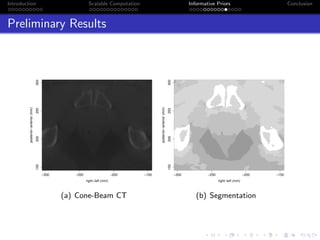
Preliminary Results
−300 −250 −200 −150
150200250300
right−left (mm)
posterior−anterior(mm)
(a) Cone-Beam CT
−300 −250 −200 −150
150200250300
right−left (mm)
posterior−anterior(mm)
(b) Segmentation
Introduction Scalable Computation Informative Priors Conclusion
ED phantom experiment
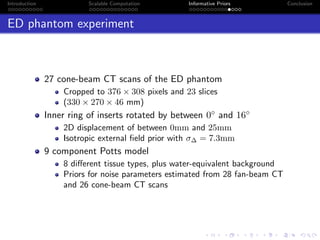
27 cone-beam CT scans of the ED phantom
Cropped to 376 × 308 pixels and 23 slices
(330 × 270 × 46 mm)
Inner ring of inserts rotated by between 0◦ and 16◦
2D displacement of between 0mm and 25mm
Isotropic external field prior with σ∆ = 7.3mm
9 component Potts model
8 different tissue types, plus water-equivalent background
Priors for noise parameters estimated from 28 fan-beam CT
and 26 cone-beam CT scans
Introduction Scalable Computation Informative Priors Conclusion
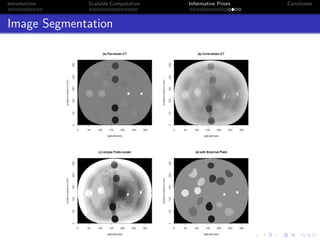
Image Segmentation
Introduction Scalable Computation Informative Priors Conclusion
Quantification of Segmentation Accuracy
Dice similarity coefficient:
DSCg =
2 × |ˆg ∩ g|
|ˆg| + |g|
(9)
where
DSCg is the Dice similarity coefficient for label g
|ˆg| is the count of pixels that were classified with the
label g
|g| is the number of pixels that are known to truly
belong to component g
|ˆg ∩ g| is the count of pixels in g that were labeled correctly
Dice (1945) Measures of the amount of ecologic association between species.
Ecology 26(3): 297–302.
Introduction Scalable Computation Informative Priors Conclusion
Results
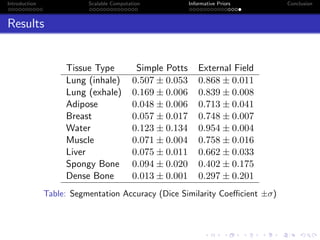
Tissue Type Simple Potts External Field
Lung (inhale) 0.507 ± 0.053 0.868 ± 0.011
Lung (exhale) 0.169 ± 0.006 0.839 ± 0.008
Adipose 0.048 ± 0.006 0.713 ± 0.041
Breast 0.057 ± 0.017 0.748 ± 0.007
Water 0.123 ± 0.134 0.954 ± 0.004
Muscle 0.071 ± 0.004 0.758 ± 0.016
Liver 0.075 ± 0.011 0.662 ± 0.033
Spongy Bone 0.094 ± 0.020 0.402 ± 0.175
Dense Bone 0.013 ± 0.001 0.297 ± 0.201
Table: Segmentation Accuracy (Dice Similarity Coefficient ±σ)
Introduction Scalable Computation Informative Priors Conclusion
Discussion
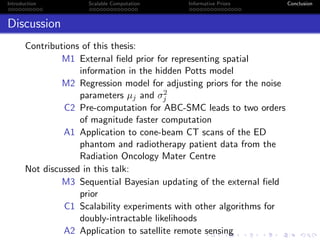
Contributions of this thesis:
M1 External field prior for representing spatial
information in the hidden Potts model
M2 Regression model for adjusting priors for the noise
parameters µj and σ2
j
C2 Pre-computation for ABC-SMC leads to two orders
of magnitude faster computation
A1 Application to cone-beam CT scans of the ED
phantom and radiotherapy patient data from the
Radiation Oncology Mater Centre
Not discussed in this talk:
M3 Sequential Bayesian updating of the external field
prior
C1 Scalability experiments with other algorithms for
doubly-intractable likelihoods
A2 Application to satellite remote sensing
Introduction Scalable Computation Informative Priors Conclusion
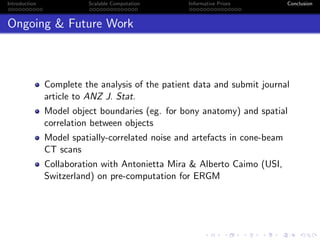
Ongoing & Future Work
Complete the analysis of the patient data and submit journal
article to ANZ J. Stat.
Model object boundaries (eg. for bony anatomy) and spatial
correlation between objects
Model spatially-correlated noise and artefacts in cone-beam
CT scans
Collaboration with Antonietta Mira & Alberto Caimo (USI,
Switzerland) on pre-computation for ERGM
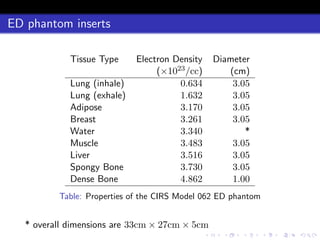
ED phantom inserts
Tissue Type Electron Density Diameter
(×1023/cc) (cm)
Lung (inhale) 0.634 3.05
Lung (exhale) 1.632 3.05
Adipose 3.170 3.05
Breast 3.261 3.05
Water 3.340 *
Muscle 3.483 3.05
Liver 3.516 3.05
Spongy Bone 3.730 3.05
Dense Bone 4.862 1.00
Table: Properties of the CIRS Model 062 ED phantom
* overall dimensions are 33cm × 27cm × 5cm
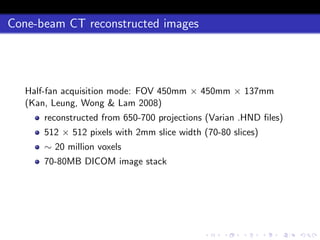
Cone-beam CT reconstructed images
Half-fan acquisition mode: FOV 450mm × 450mm × 137mm
(Kan, Leung, Wong & Lam 2008)
reconstructed from 650-700 projections (Varian .HND files)
512 × 512 pixels with 2mm slice width (70-80 slices)
∼ 20 million voxels
70-80MB DICOM image stack

Final PhD Seminar

  • 1.
    Introduction Scalable ComputationInformative Priors Conclusion Bayesian Computational Methods for Spatial Analysis of Images Matthew Moores Mathematical Sciences School Science & Engineering Faculty, QUT PhD final seminar August 1, 2014
  • 2.
    Introduction Scalable ComputationInformative Priors Conclusion Acknowledgements Principal supervisor: Kerrie Mengersen Associate supervisor: Fiona Harden Members of the Volume Analysis Tool project team at the Radiation Oncology Mater Centre (ROMC), Queensland Health: Cathy Hargrave Mike Poulsen Tim Deegan QHealth ethics HREC/12/QPAH/475 and QUT ethics 1200000724 Other co-authors: Chris Drovandi Clair Alston Christian Robert
  • 3.
    Introduction Scalable ComputationInformative Priors Conclusion Outline 1 Introduction Image-Guided Radiotherapy Cone-Beam Computed Tomography Aims & Objectives of the Thesis 2 Scalable Computation Doubly-Intractable Likelihoods Pre-computation for ABC-SMC R package bayesImageS 3 Informative Priors Informative Prior for µj and σ2 j External Field Experimental Results 4 Conclusion
  • 4.
    Introduction Scalable ComputationInformative Priors Conclusion Objectives The overall objectives of the research are: to develop a generative model of a digital image that incorporates prior information, to produce a computationally efficient implementation of this model, and to apply the model to real world data in image-guided radiotherapy and satellite remote sensing. This reflects the parallel perspectives of statistical methods, computational algorithms, and applied bio- and geo-statistics.
  • 5.
    Introduction Scalable ComputationInformative Priors Conclusion Image-Guided Radiotherapy Image courtesy of Varian Medical Systems, Inc. All rights reserved.
  • 6.
    Introduction Scalable ComputationInformative Priors Conclusion Radiotherapy Process Before Treatment fan-beam CT MRI contours treatment plan QA
  • 7.
    Introduction Scalable ComputationInformative Priors Conclusion Radiotherapy Process Before Treatment fan-beam CT MRI contours treatment plan QA Daily Fractions (∼8 weeks) position patient cone-beam CT deliver dose off-line analysis
  • 8.
    Introduction Scalable ComputationInformative Priors Conclusion Segmentation of Anatomical Structures Radiography courtesy of Cathy Hargrave, Radiation Oncology Mater Centre
  • 9.
    Introduction Scalable ComputationInformative Priors Conclusion Physiological Variability Distribution of observed translations of the organs of interest: Organ Ant-Post Sup-Inf Left-Right prostate 0.1 ± 4.1mm −0.5 ± 2.9mm 0.2 ± 0.9mm seminal vesicles 1.2 ± 7.3mm −0.7 ± 4.5mm −0.9 ± 1.9mm Volume variations in the organs of interest: Organ Volume Gas rectum 35 − 140cm3 4 − 26% bladder 120 − 381cm3 Frank, et al. (2008) Quantification of Prostate and Seminal Vesicle Interfraction Variation During IMRT. IJROBP 71(3): 813–820.
  • 10.
    Introduction Scalable ComputationInformative Priors Conclusion Cone-Beam Computed Tomography (a) Fan-beam CT (b) Cone-beam CT
  • 11.
    Introduction Scalable ComputationInformative Priors Conclusion Distribution of Pixel Intensity Hounsfield unit Frequency −1000 −800 −600 −400 −200 0 200 050001000015000 (a) Fan-Beam CT pixel intensity Frequency −1000 −800 −600 −400 −200 0 200050001000015000 (b) Cone-Beam CT
  • 12.
    Introduction Scalable ComputationInformative Priors Conclusion Specific Aims I The statistical aims of the research are: M1 derivation and representation of informative priors for the pixel labels. M2 derivation of informative priors for additive Gaussian noise from a previous image of the same subject. M3 sequential Bayesian updating of this prior information as more images are acquired. The computational aims are: C1 measuring the scalability of existing methods for Bayesian inference with intractable likelihoods. C2 development and implementation of improved algorithms for fast, approximate inference in image analysis.
  • 13.
    Introduction Scalable ComputationInformative Priors Conclusion Specific Aims II The applied aims are: A1 To classify pixels in cone-beam CT scans of radiotherapy patients according to tissue type. A2 To demonstrate the broad applicability of these methods by classifying pixels in satellite imagery according to land use or abundance of phytoplankton.
  • 14.
    Introduction Scalable ComputationInformative Priors Conclusion Research Progress 1 Moores, Hargrave, Harden & Mengersen (2014). Segmentation of cone-beam CT using a hidden Markov random field with informative priors. Journal of Physics: Conference Series 489:012076. 2 Moores & Mengersen (2014). Bayesian approaches to spatial inference: modelling and computational challenges and solutions. To appear in AIP Conference Proceedings. 3 Moores, Drovandi, Mengersen & Robert. Pre-processing for approximate Bayesian computation in image analysis. Statistics & Computing (Submitted: March 2014, Revised: June 2014). 4 Moores, Hargrave, Harden & Mengersen. An external field prior for the hidden Potts model with application to cone-beam computed tomography. Computational Statistics & Data Analysis (currently in revision). 5 Moores, Alston & Mengersen. Scalable Bayesian inference for the inverse temperature of a hidden Potts model. (In Prep). 6 Moores, Hargrave, Deegan, Poulsen, Harden & Mengersen. Multi-object segmentation of cone-beam CT using a hidden MRF with external field prior. (In Prep).
  • 15.
    Introduction Scalable ComputationInformative Priors Conclusion hidden Markov random field Joint distribution of observed pixel intensities yi ∈ y and latent labels zi ∈ z: Pr(y, z|µ, σ2 , β) ∝ L(y|µ, σ2 , z)π(z|β) (1) Additive Gaussian noise: yi|zi =j iid ∼ N µj, σ2 j (2) Potts model: π(zi|zi∼ , β) = exp {β i∼ δ(zi, z )} k j=1 exp {β i∼ δ(j, z )} (3) Potts (1952) Proceedings of the Cambridge Philosophical Society 48(1)
  • 16.
    Introduction Scalable ComputationInformative Priors Conclusion Inverse Temperature
  • 17.
    Introduction Scalable ComputationInformative Priors Conclusion Doubly-intractable likelihood p(β|z) = C(β)−1 π(β) exp {β S(z)} (4) The normalising constant of the Potts model has computational complexity of O(n2kn), since it involves a sum over all possible combinations of the labels z ∈ Z: C(β) = z∈Z exp {β S(z)} (5) S(z) is the sufficient statistic of the Potts model: S(z) = i∼ ∈L δ(zi, z ) (6) where L is the set of all unique neighbour pairs.
  • 18.
    Introduction Scalable ComputationInformative Priors Conclusion Expectation of S(z) exact expectation of S(z) for n=12 and k= β E(S(z)) 5 10 15 1 2 3 4 2 3 4 (a) n = 12 & k ∈ 2, 3, 4 exact expectation of S(z) for k=3 and n= β E(S(z)) 5 10 15 1 2 3 4 4 6 9 12 (b) k = 3 & n ∈ 4, 6, 9, 12 Figure: Distribution of Ez|β[S(z)]
  • 19.
    Introduction Scalable ComputationInformative Priors Conclusion Standard deviation of S(z) exact standard deviation of S(z) for n=12 and k= β σ(S(z)) 0.0 0.5 1.0 1.5 2.0 2.5 3.0 1 2 3 4 2 3 4 (a) n = 12 & k ∈ 2, 3, 4 exact standard deviation of S(z) for k=3 and n= β σ(S(z)) 0.0 0.5 1.0 1.5 2.0 2.5 1 2 3 4 4 6 9 12 (b) k = 3 & n ∈ 4, 6, 9, 12 Figure: Distribution of σz|β[S(z)]
  • 20.
    Introduction Scalable ComputationInformative Priors Conclusion Approximate Bayesian Computation Algorithm 1 ABC rejection sampler 1: for all iterations t ∈ 1 . . . T do 2: Draw independent proposal β ∼ π(β) 3: Generate w ∼ f(·|β ) 4: if |S(w) − S(z)| < then 5: set βt ← β 6: else 7: set βt ← βt−1 8: end if 9: end for Grelaud, Robert, Marin, Rodolphe & Taly (2009) Bayesian Analysis 4(2) Marin & Robert (2014) Bayesian Essentials with R §8.3
  • 21.
    Introduction Scalable ComputationInformative Priors Conclusion Pre-computation Step The distribution of the summary statistics f(S(w)|β) is independent of the observed data y By simulating pseudo-data for values of β, we can create a binding function φ(β) for an auxiliary model fA(S(w)|φ(β)) This binding function can be reused across multiple datasets, amortising its computational cost By replacing S(w) with approximate values drawn from our auxiliary model, we avoid the need to simulate pseudo-data during model fitting. Wood (2010) Nature 466 Cabras, Castellanos & Ruli (2014) Metron (to appear)
  • 22.
    Introduction Scalable ComputationInformative Priors Conclusion Simulation from f(·|β) 0.0 0.5 1.0 1.5 2.0 2.5 3.0 1015202530 β E(S(z)) (a) Ez|β (S(w)) 0.0 0.5 1.0 1.5 2.0 2.5 3.001234 β σ(S(z)) (b) σz|β (S(w)) Figure: Approximation of S(w)|β using 1000 iterations of Swendsen-Wang (discarding 500 as burn-in) Swendsen & Wang (1987) Physical Review Letters 58
  • 23.
    Introduction Scalable ComputationInformative Priors Conclusion Piecewise linear model 0.0 0.5 1.0 1.5 2.0 2.5 3.0 1000015000200002500030000 β ES(z) (a) ˆφµ(β) 0.0 0.5 1.0 1.5 2.0 2.5 3.0 050100150200250300350 β σS(z) (b) ˆφσ(β) Figure: Binding functions for S(w) | β with n = 56 , k = 3
  • 24.
    Introduction Scalable ComputationInformative Priors Conclusion Scalable ABC-SMC for the hidden Potts model Algorithm 2 ABC-SMC using precomputed fA(S(w)|φ(β)) 1: Draw N particles βi ∼ π0(β) 2: Draw N × M statistics ˆS(wi,m) ∼ N ˆφµ(βi), ˆφσ(βi)2 3: repeat 4: Update S(zt)|y, πt(β) 5: Adaptively select ABC tolerance t 6: Update importance weights ωi for each particle 7: if effective sample size (ESS) < Nmin then 8: Resample particles according to their weights 9: end if 10: Update particles using random walk proposal (with adaptive RWMH bandwidth σ2 t ) 11: until naccept N < 0.015 or t < 10−9 or t ≥ 100
  • 25.
    Introduction Scalable ComputationInformative Priors Conclusion Accuracy of posterior estimates for β 0.2 0.4 0.6 0.8 1.0 0.00.20.40.60.81.0 β posteriordistribution (a) pseudo-data (M=50) 0.2 0.4 0.6 0.8 1.0 0.00.20.40.60.81.0 β posteriordistribution (b) pre-computed (M=200)
  • 26.
    Introduction Scalable ComputationInformative Priors Conclusion Improvement in runtime Pseudo−data Pre−computed 0.51.02.05.010.020.050.0100.0 algorithm elapsedtime(hours) (a) elapsed (wall clock) time Pseudo−data Pre−computed 5102050100200500 algorithm CPUtime(hours) (b) CPU time
  • 27.
    Introduction Scalable ComputationInformative Priors Conclusion bayesImageS An R package for Bayesian image segmentation using the hidden Potts model: RcppArmadillo for fast computation in C++ OpenMP for parallelism § l i b r a r y ( bayesImageS ) p r i o r s ← l i s t ("k"=3,"mu"=rep (0 ,3) , "mu.sd"=sigma , "sigma"=sigma , "sigma.nu"=c (1 ,1 ,1) , "beta"=c (0 ,3)) mh ← l i s t ( algorithm="pseudo" , bandwidth =0.2) r e s u l t ← mcmcPotts ( y , neigh , block ,NULL, 55000 ,5000 , p r i o r s ,mh) Eddelbuettel & Sanderson (2014) RcppArmadillo: Accelerating R with high-performance C++ linear algebra. CSDA 71
  • 28.
    Introduction Scalable ComputationInformative Priors Conclusion Bayesian computational methods bayesImageS supports methods for updating the latent labels z: Chequerboard updating (Winkler 2003) Swendsen-Wang (1987) and also methods for updating the inverse temperature β: Pseudolikelihood (Ryd´en & Titterington 1998) Path Sampling (Gelman & Meng 1998) Exchange Algorithm (Murray, Ghahramani & MacKay 2006) Approximate Bayesian Computation (Grelaud et al. 2009) Sequential Monte Carlo (ABC-SMC) with pre-computation (Del Moral, Doucet & Jasra 2012; Moores et al. 2014)
  • 29.
    Introduction Scalable ComputationInformative Priors Conclusion Electron Density phantom (a) CIRS Model 062 ED phantom (b) Helical, fan-beam CT scanner
  • 30.
    Introduction Scalable ComputationInformative Priors Conclusion Regression Adjustment 0 1 2 3 4 −1000−800−600−400−2000200 Electron Density Hounsfieldunit (a) Fan-Beam CT 0 1 2 3 4 −1000−800−600−400−2000200 Electron Density pixelintensity (b) Cone-Beam CT
  • 31.
    Introduction Scalable ComputationInformative Priors Conclusion Distribution of Pixel Intensities Hounsfield units Density −1000 −500 0 500 1000 0.0000.0010.0020.0030.0040.0050.006 (a) Fan-beam CT Pixel intensity Density −1000 −500 0 500 1000 0.0000.0010.0020.0030.004 (b) Cone-beam CT
  • 32.
    Introduction Scalable ComputationInformative Priors Conclusion Priors for additive Gaussian noise Tissue Type Density π(µj) gas 0.63 -889.74 adipose 3.17 -155.03 RECT WALL 3.25 29.04 BLADDER 3.39 76.75 SEM VES 3.40 81.48 PROSTATE 3.45 99.25 muscle 3.48 110.99 spongy bone 3.73 197.75 dense bone 4.86 595.37
  • 33.
    Introduction Scalable ComputationInformative Priors Conclusion Treatment Plan −50 0 50 150200250 right−left (mm) posterior−anterior(mm)
  • 34.
    Introduction Scalable ComputationInformative Priors Conclusion External Field p(zi|zi∼ , β, µ, σ2 , yi) = exp {αi,zi + π(αi,zi )} k j=1 exp {αi,j + π(αi,j)} π(zi|zi∼ , β) (7) Isotropic translation: π(αi,j) = log    1 nj h∈j φ ∆(h, i)|µ∆ = 1.2, σ2 ∆ = 7.32    (8) where nj is the number of voxels in object j h ∈ j are the voxels in object j ∆(u, v) is the Euclidean distance between the coordinates of pixel u and pixel v µ∆, σ2 ∆ are parameters that describe the level of spatial variability of the object j
  • 35.
    Introduction Scalable ComputationInformative Priors Conclusion External Field II External field prior for the ED phantom (σ∆ = 7.3mm)
  • 36.
    Introduction Scalable ComputationInformative Priors Conclusion Anisotropy αi(prostate) ∼ MVN     0.1 −0.5 0.2   ,   4.12 0 0 0 2.92 0 0 0 0.92     (a) Bitmask (b) External Field
  • 37.
    Introduction Scalable ComputationInformative Priors Conclusion Seminal Vesicles αi(SV) ∼ MVN     1.2 −0.7 −0.9   ,   7.32 0 0 0 4.52 0 0 0 1.92     (a) Bitmask (b) External Field
  • 38.
    Introduction Scalable ComputationInformative Priors Conclusion External Field Organ- and patient-specific external field (slice 49, 16mm Inf)
  • 39.
    Introduction Scalable ComputationInformative Priors Conclusion Preliminary Results −300 −250 −200 −150 150200250300 right−left (mm) posterior−anterior(mm) (a) Cone-Beam CT −300 −250 −200 −150 150200250300 right−left (mm) posterior−anterior(mm) (b) Segmentation
  • 40.
    Introduction Scalable ComputationInformative Priors Conclusion ED phantom experiment 27 cone-beam CT scans of the ED phantom Cropped to 376 × 308 pixels and 23 slices (330 × 270 × 46 mm) Inner ring of inserts rotated by between 0◦ and 16◦ 2D displacement of between 0mm and 25mm Isotropic external field prior with σ∆ = 7.3mm 9 component Potts model 8 different tissue types, plus water-equivalent background Priors for noise parameters estimated from 28 fan-beam CT and 26 cone-beam CT scans
  • 41.
    Introduction Scalable ComputationInformative Priors Conclusion Image Segmentation
  • 42.
    Introduction Scalable ComputationInformative Priors Conclusion Quantification of Segmentation Accuracy Dice similarity coefficient: DSCg = 2 × |ˆg ∩ g| |ˆg| + |g| (9) where DSCg is the Dice similarity coefficient for label g |ˆg| is the count of pixels that were classified with the label g |g| is the number of pixels that are known to truly belong to component g |ˆg ∩ g| is the count of pixels in g that were labeled correctly Dice (1945) Measures of the amount of ecologic association between species. Ecology 26(3): 297–302.
  • 43.
    Introduction Scalable ComputationInformative Priors Conclusion Results Tissue Type Simple Potts External Field Lung (inhale) 0.507 ± 0.053 0.868 ± 0.011 Lung (exhale) 0.169 ± 0.006 0.839 ± 0.008 Adipose 0.048 ± 0.006 0.713 ± 0.041 Breast 0.057 ± 0.017 0.748 ± 0.007 Water 0.123 ± 0.134 0.954 ± 0.004 Muscle 0.071 ± 0.004 0.758 ± 0.016 Liver 0.075 ± 0.011 0.662 ± 0.033 Spongy Bone 0.094 ± 0.020 0.402 ± 0.175 Dense Bone 0.013 ± 0.001 0.297 ± 0.201 Table: Segmentation Accuracy (Dice Similarity Coefficient ±σ)
  • 44.
    Introduction Scalable ComputationInformative Priors Conclusion Discussion Contributions of this thesis: M1 External field prior for representing spatial information in the hidden Potts model M2 Regression model for adjusting priors for the noise parameters µj and σ2 j C2 Pre-computation for ABC-SMC leads to two orders of magnitude faster computation A1 Application to cone-beam CT scans of the ED phantom and radiotherapy patient data from the Radiation Oncology Mater Centre Not discussed in this talk: M3 Sequential Bayesian updating of the external field prior C1 Scalability experiments with other algorithms for doubly-intractable likelihoods A2 Application to satellite remote sensing
  • 45.
    Introduction Scalable ComputationInformative Priors Conclusion Ongoing & Future Work Complete the analysis of the patient data and submit journal article to ANZ J. Stat. Model object boundaries (eg. for bony anatomy) and spatial correlation between objects Model spatially-correlated noise and artefacts in cone-beam CT scans Collaboration with Antonietta Mira & Alberto Caimo (USI, Switzerland) on pre-computation for ERGM
  • 46.
    ED phantom inserts TissueType Electron Density Diameter (×1023/cc) (cm) Lung (inhale) 0.634 3.05 Lung (exhale) 1.632 3.05 Adipose 3.170 3.05 Breast 3.261 3.05 Water 3.340 * Muscle 3.483 3.05 Liver 3.516 3.05 Spongy Bone 3.730 3.05 Dense Bone 4.862 1.00 Table: Properties of the CIRS Model 062 ED phantom * overall dimensions are 33cm × 27cm × 5cm
  • 47.
    Cone-beam CT reconstructedimages Half-fan acquisition mode: FOV 450mm × 450mm × 137mm (Kan, Leung, Wong & Lam 2008) reconstructed from 650-700 projections (Varian .HND files) 512 × 512 pixels with 2mm slice width (70-80 slices) ∼ 20 million voxels 70-80MB DICOM image stack