Accelerating Pseudo-Marginal MCMC
using Gaussian Processes
Matt Moores
joint work with Chris Drovandi (QUT) and Richard Boys (Newcastle)
October 28, 2016
Matt Moores Algorithms Seminar October 28, 2016 1 / 10
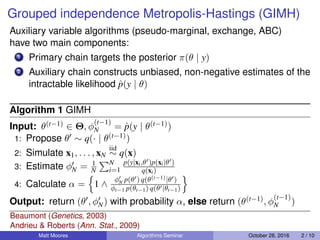
Grouped independence Metropolis-Hastings (GIMH)
Auxiliary variable algorithms (pseudo-marginal, exchange, ABC)
have two main components:
1 Primary chain targets the posterior π(θ | y)
2 Auxiliary chain constructs unbiased, non-negative estimates of the
intractable likelihood ˆp(y | θ)
Algorithm 1 GIMH
Input: θ(t−1) ∈ Θ, φ
(t−1)
N = ˆp(y | θ(t−1))
1: Propose θ ∼ q(· | θ(t−1))
2: Simulate x1, . . . , xN
iid
∼ q(x)
3: Estimate φN = 1
N
N
i=1
p(y|xi,θ )p(xi|θ )
q(xi)
4: Calculate α = 1 ∧
φN p(θ ) q(θ(t−1)|θ )
φt−1 p(θt−1) q(θ |θt−1)
Output: return (θ , φN) with probability α, else return (θ(t−1), φ
(t−1)
N )
Matt Moores Algorithms Seminar October 28, 2016 2 / 10
Beaumont (Genetics, 2003)
Andrieu & Roberts (Ann. Stat., 2009)
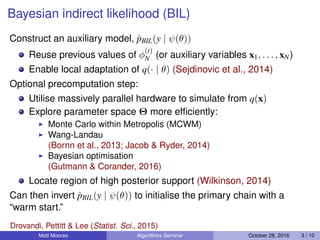
Bayesian indirect likelihood (BIL)
Construct an auxiliary model, ˆpBIL(y | ψ(θ))
Reuse previous values of φ
(t)
N (or auxiliary variables x1, . . . , xN)
Enable local adaptation of q(· | θ) (Sejdinovic et al., 2014)
Optional precomputation step:
Utilise massively parallel hardware to simulate from q(x)
Explore parameter space Θ more efficiently:
Monte Carlo within Metropolis (MCWM)
Wang-Landau
(Bornn et al., 2013; Jacob & Ryder, 2014)
Bayesian optimisation
(Gutmann & Corander, 2016)
Locate region of high posterior support (Wilkinson, 2014)
Can then invert ˆpBIL(y | ψ(θ)) to initialise the primary chain with a
“warm start.”
Matt Moores Algorithms Seminar October 28, 2016 3 / 10
Drovandi, Pettitt & Lee (Statist. Sci., 2015)
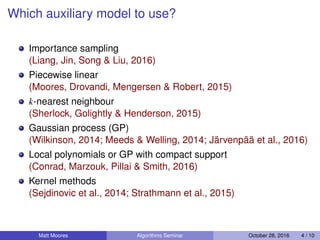
Which auxiliary model to use?
Importance sampling
(Liang, Jin, Song & Liu, 2016)
Piecewise linear
(Moores, Drovandi, Mengersen & Robert, 2015)
k-nearest neighbour
(Sherlock, Golightly & Henderson, 2015)
Gaussian process (GP)
(Wilkinson, 2014; Meeds & Welling, 2014; Järvenpää et al., 2016)
Local polynomials or GP with compact support
(Conrad, Marzouk, Pillai & Smith, 2016)
Kernel methods
(Sejdinovic et al., 2014; Strathmann et al., 2015)
Matt Moores Algorithms Seminar October 28, 2016 4 / 10
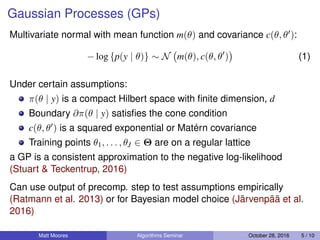
Gaussian Processes (GPs)
Multivariate normal with mean function m(θ) and covariance c(θ, θ ):
− log {p(y | θ)} ∼ N m(θ), c(θ, θ ) (1)
Under certain assumptions:
π(θ | y) is a compact Hilbert space with finite dimension, d
Boundary ∂π(θ | y) satisfies the cone condition
c(θ, θ ) is a squared exponential or Matérn covariance
Training points θ1, . . . , θJ ∈ Θ are on a regular lattice
a GP is a consistent approximation to the negative log-likelihood
(Stuart & Teckentrup, 2016)
Can use output of precomp. step to test assumptions empirically
(Ratmann et al. 2013) or for Bayesian model choice (Järvenpää et al.
2016)
Matt Moores Algorithms Seminar October 28, 2016 5 / 10
Multiplicative Noise
Can’t evaluate p(y|θ) pointwise, but by lognormal CLT:
φ
(t)
N = W p y | θ(t)
(2)
E[W] = 1 (3)
log{W}
d
−−−−→
N→∞
N −
1
2
σ2
, σ2
(4)
when x1, . . . , xN are generated from a particle filter
(Bérard, Del Moral & Doucet, 2014)
We can account for this noise by adding a nugget term to our GP:
− log ˆφ
(j)
N ∼ N mβ(θ) +
δ
2
, cγ(θ, θ ) + δI (5)
where θ(j), φ
(j)
N
J
j=1
are obtained from the precomputation step
Matt Moores Algorithms Seminar October 28, 2016 6 / 10
Delayed Acceptance (DA)
Algorithm 2 BIL with DA
Input: θ(t−1) ∈ Θ, φ
(t−1)
N = ˆp(y | θ(t−1))
1: Propose θ ∼ q(· | θ(t−1))
2: Calculate αBIL = 1 ∧ ˆpBIL(y|ψ(θ )) p(θ ) q(θ(t−1)|θ )
ˆpBIL(y|ψ(θ(t−1))) p(θ(t−1)) q(θ |θ(t−1))
Output: return (θ(t−1), φ
(t−1)
N ) with probability 1 − α, else
3: Obtain φN as per Alg. 1
4: Calculate αDA = 1 ∧
φN ˆpBIL(y|ψ(θ(t−1)))
φ
(t−1)
N ˆpBIL(y|ψ(θ ))
Output: return (θ , φN) with probability αDA, else return (θ(t−1), φ
(t−1)
N )
Matt Moores Algorithms Seminar October 28, 2016 7 / 10
Christen & Fox (JCGS, 2005)
Sherlock, Golightly & Henderson (arXiv:1509.00172 [stat.CO])
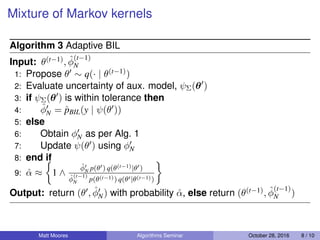
Mixture of Markov kernels
Algorithm 3 Adaptive BIL
Input: θ(t−1), ˆφ
(t−1)
N
1: Propose θ ∼ q(· | θ(t−1))
2: Evaluate uncertainty of aux. model, ψΣ(θ )
3: if ψΣ(θ ) is within tolerance then
4: ˆφN = ˆpBIL(y | ψ(θ ))
5: else
6: Obtain φN as per Alg. 1
7: Update ψ(θ ) using φN
8: end if
9: ˆα ≈ 1 ∧
ˆφN p(θ ) q(θ(t−1)|θ )
ˆφ
(t−1)
N p(θ(t−1)) q(θ |θ(t−1))
Output: return (θ , ˆφN) with probability ˆα, else return (θ(t−1), ˆφ
(t−1)
N )
Matt Moores Algorithms Seminar October 28, 2016 8 / 10
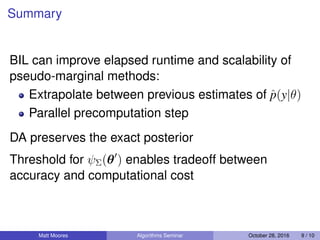
Summary
BIL can improve elapsed runtime and scalability of
pseudo-marginal methods:
Extrapolate between previous estimates of ˆp(y|θ)
Parallel precomputation step
DA preserves the exact posterior
Threshold for ψΣ(θ ) enables tradeoff between
accuracy and computational cost
Matt Moores Algorithms Seminar October 28, 2016 9 / 10
For Further Reading
C. C. Drovandi, M. Moores & R. Boys
Accelerating Pseudo-Marginal MCMC using Gaussian Processes.
Tech. Rep., QLD Univ. of Tech., 2015.
M. Moores, C. C. Drovandi, K. Mengersen & C. P. Robert
Pre-processing for approximate Bayesian computation in image analysis.
Statistics & Computing 25(1): 23–33, 2015.
C. C. Drovandi, A. N. Pettitt & A. Lee
Bayesian indirect inference using a parametric auxiliary model.
Statist. Sci. 30(1): 72–95, 2015.
M. Moores, A. N. Pettitt & K. Mengersen
Scalable Bayesian inference for the inverse temperature of a hidden Potts model.
arXiv:1503.08066 [stat.CO], 2015.
C. C. Drovandi, A. N. Pettitt & M. J. Faddy
Approximate Bayesian computation using indirect inference.
J. R. Stat. Soc. Ser. C 60(3): 317–337, 2011.
Matt Moores Algorithms Seminar October 28, 2016 10 / 10

Accelerating Pseudo-Marginal MCMC using Gaussian Processes

  • 1.
    Accelerating Pseudo-Marginal MCMC usingGaussian Processes Matt Moores joint work with Chris Drovandi (QUT) and Richard Boys (Newcastle) October 28, 2016 Matt Moores Algorithms Seminar October 28, 2016 1 / 10
  • 2.
    Grouped independence Metropolis-Hastings(GIMH) Auxiliary variable algorithms (pseudo-marginal, exchange, ABC) have two main components: 1 Primary chain targets the posterior π(θ | y) 2 Auxiliary chain constructs unbiased, non-negative estimates of the intractable likelihood ˆp(y | θ) Algorithm 1 GIMH Input: θ(t−1) ∈ Θ, φ (t−1) N = ˆp(y | θ(t−1)) 1: Propose θ ∼ q(· | θ(t−1)) 2: Simulate x1, . . . , xN iid ∼ q(x) 3: Estimate φN = 1 N N i=1 p(y|xi,θ )p(xi|θ ) q(xi) 4: Calculate α = 1 ∧ φN p(θ ) q(θ(t−1)|θ ) φt−1 p(θt−1) q(θ |θt−1) Output: return (θ , φN) with probability α, else return (θ(t−1), φ (t−1) N ) Matt Moores Algorithms Seminar October 28, 2016 2 / 10 Beaumont (Genetics, 2003) Andrieu & Roberts (Ann. Stat., 2009)
  • 3.
    Bayesian indirect likelihood(BIL) Construct an auxiliary model, ˆpBIL(y | ψ(θ)) Reuse previous values of φ (t) N (or auxiliary variables x1, . . . , xN) Enable local adaptation of q(· | θ) (Sejdinovic et al., 2014) Optional precomputation step: Utilise massively parallel hardware to simulate from q(x) Explore parameter space Θ more efficiently: Monte Carlo within Metropolis (MCWM) Wang-Landau (Bornn et al., 2013; Jacob & Ryder, 2014) Bayesian optimisation (Gutmann & Corander, 2016) Locate region of high posterior support (Wilkinson, 2014) Can then invert ˆpBIL(y | ψ(θ)) to initialise the primary chain with a “warm start.” Matt Moores Algorithms Seminar October 28, 2016 3 / 10 Drovandi, Pettitt & Lee (Statist. Sci., 2015)
  • 4.
    Which auxiliary modelto use? Importance sampling (Liang, Jin, Song & Liu, 2016) Piecewise linear (Moores, Drovandi, Mengersen & Robert, 2015) k-nearest neighbour (Sherlock, Golightly & Henderson, 2015) Gaussian process (GP) (Wilkinson, 2014; Meeds & Welling, 2014; Järvenpää et al., 2016) Local polynomials or GP with compact support (Conrad, Marzouk, Pillai & Smith, 2016) Kernel methods (Sejdinovic et al., 2014; Strathmann et al., 2015) Matt Moores Algorithms Seminar October 28, 2016 4 / 10
  • 5.
    Gaussian Processes (GPs) Multivariatenormal with mean function m(θ) and covariance c(θ, θ ): − log {p(y | θ)} ∼ N m(θ), c(θ, θ ) (1) Under certain assumptions: π(θ | y) is a compact Hilbert space with finite dimension, d Boundary ∂π(θ | y) satisfies the cone condition c(θ, θ ) is a squared exponential or Matérn covariance Training points θ1, . . . , θJ ∈ Θ are on a regular lattice a GP is a consistent approximation to the negative log-likelihood (Stuart & Teckentrup, 2016) Can use output of precomp. step to test assumptions empirically (Ratmann et al. 2013) or for Bayesian model choice (Järvenpää et al. 2016) Matt Moores Algorithms Seminar October 28, 2016 5 / 10
  • 6.
    Multiplicative Noise Can’t evaluatep(y|θ) pointwise, but by lognormal CLT: φ (t) N = W p y | θ(t) (2) E[W] = 1 (3) log{W} d −−−−→ N→∞ N − 1 2 σ2 , σ2 (4) when x1, . . . , xN are generated from a particle filter (Bérard, Del Moral & Doucet, 2014) We can account for this noise by adding a nugget term to our GP: − log ˆφ (j) N ∼ N mβ(θ) + δ 2 , cγ(θ, θ ) + δI (5) where θ(j), φ (j) N J j=1 are obtained from the precomputation step Matt Moores Algorithms Seminar October 28, 2016 6 / 10
  • 7.
    Delayed Acceptance (DA) Algorithm2 BIL with DA Input: θ(t−1) ∈ Θ, φ (t−1) N = ˆp(y | θ(t−1)) 1: Propose θ ∼ q(· | θ(t−1)) 2: Calculate αBIL = 1 ∧ ˆpBIL(y|ψ(θ )) p(θ ) q(θ(t−1)|θ ) ˆpBIL(y|ψ(θ(t−1))) p(θ(t−1)) q(θ |θ(t−1)) Output: return (θ(t−1), φ (t−1) N ) with probability 1 − α, else 3: Obtain φN as per Alg. 1 4: Calculate αDA = 1 ∧ φN ˆpBIL(y|ψ(θ(t−1))) φ (t−1) N ˆpBIL(y|ψ(θ )) Output: return (θ , φN) with probability αDA, else return (θ(t−1), φ (t−1) N ) Matt Moores Algorithms Seminar October 28, 2016 7 / 10 Christen & Fox (JCGS, 2005) Sherlock, Golightly & Henderson (arXiv:1509.00172 [stat.CO])
  • 8.
    Mixture of Markovkernels Algorithm 3 Adaptive BIL Input: θ(t−1), ˆφ (t−1) N 1: Propose θ ∼ q(· | θ(t−1)) 2: Evaluate uncertainty of aux. model, ψΣ(θ ) 3: if ψΣ(θ ) is within tolerance then 4: ˆφN = ˆpBIL(y | ψ(θ )) 5: else 6: Obtain φN as per Alg. 1 7: Update ψ(θ ) using φN 8: end if 9: ˆα ≈ 1 ∧ ˆφN p(θ ) q(θ(t−1)|θ ) ˆφ (t−1) N p(θ(t−1)) q(θ |θ(t−1)) Output: return (θ , ˆφN) with probability ˆα, else return (θ(t−1), ˆφ (t−1) N ) Matt Moores Algorithms Seminar October 28, 2016 8 / 10
  • 9.
    Summary BIL can improveelapsed runtime and scalability of pseudo-marginal methods: Extrapolate between previous estimates of ˆp(y|θ) Parallel precomputation step DA preserves the exact posterior Threshold for ψΣ(θ ) enables tradeoff between accuracy and computational cost Matt Moores Algorithms Seminar October 28, 2016 9 / 10
  • 10.
    For Further Reading C.C. Drovandi, M. Moores & R. Boys Accelerating Pseudo-Marginal MCMC using Gaussian Processes. Tech. Rep., QLD Univ. of Tech., 2015. M. Moores, C. C. Drovandi, K. Mengersen & C. P. Robert Pre-processing for approximate Bayesian computation in image analysis. Statistics & Computing 25(1): 23–33, 2015. C. C. Drovandi, A. N. Pettitt & A. Lee Bayesian indirect inference using a parametric auxiliary model. Statist. Sci. 30(1): 72–95, 2015. M. Moores, A. N. Pettitt & K. Mengersen Scalable Bayesian inference for the inverse temperature of a hidden Potts model. arXiv:1503.08066 [stat.CO], 2015. C. C. Drovandi, A. N. Pettitt & M. J. Faddy Approximate Bayesian computation using indirect inference. J. R. Stat. Soc. Ser. C 60(3): 317–337, 2011. Matt Moores Algorithms Seminar October 28, 2016 10 / 10