

   A movie poster is a poster used to
    advertise a film.
   They normally contain an image with
    text.
   Today's posters often feature
    photographs of the main actors.
   The text on movie posters usually
    contains the film title in large lettering
    and often the names of the main
    actors.
   It may also include a tag line, the name
    of the director, names of
    characters, the release date, etc.
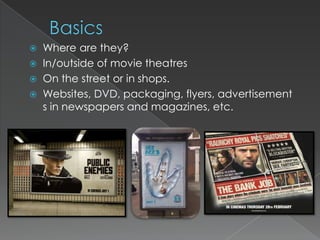
 Where are they?
 In/outside of movie theatres
 On the street or in shops.
 Websites, DVD, packaging, flyers, advertisement
  s in newspapers and magazines, etc.
As we can see the Hollywood blockbuster movie posters of 2012 all appear to
have the same basic layout – close up of the face with an item (such as an
apple) that hints towards the story of the film. However these close ups could be
a clever publicity technique, as all the close ups are of characters played by
famous actors/actresses. We can apply this to Blumler and Katz’s explanation of
IDENTIFICATION – audiences will recognise a film based on the famous actors
displayed, and this will be an immediate reason as to why they will see a film. This
would not work on our poster as British realism films tend to use unknown actors.

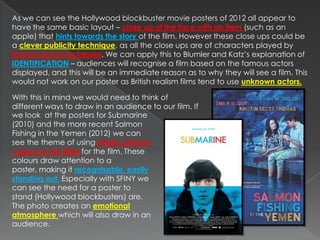
With this in mind we would need to think of
different ways to draw in an audience to our film. If
we look at the posters for Submarine
(2010) and the more recent Salmon
Fishing in the Yemen (2012) we can
see the theme of using bright, primary
colours in the titles for the film. These
colours draw attention to a
poster, making it recognisable, easily
standing out. Especially with SFINY we
can see the need for a poster to
stand (Hollywood blockbusters) are.
The photo creates an emotional
atmosphere which will also draw in an
audience.

Film poster conventions

  • 2.
    A movie poster is a poster used to advertise a film.  They normally contain an image with text.  Today's posters often feature photographs of the main actors.  The text on movie posters usually contains the film title in large lettering and often the names of the main actors.  It may also include a tag line, the name of the director, names of characters, the release date, etc.
  • 3.
     Where arethey?  In/outside of movie theatres  On the street or in shops.  Websites, DVD, packaging, flyers, advertisement s in newspapers and magazines, etc.
  • 5.
    As we cansee the Hollywood blockbuster movie posters of 2012 all appear to have the same basic layout – close up of the face with an item (such as an apple) that hints towards the story of the film. However these close ups could be a clever publicity technique, as all the close ups are of characters played by famous actors/actresses. We can apply this to Blumler and Katz’s explanation of IDENTIFICATION – audiences will recognise a film based on the famous actors displayed, and this will be an immediate reason as to why they will see a film. This would not work on our poster as British realism films tend to use unknown actors. With this in mind we would need to think of different ways to draw in an audience to our film. If we look at the posters for Submarine (2010) and the more recent Salmon Fishing in the Yemen (2012) we can see the theme of using bright, primary colours in the titles for the film. These colours draw attention to a poster, making it recognisable, easily standing out. Especially with SFINY we can see the need for a poster to stand (Hollywood blockbusters) are. The photo creates an emotional atmosphere which will also draw in an audience.