Film Poster
Codes and
Conventions
Flavio Alves 13I
To Catch The Eye
• Films are a form of promotion just like a film trailer.
This is because a film poster is a physical piece and
not a film piece. The posters can promote the film in
a lot of different ways and places.
• The most known places are on billboards, bus stops,
buses, underground stations, and at the cinemas.
Interest
• Any poster can promote something, so they aim to catch
people‟s eye, for them to read information hoping to get
them interested on the product and therefore want to find out
more about it, and end up going to watch the film.
• Because our chosen genre is Rom/Com, I will be looking at
real Rom/Com posters to help me when creating my own.
Understanding the type of
Genre
• Icons have an important role in film posters because audiences only have the poster for
them to be able to understand the genre of the film, which will debate whether they‟ll
like the poster or not. If the genre is not clearly shown on the poster, there could be a risk
of losing the audience.
• The Hangover poster shows three adults and one baby being carried by one of them. It
shows one pointing to his mouth without a tooth, and also shows the baby with sunglasses
on. From first glance, this poster looks like a comedy.
• The Oblivion poster shows two adults, one
of which has a space suit and a gun. Because
a gun means action, at first glance you would
suspect this to be an action genre.
Image
• Film posters always contain a main image which is what the audience see,
and is what is meant to catch their eye. These can either be stills from the film,
or character shots, but always contains some type of iconography to reveal
the film‟s genre.
• This poster is a good example of how to catch the
eyes of the audience, as there is a huge spider
surrounding an adult holdingin onto another one.
This shows that the film will attract more people
into going to watch the film.
• This second poster of the
same film is not such a good
example, as it is only trying to
point out to the audience
that the film will be in 3D. But
because 3D is expensive, not
many people will watch it in 3D.
Image
• The poster on the left for Donnie Darko shows one image over a black
background, which is in the shape of a bunny, which is also relevant to the
film. Inside the bunny shape, it has the bunny eyes and mouth, but also a
mixture of characters‟ faces from the film, with the most important characters
taking most of the picture‟s place inside the bunny. The colour of the image is
also mainly blue, as it is also the theme of the film.
•
• The poster on the right was brought
out to advertise the re-release, so it
was able to use a different look in the
poster. This time, the main character is
in the centre of the poster, holding a
prop and has a glowing light on his
chest.
Title
• Film posters nearly always have the film‟s title on it, because if they don‟t, then
nobody will know what the film is called and wouldn‟t be able to find out
information about it.
• One expectation of when a film poster doesn‟t need to have its title on it is
because the film is so well known, that it won‟t need it.
• The best example for this is Harry Potter & The Deathly Hallows
Part 2. All it has is the line saying „IT ALL ENDS 7.15‟. The film
distribution could take risk with this as Harry Potter is very well
known and therefore would get its audience easily, also
because it is the 2nd part of the last film Harry Potter will ever
do. Even without the title, the film is still recognisable because
it has two images of the two main characters who fight to the
end.
• Because our film will not be well known after its production, our company will
not be able to afford to not use the title of our film in the poster.
Directors, Producers and
Actors
• Usually the director and
producer of the film are
displayed, especially if the
director and producers
are well known and are
the main selling point of
the film (e.g. Big name
directors like Steven
Spielberg or producers like
Tim Burton). If it is a big
name director/producer,
then their name will be big
on the poster, but if not,
then it will still be visible but
not as obvious.
Director
Directors, Producers and
Actors
• The actors of the film are
listed either at the top or
bottom of the poster, or
at random points of the
poster if the film genre
can get away with
random arrangements. If
the film has a small cast,
then only the main actors
are on the poster, but if
the film has a well known
cast, then usually all of
the big names are on the
poster to sell the film.
Actors
Quotes, Recommendations
and Ratings
• Once a film has been screened to critics, the promotion team of a
film can re-create posters or re-cut trailers to include positive reviews,
ratings, feedback and recommendations.
This extract of a review
compares this film to
Jaws, saying that „It has
the same effect for skiing
as the effect jaws had
for swimming. This means
that it will be just as scary
as Jaws, and the
techniques are similar.
Awards
• Similarly to reviews and positive feedback, if a film is still being advertised during awards
season when the actors are nominated for awards, the trailers and posters can include
these details. If a film is nominated for an award, it means that it is considered as a well-
received film, so the audiences would be more interested in seeing it.
• Likewise, if an actor in the film or a member of the production team has previously been
nominated for a prestigious award or even won, this could also be included in the film‟s
promotion.
• This will show audiences that if they
liked the films Silver linings playbook
or The Fighter, then they will most likely
enjoy this film too because it is from
the same director.
Taglines
• In film trailers, posters and other promotions, taglines are used within them all to
emphasise a point about a film as well as hint to what will happen in the film for
audiences. Examples of this are Alien „In space no one can hear you scream‟.
• Taglines aim to be memorable for audiences so that when they think of it, they will think
of the film. An example of this is Monsters Inc. (2001) „You won‟t believe your eye‟.
• Sometimes the tagline for a film is a line that is mentioned or repeated throughout a film.
Examples are Forrest Gump (1994) with the tagline „Life is like a box of chocolates..‟ or
„One ring to rule them all.‟ from the The Lord of The Rings (2001-2003) series.
The tagline for Sleepy Hollow connects directly
to the genre of the film. „Heads Will Roll‟
automatically tells the audience that it is going
to be a horror movie, especially when there‟s a
picture of riding a horse with some sort of
weapon, that possibly chops people‟s heads
off and leaves them rolling on the floor, hence
the tagline „Heads Will Roll‟.
Date, Rating, and Extra
Info..
• Film posters need dates on them so that audiences who see them know when the film will
be out in the cinemas (Or buy it on DVD if it‟s a DVD poster). There are different types of
dates that posters can use. They can be precise and use the exact date, such as ‟13th
July‟. Or, they can put just the month, season, or a simple „Coming Soon‟, if the film is still
in production. The dates of the film depends on how well known the film is before it
comes out and whether or not the promotion company will benefit from releasing posters
months prior to the film‟s release or only a few weeks before.
Date, Rating, and Extra
Info..
• One of the most important parts of a film poster is all the small print information which
contains the name of the director, producers, actors, soundtrack, production company,
screenplay, and much more, as well as the film‟s rating, and a website link to find out
more about the film. The information on the posters is very small, so attention is not
diverted from the image and other parts of the poster.
For the Fight Club poster, the information follows the
copyright guidelines to include the production company
(FOX 2000 PICTURES AND REGENCY ENTERPRISES) and the
company owner (LINSON FILMS). Followed by the main actors
(BRAD PITT EDWARD NORTON HELENA BONHAM CARTER) and
then the film‟s title (“FIGHT CLUB”) with a few other name
cast. The creators in second (Michael KAPLAN), music by (THE
DUST BROTHERS (MICHAEL SIMPSON AND JOHN KING)). Editor
(JAMES HAYGOOD), director of photography (JEFF
CRONENWETH), executive producer (ARNON
MILCHAN), based on the novel by (CHUCK
PALAHNIUK), screenplay by (JIM UHLS), produced by (ART
LINSON, CEAN CHAFFIN, ROSS GRAYSON BELL), directed by
(DAVID FINCHER) along with images of sponsors and
producers, along with the website link and rating.
Date, Rating, and Extra
Info..
Film Theories and Film
Posters
• Now that I have looked at film poster codes and conventions, I can
apply film theories to them.
• Roland Barthes: Media Theory – The Action/Proairetic Code is the idea of
little actions that do not particularly raise questions, but creates tension
and builds suspense for audiences to guess what happens next. This can
be used in film posters, as little parts of the poster may not straight away
raise questions, but could have an impact on the film.
• When a text is not being fully explained, it is considered to be Barthes
Hermeneutic Code, as audiences want to find out what happens as so
far everything seems to be a mystery. This is very applicable to film
posters, as audiences do not have the whole story, so they are curious to
find out more.
• The Enigma Code pushes audiences to ask questions about the film‟s
plot, which they can do from seeing sneaks of a film‟s plot in film posters.
• The Semantic Code and Symbolic Code look at symbols and
connotations and meanings of symbols, so if lots of symbols are on a film
poster, what could they imply?
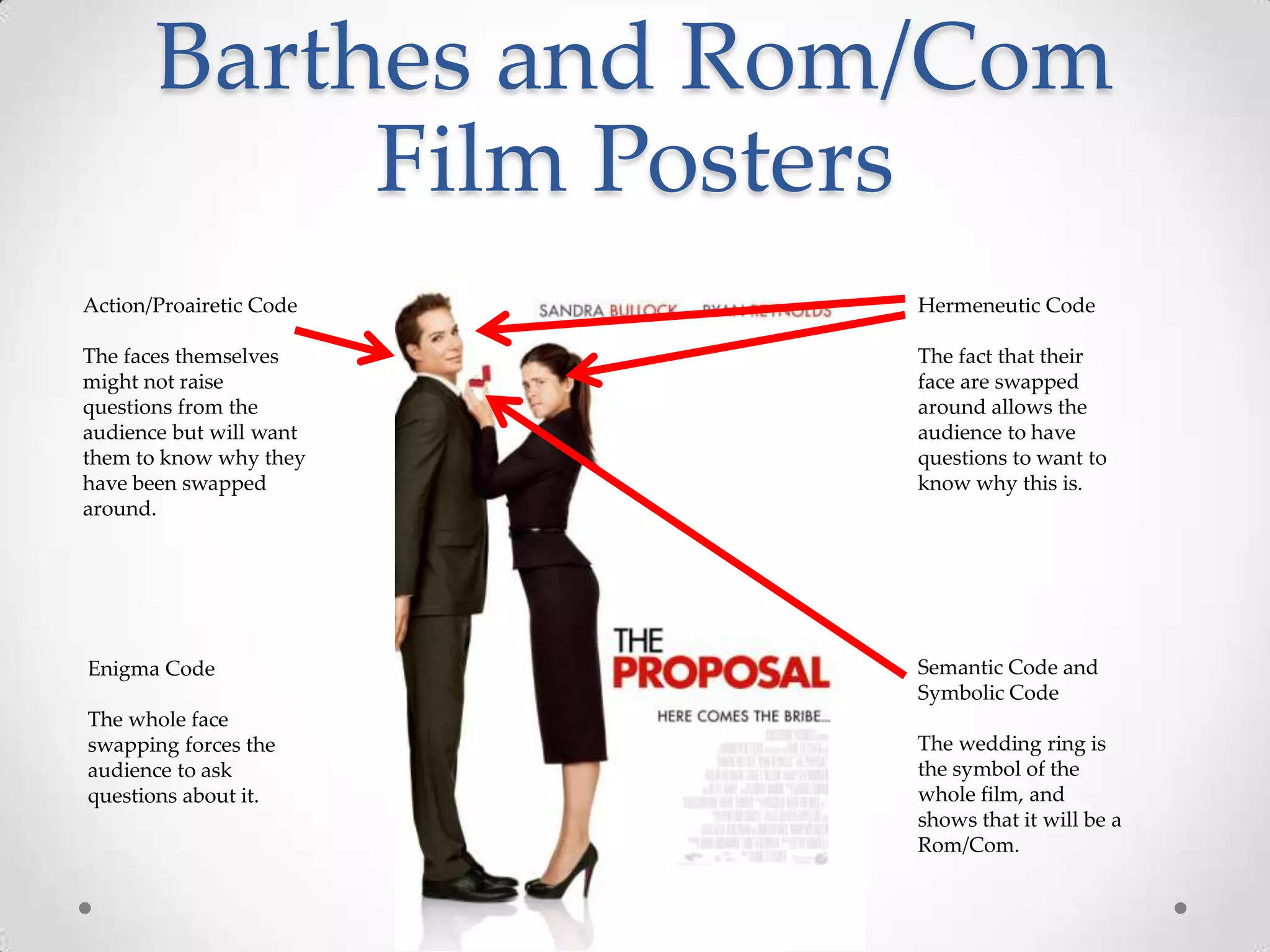
Barthes and Rom/Com
Film Posters
Hermeneutic Code
The fact that their
face are swapped
around allows the
audience to have
questions to want to
know why this is.
Semantic Code and
Symbolic Code
The wedding ring is
the symbol of the
whole film, and
shows that it will be a
Rom/Com.
Enigma Code
The whole face
swapping forces the
audience to ask
questions about it.
Action/Proairetic Code
The faces themselves
might not raise
questions from the
audience but will want
them to know why they
have been swapped
around.

Film Poster Codes and Conventions

  • 1.
  • 2.
    To Catch TheEye • Films are a form of promotion just like a film trailer. This is because a film poster is a physical piece and not a film piece. The posters can promote the film in a lot of different ways and places. • The most known places are on billboards, bus stops, buses, underground stations, and at the cinemas.
  • 3.
    Interest • Any postercan promote something, so they aim to catch people‟s eye, for them to read information hoping to get them interested on the product and therefore want to find out more about it, and end up going to watch the film. • Because our chosen genre is Rom/Com, I will be looking at real Rom/Com posters to help me when creating my own.
  • 4.
    Understanding the typeof Genre • Icons have an important role in film posters because audiences only have the poster for them to be able to understand the genre of the film, which will debate whether they‟ll like the poster or not. If the genre is not clearly shown on the poster, there could be a risk of losing the audience. • The Hangover poster shows three adults and one baby being carried by one of them. It shows one pointing to his mouth without a tooth, and also shows the baby with sunglasses on. From first glance, this poster looks like a comedy. • The Oblivion poster shows two adults, one of which has a space suit and a gun. Because a gun means action, at first glance you would suspect this to be an action genre.
  • 5.
    Image • Film postersalways contain a main image which is what the audience see, and is what is meant to catch their eye. These can either be stills from the film, or character shots, but always contains some type of iconography to reveal the film‟s genre. • This poster is a good example of how to catch the eyes of the audience, as there is a huge spider surrounding an adult holdingin onto another one. This shows that the film will attract more people into going to watch the film. • This second poster of the same film is not such a good example, as it is only trying to point out to the audience that the film will be in 3D. But because 3D is expensive, not many people will watch it in 3D.
  • 6.
    Image • The posteron the left for Donnie Darko shows one image over a black background, which is in the shape of a bunny, which is also relevant to the film. Inside the bunny shape, it has the bunny eyes and mouth, but also a mixture of characters‟ faces from the film, with the most important characters taking most of the picture‟s place inside the bunny. The colour of the image is also mainly blue, as it is also the theme of the film. • • The poster on the right was brought out to advertise the re-release, so it was able to use a different look in the poster. This time, the main character is in the centre of the poster, holding a prop and has a glowing light on his chest.
  • 7.
    Title • Film postersnearly always have the film‟s title on it, because if they don‟t, then nobody will know what the film is called and wouldn‟t be able to find out information about it. • One expectation of when a film poster doesn‟t need to have its title on it is because the film is so well known, that it won‟t need it. • The best example for this is Harry Potter & The Deathly Hallows Part 2. All it has is the line saying „IT ALL ENDS 7.15‟. The film distribution could take risk with this as Harry Potter is very well known and therefore would get its audience easily, also because it is the 2nd part of the last film Harry Potter will ever do. Even without the title, the film is still recognisable because it has two images of the two main characters who fight to the end. • Because our film will not be well known after its production, our company will not be able to afford to not use the title of our film in the poster.
  • 8.
    Directors, Producers and Actors •Usually the director and producer of the film are displayed, especially if the director and producers are well known and are the main selling point of the film (e.g. Big name directors like Steven Spielberg or producers like Tim Burton). If it is a big name director/producer, then their name will be big on the poster, but if not, then it will still be visible but not as obvious. Director
  • 9.
    Directors, Producers and Actors •The actors of the film are listed either at the top or bottom of the poster, or at random points of the poster if the film genre can get away with random arrangements. If the film has a small cast, then only the main actors are on the poster, but if the film has a well known cast, then usually all of the big names are on the poster to sell the film. Actors
  • 10.
    Quotes, Recommendations and Ratings •Once a film has been screened to critics, the promotion team of a film can re-create posters or re-cut trailers to include positive reviews, ratings, feedback and recommendations. This extract of a review compares this film to Jaws, saying that „It has the same effect for skiing as the effect jaws had for swimming. This means that it will be just as scary as Jaws, and the techniques are similar.
  • 11.
    Awards • Similarly toreviews and positive feedback, if a film is still being advertised during awards season when the actors are nominated for awards, the trailers and posters can include these details. If a film is nominated for an award, it means that it is considered as a well- received film, so the audiences would be more interested in seeing it. • Likewise, if an actor in the film or a member of the production team has previously been nominated for a prestigious award or even won, this could also be included in the film‟s promotion. • This will show audiences that if they liked the films Silver linings playbook or The Fighter, then they will most likely enjoy this film too because it is from the same director.
  • 12.
    Taglines • In filmtrailers, posters and other promotions, taglines are used within them all to emphasise a point about a film as well as hint to what will happen in the film for audiences. Examples of this are Alien „In space no one can hear you scream‟. • Taglines aim to be memorable for audiences so that when they think of it, they will think of the film. An example of this is Monsters Inc. (2001) „You won‟t believe your eye‟. • Sometimes the tagline for a film is a line that is mentioned or repeated throughout a film. Examples are Forrest Gump (1994) with the tagline „Life is like a box of chocolates..‟ or „One ring to rule them all.‟ from the The Lord of The Rings (2001-2003) series. The tagline for Sleepy Hollow connects directly to the genre of the film. „Heads Will Roll‟ automatically tells the audience that it is going to be a horror movie, especially when there‟s a picture of riding a horse with some sort of weapon, that possibly chops people‟s heads off and leaves them rolling on the floor, hence the tagline „Heads Will Roll‟.
  • 13.
    Date, Rating, andExtra Info.. • Film posters need dates on them so that audiences who see them know when the film will be out in the cinemas (Or buy it on DVD if it‟s a DVD poster). There are different types of dates that posters can use. They can be precise and use the exact date, such as ‟13th July‟. Or, they can put just the month, season, or a simple „Coming Soon‟, if the film is still in production. The dates of the film depends on how well known the film is before it comes out and whether or not the promotion company will benefit from releasing posters months prior to the film‟s release or only a few weeks before.
  • 14.
    Date, Rating, andExtra Info.. • One of the most important parts of a film poster is all the small print information which contains the name of the director, producers, actors, soundtrack, production company, screenplay, and much more, as well as the film‟s rating, and a website link to find out more about the film. The information on the posters is very small, so attention is not diverted from the image and other parts of the poster. For the Fight Club poster, the information follows the copyright guidelines to include the production company (FOX 2000 PICTURES AND REGENCY ENTERPRISES) and the company owner (LINSON FILMS). Followed by the main actors (BRAD PITT EDWARD NORTON HELENA BONHAM CARTER) and then the film‟s title (“FIGHT CLUB”) with a few other name cast. The creators in second (Michael KAPLAN), music by (THE DUST BROTHERS (MICHAEL SIMPSON AND JOHN KING)). Editor (JAMES HAYGOOD), director of photography (JEFF CRONENWETH), executive producer (ARNON MILCHAN), based on the novel by (CHUCK PALAHNIUK), screenplay by (JIM UHLS), produced by (ART LINSON, CEAN CHAFFIN, ROSS GRAYSON BELL), directed by (DAVID FINCHER) along with images of sponsors and producers, along with the website link and rating.
  • 15.
    Date, Rating, andExtra Info..
  • 16.
    Film Theories andFilm Posters • Now that I have looked at film poster codes and conventions, I can apply film theories to them. • Roland Barthes: Media Theory – The Action/Proairetic Code is the idea of little actions that do not particularly raise questions, but creates tension and builds suspense for audiences to guess what happens next. This can be used in film posters, as little parts of the poster may not straight away raise questions, but could have an impact on the film. • When a text is not being fully explained, it is considered to be Barthes Hermeneutic Code, as audiences want to find out what happens as so far everything seems to be a mystery. This is very applicable to film posters, as audiences do not have the whole story, so they are curious to find out more. • The Enigma Code pushes audiences to ask questions about the film‟s plot, which they can do from seeing sneaks of a film‟s plot in film posters. • The Semantic Code and Symbolic Code look at symbols and connotations and meanings of symbols, so if lots of symbols are on a film poster, what could they imply?
  • 17.
    Barthes and Rom/Com FilmPosters Hermeneutic Code The fact that their face are swapped around allows the audience to have questions to want to know why this is. Semantic Code and Symbolic Code The wedding ring is the symbol of the whole film, and shows that it will be a Rom/Com. Enigma Code The whole face swapping forces the audience to ask questions about it. Action/Proairetic Code The faces themselves might not raise questions from the audience but will want them to know why they have been swapped around.