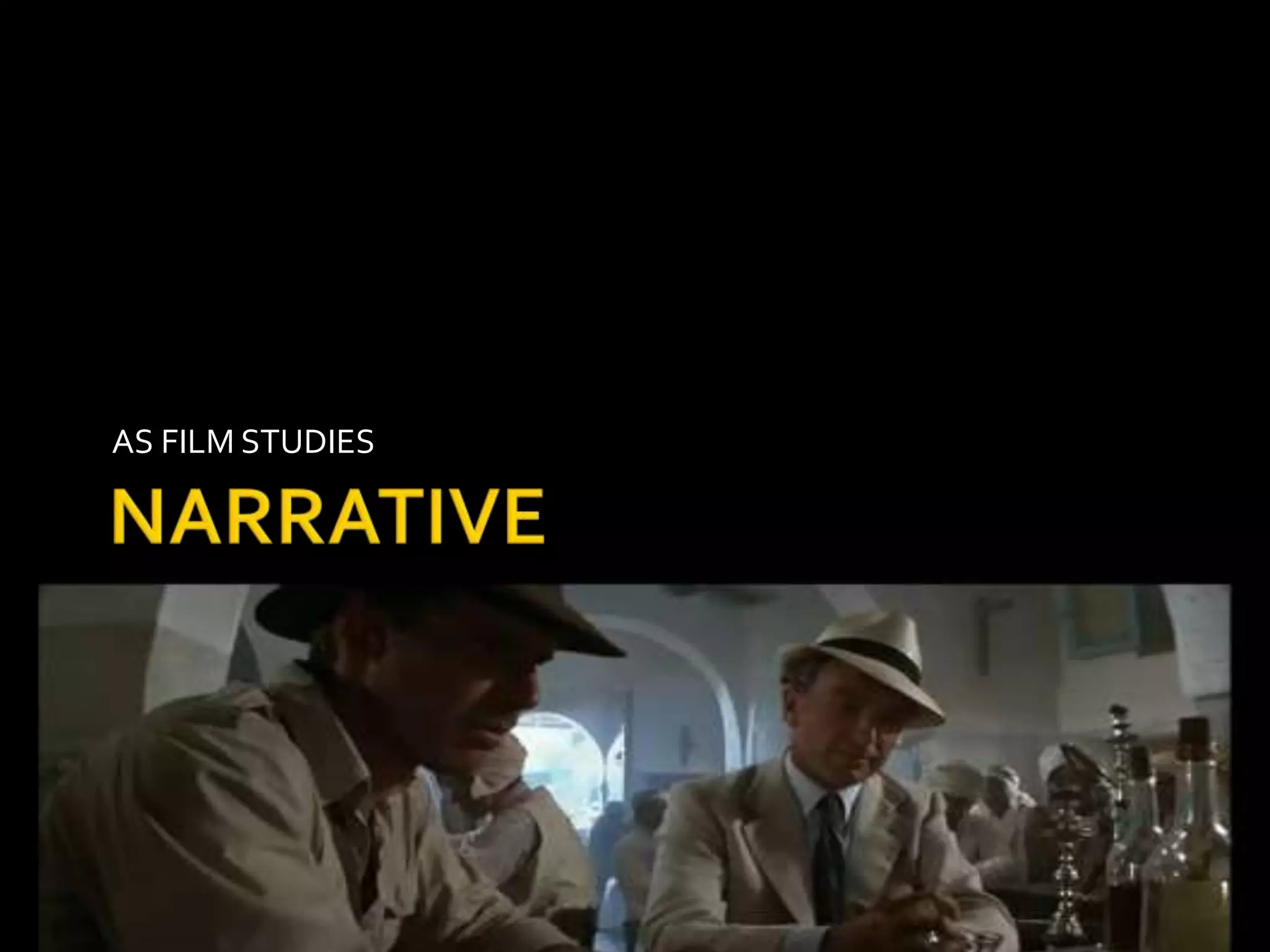
AS FILM STUDIES
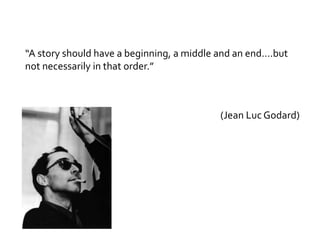
“A story should have a beginning, a middle and an end….but
not necessarily in that order.”
(Jean Luc Godard)
Filmmakers talk about stories and scripts.
Film theorists talk about narrative.
Essentially they are talking about the same thing but using
different words to do it.
To clarify we need a definition…
The Art of telling a story
NARRATIVE DEFINITION:
“ a chain of events in cause-effect relationship
occurring in time and space.”
Bordwell andThompson Film Art: an introduction
Timothy Corrigan in A short guide to writing about film identifies
two principle components in a narrative:
• the story is all the events that are presented to us or that we
can infer have happened;
• the plot is the arrangement of those events in a certain order
or structure.
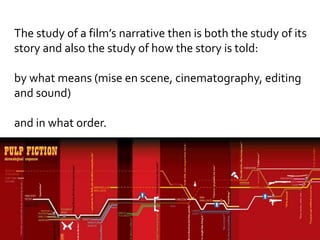
The study of a film’s narrative then is both the study of its
story and also the study of how the story is told:
by what means (mise en scene, cinematography, editing
and sound)
and in what order.
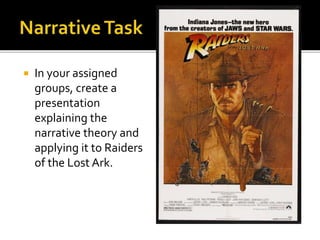
 In your assigned
groups, create a
presentation
explaining the
narrative theory and
applying it to Raiders
of the Lost Ark.
Compression of Time:
Most films operate a high degree of ellipsis
or time manipulation. In order to move the
story forward, the audience only ‘sees’ the
moments in time which are relevant to the
Narrative.
Some texts operate time as a more
balanced ‘Real time’ construction but
Classical/Post Classical Hollywood
Narrative maintains strict control over
Narrative Time.
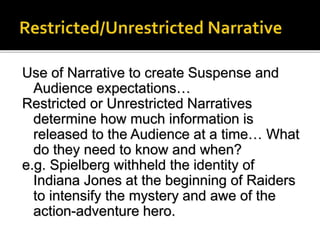
Use of Narrative to create Suspense and
Audience expectations…
Restricted or Unrestricted Narratives
determine how much information is
released to the Audience at a time… What
do they need to know and when?
e.g. Spielberg withheld the identity of
Indiana Jones at the beginning of Raiders
to intensify the mystery and awe of the
action-adventure hero.
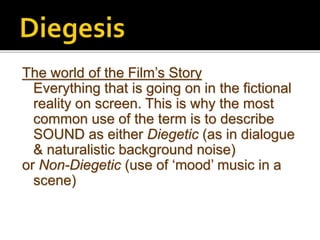
The world of the Film’s Story
Everything that is going on in the fictional
reality on screen. This is why the most
common use of the term is to describe
SOUND as either Diegetic (as in dialogue
& naturalistic background noise)
or Non-Diegetic (use of ‘mood’ music in a
scene)
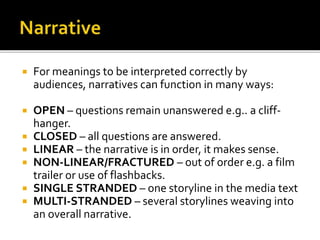
 For meanings to be interpreted correctly by
audiences, narratives can function in many ways:
 OPEN – questions remain unanswered e.g.. a cliff-
hanger.
 CLOSED – all questions are answered.
 LINEAR – the narrative is in order, it makes sense.
 NON-LINEAR/FRACTURED – out of order e.g. a film
trailer or use of flashbacks.
 SINGLE STRANDED – one storyline in the media text
 MULTI-STRANDED – several storylines weaving into
an overall narrative.
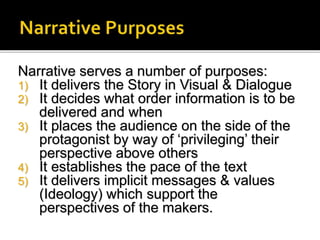
Narrative serves a number of purposes:
1) It delivers the Story in Visual & Dialogue
2) It decides what order information is to be
delivered and when
3) It places the audience on the side of the
protagonist by way of ‘privileging’ their
perspective above others
4) It establishes the pace of the text
5) It delivers implicit messages & values
(Ideology) which support the
perspectives of the makers.

Film narrative intro

  • 1.
  • 2.
    “A story shouldhave a beginning, a middle and an end….but not necessarily in that order.” (Jean Luc Godard)
  • 3.
    Filmmakers talk aboutstories and scripts. Film theorists talk about narrative. Essentially they are talking about the same thing but using different words to do it. To clarify we need a definition… The Art of telling a story
  • 4.
    NARRATIVE DEFINITION: “ achain of events in cause-effect relationship occurring in time and space.” Bordwell andThompson Film Art: an introduction Timothy Corrigan in A short guide to writing about film identifies two principle components in a narrative: • the story is all the events that are presented to us or that we can infer have happened; • the plot is the arrangement of those events in a certain order or structure.
  • 5.
    The study ofa film’s narrative then is both the study of its story and also the study of how the story is told: by what means (mise en scene, cinematography, editing and sound) and in what order.
  • 6.
     In yourassigned groups, create a presentation explaining the narrative theory and applying it to Raiders of the Lost Ark.
  • 7.
    Compression of Time: Mostfilms operate a high degree of ellipsis or time manipulation. In order to move the story forward, the audience only ‘sees’ the moments in time which are relevant to the Narrative. Some texts operate time as a more balanced ‘Real time’ construction but Classical/Post Classical Hollywood Narrative maintains strict control over Narrative Time.
  • 8.
    Use of Narrativeto create Suspense and Audience expectations… Restricted or Unrestricted Narratives determine how much information is released to the Audience at a time… What do they need to know and when? e.g. Spielberg withheld the identity of Indiana Jones at the beginning of Raiders to intensify the mystery and awe of the action-adventure hero.
  • 9.
    The world ofthe Film’s Story Everything that is going on in the fictional reality on screen. This is why the most common use of the term is to describe SOUND as either Diegetic (as in dialogue & naturalistic background noise) or Non-Diegetic (use of ‘mood’ music in a scene)
  • 10.
     For meaningsto be interpreted correctly by audiences, narratives can function in many ways:  OPEN – questions remain unanswered e.g.. a cliff- hanger.  CLOSED – all questions are answered.  LINEAR – the narrative is in order, it makes sense.  NON-LINEAR/FRACTURED – out of order e.g. a film trailer or use of flashbacks.  SINGLE STRANDED – one storyline in the media text  MULTI-STRANDED – several storylines weaving into an overall narrative.
  • 11.
    Narrative serves anumber of purposes: 1) It delivers the Story in Visual & Dialogue 2) It decides what order information is to be delivered and when 3) It places the audience on the side of the protagonist by way of ‘privileging’ their perspective above others 4) It establishes the pace of the text 5) It delivers implicit messages & values (Ideology) which support the perspectives of the makers.