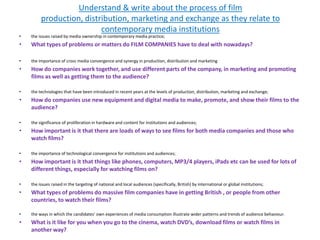
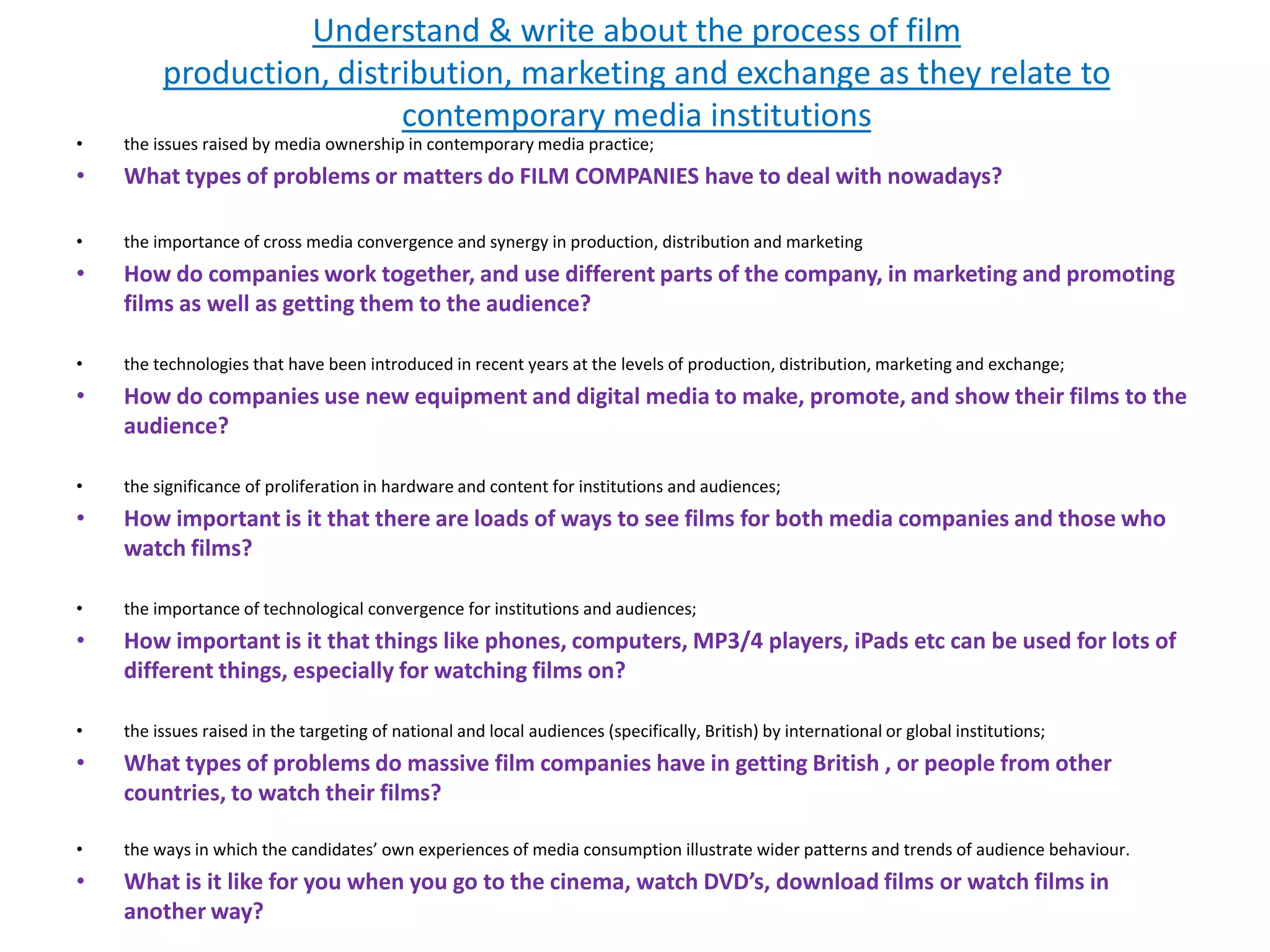
Understand & write about the process of film
production, distribution, marketing and exchange as they relate to
contemporary media institutions
• the issues raised by media ownership in contemporary media practice;
• What types of problems or matters do FILM COMPANIES have to deal with nowadays?
• the importance of cross media convergence and synergy in production, distribution and marketing
• How do companies work together, and use different parts of the company, in marketing and promoting
films as well as getting them to the audience?
• the technologies that have been introduced in recent years at the levels of production, distribution, marketing and exchange;
• How do companies use new equipment and digital media to make, promote, and show their films to the
audience?
• the significance of proliferation in hardware and content for institutions and audiences;
• How important is it that there are loads of ways to see films for both media companies and those who
watch films?
• the importance of technological convergence for institutions and audiences;
• How important is it that things like phones, computers, MP3/4 players, iPads etc can be used for lots of
different things, especially for watching films on?
• the issues raised in the targeting of national and local audiences (specifically, British) by international or global institutions;
• What types of problems do massive film companies have in getting British , or people from other
countries, to watch their films?
• the ways in which the candidates’ own experiences of media consumption illustrate wider patterns and trends of audience behaviour.
• What is it like for you when you go to the cinema, watch DVD’s, download films or watch films in
another way?
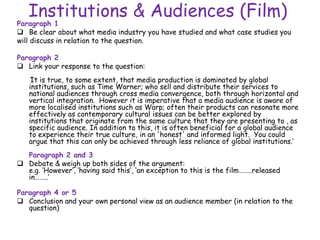
Institutions & Audiences (Film)
Paragraph 1
 Be clear about what media industry you have studied and what case studies you
will discuss in relation to the question.
Paragraph 2
 Link your response to the question:
‘It is true, to some extent, that media production is dominated by global
institutions, such as Time Warner; who sell and distribute their services to
national audiences through cross media convergence, both through horizontal and
vertical integration. However it is imperative that a media audience is aware of
more localised institutions such as Warp; often their products can resonate more
effectively as contemporary cultural issues can be better explored by
institutions that originate from the same culture that they are presenting to , as
specific audience. In addition to this, it is often beneficial for a global audience
to experience their true culture, in an 'honest' and informed light. You could
argue that this can only be achieved through less reliance of global institutions.’
Paragraph 2 and 3
 Debate & weigh up both sides of the argument:
e.g. ‘However’, ‘having said this’, ‘an exception to this is the film……..released
in……..’
Paragraph 4 or 5
 Conclusion and your own personal view as an audience member (in relation to the
question)
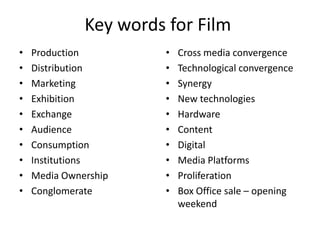
Key words for Film
• Production
• Distribution
• Marketing
• Exhibition
• Exchange
• Audience
• Consumption
• Institutions
• Media Ownership
• Conglomerate
• Cross media convergence
• Technological convergence
• Synergy
• New technologies
• Hardware
• Content
• Digital
• Media Platforms
• Proliferation
• Box Office sale – opening
weekend
Case study: Case Study:
Case Study: Case Study:
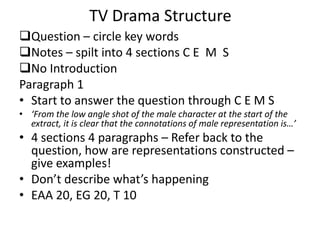
TV Drama Structure
Question – circle key words
Notes – spilt into 4 sections C E M S
No Introduction
Paragraph 1
• Start to answer the question through C E M S
• ‘From the low angle shot of the male character at the start of the
extract, it is clear that the connotations of male representation is…’
• 4 sections 4 paragraphs – Refer back to the
question, how are representations constructed –
give examples!
• Don’t describe what’s happening
• EAA 20, EG 20, T 10
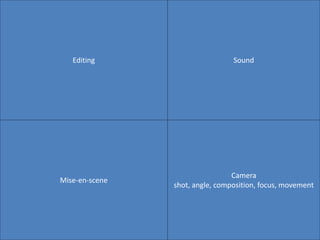
Editing Sound
Mise-en-scene
Camera
shot, angle, composition, focus, movement

Film guidance

  • 1.
    Understand & writeabout the process of film production, distribution, marketing and exchange as they relate to contemporary media institutions • the issues raised by media ownership in contemporary media practice; • What types of problems or matters do FILM COMPANIES have to deal with nowadays? • the importance of cross media convergence and synergy in production, distribution and marketing • How do companies work together, and use different parts of the company, in marketing and promoting films as well as getting them to the audience? • the technologies that have been introduced in recent years at the levels of production, distribution, marketing and exchange; • How do companies use new equipment and digital media to make, promote, and show their films to the audience? • the significance of proliferation in hardware and content for institutions and audiences; • How important is it that there are loads of ways to see films for both media companies and those who watch films? • the importance of technological convergence for institutions and audiences; • How important is it that things like phones, computers, MP3/4 players, iPads etc can be used for lots of different things, especially for watching films on? • the issues raised in the targeting of national and local audiences (specifically, British) by international or global institutions; • What types of problems do massive film companies have in getting British , or people from other countries, to watch their films? • the ways in which the candidates’ own experiences of media consumption illustrate wider patterns and trends of audience behaviour. • What is it like for you when you go to the cinema, watch DVD’s, download films or watch films in another way?
  • 2.
    Institutions & Audiences(Film) Paragraph 1  Be clear about what media industry you have studied and what case studies you will discuss in relation to the question. Paragraph 2  Link your response to the question: ‘It is true, to some extent, that media production is dominated by global institutions, such as Time Warner; who sell and distribute their services to national audiences through cross media convergence, both through horizontal and vertical integration. However it is imperative that a media audience is aware of more localised institutions such as Warp; often their products can resonate more effectively as contemporary cultural issues can be better explored by institutions that originate from the same culture that they are presenting to , as specific audience. In addition to this, it is often beneficial for a global audience to experience their true culture, in an 'honest' and informed light. You could argue that this can only be achieved through less reliance of global institutions.’ Paragraph 2 and 3  Debate & weigh up both sides of the argument: e.g. ‘However’, ‘having said this’, ‘an exception to this is the film……..released in……..’ Paragraph 4 or 5  Conclusion and your own personal view as an audience member (in relation to the question)
  • 3.
    Key words forFilm • Production • Distribution • Marketing • Exhibition • Exchange • Audience • Consumption • Institutions • Media Ownership • Conglomerate • Cross media convergence • Technological convergence • Synergy • New technologies • Hardware • Content • Digital • Media Platforms • Proliferation • Box Office sale – opening weekend
  • 4.
    Case study: CaseStudy: Case Study: Case Study:
  • 5.
    TV Drama Structure Question– circle key words Notes – spilt into 4 sections C E M S No Introduction Paragraph 1 • Start to answer the question through C E M S • ‘From the low angle shot of the male character at the start of the extract, it is clear that the connotations of male representation is…’ • 4 sections 4 paragraphs – Refer back to the question, how are representations constructed – give examples! • Don’t describe what’s happening • EAA 20, EG 20, T 10
  • 6.

Editor's Notes

  • #6 Camera shot, angle, composition, focus, movement