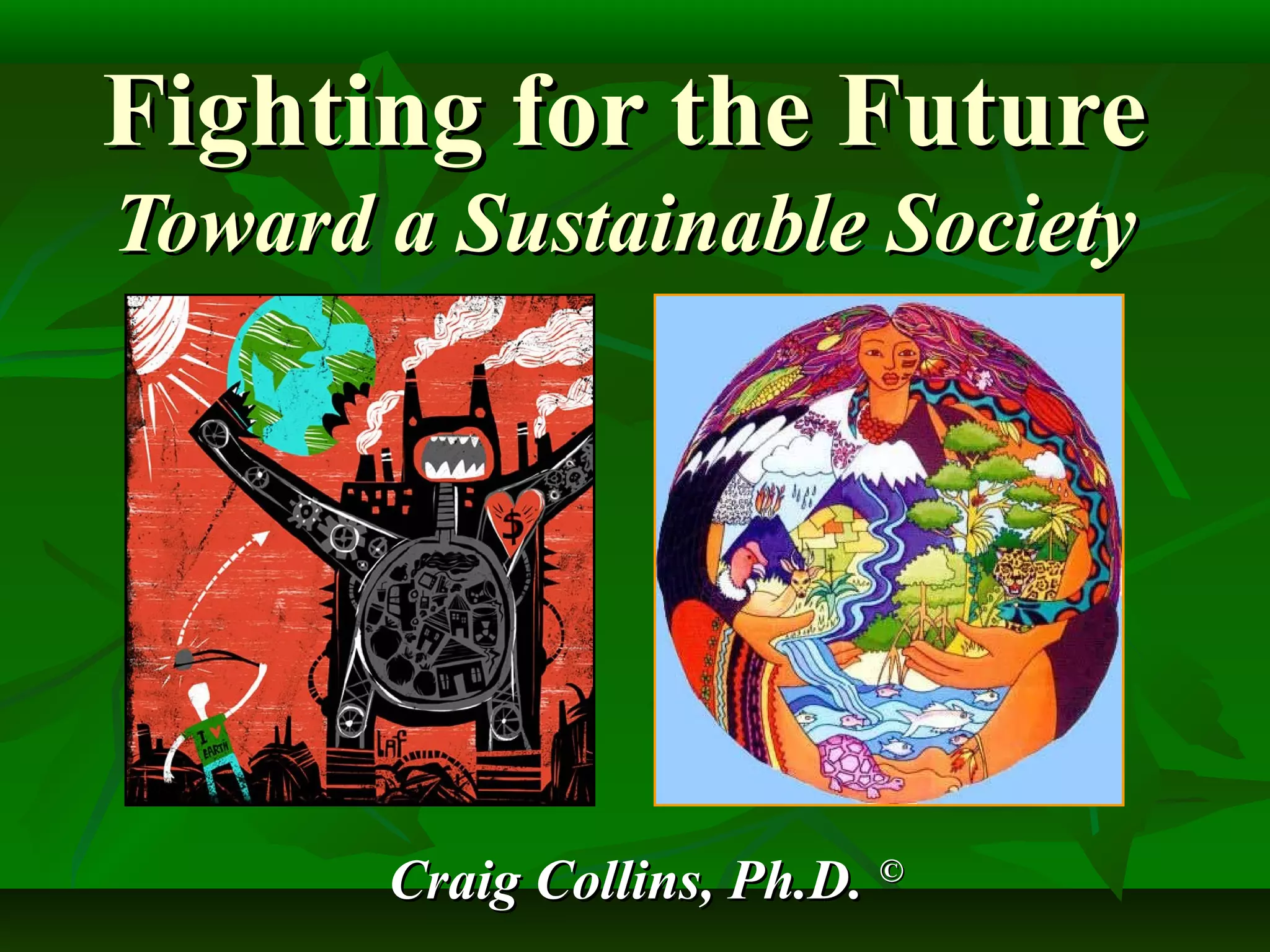
Fighting for the FutureFighting for the Future
Toward a Sustainable SocietyToward a Sustainable Society
Craig Collins, Ph.D.Craig Collins, Ph.D. ©©
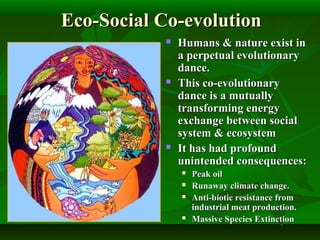
Eco-Social Co-evolutionEco-Social Co-evolution
 Humans & nature exist inHumans & nature exist in
a perpetual evolutionarya perpetual evolutionary
dance.dance.
 This co-evolutionaryThis co-evolutionary
dance is a mutuallydance is a mutually
transforming energytransforming energy
exchange between socialexchange between social
system & ecosystemsystem & ecosystem
 It has had profoundIt has had profound
unintended consequences:unintended consequences:
 Peak oilPeak oil
 Runaway climate change.Runaway climate change.
 Anti-biotic resistance fromAnti-biotic resistance from
industrial meat production.industrial meat production.
 Massive Species ExtinctionMassive Species Extinction
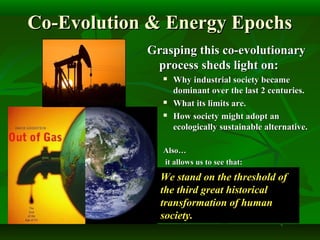
Co-Evolution & Energy EpochsCo-Evolution & Energy Epochs
Grasping this co-evolutionaryGrasping this co-evolutionary
process sheds light on:process sheds light on:
 Why industrial society becameWhy industrial society became
dominant over the last 2 centuries.dominant over the last 2 centuries.
 What its limits are.What its limits are.
 How society might adopt anHow society might adopt an
ecologically sustainable alternative.ecologically sustainable alternative.
Also…Also…
it allows us to see that:it allows us to see that:
We stand on the threshold of
the third great historical
transformation of human
society.
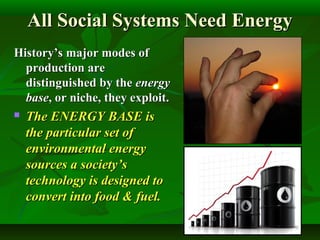
All Social Systems Need EnergyAll Social Systems Need Energy
History’s major modes ofHistory’s major modes of
production areproduction are
distinguished by thedistinguished by the energyenergy
basebase, or niche, they exploit., or niche, they exploit.
 The ENERGY BASE isThe ENERGY BASE is
the particular set ofthe particular set of
environmental energyenvironmental energy
sources a society’ssources a society’s
technology is designed totechnology is designed to
convert into food & fuel.convert into food & fuel.
History’s 3 Major Modes of Survival HaveHistory’s 3 Major Modes of Survival Have
Metabolized Their Own Unique Energy NicheMetabolized Their Own Unique Energy Niche
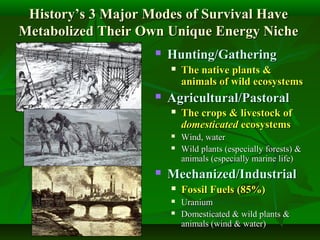
 Hunting/GatheringHunting/Gathering
 The native plants &The native plants &
animals of wild ecosystemsanimals of wild ecosystems
 Agricultural/PastoralAgricultural/Pastoral
 The crops & livestock ofThe crops & livestock of
domesticateddomesticated ecosystemsecosystems
 Wind, waterWind, water
 Wild plants (especially forests) &Wild plants (especially forests) &
animals (especially marine life)animals (especially marine life)
 Mechanized/IndustrialMechanized/Industrial
 Fossil Fuels (85%)Fossil Fuels (85%)
 UraniumUranium
 Domesticated & wild plants &Domesticated & wild plants &
animals (wind & water)animals (wind & water)
Eco-social Evolution’s Central InsightsEco-social Evolution’s Central Insights
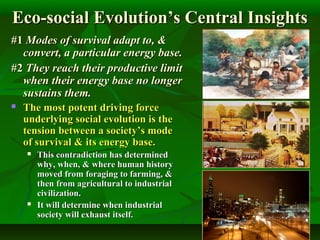
#1#1 Modes of survival adapt to, &Modes of survival adapt to, &
convert, a particular energy base.convert, a particular energy base.
#2#2 They reach their productive limitThey reach their productive limit
when their energy base no longerwhen their energy base no longer
sustains them.sustains them.
 The most potent driving forceThe most potent driving force
underlying social evolution is theunderlying social evolution is the
tension between a society’s modetension between a society’s mode
of survival & its energy base.of survival & its energy base.
 This contradiction has determinedThis contradiction has determined
why, when, & where human historywhy, when, & where human history
moved from foraging to farming, &moved from foraging to farming, &
then from agricultural to industrialthen from agricultural to industrial
civilization.civilization.
 It will determine when industrialIt will determine when industrial
society will exhaust itself.society will exhaust itself.
Technology Conforms To & Converts Energy BaseTechnology Conforms To & Converts Energy Base
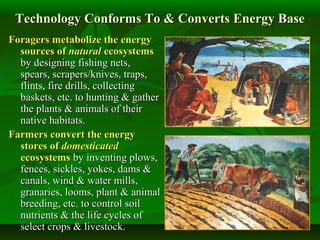
ForagersForagers metabolize the energymetabolize the energy
sources ofsources of naturalnatural ecosystemsecosystems
by designing fishing nets,by designing fishing nets,
spears, scrapers/knives, traps,spears, scrapers/knives, traps,
flints, fire drills, collectingflints, fire drills, collecting
baskets, etc. to hunting & gatherbaskets, etc. to hunting & gather
the plants & animals of theirthe plants & animals of their
native habitats.native habitats.
FarmersFarmers convert the energyconvert the energy
stores ofstores of domesticateddomesticated
ecosystemsecosystems by inventing plows,by inventing plows,
fences, sickles, yokes, dams &fences, sickles, yokes, dams &
canals, wind & water mills,canals, wind & water mills,
granaries, looms, plant & animalgranaries, looms, plant & animal
breeding, etc. to control soilbreeding, etc. to control soil
nutrients & the life cycles ofnutrients & the life cycles of
select crops & livestock.select crops & livestock.
Social Relations Adapt toSocial Relations Adapt to
Technology & Energy NicheTechnology & Energy Niche
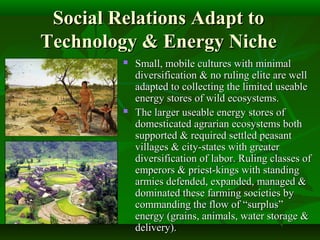
 Small, mobile cultures with minimalSmall, mobile cultures with minimal
diversification & no ruling elite are welldiversification & no ruling elite are well
adapted to collecting the limited useableadapted to collecting the limited useable
energy stores of wild ecosystems.energy stores of wild ecosystems.
 The larger useable energy stores ofThe larger useable energy stores of
domesticated agrarian ecosystems bothdomesticated agrarian ecosystems both
supported & required settled peasantsupported & required settled peasant
villages & city-states with greatervillages & city-states with greater
diversification of labor. Ruling classes ofdiversification of labor. Ruling classes of
emperors & priest-kings with standingemperors & priest-kings with standing
armies defended, expanded, managed &armies defended, expanded, managed &
dominated these farming societies bydominated these farming societies by
commanding the flow of “surplus”commanding the flow of “surplus”
energy (grains, animals, water storage &energy (grains, animals, water storage &
delivery).delivery).
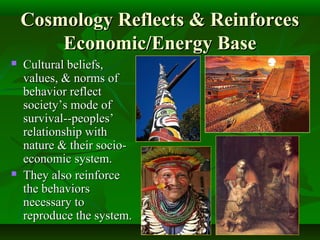
Cosmology Reflects & ReinforcesCosmology Reflects & Reinforces
Economic/Energy BaseEconomic/Energy Base
 Cultural beliefs,Cultural beliefs,
values, & norms ofvalues, & norms of
behavior reflectbehavior reflect
society’s mode ofsociety’s mode of
survival--peoples’survival--peoples’
relationship withrelationship with
nature & their socio-nature & their socio-
economic system.economic system.
 They also reinforceThey also reinforce
the behaviorsthe behaviors
necessary tonecessary to
reproduce the system.reproduce the system.
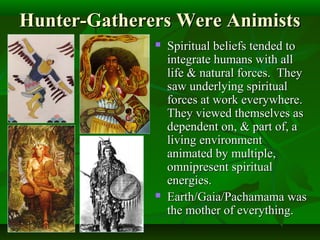
Hunter-Gatherers Were AnimistsHunter-Gatherers Were Animists
 Spiritual beliefs tended toSpiritual beliefs tended to
integrate humans with allintegrate humans with all
life & natural forces. Theylife & natural forces. They
saw underlying spiritualsaw underlying spiritual
forces at work everywhere.forces at work everywhere.
They viewed themselves asThey viewed themselves as
dependent on, & part of, adependent on, & part of, a
living environmentliving environment
animated by multiple,animated by multiple,
omnipresent spiritualomnipresent spiritual
energies.energies.
 Earth/Gaia/Pachamama wasEarth/Gaia/Pachamama was
the mother of everything.the mother of everything.
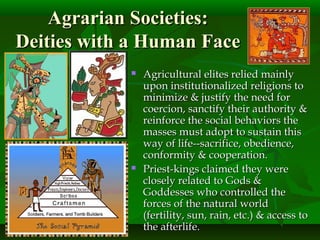
Agrarian Societies:Agrarian Societies:
Deities with a Human FaceDeities with a Human Face
 Agricultural elites relied mainlyAgricultural elites relied mainly
upon institutionalized religions toupon institutionalized religions to
minimize & justify the need forminimize & justify the need for
coercion, sanctify their authority &coercion, sanctify their authority &
reinforce the social behaviors thereinforce the social behaviors the
masses must adopt to sustain thismasses must adopt to sustain this
way of life--sacrifice, obedience,way of life--sacrifice, obedience,
conformity & cooperation.conformity & cooperation.
 Priest-kings claimed they werePriest-kings claimed they were
closely related to Gods &closely related to Gods &
Goddesses who controlled theGoddesses who controlled the
forces of the natural worldforces of the natural world
(fertility, sun, rain, etc.) & access to(fertility, sun, rain, etc.) & access to
the afterlife.the afterlife.
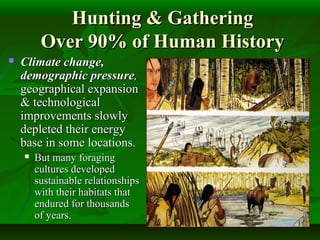
Hunting & GatheringHunting & Gathering
Over 90% of Human HistoryOver 90% of Human History
 Climate change,Climate change,
demographic pressuredemographic pressure,,
geographical expansiongeographical expansion
& technological& technological
improvements slowlyimprovements slowly
depleted their energydepleted their energy
base in some locations.base in some locations.
 But many foragingBut many foraging
cultures developedcultures developed
sustainable relationshipssustainable relationships
with their habitats thatwith their habitats that
endured for thousandsendured for thousands
of years.of years.
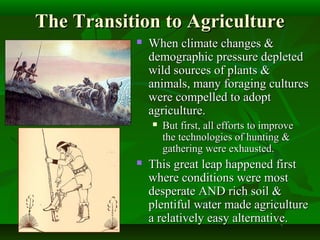
The Transition to AgricultureThe Transition to Agriculture
 When climate changes &When climate changes &
demographic pressure depleteddemographic pressure depleted
wild sources of plants &wild sources of plants &
animals, many foraging culturesanimals, many foraging cultures
were compelled to adoptwere compelled to adopt
agriculture.agriculture.
 But first, all efforts to improveBut first, all efforts to improve
the technologies of hunting &the technologies of hunting &
gathering were exhausted.gathering were exhausted.
 This great leap happened firstThis great leap happened first
where conditions were mostwhere conditions were most
desperate AND rich soil &desperate AND rich soil &
plentiful water made agricultureplentiful water made agriculture
a relatively easy alternative.a relatively easy alternative.
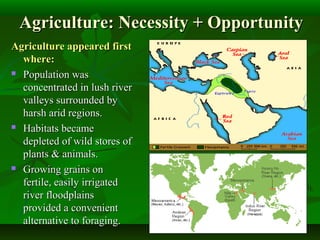
Agriculture: Necessity + OpportunityAgriculture: Necessity + Opportunity
Agriculture appeared firstAgriculture appeared first
where:where:
 Population wasPopulation was
concentrated in lush riverconcentrated in lush river
valleys surrounded byvalleys surrounded by
harsh arid regions.harsh arid regions.
 Habitats becameHabitats became
depleted of wild stores ofdepleted of wild stores of
plants & animals.plants & animals.
 Growing grains onGrowing grains on
fertile, easily irrigatedfertile, easily irrigated
river floodplainsriver floodplains
provided a convenientprovided a convenient
alternative to foraging.alternative to foraging.
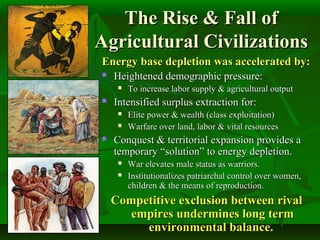
The Rise & Fall ofThe Rise & Fall of
Agricultural CivilizationsAgricultural Civilizations
Energy base depletion was accelerated by:Energy base depletion was accelerated by:
 Heightened demographic pressure:Heightened demographic pressure:
 To increase labor supply & agricultural outputTo increase labor supply & agricultural output
 Intensified surplus extraction for:Intensified surplus extraction for:
 Elite power & wealth (class exploitation)Elite power & wealth (class exploitation)
 Warfare over land, labor & vital resourcesWarfare over land, labor & vital resources
 Conquest & territorial expansion provides aConquest & territorial expansion provides a
temporary “solution” to energy depletion.temporary “solution” to energy depletion.
 War elevates male status as warriors.War elevates male status as warriors.
 Institutionalizes patriarchal control over women,Institutionalizes patriarchal control over women,
children & the means of reproduction.children & the means of reproduction.
Competitive exclusion between rivalCompetitive exclusion between rival
empires undermines long termempires undermines long term
environmental balance.environmental balance.
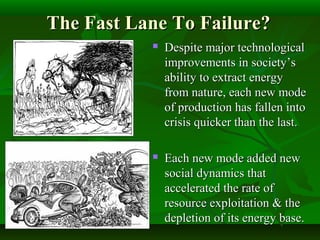
The Fast Lane To Failure?The Fast Lane To Failure?
 Despite major technologicalDespite major technological
improvements in society’simprovements in society’s
ability to extract energyability to extract energy
from nature, each new modefrom nature, each new mode
of production has fallen intoof production has fallen into
crisis quicker than the last.crisis quicker than the last.
 Each new mode added newEach new mode added new
social dynamics thatsocial dynamics that
accelerated the rate ofaccelerated the rate of
resource exploitation & theresource exploitation & the
depletion of its energy base.depletion of its energy base.
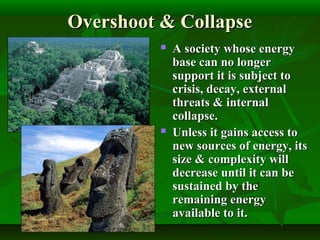
Overshoot & CollapseOvershoot & Collapse
 A society whose energyA society whose energy
base can no longerbase can no longer
support it is subject tosupport it is subject to
crisis, decay, externalcrisis, decay, external
threats & internalthreats & internal
collapse.collapse.
 Unless it gains access toUnless it gains access to
new sources of energy, itsnew sources of energy, its
size & complexity willsize & complexity will
decrease until it can bedecrease until it can be
sustained by thesustained by the
remaining energyremaining energy
available to it.available to it.
Energy Base &Energy Base & RevolutionaryRevolutionary ChangeChange
 No society adopts a new energyNo society adopts a new energy
base & mode of survival untilbase & mode of survival until
its old energy base no longerits old energy base no longer
sustains it.sustains it.
 Necessity has been the motherNecessity has been the mother
of invention for each greatof invention for each great
revolutionary leap from onerevolutionary leap from one
mode of production to another.mode of production to another.
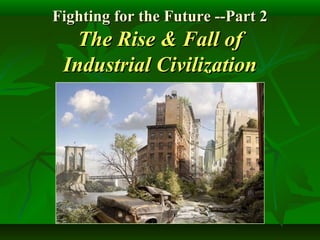
Fighting for the Future --Part 2Fighting for the Future --Part 2
The Rise & Fall ofThe Rise & Fall of
Industrial CivilizationIndustrial Civilization
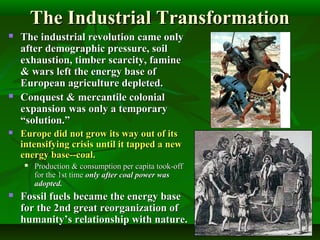
The Industrial TransformationThe Industrial Transformation
 The industrial revolution came onlyThe industrial revolution came only
after demographic pressure, soilafter demographic pressure, soil
exhaustion, timber scarcity, famineexhaustion, timber scarcity, famine
& wars left the energy base of& wars left the energy base of
European agriculture depleted.European agriculture depleted.
 Conquest & mercantile colonialConquest & mercantile colonial
expansion was only a temporaryexpansion was only a temporary
“solution.”“solution.”
 Europe did not grow its way out of itsEurope did not grow its way out of its
intensifying crisis until it tapped a newintensifying crisis until it tapped a new
energy base--coal.energy base--coal.
 Production & consumption per capita took-offProduction & consumption per capita took-off
for the 1st timefor the 1st time only after coal power wasonly after coal power was
adopted.adopted.
 Fossil fuels became the energy baseFossil fuels became the energy base
for the 2nd great reorganization offor the 2nd great reorganization of
humanity’s relationship with nature.humanity’s relationship with nature.
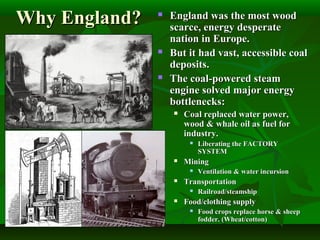
Why England?Why England?  England was the most woodEngland was the most wood
scarce, energy desperatescarce, energy desperate
nation in Europe.nation in Europe.
 But it had vast, accessible coalBut it had vast, accessible coal
deposits.deposits.
 The coal-powered steamThe coal-powered steam
engine solved major energyengine solved major energy
bottlenecks:bottlenecks:
 Coal replaced water power,Coal replaced water power,
wood & whale oil as fuel forwood & whale oil as fuel for
industry.industry.
 Liberating the FACTORYLiberating the FACTORY
SYSTEMSYSTEM
 MiningMining
 Ventilation & water incursionVentilation & water incursion
 TransportationTransportation
 Railroad/steamshipRailroad/steamship
 Food/clothing supplyFood/clothing supply
 Food crops replace horse & sheepFood crops replace horse & sheep
fodder. (Wheat/cotton)fodder. (Wheat/cotton)
Coal & Class ConflictCoal & Class Conflict
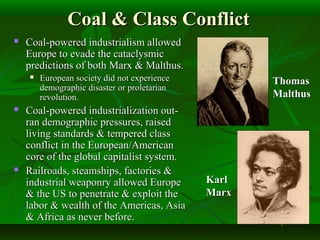
 Coal-powered industrialism allowedCoal-powered industrialism allowed
Europe to evade the cataclysmicEurope to evade the cataclysmic
predictions of both Marx & Malthus.predictions of both Marx & Malthus.
 European society did not experienceEuropean society did not experience
demographic disaster or proletariandemographic disaster or proletarian
revolution.revolution.
 Coal-powered industrialization out-Coal-powered industrialization out-
ran demographic pressures, raisedran demographic pressures, raised
living standards & tempered classliving standards & tempered class
conflict in the European/Americanconflict in the European/American
core of the global capitalist system.core of the global capitalist system.
 Railroads, steamships, factories &Railroads, steamships, factories &
industrial weaponry allowed Europeindustrial weaponry allowed Europe
& the US to penetrate & exploit the& the US to penetrate & exploit the
labor & wealth of the Americas, Asialabor & wealth of the Americas, Asia
& Africa as never before.& Africa as never before.
ThomasThomas
MalthusMalthus
KarlKarl
MarxMarx
—— Fossil Fuels —Fossil Fuels —
Not Just Another ResourceNot Just Another Resource
 Without coal-poweredWithout coal-powered
machines/factories themachines/factories the
industrial revolutionindustrial revolution
would not have beenwould not have been
possible.possible.
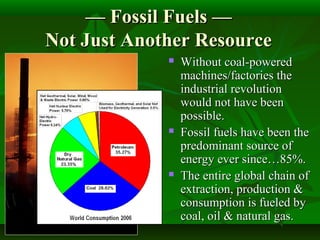
 Fossil fuels have been theFossil fuels have been the
predominant source ofpredominant source of
energy ever since…85%.energy ever since…85%.
 The entire global chain ofThe entire global chain of
extraction, production &extraction, production &
consumption is fueled byconsumption is fueled by
coal, oil & natural gas.coal, oil & natural gas.
Fossil Fuels--The Energy Base ofFossil Fuels--The Energy Base of
Industrial SocietyIndustrial Society
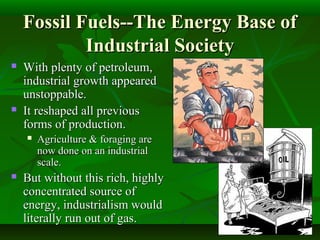
 With plenty of petroleum,With plenty of petroleum,
industrial growth appearedindustrial growth appeared
unstoppable.unstoppable.
 It reshaped all previousIt reshaped all previous
forms of production.forms of production.
 Agriculture & foraging areAgriculture & foraging are
now done on an industrialnow done on an industrial
scale.scale.
 But without this rich, highlyBut without this rich, highly
concentrated source ofconcentrated source of
energy, industrialism wouldenergy, industrialism would
literally run out of gas.literally run out of gas.
Industrial AgricultureIndustrial Agriculture
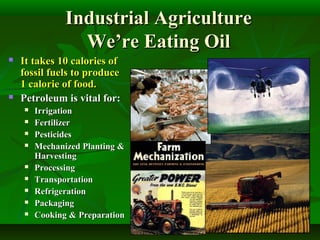
We’re Eating OilWe’re Eating Oil
 It takes 10 calories ofIt takes 10 calories of
fossil fuels to producefossil fuels to produce
1 calorie of food.1 calorie of food.
 Petroleum is vital for:Petroleum is vital for:
 IrrigationIrrigation
 FertilizerFertilizer
 PesticidesPesticides
 Mechanized Planting &Mechanized Planting &
HarvestingHarvesting
 ProcessingProcessing
 TransportationTransportation
 RefrigerationRefrigeration
 PackagingPackaging
 Cooking & PreparationCooking & Preparation
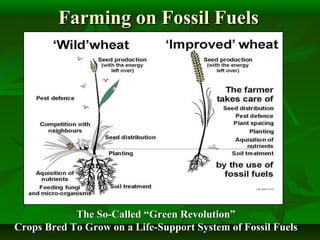
Farming on Fossil FuelsFarming on Fossil Fuels
The So-Called “Green Revolution”The So-Called “Green Revolution”
Crops Bred To Grow on a Life-Support System of Fossil FuelsCrops Bred To Grow on a Life-Support System of Fossil Fuels
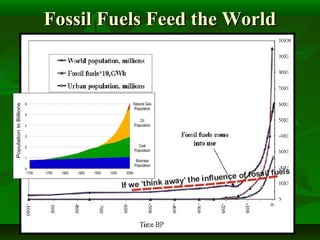
Fossil Fuels Feed the WorldFossil Fuels Feed the World
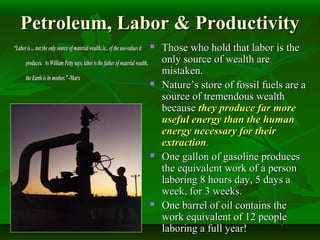
Petroleum, Labor & ProductivityPetroleum, Labor & Productivity
 Those who hold that labor is theThose who hold that labor is the
only source of wealth areonly source of wealth are
mistaken.mistaken.
 Nature’s store of fossil fuels are aNature’s store of fossil fuels are a
source of tremendous wealthsource of tremendous wealth
becausebecause they produce far morethey produce far more
useful energy than the humanuseful energy than the human
energy necessary for theirenergy necessary for their
extractionextraction..
 One gallon of gasoline producesOne gallon of gasoline produces
the equivalent work of a personthe equivalent work of a person
laboring 8 hours day, 5 days alaboring 8 hours day, 5 days a
week, for 3 weeks.week, for 3 weeks.
 One barrel of oil contains theOne barrel of oil contains the
work equivalent of 12 peoplework equivalent of 12 people
laboring a full year!laboring a full year!
““Laboris... nottheonlysourceofmaterial wealth,ie., oftheuse-values itLaboris... nottheonlysourceofmaterial wealth,ie., oftheuse-values it
produces. AsWilliam Petty says,laboristhefatherofmaterialwealth,produces. AsWilliam Petty says,laboristhefatherofmaterialwealth,
the Earthisitsmother.”theEarthisitsmother.” -Marx-Marx
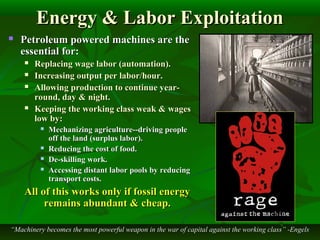
Energy & Labor ExploitationEnergy & Labor Exploitation
 Petroleum powered machines are thePetroleum powered machines are the
essential for:essential for:
 Replacing wage labor (automation).Replacing wage labor (automation).
 Increasing output per labor/hour.Increasing output per labor/hour.
 Allowing production to continue year-Allowing production to continue year-
round, day & night.round, day & night.
 Keeping the working class weak & wagesKeeping the working class weak & wages
low by:low by:
 Mechanizing agriculture--driving peopleMechanizing agriculture--driving people
off the land (surplus labor).off the land (surplus labor).
 Reducing the cost of food.Reducing the cost of food.
 De-skilling work.De-skilling work.
 Accessing distant labor pools by reducingAccessing distant labor pools by reducing
transport costs.transport costs.
All of this works only if fossil energyAll of this works only if fossil energy
remains abundant & cheap.remains abundant & cheap.
““Machinery becomes the most powerful weapon in the war of capital against the working class” -EngelsMachinery becomes the most powerful weapon in the war of capital against the working class” -Engels
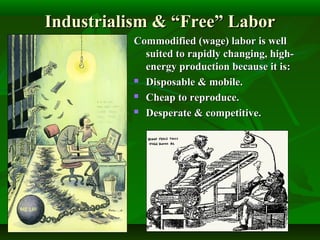
Industrialism & “Free” LaborIndustrialism & “Free” Labor
Commodified (wage) labor is wellCommodified (wage) labor is well
suited to rapidly changing, high-suited to rapidly changing, high-
energy production because it is:energy production because it is:
 Disposable & mobile.Disposable & mobile.
 Cheap to reproduce.Cheap to reproduce.
 Desperate & competitive.Desperate & competitive.
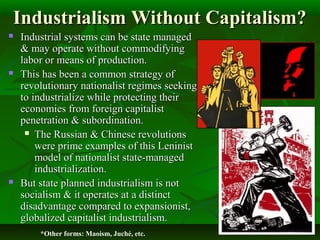
Industrialism Without Capitalism?Industrialism Without Capitalism?
 Industrial systems can be state managedIndustrial systems can be state managed
& may operate without commodifying& may operate without commodifying
labor or means of production.labor or means of production.
 This has been a common strategy ofThis has been a common strategy of
revolutionary nationalist regimes seekingrevolutionary nationalist regimes seeking
to industrialize while protecting theirto industrialize while protecting their
economies from foreign capitalisteconomies from foreign capitalist
penetration & subordination.penetration & subordination.
 The Russian & Chinese revolutionsThe Russian & Chinese revolutions
were prime examples of this Leninistwere prime examples of this Leninist
model of nationalist state-managedmodel of nationalist state-managed
industrialization.industrialization.
 But state planned industrialism is notBut state planned industrialism is not
socialism & it operates at a distinctsocialism & it operates at a distinct
disadvantage compared to expansionist,disadvantage compared to expansionist,
globalized capitalist industrialism.globalized capitalist industrialism.
*Other forms: Maoism, Juché, etc.
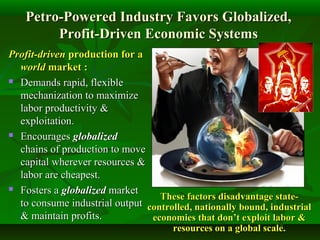
Petro-Powered Industry Favors Globalized,Petro-Powered Industry Favors Globalized,
Profit-Driven Economic SystemsProfit-Driven Economic Systems
Profit-drivenProfit-driven production for aproduction for a
worldworld marketmarket ::
 Demands rapid, flexibleDemands rapid, flexible
mechanization to maximizemechanization to maximize
labor productivity &labor productivity &
exploitation.exploitation.
 EncouragesEncourages globalizedglobalized
chains of production to movechains of production to move
capital wherever resources &capital wherever resources &
labor are cheapest.labor are cheapest.
 Fosters aFosters a globalizedglobalized marketmarket
to consume industrial outputto consume industrial output
& maintain profits.& maintain profits.
These factors disadvantage state-These factors disadvantage state-
controlled, nationally bound, industrialcontrolled, nationally bound, industrial
economies that don’t exploit labor &economies that don’t exploit labor &
resources on a global scale.resources on a global scale.
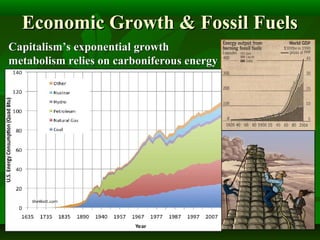
Economic Growth & Fossil FuelsEconomic Growth & Fossil Fuels
Capitalism’s exponential growthCapitalism’s exponential growth
metabolism relies on carboniferous energymetabolism relies on carboniferous energy
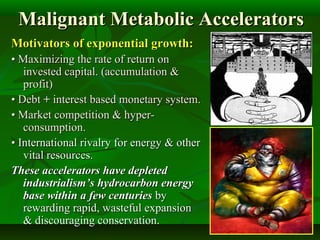
Malignant Metabolic AcceleratorsMalignant Metabolic Accelerators
Motivators of exponential growth:Motivators of exponential growth:
•• Maximizing the rate of return onMaximizing the rate of return on
invested capital. (accumulation &invested capital. (accumulation &
profit)profit)
•• DebtDebt ++ interest based monetary system.interest based monetary system.
•• Market competition & hyper-Market competition & hyper-
consumption.consumption.
•• International rivalry for energy & otherInternational rivalry for energy & other
vital resources.vital resources.
These accelerators have depletedThese accelerators have depleted
industrialism’s hydrocarbon energyindustrialism’s hydrocarbon energy
base within a few centuriesbase within a few centuries byby
rewarding rapid, wasteful expansionrewarding rapid, wasteful expansion
& discouraging conservation.& discouraging conservation.
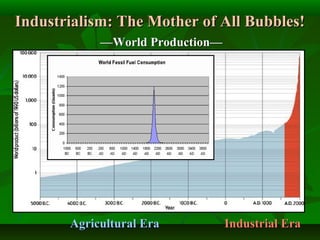
Industrialism: The Mother of All Bubbles!Industrialism: The Mother of All Bubbles!
——World Production—World Production—
Agricultural EraAgricultural Era Industrial EraIndustrial Era
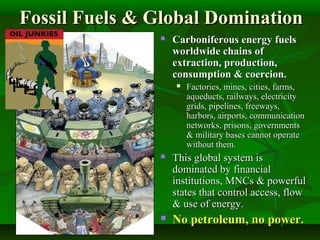
Fossil Fuels & Global DominationFossil Fuels & Global Domination
 Carboniferous energy fuelsCarboniferous energy fuels
worldwide chains ofworldwide chains of
extraction, production,extraction, production,
consumption & coercion.consumption & coercion.
 Factories, mines, cities, farms,Factories, mines, cities, farms,
aqueducts, railways, electricityaqueducts, railways, electricity
grids, pipelines, freeways,grids, pipelines, freeways,
harbors, airports, communicationharbors, airports, communication
networks, prisons, governmentsnetworks, prisons, governments
& military bases cannot operate& military bases cannot operate
without them.without them.
 This global system isThis global system is
dominated by financialdominated by financial
institutions, MNCs & powerfulinstitutions, MNCs & powerful
states that control access, flowstates that control access, flow
& use of energy.& use of energy.
 No petroleum, no power.No petroleum, no power.
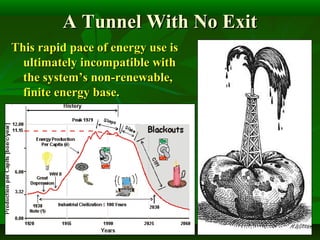
A Tunnel With No ExitA Tunnel With No Exit
This rapid pace of energy use isThis rapid pace of energy use is
ultimately incompatible withultimately incompatible with
the system’s non-renewable,the system’s non-renewable,
finite energy base.finite energy base.
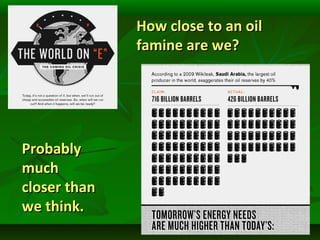
ProbablyProbably
muchmuch
closer thancloser than
we think.we think.
How close to an oilHow close to an oil
famine are we?famine are we?
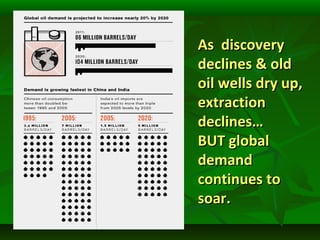
As discoveryAs discovery
declines & olddeclines & old
oil wells dry up,oil wells dry up,
extractionextraction
declines…declines…
BUT globalBUT global
demanddemand
continues tocontinues to
soar.soar.
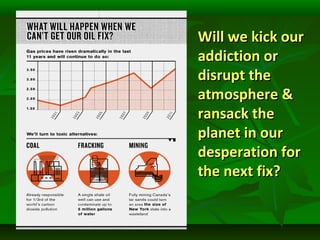
Will we kick ourWill we kick our
addiction oraddiction or
disrupt thedisrupt the
atmosphere &atmosphere &
ransack theransack the
planet in ourplanet in our
desperation fordesperation for
the next fix?the next fix?
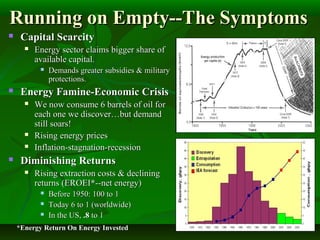
Running on Empty--The SymptomsRunning on Empty--The Symptoms
 Capital ScarcityCapital Scarcity
 Energy sector claims bigger share ofEnergy sector claims bigger share of
available capital.available capital.
 Demands greater subsidies & militaryDemands greater subsidies & military
protections.protections.
 Energy Famine-Economic CrisisEnergy Famine-Economic Crisis
 We now consume 6 barrels of oil forWe now consume 6 barrels of oil for
each one we discover…but demandeach one we discover…but demand
still soars!still soars!
 Rising energy pricesRising energy prices
 Inflation-stagnation-recessionInflation-stagnation-recession
 Diminishing ReturnsDiminishing Returns
 Rising extraction costs & decliningRising extraction costs & declining
returns (EROEIreturns (EROEI**--net energy)--net energy)
 Before 1950: 100 to 1Before 1950: 100 to 1
 Today 6 to 1 (worldwide)Today 6 to 1 (worldwide)
 In the US,In the US, .8.8 to 1to 1
*Energy Return On Energy Invested*Energy Return On Energy Invested
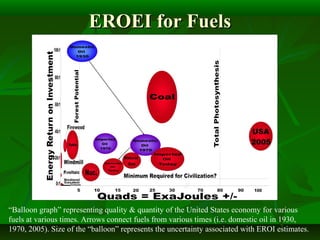
EROEI for FuelsEROEI for Fuels
“Balloon graph” representing quality & quantity of the United States economy for various
fuels at various times. Arrows connect fuels from various times (i.e. domestic oil in 1930,
1970, 2005). Size of the “balloon” represents the uncertainty associated with EROI estimates.
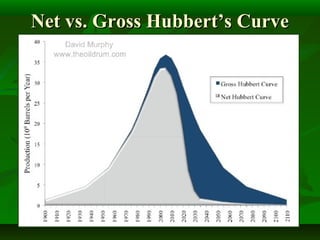
Net vs. Gross Hubbert’s CurveNet vs. Gross Hubbert’s Curve
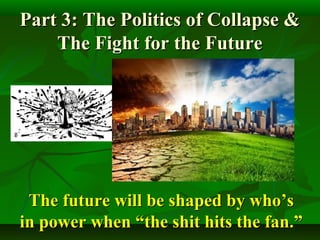
Part 3: The Politics of Collapse &Part 3: The Politics of Collapse &
The Fight for the FutureThe Fight for the Future
The future will be shaped by who’sThe future will be shaped by who’s
in power when “the shit hits the fan.”in power when “the shit hits the fan.”
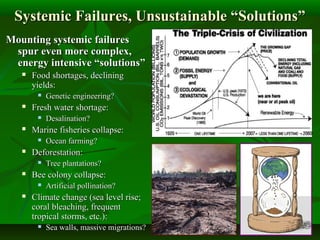
Systemic Failures, Unsustainable “Solutions”Systemic Failures, Unsustainable “Solutions”
Mounting systemic failuresMounting systemic failures
spur even more complex,spur even more complex,
energy intensive “solutions”energy intensive “solutions”
 Food shortages, decliningFood shortages, declining
yields:yields:
 Genetic engineering?Genetic engineering?
 Fresh water shortage:Fresh water shortage:
 Desalination?Desalination?
 Marine fisheries collapse:Marine fisheries collapse:
 Ocean farming?Ocean farming?
 Deforestation:Deforestation:
 Tree plantations?Tree plantations?
 Bee colony collapse:Bee colony collapse:
 Artificial pollination?Artificial pollination?
 Climate change (sea level rise;Climate change (sea level rise;
coral bleaching, frequentcoral bleaching, frequent
tropical storms, etc.):tropical storms, etc.):
 Sea walls, massive migrations?Sea walls, massive migrations?
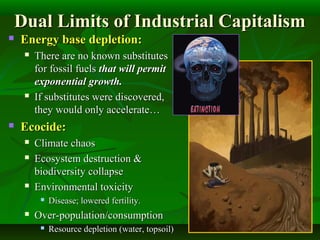
Dual Limits of Industrial CapitalismDual Limits of Industrial Capitalism
 Energy base depletion:Energy base depletion:
 There are no known substitutesThere are no known substitutes
for fossil fuelsfor fossil fuels that will permitthat will permit
exponential growth.exponential growth.
 If substitutes were discovered,If substitutes were discovered,
they would only accelerate…they would only accelerate…
 Ecocide:Ecocide:
 Climate chaosClimate chaos
 Ecosystem destruction &Ecosystem destruction &
biodiversity collapsebiodiversity collapse
 Environmental toxicityEnvironmental toxicity
 Disease; lowered fertility.Disease; lowered fertility.
 Over-population/consumptionOver-population/consumption
 Resource depletion (water, topsoil)Resource depletion (water, topsoil)
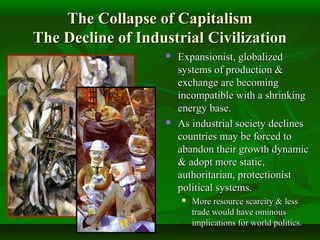
The Collapse of CapitalismThe Collapse of Capitalism
The Decline of Industrial CivilizationThe Decline of Industrial Civilization
 Expansionist, globalizedExpansionist, globalized
systems of production &systems of production &
exchange are becomingexchange are becoming
incompatible with a shrinkingincompatible with a shrinking
energy base.energy base.
 As industrial society declinesAs industrial society declines
countries may be forced tocountries may be forced to
abandon their growth dynamicabandon their growth dynamic
& adopt more static,& adopt more static,
authoritarian, protectionistauthoritarian, protectionist
political systems.political systems.
 More resource scarcity & lessMore resource scarcity & less
trade would have ominoustrade would have ominous
implications for world politics.implications for world politics.
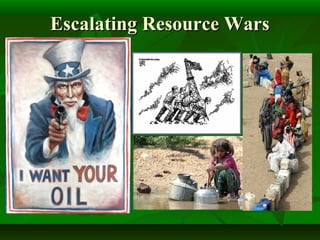
Escalating Resource WarsEscalating Resource Wars
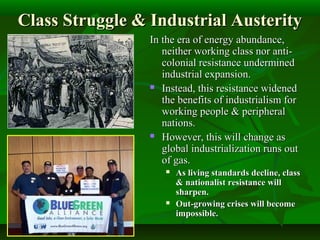
Class Struggle & Industrial AusterityClass Struggle & Industrial Austerity
In the era of energy abundance,In the era of energy abundance,
neither working class nor anti-neither working class nor anti-
colonial resistance underminedcolonial resistance undermined
industrial expansion.industrial expansion.
 Instead, this resistance widenedInstead, this resistance widened
the benefits of industrialism forthe benefits of industrialism for
working people & peripheralworking people & peripheral
nations.nations.
 However, this will change asHowever, this will change as
global industrialization runs outglobal industrialization runs out
of gas.of gas.
 As living standards decline, classAs living standards decline, class
& nationalist resistance will& nationalist resistance will
sharpen.sharpen.
 Out-growing crises will becomeOut-growing crises will become
impossible.impossible.
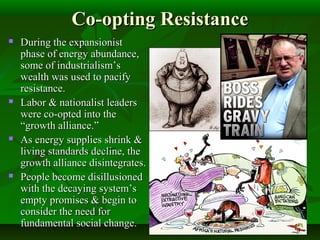
Co-opting ResistanceCo-opting Resistance
 During the expansionistDuring the expansionist
phase of energy abundance,phase of energy abundance,
some of industrialism’ssome of industrialism’s
wealth was used to pacifywealth was used to pacify
resistance.resistance.
 Labor & nationalist leadersLabor & nationalist leaders
were co-opted into thewere co-opted into the
“growth alliance.”“growth alliance.”
 As energy supplies shrink &As energy supplies shrink &
living standards decline, theliving standards decline, the
growth alliance disintegrates.growth alliance disintegrates.
 People become disillusionedPeople become disillusioned
with the decaying system’swith the decaying system’s
empty promises & begin toempty promises & begin to
consider the need forconsider the need for
fundamental social change.fundamental social change.
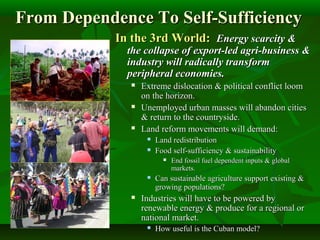
From Dependence To Self-SufficiencyFrom Dependence To Self-Sufficiency
In the 3rd World:In the 3rd World: Energy scarcity &Energy scarcity &
the collapse of export-led agri-business &the collapse of export-led agri-business &
industry will radically transformindustry will radically transform
peripheral economies.peripheral economies.
 Extreme dislocation & political conflict loomExtreme dislocation & political conflict loom
on the horizon.on the horizon.
 Unemployed urban masses will abandon citiesUnemployed urban masses will abandon cities
& return to the countryside.& return to the countryside.
 Land reform movements will demand:Land reform movements will demand:
 Land redistributionLand redistribution
 Food self-sufficiency & sustainabilityFood self-sufficiency & sustainability
 End fossil fuel dependent inputs & globalEnd fossil fuel dependent inputs & global
markets.markets.
 Can sustainable agriculture support existing &Can sustainable agriculture support existing &
growing populations?growing populations?
 Industries will have to be powered byIndustries will have to be powered by
renewable energy & produce for a regional orrenewable energy & produce for a regional or
national market.national market.
 How useful is the Cuban model?How useful is the Cuban model?
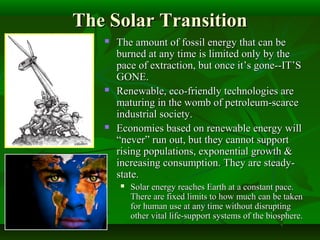
The Solar TransitionThe Solar Transition
 The amount of fossil energy that can beThe amount of fossil energy that can be
burned at any time is limited only by theburned at any time is limited only by the
pace of extraction, but once it’s gone--IT’Space of extraction, but once it’s gone--IT’S
GONE.GONE.
 Renewable, eco-friendly technologies areRenewable, eco-friendly technologies are
maturing in the womb of petroleum-scarcematuring in the womb of petroleum-scarce
industrial society.industrial society.
 Economies based on renewable energy willEconomies based on renewable energy will
“never” run out, but they cannot support“never” run out, but they cannot support
rising populations, exponential growth &rising populations, exponential growth &
increasing consumption. They are steady-increasing consumption. They are steady-
state.state.
 Solar energy reaches Earth at a constant pace.Solar energy reaches Earth at a constant pace.
There are fixed limits to how much can be takenThere are fixed limits to how much can be taken
for human use at any time without disruptingfor human use at any time without disrupting
other vital life-support systems of the biosphere.other vital life-support systems of the biosphere.
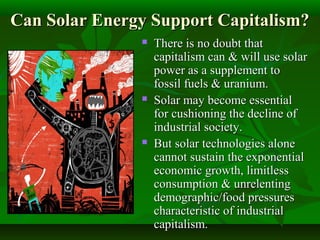
Can Solar Energy Support Capitalism?Can Solar Energy Support Capitalism?
 There is no doubt thatThere is no doubt that
capitalism can & will use solarcapitalism can & will use solar
power as a supplement topower as a supplement to
fossil fuels & uranium.fossil fuels & uranium.
 Solar may become essentialSolar may become essential
for cushioning the decline offor cushioning the decline of
industrial society.industrial society.
 But solar technologies aloneBut solar technologies alone
cannot sustain the exponentialcannot sustain the exponential
economic growth, limitlesseconomic growth, limitless
consumption & unrelentingconsumption & unrelenting
demographic/food pressuresdemographic/food pressures
characteristic of industrialcharacteristic of industrial
capitalism.capitalism.
A New World is ComingA New World is Coming
 In the 21st century,In the 21st century,
carboniferous capitalism &carboniferous capitalism &
industrialism will collapseindustrialism will collapse
& low waste, steady-state& low waste, steady-state
societies will emerge.societies will emerge.
 But new sustainableBut new sustainable
technologies will onlytechnologies will only
provide the basic limits &provide the basic limits &
potentials of emergingpotentials of emerging
social formations.social formations.
 Within these constraints,Within these constraints,
many futures are possible.many futures are possible.
Another world isAnother world is inevitable.inevitable.
But what kind?But what kind?
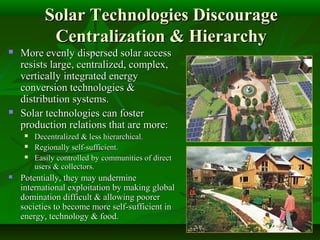
Solar Technologies DiscourageSolar Technologies Discourage
Centralization & HierarchyCentralization & Hierarchy
 More evenly dispersed solar accessMore evenly dispersed solar access
resists large, centralized, complex,resists large, centralized, complex,
vertically integrated energyvertically integrated energy
conversion technologies &conversion technologies &
distribution systems.distribution systems.
 Solar technologies can fosterSolar technologies can foster
production relations that are more:production relations that are more:
 Decentralized & less hierarchical.Decentralized & less hierarchical.
 Regionally self-sufficient.Regionally self-sufficient.
 Easily controlled by communities of directEasily controlled by communities of direct
users & collectors.users & collectors.
 Potentially, they may underminePotentially, they may undermine
international exploitation by making globalinternational exploitation by making global
domination difficult & allowing poorerdomination difficult & allowing poorer
societies to become more self-sufficient insocieties to become more self-sufficient in
energy, technology & food.energy, technology & food.
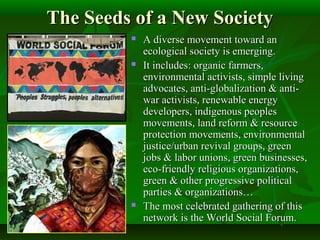
The Seeds of a New SocietyThe Seeds of a New Society
 A diverse movement toward anA diverse movement toward an
ecological society is emerging.ecological society is emerging.
 It includes: organic farmers,It includes: organic farmers,
environmental activists, simple livingenvironmental activists, simple living
advocates, anti-globalization & anti-advocates, anti-globalization & anti-
war activists, renewable energywar activists, renewable energy
developers, indigenous peoplesdevelopers, indigenous peoples
movements, land reform & resourcemovements, land reform & resource
protection movements, environmentalprotection movements, environmental
justice/urban revival groups, greenjustice/urban revival groups, green
jobs & labor unions, green businesses,jobs & labor unions, green businesses,
eco-friendly religious organizations,eco-friendly religious organizations,
green & other progressive politicalgreen & other progressive political
parties & organizations…parties & organizations…
 The most celebrated gathering of thisThe most celebrated gathering of this
network is the World Social Forum.network is the World Social Forum.
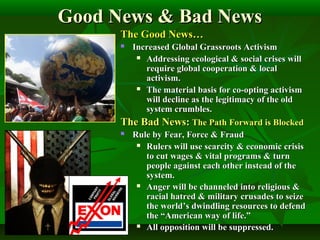
Good News & Bad NewsGood News & Bad News
The Good News…The Good News…
 Increased Global Grassroots ActivismIncreased Global Grassroots Activism
 Addressing ecological & social crises willAddressing ecological & social crises will
require global cooperation & localrequire global cooperation & local
activism.activism.
 The material basis for co-opting activismThe material basis for co-opting activism
will decline as the legitimacy of the oldwill decline as the legitimacy of the old
system crumbles.system crumbles.
The Bad News:The Bad News: The Path Forward is BlockedThe Path Forward is Blocked
 Rule by Fear, Force & FraudRule by Fear, Force & Fraud
 Rulers will use scarcity & economic crisisRulers will use scarcity & economic crisis
to cut wages & vital programs & turnto cut wages & vital programs & turn
people against each other instead of thepeople against each other instead of the
system.system.
 Anger will be channeled into religious &Anger will be channeled into religious &
racial hatred & military crusades to seizeracial hatred & military crusades to seize
the world’s dwindling resources to defendthe world’s dwindling resources to defend
the “American way of life.”the “American way of life.”
 All opposition will be suppressed.All opposition will be suppressed.
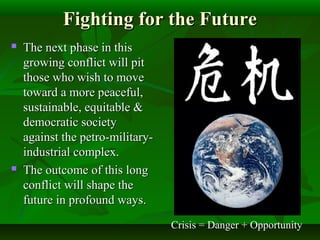
Fighting for the FutureFighting for the Future
 The next phase in thisThe next phase in this
growing conflict will pitgrowing conflict will pit
those who wish to movethose who wish to move
toward a more peaceful,toward a more peaceful,
sustainable, equitable &sustainable, equitable &
democratic societydemocratic society
against the petro-military-against the petro-military-
industrial complex.industrial complex.
 The outcome of this longThe outcome of this long
conflict will shape theconflict will shape the
future in profound ways.future in profound ways.
Crisis = Danger + Opportunity
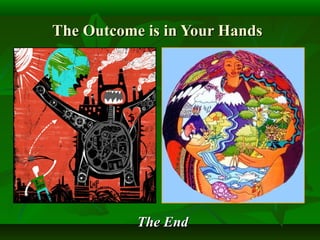
The Outcome is in Your HandsThe Outcome is in Your Hands
The EndThe End

Fighting for the Future

  • 1.
    Fighting for theFutureFighting for the Future Toward a Sustainable SocietyToward a Sustainable Society Craig Collins, Ph.D.Craig Collins, Ph.D. ©©
  • 2.
    Eco-Social Co-evolutionEco-Social Co-evolution Humans & nature exist inHumans & nature exist in a perpetual evolutionarya perpetual evolutionary dance.dance.  This co-evolutionaryThis co-evolutionary dance is a mutuallydance is a mutually transforming energytransforming energy exchange between socialexchange between social system & ecosystemsystem & ecosystem  It has had profoundIt has had profound unintended consequences:unintended consequences:  Peak oilPeak oil  Runaway climate change.Runaway climate change.  Anti-biotic resistance fromAnti-biotic resistance from industrial meat production.industrial meat production.  Massive Species ExtinctionMassive Species Extinction
  • 3.
    Co-Evolution & EnergyEpochsCo-Evolution & Energy Epochs Grasping this co-evolutionaryGrasping this co-evolutionary process sheds light on:process sheds light on:  Why industrial society becameWhy industrial society became dominant over the last 2 centuries.dominant over the last 2 centuries.  What its limits are.What its limits are.  How society might adopt anHow society might adopt an ecologically sustainable alternative.ecologically sustainable alternative. Also…Also… it allows us to see that:it allows us to see that: We stand on the threshold of the third great historical transformation of human society.
  • 4.
    All Social SystemsNeed EnergyAll Social Systems Need Energy History’s major modes ofHistory’s major modes of production areproduction are distinguished by thedistinguished by the energyenergy basebase, or niche, they exploit., or niche, they exploit.  The ENERGY BASE isThe ENERGY BASE is the particular set ofthe particular set of environmental energyenvironmental energy sources a society’ssources a society’s technology is designed totechnology is designed to convert into food & fuel.convert into food & fuel.
  • 5.
    History’s 3 MajorModes of Survival HaveHistory’s 3 Major Modes of Survival Have Metabolized Their Own Unique Energy NicheMetabolized Their Own Unique Energy Niche  Hunting/GatheringHunting/Gathering  The native plants &The native plants & animals of wild ecosystemsanimals of wild ecosystems  Agricultural/PastoralAgricultural/Pastoral  The crops & livestock ofThe crops & livestock of domesticateddomesticated ecosystemsecosystems  Wind, waterWind, water  Wild plants (especially forests) &Wild plants (especially forests) & animals (especially marine life)animals (especially marine life)  Mechanized/IndustrialMechanized/Industrial  Fossil Fuels (85%)Fossil Fuels (85%)  UraniumUranium  Domesticated & wild plants &Domesticated & wild plants & animals (wind & water)animals (wind & water)
  • 6.
    Eco-social Evolution’s CentralInsightsEco-social Evolution’s Central Insights #1#1 Modes of survival adapt to, &Modes of survival adapt to, & convert, a particular energy base.convert, a particular energy base. #2#2 They reach their productive limitThey reach their productive limit when their energy base no longerwhen their energy base no longer sustains them.sustains them.  The most potent driving forceThe most potent driving force underlying social evolution is theunderlying social evolution is the tension between a society’s modetension between a society’s mode of survival & its energy base.of survival & its energy base.  This contradiction has determinedThis contradiction has determined why, when, & where human historywhy, when, & where human history moved from foraging to farming, &moved from foraging to farming, & then from agricultural to industrialthen from agricultural to industrial civilization.civilization.  It will determine when industrialIt will determine when industrial society will exhaust itself.society will exhaust itself.
  • 7.
    Technology Conforms To& Converts Energy BaseTechnology Conforms To & Converts Energy Base ForagersForagers metabolize the energymetabolize the energy sources ofsources of naturalnatural ecosystemsecosystems by designing fishing nets,by designing fishing nets, spears, scrapers/knives, traps,spears, scrapers/knives, traps, flints, fire drills, collectingflints, fire drills, collecting baskets, etc. to hunting & gatherbaskets, etc. to hunting & gather the plants & animals of theirthe plants & animals of their native habitats.native habitats. FarmersFarmers convert the energyconvert the energy stores ofstores of domesticateddomesticated ecosystemsecosystems by inventing plows,by inventing plows, fences, sickles, yokes, dams &fences, sickles, yokes, dams & canals, wind & water mills,canals, wind & water mills, granaries, looms, plant & animalgranaries, looms, plant & animal breeding, etc. to control soilbreeding, etc. to control soil nutrients & the life cycles ofnutrients & the life cycles of select crops & livestock.select crops & livestock.
  • 8.
    Social Relations AdapttoSocial Relations Adapt to Technology & Energy NicheTechnology & Energy Niche  Small, mobile cultures with minimalSmall, mobile cultures with minimal diversification & no ruling elite are welldiversification & no ruling elite are well adapted to collecting the limited useableadapted to collecting the limited useable energy stores of wild ecosystems.energy stores of wild ecosystems.  The larger useable energy stores ofThe larger useable energy stores of domesticated agrarian ecosystems bothdomesticated agrarian ecosystems both supported & required settled peasantsupported & required settled peasant villages & city-states with greatervillages & city-states with greater diversification of labor. Ruling classes ofdiversification of labor. Ruling classes of emperors & priest-kings with standingemperors & priest-kings with standing armies defended, expanded, managed &armies defended, expanded, managed & dominated these farming societies bydominated these farming societies by commanding the flow of “surplus”commanding the flow of “surplus” energy (grains, animals, water storage &energy (grains, animals, water storage & delivery).delivery).
  • 9.
    Cosmology Reflects &ReinforcesCosmology Reflects & Reinforces Economic/Energy BaseEconomic/Energy Base  Cultural beliefs,Cultural beliefs, values, & norms ofvalues, & norms of behavior reflectbehavior reflect society’s mode ofsociety’s mode of survival--peoples’survival--peoples’ relationship withrelationship with nature & their socio-nature & their socio- economic system.economic system.  They also reinforceThey also reinforce the behaviorsthe behaviors necessary tonecessary to reproduce the system.reproduce the system.
  • 10.
    Hunter-Gatherers Were AnimistsHunter-GatherersWere Animists  Spiritual beliefs tended toSpiritual beliefs tended to integrate humans with allintegrate humans with all life & natural forces. Theylife & natural forces. They saw underlying spiritualsaw underlying spiritual forces at work everywhere.forces at work everywhere. They viewed themselves asThey viewed themselves as dependent on, & part of, adependent on, & part of, a living environmentliving environment animated by multiple,animated by multiple, omnipresent spiritualomnipresent spiritual energies.energies.  Earth/Gaia/Pachamama wasEarth/Gaia/Pachamama was the mother of everything.the mother of everything.
  • 11.
    Agrarian Societies:Agrarian Societies: Deitieswith a Human FaceDeities with a Human Face  Agricultural elites relied mainlyAgricultural elites relied mainly upon institutionalized religions toupon institutionalized religions to minimize & justify the need forminimize & justify the need for coercion, sanctify their authority &coercion, sanctify their authority & reinforce the social behaviors thereinforce the social behaviors the masses must adopt to sustain thismasses must adopt to sustain this way of life--sacrifice, obedience,way of life--sacrifice, obedience, conformity & cooperation.conformity & cooperation.  Priest-kings claimed they werePriest-kings claimed they were closely related to Gods &closely related to Gods & Goddesses who controlled theGoddesses who controlled the forces of the natural worldforces of the natural world (fertility, sun, rain, etc.) & access to(fertility, sun, rain, etc.) & access to the afterlife.the afterlife.
  • 12.
    Hunting & GatheringHunting& Gathering Over 90% of Human HistoryOver 90% of Human History  Climate change,Climate change, demographic pressuredemographic pressure,, geographical expansiongeographical expansion & technological& technological improvements slowlyimprovements slowly depleted their energydepleted their energy base in some locations.base in some locations.  But many foragingBut many foraging cultures developedcultures developed sustainable relationshipssustainable relationships with their habitats thatwith their habitats that endured for thousandsendured for thousands of years.of years.
  • 13.
    The Transition toAgricultureThe Transition to Agriculture  When climate changes &When climate changes & demographic pressure depleteddemographic pressure depleted wild sources of plants &wild sources of plants & animals, many foraging culturesanimals, many foraging cultures were compelled to adoptwere compelled to adopt agriculture.agriculture.  But first, all efforts to improveBut first, all efforts to improve the technologies of hunting &the technologies of hunting & gathering were exhausted.gathering were exhausted.  This great leap happened firstThis great leap happened first where conditions were mostwhere conditions were most desperate AND rich soil &desperate AND rich soil & plentiful water made agricultureplentiful water made agriculture a relatively easy alternative.a relatively easy alternative.
  • 14.
    Agriculture: Necessity +OpportunityAgriculture: Necessity + Opportunity Agriculture appeared firstAgriculture appeared first where:where:  Population wasPopulation was concentrated in lush riverconcentrated in lush river valleys surrounded byvalleys surrounded by harsh arid regions.harsh arid regions.  Habitats becameHabitats became depleted of wild stores ofdepleted of wild stores of plants & animals.plants & animals.  Growing grains onGrowing grains on fertile, easily irrigatedfertile, easily irrigated river floodplainsriver floodplains provided a convenientprovided a convenient alternative to foraging.alternative to foraging.
  • 15.
    The Rise &Fall ofThe Rise & Fall of Agricultural CivilizationsAgricultural Civilizations Energy base depletion was accelerated by:Energy base depletion was accelerated by:  Heightened demographic pressure:Heightened demographic pressure:  To increase labor supply & agricultural outputTo increase labor supply & agricultural output  Intensified surplus extraction for:Intensified surplus extraction for:  Elite power & wealth (class exploitation)Elite power & wealth (class exploitation)  Warfare over land, labor & vital resourcesWarfare over land, labor & vital resources  Conquest & territorial expansion provides aConquest & territorial expansion provides a temporary “solution” to energy depletion.temporary “solution” to energy depletion.  War elevates male status as warriors.War elevates male status as warriors.  Institutionalizes patriarchal control over women,Institutionalizes patriarchal control over women, children & the means of reproduction.children & the means of reproduction. Competitive exclusion between rivalCompetitive exclusion between rival empires undermines long termempires undermines long term environmental balance.environmental balance.
  • 16.
    The Fast LaneTo Failure?The Fast Lane To Failure?  Despite major technologicalDespite major technological improvements in society’simprovements in society’s ability to extract energyability to extract energy from nature, each new modefrom nature, each new mode of production has fallen intoof production has fallen into crisis quicker than the last.crisis quicker than the last.  Each new mode added newEach new mode added new social dynamics thatsocial dynamics that accelerated the rate ofaccelerated the rate of resource exploitation & theresource exploitation & the depletion of its energy base.depletion of its energy base.
  • 17.
    Overshoot & CollapseOvershoot& Collapse  A society whose energyA society whose energy base can no longerbase can no longer support it is subject tosupport it is subject to crisis, decay, externalcrisis, decay, external threats & internalthreats & internal collapse.collapse.  Unless it gains access toUnless it gains access to new sources of energy, itsnew sources of energy, its size & complexity willsize & complexity will decrease until it can bedecrease until it can be sustained by thesustained by the remaining energyremaining energy available to it.available to it.
  • 18.
    Energy Base &EnergyBase & RevolutionaryRevolutionary ChangeChange  No society adopts a new energyNo society adopts a new energy base & mode of survival untilbase & mode of survival until its old energy base no longerits old energy base no longer sustains it.sustains it.  Necessity has been the motherNecessity has been the mother of invention for each greatof invention for each great revolutionary leap from onerevolutionary leap from one mode of production to another.mode of production to another.
  • 19.
    Fighting for theFuture --Part 2Fighting for the Future --Part 2 The Rise & Fall ofThe Rise & Fall of Industrial CivilizationIndustrial Civilization
  • 20.
    The Industrial TransformationTheIndustrial Transformation  The industrial revolution came onlyThe industrial revolution came only after demographic pressure, soilafter demographic pressure, soil exhaustion, timber scarcity, famineexhaustion, timber scarcity, famine & wars left the energy base of& wars left the energy base of European agriculture depleted.European agriculture depleted.  Conquest & mercantile colonialConquest & mercantile colonial expansion was only a temporaryexpansion was only a temporary “solution.”“solution.”  Europe did not grow its way out of itsEurope did not grow its way out of its intensifying crisis until it tapped a newintensifying crisis until it tapped a new energy base--coal.energy base--coal.  Production & consumption per capita took-offProduction & consumption per capita took-off for the 1st timefor the 1st time only after coal power wasonly after coal power was adopted.adopted.  Fossil fuels became the energy baseFossil fuels became the energy base for the 2nd great reorganization offor the 2nd great reorganization of humanity’s relationship with nature.humanity’s relationship with nature.
  • 21.
    Why England?Why England? England was the most woodEngland was the most wood scarce, energy desperatescarce, energy desperate nation in Europe.nation in Europe.  But it had vast, accessible coalBut it had vast, accessible coal deposits.deposits.  The coal-powered steamThe coal-powered steam engine solved major energyengine solved major energy bottlenecks:bottlenecks:  Coal replaced water power,Coal replaced water power, wood & whale oil as fuel forwood & whale oil as fuel for industry.industry.  Liberating the FACTORYLiberating the FACTORY SYSTEMSYSTEM  MiningMining  Ventilation & water incursionVentilation & water incursion  TransportationTransportation  Railroad/steamshipRailroad/steamship  Food/clothing supplyFood/clothing supply  Food crops replace horse & sheepFood crops replace horse & sheep fodder. (Wheat/cotton)fodder. (Wheat/cotton)
  • 22.
    Coal & ClassConflictCoal & Class Conflict  Coal-powered industrialism allowedCoal-powered industrialism allowed Europe to evade the cataclysmicEurope to evade the cataclysmic predictions of both Marx & Malthus.predictions of both Marx & Malthus.  European society did not experienceEuropean society did not experience demographic disaster or proletariandemographic disaster or proletarian revolution.revolution.  Coal-powered industrialization out-Coal-powered industrialization out- ran demographic pressures, raisedran demographic pressures, raised living standards & tempered classliving standards & tempered class conflict in the European/Americanconflict in the European/American core of the global capitalist system.core of the global capitalist system.  Railroads, steamships, factories &Railroads, steamships, factories & industrial weaponry allowed Europeindustrial weaponry allowed Europe & the US to penetrate & exploit the& the US to penetrate & exploit the labor & wealth of the Americas, Asialabor & wealth of the Americas, Asia & Africa as never before.& Africa as never before. ThomasThomas MalthusMalthus KarlKarl MarxMarx
  • 23.
    —— Fossil Fuels—Fossil Fuels — Not Just Another ResourceNot Just Another Resource  Without coal-poweredWithout coal-powered machines/factories themachines/factories the industrial revolutionindustrial revolution would not have beenwould not have been possible.possible.  Fossil fuels have been theFossil fuels have been the predominant source ofpredominant source of energy ever since…85%.energy ever since…85%.  The entire global chain ofThe entire global chain of extraction, production &extraction, production & consumption is fueled byconsumption is fueled by coal, oil & natural gas.coal, oil & natural gas.
  • 24.
    Fossil Fuels--The EnergyBase ofFossil Fuels--The Energy Base of Industrial SocietyIndustrial Society  With plenty of petroleum,With plenty of petroleum, industrial growth appearedindustrial growth appeared unstoppable.unstoppable.  It reshaped all previousIt reshaped all previous forms of production.forms of production.  Agriculture & foraging areAgriculture & foraging are now done on an industrialnow done on an industrial scale.scale.  But without this rich, highlyBut without this rich, highly concentrated source ofconcentrated source of energy, industrialism wouldenergy, industrialism would literally run out of gas.literally run out of gas.
  • 25.
    Industrial AgricultureIndustrial Agriculture We’reEating OilWe’re Eating Oil  It takes 10 calories ofIt takes 10 calories of fossil fuels to producefossil fuels to produce 1 calorie of food.1 calorie of food.  Petroleum is vital for:Petroleum is vital for:  IrrigationIrrigation  FertilizerFertilizer  PesticidesPesticides  Mechanized Planting &Mechanized Planting & HarvestingHarvesting  ProcessingProcessing  TransportationTransportation  RefrigerationRefrigeration  PackagingPackaging  Cooking & PreparationCooking & Preparation
  • 26.
    Farming on FossilFuelsFarming on Fossil Fuels The So-Called “Green Revolution”The So-Called “Green Revolution” Crops Bred To Grow on a Life-Support System of Fossil FuelsCrops Bred To Grow on a Life-Support System of Fossil Fuels
  • 27.
    Fossil Fuels Feedthe WorldFossil Fuels Feed the World
  • 28.
    Petroleum, Labor &ProductivityPetroleum, Labor & Productivity  Those who hold that labor is theThose who hold that labor is the only source of wealth areonly source of wealth are mistaken.mistaken.  Nature’s store of fossil fuels are aNature’s store of fossil fuels are a source of tremendous wealthsource of tremendous wealth becausebecause they produce far morethey produce far more useful energy than the humanuseful energy than the human energy necessary for theirenergy necessary for their extractionextraction..  One gallon of gasoline producesOne gallon of gasoline produces the equivalent work of a personthe equivalent work of a person laboring 8 hours day, 5 days alaboring 8 hours day, 5 days a week, for 3 weeks.week, for 3 weeks.  One barrel of oil contains theOne barrel of oil contains the work equivalent of 12 peoplework equivalent of 12 people laboring a full year!laboring a full year! ““Laboris... nottheonlysourceofmaterial wealth,ie., oftheuse-values itLaboris... nottheonlysourceofmaterial wealth,ie., oftheuse-values it produces. AsWilliam Petty says,laboristhefatherofmaterialwealth,produces. AsWilliam Petty says,laboristhefatherofmaterialwealth, the Earthisitsmother.”theEarthisitsmother.” -Marx-Marx
  • 29.
    Energy & LaborExploitationEnergy & Labor Exploitation  Petroleum powered machines are thePetroleum powered machines are the essential for:essential for:  Replacing wage labor (automation).Replacing wage labor (automation).  Increasing output per labor/hour.Increasing output per labor/hour.  Allowing production to continue year-Allowing production to continue year- round, day & night.round, day & night.  Keeping the working class weak & wagesKeeping the working class weak & wages low by:low by:  Mechanizing agriculture--driving peopleMechanizing agriculture--driving people off the land (surplus labor).off the land (surplus labor).  Reducing the cost of food.Reducing the cost of food.  De-skilling work.De-skilling work.  Accessing distant labor pools by reducingAccessing distant labor pools by reducing transport costs.transport costs. All of this works only if fossil energyAll of this works only if fossil energy remains abundant & cheap.remains abundant & cheap. ““Machinery becomes the most powerful weapon in the war of capital against the working class” -EngelsMachinery becomes the most powerful weapon in the war of capital against the working class” -Engels
  • 30.
    Industrialism & “Free”LaborIndustrialism & “Free” Labor Commodified (wage) labor is wellCommodified (wage) labor is well suited to rapidly changing, high-suited to rapidly changing, high- energy production because it is:energy production because it is:  Disposable & mobile.Disposable & mobile.  Cheap to reproduce.Cheap to reproduce.  Desperate & competitive.Desperate & competitive.
  • 31.
    Industrialism Without Capitalism?IndustrialismWithout Capitalism?  Industrial systems can be state managedIndustrial systems can be state managed & may operate without commodifying& may operate without commodifying labor or means of production.labor or means of production.  This has been a common strategy ofThis has been a common strategy of revolutionary nationalist regimes seekingrevolutionary nationalist regimes seeking to industrialize while protecting theirto industrialize while protecting their economies from foreign capitalisteconomies from foreign capitalist penetration & subordination.penetration & subordination.  The Russian & Chinese revolutionsThe Russian & Chinese revolutions were prime examples of this Leninistwere prime examples of this Leninist model of nationalist state-managedmodel of nationalist state-managed industrialization.industrialization.  But state planned industrialism is notBut state planned industrialism is not socialism & it operates at a distinctsocialism & it operates at a distinct disadvantage compared to expansionist,disadvantage compared to expansionist, globalized capitalist industrialism.globalized capitalist industrialism. *Other forms: Maoism, Juché, etc.
  • 32.
    Petro-Powered Industry FavorsGlobalized,Petro-Powered Industry Favors Globalized, Profit-Driven Economic SystemsProfit-Driven Economic Systems Profit-drivenProfit-driven production for aproduction for a worldworld marketmarket ::  Demands rapid, flexibleDemands rapid, flexible mechanization to maximizemechanization to maximize labor productivity &labor productivity & exploitation.exploitation.  EncouragesEncourages globalizedglobalized chains of production to movechains of production to move capital wherever resources &capital wherever resources & labor are cheapest.labor are cheapest.  Fosters aFosters a globalizedglobalized marketmarket to consume industrial outputto consume industrial output & maintain profits.& maintain profits. These factors disadvantage state-These factors disadvantage state- controlled, nationally bound, industrialcontrolled, nationally bound, industrial economies that don’t exploit labor &economies that don’t exploit labor & resources on a global scale.resources on a global scale.
  • 33.
    Economic Growth &Fossil FuelsEconomic Growth & Fossil Fuels Capitalism’s exponential growthCapitalism’s exponential growth metabolism relies on carboniferous energymetabolism relies on carboniferous energy
  • 34.
    Malignant Metabolic AcceleratorsMalignantMetabolic Accelerators Motivators of exponential growth:Motivators of exponential growth: •• Maximizing the rate of return onMaximizing the rate of return on invested capital. (accumulation &invested capital. (accumulation & profit)profit) •• DebtDebt ++ interest based monetary system.interest based monetary system. •• Market competition & hyper-Market competition & hyper- consumption.consumption. •• International rivalry for energy & otherInternational rivalry for energy & other vital resources.vital resources. These accelerators have depletedThese accelerators have depleted industrialism’s hydrocarbon energyindustrialism’s hydrocarbon energy base within a few centuriesbase within a few centuries byby rewarding rapid, wasteful expansionrewarding rapid, wasteful expansion & discouraging conservation.& discouraging conservation.
  • 35.
    Industrialism: The Motherof All Bubbles!Industrialism: The Mother of All Bubbles! ——World Production—World Production— Agricultural EraAgricultural Era Industrial EraIndustrial Era
  • 36.
    Fossil Fuels &Global DominationFossil Fuels & Global Domination  Carboniferous energy fuelsCarboniferous energy fuels worldwide chains ofworldwide chains of extraction, production,extraction, production, consumption & coercion.consumption & coercion.  Factories, mines, cities, farms,Factories, mines, cities, farms, aqueducts, railways, electricityaqueducts, railways, electricity grids, pipelines, freeways,grids, pipelines, freeways, harbors, airports, communicationharbors, airports, communication networks, prisons, governmentsnetworks, prisons, governments & military bases cannot operate& military bases cannot operate without them.without them.  This global system isThis global system is dominated by financialdominated by financial institutions, MNCs & powerfulinstitutions, MNCs & powerful states that control access, flowstates that control access, flow & use of energy.& use of energy.  No petroleum, no power.No petroleum, no power.
  • 37.
    A Tunnel WithNo ExitA Tunnel With No Exit This rapid pace of energy use isThis rapid pace of energy use is ultimately incompatible withultimately incompatible with the system’s non-renewable,the system’s non-renewable, finite energy base.finite energy base.
  • 38.
    ProbablyProbably muchmuch closer thancloser than wethink.we think. How close to an oilHow close to an oil famine are we?famine are we?
  • 39.
    As discoveryAs discovery declines& olddeclines & old oil wells dry up,oil wells dry up, extractionextraction declines…declines… BUT globalBUT global demanddemand continues tocontinues to soar.soar.
  • 40.
    Will we kickourWill we kick our addiction oraddiction or disrupt thedisrupt the atmosphere &atmosphere & ransack theransack the planet in ourplanet in our desperation fordesperation for the next fix?the next fix?
  • 41.
    Running on Empty--TheSymptomsRunning on Empty--The Symptoms  Capital ScarcityCapital Scarcity  Energy sector claims bigger share ofEnergy sector claims bigger share of available capital.available capital.  Demands greater subsidies & militaryDemands greater subsidies & military protections.protections.  Energy Famine-Economic CrisisEnergy Famine-Economic Crisis  We now consume 6 barrels of oil forWe now consume 6 barrels of oil for each one we discover…but demandeach one we discover…but demand still soars!still soars!  Rising energy pricesRising energy prices  Inflation-stagnation-recessionInflation-stagnation-recession  Diminishing ReturnsDiminishing Returns  Rising extraction costs & decliningRising extraction costs & declining returns (EROEIreturns (EROEI**--net energy)--net energy)  Before 1950: 100 to 1Before 1950: 100 to 1  Today 6 to 1 (worldwide)Today 6 to 1 (worldwide)  In the US,In the US, .8.8 to 1to 1 *Energy Return On Energy Invested*Energy Return On Energy Invested
  • 42.
    EROEI for FuelsEROEIfor Fuels “Balloon graph” representing quality & quantity of the United States economy for various fuels at various times. Arrows connect fuels from various times (i.e. domestic oil in 1930, 1970, 2005). Size of the “balloon” represents the uncertainty associated with EROI estimates.
  • 43.
    Net vs. GrossHubbert’s CurveNet vs. Gross Hubbert’s Curve
  • 44.
    Part 3: ThePolitics of Collapse &Part 3: The Politics of Collapse & The Fight for the FutureThe Fight for the Future The future will be shaped by who’sThe future will be shaped by who’s in power when “the shit hits the fan.”in power when “the shit hits the fan.”
  • 45.
    Systemic Failures, Unsustainable“Solutions”Systemic Failures, Unsustainable “Solutions” Mounting systemic failuresMounting systemic failures spur even more complex,spur even more complex, energy intensive “solutions”energy intensive “solutions”  Food shortages, decliningFood shortages, declining yields:yields:  Genetic engineering?Genetic engineering?  Fresh water shortage:Fresh water shortage:  Desalination?Desalination?  Marine fisheries collapse:Marine fisheries collapse:  Ocean farming?Ocean farming?  Deforestation:Deforestation:  Tree plantations?Tree plantations?  Bee colony collapse:Bee colony collapse:  Artificial pollination?Artificial pollination?  Climate change (sea level rise;Climate change (sea level rise; coral bleaching, frequentcoral bleaching, frequent tropical storms, etc.):tropical storms, etc.):  Sea walls, massive migrations?Sea walls, massive migrations?
  • 46.
    Dual Limits ofIndustrial CapitalismDual Limits of Industrial Capitalism  Energy base depletion:Energy base depletion:  There are no known substitutesThere are no known substitutes for fossil fuelsfor fossil fuels that will permitthat will permit exponential growth.exponential growth.  If substitutes were discovered,If substitutes were discovered, they would only accelerate…they would only accelerate…  Ecocide:Ecocide:  Climate chaosClimate chaos  Ecosystem destruction &Ecosystem destruction & biodiversity collapsebiodiversity collapse  Environmental toxicityEnvironmental toxicity  Disease; lowered fertility.Disease; lowered fertility.  Over-population/consumptionOver-population/consumption  Resource depletion (water, topsoil)Resource depletion (water, topsoil)
  • 47.
    The Collapse ofCapitalismThe Collapse of Capitalism The Decline of Industrial CivilizationThe Decline of Industrial Civilization  Expansionist, globalizedExpansionist, globalized systems of production &systems of production & exchange are becomingexchange are becoming incompatible with a shrinkingincompatible with a shrinking energy base.energy base.  As industrial society declinesAs industrial society declines countries may be forced tocountries may be forced to abandon their growth dynamicabandon their growth dynamic & adopt more static,& adopt more static, authoritarian, protectionistauthoritarian, protectionist political systems.political systems.  More resource scarcity & lessMore resource scarcity & less trade would have ominoustrade would have ominous implications for world politics.implications for world politics.
  • 48.
  • 49.
    Class Struggle &Industrial AusterityClass Struggle & Industrial Austerity In the era of energy abundance,In the era of energy abundance, neither working class nor anti-neither working class nor anti- colonial resistance underminedcolonial resistance undermined industrial expansion.industrial expansion.  Instead, this resistance widenedInstead, this resistance widened the benefits of industrialism forthe benefits of industrialism for working people & peripheralworking people & peripheral nations.nations.  However, this will change asHowever, this will change as global industrialization runs outglobal industrialization runs out of gas.of gas.  As living standards decline, classAs living standards decline, class & nationalist resistance will& nationalist resistance will sharpen.sharpen.  Out-growing crises will becomeOut-growing crises will become impossible.impossible.
  • 50.
    Co-opting ResistanceCo-opting Resistance During the expansionistDuring the expansionist phase of energy abundance,phase of energy abundance, some of industrialism’ssome of industrialism’s wealth was used to pacifywealth was used to pacify resistance.resistance.  Labor & nationalist leadersLabor & nationalist leaders were co-opted into thewere co-opted into the “growth alliance.”“growth alliance.”  As energy supplies shrink &As energy supplies shrink & living standards decline, theliving standards decline, the growth alliance disintegrates.growth alliance disintegrates.  People become disillusionedPeople become disillusioned with the decaying system’swith the decaying system’s empty promises & begin toempty promises & begin to consider the need forconsider the need for fundamental social change.fundamental social change.
  • 51.
    From Dependence ToSelf-SufficiencyFrom Dependence To Self-Sufficiency In the 3rd World:In the 3rd World: Energy scarcity &Energy scarcity & the collapse of export-led agri-business &the collapse of export-led agri-business & industry will radically transformindustry will radically transform peripheral economies.peripheral economies.  Extreme dislocation & political conflict loomExtreme dislocation & political conflict loom on the horizon.on the horizon.  Unemployed urban masses will abandon citiesUnemployed urban masses will abandon cities & return to the countryside.& return to the countryside.  Land reform movements will demand:Land reform movements will demand:  Land redistributionLand redistribution  Food self-sufficiency & sustainabilityFood self-sufficiency & sustainability  End fossil fuel dependent inputs & globalEnd fossil fuel dependent inputs & global markets.markets.  Can sustainable agriculture support existing &Can sustainable agriculture support existing & growing populations?growing populations?  Industries will have to be powered byIndustries will have to be powered by renewable energy & produce for a regional orrenewable energy & produce for a regional or national market.national market.  How useful is the Cuban model?How useful is the Cuban model?
  • 52.
    The Solar TransitionTheSolar Transition  The amount of fossil energy that can beThe amount of fossil energy that can be burned at any time is limited only by theburned at any time is limited only by the pace of extraction, but once it’s gone--IT’Space of extraction, but once it’s gone--IT’S GONE.GONE.  Renewable, eco-friendly technologies areRenewable, eco-friendly technologies are maturing in the womb of petroleum-scarcematuring in the womb of petroleum-scarce industrial society.industrial society.  Economies based on renewable energy willEconomies based on renewable energy will “never” run out, but they cannot support“never” run out, but they cannot support rising populations, exponential growth &rising populations, exponential growth & increasing consumption. They are steady-increasing consumption. They are steady- state.state.  Solar energy reaches Earth at a constant pace.Solar energy reaches Earth at a constant pace. There are fixed limits to how much can be takenThere are fixed limits to how much can be taken for human use at any time without disruptingfor human use at any time without disrupting other vital life-support systems of the biosphere.other vital life-support systems of the biosphere.
  • 53.
    Can Solar EnergySupport Capitalism?Can Solar Energy Support Capitalism?  There is no doubt thatThere is no doubt that capitalism can & will use solarcapitalism can & will use solar power as a supplement topower as a supplement to fossil fuels & uranium.fossil fuels & uranium.  Solar may become essentialSolar may become essential for cushioning the decline offor cushioning the decline of industrial society.industrial society.  But solar technologies aloneBut solar technologies alone cannot sustain the exponentialcannot sustain the exponential economic growth, limitlesseconomic growth, limitless consumption & unrelentingconsumption & unrelenting demographic/food pressuresdemographic/food pressures characteristic of industrialcharacteristic of industrial capitalism.capitalism.
  • 54.
    A New Worldis ComingA New World is Coming  In the 21st century,In the 21st century, carboniferous capitalism &carboniferous capitalism & industrialism will collapseindustrialism will collapse & low waste, steady-state& low waste, steady-state societies will emerge.societies will emerge.  But new sustainableBut new sustainable technologies will onlytechnologies will only provide the basic limits &provide the basic limits & potentials of emergingpotentials of emerging social formations.social formations.  Within these constraints,Within these constraints, many futures are possible.many futures are possible. Another world isAnother world is inevitable.inevitable. But what kind?But what kind?
  • 55.
    Solar Technologies DiscourageSolarTechnologies Discourage Centralization & HierarchyCentralization & Hierarchy  More evenly dispersed solar accessMore evenly dispersed solar access resists large, centralized, complex,resists large, centralized, complex, vertically integrated energyvertically integrated energy conversion technologies &conversion technologies & distribution systems.distribution systems.  Solar technologies can fosterSolar technologies can foster production relations that are more:production relations that are more:  Decentralized & less hierarchical.Decentralized & less hierarchical.  Regionally self-sufficient.Regionally self-sufficient.  Easily controlled by communities of directEasily controlled by communities of direct users & collectors.users & collectors.  Potentially, they may underminePotentially, they may undermine international exploitation by making globalinternational exploitation by making global domination difficult & allowing poorerdomination difficult & allowing poorer societies to become more self-sufficient insocieties to become more self-sufficient in energy, technology & food.energy, technology & food.
  • 56.
    The Seeds ofa New SocietyThe Seeds of a New Society  A diverse movement toward anA diverse movement toward an ecological society is emerging.ecological society is emerging.  It includes: organic farmers,It includes: organic farmers, environmental activists, simple livingenvironmental activists, simple living advocates, anti-globalization & anti-advocates, anti-globalization & anti- war activists, renewable energywar activists, renewable energy developers, indigenous peoplesdevelopers, indigenous peoples movements, land reform & resourcemovements, land reform & resource protection movements, environmentalprotection movements, environmental justice/urban revival groups, greenjustice/urban revival groups, green jobs & labor unions, green businesses,jobs & labor unions, green businesses, eco-friendly religious organizations,eco-friendly religious organizations, green & other progressive politicalgreen & other progressive political parties & organizations…parties & organizations…  The most celebrated gathering of thisThe most celebrated gathering of this network is the World Social Forum.network is the World Social Forum.
  • 57.
    Good News &Bad NewsGood News & Bad News The Good News…The Good News…  Increased Global Grassroots ActivismIncreased Global Grassroots Activism  Addressing ecological & social crises willAddressing ecological & social crises will require global cooperation & localrequire global cooperation & local activism.activism.  The material basis for co-opting activismThe material basis for co-opting activism will decline as the legitimacy of the oldwill decline as the legitimacy of the old system crumbles.system crumbles. The Bad News:The Bad News: The Path Forward is BlockedThe Path Forward is Blocked  Rule by Fear, Force & FraudRule by Fear, Force & Fraud  Rulers will use scarcity & economic crisisRulers will use scarcity & economic crisis to cut wages & vital programs & turnto cut wages & vital programs & turn people against each other instead of thepeople against each other instead of the system.system.  Anger will be channeled into religious &Anger will be channeled into religious & racial hatred & military crusades to seizeracial hatred & military crusades to seize the world’s dwindling resources to defendthe world’s dwindling resources to defend the “American way of life.”the “American way of life.”  All opposition will be suppressed.All opposition will be suppressed.
  • 58.
    Fighting for theFutureFighting for the Future  The next phase in thisThe next phase in this growing conflict will pitgrowing conflict will pit those who wish to movethose who wish to move toward a more peaceful,toward a more peaceful, sustainable, equitable &sustainable, equitable & democratic societydemocratic society against the petro-military-against the petro-military- industrial complex.industrial complex.  The outcome of this longThe outcome of this long conflict will shape theconflict will shape the future in profound ways.future in profound ways. Crisis = Danger + Opportunity
  • 59.
    The Outcome isin Your HandsThe Outcome is in Your Hands The EndThe End