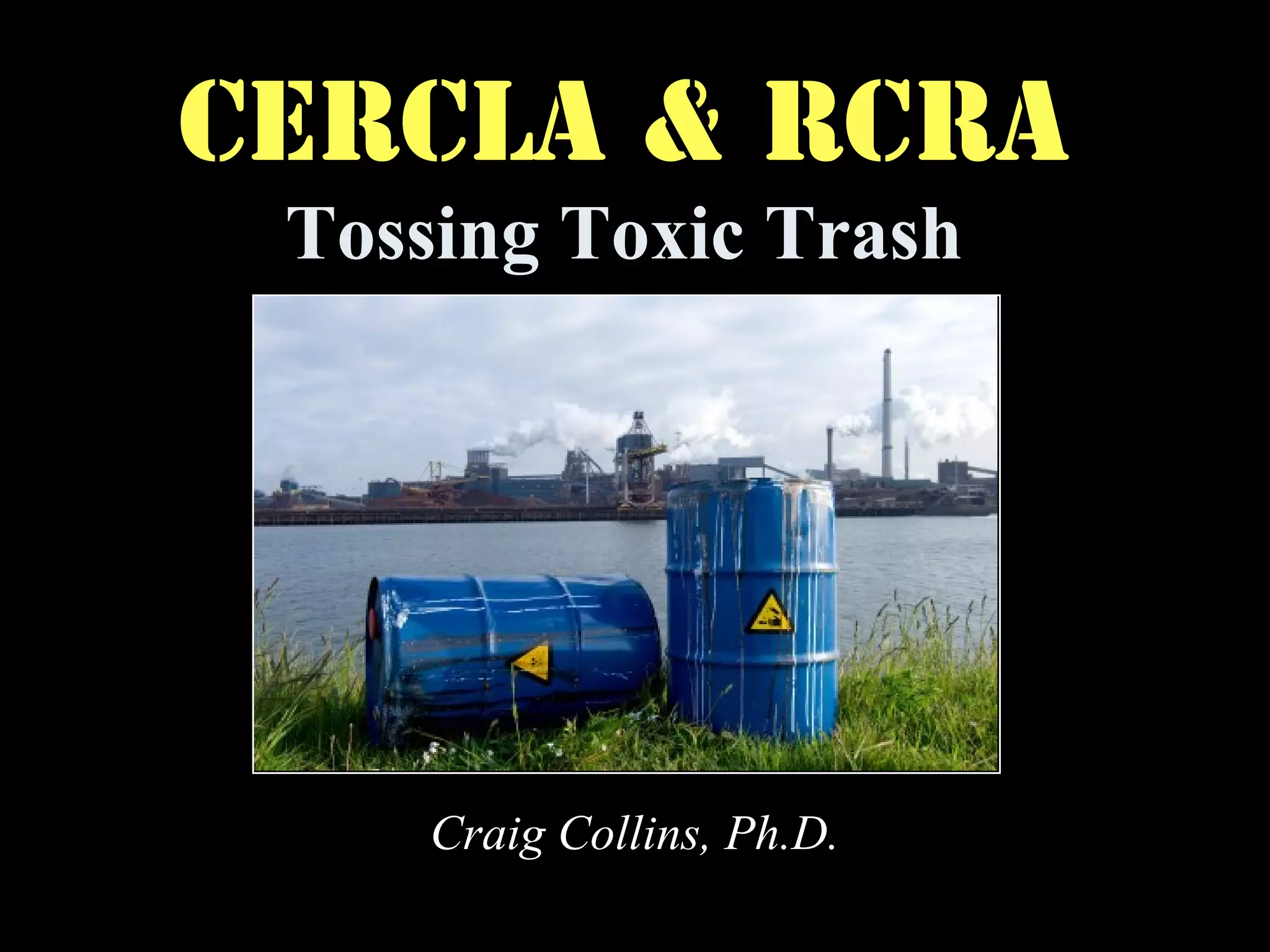
CERCLA & RCRA
Tossing Toxic Trash
Craig Collins, Ph.D.
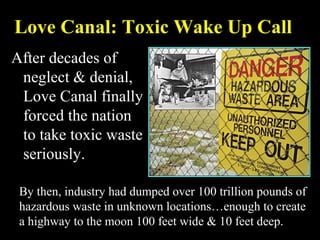
Love Canal: Toxic Wake Up Call
After decades of
neglect & denial,
Love Canal finally
forced the nation
to take toxic waste
seriously.
By then, industry had dumped over 100 trillion pounds of
hazardous waste in unknown locations…enough to create
a highway to the moon 100 feet wide & 10 feet deep.
2 Laws Cover Hazardous Waste
Clean-up & Disposal
CERCLA--Superfund*
• CERCLA is NOT a
regulatory statute; it is a
cleanup & liability law.
• It cleans up abandoned
or “orphaned” toxic sites
by imposing strict clean-
up liability on those
parties responsible for
creating them.
* CERCLA (Comprehensive Environmental
Response, Compensation, & Liability Act,
1980)
RCRA (Resource Conservation
& Recovery Act, 1976)
• RCRA is a regulatory
law.
• It gives EPA “cradle-to-
grave” oversight over the
generation, transport,
treatment & disposal of
hazardous waste.
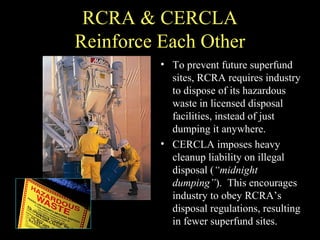
RCRA & CERCLA
Reinforce Each Other
• To prevent future superfund
sites, RCRA requires industry
to dispose of its hazardous
waste in licensed disposal
facilities, instead of just
dumping it anywhere.
• CERCLA imposes heavy
cleanup liability on illegal
disposal (“midnight
dumping”). This encourages
industry to obey RCRA’s
disposal regulations, resulting
in fewer superfund sites.
Superfund: Liability & Cleanup
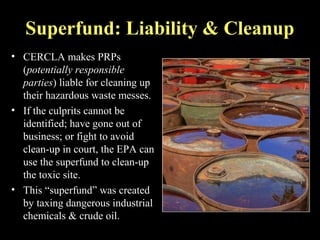
• CERCLA makes PRPs
(potentially responsible
parties) liable for cleaning up
their hazardous waste messes.
• If the culprits cannot be
identified; have gone out of
business; or fight to avoid
clean-up in court, the EPA can
use the superfund to clean-up
the toxic site.
• This “superfund” was created
by taxing dangerous industrial
chemicals & crude oil.
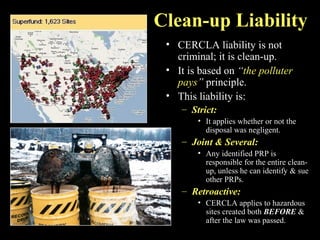
Clean-up Liability
• CERCLA liability is not
criminal; it is clean-up.
• It is based on “the polluter
pays” principle.
• This liability is:
– Strict:
• It applies whether or not the
disposal was negligent.
– Joint & Several:
• Any identified PRP is
responsible for the entire clean-
up, unless he can identify & sue
other PRPs.
– Retroactive:
• CERCLA applies to hazardous
sites created both BEFORE &
after the law was passed.
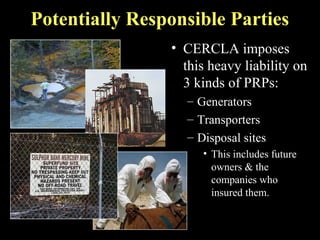
Potentially Responsible Parties
• CERCLA imposes
this heavy liability on
3 kinds of PRPs:
– Generators
– Transporters
– Disposal sites
• This includes future
owners & the
companies who
insured them.
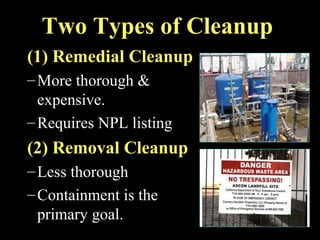
Two Types of Cleanup
(1) Remedial Cleanup
–More thorough &
expensive.
–Requires NPL listing
(2) Removal Cleanup
–Less thorough
–Containment is the
primary goal.
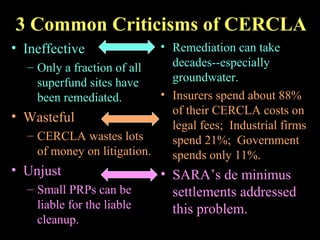
3 Common Criticisms of CERCLA
• Ineffective
– Only a fraction of all
superfund sites have
been remediated.
• Wasteful
– CERCLA wastes lots
of money on litigation.
• Unjust
– Small PRPs can be
liable for the liable
cleanup.
• Remediation can take
decades--especially
groundwater.
• Insurers spend about 88%
of their CERCLA costs on
legal fees; Industrial firms
spend 21%; Government
spends only 11%.
• SARA’s de minimus
settlements addressed
this problem.
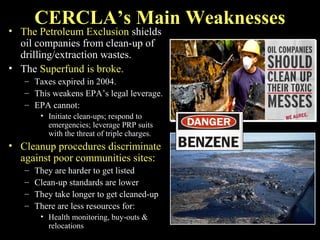
CERCLA’s Main Weaknesses
• The Petroleum Exclusion shields
oil companies from clean-up of
drilling/extraction wastes.
• The Superfund is broke.
– Taxes expired in 2004.
– This weakens EPA’s legal leverage.
– EPA cannot:
• Initiate clean-ups; respond to
emergencies; leverage PRP suits
with the threat of triple charges.
• Cleanup procedures discriminate
against poor communities sites:
– They are harder to get listed
– Clean-up standards are lower
– They take longer to get cleaned-up
– There are less resources for:
• Health monitoring, buy-outs &
relocations
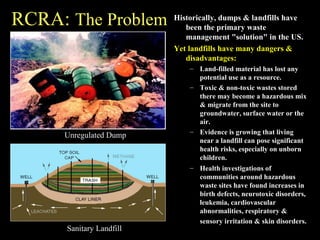
RCRA: The Problem Historically, dumps & landfills have
been the primary waste
management "solution" in the US.
Yet landfills have many dangers &
disadvantages:
– Land-filled material has lost any
potential use as a resource.
– Toxic & non-toxic wastes stored
there may become a hazardous mix
& migrate from the site to
groundwater, surface water or the
air.
– Evidence is growing that living
near a landfill can pose significant
health risks, especially on unborn
children.
– Health investigations of
communities around hazardous
waste sites have found increases in
birth defects, neurotoxic disorders,
leukemia, cardiovascular
abnormalities, respiratory &
sensory irritation & skin disorders.
Sanitary Landfill
Unregulated Dump
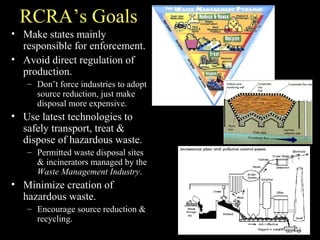
RCRA’s Goals
• Make states mainly
responsible for enforcement.
• Avoid direct regulation of
production.
– Don’t force industries to adopt
source reduction, just make
disposal more expensive.
• Use latest technologies to
safely transport, treat &
dispose of hazardous waste.
– Permitted waste disposal sites
& incinerators managed by the
Waste Management Industry.
• Minimize creation of
hazardous waste.
– Encourage source reduction &
recycling.
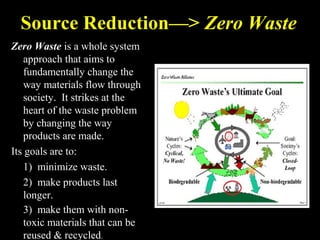
Source Reduction—> Zero Waste
Zero Waste is a whole system
approach that aims to
fundamentally change the
way materials flow through
society. It strikes at the
heart of the waste problem
by changing the way
products are made.
Its goals are to:
1) minimize waste.
2) make products last
longer.
3) make them with non-
toxic materials that can be
reused & recycled.
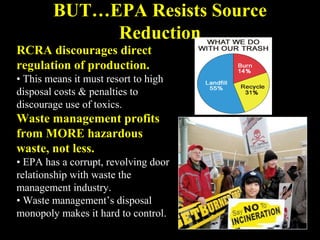
BUT…EPA Resists Source
Reduction
RCRA discourages direct
regulation of production.
• This means it must resort to high
disposal costs & penalties to
discourage use of toxics.
Waste management profits
from MORE hazardous
waste, not less.
• EPA has a corrupt, revolving door
relationship with waste the
management industry.
• Waste management’s disposal
monopoly makes it hard to control.
“Cradle-to-Grave” Regulation
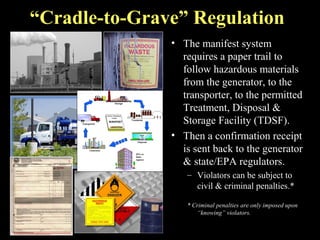
• The manifest system
requires a paper trail to
follow hazardous materials
from the generator, to the
transporter, to the permitted
Treatment, Disposal &
Storage Facility (TDSF).
• Then a confirmation receipt
is sent back to the generator
& state/EPA regulators.
– Violators can be subject to
civil & criminal penalties.*
* Criminal penalties are only imposed upon
“knowing” violators.
RCRA’s Persistent Problems
• The petroleum exclusion
allows toxic oil waste to be
discarded as NON-hazardous
waste.
• Modern incineration & land
disposal units are still very
dangerous.
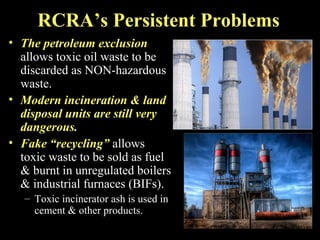
• Fake “recycling” allows
toxic waste to be sold as fuel
& burnt in unregulated boilers
& industrial furnaces (BIFs).
– Toxic incinerator ash is used in
cement & other products.

CERCLA & RCRA: Tossing Toxic Trash

  • 1.
    CERCLA & RCRA TossingToxic Trash Craig Collins, Ph.D.
  • 2.
    Love Canal: ToxicWake Up Call After decades of neglect & denial, Love Canal finally forced the nation to take toxic waste seriously. By then, industry had dumped over 100 trillion pounds of hazardous waste in unknown locations…enough to create a highway to the moon 100 feet wide & 10 feet deep.
  • 3.
    2 Laws CoverHazardous Waste Clean-up & Disposal CERCLA--Superfund* • CERCLA is NOT a regulatory statute; it is a cleanup & liability law. • It cleans up abandoned or “orphaned” toxic sites by imposing strict clean- up liability on those parties responsible for creating them. * CERCLA (Comprehensive Environmental Response, Compensation, & Liability Act, 1980) RCRA (Resource Conservation & Recovery Act, 1976) • RCRA is a regulatory law. • It gives EPA “cradle-to- grave” oversight over the generation, transport, treatment & disposal of hazardous waste.
  • 4.
    RCRA & CERCLA ReinforceEach Other • To prevent future superfund sites, RCRA requires industry to dispose of its hazardous waste in licensed disposal facilities, instead of just dumping it anywhere. • CERCLA imposes heavy cleanup liability on illegal disposal (“midnight dumping”). This encourages industry to obey RCRA’s disposal regulations, resulting in fewer superfund sites.
  • 5.
    Superfund: Liability &Cleanup • CERCLA makes PRPs (potentially responsible parties) liable for cleaning up their hazardous waste messes. • If the culprits cannot be identified; have gone out of business; or fight to avoid clean-up in court, the EPA can use the superfund to clean-up the toxic site. • This “superfund” was created by taxing dangerous industrial chemicals & crude oil.
  • 6.
    Clean-up Liability • CERCLAliability is not criminal; it is clean-up. • It is based on “the polluter pays” principle. • This liability is: – Strict: • It applies whether or not the disposal was negligent. – Joint & Several: • Any identified PRP is responsible for the entire clean- up, unless he can identify & sue other PRPs. – Retroactive: • CERCLA applies to hazardous sites created both BEFORE & after the law was passed.
  • 7.
    Potentially Responsible Parties •CERCLA imposes this heavy liability on 3 kinds of PRPs: – Generators – Transporters – Disposal sites • This includes future owners & the companies who insured them.
  • 8.
    Two Types ofCleanup (1) Remedial Cleanup –More thorough & expensive. –Requires NPL listing (2) Removal Cleanup –Less thorough –Containment is the primary goal.
  • 9.
    3 Common Criticismsof CERCLA • Ineffective – Only a fraction of all superfund sites have been remediated. • Wasteful – CERCLA wastes lots of money on litigation. • Unjust – Small PRPs can be liable for the liable cleanup. • Remediation can take decades--especially groundwater. • Insurers spend about 88% of their CERCLA costs on legal fees; Industrial firms spend 21%; Government spends only 11%. • SARA’s de minimus settlements addressed this problem.
  • 10.
    CERCLA’s Main Weaknesses •The Petroleum Exclusion shields oil companies from clean-up of drilling/extraction wastes. • The Superfund is broke. – Taxes expired in 2004. – This weakens EPA’s legal leverage. – EPA cannot: • Initiate clean-ups; respond to emergencies; leverage PRP suits with the threat of triple charges. • Cleanup procedures discriminate against poor communities sites: – They are harder to get listed – Clean-up standards are lower – They take longer to get cleaned-up – There are less resources for: • Health monitoring, buy-outs & relocations
  • 11.
    RCRA: The ProblemHistorically, dumps & landfills have been the primary waste management "solution" in the US. Yet landfills have many dangers & disadvantages: – Land-filled material has lost any potential use as a resource. – Toxic & non-toxic wastes stored there may become a hazardous mix & migrate from the site to groundwater, surface water or the air. – Evidence is growing that living near a landfill can pose significant health risks, especially on unborn children. – Health investigations of communities around hazardous waste sites have found increases in birth defects, neurotoxic disorders, leukemia, cardiovascular abnormalities, respiratory & sensory irritation & skin disorders. Sanitary Landfill Unregulated Dump
  • 12.
    RCRA’s Goals • Makestates mainly responsible for enforcement. • Avoid direct regulation of production. – Don’t force industries to adopt source reduction, just make disposal more expensive. • Use latest technologies to safely transport, treat & dispose of hazardous waste. – Permitted waste disposal sites & incinerators managed by the Waste Management Industry. • Minimize creation of hazardous waste. – Encourage source reduction & recycling.
  • 13.
    Source Reduction—> ZeroWaste Zero Waste is a whole system approach that aims to fundamentally change the way materials flow through society. It strikes at the heart of the waste problem by changing the way products are made. Its goals are to: 1) minimize waste. 2) make products last longer. 3) make them with non- toxic materials that can be reused & recycled.
  • 14.
    BUT…EPA Resists Source Reduction RCRAdiscourages direct regulation of production. • This means it must resort to high disposal costs & penalties to discourage use of toxics. Waste management profits from MORE hazardous waste, not less. • EPA has a corrupt, revolving door relationship with waste the management industry. • Waste management’s disposal monopoly makes it hard to control.
  • 15.
    “Cradle-to-Grave” Regulation • Themanifest system requires a paper trail to follow hazardous materials from the generator, to the transporter, to the permitted Treatment, Disposal & Storage Facility (TDSF). • Then a confirmation receipt is sent back to the generator & state/EPA regulators. – Violators can be subject to civil & criminal penalties.* * Criminal penalties are only imposed upon “knowing” violators.
  • 16.
    RCRA’s Persistent Problems •The petroleum exclusion allows toxic oil waste to be discarded as NON-hazardous waste. • Modern incineration & land disposal units are still very dangerous. • Fake “recycling” allows toxic waste to be sold as fuel & burnt in unregulated boilers & industrial furnaces (BIFs). – Toxic incinerator ash is used in cement & other products.