ECONOMIC SYSTEM-
FOOD GETTING
*SUBSISTENCE
PATTERNS
REYNALDO PASCUA SINGUEO,MAED SS.
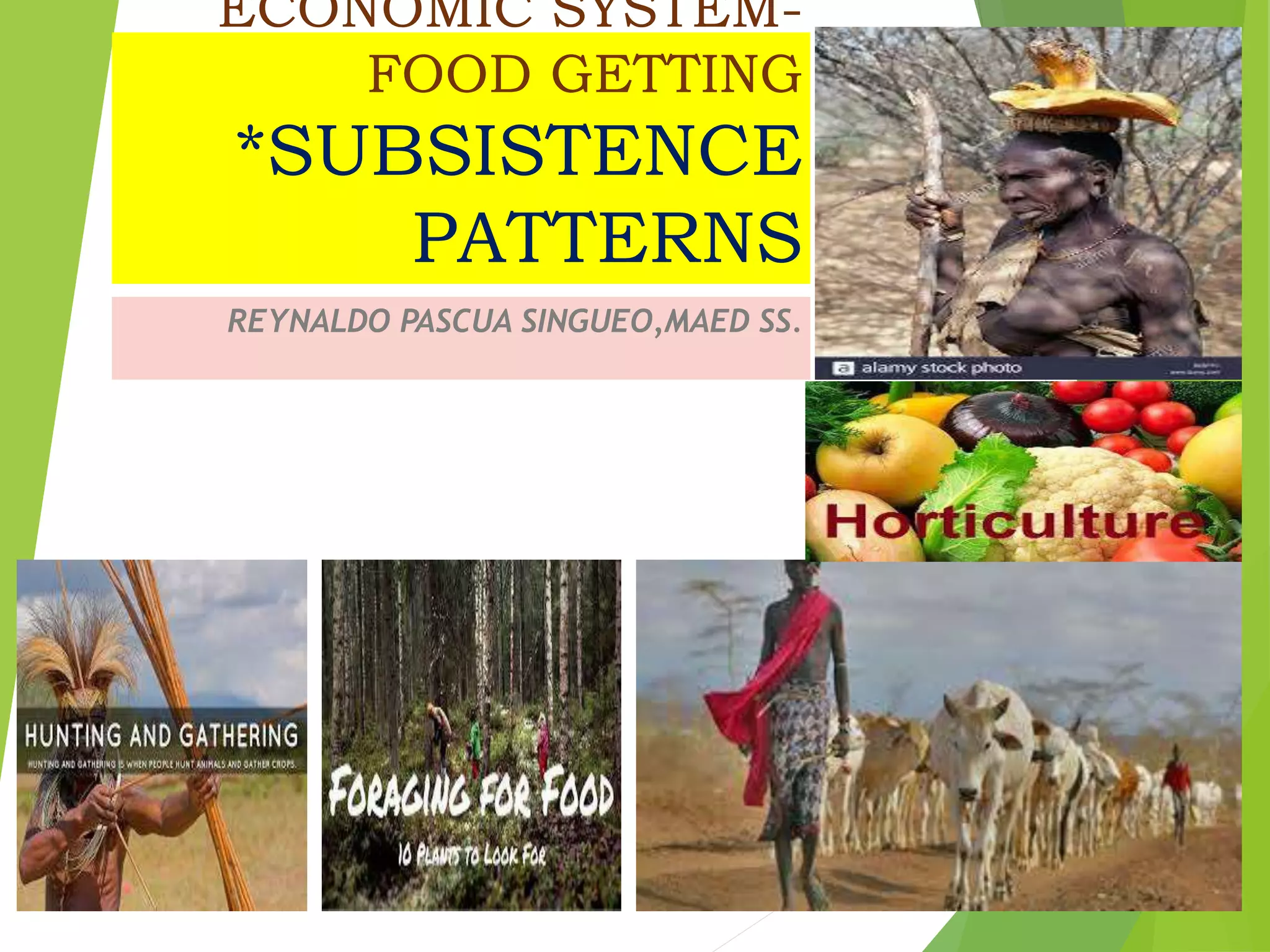
Food Getting/collection
Defined as all form of
subsistence technology in which
food getting is dependent on
naturally occurring resources
that is, wild plants and animals.
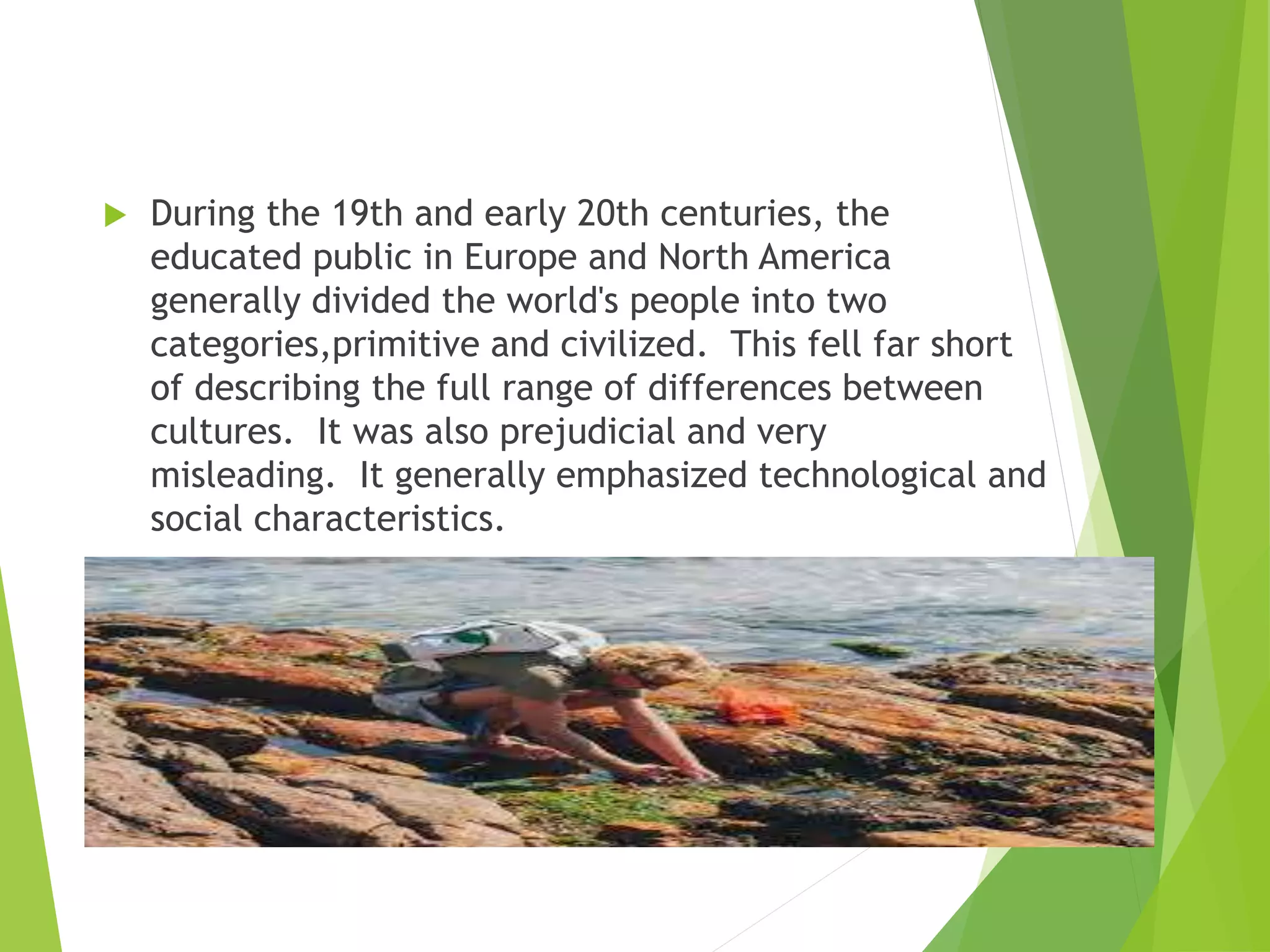
 During the 19th and early 20th centuries, the
educated public in Europe and North America
generally divided the world's people into two
categories,primitive and civilized. This fell far short
of describing the full range of differences between
cultures. It was also prejudicial and very
misleading. It generally emphasized technological and
social characteristics.
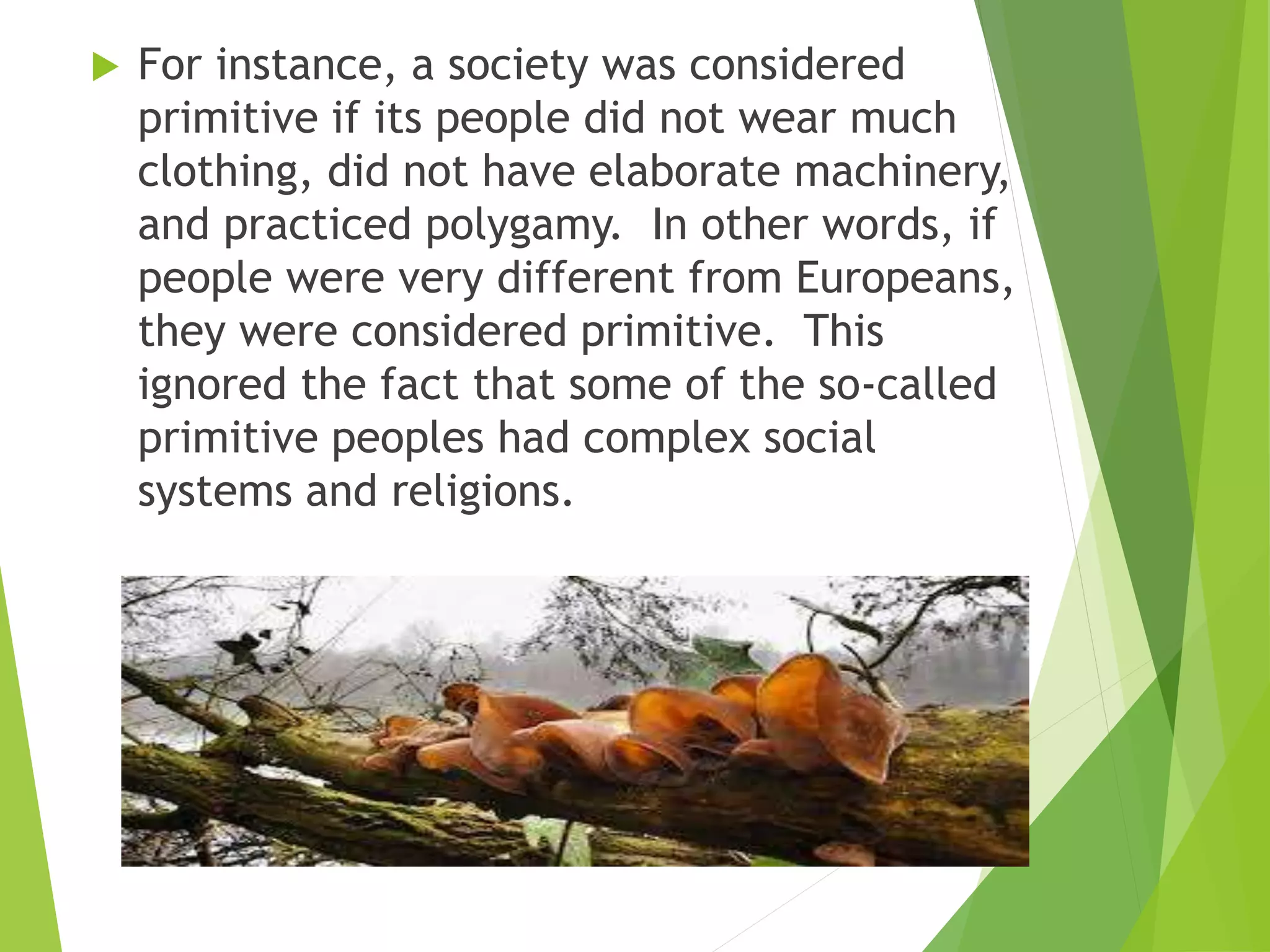
 For instance, a society was considered
primitive if its people did not wear much
clothing, did not have elaborate machinery,
and practiced polygamy. In other words, if
people were very different from Europeans,
they were considered primitive. This
ignored the fact that some of the so-called
primitive peoples had complex social
systems and religions.
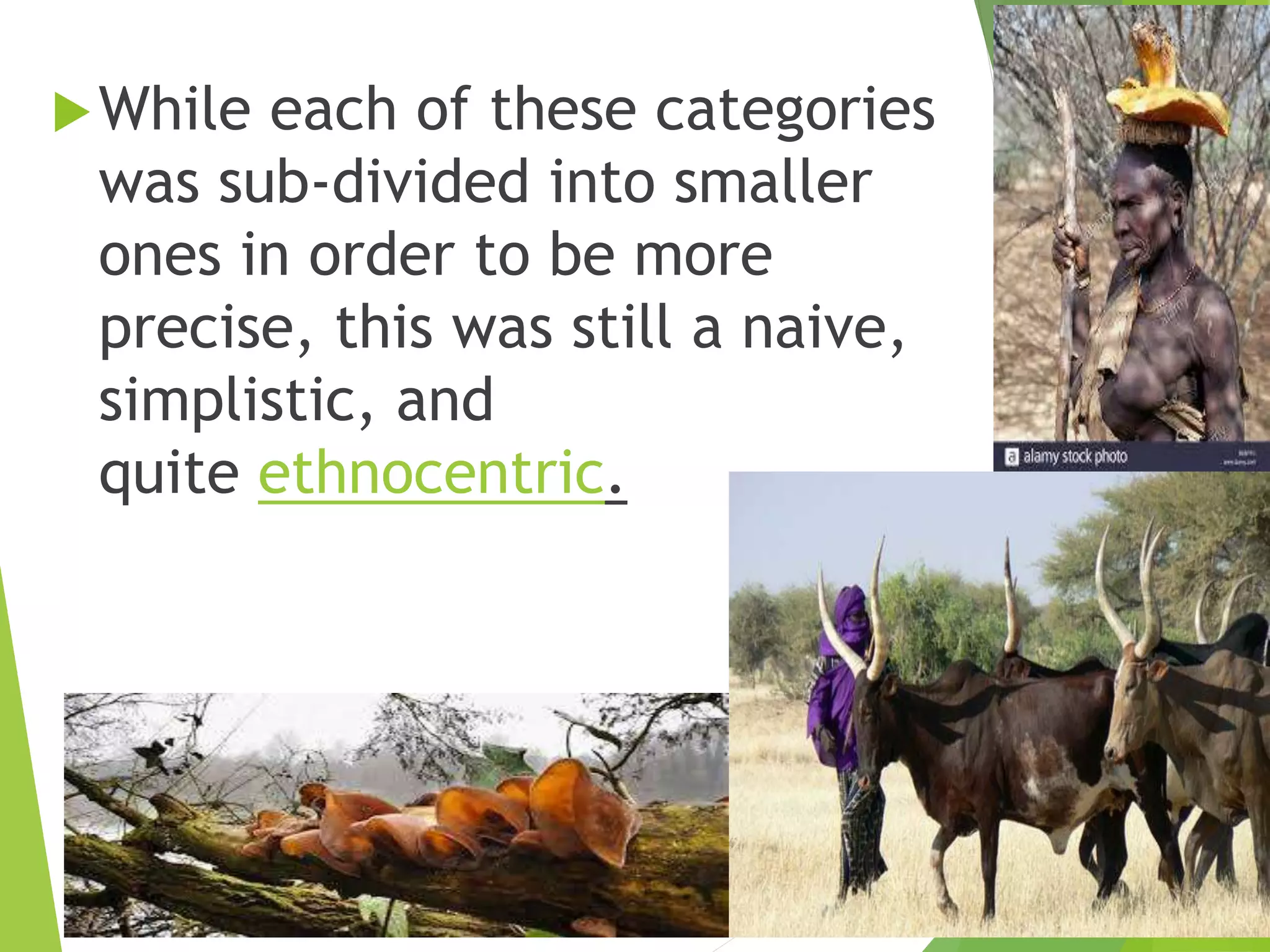
While each of these categories
was sub-divided into smaller
ones in order to be more
precise, this was still a naive,
simplistic, and
quite ethnocentric.
 By the 1930's, enough first
hand ethnographic data about the
cultures of the world had been
gathered for anthropologists to
understand that there is a better way
of categorizing them. They based
their distinctions primarily on
differences in subsistence patterns--
i.e., sources and methods a society
uses to obtain its food and other
necessities
 This focus on economic
differences proved to be useful
because much of the rest of a
culture is directly related to its
economy. If you know what the
subsistence base is, it is possible
to predict many of the other basic
cultural patterns.
There is a surprisingly high positive
correlation between the type of economy and such
things as population sizes and densities, social and
political systems, scale of warfare, and complexity of
science, mathematics, and technology. Using this
approach, anthropologists divided the cultures of the
world into four basic subsistence types:
 Foraging (hunting and gathering wild plants and
animals)
 Pastoralism (herding large domesticated animals)
 Horticulture (small-scale, low intensity farming)
 Intensive agriculture (large-scale, intensive
farming)
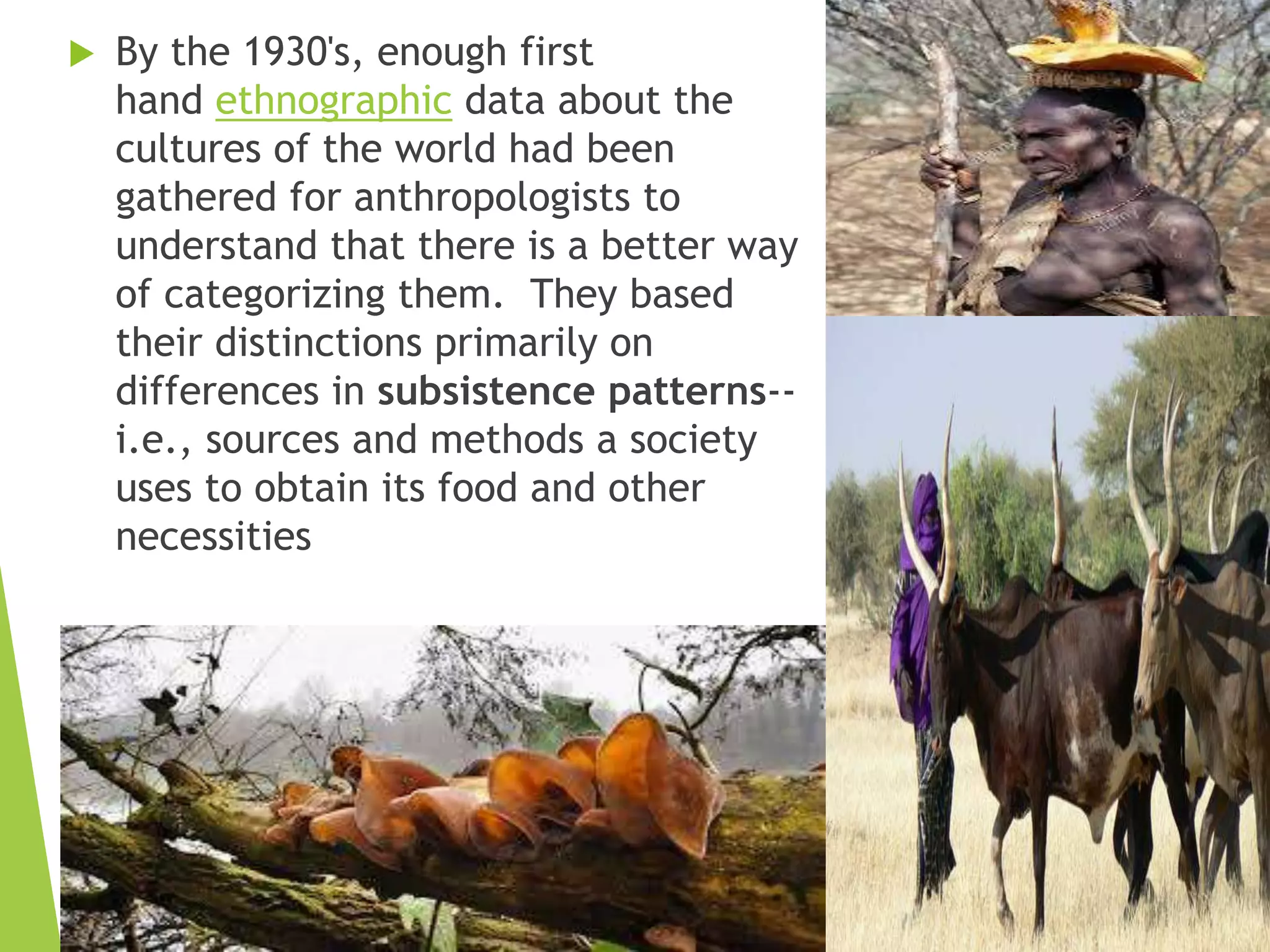
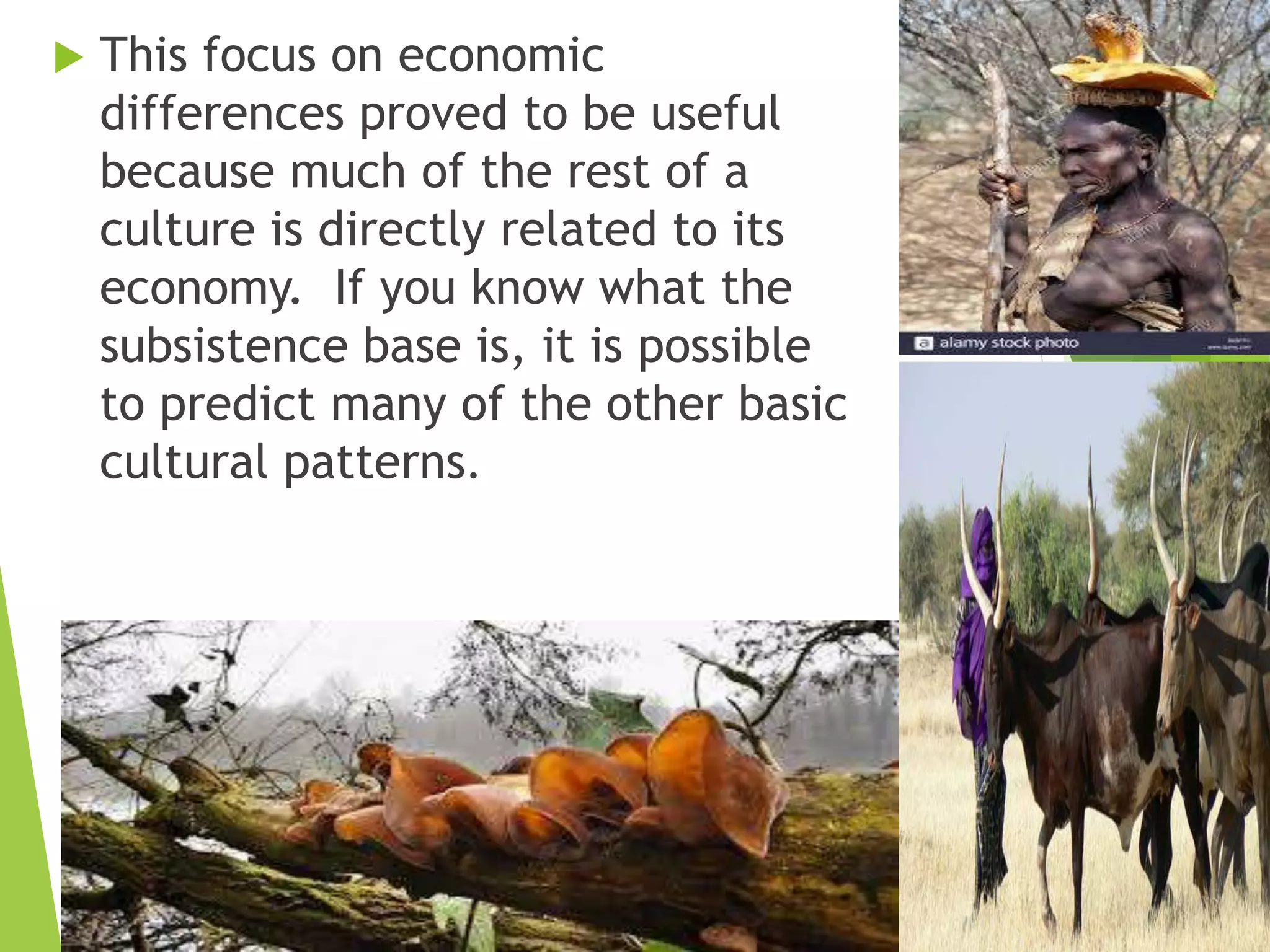
1. FORAGING (hunting and
gathering wild plants and animals)
 Ancient subsistence pattern, no
exclusive foraging societies still
exist
 Almost every man a hunter, every
woman a gatherer
 No permanent year-round
settlements
 Pedestrian – Aborigines, San of S.W. Africa,
California Indians and Paiutes
Peaceful, democratic, women have some
power
 Equestrian – Great Plains Indians, Southern
Argentinian grasslands.
Hunt on horseback, warlike, male-dominated,
raiding/stealing is path to respect, buffalo is
primary source of calories.
 Aquatic – Inuit, Kwakiutl
Subsist on marine life, reliable and productive
life, politically powerful men.
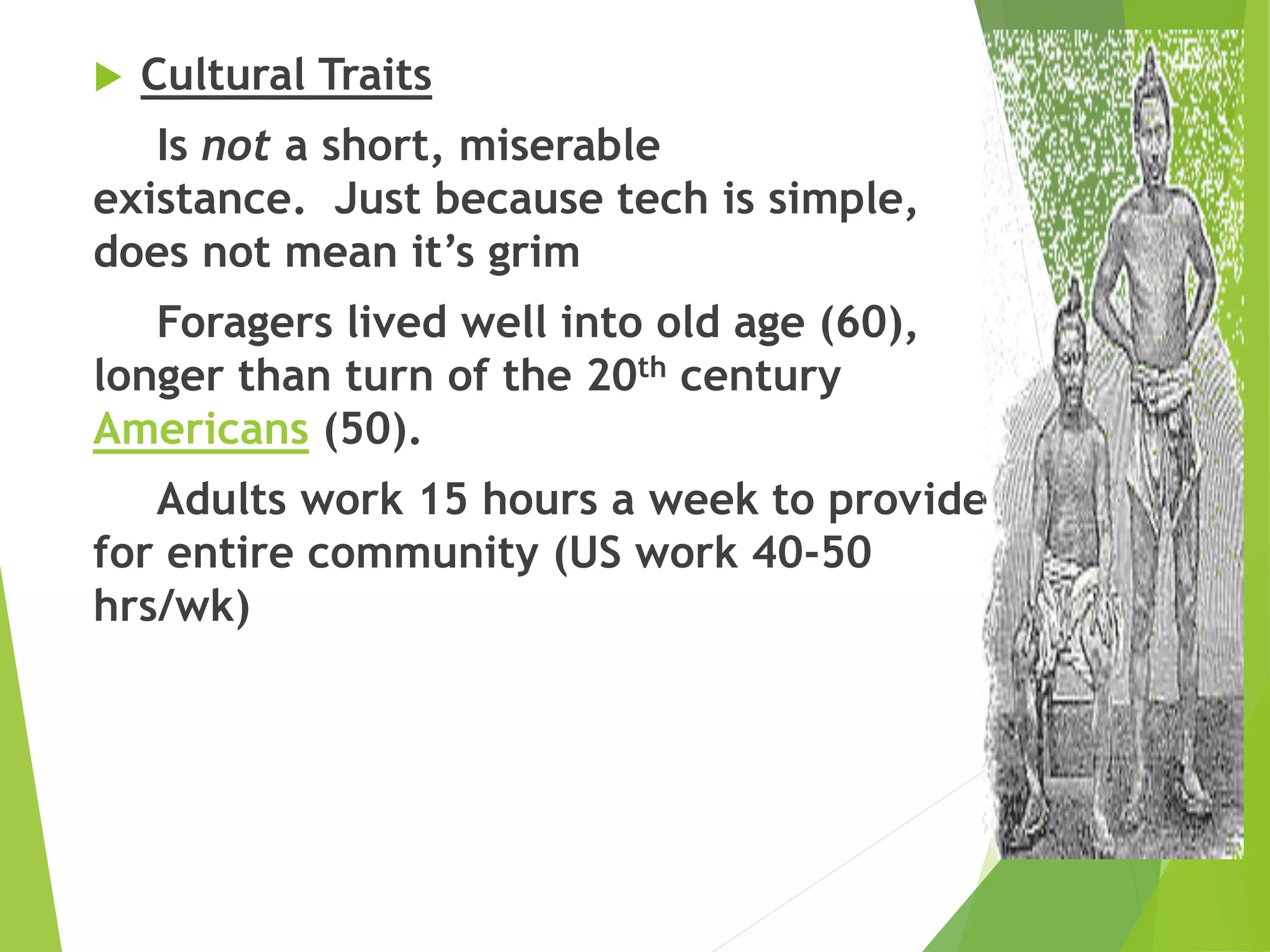
 Cultural Traits
Is not a short, miserable
existance. Just because tech is simple,
does not mean it’s grim
Foragers lived well into old age (60),
longer than turn of the 20th century
Americans (50).
Adults work 15 hours a week to provide
for entire community (US work 40-50
hrs/wk)
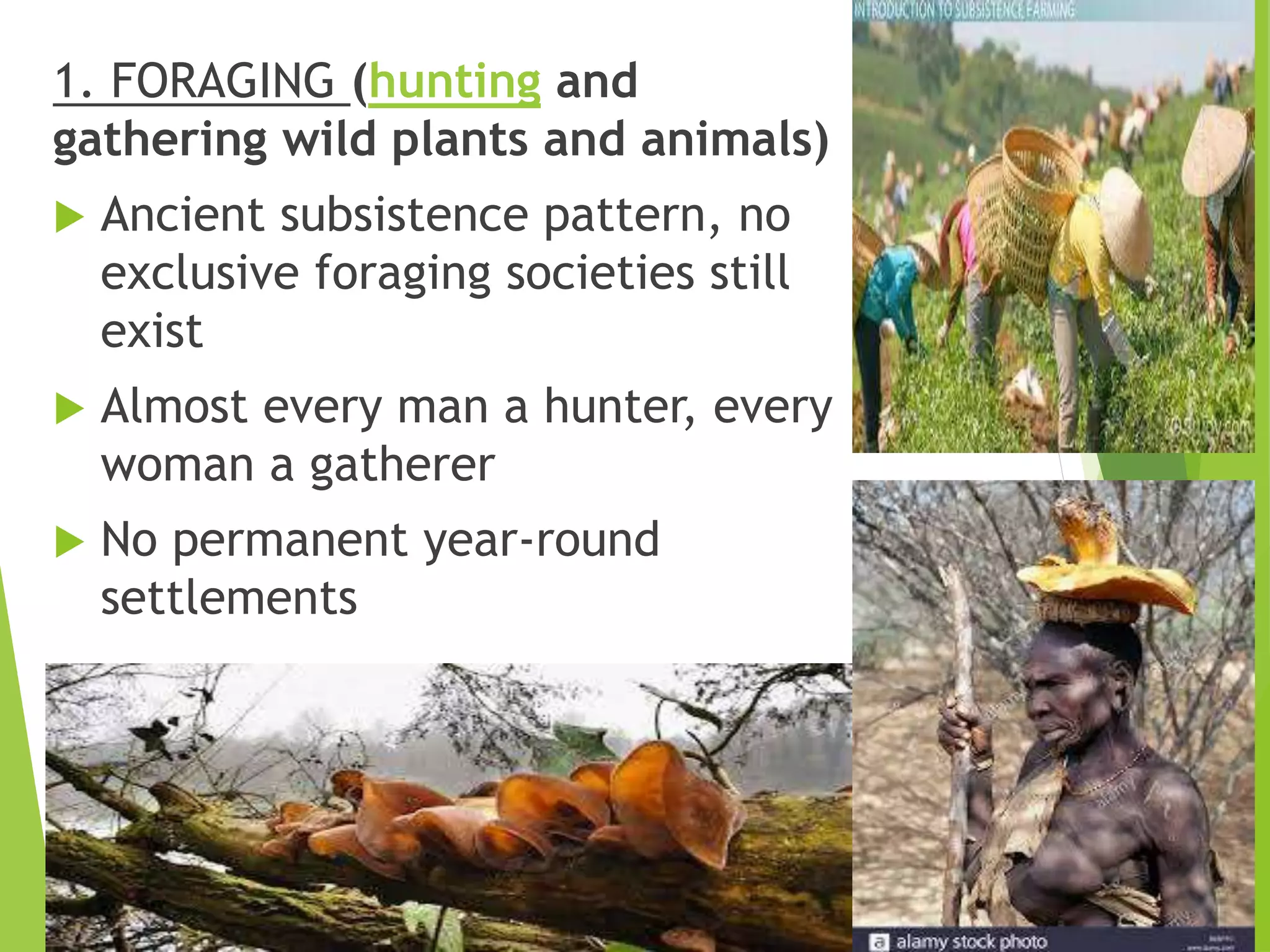
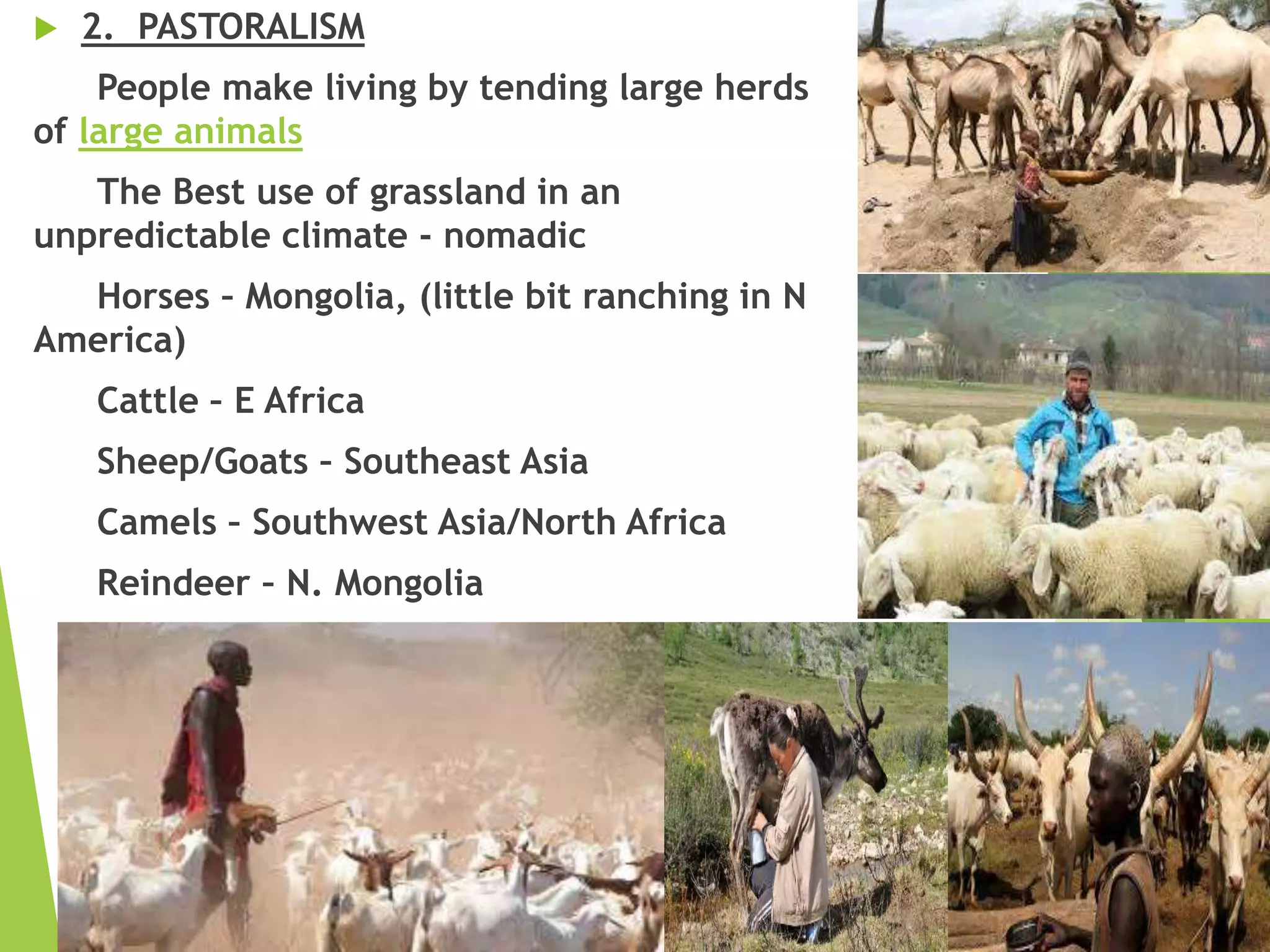
 2. PASTORALISM
People make living by tending large herds
of large animals
The Best use of grassland in an
unpredictable climate - nomadic
Horses – Mongolia, (little bit ranching in N
America)
Cattle – E Africa
Sheep/Goats – Southeast Asia
Camels – Southwest Asia/North Africa
Reindeer – N. Mongolia
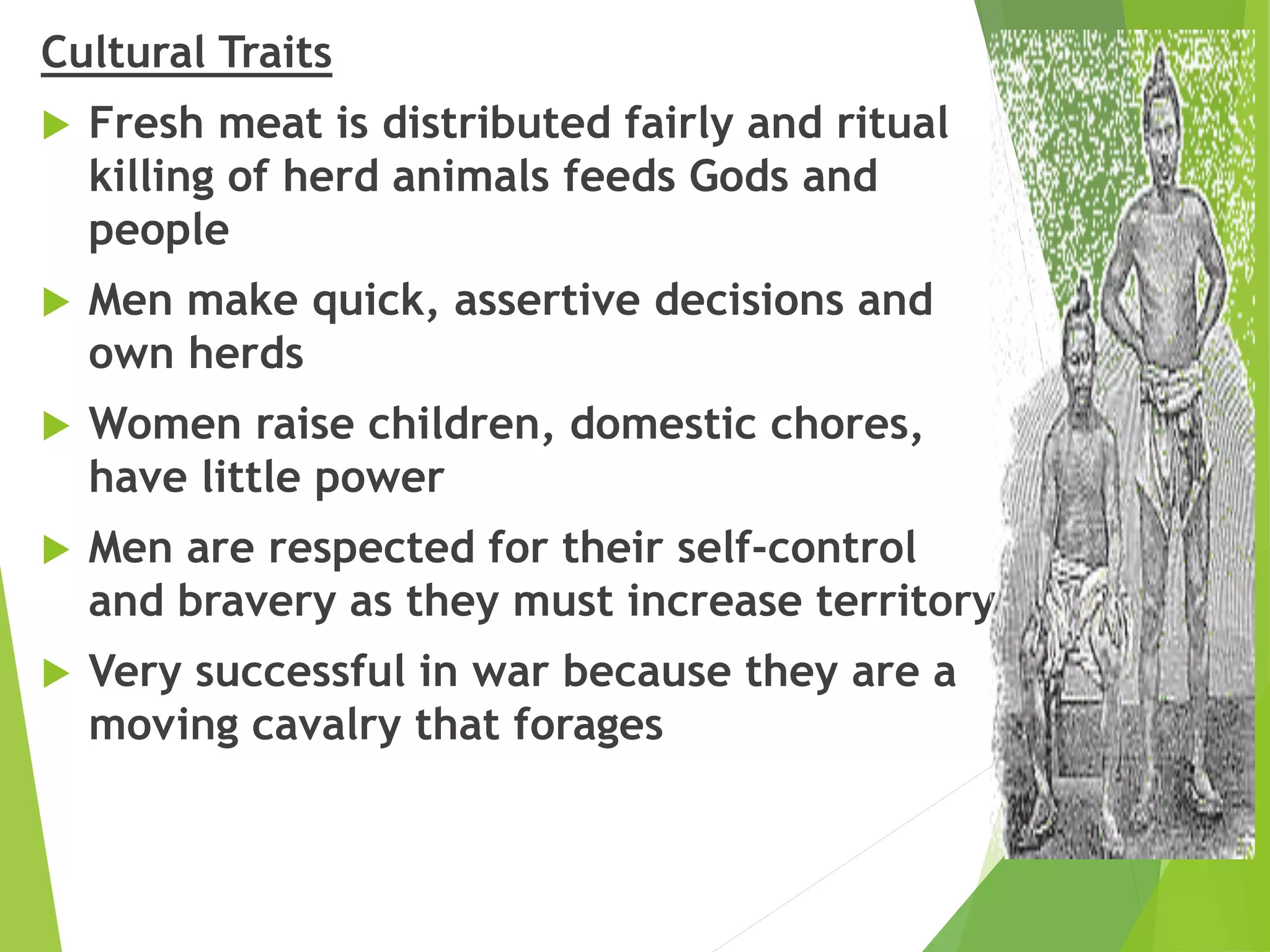
Cultural Traits
 Fresh meat is distributed fairly and ritual
killing of herd animals feeds Gods and
people
 Men make quick, assertive decisions and
own herds
 Women raise children, domestic chores,
have little power
 Men are respected for their self-control
and bravery as they must increase territory
 Very successful in war because they are a
moving cavalry that forages
3. HORTICULTURE
 Small scale, low intensity farming, part time
tending and planting of domesticated plants
and animals
 High population density – more productive
than foraging, but more labor intensive.
 In the past, most societies were horticultural,
now only exist in:
 Amazon Basin
 Congo Basin
 Southeast Asia
 Shifting field use, slash and burn techniques,
plant, then move every few years.
 Know very much about farming and when
field shifting is taken away, the result is soil
depletion and poverty.
 Can be very warlike with periodic raids on
neighboring villages.
4. INTENSIVE AGRICULTURE
 Primary subsistence pattern of large-scale
populous societies
 Made possible by domestication of field
animals and irrigation in large populations
 Ancient – Egypt, Mesopotamia (Iraq and
Syria), India, Pakistan, N China,
MesoAmerica, Andes
 Now- Primary food production pattern in all
developed nations except where it’s very
dry or cold using large scale industrial
techniques.
 Produced Major Social Changes
 Year Round settlements –> Village
markets –> Towns -> Cities
 Complex divisions of labor - Urban
centers occupied by specialists - Social
Classes
 Farmers lose political power – power
goes to “kings” – little sharing of natural
resources – women have little status or
power
 Major war, major disease /
epidemics, increase in knowledge
and life expectancy, change from a
large family to just a nuclear family
that moves often.
 Move from physical power to
mental power, therefore, women
have gained power somewhat.
END…
Cultural anthropology subsistence

Cultural anthropology subsistence

  • 1.
  • 2.
    Food Getting/collection Defined asall form of subsistence technology in which food getting is dependent on naturally occurring resources that is, wild plants and animals.
  • 3.
     During the19th and early 20th centuries, the educated public in Europe and North America generally divided the world's people into two categories,primitive and civilized. This fell far short of describing the full range of differences between cultures. It was also prejudicial and very misleading. It generally emphasized technological and social characteristics.
  • 4.
     For instance,a society was considered primitive if its people did not wear much clothing, did not have elaborate machinery, and practiced polygamy. In other words, if people were very different from Europeans, they were considered primitive. This ignored the fact that some of the so-called primitive peoples had complex social systems and religions.
  • 5.
    While each ofthese categories was sub-divided into smaller ones in order to be more precise, this was still a naive, simplistic, and quite ethnocentric.
  • 6.
     By the1930's, enough first hand ethnographic data about the cultures of the world had been gathered for anthropologists to understand that there is a better way of categorizing them. They based their distinctions primarily on differences in subsistence patterns-- i.e., sources and methods a society uses to obtain its food and other necessities
  • 7.
     This focuson economic differences proved to be useful because much of the rest of a culture is directly related to its economy. If you know what the subsistence base is, it is possible to predict many of the other basic cultural patterns.
  • 8.
    There is asurprisingly high positive correlation between the type of economy and such things as population sizes and densities, social and political systems, scale of warfare, and complexity of science, mathematics, and technology. Using this approach, anthropologists divided the cultures of the world into four basic subsistence types:  Foraging (hunting and gathering wild plants and animals)  Pastoralism (herding large domesticated animals)  Horticulture (small-scale, low intensity farming)  Intensive agriculture (large-scale, intensive farming)
  • 9.
    1. FORAGING (huntingand gathering wild plants and animals)  Ancient subsistence pattern, no exclusive foraging societies still exist  Almost every man a hunter, every woman a gatherer  No permanent year-round settlements
  • 10.
     Pedestrian –Aborigines, San of S.W. Africa, California Indians and Paiutes Peaceful, democratic, women have some power  Equestrian – Great Plains Indians, Southern Argentinian grasslands. Hunt on horseback, warlike, male-dominated, raiding/stealing is path to respect, buffalo is primary source of calories.  Aquatic – Inuit, Kwakiutl Subsist on marine life, reliable and productive life, politically powerful men.
  • 11.
     Cultural Traits Isnot a short, miserable existance. Just because tech is simple, does not mean it’s grim Foragers lived well into old age (60), longer than turn of the 20th century Americans (50). Adults work 15 hours a week to provide for entire community (US work 40-50 hrs/wk)
  • 12.
     2. PASTORALISM Peoplemake living by tending large herds of large animals The Best use of grassland in an unpredictable climate - nomadic Horses – Mongolia, (little bit ranching in N America) Cattle – E Africa Sheep/Goats – Southeast Asia Camels – Southwest Asia/North Africa Reindeer – N. Mongolia
  • 13.
    Cultural Traits  Freshmeat is distributed fairly and ritual killing of herd animals feeds Gods and people  Men make quick, assertive decisions and own herds  Women raise children, domestic chores, have little power  Men are respected for their self-control and bravery as they must increase territory  Very successful in war because they are a moving cavalry that forages
  • 14.
    3. HORTICULTURE  Smallscale, low intensity farming, part time tending and planting of domesticated plants and animals  High population density – more productive than foraging, but more labor intensive.  In the past, most societies were horticultural, now only exist in:  Amazon Basin  Congo Basin  Southeast Asia
  • 15.
     Shifting fielduse, slash and burn techniques, plant, then move every few years.  Know very much about farming and when field shifting is taken away, the result is soil depletion and poverty.  Can be very warlike with periodic raids on neighboring villages.
  • 16.
    4. INTENSIVE AGRICULTURE Primary subsistence pattern of large-scale populous societies  Made possible by domestication of field animals and irrigation in large populations  Ancient – Egypt, Mesopotamia (Iraq and Syria), India, Pakistan, N China, MesoAmerica, Andes  Now- Primary food production pattern in all developed nations except where it’s very dry or cold using large scale industrial techniques.
  • 17.
     Produced MajorSocial Changes  Year Round settlements –> Village markets –> Towns -> Cities  Complex divisions of labor - Urban centers occupied by specialists - Social Classes  Farmers lose political power – power goes to “kings” – little sharing of natural resources – women have little status or power
  • 18.
     Major war,major disease / epidemics, increase in knowledge and life expectancy, change from a large family to just a nuclear family that moves often.  Move from physical power to mental power, therefore, women have gained power somewhat. END…