CASE PRESENTATION
Dr. Bhavna Tyagi
CASE HISTORY
A 36-years-old female patient presented at
the Department of Oral Pathology of School of
Dental Sciences, Greater Noida, with a 3-year
history of a painless mass in the left Buccal
mucosa which was interfering with her ability
to eat normally.
2
HISTORY OF PRESENT ILLNESS
• Patient presented with the soft nodule in the
left buccal mucosa (angle of the mouth)
from last 3 years .
• Not associated with any pain.
3
NO ABNORMLITY DETECTED EXTRAORALLY
INTRAORAL FINDINGS
Size- 1cmx1cm
Shape- Round
Margins- Regular
Colour- Reddish white
Fluctuant
Consistency- Firm
Number-1
Extent-At the corner of mouth
PROVISIONAL DIAGNOSIS
Fibroma
Differential diagnosis
• Pyogenic granuloma
• Peripheral giant cell granuloma
• Lipoma
• Mucocele
INVESTIGATIONS
• Hb- 12gm%
• BT- 1 min
• CT- 4 min 30 sec
BIOPSY
• Excisional biopsy done
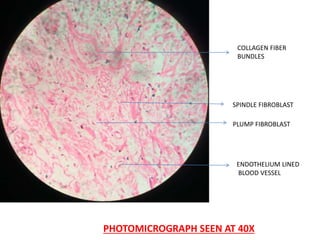
• HISTOPATHOLOGICAL FINDINGS
H &E stained section showed stratified squamous
epithelium & the underlying connective tissue showed
numerous plump fibroblasts with dense collagen fibres
bundles along with blood vessels and few inflammatory
cells. At some places muscle tissue was also seen in
deeper sections. Overall clinicopathological features
were suggestive of 'FIBROMA'.
• FINAL DIAGNOSIS- FIBROMA
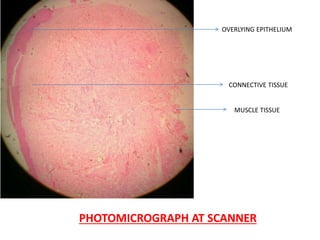
PHOTOMICROGRAPH AT SCANNER
OVERLYING EPITHELIUM
CONNECTIVE TISSUE
MUSCLE TISSUE
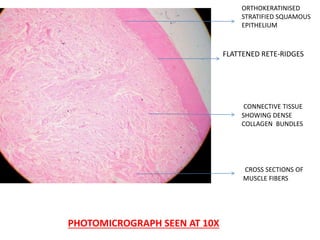
PHOTOMICROGRAPH SEEN AT 10X
CROSS SECTIONS OF
MUSCLE FIBERS
ORTHOKERATINISED
STRATIFIED SQUAMOUS
EPITHELIUM
CONNECTIVE TISSUE
SHOWING DENSE
COLLAGEN BUNDLES
FLATTENED RETE-RIDGES
PHOTOMICROGRAPH SEEN AT 40X
COLLAGEN FIBER
BUNDLES
PLUMP FIBROBLAST
ENDOTHELIUM LINED
BLOOD VESSEL
SPINDLE FIBROBLAST
DISCUSSION
• Pyogenic granuloma:The most frequent intraoral
site is the gingiva (approximately 75%). It can also
occur on the lips, tongue, buccal mucosa, palate and
floor of the mouth.
Jafarzadeh H, Sanatkhani M, Mohtasham N. Oral pyogenic granuloma: a
review. Journal of oral science. 2006;48(4):167-75.
• Peripheral giant cell granuloma:presents as a soft tissue
purplish-red nodule. This lesion probably does not
represent a true neoplasm, but rather may be reactive
in nature, believed to be stimulated by local irritation or
trauma, but the cause is not certainly known.
Tandon PN, Gupta SK, Gupta DS, Jurel SK, Saraswat A. Peripheral giant cell granuloma.
Contemporary clinical dentistry. 2012 Apr 1;3(5):118.
• Lipoma:common tumor of soft tissue. Buccal
mucosa, tongue, and floor of the mouth are
among the common locations. The clinical
presentation is typically as an asymptomatic
yellowish mass. The overlying epithelium is intact,
and superficial blood vessels are usually evident
over the tumor.
Hoseini AT, Razavi SM, Khabazian A. Lipoma in oral mucosa: Two case
reports. Dent Res J (Isfahan). 2010 Nov 13;7(1):41-3.
• Mucocele:Mucocele can be frequently found in
the lower lips of young patients and is associated
with some kind of local trauma. Fibroma is found
more often in adult patients in the buccal mucosa,
resulting from constant irritation of the soft tissue.
• A 50 years old Saudi male reported the presence of
a ball in his mouth approximately six months
ago.He complained of wounds on the tissue while
eating. This painless ball became ulcerated,
bleeding and with pain.
Elrahawy KM, Nagy AI, El-Swilem RO. Fibroma of Buccal Mucosa:
Case Report and Literature Review. European Scientific Journal, ESJ. 2017 Feb
28;13(6).
Histopathological findings
• Fibromas are asymptomatic lesions found more
frequently in the buccal mucosa.
• Age: Third -fourth decade of life.(As in our case
Fibroma occurred in a 36 year old female)
• Females are twice as likely to develop this benign
tumor than male.
Alam MN, Chandrasekaran SC, Valiathan M. Fibroma Of The Gingiva: A Case Report Of 20 Year Long
Standing Lesion. International Journal of Contemporary Dentistry. 2011 Oct 1;1(3).
• They present a smooth surface, nodular
appearance, hard consistency and a sessile
base.
• A fibroma beneath a denture has no room to
expand uniformly in all directions and so
develops as a flat, pancake-shaped mass with
small surface papules along the outer edges.
Valério RA, Queiroz AM, Romualdo PC, Brentegani LG, Paula-Silva FW. Mucocele and fibroma:
treatment and clinical features for differential diagnosis. Brazilian dental journal. 2013
Oct;24(5):537-41.
• This leaf-shaped fibroma may be
associated with an underlying
cupped-out area of bony
erosion.(fig B)
• Another unique variant of
denture-related fibroma, the
epulis fissuratum (epulis means
“mass on the gingiva”) is an
irregular, linear, fibrous
hyperplasia.(fig c)
• occurring in the mucosal
vestibule or sulcus adjacent to
the alveolar ridge, where the
edge of a loose-fitting denture
chronically pounds into the
tissue.
Gnepp DR. Diagnostic surgical pathology of the head and neck. Elsevier Health Sciences; 2009
Apr 7
• Color is similar to the mucosa or may be
bluish, measuring up to 2 cm in diameter, and
displaying slow growth due to low mitotic
index.
• The surface may be either intact (34%) or
ulcerated (66%). Bagde H. Peripheral Cemento Ossifying Fibroma–Cas
E Report. Int J Dent Case Reports. 2012;2(5):15-8.
• The reported case was of 1cm × 1 cm in
diameter.
• The lesion represents varying stages of a
fibroma with ossification, however,
ossification or calcification may not be evident
in all cases, particularly in earlier stages of
growth.
Histopathological features
• Lesions are often encapsulated, usually well
delimited and do not produce metastasis.
• Histopathologically, fibroma can exhibit as an
intact or ulcerated stratified squamous
epithelium along with shortening and
flattening of rete pegs.
• A dense and minimally cellular stroma of
collagen fibers arranged randomly or
organized into interlacing fascicles.
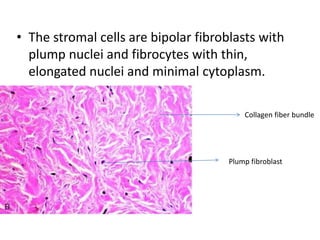
• The stromal cells are bipolar fibroblasts with
plump nuclei and fibrocytes with thin,
elongated nuclei and minimal cytoplasm.
Collagen fiber bundle
Plump fibroblast
• The surface epithelium may be atrophic and may
show signs of continued trauma, such as excess
keratin, intracellular edema of the superficial
layers, and traumatic ulceration.
• The hyperkeratinized epithelium is not dysplastic
or precancerous and is essentially a frictional
keratosis.
• Rarely, melanin deposition is seen in the basal
layer.
• This has no diagnostic significance, but its
presence has led some to refer to such a lesion as
pigmented fibroma.
• An epulis fissuratum is microscopically similar to a
routine irritation fibroma except that the chronic
inflammatory cells are more numerous and the
surface epithelium is much more likely to be
ulcerated.
The intact surface
epithelium is often quite
acanthotic, with occasional
lesions showing enough
elongation of rete processes
to justify a secondary
diagnosis of
pseudoepitheliomatous
hyperplasia .
• The pathologist must be very careful not to
misinterpret this epithelial hyperplasia as well-
differentiated squamous cell carcinoma or
verrucous carcinoma.
• It is important, in this regard, to understand
that carcinoma in association with epulis
fissuratum is extremely rare.
Oral fibromas (OF) and inflammatory hyperplasia (IH) account for
the great majority of the lesions.
• The OF and IH are lesions that superimpose clinical and
microscopical characteristics.
• HE and MT staining analysis showed thick collagenous fibers in the
centre of the lesion were the main microscopic characteristics and
should be considered in diagnosis of OF.
Histopatológico C. Differential diagnosis between oral fibroma and inflammatory hyperplasia: a proposal for
histopathological criteria. Rev. Fac. Odontol. Porto Alegre. 2013 Jan;54(1-3):14-8.
• Irritation fibroma and other localized fibrous
hyperplasias are easily removed by conservative
surgical excision, with no need to remove a margin
of surrounding normal mucosa.
• Recurrence is unlikely unless the inciting trauma
continues or is repeated.
• The bony concavity associated with some leaf-
shaped fibromas under dentures will recontour to
normal after removal of the offending mass.
• For epulis fissuratum, the treatment includes both
surgical removal and reline or remake of the
offending denture.
CONCLUSION
• Fibroma clinically resembles as pyogenic
granuloma, peripheral giant cell granuloma or
peripheral odontogenic tumors, so
radiographic and histopathological
examination is essential for accurate
diagnosis.
1. Valério RA, Queiroz AM, Romualdo PC, Brentegani LG, Paula-Silva FW. Mucocele and
fibroma: treatment and clinical features for differential diagnosis. Brazilian dental
journal. 2013 Oct;24(5):537-41.
2. Bagde H, Waghmare A, Savitha B, Vhanmane P. Irritation Fibroma–Case Report.
International Journal of Dental Clinics. 2013 Mar 30;5(1).
3. Alam MN, Chandrasekaran SC, Valiathan M. Fibroma Of The Gingiva: A Case Report
Of 20 Year Long Standing Lesion. International Journal of Contemporary Dentistry.
2011 Oct 1;1(3).
4. Histopatológico C. Differential diagnosis between oral fibroma and inflammatory
hyperplasia: a proposal for histopathological criteria. Rev. Fac. Odontol. Porto Alegre.
2013 Jan;54(1-3):14-8.
5. Patil S, Rao RS, Sharath S, Agarwal A. True fibroma of alveolar mucosa. Case reports
in dentistry. 2014 Mar 4;2014.
6. Hoseini AT, Razavi SM, Khabazian A. Lipoma in oral mucosa: Two case reports. Dent
Res J (Isfahan). 2010 Nov 13;7(1):41-3.
7. Tandon PN, Gupta SK, Gupta DS, Jurel SK, Saraswat A. Peripheral giant cell
granuloma. Contemporary clinical dentistry. 2012 Apr 1;3(5):118.
8. Gnepp DR. Diagnostic surgical pathology of the head and neck. Elsevier Health
Sciences; 2009 Apr 7
Fibroma case presentation

Fibroma case presentation

  • 1.
  • 2.
    CASE HISTORY A 36-years-oldfemale patient presented at the Department of Oral Pathology of School of Dental Sciences, Greater Noida, with a 3-year history of a painless mass in the left Buccal mucosa which was interfering with her ability to eat normally. 2
  • 3.
    HISTORY OF PRESENTILLNESS • Patient presented with the soft nodule in the left buccal mucosa (angle of the mouth) from last 3 years . • Not associated with any pain. 3
  • 4.
  • 5.
    INTRAORAL FINDINGS Size- 1cmx1cm Shape-Round Margins- Regular Colour- Reddish white Fluctuant Consistency- Firm Number-1 Extent-At the corner of mouth
  • 6.
  • 7.
    Differential diagnosis • Pyogenicgranuloma • Peripheral giant cell granuloma • Lipoma • Mucocele
  • 8.
    INVESTIGATIONS • Hb- 12gm% •BT- 1 min • CT- 4 min 30 sec BIOPSY • Excisional biopsy done
  • 9.
    • HISTOPATHOLOGICAL FINDINGS H&E stained section showed stratified squamous epithelium & the underlying connective tissue showed numerous plump fibroblasts with dense collagen fibres bundles along with blood vessels and few inflammatory cells. At some places muscle tissue was also seen in deeper sections. Overall clinicopathological features were suggestive of 'FIBROMA'. • FINAL DIAGNOSIS- FIBROMA
  • 10.
    PHOTOMICROGRAPH AT SCANNER OVERLYINGEPITHELIUM CONNECTIVE TISSUE MUSCLE TISSUE
  • 11.
    PHOTOMICROGRAPH SEEN AT10X CROSS SECTIONS OF MUSCLE FIBERS ORTHOKERATINISED STRATIFIED SQUAMOUS EPITHELIUM CONNECTIVE TISSUE SHOWING DENSE COLLAGEN BUNDLES FLATTENED RETE-RIDGES
  • 12.
    PHOTOMICROGRAPH SEEN AT40X COLLAGEN FIBER BUNDLES PLUMP FIBROBLAST ENDOTHELIUM LINED BLOOD VESSEL SPINDLE FIBROBLAST
  • 13.
  • 14.
    • Pyogenic granuloma:Themost frequent intraoral site is the gingiva (approximately 75%). It can also occur on the lips, tongue, buccal mucosa, palate and floor of the mouth. Jafarzadeh H, Sanatkhani M, Mohtasham N. Oral pyogenic granuloma: a review. Journal of oral science. 2006;48(4):167-75. • Peripheral giant cell granuloma:presents as a soft tissue purplish-red nodule. This lesion probably does not represent a true neoplasm, but rather may be reactive in nature, believed to be stimulated by local irritation or trauma, but the cause is not certainly known. Tandon PN, Gupta SK, Gupta DS, Jurel SK, Saraswat A. Peripheral giant cell granuloma. Contemporary clinical dentistry. 2012 Apr 1;3(5):118.
  • 15.
    • Lipoma:common tumorof soft tissue. Buccal mucosa, tongue, and floor of the mouth are among the common locations. The clinical presentation is typically as an asymptomatic yellowish mass. The overlying epithelium is intact, and superficial blood vessels are usually evident over the tumor. Hoseini AT, Razavi SM, Khabazian A. Lipoma in oral mucosa: Two case reports. Dent Res J (Isfahan). 2010 Nov 13;7(1):41-3. • Mucocele:Mucocele can be frequently found in the lower lips of young patients and is associated with some kind of local trauma. Fibroma is found more often in adult patients in the buccal mucosa, resulting from constant irritation of the soft tissue.
  • 16.
    • A 50years old Saudi male reported the presence of a ball in his mouth approximately six months ago.He complained of wounds on the tissue while eating. This painless ball became ulcerated, bleeding and with pain. Elrahawy KM, Nagy AI, El-Swilem RO. Fibroma of Buccal Mucosa: Case Report and Literature Review. European Scientific Journal, ESJ. 2017 Feb 28;13(6).
  • 17.
  • 18.
    • Fibromas areasymptomatic lesions found more frequently in the buccal mucosa. • Age: Third -fourth decade of life.(As in our case Fibroma occurred in a 36 year old female) • Females are twice as likely to develop this benign tumor than male. Alam MN, Chandrasekaran SC, Valiathan M. Fibroma Of The Gingiva: A Case Report Of 20 Year Long Standing Lesion. International Journal of Contemporary Dentistry. 2011 Oct 1;1(3).
  • 19.
    • They presenta smooth surface, nodular appearance, hard consistency and a sessile base. • A fibroma beneath a denture has no room to expand uniformly in all directions and so develops as a flat, pancake-shaped mass with small surface papules along the outer edges. Valério RA, Queiroz AM, Romualdo PC, Brentegani LG, Paula-Silva FW. Mucocele and fibroma: treatment and clinical features for differential diagnosis. Brazilian dental journal. 2013 Oct;24(5):537-41.
  • 20.
    • This leaf-shapedfibroma may be associated with an underlying cupped-out area of bony erosion.(fig B) • Another unique variant of denture-related fibroma, the epulis fissuratum (epulis means “mass on the gingiva”) is an irregular, linear, fibrous hyperplasia.(fig c) • occurring in the mucosal vestibule or sulcus adjacent to the alveolar ridge, where the edge of a loose-fitting denture chronically pounds into the tissue. Gnepp DR. Diagnostic surgical pathology of the head and neck. Elsevier Health Sciences; 2009 Apr 7
  • 21.
    • Color issimilar to the mucosa or may be bluish, measuring up to 2 cm in diameter, and displaying slow growth due to low mitotic index. • The surface may be either intact (34%) or ulcerated (66%). Bagde H. Peripheral Cemento Ossifying Fibroma–Cas E Report. Int J Dent Case Reports. 2012;2(5):15-8.
  • 22.
    • The reportedcase was of 1cm × 1 cm in diameter. • The lesion represents varying stages of a fibroma with ossification, however, ossification or calcification may not be evident in all cases, particularly in earlier stages of growth.
  • 23.
    Histopathological features • Lesionsare often encapsulated, usually well delimited and do not produce metastasis. • Histopathologically, fibroma can exhibit as an intact or ulcerated stratified squamous epithelium along with shortening and flattening of rete pegs. • A dense and minimally cellular stroma of collagen fibers arranged randomly or organized into interlacing fascicles.
  • 24.
    • The stromalcells are bipolar fibroblasts with plump nuclei and fibrocytes with thin, elongated nuclei and minimal cytoplasm. Collagen fiber bundle Plump fibroblast
  • 25.
    • The surfaceepithelium may be atrophic and may show signs of continued trauma, such as excess keratin, intracellular edema of the superficial layers, and traumatic ulceration. • The hyperkeratinized epithelium is not dysplastic or precancerous and is essentially a frictional keratosis. • Rarely, melanin deposition is seen in the basal layer. • This has no diagnostic significance, but its presence has led some to refer to such a lesion as pigmented fibroma.
  • 26.
    • An epulisfissuratum is microscopically similar to a routine irritation fibroma except that the chronic inflammatory cells are more numerous and the surface epithelium is much more likely to be ulcerated. The intact surface epithelium is often quite acanthotic, with occasional lesions showing enough elongation of rete processes to justify a secondary diagnosis of pseudoepitheliomatous hyperplasia .
  • 27.
    • The pathologistmust be very careful not to misinterpret this epithelial hyperplasia as well- differentiated squamous cell carcinoma or verrucous carcinoma. • It is important, in this regard, to understand that carcinoma in association with epulis fissuratum is extremely rare.
  • 28.
    Oral fibromas (OF)and inflammatory hyperplasia (IH) account for the great majority of the lesions. • The OF and IH are lesions that superimpose clinical and microscopical characteristics. • HE and MT staining analysis showed thick collagenous fibers in the centre of the lesion were the main microscopic characteristics and should be considered in diagnosis of OF. Histopatológico C. Differential diagnosis between oral fibroma and inflammatory hyperplasia: a proposal for histopathological criteria. Rev. Fac. Odontol. Porto Alegre. 2013 Jan;54(1-3):14-8.
  • 29.
    • Irritation fibromaand other localized fibrous hyperplasias are easily removed by conservative surgical excision, with no need to remove a margin of surrounding normal mucosa. • Recurrence is unlikely unless the inciting trauma continues or is repeated. • The bony concavity associated with some leaf- shaped fibromas under dentures will recontour to normal after removal of the offending mass. • For epulis fissuratum, the treatment includes both surgical removal and reline or remake of the offending denture.
  • 30.
    CONCLUSION • Fibroma clinicallyresembles as pyogenic granuloma, peripheral giant cell granuloma or peripheral odontogenic tumors, so radiographic and histopathological examination is essential for accurate diagnosis.
  • 31.
    1. Valério RA,Queiroz AM, Romualdo PC, Brentegani LG, Paula-Silva FW. Mucocele and fibroma: treatment and clinical features for differential diagnosis. Brazilian dental journal. 2013 Oct;24(5):537-41. 2. Bagde H, Waghmare A, Savitha B, Vhanmane P. Irritation Fibroma–Case Report. International Journal of Dental Clinics. 2013 Mar 30;5(1). 3. Alam MN, Chandrasekaran SC, Valiathan M. Fibroma Of The Gingiva: A Case Report Of 20 Year Long Standing Lesion. International Journal of Contemporary Dentistry. 2011 Oct 1;1(3). 4. Histopatológico C. Differential diagnosis between oral fibroma and inflammatory hyperplasia: a proposal for histopathological criteria. Rev. Fac. Odontol. Porto Alegre. 2013 Jan;54(1-3):14-8. 5. Patil S, Rao RS, Sharath S, Agarwal A. True fibroma of alveolar mucosa. Case reports in dentistry. 2014 Mar 4;2014. 6. Hoseini AT, Razavi SM, Khabazian A. Lipoma in oral mucosa: Two case reports. Dent Res J (Isfahan). 2010 Nov 13;7(1):41-3. 7. Tandon PN, Gupta SK, Gupta DS, Jurel SK, Saraswat A. Peripheral giant cell granuloma. Contemporary clinical dentistry. 2012 Apr 1;3(5):118. 8. Gnepp DR. Diagnostic surgical pathology of the head and neck. Elsevier Health Sciences; 2009 Apr 7