CASE PRESENTATION
PYOGENIC GRANULOMA
INTRODUCTION
 Exophytic gingival lesions represent some of the more
frequently encountered lesions in the oral cavity.
 Some of these lesions are reactive in nature.
 PYOGENIC GRANULOMA :It is a tumor like growth that
is considered an exaggerated , conditioned response to
minor trauma.
2
CASE HISTORY
A 30 -year- old lady presented at the Department of Oral
Medicine and Radiology of School of Dental Sciences,
Greater Noida, with a 3-months history of a painless
gingival swelling in the left lower back tooth region which
was interfering with her ability to speak and eat normally.
3
HISTORY OF PRESENT ILLNESS
• Patient presented with the swelling in the left
mandibular posterior tooth region from last 3 months.
• Swelling was not associated with any pain.
• Swelling was localized & increasing in size with in the
time duration of 3 months & associated with 35 & 36.
4
PAST MEDICAL HISTORY
No significant history.
5
PERSONAL HISTORY
Appetite: Normal
Type of diet: Non-Vegetarian
Adverse habits: No adverse Habits
OTHER HISTORY
No history of any systemic illness.
EXTRA ORAL EXAMINATION
 No changes were observed in the extra oral examination.
6
INTRA ORAL EXAMINATION
 The intraoral examination revealed a sessile nodule with
a smooth surface and a discrete ulcerated area, having
fiery red color and measuring approximately 0.7 cm in
maximum diameter.
7
• Size – 0.7cm in maximum diameter
• Shape – oval
• Margins – regular
• Colour – whitish reddish
• Fluctuant/non fluctuant – non fluctuant
• Consistency – firm
• Number – 1
• Extent – left posterior teeth region i.e 35,36
• Swelling was not associated with pus discharge
8
9
Clinical
photograph
0.7cm in maximum
diameter
oval
Provisional Diagnosis
 Pyogenic granuloma
10
INVESTIGATIONS
 Haemogram :-
 BT :- 1 min 10 sec
 CT :- 4 min 30 sec
 Hb :- 11 gm%
11
12
Surgical excision done in
PERIODONTAL department
GROSSING
 Single soft tissue , firm in consistency , oval in shape , greyish
brown in color, measuring around 0.7 × 1.5 cm Received in 10%
formalin.
13
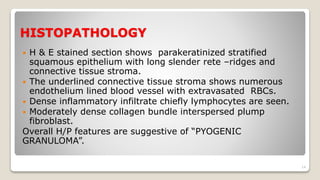
HISTOPATHOLOGY
 H & E stained section shows parakeratinized stratified
squamous epithelium with long slender rete –ridges and
connective tissue stroma.
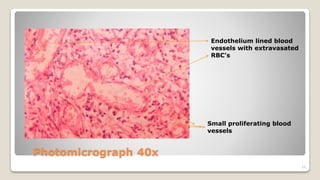
 The underlined connective tissue stroma shows numerous
endothelium lined blood vessel with extravasated RBCs.
 Dense inflammatory infiltrate chiefly lymphocytes are seen.
 Moderately dense collagen bundle interspersed plump
fibroblast.
Overall H/P features are suggestive of “PYOGENIC
GRANULOMA”.
14
Photomicrograph 10x
15
Stratified squamous epithelium with long
slender rete –ridges
Connective tissue stroma
Numerous endothelium lined blood vessel
16
Small proliferating blood
vessels
Endothelium lined blood
vessels with extravasated
RBC’s
Photomicrograph 40x
17
Dense
inflammatory
infiltrate
DIAGNOSIS
 The microscopic feature were consistent with pyogenic
granuloma.
18
MANAGEMENT
 Surgical excision was done.
19
DISCUSSION
20
 Soft tissue enlargements of the oral cavity often present
a diagnostic challenge because a diverse group of
pathologic processes can produce such lesions.
 An enlargement may represent a variation of normal
anatomic structures, inflammation, cysts, developmental
anomalies, and neoplasm.
21
 Pyogenic granuloma is of the most common entities
responsible for causing soft tissue enlargements.
 It is a tumor like growth that is considered an
exaggerated , conditioned response to minor trauma.
 Occurrence of pyogenic granuloma was first described in
1897 by Poncet and Dor. Hominis.
22
 Pyogenic granuloma has been referred to by a variety of
other names such as:
Granuloma pediculatum benignum,
Benign vascular tumor,
Pregnancy tumor,
Vascular epulis,
Crocker and Hartzell's disease.
 It was given its present name by Crocker in 1903
23
INCIDENCE AND PREVALENCE
 According to Cawson et al. oral pyogenic granuloma is
relatively common. Represents 0.5% of all skin nodules in
children.
 Esmeili et al. in their review stated that hyperplastic
reactive lesions represent as a group the most common
oral lesions, excluding caries, periodontal, and periapical
inflammatory disease.
24
Cawson R.A & Odell E.W. Cawson’s essentials of oral pathology & oral medicine, eighth
edition, Chapter 19, Pages 316- 317.
 In an analysis of 244 cases of gingival lesions in South
Indian population, Shamim et al. found that non
neoplastic lesions accounted for 75.5% of cases with oral
pyogenic granuloma being most frequent lesion,
accounting for 52.71% cases.
25
Shamim T, Varghese VI, Shameena PM, Sudha S. A retrospective analysis of gingival biopsied lesions in
south Indian population: 2001-2006. Med Oral Pathol Oral Cir Bucal. 2008;13:414–8.
ETIOPATHOGENESIS
 Some authors regard pyogenic granuloma as an
“infectious” entity.
 Kerr has reported staphylococci and botryomycosis,
foreign bodies, and localization of infection in walls of
blood vessel as contributing factors in the development
of the lesion.
26
Kamal R, Dahiya P, Puri A. Oral pyogenic granuloma: various concepts of etiopathogenesis.
Journal of oral and maxillofacial pathology. 2012 Jan 1;16(1):79
 According to Shafer et al., oral pyogenic granuloma arises
as a result of infection by either staphylococci or
streptococci, partially because it was shown that these
microorganisms could produce colonies with fungus-like
characteristics.
 They also stated that oral pyogenic granuloma arises as a
result of some minor trauma to the tissues provide
a pathway for invasion of nonspecific types of
microorganisms.
27
 They explain the mechanism : any irritant applied to living
tissue may act either as a stimulus or as a destructive
agent or both.
 If many cells are present in a small volume of tissue and
there is a relative reduction of blood flow through the area
as in inflammation, the concentration of the stimulating
substance will be high and growth will be stimulated.
28
Shafer, Hine & Levy. Shafer’s textbook of oral pathology, sixth edition, Chapter 5, Pages 328-330.
 As differentiation and maturation are attained, the cells
become widely separated and the concentration of the
substance falls and little growth occurs.
 In this type of inflammation that results in the formation
of oral pyogenic granuloma, destruction of fixed tissue
cells is slight but stimulus to proliferation of vascular
endothelium persists and exerts its influence over a long
period of time.
29
 Regezi et al. suggest that pyogenic granuloma represents
an exuberant connective tissue proliferation to a known
stimulus or injury like calculus or foreign material within
the gingival crevice.
 Hosseini et al. stated that there are clinical observations
that gingiva may be enlarged during pregnancy and may
atrophy during menopause. On basis of these
observations, gingiva can be regarded as another “target
organ” for direct action of estrogen and progesterone.
30
 Immunosuppressive drugs such as cyclosporine.
 wrong selection of healing cap for implants are some of
the other precipitating factors for pyogenic granulomas.
Bachmeyer C, Devergie A, Mansouri S, Dubertret L, Aractingi S. Pyogenic granuloma of the
tongue in chronic graft versus host disease. Ann Dermatol Venereol. 1996;123:552–4
31
CLINICAL FEATURES
 Arises more frequently on the gingiva –75%of all cases.
 May occur on lips, tongue and buccal mucosa and
occasionally on other areas.
 Maxillary anterior region > posterior with the buccal
surfaces being affected more than the lingual surfaces.
32
 Appears as an elevated, smooth or exophytic, sessile or
pedunculated growth covered with red hemorrhagic and
compressible erythematous papules, which appear
lobulated and warty showing ulcerations and covered by
yellow fibrinous membrane.
 The color varies from red, reddish purple to pink
depending on the vascularity of the growth.
33
 Tendency for hemorrhage either spontaneously or upon
slight trauma.
 The size varies from a few millimeters to several
centimeters and it is usually slow growing,
asymptomatic, painless growth, but at times it grows
rapidly.
34
 The case presented here showed a growth localized
to the lingual surfaces of the lower left posterior
mandibular, reddish in color, the growth was
present since 3 month. It had gradually increased in
size, it had started to bleed intermittently and it also
interfered during mastication, which prompted the
patient to seek treatment.
35
MICROSCOPIC FEATURES
 Microscopically, it consists
of many dilated blood
vessels in a loose
oedematous connective
tissue stroma.
 There is typically a dense
acute inflammatory
infiltrate, but this may be
scanty or absent.
H & E stained section shows
parakeratinized stratified squamous
epithelium with long slender rete –
ridges and connective tissue stroma.
The underlined connective tissue
stroma shows numerous
endothelium lined blood vessel
with extravasated RBCs.
Dense inflammatory infiltrate
chiefly lymphocytes are seen.
Moderately dense collagen bundle
interspersed plump fibroblast
Case presented here
36
DIFFERENTIAL DIAGNOSIS
GINGIVAL REACTIVE
FIBROUS LESION
Focal fibrous hyperplasia
Peripheral giant cell granuloma
Peripheral ossifying fibroma
Post extraction granuloma Hemangioma
Kaposi's sarcoma
37
CONCLUSION
 Pyogenic granulomas are commonly encountered soft tissue
enlargements. However, etiopathogenesis of oral pyogenic
granuloma is still debatable.
 Careful diagnosis is essential to differentiate this lesion from
vascular lesions.
 Meticulous oral hygiene should be instituted.
 Surgical excision of the growth, along with curettage should be
done to prevent recurrences of this common lesion
38
REFRENCES
1. Shafer, Hine & Levy. Shafer’s textbook of oral pathology, sixth edition, Chapter 5, Pages
328-330.
2. Cawson R.A & Odell E.W. Cawson’s essentials of oral pathology & oral medicine, eighth
edition, Chapter 19, Pages 316- 317.
3. Neville B.W, Damm D.D & White D.K. Color atlas of clinical oral pathology, second edition,
Chapter 9, Pages 284-285.
4. Bachmeyer C, Devergie A, Mansouri S, Dubertret L, Aractingi S. Pyogenic granuloma of
the tongue in chronic graft versus host disease. Ann Dermatol Venereol. 1996;123:552–4
5. Kamal R, Dahiya P, Puri A. Oral pyogenic granuloma: various concepts of
etiopathogenesis. Journal of oral and maxillofacial pathology. 2012 Jan 1;16(1):79
6. Gomes SR, Shakir QJ, Thaker PV, Tavadia JK. Pyogenic granuloma of the gingiva: A
misnomer?-A case report and review of literature. Journal of indian society of
periodontology. 2013 Jul 1;17(4):514.
7. Shamim T, Varghese VI, Shameena PM, Sudha S. A retrospective analysis of gingival
biopsied lesions in south Indian population: 2001-2006. Med Oral Pathol Oral Cir
Bucal. 2008;13:414–8.
39

Pyogenic granuloma a case presentation

  • 1.
  • 2.
    INTRODUCTION  Exophytic gingivallesions represent some of the more frequently encountered lesions in the oral cavity.  Some of these lesions are reactive in nature.  PYOGENIC GRANULOMA :It is a tumor like growth that is considered an exaggerated , conditioned response to minor trauma. 2
  • 3.
    CASE HISTORY A 30-year- old lady presented at the Department of Oral Medicine and Radiology of School of Dental Sciences, Greater Noida, with a 3-months history of a painless gingival swelling in the left lower back tooth region which was interfering with her ability to speak and eat normally. 3
  • 4.
    HISTORY OF PRESENTILLNESS • Patient presented with the swelling in the left mandibular posterior tooth region from last 3 months. • Swelling was not associated with any pain. • Swelling was localized & increasing in size with in the time duration of 3 months & associated with 35 & 36. 4
  • 5.
    PAST MEDICAL HISTORY Nosignificant history. 5 PERSONAL HISTORY Appetite: Normal Type of diet: Non-Vegetarian Adverse habits: No adverse Habits OTHER HISTORY No history of any systemic illness.
  • 6.
    EXTRA ORAL EXAMINATION No changes were observed in the extra oral examination. 6
  • 7.
    INTRA ORAL EXAMINATION The intraoral examination revealed a sessile nodule with a smooth surface and a discrete ulcerated area, having fiery red color and measuring approximately 0.7 cm in maximum diameter. 7
  • 8.
    • Size –0.7cm in maximum diameter • Shape – oval • Margins – regular • Colour – whitish reddish • Fluctuant/non fluctuant – non fluctuant • Consistency – firm • Number – 1 • Extent – left posterior teeth region i.e 35,36 • Swelling was not associated with pus discharge 8
  • 9.
  • 10.
  • 11.
    INVESTIGATIONS  Haemogram :- BT :- 1 min 10 sec  CT :- 4 min 30 sec  Hb :- 11 gm% 11
  • 12.
    12 Surgical excision donein PERIODONTAL department
  • 13.
    GROSSING  Single softtissue , firm in consistency , oval in shape , greyish brown in color, measuring around 0.7 × 1.5 cm Received in 10% formalin. 13
  • 14.
    HISTOPATHOLOGY  H &E stained section shows parakeratinized stratified squamous epithelium with long slender rete –ridges and connective tissue stroma.  The underlined connective tissue stroma shows numerous endothelium lined blood vessel with extravasated RBCs.  Dense inflammatory infiltrate chiefly lymphocytes are seen.  Moderately dense collagen bundle interspersed plump fibroblast. Overall H/P features are suggestive of “PYOGENIC GRANULOMA”. 14
  • 15.
    Photomicrograph 10x 15 Stratified squamousepithelium with long slender rete –ridges Connective tissue stroma Numerous endothelium lined blood vessel
  • 16.
    16 Small proliferating blood vessels Endotheliumlined blood vessels with extravasated RBC’s
  • 17.
  • 18.
    DIAGNOSIS  The microscopicfeature were consistent with pyogenic granuloma. 18
  • 19.
  • 20.
  • 21.
     Soft tissueenlargements of the oral cavity often present a diagnostic challenge because a diverse group of pathologic processes can produce such lesions.  An enlargement may represent a variation of normal anatomic structures, inflammation, cysts, developmental anomalies, and neoplasm. 21
  • 22.
     Pyogenic granulomais of the most common entities responsible for causing soft tissue enlargements.  It is a tumor like growth that is considered an exaggerated , conditioned response to minor trauma.  Occurrence of pyogenic granuloma was first described in 1897 by Poncet and Dor. Hominis. 22
  • 23.
     Pyogenic granulomahas been referred to by a variety of other names such as: Granuloma pediculatum benignum, Benign vascular tumor, Pregnancy tumor, Vascular epulis, Crocker and Hartzell's disease.  It was given its present name by Crocker in 1903 23
  • 24.
    INCIDENCE AND PREVALENCE According to Cawson et al. oral pyogenic granuloma is relatively common. Represents 0.5% of all skin nodules in children.  Esmeili et al. in their review stated that hyperplastic reactive lesions represent as a group the most common oral lesions, excluding caries, periodontal, and periapical inflammatory disease. 24 Cawson R.A & Odell E.W. Cawson’s essentials of oral pathology & oral medicine, eighth edition, Chapter 19, Pages 316- 317.
  • 25.
     In ananalysis of 244 cases of gingival lesions in South Indian population, Shamim et al. found that non neoplastic lesions accounted for 75.5% of cases with oral pyogenic granuloma being most frequent lesion, accounting for 52.71% cases. 25 Shamim T, Varghese VI, Shameena PM, Sudha S. A retrospective analysis of gingival biopsied lesions in south Indian population: 2001-2006. Med Oral Pathol Oral Cir Bucal. 2008;13:414–8.
  • 26.
    ETIOPATHOGENESIS  Some authorsregard pyogenic granuloma as an “infectious” entity.  Kerr has reported staphylococci and botryomycosis, foreign bodies, and localization of infection in walls of blood vessel as contributing factors in the development of the lesion. 26 Kamal R, Dahiya P, Puri A. Oral pyogenic granuloma: various concepts of etiopathogenesis. Journal of oral and maxillofacial pathology. 2012 Jan 1;16(1):79
  • 27.
     According toShafer et al., oral pyogenic granuloma arises as a result of infection by either staphylococci or streptococci, partially because it was shown that these microorganisms could produce colonies with fungus-like characteristics.  They also stated that oral pyogenic granuloma arises as a result of some minor trauma to the tissues provide a pathway for invasion of nonspecific types of microorganisms. 27
  • 28.
     They explainthe mechanism : any irritant applied to living tissue may act either as a stimulus or as a destructive agent or both.  If many cells are present in a small volume of tissue and there is a relative reduction of blood flow through the area as in inflammation, the concentration of the stimulating substance will be high and growth will be stimulated. 28 Shafer, Hine & Levy. Shafer’s textbook of oral pathology, sixth edition, Chapter 5, Pages 328-330.
  • 29.
     As differentiationand maturation are attained, the cells become widely separated and the concentration of the substance falls and little growth occurs.  In this type of inflammation that results in the formation of oral pyogenic granuloma, destruction of fixed tissue cells is slight but stimulus to proliferation of vascular endothelium persists and exerts its influence over a long period of time. 29
  • 30.
     Regezi etal. suggest that pyogenic granuloma represents an exuberant connective tissue proliferation to a known stimulus or injury like calculus or foreign material within the gingival crevice.  Hosseini et al. stated that there are clinical observations that gingiva may be enlarged during pregnancy and may atrophy during menopause. On basis of these observations, gingiva can be regarded as another “target organ” for direct action of estrogen and progesterone. 30
  • 31.
     Immunosuppressive drugssuch as cyclosporine.  wrong selection of healing cap for implants are some of the other precipitating factors for pyogenic granulomas. Bachmeyer C, Devergie A, Mansouri S, Dubertret L, Aractingi S. Pyogenic granuloma of the tongue in chronic graft versus host disease. Ann Dermatol Venereol. 1996;123:552–4 31
  • 32.
    CLINICAL FEATURES  Arisesmore frequently on the gingiva –75%of all cases.  May occur on lips, tongue and buccal mucosa and occasionally on other areas.  Maxillary anterior region > posterior with the buccal surfaces being affected more than the lingual surfaces. 32
  • 33.
     Appears asan elevated, smooth or exophytic, sessile or pedunculated growth covered with red hemorrhagic and compressible erythematous papules, which appear lobulated and warty showing ulcerations and covered by yellow fibrinous membrane.  The color varies from red, reddish purple to pink depending on the vascularity of the growth. 33
  • 34.
     Tendency forhemorrhage either spontaneously or upon slight trauma.  The size varies from a few millimeters to several centimeters and it is usually slow growing, asymptomatic, painless growth, but at times it grows rapidly. 34
  • 35.
     The casepresented here showed a growth localized to the lingual surfaces of the lower left posterior mandibular, reddish in color, the growth was present since 3 month. It had gradually increased in size, it had started to bleed intermittently and it also interfered during mastication, which prompted the patient to seek treatment. 35
  • 36.
    MICROSCOPIC FEATURES  Microscopically,it consists of many dilated blood vessels in a loose oedematous connective tissue stroma.  There is typically a dense acute inflammatory infiltrate, but this may be scanty or absent. H & E stained section shows parakeratinized stratified squamous epithelium with long slender rete – ridges and connective tissue stroma. The underlined connective tissue stroma shows numerous endothelium lined blood vessel with extravasated RBCs. Dense inflammatory infiltrate chiefly lymphocytes are seen. Moderately dense collagen bundle interspersed plump fibroblast Case presented here 36
  • 37.
    DIFFERENTIAL DIAGNOSIS GINGIVAL REACTIVE FIBROUSLESION Focal fibrous hyperplasia Peripheral giant cell granuloma Peripheral ossifying fibroma Post extraction granuloma Hemangioma Kaposi's sarcoma 37
  • 38.
    CONCLUSION  Pyogenic granulomasare commonly encountered soft tissue enlargements. However, etiopathogenesis of oral pyogenic granuloma is still debatable.  Careful diagnosis is essential to differentiate this lesion from vascular lesions.  Meticulous oral hygiene should be instituted.  Surgical excision of the growth, along with curettage should be done to prevent recurrences of this common lesion 38
  • 39.
    REFRENCES 1. Shafer, Hine& Levy. Shafer’s textbook of oral pathology, sixth edition, Chapter 5, Pages 328-330. 2. Cawson R.A & Odell E.W. Cawson’s essentials of oral pathology & oral medicine, eighth edition, Chapter 19, Pages 316- 317. 3. Neville B.W, Damm D.D & White D.K. Color atlas of clinical oral pathology, second edition, Chapter 9, Pages 284-285. 4. Bachmeyer C, Devergie A, Mansouri S, Dubertret L, Aractingi S. Pyogenic granuloma of the tongue in chronic graft versus host disease. Ann Dermatol Venereol. 1996;123:552–4 5. Kamal R, Dahiya P, Puri A. Oral pyogenic granuloma: various concepts of etiopathogenesis. Journal of oral and maxillofacial pathology. 2012 Jan 1;16(1):79 6. Gomes SR, Shakir QJ, Thaker PV, Tavadia JK. Pyogenic granuloma of the gingiva: A misnomer?-A case report and review of literature. Journal of indian society of periodontology. 2013 Jul 1;17(4):514. 7. Shamim T, Varghese VI, Shameena PM, Sudha S. A retrospective analysis of gingival biopsied lesions in south Indian population: 2001-2006. Med Oral Pathol Oral Cir Bucal. 2008;13:414–8. 39