P780.02 Spring
2003 L3
Richard KassFeynman Diagrams
Feynman diagrams are pictorial representations of
AMPLTUDES of particle reactions, i.e scatterings or
decays. Use of Feynman diagrams can greatly reduce the
amount of computation involved in calculating a rate or
cross section of a physical process, e.g.
muon decay: µ−
→e-
νeνµ or e+
e-
→ µ+
µ-
scattering.
Like electrical circuit diagrams, every line in the diagram has a strict
mathematical interpretation. Unfortunately the mathematical overhead necessary
to do complete calculations with this technique is large and there is not enough
time in this course to go through all the details. The details of Feynman diagrams
are addressed in Advanced Quantum and/or 880.02. For a taste and summary of
the rules look at Griffiths (e.g. sections 6.3, 6.6, and 7.5) or Relativistic Quantum
Mechanics by Bjorken & Drell.
Feynman and his diagrams
P780.02 Spring
2003 L3
Richard Kass
Feynman Diagrams
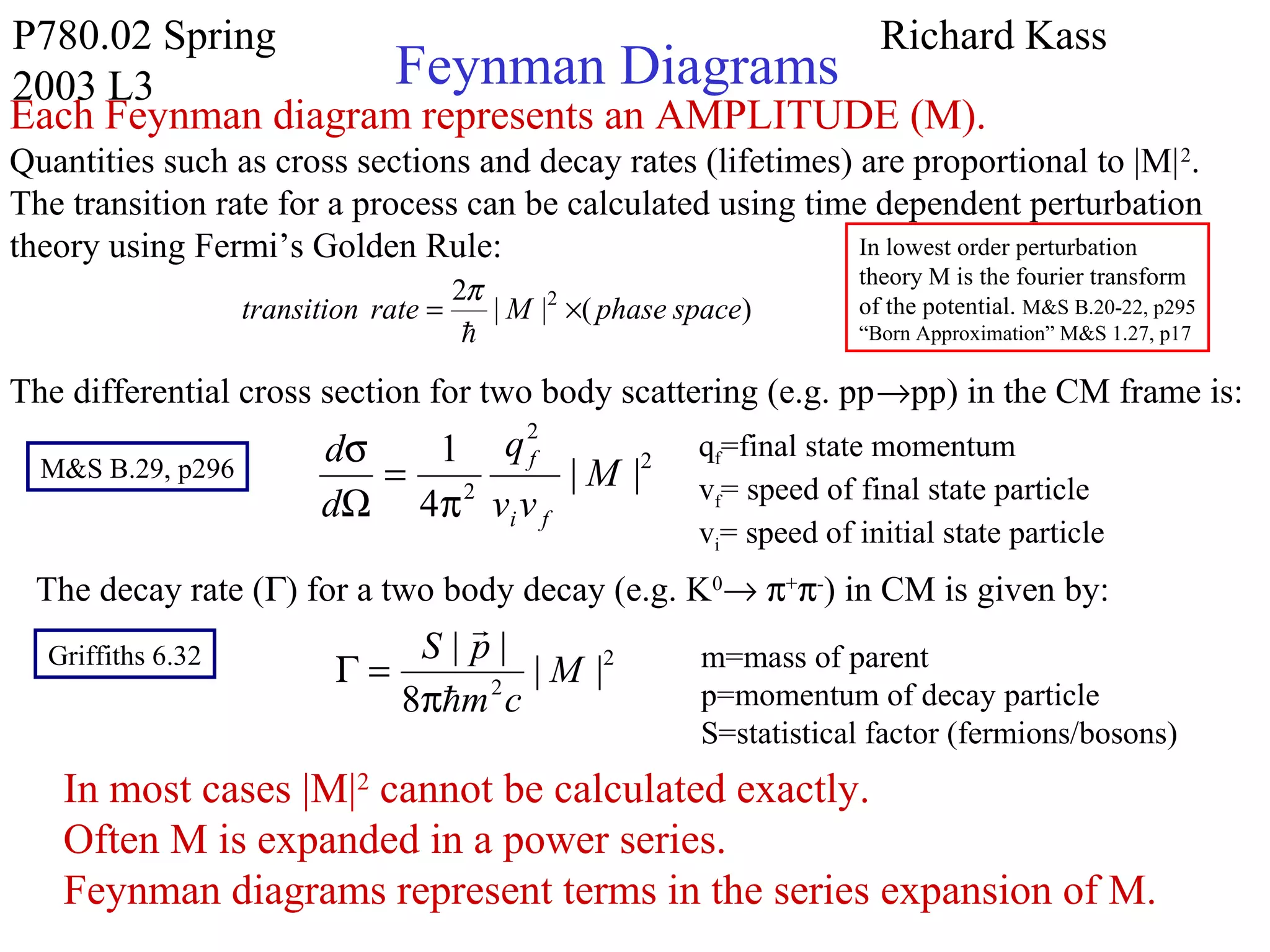
Each Feynman diagram represents an AMPLITUDE (M).
Quantities such as cross sections and decay rates (lifetimes) are proportional to |M|2
.
The transition rate for a process can be calculated using time dependent perturbation
theory using Fermi’s Golden Rule:
qf=final state momentum
vf= speed of final state particle
vi= speed of initial state particle
)(||
2 2
spacephaseMratetransition ×=

π
The differential cross section for two body scattering (e.g. pp→pp) in the CM frame is:
2
2
2
||
4
1
M
vv
q
d
d
fi
f
π
=
Ω
σ
The decay rate (Γ) for a two body decay (e.g. K0
→ π+
π-
) in CM is given by:
M&S B.29, p296
2
2
||
8
||
M
cm
pS


π
=ΓGriffiths 6.32 m=mass of parent
p=momentum of decay particle
S=statistical factor (fermions/bosons)
In most cases |M|2
cannot be calculated exactly.
Often M is expanded in a power series.
Feynman diagrams represent terms in the series expansion of M.
In lowest order perturbation
theory M is the fourier transform
of the potential. M&S B.20-22, p295
“Born Approximation” M&S 1.27, p17
P780.02 Spring
2003 L3
Richard KassFeynman Diagrams
Feynman diagrams plot time vs space:
time
space initial state final state
e-
e-
e-
e-
Moller Scattering e-
e-
→e-
e-
OR
time
space
initial state
final state
M&S
style QED Rules
Solid lines are charged fermions
electrons or positrons (spinor wavefunctions)
Wavy (or dashed) lines are photons
Arrow on solid line signifies e-
or e+
e-
arrow in same direction as time
e+
arrow opposite direction as time
At each vertex there is a coupling constant
√α, α= 1/137=fine structure constant
Quantum numbers are conserved at a vertex
e.g. electric charge, lepton number
“Virtual” Particles do not conserve E, p
virtual particles are internal to diagram(s)
for γ’s: E2
-p2
≠0 (off “mass shell”)
in all calculations we integrate over the virtual
particles 4-momentum (4d integral)
Photons couple to electric charge
no photons only vertices
P780.02 Spring
2003 L3
Richard Kass
Feynman Diagrams
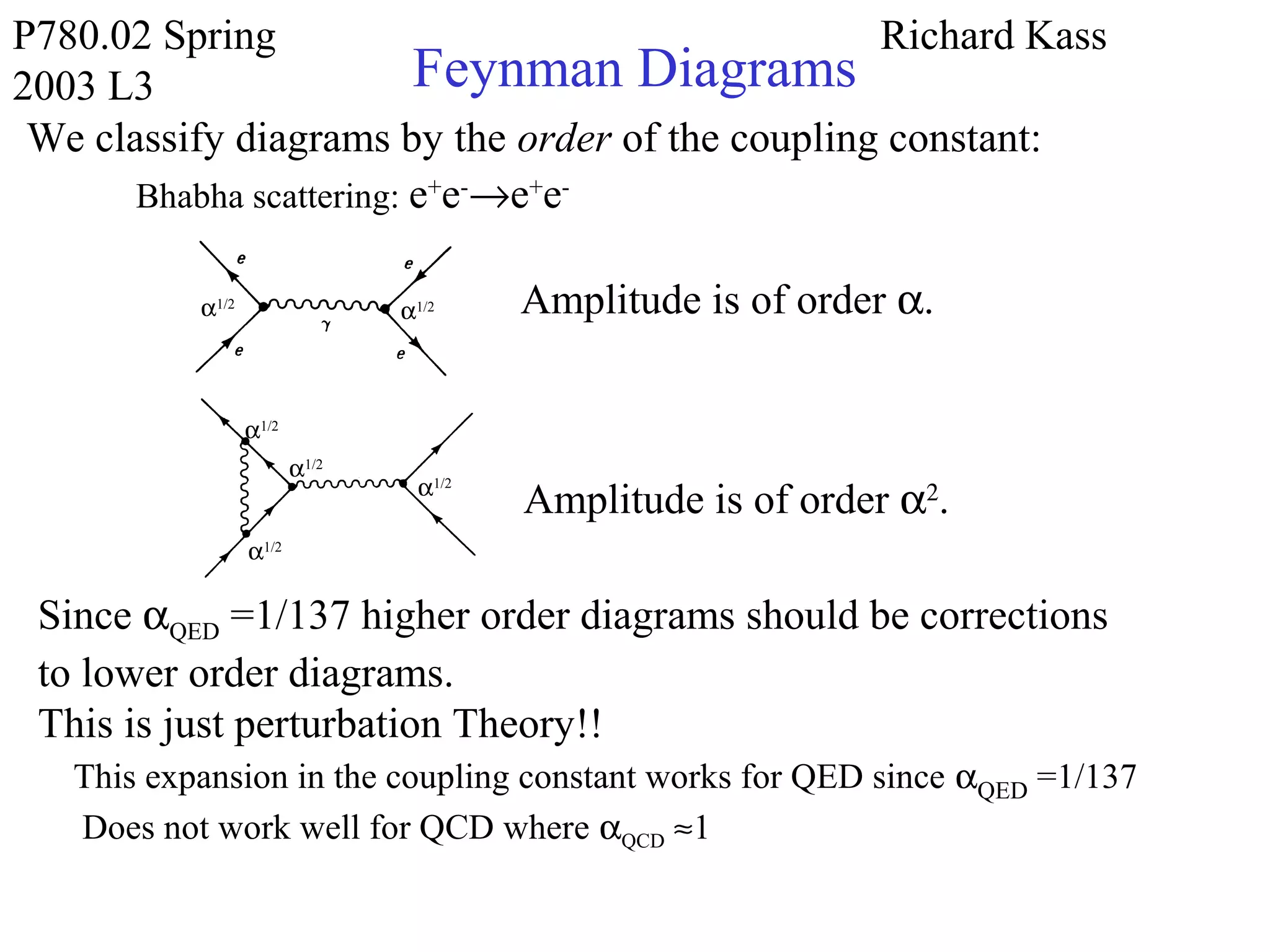
We classify diagrams by the order of the coupling constant:
Bhabha scattering: e+
e-
→e+
e-
Amplitude is of order α.
Amplitude is of order α2
.
Since αQED =1/137 higher order diagrams should be corrections
to lower order diagrams.
This is just perturbation Theory!!
This expansion in the coupling constant works for QED since αQED =1/137
Does not work well for QCD where αQCD ≈1
α1/2
α1/2
α1/2
α1/2
α1/2
α1/2
P780.02 Spring
2003 L3
Richard Kass
Feynman Diagrams
For a given order of the coupling constant there can be many diagrams
Bhabha scattering: e+
e-
→e+
e-
Must add/subtract diagram together to get the total amplitude
total amplitude must reflect the symmetry of the process
e+
e-
→γγ identical bosons in final state, amplitude symmetric under exchange of γ1, γ2.
e+
e-
γ1
γ2 e+
e- γ1
γ2
+
Moller scattering: e-
e-
→e-
e-
identical fermions in initial and final state
amplitude anti-symmetric under exchange of (1,2) and (a,b)
e-
1 e-
a
e-
be-
2
e-
1 e-
b
e-
ae-
2
-
amplitudes can
interfere constructively
or destructively
P780.02 Spring
2003 L3
Richard Kass
Feynman Diagrams
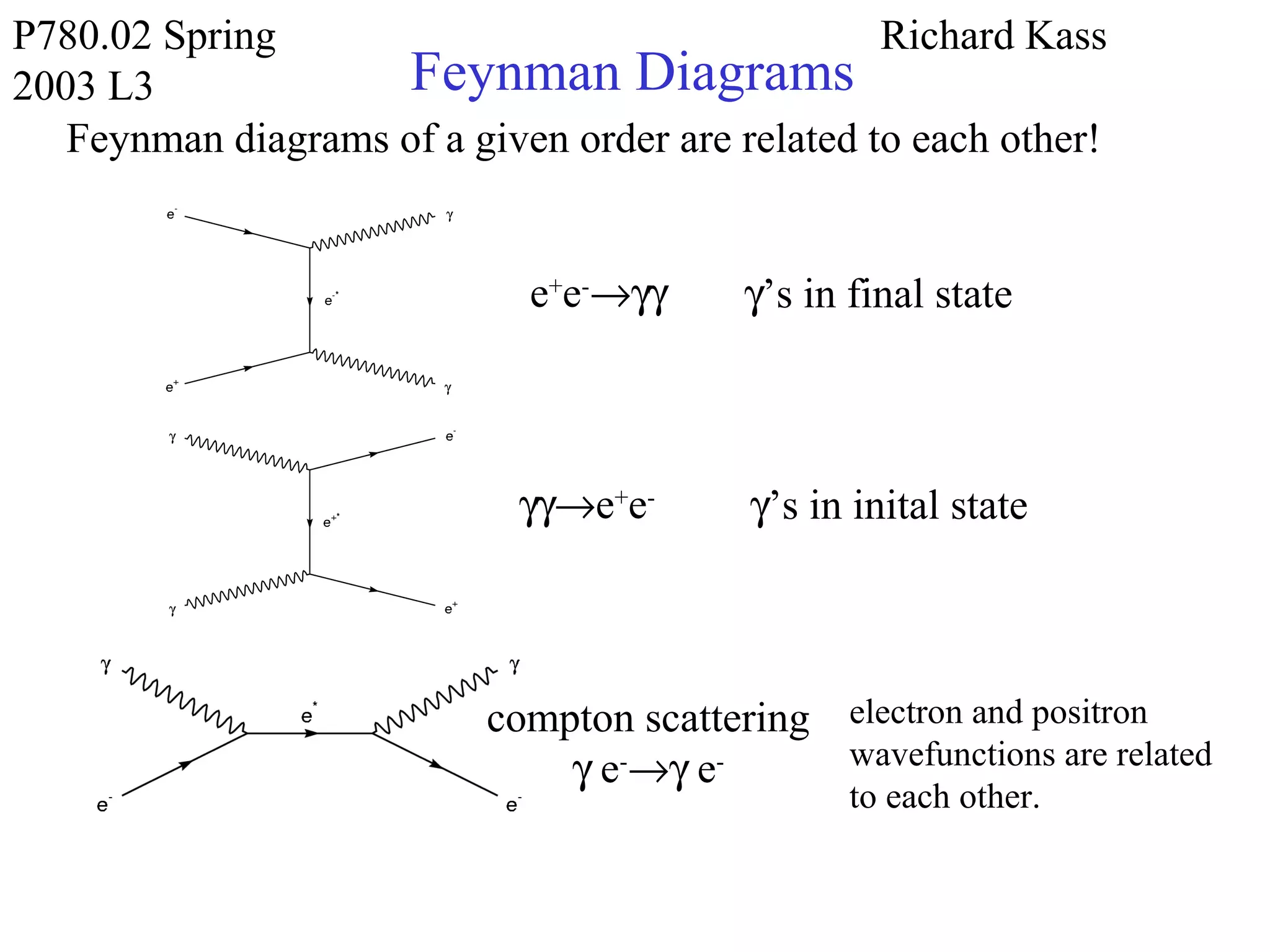
Feynman diagrams of a given order are related to each other!
e+
e-
→γγ
γγ→e+
e-
compton scattering
γ e-
→γ e-
electron and positron
wavefunctions are related
to each other.
γ’s in final state
γ’s in inital state
P780.02 Spring
2003 L3
Richard KassAnomalous Magnetic Moment
The electron's anomalous magnetic moment (ae
) is now known to 4 parts per billion.
Current theoretical limit is due to 4th order corrections (>100 10-dimensional integrals)
The muons's anomalous magnetic moment (aµ
) is known to 1.3 parts per million.
(recent screwup with sign convention on theoretical a calculations caused a stir!)
Calculation of Anomalous Magnetic Moment
of electron is one of the great triumphs of QED.
In Dirac’s theory a point like spin 1/2 object of electric
charge q and mass m has a magnetic moment: µ=qS/m.
In 1948 Schwinger calculated the first-order radiative correction
to the naïve Dirac magnetic moment of the electron.
The radiation and re-absorption of a single virtual photon,
contributes an anomalous magnetic moment of ae
= α/2π ≈ 0.00116.
Dirac MM modified to: µ=g(qS/m) and
deviation from Dirac-ness is: ae
≡ (ge
- 2) / 2
Basic interaction
with B field photon
First order correction
3rd order corrections

feynman

  • 1.
    P780.02 Spring 2003 L3 RichardKassFeynman Diagrams Feynman diagrams are pictorial representations of AMPLTUDES of particle reactions, i.e scatterings or decays. Use of Feynman diagrams can greatly reduce the amount of computation involved in calculating a rate or cross section of a physical process, e.g. muon decay: µ− →e- νeνµ or e+ e- → µ+ µ- scattering. Like electrical circuit diagrams, every line in the diagram has a strict mathematical interpretation. Unfortunately the mathematical overhead necessary to do complete calculations with this technique is large and there is not enough time in this course to go through all the details. The details of Feynman diagrams are addressed in Advanced Quantum and/or 880.02. For a taste and summary of the rules look at Griffiths (e.g. sections 6.3, 6.6, and 7.5) or Relativistic Quantum Mechanics by Bjorken & Drell. Feynman and his diagrams
  • 2.
    P780.02 Spring 2003 L3 RichardKass Feynman Diagrams Each Feynman diagram represents an AMPLITUDE (M). Quantities such as cross sections and decay rates (lifetimes) are proportional to |M|2 . The transition rate for a process can be calculated using time dependent perturbation theory using Fermi’s Golden Rule: qf=final state momentum vf= speed of final state particle vi= speed of initial state particle )(|| 2 2 spacephaseMratetransition ×=  π The differential cross section for two body scattering (e.g. pp→pp) in the CM frame is: 2 2 2 || 4 1 M vv q d d fi f π = Ω σ The decay rate (Γ) for a two body decay (e.g. K0 → π+ π- ) in CM is given by: M&S B.29, p296 2 2 || 8 || M cm pS   π =ΓGriffiths 6.32 m=mass of parent p=momentum of decay particle S=statistical factor (fermions/bosons) In most cases |M|2 cannot be calculated exactly. Often M is expanded in a power series. Feynman diagrams represent terms in the series expansion of M. In lowest order perturbation theory M is the fourier transform of the potential. M&S B.20-22, p295 “Born Approximation” M&S 1.27, p17
  • 3.
    P780.02 Spring 2003 L3 RichardKassFeynman Diagrams Feynman diagrams plot time vs space: time space initial state final state e- e- e- e- Moller Scattering e- e- →e- e- OR time space initial state final state M&S style QED Rules Solid lines are charged fermions electrons or positrons (spinor wavefunctions) Wavy (or dashed) lines are photons Arrow on solid line signifies e- or e+ e- arrow in same direction as time e+ arrow opposite direction as time At each vertex there is a coupling constant √α, α= 1/137=fine structure constant Quantum numbers are conserved at a vertex e.g. electric charge, lepton number “Virtual” Particles do not conserve E, p virtual particles are internal to diagram(s) for γ’s: E2 -p2 ≠0 (off “mass shell”) in all calculations we integrate over the virtual particles 4-momentum (4d integral) Photons couple to electric charge no photons only vertices
  • 4.
    P780.02 Spring 2003 L3 RichardKass Feynman Diagrams We classify diagrams by the order of the coupling constant: Bhabha scattering: e+ e- →e+ e- Amplitude is of order α. Amplitude is of order α2 . Since αQED =1/137 higher order diagrams should be corrections to lower order diagrams. This is just perturbation Theory!! This expansion in the coupling constant works for QED since αQED =1/137 Does not work well for QCD where αQCD ≈1 α1/2 α1/2 α1/2 α1/2 α1/2 α1/2
  • 5.
    P780.02 Spring 2003 L3 RichardKass Feynman Diagrams For a given order of the coupling constant there can be many diagrams Bhabha scattering: e+ e- →e+ e- Must add/subtract diagram together to get the total amplitude total amplitude must reflect the symmetry of the process e+ e- →γγ identical bosons in final state, amplitude symmetric under exchange of γ1, γ2. e+ e- γ1 γ2 e+ e- γ1 γ2 + Moller scattering: e- e- →e- e- identical fermions in initial and final state amplitude anti-symmetric under exchange of (1,2) and (a,b) e- 1 e- a e- be- 2 e- 1 e- b e- ae- 2 - amplitudes can interfere constructively or destructively
  • 6.
    P780.02 Spring 2003 L3 RichardKass Feynman Diagrams Feynman diagrams of a given order are related to each other! e+ e- →γγ γγ→e+ e- compton scattering γ e- →γ e- electron and positron wavefunctions are related to each other. γ’s in final state γ’s in inital state
  • 7.
    P780.02 Spring 2003 L3 RichardKassAnomalous Magnetic Moment The electron's anomalous magnetic moment (ae ) is now known to 4 parts per billion. Current theoretical limit is due to 4th order corrections (>100 10-dimensional integrals) The muons's anomalous magnetic moment (aµ ) is known to 1.3 parts per million. (recent screwup with sign convention on theoretical a calculations caused a stir!) Calculation of Anomalous Magnetic Moment of electron is one of the great triumphs of QED. In Dirac’s theory a point like spin 1/2 object of electric charge q and mass m has a magnetic moment: µ=qS/m. In 1948 Schwinger calculated the first-order radiative correction to the naïve Dirac magnetic moment of the electron. The radiation and re-absorption of a single virtual photon, contributes an anomalous magnetic moment of ae = α/2π ≈ 0.00116. Dirac MM modified to: µ=g(qS/m) and deviation from Dirac-ness is: ae ≡ (ge - 2) / 2 Basic interaction with B field photon First order correction 3rd order corrections