JOURNAL OF SCIENCE OF HNUE
Mathematical and Physical Sci., 2013, Vol. 58, No. 7, pp. 138-146
This paper is available online at http://stdb.hnue.edu.vn
PHASE TRANSITION AND THE CASIMIR EFFECT IN A COMPLEX SCALAR
FIELD WITH ONE COMPACTIFIED SPATIAL DIMENSION
Tran Huu Phat1
and Nguyen Thi Tham2
1
Vietnam Atomic Energy Institute,
2
Faculty of Physics, Hanoi University of Education No. 2, Xuan Hoa, Vinh Phuc
Abstract. Phase transition and the Casimir effect are studied in the complex scalar
field with one spatial dimension to be compactified. It is shown that the phase
transition is of the second order and the Casimir effect behaves quite differently
depending on whether it’s under periodic or anti-periodic boundary conditions.
Keywords: Phase transition, Casimir effect, complex scalar field, compactified
spatial.
1. Introduction
It is well known that a characteristic of quantum field theory in space-time with
nontrivial topology is the existence of non-equivalent types of fields with the same spin
[1, 2, 3]. For a scalar system in space-time which is locally flat but with topolog, that is
a Minkowskian space with one of the spatial dimensions compactified in a circle of finite
radius L, the non-trivial topology is transferred into periodic (sign +) and anti-periodic
(sign -) boundary conditions:
φ(t, x, y, z) = ±φ(t, x, y, z + L) (1.1)
The seminal discovery in this direction is the so-called Casimir effect [4, 5], where the
Casimir force generated by the electromagnetic field that exists in the area between two
parallel planar plates was found to be
F = −
π2
cS
240L4
,
here S is the area of the parallel plates and L is the distance between two plates fulfilling
the condition L2
≪ S. The Casimir effect was first written about in 1948 [4], but since the
Received June 30, 2013. Accepted August 27, 2013.
Contact Nguyen Thi Tham, e-mail address: nguyenthamhn@gmail.com
138
Phase transition and the casimir effect in a complex scalar field...
1970s this effect has received increasing attention of scientists. Newer and more precise
experiments demonstrating the Casimir force have been performed and more are under
way. Recently, the Casimir effect has become a hot topic in various domains of science
and technology, ranging from cosmology to nanophysics [5, 6, 7]. Calculations of the
Casimir effect do not exist below zero degrees. It has been seen that the strength of the
Casimir force decreases as the distance between two plates increases. At this time it is
not possible to predict the repulsive or attractive force for different objects and there is
no indication that the Casimir force is dependent on distance at finite temperatures. The
Lagrangian we consider is of the form
L = ∂µφ∗
∂φ − U, U = m2
φ∗
φ +
λ
2
(φ∗
φ)2
. (1.2)
in which φ is a complex scalar field and m and λ are coupling constants. In the present
article, we calculate the effective potential in a complex scalar field and, based on this, the
phase transition in compactified space-time is derived. We then study the Casimir effect
at a finite temperature and calculate Casimir energies and Casimir forces that correspond
to both boundary conditions (periodic and anti-periodic).
2. Content
2.1. Effective potential and phase transition
The space is compactified along the oz axis with length L. Then the Euclidian
Action is defined as
SE = i
L∫
0
dz
∫
LEdτdx⊥, dx⊥ = dxdy, (2.1)
where LE is the Euclidian form of the Lagrangian (1.2) and t = iτ. Assume that when
λ > 0 and m2
< 0, the field operator φ develops vacuum expectation value
⟨φ⟩ = ⟨φ∗
⟩ = u,
then the U(1) symmetry of the complex scalar field given in (1.2) is spontaneously broken.
In the tree approximation u corresponds to the minimum of U,
(
∂U
∂φ
)
φ=φ∗=0
= 0,
yielding u =
√
−
m2
λ
. At minimum the potential energy U reads U = m2
u2
+
λ
2
u4
. Let
us next decompose φ and φ∗
φ =
1
√
2
(u + φ1 + iφ2) , φ∗
=
1
√
2
(u + φ1 − iφ2) . (2.2)
Inserting (2.2) into (1.2) we get the matrix D representing the interaction betweenφ1, φ2
139
Tran Huu Phat and Nguyen Thi Tham
iD−1
= ∥Aik∥ , A11 = ω2
+ ⃗k2
+ 2λu2
, A22 = ω2
+ ⃗k2
, A12 = A21 = 0.
The partition function is established as
Z =
∫
Dφ∗
Dφ exp [−SE]
In a one-loop approximation we have that
Z = e−V LU
∫
Dφ1Dφ2 exp
[
−
∫
dxϕ+
iD−1
ϕ
]
where ϕ+
= (φ1, φ2) The effective potential is defined as
Ω = −
ln Z
V L
= Ωs + U, (2.3)
in which
ΩS =
T
2L
∞∑
m=−∞
∞∑
n=−∞
∫
dk⊥
(2π)2
{
ln
[
ω2
m + E2
1n
]
+ ln
[
ω2
m + E2
2n
]}
. (2.4)
with
E1n =
√
k2
⊥ + k2
3n + M2, E2n =
√
k2
⊥ + k2
3n, M2
= 2λu2
(2.5)
and
k3n = (2n + 1)
π
L
, n = 0, ±1, ±2, .... (2.6)
for anti-periodic boundary conditions, and
k3n = 2n
π
L
, n = ±1, ±2, ... (2.7)
for periodic boundary conditions. Note that En in (2.5) is exactly the gapless spectrum of
the Goldston boson in the broken phase and there is a similarity between L appearing in
(2.6) and (2.7) with T in the Matsubara formula β = 1/T, and therefore it is convenient
to impose a = 1/L for later use. Parameter a has the dimension of energy. Making use of
the formula:
T
∞∑
n=−∞
ln
(
ω2
+ E2
)
= E + T ln
(
1 − e−E/T
)
,
and taking into account (2.5), (2.6) and (2.7), we arrive at the expression for ΩS
ΩS = −a
∞∑
n=−∞
∫
dk⊥
(2π)2
{
E1n + E2n + T ln
[
1 − e−βE1n
]
+ T ln
[
1 − e−βE2n
]}
.
(2.8)
140
Phase transition and the casimir effect in a complex scalar field...
The two first terms under the integral in (2.8) are exactly the energy of an
electromagnetic vacuum restricted between two plates which gives rise to the Casimir
energy. Next let us study the phase transition of the complex scalar field without the
Casimir effect at various values of a. The effective potential (2.3) is rewritten in the form
Ω = ΩS(T) − ΩS(T = 0) + U
= −aT
∞∑
n=−∞
∫
dk⊥
(2π)2
{
T ln
(
1 − e−βE1n
)
+ T ln
(
1 − e−βE2n
)}
+ U (2.9)
From (2.9) we derive the gap equation
∂Ω
∂u
= 0, or
m2
+ λu2
+
aλ
π
n∑
n=−∞
∞∫
0
dk
k
√
k2 + k2
3n + 2λu2
1
eβEn − 1
= 0. (2.10)
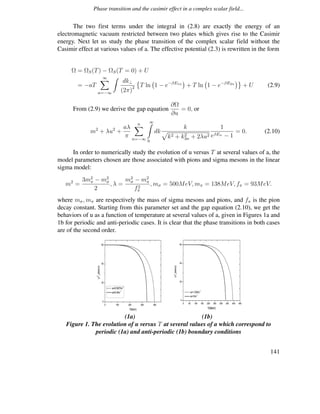
In order to numerically study the evolution of u versus T at several values of a, the
model parameters chosen are those associated with pions and sigma mesons in the linear
sigma model:
m2
=
3m2
π − m2
σ
2
, λ =
m2
σ − m2
π
f2
π
, mσ = 500MeV, mπ = 138MeV, fπ = 93MeV.
where mσ, mπ are respectively the mass of sigma mesons and pions, and fπ is the pion
decay constant. Starting from this parameter set and the gap equation (2.10), we get the
behaviors of u as a function of temperature at several values of a, given in Figures 1a and
1b for periodic and anti-periodic cases. It is clear that the phase transitions in both cases
are of the second order.
(1a) (1b)
Figure 1. The evolution of u versus T at several values of a which correspond to
periodic (1a) and anti-periodic (1b) boundary conditions
141
Tran Huu Phat and Nguyen Thi Tham
2.2. Casimir effect
Let us mention that the vacuum energy caused by the electromagnetic field
restricted between two parallel planar plates is of the form
E(a) = −a
∫
dk⊥
(2π)2
∞∑
n=−∞
EnS, (2.11)
in which S is the area of planar plate, . It is evident that E(a) diverges. So we try to
renormalize it by introducing a rapid damping factor
ER (a) = −a
∫
dk⊥
(2π)3
∞∑
n=−∞
Ene−δEn
S, (2.12)
and the Casimir energy then reads
EC (a) = lim
δ→0
ER(a). (2.13)
Applying the Abel-Plana formula [8, 9]
∞∑
n=0
F(n) −
∞∫
0
F(t)dt =
1
2
F(0) + i
∞∫
0
dt
F(it) − F(−it)
e2πt − 1
,
for periodic conditions and
∞∑
n=0
F(n +
1
2
) − 2
∞∫
0
F(t)dt = i
∞∫
0
dt
∑
λ=±1
F (it) − F (−it)
e2π(t+i λ
2 ) − 1
.
for anti-periodic conditions to the calculation of (2.12) and (2.13), we derive the
expressions for the Casimir energy
EP
C (a) =
16π2
L3
∞∫
0
ydy
∞∫
b
dt
√
t2 − b2
e2πt − 1
,
2.14a
which correspond to periodic conditions and
EA
C (a) = −
16π2
L3
∞∫
0
ydy
∞∫
b
dt
√
t2 − b2
e2πt + 1
. (2.14)
which correspond to anti-periodic conditions. The parameters appearing in 2.14a and 2.14
are defined as
y = L
|k⊥|
2π
, b2
= y2
+ M2
∗ , M2
∗ = L2 M2
(2π)2
.
142
Phase transition and the casimir effect in a complex scalar field...
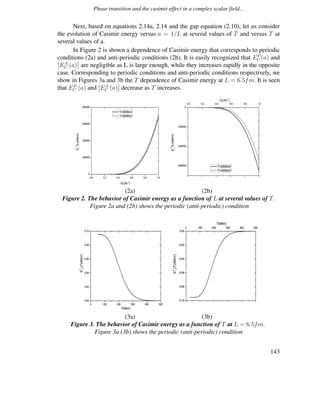
Next, based on equations 2.14a, 2.14 and the gap equation (2.10), let us consider
the evolution of Casimir energy versus a = 1/L at several values of T and versus T at
several values of a.
In Figure 2 is shown a dependence of Casimir energy that corresponds to periodic
conditions (2a) and anti-periodic conditions (2b). It is easily recognized that EP
C (a) and
EA
C (a) are negligible as L is large enough, while they increases rapidly in the opposite
case. Corresponding to periodic conditions and anti-periodic conditions respectively, we
show in Figures 3a and 3b the T dependence of Casimir energy at L = 6.5fm. It is seen
that EP
C (a) and EA
C (a) decrease as T increases.
(2a) (2b)
Figure 2. The behavior of Casimir energy as a function of L at several values of T.
Figure 2a and (2b) shows the periodic (anti-periodic) condition
(3a) (3b)
Figure 3. The behavior of Casimir energy as a function of T at L = 6.5fm.
Figure 3a (3b) shows the periodic (anti-periodic) condition
143
Tran Huu Phat and Nguyen Thi Tham
Finally, the Casimir forces FP
C (L) and FA
C (L) acting on two parallel plates are
concerned for both cases of periodic and anti-periodic conditions. They are determined
by
FP,A
C (L) = −
∂EP,A
C (L)
∂L
, (2.15)
Inserting 2.14 into 2.15 we find immediately that
FP
C (L) =
8λu2
L2
∞∫
0
ydy
∞∫
b
dt
(e2πt − 1)
√
t2 − b2
+
4
3L
EP
C (L),
(2.16)
FA
C (L) = −
8λu2
L2
∞∫
0
ydy
∞∫
b
dt
(e2πt + 1)
√
t2 − b2
+
4
3L
EA
C (L) .
Combining equations 2.14a, 2.14 and 2.16 together leads to the graphs representing
the L dependence of Casimir forces at T = 200MeV depicted in Figure 4 and the graphs
representing the T dependence of Casimir forces at L = 6.5 fm plotted in Figure 5.
Figures 4 and 5 indicate that
- The Casimir force is repulsive for periodic boundary conditions and becomes
attractive when boundary conditions are anti-periodic.
- The strength of the Casimir force decreases quickly as the distance L between the
two plates increases.
- Casimir forces depend considerably on temperature T for T < 300MeV.
(4a) (4b)
Figure 4. The evolution of Casimir forces versus L at T = 200MeV
144
Phase transition and the casimir effect in a complex scalar field...
(5a) (5b)
Figure 5. The evolution of Casimir forces versus T at L = 6.5fm
3. Conclusion
In the preceding sections we systematically studied the phase transition and Casimir
effect in a complex scalar field embedded in compactified space-time. We obtained the
following results:
i) The U(1) restoration phase transition at high temperature is of the second order
for both boundary conditions and the critical temperature depends on L.
ii) Based on the calculated Casimir energies and Casimir forces for periodic and
anti-periodic boundary conditions, we investigated numerically their T dependences at
several values of L, plotted in Figures 3 and 5, and their L dependences at several values
of T, plotted in Figures 2 and 4.
iii) The physical content of periodic and anti-periodic boundary conditions is
cleared up in Figure 4 which shows that the Casimir force is repulsive for periodic
conditions while it is attractive when boundary conditions are anti-periodic. Evidently
this statement is very interesting for those working in nanophysics and nanotechnology.
The revelation that the critical temperature depends on the compactified length L
reveals a new direction for the investigation of high temperature superconductors and
Bose-Einstein condensations in space with (2D + ε) dimensions.
Acknowledgments. This paper is financially supported by the Vietnam National
Foundation for Science and Technology Development (NAFOSTED) under Grant No.
103.01-2011.05.
145
Tran Huu Phat and Nguyen Thi Tham
REFERENCES
[1] L. H. Ford, 1980. Vacuum polarization in a nonsimply connected spacetime.
Phys.Rev. D21, pp. 933-948.
[2] L. H. Ford, 1980. Instabilities in interacting quantum field theories in
non-Minkowskian spacetimes. Phys. Rev. D22, pp. 3003-3011.
[3] Modern Kaluza - Klein Theories, 1987. Edited by T. Appelquits, A. Chodos and
P.T.Freud (Addison - Wesley, Reading, MA, USA).
[4] H. B. G.Casimir, 1948. On the attraction between two perfectly conducting plates.
Proc. K. Ned. Akad. Wet. 51, p. 793.
[5] M. Bordag, V.Mohideen and V.M.Mostepanenk, 2001. New developments in the
Casimir effect. Phys. Rep. 353, 1, 1205.
[6] J. H. Schwarz. Update of String Theory. Astro-ph/0304507.
[7] N. Arkani-Hamed, S.Dimopoulos, and Dvali, 1998. The Hierarchy problem and new
dimensions at a millimeter. Phys.Lett. B429, p. 263.
[8] E. Elizalde, S. Nojiri and S. D. Odintsov, 2004. Late-time cosmology in a (phantom)
scalar-tensor theory: Dark energy and the cosmic speed-up. Phys.Rev. D70, 043539.
[9] E. Elizalde, 2006. Uses of zeta regularization in QFT with boundary conditions: a
cosmo-topological Casimir effect. J.Phys. A39, 6299.
146

Phase transition and casimir effect

  • 1.
    JOURNAL OF SCIENCEOF HNUE Mathematical and Physical Sci., 2013, Vol. 58, No. 7, pp. 138-146 This paper is available online at http://stdb.hnue.edu.vn PHASE TRANSITION AND THE CASIMIR EFFECT IN A COMPLEX SCALAR FIELD WITH ONE COMPACTIFIED SPATIAL DIMENSION Tran Huu Phat1 and Nguyen Thi Tham2 1 Vietnam Atomic Energy Institute, 2 Faculty of Physics, Hanoi University of Education No. 2, Xuan Hoa, Vinh Phuc Abstract. Phase transition and the Casimir effect are studied in the complex scalar field with one spatial dimension to be compactified. It is shown that the phase transition is of the second order and the Casimir effect behaves quite differently depending on whether it’s under periodic or anti-periodic boundary conditions. Keywords: Phase transition, Casimir effect, complex scalar field, compactified spatial. 1. Introduction It is well known that a characteristic of quantum field theory in space-time with nontrivial topology is the existence of non-equivalent types of fields with the same spin [1, 2, 3]. For a scalar system in space-time which is locally flat but with topolog, that is a Minkowskian space with one of the spatial dimensions compactified in a circle of finite radius L, the non-trivial topology is transferred into periodic (sign +) and anti-periodic (sign -) boundary conditions: φ(t, x, y, z) = ±φ(t, x, y, z + L) (1.1) The seminal discovery in this direction is the so-called Casimir effect [4, 5], where the Casimir force generated by the electromagnetic field that exists in the area between two parallel planar plates was found to be F = − π2 cS 240L4 , here S is the area of the parallel plates and L is the distance between two plates fulfilling the condition L2 ≪ S. The Casimir effect was first written about in 1948 [4], but since the Received June 30, 2013. Accepted August 27, 2013. Contact Nguyen Thi Tham, e-mail address: nguyenthamhn@gmail.com 138
  • 2.
    Phase transition andthe casimir effect in a complex scalar field... 1970s this effect has received increasing attention of scientists. Newer and more precise experiments demonstrating the Casimir force have been performed and more are under way. Recently, the Casimir effect has become a hot topic in various domains of science and technology, ranging from cosmology to nanophysics [5, 6, 7]. Calculations of the Casimir effect do not exist below zero degrees. It has been seen that the strength of the Casimir force decreases as the distance between two plates increases. At this time it is not possible to predict the repulsive or attractive force for different objects and there is no indication that the Casimir force is dependent on distance at finite temperatures. The Lagrangian we consider is of the form L = ∂µφ∗ ∂φ − U, U = m2 φ∗ φ + λ 2 (φ∗ φ)2 . (1.2) in which φ is a complex scalar field and m and λ are coupling constants. In the present article, we calculate the effective potential in a complex scalar field and, based on this, the phase transition in compactified space-time is derived. We then study the Casimir effect at a finite temperature and calculate Casimir energies and Casimir forces that correspond to both boundary conditions (periodic and anti-periodic). 2. Content 2.1. Effective potential and phase transition The space is compactified along the oz axis with length L. Then the Euclidian Action is defined as SE = i L∫ 0 dz ∫ LEdτdx⊥, dx⊥ = dxdy, (2.1) where LE is the Euclidian form of the Lagrangian (1.2) and t = iτ. Assume that when λ > 0 and m2 < 0, the field operator φ develops vacuum expectation value ⟨φ⟩ = ⟨φ∗ ⟩ = u, then the U(1) symmetry of the complex scalar field given in (1.2) is spontaneously broken. In the tree approximation u corresponds to the minimum of U, ( ∂U ∂φ ) φ=φ∗=0 = 0, yielding u = √ − m2 λ . At minimum the potential energy U reads U = m2 u2 + λ 2 u4 . Let us next decompose φ and φ∗ φ = 1 √ 2 (u + φ1 + iφ2) , φ∗ = 1 √ 2 (u + φ1 − iφ2) . (2.2) Inserting (2.2) into (1.2) we get the matrix D representing the interaction betweenφ1, φ2 139
  • 3.
    Tran Huu Phatand Nguyen Thi Tham iD−1 = ∥Aik∥ , A11 = ω2 + ⃗k2 + 2λu2 , A22 = ω2 + ⃗k2 , A12 = A21 = 0. The partition function is established as Z = ∫ Dφ∗ Dφ exp [−SE] In a one-loop approximation we have that Z = e−V LU ∫ Dφ1Dφ2 exp [ − ∫ dxϕ+ iD−1 ϕ ] where ϕ+ = (φ1, φ2) The effective potential is defined as Ω = − ln Z V L = Ωs + U, (2.3) in which ΩS = T 2L ∞∑ m=−∞ ∞∑ n=−∞ ∫ dk⊥ (2π)2 { ln [ ω2 m + E2 1n ] + ln [ ω2 m + E2 2n ]} . (2.4) with E1n = √ k2 ⊥ + k2 3n + M2, E2n = √ k2 ⊥ + k2 3n, M2 = 2λu2 (2.5) and k3n = (2n + 1) π L , n = 0, ±1, ±2, .... (2.6) for anti-periodic boundary conditions, and k3n = 2n π L , n = ±1, ±2, ... (2.7) for periodic boundary conditions. Note that En in (2.5) is exactly the gapless spectrum of the Goldston boson in the broken phase and there is a similarity between L appearing in (2.6) and (2.7) with T in the Matsubara formula β = 1/T, and therefore it is convenient to impose a = 1/L for later use. Parameter a has the dimension of energy. Making use of the formula: T ∞∑ n=−∞ ln ( ω2 + E2 ) = E + T ln ( 1 − e−E/T ) , and taking into account (2.5), (2.6) and (2.7), we arrive at the expression for ΩS ΩS = −a ∞∑ n=−∞ ∫ dk⊥ (2π)2 { E1n + E2n + T ln [ 1 − e−βE1n ] + T ln [ 1 − e−βE2n ]} . (2.8) 140
  • 4.
    Phase transition andthe casimir effect in a complex scalar field... The two first terms under the integral in (2.8) are exactly the energy of an electromagnetic vacuum restricted between two plates which gives rise to the Casimir energy. Next let us study the phase transition of the complex scalar field without the Casimir effect at various values of a. The effective potential (2.3) is rewritten in the form Ω = ΩS(T) − ΩS(T = 0) + U = −aT ∞∑ n=−∞ ∫ dk⊥ (2π)2 { T ln ( 1 − e−βE1n ) + T ln ( 1 − e−βE2n )} + U (2.9) From (2.9) we derive the gap equation ∂Ω ∂u = 0, or m2 + λu2 + aλ π n∑ n=−∞ ∞∫ 0 dk k √ k2 + k2 3n + 2λu2 1 eβEn − 1 = 0. (2.10) In order to numerically study the evolution of u versus T at several values of a, the model parameters chosen are those associated with pions and sigma mesons in the linear sigma model: m2 = 3m2 π − m2 σ 2 , λ = m2 σ − m2 π f2 π , mσ = 500MeV, mπ = 138MeV, fπ = 93MeV. where mσ, mπ are respectively the mass of sigma mesons and pions, and fπ is the pion decay constant. Starting from this parameter set and the gap equation (2.10), we get the behaviors of u as a function of temperature at several values of a, given in Figures 1a and 1b for periodic and anti-periodic cases. It is clear that the phase transitions in both cases are of the second order. (1a) (1b) Figure 1. The evolution of u versus T at several values of a which correspond to periodic (1a) and anti-periodic (1b) boundary conditions 141
  • 5.
    Tran Huu Phatand Nguyen Thi Tham 2.2. Casimir effect Let us mention that the vacuum energy caused by the electromagnetic field restricted between two parallel planar plates is of the form E(a) = −a ∫ dk⊥ (2π)2 ∞∑ n=−∞ EnS, (2.11) in which S is the area of planar plate, . It is evident that E(a) diverges. So we try to renormalize it by introducing a rapid damping factor ER (a) = −a ∫ dk⊥ (2π)3 ∞∑ n=−∞ Ene−δEn S, (2.12) and the Casimir energy then reads EC (a) = lim δ→0 ER(a). (2.13) Applying the Abel-Plana formula [8, 9] ∞∑ n=0 F(n) − ∞∫ 0 F(t)dt = 1 2 F(0) + i ∞∫ 0 dt F(it) − F(−it) e2πt − 1 , for periodic conditions and ∞∑ n=0 F(n + 1 2 ) − 2 ∞∫ 0 F(t)dt = i ∞∫ 0 dt ∑ λ=±1 F (it) − F (−it) e2π(t+i λ 2 ) − 1 . for anti-periodic conditions to the calculation of (2.12) and (2.13), we derive the expressions for the Casimir energy EP C (a) = 16π2 L3 ∞∫ 0 ydy ∞∫ b dt √ t2 − b2 e2πt − 1 , 2.14a which correspond to periodic conditions and EA C (a) = − 16π2 L3 ∞∫ 0 ydy ∞∫ b dt √ t2 − b2 e2πt + 1 . (2.14) which correspond to anti-periodic conditions. The parameters appearing in 2.14a and 2.14 are defined as y = L |k⊥| 2π , b2 = y2 + M2 ∗ , M2 ∗ = L2 M2 (2π)2 . 142
  • 6.
    Phase transition andthe casimir effect in a complex scalar field... Next, based on equations 2.14a, 2.14 and the gap equation (2.10), let us consider the evolution of Casimir energy versus a = 1/L at several values of T and versus T at several values of a. In Figure 2 is shown a dependence of Casimir energy that corresponds to periodic conditions (2a) and anti-periodic conditions (2b). It is easily recognized that EP C (a) and EA C (a) are negligible as L is large enough, while they increases rapidly in the opposite case. Corresponding to periodic conditions and anti-periodic conditions respectively, we show in Figures 3a and 3b the T dependence of Casimir energy at L = 6.5fm. It is seen that EP C (a) and EA C (a) decrease as T increases. (2a) (2b) Figure 2. The behavior of Casimir energy as a function of L at several values of T. Figure 2a and (2b) shows the periodic (anti-periodic) condition (3a) (3b) Figure 3. The behavior of Casimir energy as a function of T at L = 6.5fm. Figure 3a (3b) shows the periodic (anti-periodic) condition 143
  • 7.
    Tran Huu Phatand Nguyen Thi Tham Finally, the Casimir forces FP C (L) and FA C (L) acting on two parallel plates are concerned for both cases of periodic and anti-periodic conditions. They are determined by FP,A C (L) = − ∂EP,A C (L) ∂L , (2.15) Inserting 2.14 into 2.15 we find immediately that FP C (L) = 8λu2 L2 ∞∫ 0 ydy ∞∫ b dt (e2πt − 1) √ t2 − b2 + 4 3L EP C (L), (2.16) FA C (L) = − 8λu2 L2 ∞∫ 0 ydy ∞∫ b dt (e2πt + 1) √ t2 − b2 + 4 3L EA C (L) . Combining equations 2.14a, 2.14 and 2.16 together leads to the graphs representing the L dependence of Casimir forces at T = 200MeV depicted in Figure 4 and the graphs representing the T dependence of Casimir forces at L = 6.5 fm plotted in Figure 5. Figures 4 and 5 indicate that - The Casimir force is repulsive for periodic boundary conditions and becomes attractive when boundary conditions are anti-periodic. - The strength of the Casimir force decreases quickly as the distance L between the two plates increases. - Casimir forces depend considerably on temperature T for T < 300MeV. (4a) (4b) Figure 4. The evolution of Casimir forces versus L at T = 200MeV 144
  • 8.
    Phase transition andthe casimir effect in a complex scalar field... (5a) (5b) Figure 5. The evolution of Casimir forces versus T at L = 6.5fm 3. Conclusion In the preceding sections we systematically studied the phase transition and Casimir effect in a complex scalar field embedded in compactified space-time. We obtained the following results: i) The U(1) restoration phase transition at high temperature is of the second order for both boundary conditions and the critical temperature depends on L. ii) Based on the calculated Casimir energies and Casimir forces for periodic and anti-periodic boundary conditions, we investigated numerically their T dependences at several values of L, plotted in Figures 3 and 5, and their L dependences at several values of T, plotted in Figures 2 and 4. iii) The physical content of periodic and anti-periodic boundary conditions is cleared up in Figure 4 which shows that the Casimir force is repulsive for periodic conditions while it is attractive when boundary conditions are anti-periodic. Evidently this statement is very interesting for those working in nanophysics and nanotechnology. The revelation that the critical temperature depends on the compactified length L reveals a new direction for the investigation of high temperature superconductors and Bose-Einstein condensations in space with (2D + ε) dimensions. Acknowledgments. This paper is financially supported by the Vietnam National Foundation for Science and Technology Development (NAFOSTED) under Grant No. 103.01-2011.05. 145
  • 9.
    Tran Huu Phatand Nguyen Thi Tham REFERENCES [1] L. H. Ford, 1980. Vacuum polarization in a nonsimply connected spacetime. Phys.Rev. D21, pp. 933-948. [2] L. H. Ford, 1980. Instabilities in interacting quantum field theories in non-Minkowskian spacetimes. Phys. Rev. D22, pp. 3003-3011. [3] Modern Kaluza - Klein Theories, 1987. Edited by T. Appelquits, A. Chodos and P.T.Freud (Addison - Wesley, Reading, MA, USA). [4] H. B. G.Casimir, 1948. On the attraction between two perfectly conducting plates. Proc. K. Ned. Akad. Wet. 51, p. 793. [5] M. Bordag, V.Mohideen and V.M.Mostepanenk, 2001. New developments in the Casimir effect. Phys. Rep. 353, 1, 1205. [6] J. H. Schwarz. Update of String Theory. Astro-ph/0304507. [7] N. Arkani-Hamed, S.Dimopoulos, and Dvali, 1998. The Hierarchy problem and new dimensions at a millimeter. Phys.Lett. B429, p. 263. [8] E. Elizalde, S. Nojiri and S. D. Odintsov, 2004. Late-time cosmology in a (phantom) scalar-tensor theory: Dark energy and the cosmic speed-up. Phys.Rev. D70, 043539. [9] E. Elizalde, 2006. Uses of zeta regularization in QFT with boundary conditions: a cosmo-topological Casimir effect. J.Phys. A39, 6299. 146