HERNÁN CORTÉS
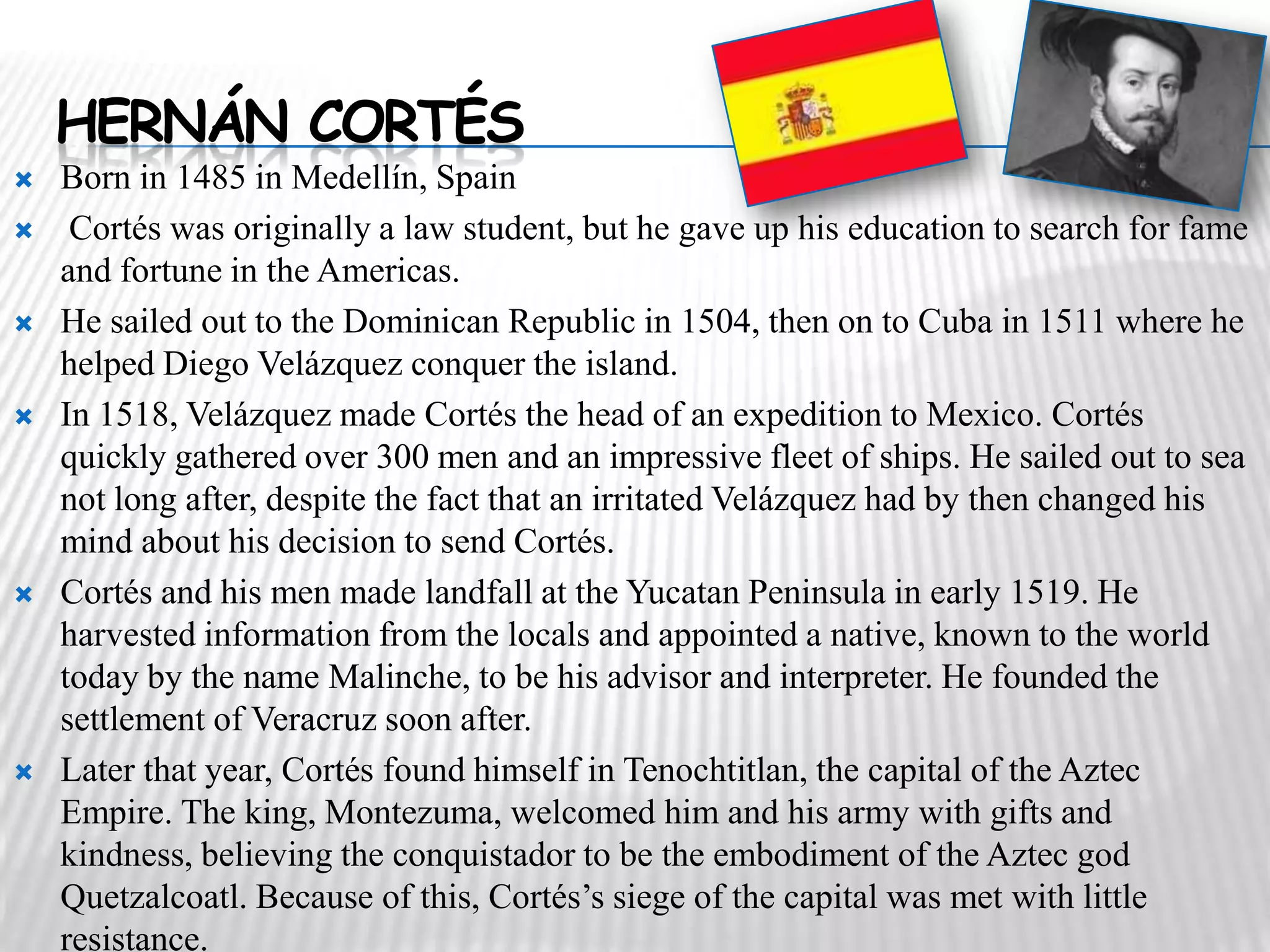
   Born in 1485 in Medellín, Spain
    Cortés was originally a law student, but he gave up his education to search for fame
    and fortune in the Americas.
   He sailed out to the Dominican Republic in 1504, then on to Cuba in 1511 where he
    helped Diego Velázquez conquer the island.
   In 1518, Velázquez made Cortés the head of an expedition to Mexico. Cortés
    quickly gathered over 300 men and an impressive fleet of ships. He sailed out to sea
    not long after, despite the fact that an irritated Velázquez had by then changed his
    mind about his decision to send Cortés.
   Cortés and his men made landfall at the Yucatan Peninsula in early 1519. He
    harvested information from the locals and appointed a native, known to the world
    today by the name Malinche, to be his advisor and interpreter. He founded the
    settlement of Veracruz soon after.
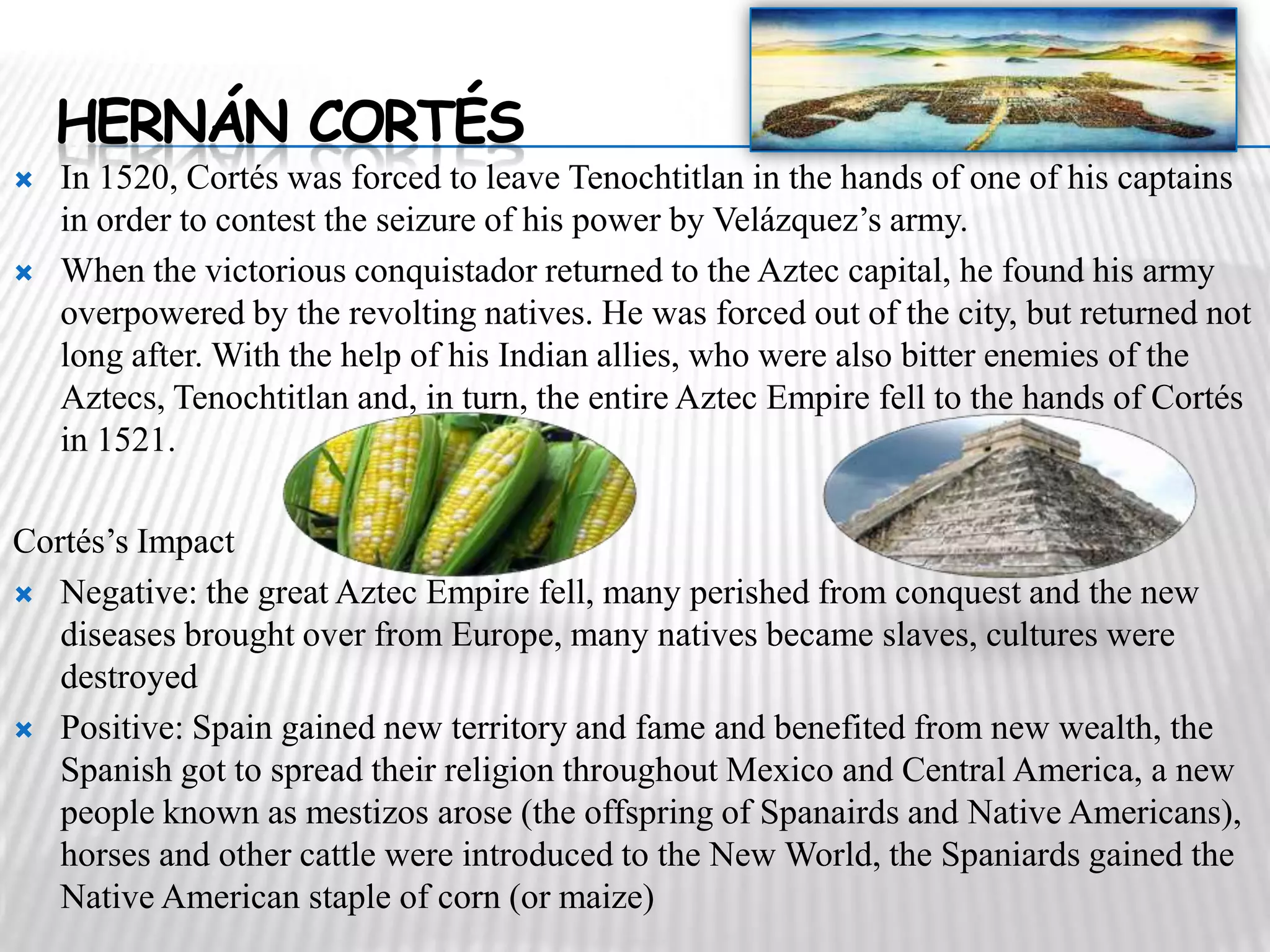
   Later that year, Cortés found himself in Tenochtitlan, the capital of the Aztec
    Empire. The king, Montezuma, welcomed him and his army with gifts and
    kindness, believing the conquistador to be the embodiment of the Aztec god
    Quetzalcoatl. Because of this, Cortés’s siege of the capital was met with little
    resistance.
HERNÁN CORTÉS
   In 1520, Cortés was forced to leave Tenochtitlan in the hands of one of his captains
    in order to contest the seizure of his power by Velázquez’s army.
   When the victorious conquistador returned to the Aztec capital, he found his army
    overpowered by the revolting natives. He was forced out of the city, but returned not
    long after. With the help of his Indian allies, who were also bitter enemies of the
    Aztecs, Tenochtitlan and, in turn, the entire Aztec Empire fell to the hands of Cortés
    in 1521.

Cortés’s Impact
 Negative: the great Aztec Empire fell, many perished from conquest and the new
   diseases brought over from Europe, many natives became slaves, cultures were
   destroyed
 Positive: Spain gained new territory and fame and benefited from new wealth, the
   Spanish got to spread their religion throughout Mexico and Central America, a new
   people known as mestizos arose (the offspring of Spanairds and Native Americans),
   horses and other cattle were introduced to the New World, the Spaniards gained the
   Native American staple of corn (or maize)
FRANCISCO PIZARRO
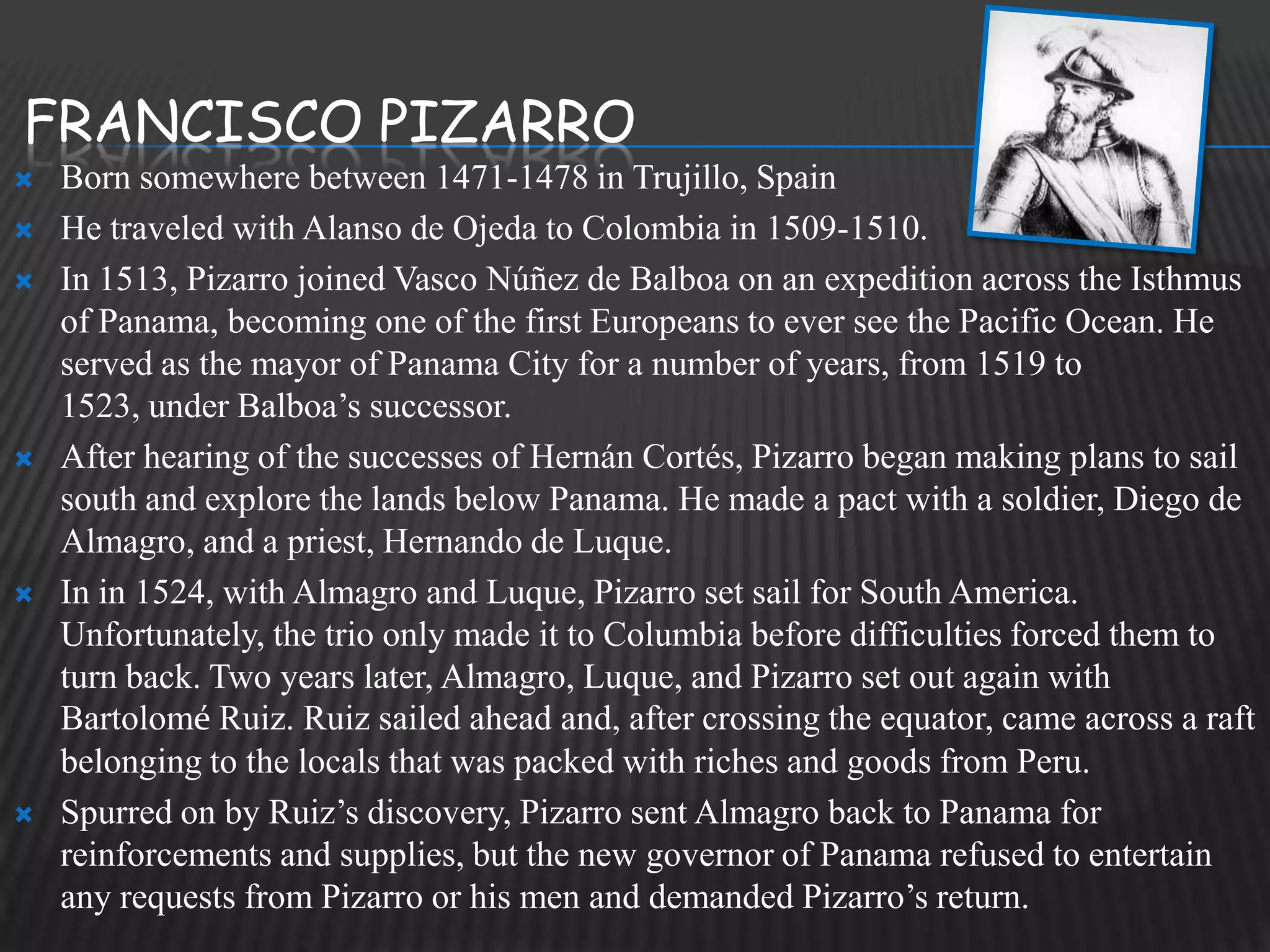
   Born somewhere between 1471-1478 in Trujillo, Spain
   He traveled with Alanso de Ojeda to Colombia in 1509-1510.
   In 1513, Pizarro joined Vasco Núñez de Balboa on an expedition across the Isthmus
    of Panama, becoming one of the first Europeans to ever see the Pacific Ocean. He
    served as the mayor of Panama City for a number of years, from 1519 to
    1523, under Balboa’s successor.
   After hearing of the successes of Hernán Cortés, Pizarro began making plans to sail
    south and explore the lands below Panama. He made a pact with a soldier, Diego de
    Almagro, and a priest, Hernando de Luque.
   In in 1524, with Almagro and Luque, Pizarro set sail for South America.
    Unfortunately, the trio only made it to Columbia before difficulties forced them to
    turn back. Two years later, Almagro, Luque, and Pizarro set out again with
    Bartolomé Ruiz. Ruiz sailed ahead and, after crossing the equator, came across a raft
    belonging to the locals that was packed with riches and goods from Peru.
   Spurred on by Ruiz’s discovery, Pizarro sent Almagro back to Panama for
    reinforcements and supplies, but the new governor of Panama refused to entertain
    any requests from Pizarro or his men and demanded Pizarro’s return.
FRANCISCO PIZARRO
   At this point, refusing to go back to Panama, Pizarro was said to have drawn a line
    in the sand, telling his men to either cross it and join him in his quest for wealth or to
    leave him. Only thirteen individuals, known as the Famous Thirteen, stayed behind
    and accompanied Pizarro as he continued south.
   Thirteen men could only do so much; the conquest of Peru required more recruits
    and more supplies. After the governor denied the request for a third
    expedition, Pizarro travelled to Spain in 1528 to gain the support of royalty. He won
    the king’s favor and was given permission to conquer Peru. Pizarro embarked on his
    third expedition in 1530.
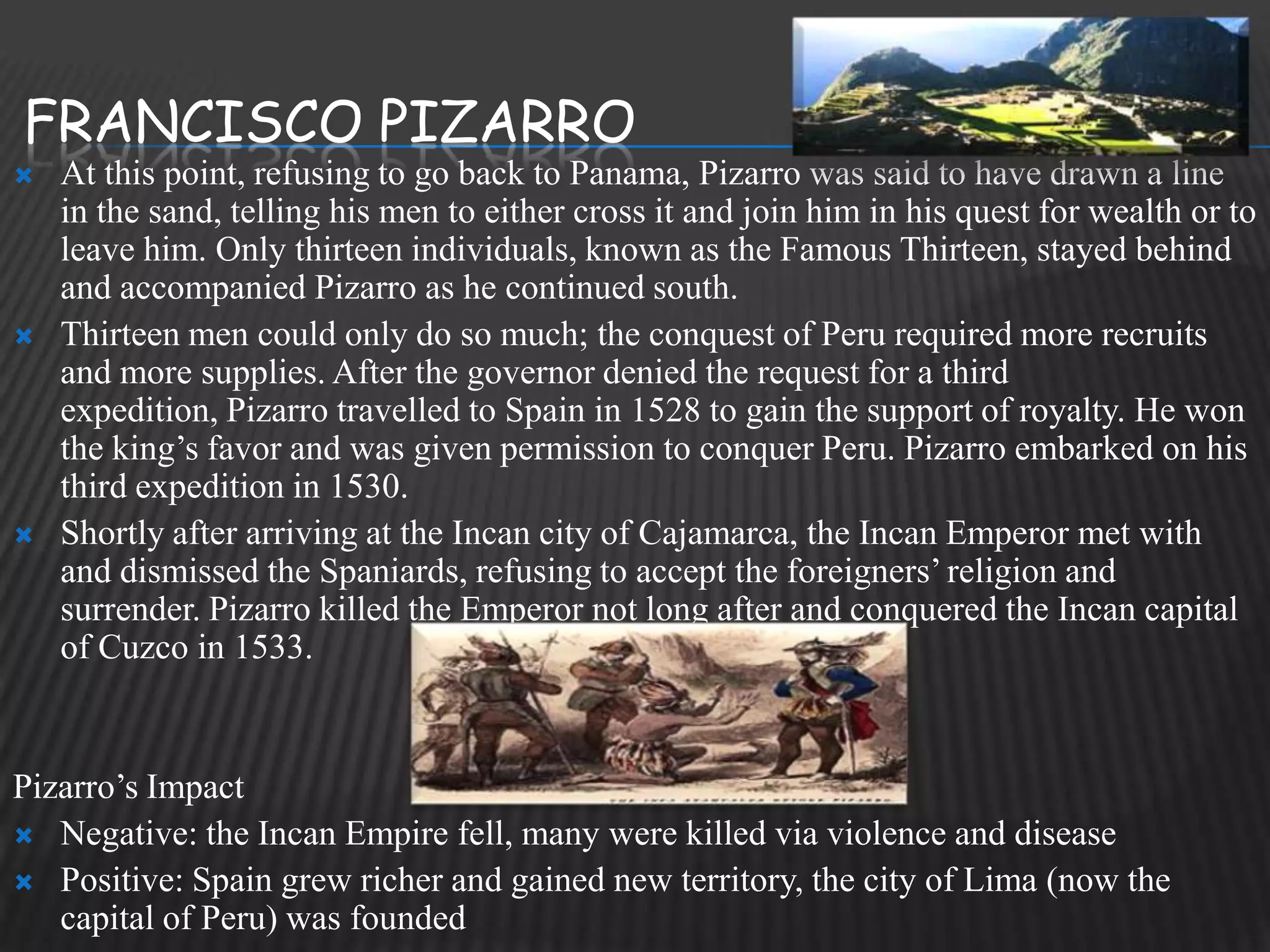
   Shortly after arriving at the Incan city of Cajamarca, the Incan Emperor met with
    and dismissed the Spaniards, refusing to accept the foreigners’ religion and
    surrender. Pizarro killed the Emperor not long after and conquered the Incan capital
    of Cuzco in 1533.


Pizarro’s Impact
 Negative: the Incan Empire fell, many were killed via violence and disease
 Positive: Spain grew richer and gained new territory, the city of Lima (now the
   capital of Peru) was founded
FERDINAND MAGELLAN
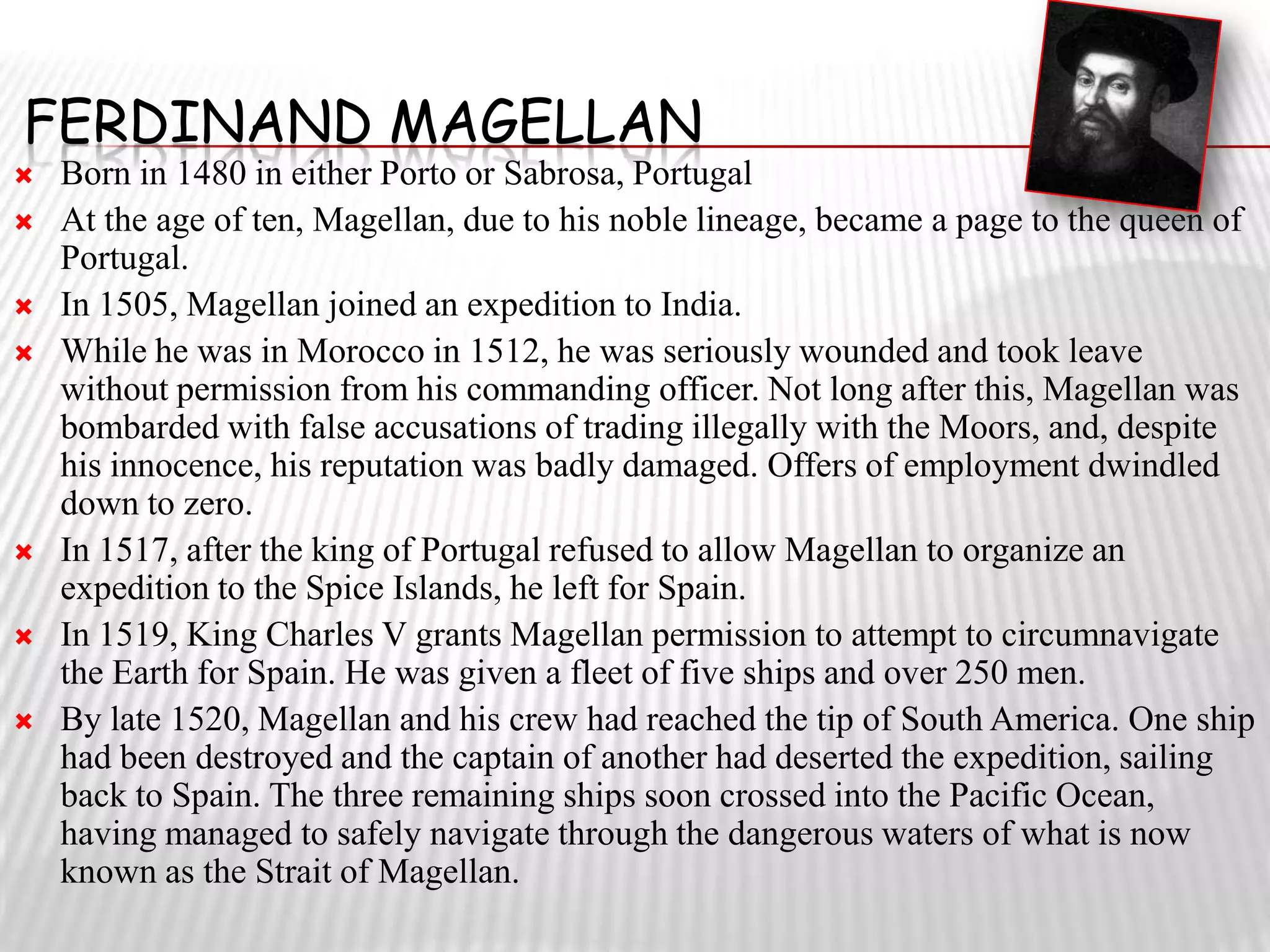
   Born in 1480 in either Porto or Sabrosa, Portugal
   At the age of ten, Magellan, due to his noble lineage, became a page to the queen of
    Portugal.
   In 1505, Magellan joined an expedition to India.
   While he was in Morocco in 1512, he was seriously wounded and took leave
    without permission from his commanding officer. Not long after this, Magellan was
    bombarded with false accusations of trading illegally with the Moors, and, despite
    his innocence, his reputation was badly damaged. Offers of employment dwindled
    down to zero.
   In 1517, after the king of Portugal refused to allow Magellan to organize an
    expedition to the Spice Islands, he left for Spain.
   In 1519, King Charles V grants Magellan permission to attempt to circumnavigate
    the Earth for Spain. He was given a fleet of five ships and over 250 men.
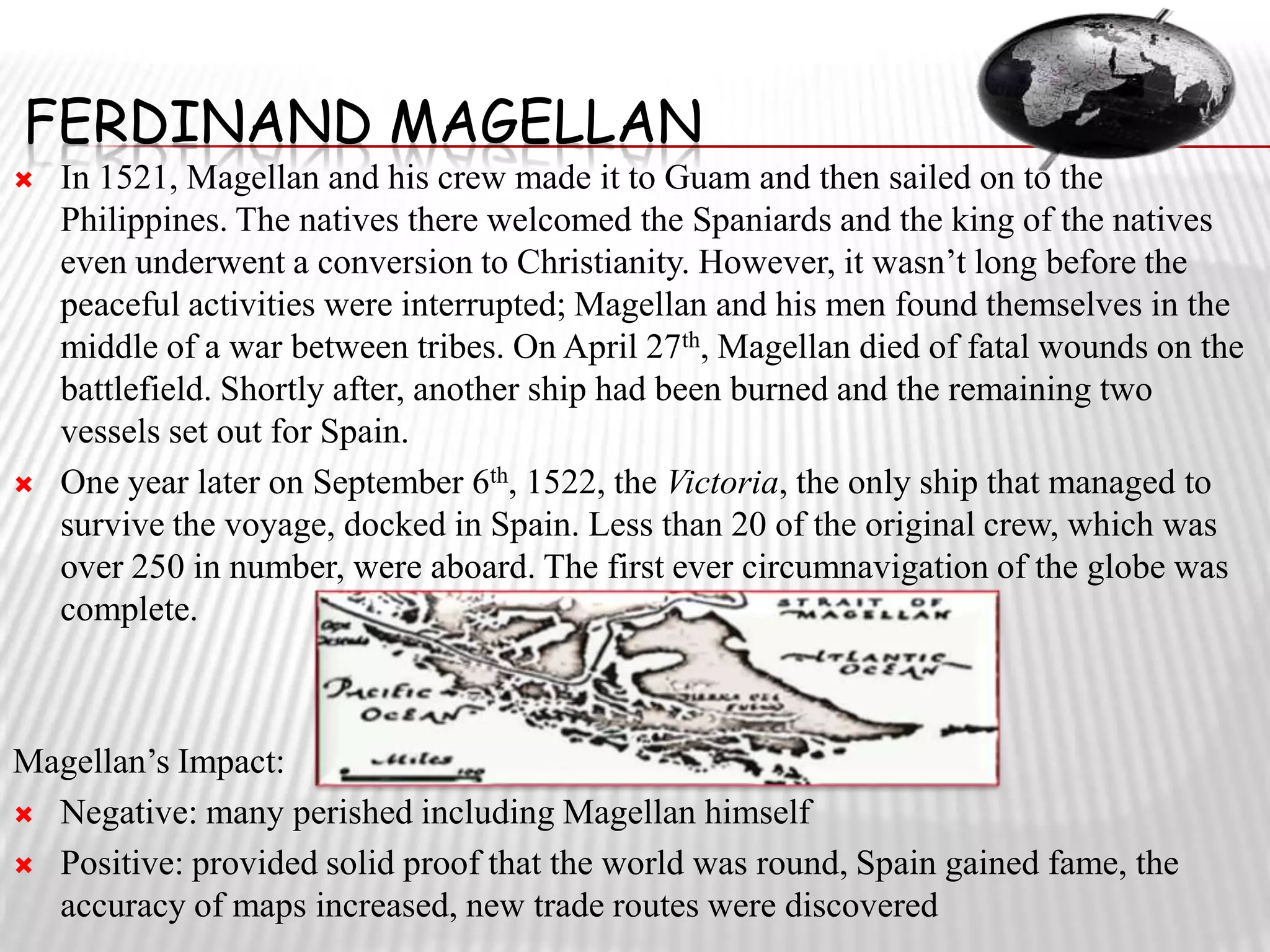
   By late 1520, Magellan and his crew had reached the tip of South America. One ship
    had been destroyed and the captain of another had deserted the expedition, sailing
    back to Spain. The three remaining ships soon crossed into the Pacific Ocean,
    having managed to safely navigate through the dangerous waters of what is now
    known as the Strait of Magellan.
FERDINAND MAGELLAN
   In 1521, Magellan and his crew made it to Guam and then sailed on to the
    Philippines. The natives there welcomed the Spaniards and the king of the natives
    even underwent a conversion to Christianity. However, it wasn’t long before the
    peaceful activities were interrupted; Magellan and his men found themselves in the
    middle of a war between tribes. On April 27th, Magellan died of fatal wounds on the
    battlefield. Shortly after, another ship had been burned and the remaining two
    vessels set out for Spain.
   One year later on September 6th, 1522, the Victoria, the only ship that managed to
    survive the voyage, docked in Spain. Less than 20 of the original crew, which was
    over 250 in number, were aboard. The first ever circumnavigation of the globe was
    complete.


Magellan’s Impact:
 Negative: many perished including Magellan himself

 Positive: provided solid proof that the world was round, Spain gained fame, the
  accuracy of maps increased, new trade routes were discovered
CHRISTOPHER COLUMBUS
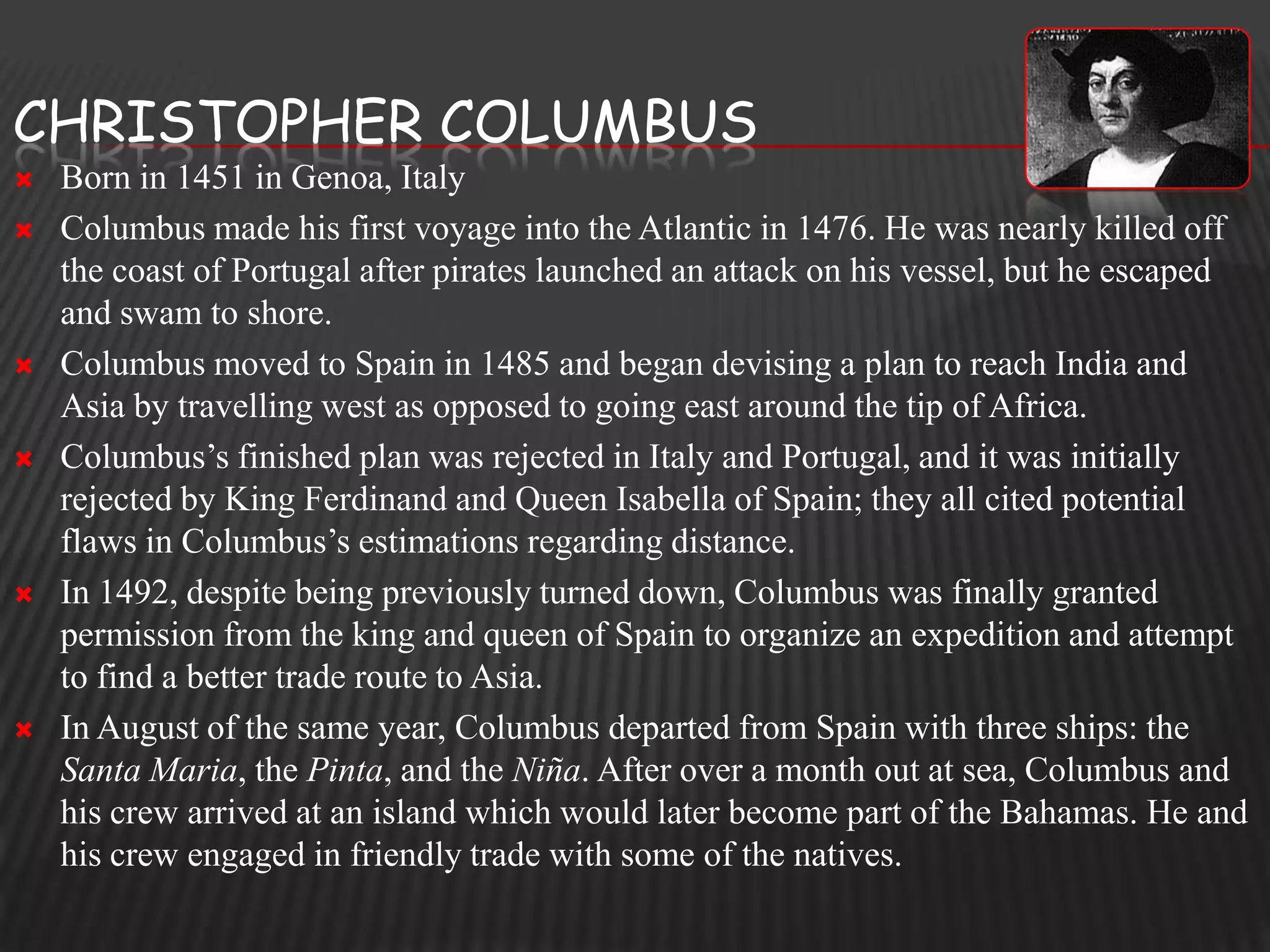
   Born in 1451 in Genoa, Italy
   Columbus made his first voyage into the Atlantic in 1476. He was nearly killed off
    the coast of Portugal after pirates launched an attack on his vessel, but he escaped
    and swam to shore.
   Columbus moved to Spain in 1485 and began devising a plan to reach India and
    Asia by travelling west as opposed to going east around the tip of Africa.
   Columbus’s finished plan was rejected in Italy and Portugal, and it was initially
    rejected by King Ferdinand and Queen Isabella of Spain; they all cited potential
    flaws in Columbus’s estimations regarding distance.
   In 1492, despite being previously turned down, Columbus was finally granted
    permission from the king and queen of Spain to organize an expedition and attempt
    to find a better trade route to Asia.
   In August of the same year, Columbus departed from Spain with three ships: the
    Santa Maria, the Pinta, and the Niña. After over a month out at sea, Columbus and
    his crew arrived at an island which would later become part of the Bahamas. He and
    his crew engaged in friendly trade with some of the natives.
CHRISTOPHER COLUMBUS
  Columbus sailed on to Cuba and Hispaniola (modern day Haiti/Dominican
   Republic). The Santa Maria collided with a reef near the latter and sank. He
   founded a settlement on Hispaniola called “La Navidad” using salvaged ship parts.
 Believing he did what he had set out to do (find a trade route to Asia), Columbus
   returned to Spain to report his findings to King Ferdinand and Queen Isabella.
 Columbus would later embark on three more voyages. He would visit many more
   islands and sail near the coast of what he believed was Asia, but was truly South and
   Central America, in search of a trade route to the Indian Ocean.
 In 1506, Columbus dies, still completely oblivious to the fact that what he
   discovered was not a trade route to Asia, but two entirely new (to the Europeans, at
   least) continents.
Columbus’s Impact:
 Negative: countless indigenous peoples would later die from disease or violence
   stemming from European colonization, cultures would be destroyed and lost forever
 Positive: remaining Native Americans gain the horse, the Old World would gain
   territory and all different sorts of food and goods that were previously
   unavailable, European colonization would lead to the rise of new civilizations
 Other: Native Americans are often called “Indians” and the Caribbean islands are
   known as the “West Indies” because Columbus had believed he landed in India
BIBLIOGRAPHY
Information
     http://www.thelatinlibrary.com/imperialism/notes/cortez.html
     http://www.biography.com/people/francisco-pizarro-9442295?page=1
     http://www.biography.com/people/francisco-pizarro-9442295?page=2
     http://www.biography.com/people/francisco-pizarro-9442295?page=3
     http://www.biography.com/people/ferdinand-magellan-9395202?page=1
     http://www.biography.com/people/ferdinand-magellan-9395202?page=2
     http://www.truetotheblue.com/Magellan/timeline.html
     http://www.biography.com/people/christopher-columbus-9254209?page=1
     http://www.biography.com/people/christopher-columbus-9254209?page=2
     http://www.biography.com/people/christopher-columbus-9254209?page=3
     http://www.columbusnavigation.com/cctl.shtml
Pictures
     http://beginnings-1750-p5.wikispaces.com/file/view/shippy.JPG/30177665/shippy.JPG
     http://farm5.staticflickr.com/4147/4992281750_b8c2911438_z.jpg
     http://www.ruggieroweb.com/RTW%20Trips/spain%20flag.jpg
     http://www.mexicolore.co.uk/images-3/325_02_2.jpg
     http://www.tomatocasual.com/wp-content/uploads/corn.jpg
     http://www.crystalinks.com/aztecpyramid1.jpg
     http://upload.wikimedia.org/wikipedia/commons/thumb/4/43/Pizarro.jpg/220px-Pizarro.jpg
     http://www.sharoncarrtravel.com/images/peru2.jpg
     http://content.answcdn.com/main/content/img/webpics/Ferdinand_Magellan.jpg
     http://www.reformation.org/en-strait-of-magellan.jpg
     http://www.globeshowcase.com/prodimages-cdls/RG/rg-42804-L.jpg
     http://www.paradoxplace.com/Perspectives/Genl%20Images/Images/Portrait_Images/Columbus/Piombo-Columbus-
      BR.jpg
     http://csshook.com/cssresources/wp-content/uploads/2009/03/old-world-map.jpg
     https://incaencyclopediag.pbworks.com/f/1264488370/incas.jpeg

Age of Exploration- Famous Explorers

  • 2.
    HERNÁN CORTÉS  Born in 1485 in Medellín, Spain  Cortés was originally a law student, but he gave up his education to search for fame and fortune in the Americas.  He sailed out to the Dominican Republic in 1504, then on to Cuba in 1511 where he helped Diego Velázquez conquer the island.  In 1518, Velázquez made Cortés the head of an expedition to Mexico. Cortés quickly gathered over 300 men and an impressive fleet of ships. He sailed out to sea not long after, despite the fact that an irritated Velázquez had by then changed his mind about his decision to send Cortés.  Cortés and his men made landfall at the Yucatan Peninsula in early 1519. He harvested information from the locals and appointed a native, known to the world today by the name Malinche, to be his advisor and interpreter. He founded the settlement of Veracruz soon after.  Later that year, Cortés found himself in Tenochtitlan, the capital of the Aztec Empire. The king, Montezuma, welcomed him and his army with gifts and kindness, believing the conquistador to be the embodiment of the Aztec god Quetzalcoatl. Because of this, Cortés’s siege of the capital was met with little resistance.
  • 3.
    HERNÁN CORTÉS  In 1520, Cortés was forced to leave Tenochtitlan in the hands of one of his captains in order to contest the seizure of his power by Velázquez’s army.  When the victorious conquistador returned to the Aztec capital, he found his army overpowered by the revolting natives. He was forced out of the city, but returned not long after. With the help of his Indian allies, who were also bitter enemies of the Aztecs, Tenochtitlan and, in turn, the entire Aztec Empire fell to the hands of Cortés in 1521. Cortés’s Impact  Negative: the great Aztec Empire fell, many perished from conquest and the new diseases brought over from Europe, many natives became slaves, cultures were destroyed  Positive: Spain gained new territory and fame and benefited from new wealth, the Spanish got to spread their religion throughout Mexico and Central America, a new people known as mestizos arose (the offspring of Spanairds and Native Americans), horses and other cattle were introduced to the New World, the Spaniards gained the Native American staple of corn (or maize)
  • 4.
    FRANCISCO PIZARRO  Born somewhere between 1471-1478 in Trujillo, Spain  He traveled with Alanso de Ojeda to Colombia in 1509-1510.  In 1513, Pizarro joined Vasco Núñez de Balboa on an expedition across the Isthmus of Panama, becoming one of the first Europeans to ever see the Pacific Ocean. He served as the mayor of Panama City for a number of years, from 1519 to 1523, under Balboa’s successor.  After hearing of the successes of Hernán Cortés, Pizarro began making plans to sail south and explore the lands below Panama. He made a pact with a soldier, Diego de Almagro, and a priest, Hernando de Luque.  In in 1524, with Almagro and Luque, Pizarro set sail for South America. Unfortunately, the trio only made it to Columbia before difficulties forced them to turn back. Two years later, Almagro, Luque, and Pizarro set out again with Bartolomé Ruiz. Ruiz sailed ahead and, after crossing the equator, came across a raft belonging to the locals that was packed with riches and goods from Peru.  Spurred on by Ruiz’s discovery, Pizarro sent Almagro back to Panama for reinforcements and supplies, but the new governor of Panama refused to entertain any requests from Pizarro or his men and demanded Pizarro’s return.
  • 5.
    FRANCISCO PIZARRO  At this point, refusing to go back to Panama, Pizarro was said to have drawn a line in the sand, telling his men to either cross it and join him in his quest for wealth or to leave him. Only thirteen individuals, known as the Famous Thirteen, stayed behind and accompanied Pizarro as he continued south.  Thirteen men could only do so much; the conquest of Peru required more recruits and more supplies. After the governor denied the request for a third expedition, Pizarro travelled to Spain in 1528 to gain the support of royalty. He won the king’s favor and was given permission to conquer Peru. Pizarro embarked on his third expedition in 1530.  Shortly after arriving at the Incan city of Cajamarca, the Incan Emperor met with and dismissed the Spaniards, refusing to accept the foreigners’ religion and surrender. Pizarro killed the Emperor not long after and conquered the Incan capital of Cuzco in 1533. Pizarro’s Impact  Negative: the Incan Empire fell, many were killed via violence and disease  Positive: Spain grew richer and gained new territory, the city of Lima (now the capital of Peru) was founded
  • 6.
    FERDINAND MAGELLAN  Born in 1480 in either Porto or Sabrosa, Portugal  At the age of ten, Magellan, due to his noble lineage, became a page to the queen of Portugal.  In 1505, Magellan joined an expedition to India.  While he was in Morocco in 1512, he was seriously wounded and took leave without permission from his commanding officer. Not long after this, Magellan was bombarded with false accusations of trading illegally with the Moors, and, despite his innocence, his reputation was badly damaged. Offers of employment dwindled down to zero.  In 1517, after the king of Portugal refused to allow Magellan to organize an expedition to the Spice Islands, he left for Spain.  In 1519, King Charles V grants Magellan permission to attempt to circumnavigate the Earth for Spain. He was given a fleet of five ships and over 250 men.  By late 1520, Magellan and his crew had reached the tip of South America. One ship had been destroyed and the captain of another had deserted the expedition, sailing back to Spain. The three remaining ships soon crossed into the Pacific Ocean, having managed to safely navigate through the dangerous waters of what is now known as the Strait of Magellan.
  • 7.
    FERDINAND MAGELLAN  In 1521, Magellan and his crew made it to Guam and then sailed on to the Philippines. The natives there welcomed the Spaniards and the king of the natives even underwent a conversion to Christianity. However, it wasn’t long before the peaceful activities were interrupted; Magellan and his men found themselves in the middle of a war between tribes. On April 27th, Magellan died of fatal wounds on the battlefield. Shortly after, another ship had been burned and the remaining two vessels set out for Spain.  One year later on September 6th, 1522, the Victoria, the only ship that managed to survive the voyage, docked in Spain. Less than 20 of the original crew, which was over 250 in number, were aboard. The first ever circumnavigation of the globe was complete. Magellan’s Impact:  Negative: many perished including Magellan himself  Positive: provided solid proof that the world was round, Spain gained fame, the accuracy of maps increased, new trade routes were discovered
  • 8.
    CHRISTOPHER COLUMBUS  Born in 1451 in Genoa, Italy  Columbus made his first voyage into the Atlantic in 1476. He was nearly killed off the coast of Portugal after pirates launched an attack on his vessel, but he escaped and swam to shore.  Columbus moved to Spain in 1485 and began devising a plan to reach India and Asia by travelling west as opposed to going east around the tip of Africa.  Columbus’s finished plan was rejected in Italy and Portugal, and it was initially rejected by King Ferdinand and Queen Isabella of Spain; they all cited potential flaws in Columbus’s estimations regarding distance.  In 1492, despite being previously turned down, Columbus was finally granted permission from the king and queen of Spain to organize an expedition and attempt to find a better trade route to Asia.  In August of the same year, Columbus departed from Spain with three ships: the Santa Maria, the Pinta, and the Niña. After over a month out at sea, Columbus and his crew arrived at an island which would later become part of the Bahamas. He and his crew engaged in friendly trade with some of the natives.
  • 9.
    CHRISTOPHER COLUMBUS  Columbus sailed on to Cuba and Hispaniola (modern day Haiti/Dominican Republic). The Santa Maria collided with a reef near the latter and sank. He founded a settlement on Hispaniola called “La Navidad” using salvaged ship parts.  Believing he did what he had set out to do (find a trade route to Asia), Columbus returned to Spain to report his findings to King Ferdinand and Queen Isabella.  Columbus would later embark on three more voyages. He would visit many more islands and sail near the coast of what he believed was Asia, but was truly South and Central America, in search of a trade route to the Indian Ocean.  In 1506, Columbus dies, still completely oblivious to the fact that what he discovered was not a trade route to Asia, but two entirely new (to the Europeans, at least) continents. Columbus’s Impact:  Negative: countless indigenous peoples would later die from disease or violence stemming from European colonization, cultures would be destroyed and lost forever  Positive: remaining Native Americans gain the horse, the Old World would gain territory and all different sorts of food and goods that were previously unavailable, European colonization would lead to the rise of new civilizations  Other: Native Americans are often called “Indians” and the Caribbean islands are known as the “West Indies” because Columbus had believed he landed in India
  • 10.
    BIBLIOGRAPHY Information  http://www.thelatinlibrary.com/imperialism/notes/cortez.html  http://www.biography.com/people/francisco-pizarro-9442295?page=1  http://www.biography.com/people/francisco-pizarro-9442295?page=2  http://www.biography.com/people/francisco-pizarro-9442295?page=3  http://www.biography.com/people/ferdinand-magellan-9395202?page=1  http://www.biography.com/people/ferdinand-magellan-9395202?page=2  http://www.truetotheblue.com/Magellan/timeline.html  http://www.biography.com/people/christopher-columbus-9254209?page=1  http://www.biography.com/people/christopher-columbus-9254209?page=2  http://www.biography.com/people/christopher-columbus-9254209?page=3  http://www.columbusnavigation.com/cctl.shtml Pictures  http://beginnings-1750-p5.wikispaces.com/file/view/shippy.JPG/30177665/shippy.JPG  http://farm5.staticflickr.com/4147/4992281750_b8c2911438_z.jpg  http://www.ruggieroweb.com/RTW%20Trips/spain%20flag.jpg  http://www.mexicolore.co.uk/images-3/325_02_2.jpg  http://www.tomatocasual.com/wp-content/uploads/corn.jpg  http://www.crystalinks.com/aztecpyramid1.jpg  http://upload.wikimedia.org/wikipedia/commons/thumb/4/43/Pizarro.jpg/220px-Pizarro.jpg  http://www.sharoncarrtravel.com/images/peru2.jpg  http://content.answcdn.com/main/content/img/webpics/Ferdinand_Magellan.jpg  http://www.reformation.org/en-strait-of-magellan.jpg  http://www.globeshowcase.com/prodimages-cdls/RG/rg-42804-L.jpg  http://www.paradoxplace.com/Perspectives/Genl%20Images/Images/Portrait_Images/Columbus/Piombo-Columbus- BR.jpg  http://csshook.com/cssresources/wp-content/uploads/2009/03/old-world-map.jpg  https://incaencyclopediag.pbworks.com/f/1264488370/incas.jpeg