Aim: How was feudalism in
Japan similar/different to
feudalism in Europe?


          Do Now: For review, create a
          definition for feudalism and explain
          why a system of feudalism might
          develop
Aim: How was feudalism in
Japan similar/different to
feudalism in Europe? (Day 2)

          Do Now: Take your handout out from
          yesterday! On your assignment sheet,
          add to homework Friday night: Study for
          your quiz on Monday.
Geography: Japan, a Land Apart
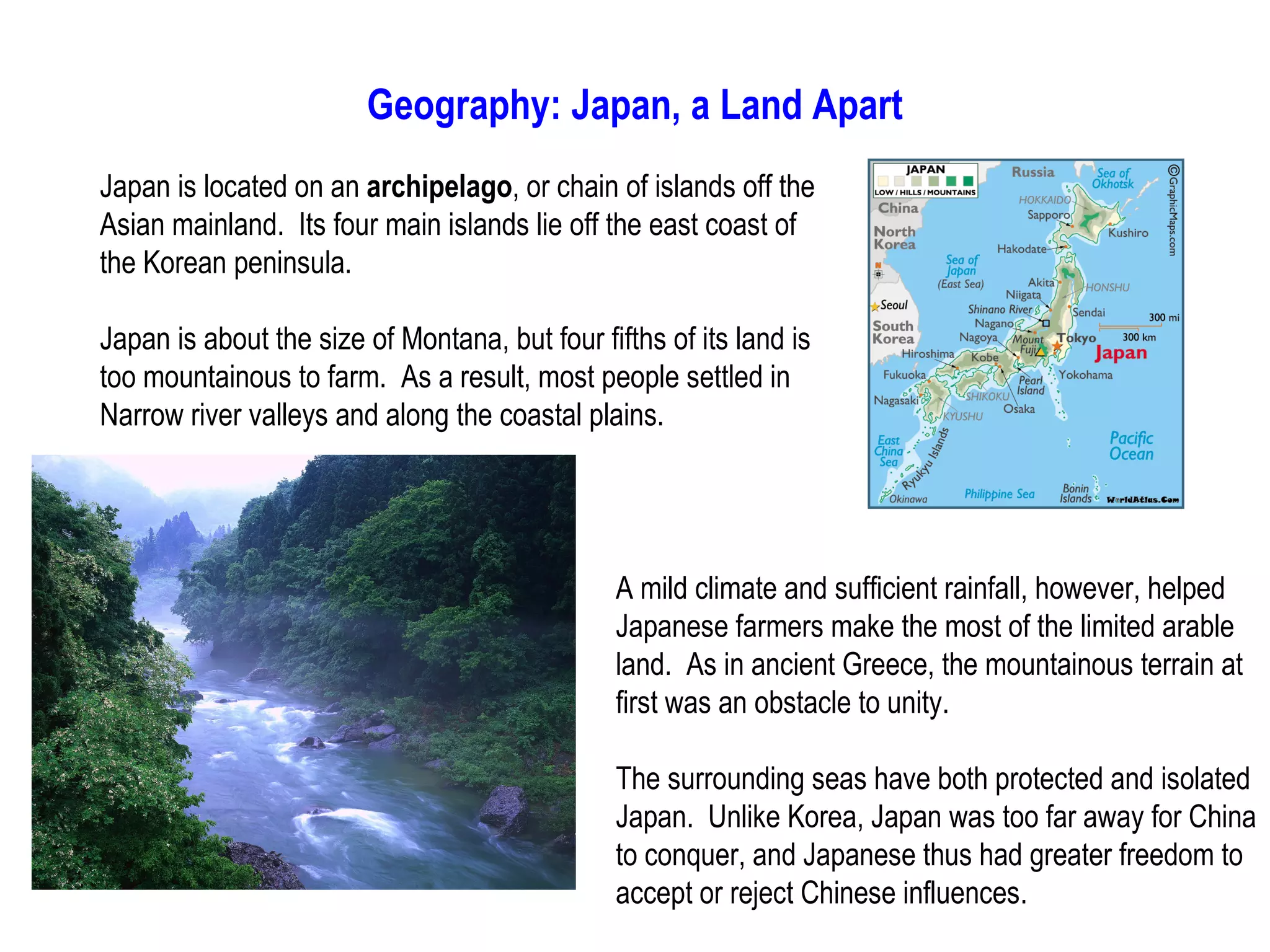
Japan is located on an archipelago, or chain of islands off the
Asian mainland. Its four main islands lie off the east coast of
the Korean peninsula.

Japan is about the size of Montana, but four fifths of its land is
too mountainous to farm. As a result, most people settled in
Narrow river valleys and along the coastal plains.


                                               A mild climate and sufficient rainfall, however, helped
                                               Japanese farmers make the most of the limited arable
                                               land. As in ancient Greece, the mountainous terrain at
                                               first was an obstacle to unity.

                                               The surrounding seas have both protected and isolated
                                               Japan. Unlike Korea, Japan was too far away for China
                                               to conquer, and Japanese thus had greater freedom to
                                               accept or reject Chinese influences.
Japan’s Feudal Society

Emperors served as a figurehead            Popes and the Church held much
  but held no political power                      political power


            Shogun                                    Monarch


                                                       Lords
            Daimyo
                                                     (Vassals)


           Samurai                                    Knights


          Peasants
                                                     Peasants
           Artisans
                                                      Serfs
          Merchants


  Japan’s Feudal Pyramid                     Europe’s Feudal Pyramid
Japan’s Feudal Society

In Theory, the emperor headed Japanese society. In fact, he was a
powerless, though revered, figurehead. Real power lay in the hands of the
shogun, or supreme military commander. Yoritomo Minamoto was
appointed shogun in 1192. He set up the Kamakura shogunate, the first
 of three military dynasties that ruled Japan for almost 700 years.
Often the shogun controlled only a small part of Japan. He distributed
lands to vassal lords who agreed to support him with their armies in time of need. These great
                                warrior lords were later called daimyo. They, in turn, granted
                                land to lesser warriors called samurai meaning “those who
                                serve. Samurai were the fighting aristocracy of a war-torn land.
                                At the bottom of the social period were the peasants, artisans,
                                and at the very bottom, merchants.
The Code of Bushido


          The Code of Bushido                             The Code of Chivalry
 Code which conducted the way of life for      Code which conducted the way of life for
  Samurai                                        Knights
 Means “The way of the warrior.”               Required knights to be brave, loyal, and true
 Emphasized honor, bravery, and absolute        to their word.
                                                In warfare, they had to fight fairly and be
  loyalty to one’s lord
                                                 generous to their enemies for example, they
 Taught samurai not to fear death: “If you
                                                 would not attack another knight before he
                                                 had a chance to put on his armor and
  think of saving your life,” it was said,       prepare for battle.
 “you had better not go to war at all”          Chivalry raised women to a new status
                       A samurai who             as the code called for women to
                      betrayed the code of        be protected and cherished
                      bushido was expected
                      to commit seppuku, or
                     ritual suicide, rather
                     than live without honor
The Role of Women in Japanese Feudal Society
                       During the Age of the samurai, the position of women declined steadily. At
                       first, some women in feudal society trained in the military arts or supervised
                       their family’s estates. A few even became legendary warriors. As fighting
                       increased, though, inheritance was limited to sons.


Unlike the European ideal of chivalry, though, the samurai
code did not set women on a pedestal. Instead, the wife of a
warrior had to accept the same hardships as her husband and
owed the same loyalty to his overlord
Religions of Feudal Japan
                                  Early Japanese society was divided into uji, or clans. Each uji had
                                  its own chief and special god or goddess, called kami, who was
                                  seen as the clan’s original ancestor. Kami were generally nature
                                  spirits. This worship of the forces of nature became known as
                                  Shintoism, meaning “way of the gods.” This idea was similar to
                                  the African beliefs of Animism which also believed that
                                  everything in nature had a spirit. Although Shintoism never evolved
                                  into an international religion, its traditions survive to the present
                                  day.

During Japan’s feudal age, a Buddhist sect from China won
widespread acceptance among samurai. Known in Japan as
Zen, it emphasized meditation and devotion to duty. Zen
Buddhists believed that people could siik enlightenment, not only
through meditation, but through precise performance of everyday
tasks. Zen reverence for nature also influenced the development
of fine landscape paintings.
Close: 1) Explain 2 ways Japanese and
          European feudalism were similar.
       2) Explain 2 ways they were
          different

Fedual japan carousel lesson ppt

  • 1.
    Aim: How wasfeudalism in Japan similar/different to feudalism in Europe? Do Now: For review, create a definition for feudalism and explain why a system of feudalism might develop
  • 2.
    Aim: How wasfeudalism in Japan similar/different to feudalism in Europe? (Day 2) Do Now: Take your handout out from yesterday! On your assignment sheet, add to homework Friday night: Study for your quiz on Monday.
  • 4.
    Geography: Japan, aLand Apart Japan is located on an archipelago, or chain of islands off the Asian mainland. Its four main islands lie off the east coast of the Korean peninsula. Japan is about the size of Montana, but four fifths of its land is too mountainous to farm. As a result, most people settled in Narrow river valleys and along the coastal plains. A mild climate and sufficient rainfall, however, helped Japanese farmers make the most of the limited arable land. As in ancient Greece, the mountainous terrain at first was an obstacle to unity. The surrounding seas have both protected and isolated Japan. Unlike Korea, Japan was too far away for China to conquer, and Japanese thus had greater freedom to accept or reject Chinese influences.
  • 5.
    Japan’s Feudal Society Emperorsserved as a figurehead Popes and the Church held much but held no political power political power Shogun Monarch Lords Daimyo (Vassals) Samurai Knights Peasants Peasants Artisans Serfs Merchants Japan’s Feudal Pyramid Europe’s Feudal Pyramid
  • 6.
    Japan’s Feudal Society InTheory, the emperor headed Japanese society. In fact, he was a powerless, though revered, figurehead. Real power lay in the hands of the shogun, or supreme military commander. Yoritomo Minamoto was appointed shogun in 1192. He set up the Kamakura shogunate, the first of three military dynasties that ruled Japan for almost 700 years. Often the shogun controlled only a small part of Japan. He distributed lands to vassal lords who agreed to support him with their armies in time of need. These great warrior lords were later called daimyo. They, in turn, granted land to lesser warriors called samurai meaning “those who serve. Samurai were the fighting aristocracy of a war-torn land. At the bottom of the social period were the peasants, artisans, and at the very bottom, merchants.
  • 7.
    The Code ofBushido The Code of Bushido The Code of Chivalry  Code which conducted the way of life for  Code which conducted the way of life for Samurai Knights  Means “The way of the warrior.”  Required knights to be brave, loyal, and true  Emphasized honor, bravery, and absolute to their word.  In warfare, they had to fight fairly and be loyalty to one’s lord generous to their enemies for example, they  Taught samurai not to fear death: “If you would not attack another knight before he had a chance to put on his armor and think of saving your life,” it was said, prepare for battle. “you had better not go to war at all”  Chivalry raised women to a new status  A samurai who as the code called for women to betrayed the code of be protected and cherished bushido was expected to commit seppuku, or ritual suicide, rather than live without honor
  • 8.
    The Role ofWomen in Japanese Feudal Society During the Age of the samurai, the position of women declined steadily. At first, some women in feudal society trained in the military arts or supervised their family’s estates. A few even became legendary warriors. As fighting increased, though, inheritance was limited to sons. Unlike the European ideal of chivalry, though, the samurai code did not set women on a pedestal. Instead, the wife of a warrior had to accept the same hardships as her husband and owed the same loyalty to his overlord
  • 9.
    Religions of FeudalJapan Early Japanese society was divided into uji, or clans. Each uji had its own chief and special god or goddess, called kami, who was seen as the clan’s original ancestor. Kami were generally nature spirits. This worship of the forces of nature became known as Shintoism, meaning “way of the gods.” This idea was similar to the African beliefs of Animism which also believed that everything in nature had a spirit. Although Shintoism never evolved into an international religion, its traditions survive to the present day. During Japan’s feudal age, a Buddhist sect from China won widespread acceptance among samurai. Known in Japan as Zen, it emphasized meditation and devotion to duty. Zen Buddhists believed that people could siik enlightenment, not only through meditation, but through precise performance of everyday tasks. Zen reverence for nature also influenced the development of fine landscape paintings.
  • 10.
    Close: 1) Explain2 ways Japanese and European feudalism were similar. 2) Explain 2 ways they were different