Subject: ANATOMY
PRESENTED BY: komal zulfiqar
Introduction:
"Nature is neither lazy nor devoid of foresight.
Having given the matter thought, she knows in
advance that the lung of the fetus does not require
the same arrangements of a perfected lung. She
has therefore anastomosed the pulmonary artery
with the aorta, and the left and right atria. . . .“
-Galen, 2nd Century
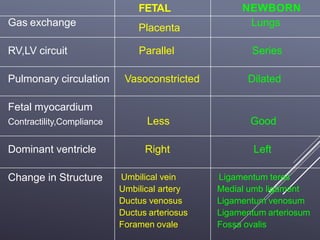
FETAL NEWBORN
Gas exchange Placenta Lungs
RV,LV circuit Parallel Series
Pulmonary circulation Vasoconstricted Dilated
Fetal myocardium
Contractility,Compliance Less Good
Dominant ventricle Right Left
Change in Structure Umbilical vein
Umbilical artery
Ductus venosus
Ductus arteriosus
Foramen ovale
Ligamentum teres
Medial umb ligament
Ligamentum venosum
Ligamentum arteriosum
Fossa ovalis
4 UNIQUE FETAL CVS STRUCTURES :FOUR
SHUNTS
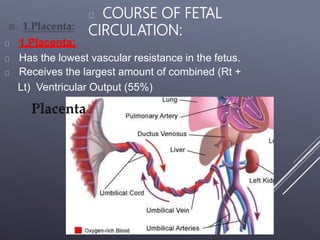
COURSE OF FETAL
CIRCULATION:
1.Placenta:
Has the lowest vascular resistance in the fetus.
Receives the largest amount of combined (Rt +
Lt) Ventricular Output (55%)
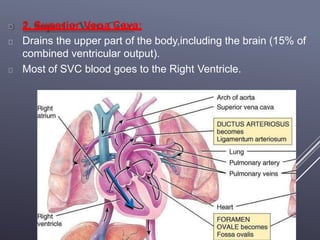
2. Superior Vena Cava:
Drains the upper part of the body,including the brain (15% of
combined ventricular output).
Most of SVC blood goes to the Right Ventricle.
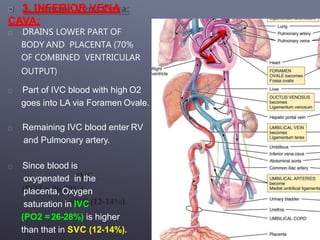
3. INFERIOR VENA
CAVA:
DRAINS LOWER PART OF
BODY AND PLACENTA (70%
OF COMBINED VENTRICULAR
OUTPUT)
Part of IVC blood with high O2
goes into LA via Foramen Ovale.
Remaining IVC blood enter RV
and Pulmonary artery.
Since blood is
oxygenated in the
placenta, Oxygen
saturation in IVC
(PO2 =26-28%) is higher
than that in SVC (12-14%).
COURSE OF FETAL CIRCULATION:
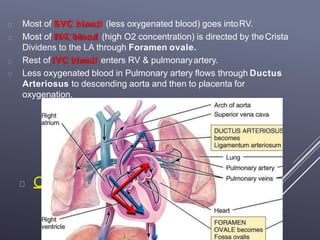
Most of SVC blood (less oxygenated blood) goes intoRV.
Most of IVC blood (high O2 concentration) is directed by theCrista
Dividens to the LA through Foramen ovale.
Rest of IVC blood enters RV & pulmonaryartery.
Less oxygenated blood in Pulmonary artery flows through Ductus
Arteriosus to descending aorta and then to placenta for
oxygenation.
COURSE OF FETAL CIRCULATION:
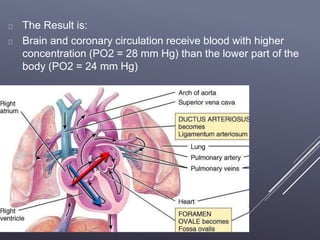
The Result is:
Brain and coronary circulation receive blood with higher
concentration (PO2 = 28 mm Hg) than the lower part of the
body (PO2 = 24 mm Hg)
FETAL CIRCULATION: THE PATHWAY:
PLACENTA  OXYGENATED BLOOD UMBILICAL VEIN
Hepatic
circulation
Bypasses liver & joins
IVC via ductus
venosus
Partially mixes with poorly oxygenated
IVC blood derived from lower part of
fetal body
FETAL CIRCULATION:
Combined lower body blood plus umbilical venous
blood flow (PO2 of ≈26–28 mm Hg) passes through
IVC to the Right atrium and is preferentially
directed across the foramen ovale to the left atrium.
The blood then flows into the left ventricle and is
ejected into the ascending aorta.
Fetal SVC blood, which is considerably less
oxygenated (PO2 of 12–14 mm Hg), enters the Right
atrium and preferentially traverses the tricuspid
valve, rather thanthe foramen ovale, and flows
primarily to the right ventricle.
FETAL CIRCULATION:
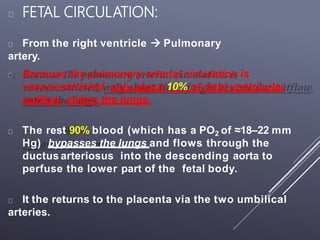
From the right ventricle  Pulmonary
artery.
Because the pulmonary arterial circulation is
vasoconstricted, only about 10% of right ventricular
outflow enters the lungs.
The rest 90% blood (which has a PO2 of ≈18–22 mm
Hg) bypasses the lungs and flows through the
ductus arteriosus into the descending aorta to
perfuse the lower part of the fetal body.
It the returns to the placenta via the two umbilical
arteries.
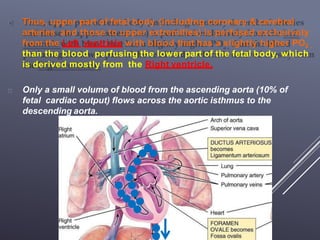
Thus, upper part of fetal body (including coronary & cerebral
arteries and those to upper extremities) is perfused exclusively
from the Left ventricle with blood that has a slightly higher PO2 ,
than the blood perfusing the lower part of the fetal body, which
is derived mostly from the Right ventricle.
Only a small volume of blood from the ascending aorta (10% of
fetal cardiac output) flows across the aortic isthmus to the
descending aorta.
Thus, upper part of fetal body (including coronary & cerebral
arteries and those to upper extremities) is perfused exclusively
from the Left ventricle with blood that has a slightly higher PO2 ,
than the blood perfusing the lower part of the fetal body, which
is derived mostly from the Right ventricle.
Only a small volume of blood from the ascending aorta (10% of
fetal cardiac output) flows across the aortic isthmus to the
descending aorta.
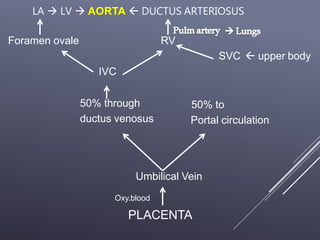
LA  LV  AORTA  DUCTUS ARTERIOSUS
Foramen ovale RV
SVC  upper body
IVC
50% through
ductus venosus
50% to
Portal circulation
Umbilical Vein
Oxy.blood
PLACENTA
AORTA
Deoxygenated blood
Descending aorta
Abdominal aorta
Common iliac artery
Umbilical arteries
PLACENTA
Oxygenation
Umbilical Vein
FETAL CIRCULATION:
The total fetal cardiac output—the combined output of both
the left and right ventricles—is ≈450mL/kg/min.
Descending aortic blood flow :
-65%  returns to placenta;
-Remaining 35%  perfuses the fetal organs & tissues.
Right ventricular output is about 1.3 times the left
ventricular flow.
Thus, during fetal life the rightventricle
-is pumping against systemic blood pressure
-is performing greater volume of work than LV.
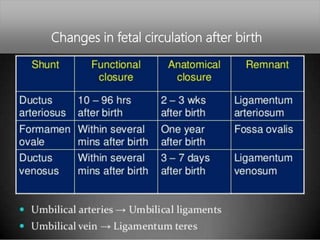
Changes in fetal
circulation AFTER BIRTH
Changes in fetal circulation after birth
FETAL VS INFANT CIRCULATION
FETAL INFANT
 • Low pressure system
 • Right to left shunting
 • Lungs non-functional
 • Increased pulmonary
resistance
 • Decreased systemic
resistance
 •High pressure system
 •Left to right blood flow
 •Lungs functional
 •Decreased pulmonary
resistance
 •Increased systemic resistance
INFANT
FETAL
THANK YOU

Fetal circulation

  • 1.
  • 3.
    Introduction: "Nature is neitherlazy nor devoid of foresight. Having given the matter thought, she knows in advance that the lung of the fetus does not require the same arrangements of a perfected lung. She has therefore anastomosed the pulmonary artery with the aorta, and the left and right atria. . . .“ -Galen, 2nd Century
  • 4.
    FETAL NEWBORN Gas exchangePlacenta Lungs RV,LV circuit Parallel Series Pulmonary circulation Vasoconstricted Dilated Fetal myocardium Contractility,Compliance Less Good Dominant ventricle Right Left Change in Structure Umbilical vein Umbilical artery Ductus venosus Ductus arteriosus Foramen ovale Ligamentum teres Medial umb ligament Ligamentum venosum Ligamentum arteriosum Fossa ovalis
  • 5.
    4 UNIQUE FETALCVS STRUCTURES :FOUR SHUNTS
  • 6.
    COURSE OF FETAL CIRCULATION: 1.Placenta: Hasthe lowest vascular resistance in the fetus. Receives the largest amount of combined (Rt + Lt) Ventricular Output (55%)
  • 7.
    2. Superior VenaCava: Drains the upper part of the body,including the brain (15% of combined ventricular output). Most of SVC blood goes to the Right Ventricle.
  • 8.
    3. INFERIOR VENA CAVA: DRAINSLOWER PART OF BODY AND PLACENTA (70% OF COMBINED VENTRICULAR OUTPUT) Part of IVC blood with high O2 goes into LA via Foramen Ovale. Remaining IVC blood enter RV and Pulmonary artery. Since blood is oxygenated in the placenta, Oxygen saturation in IVC (PO2 =26-28%) is higher than that in SVC (12-14%).
  • 9.
    COURSE OF FETALCIRCULATION: Most of SVC blood (less oxygenated blood) goes intoRV. Most of IVC blood (high O2 concentration) is directed by theCrista Dividens to the LA through Foramen ovale. Rest of IVC blood enters RV & pulmonaryartery. Less oxygenated blood in Pulmonary artery flows through Ductus Arteriosus to descending aorta and then to placenta for oxygenation.
  • 10.
    COURSE OF FETALCIRCULATION: The Result is: Brain and coronary circulation receive blood with higher concentration (PO2 = 28 mm Hg) than the lower part of the body (PO2 = 24 mm Hg)
  • 11.
    FETAL CIRCULATION: THEPATHWAY: PLACENTA  OXYGENATED BLOOD UMBILICAL VEIN Hepatic circulation Bypasses liver & joins IVC via ductus venosus Partially mixes with poorly oxygenated IVC blood derived from lower part of fetal body
  • 12.
    FETAL CIRCULATION: Combined lowerbody blood plus umbilical venous blood flow (PO2 of ≈26–28 mm Hg) passes through IVC to the Right atrium and is preferentially directed across the foramen ovale to the left atrium. The blood then flows into the left ventricle and is ejected into the ascending aorta. Fetal SVC blood, which is considerably less oxygenated (PO2 of 12–14 mm Hg), enters the Right atrium and preferentially traverses the tricuspid valve, rather thanthe foramen ovale, and flows primarily to the right ventricle.
  • 13.
    FETAL CIRCULATION: From theright ventricle  Pulmonary artery. Because the pulmonary arterial circulation is vasoconstricted, only about 10% of right ventricular outflow enters the lungs. The rest 90% blood (which has a PO2 of ≈18–22 mm Hg) bypasses the lungs and flows through the ductus arteriosus into the descending aorta to perfuse the lower part of the fetal body. It the returns to the placenta via the two umbilical arteries.
  • 14.
    Thus, upper partof fetal body (including coronary & cerebral arteries and those to upper extremities) is perfused exclusively from the Left ventricle with blood that has a slightly higher PO2 , than the blood perfusing the lower part of the fetal body, which is derived mostly from the Right ventricle. Only a small volume of blood from the ascending aorta (10% of fetal cardiac output) flows across the aortic isthmus to the descending aorta.
  • 15.
    Thus, upper partof fetal body (including coronary & cerebral arteries and those to upper extremities) is perfused exclusively from the Left ventricle with blood that has a slightly higher PO2 , than the blood perfusing the lower part of the fetal body, which is derived mostly from the Right ventricle. Only a small volume of blood from the ascending aorta (10% of fetal cardiac output) flows across the aortic isthmus to the descending aorta.
  • 16.
    LA  LV AORTA  DUCTUS ARTERIOSUS Foramen ovale RV SVC  upper body IVC 50% through ductus venosus 50% to Portal circulation Umbilical Vein Oxy.blood PLACENTA
  • 17.
    AORTA Deoxygenated blood Descending aorta Abdominalaorta Common iliac artery Umbilical arteries PLACENTA Oxygenation Umbilical Vein
  • 18.
    FETAL CIRCULATION: The totalfetal cardiac output—the combined output of both the left and right ventricles—is ≈450mL/kg/min. Descending aortic blood flow : -65%  returns to placenta; -Remaining 35%  perfuses the fetal organs & tissues. Right ventricular output is about 1.3 times the left ventricular flow. Thus, during fetal life the rightventricle -is pumping against systemic blood pressure -is performing greater volume of work than LV.
  • 19.
  • 20.
    Changes in fetalcirculation after birth
  • 21.
    FETAL VS INFANTCIRCULATION FETAL INFANT  • Low pressure system  • Right to left shunting  • Lungs non-functional  • Increased pulmonary resistance  • Decreased systemic resistance  •High pressure system  •Left to right blood flow  •Lungs functional  •Decreased pulmonary resistance  •Increased systemic resistance INFANT FETAL
  • 24.