Fetal Anomaly Scan
Second trimester anatomy scan, or
TIFFA (targeted imaging for fetal
anomalies)
Introduction
• The second trimester targeted scan is done
between 18 and 22 weeks.
• The primary objective of this scan is to do a detailed
anatomical evaluation of the fetus and to maximize the
detection of anomalies that may be present at this stage.
• A systematic method of ultrasound scanning of the fetus will
ensure that a reasonably complete examination of the fetus is
accomplished.
• Since this scan is primarily meant for exclusion
or diagnosis of fetal anomalies,it is important
that a thorough examination of the fetus is
done during this period.
• The second trimester targeted scan is a head
to toe clinical examination of the fetus.
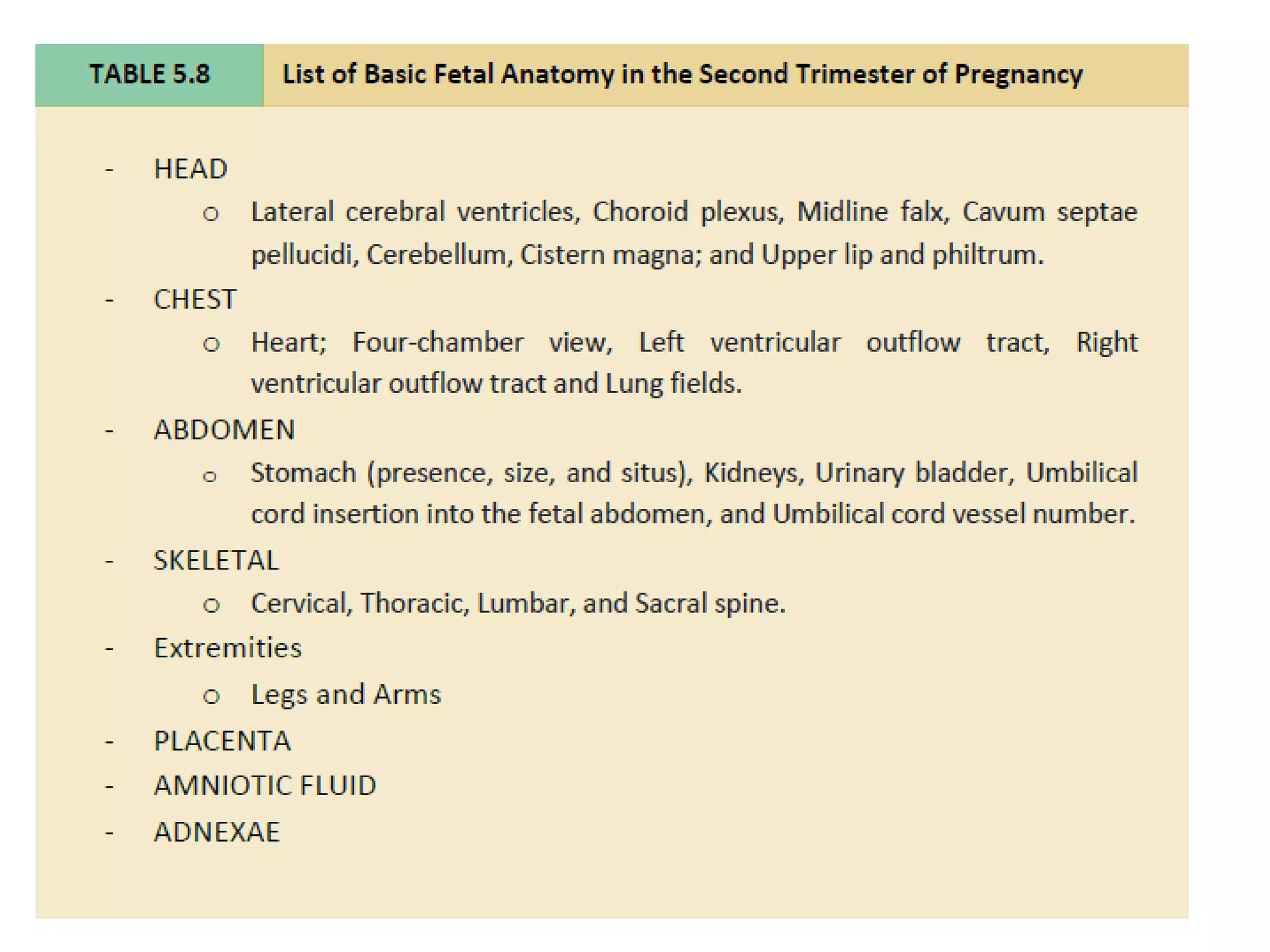
Objectives
• To predict with confidence, the structural
normalcy of the baby within reasonable limits
of expectation
• To identify severe and lethal abnormalities
• To raise the suspicion of an abnormality, which
would warrant further testing or serial scans
The ‘‘Rule of Three’’ Concept
• The ‘‘rule of three’’ concept was evolved in the year 1995
by the authors.
• It is a systematic method of examination of
the fetus designed to achieve maximum yield from the
ultrasound examination in the least possible time.
• It is easily reproducible and is useful for audit. By following the
‘‘rule of three’’, it is possible to say that all aspects of the fetus that
are expected to be seen have indeed been imaged.
• This ensures that the examination has been done satisfactorily.
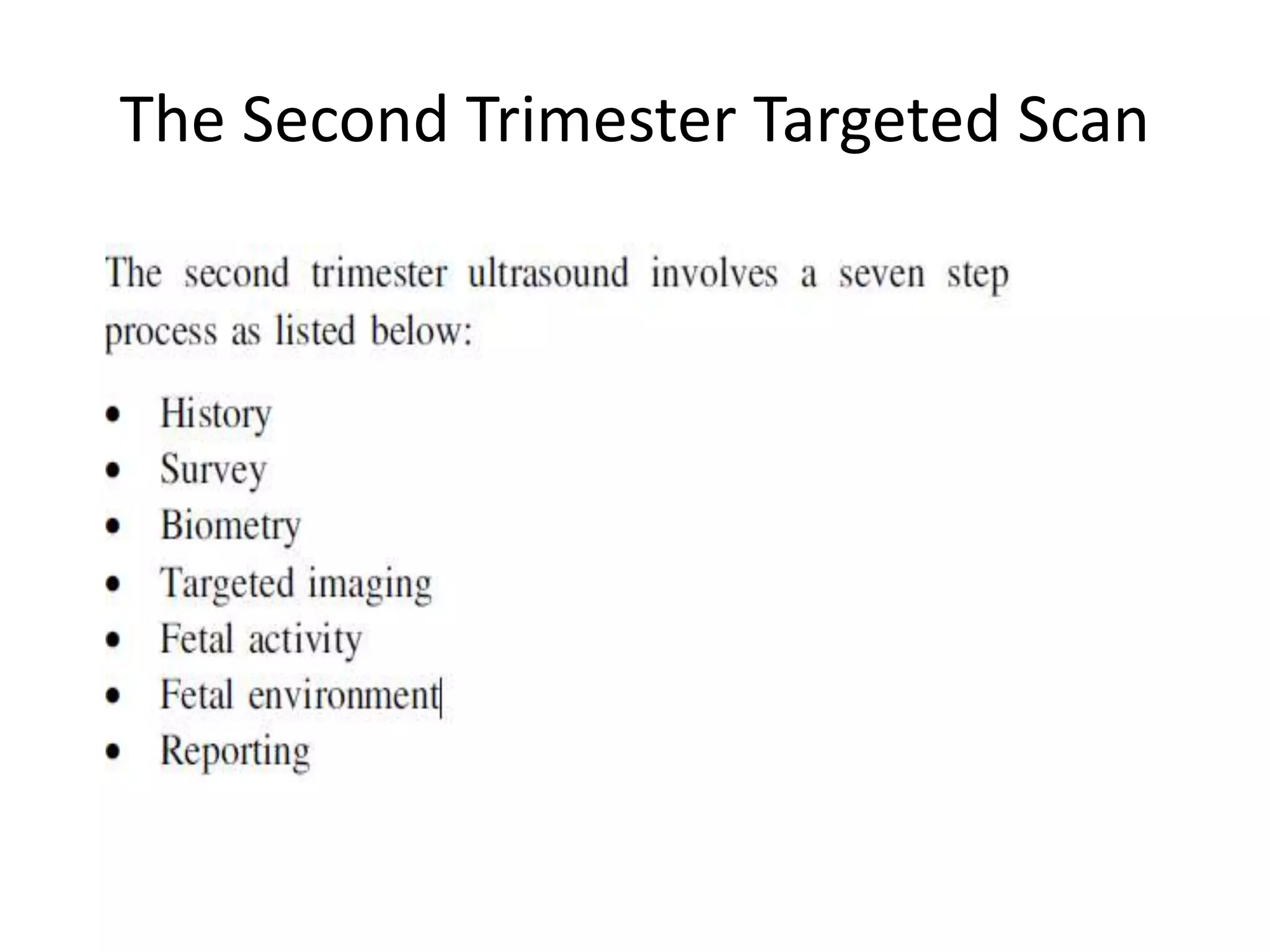
The Second Trimester Targeted Scan
At the end of the examination, one must
be able to declare with confidence, the following
three aspects:
• The fetus is structurally normal for this period of
gestation
• Major abnormalities have been detected or
excluded
• A suspicion of an anomaly is raised
Anatomical Planes and Structures to be Examined
• Head:
1. Transthalamic plane
2. Ventricular plane
3. Transcerebellar plane
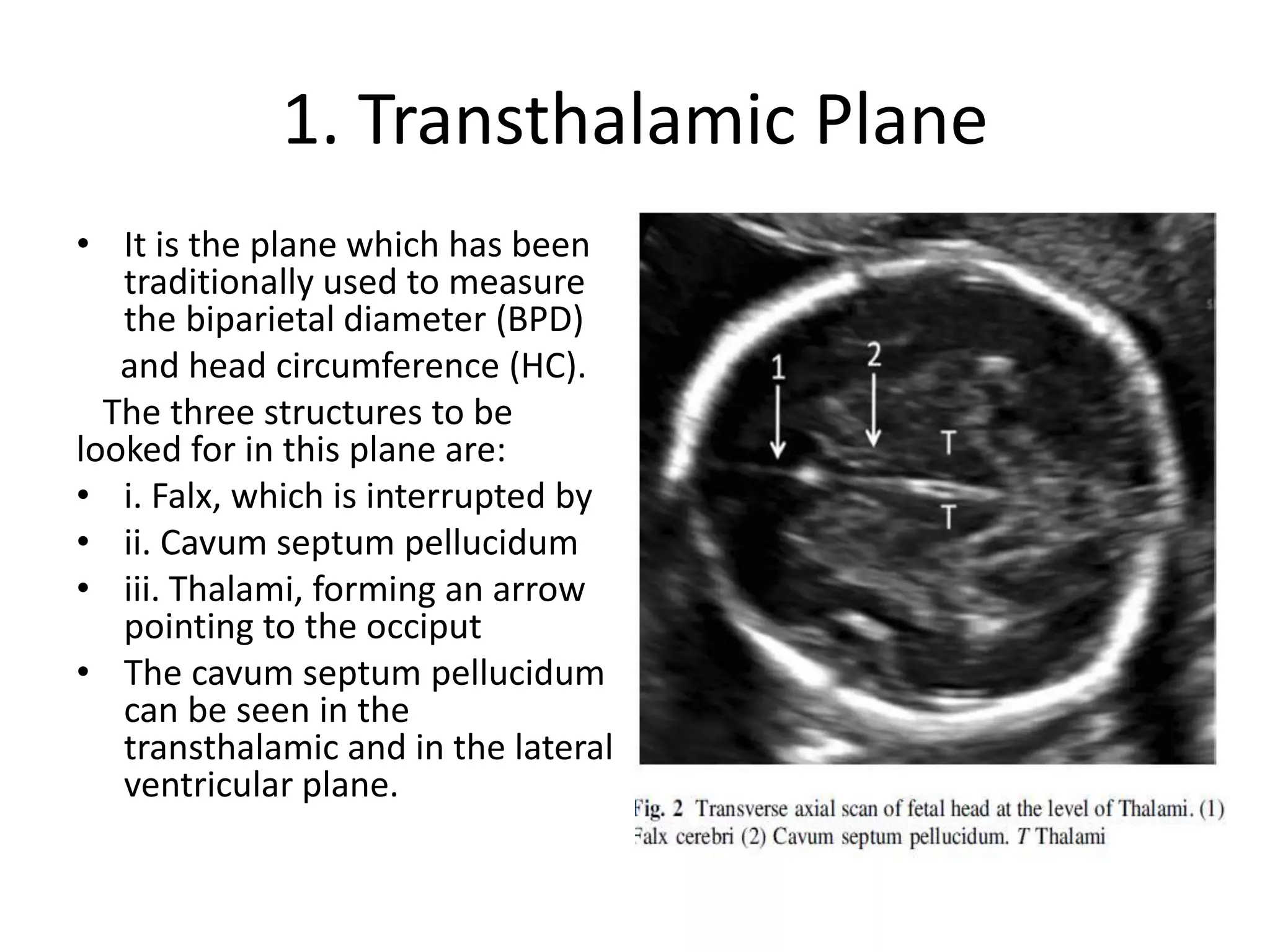
1. Transthalamic Plane
• It is the plane which has been
traditionally used to measure
the biparietal diameter (BPD)
and head circumference (HC).
The three structures to be
looked for in this plane are:
• i. Falx, which is interrupted by
• ii. Cavum septum pellucidum
• iii. Thalami, forming an arrow
pointing to the occiput
• The cavum septum pellucidum
can be seen in the
transthalamic and in the lateral
ventricular plane.
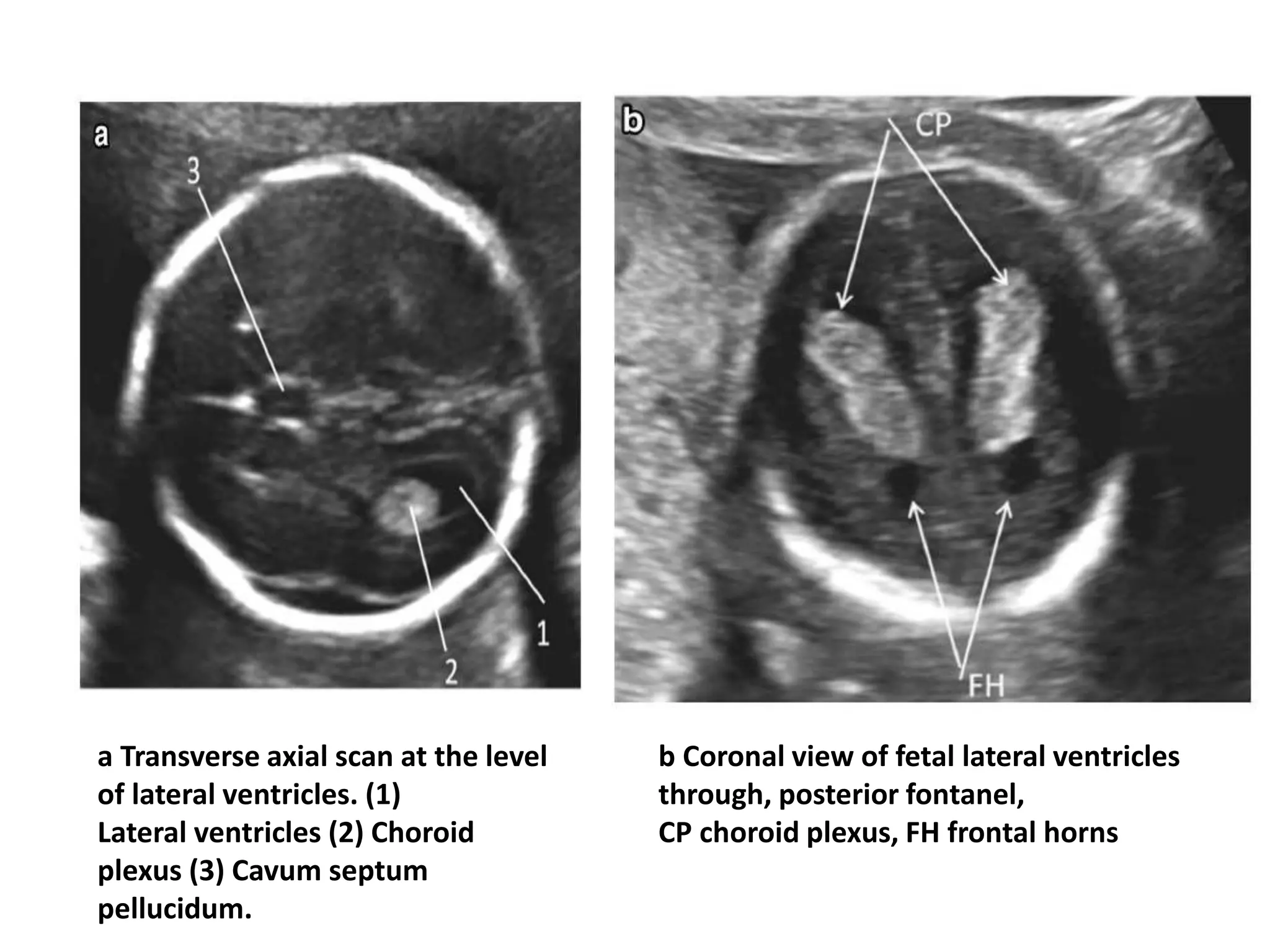
2. Ventricular Plane
• The three structures to
be identified in this
plane are:
i. The lateral ventricles
ii. Choroid plexes and
iii. Cavum septum
pellucidum
Choroid fills more than 60% of atrium width between the medial ventricle wall and
the choroid is less than 3 mm.
a Transverse axial scan at the level
of lateral ventricles. (1)
Lateral ventricles (2) Choroid
plexus (3) Cavum septum
pellucidum.
b Coronal view of fetal lateral ventricles
through, posterior fontanel,
CP choroid plexus, FH frontal horns
3. Transcerebellar Plane
It is imaged by rotating the probe posteriorly from the
BPD plane till a clear view of the posterior fossa and the
occipital bone is obtained.
The three structures to be identified in the posterior
fossa are:
i. Rounded cerebellar hemispheres (dumb-bell shaped).
ii. Vermis of the cerebellum. (there should be no space
in between the two cerebellar hemispheres).
iii. Cisterna magna (seen as a clear space between the
cerebellum and the occipital bone).
TRANSCEREBELLAR DIAMETER
• It is measured as the maximal diameter between the cerebellar
hemispheres on an axial scan.
• The TCD is not thought to be significantly altered by the presence
of IUGR
• Up to about 24 weeks, the transverse cerebellar diameter
corresponds to gestational weeks.
• The cisterna magna is the cerebrospinal fluid (CSF) space behind the
cerebellum and is measured between the cerebellar vermis and
inner occipital bone on an axial plane that includes the anterior end
of the CSP and the midplane of the cerebellum. It is normally 2 to
10 mm
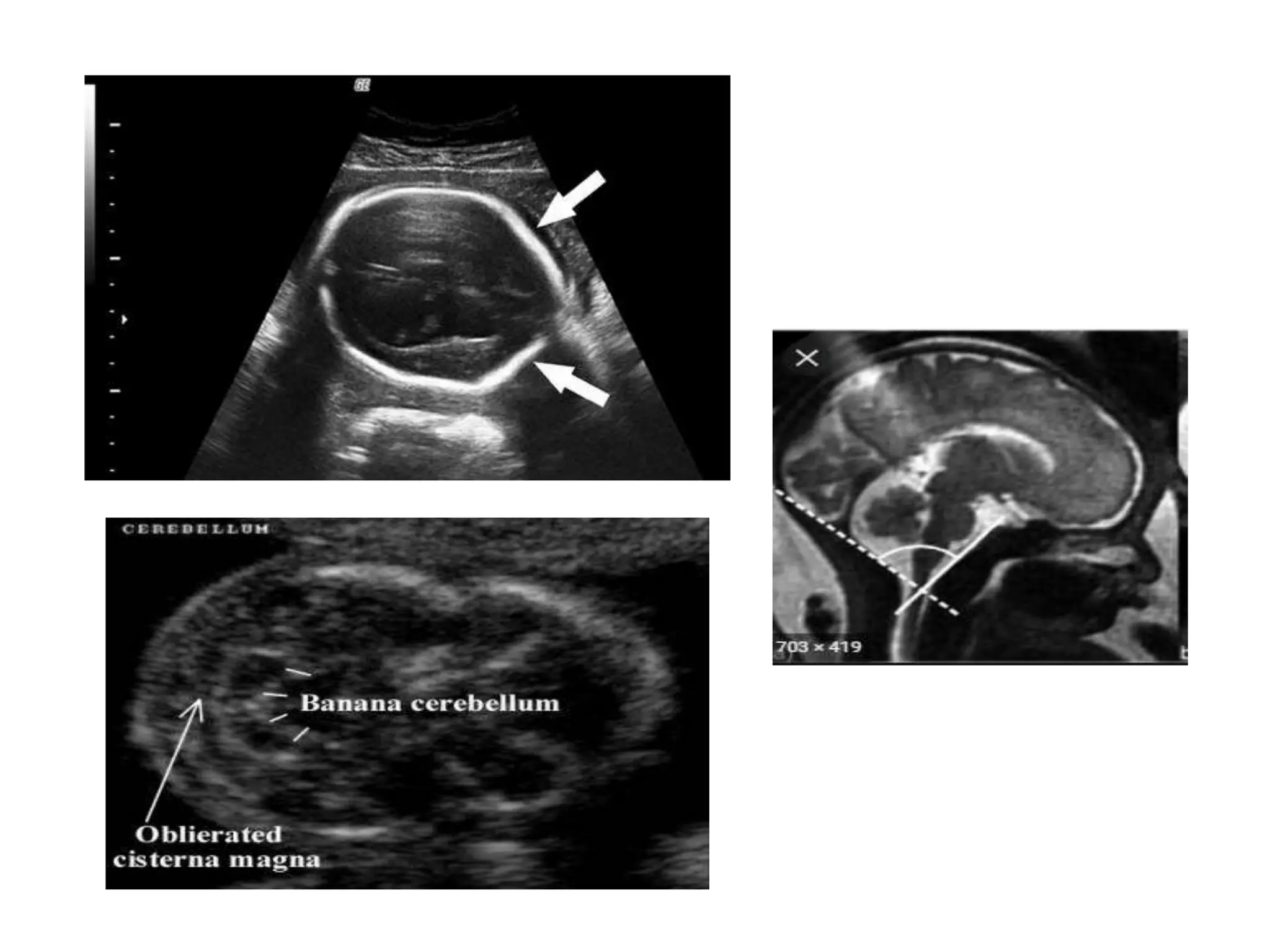
• Cisterna magna obliteration suggests Chiari II
malformation and spina bifida.
• Excessive enlargement may be seen with
mega– cisterna magna, Blake pouch cyst,
vermian dysplasia, Dandy-Walker syndrome,
and arachnoid cysts.
VARIANTS (USUALLY NORMAL)
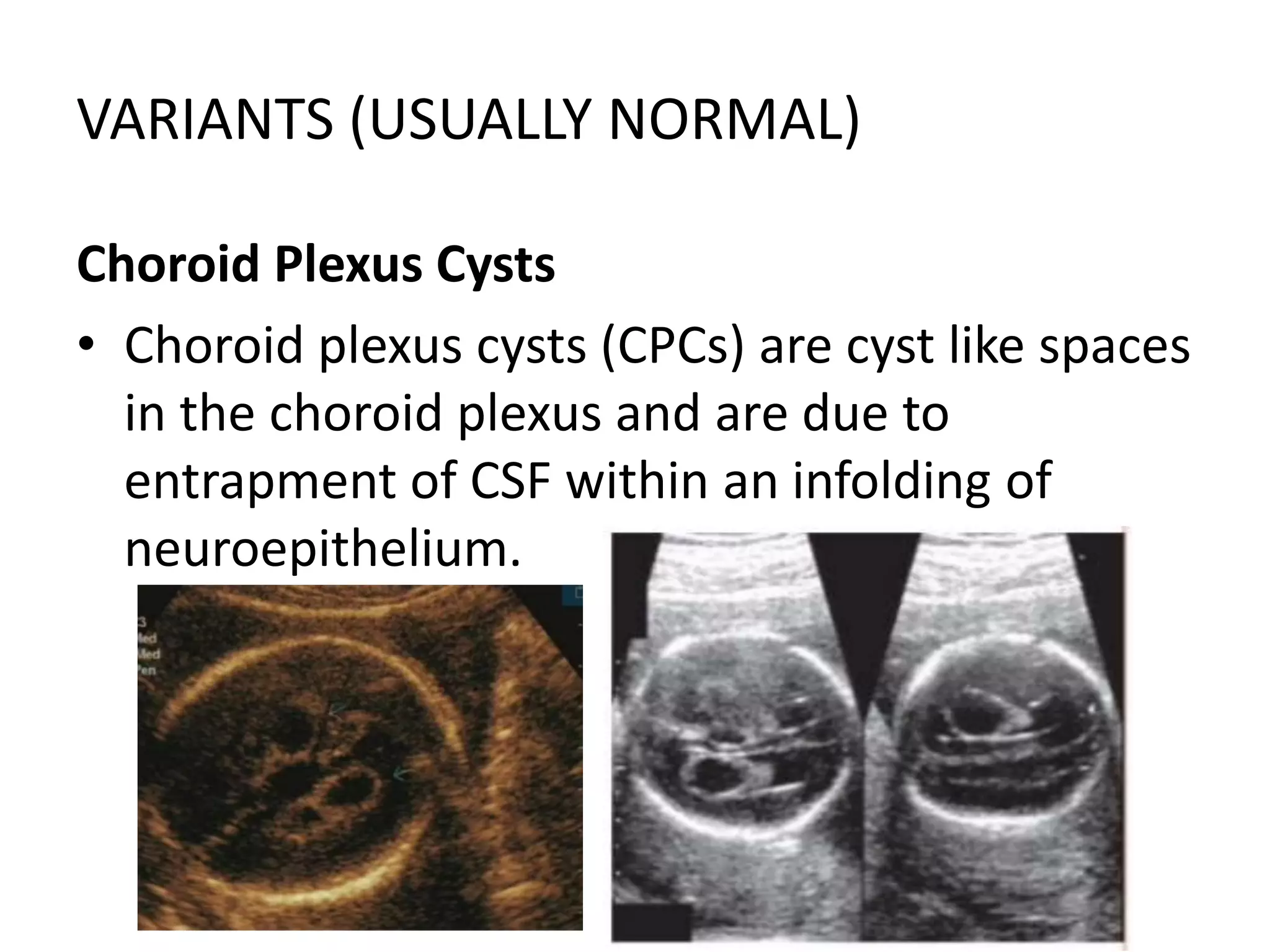
Choroid Plexus Cysts
• Choroid plexus cysts (CPCs) are cyst like spaces
in the choroid plexus and are due to
entrapment of CSF within an infolding of
neuroepithelium.
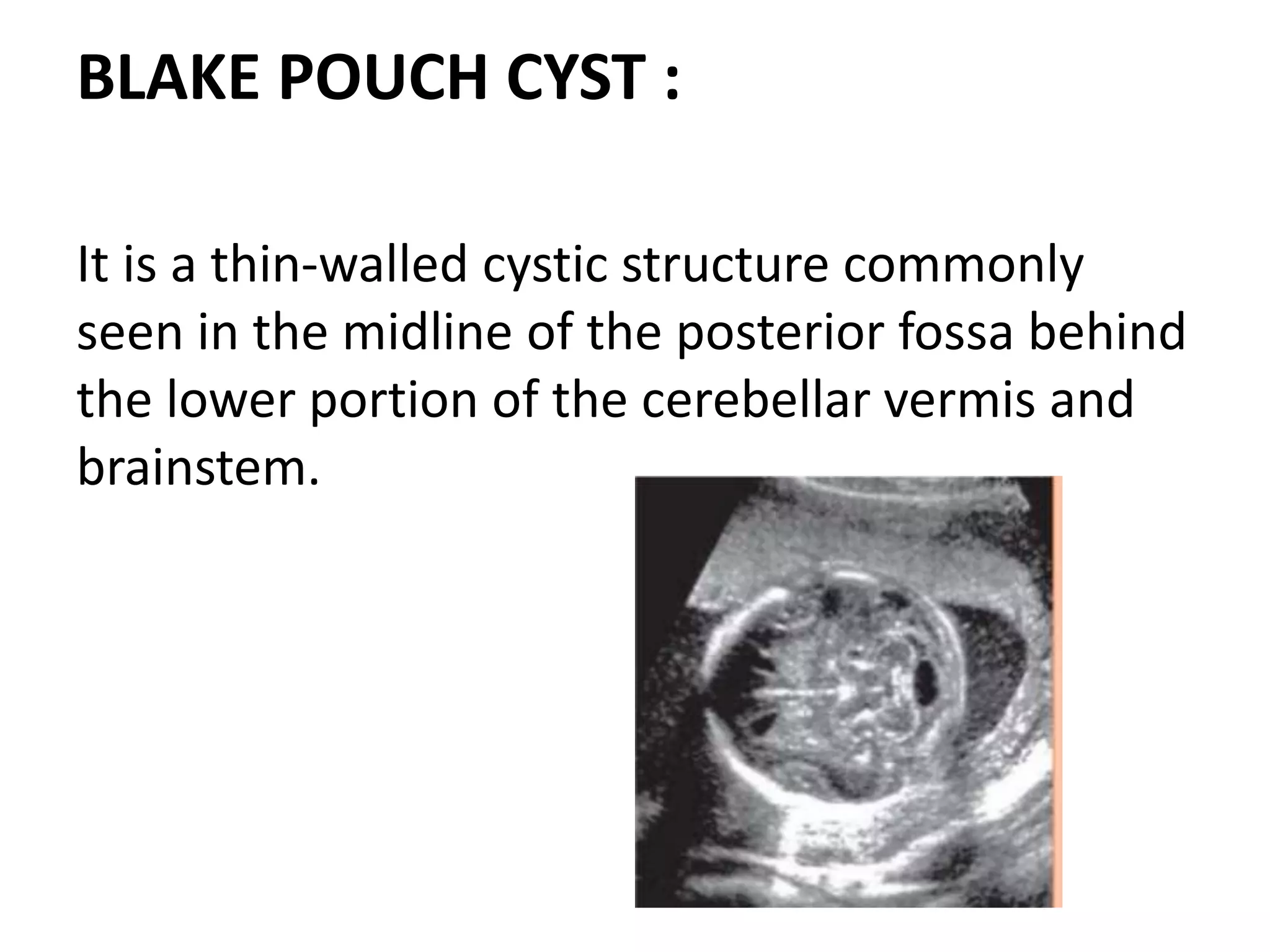
BLAKE POUCH CYST :
It is a thin-walled cystic structure commonly
seen in the midline of the posterior fossa behind
the lower portion of the cerebellar vermis and
brainstem.
CAVUM VELI INTERPOSITI
• Cavum veli interpositi (CVI) is a small cystic
collection in the midline, seen below the
splenium of the corpus callosum, behind the
upper brainstem and above the region of the
pineal gland
VENTRICULOMEGALY
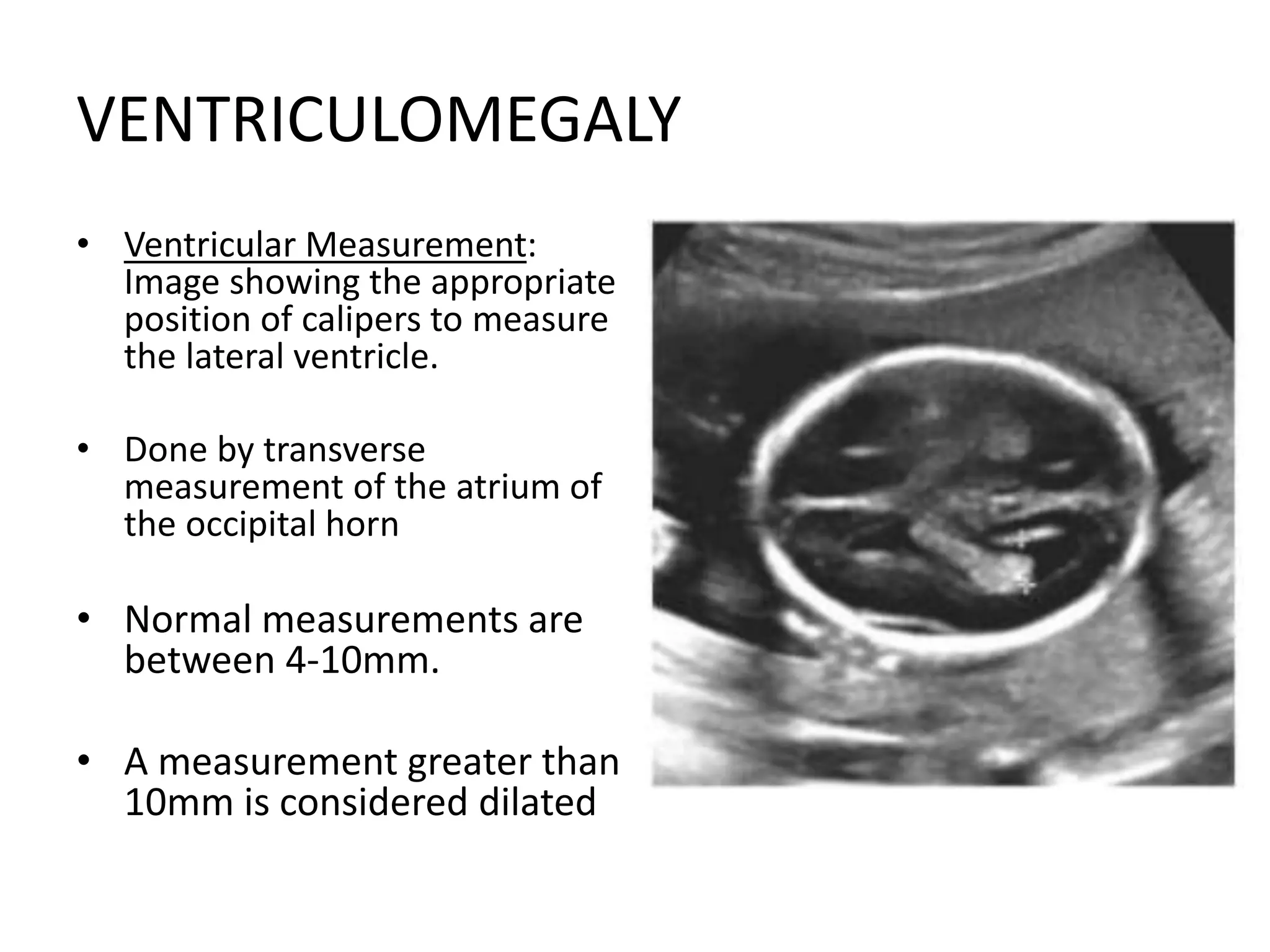
• Ventricular Measurement:
Image showing the appropriate
position of calipers to measure
the lateral ventricle.
• Done by transverse
measurement of the atrium of
the occipital horn
• Normal measurements are
between 4-10mm.
• A measurement greater than
10mm is considered dilated
• Mild Ventriculomegaly: the ventricles measure
between 10–11mm.
• Moderate Ventriculomegaly: the ventricles
measure between 12–14mm.
• Severe Ventriculomegaly: the ventricles
measure 15mm or more
• Hydrocephalus (HC) refers to enlarged
ventricles associated with increased
intracranial pressure and thus is typically
associated with head enlargement.
• lateral ventricular diameter >15 mm
ERRORS OF DORSAL INDUCTION
• CNS development begins with development of
the notochord, which subsequently induces the
dorsal development of the neural plate, which
closes to form the neural tube, which becomes
the spinal cord and part of the brain.
• Errors of dorsal induction can result from many
different genetic and teratogenic factors and
affect development of the dorsal neural plate and
closure of the neural canal (neurulation).
CEPHALOCELE AND ENCEPHALOCELE
• A cephalocele is a herniation of intracranial structures
through a defect in the cranium or skull base.
• It is termed cranial meningocele when it contains only
meninges & CSF and encephalocele when it contains brain
tissue.
ERRORS OF DORSAL INDUCTION
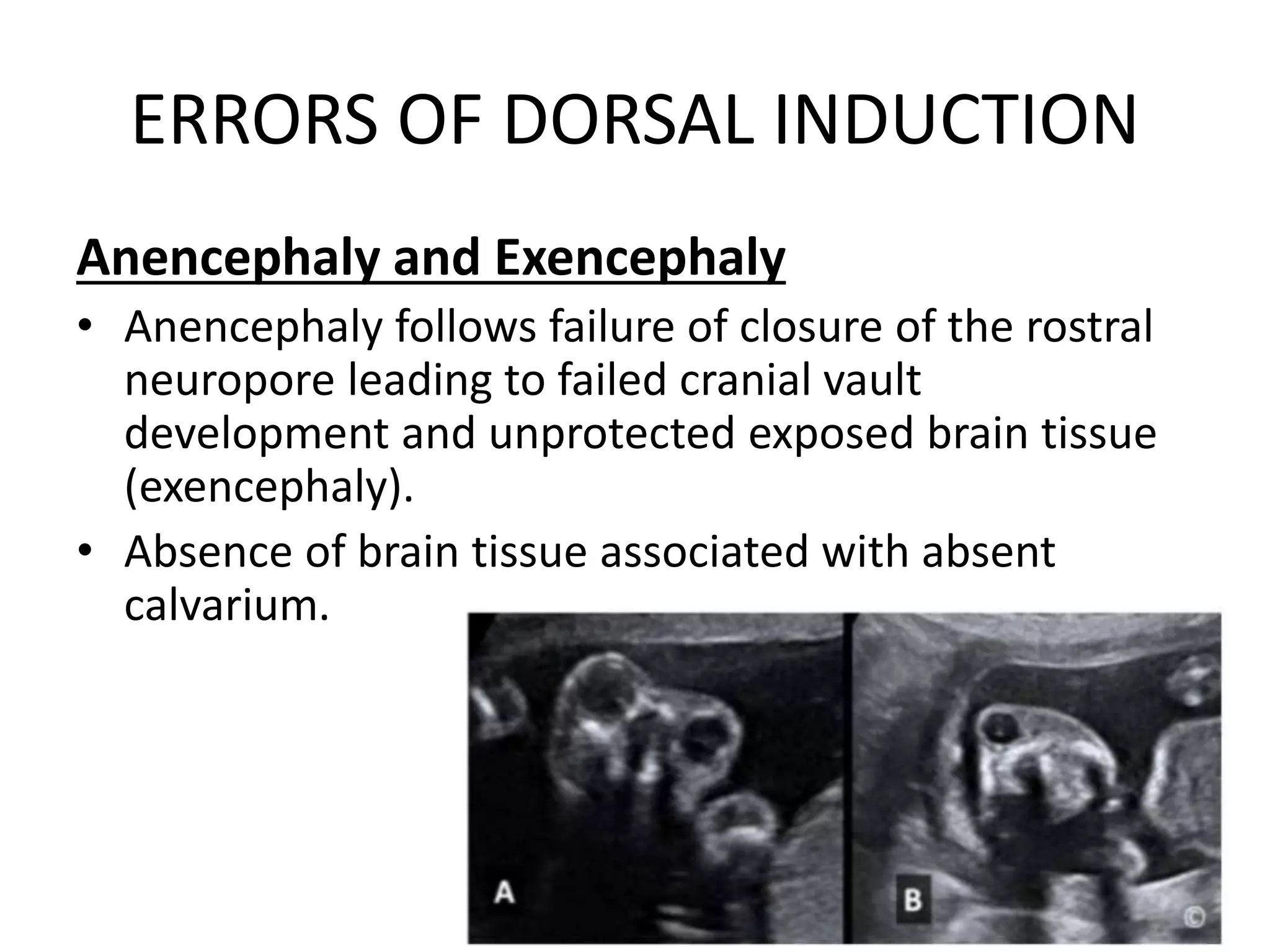
Anencephaly and Exencephaly
• Anencephaly follows failure of closure of the rostral
neuropore leading to failed cranial vault
development and unprotected exposed brain tissue
(exencephaly).
• Absence of brain tissue associated with absent
calvarium.
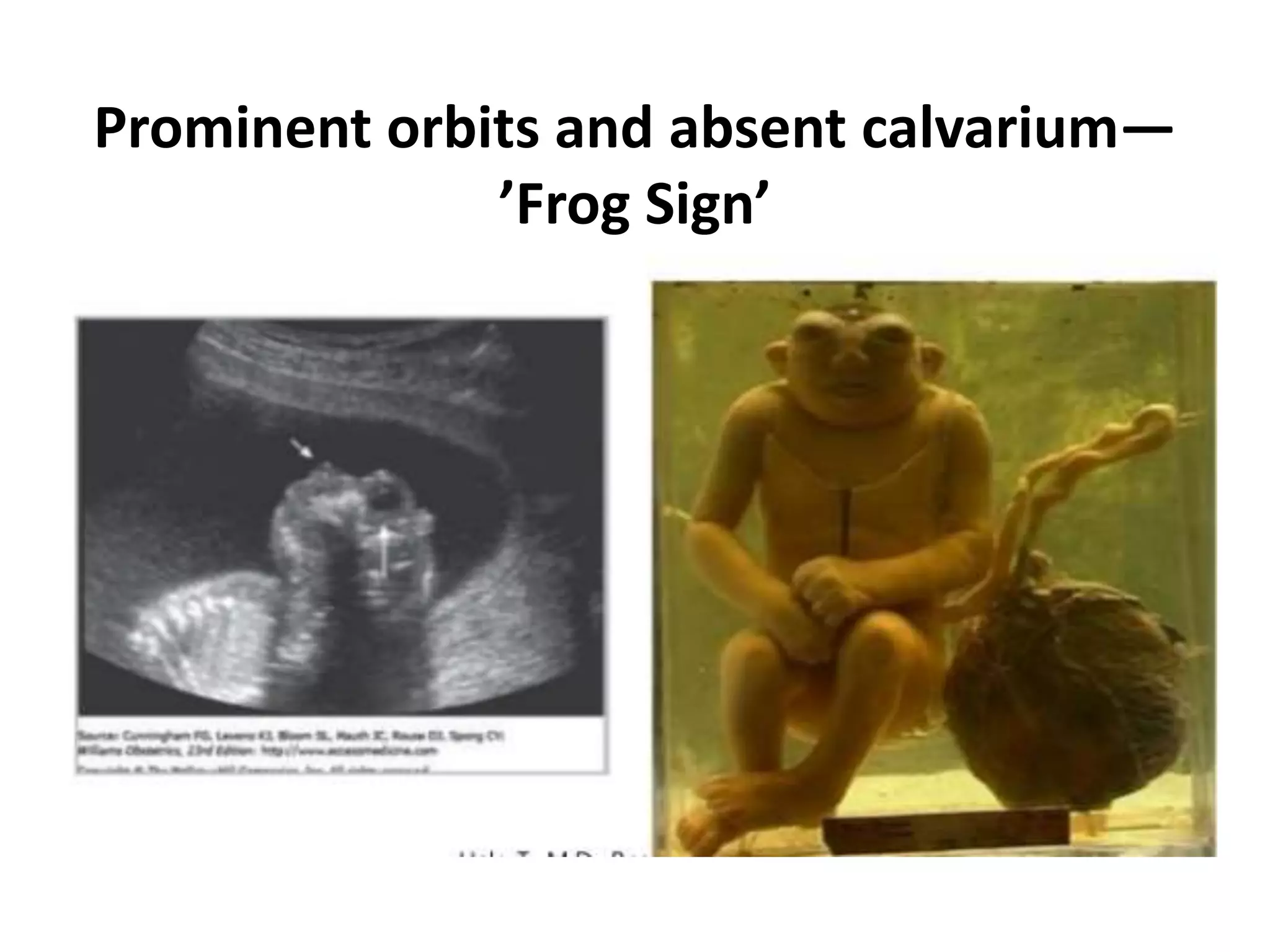
Prominent orbits and absent calvarium—
’Frog Sign’
ERRORS OF VENTRAL INDUCTION
• Errors of ventral induction occur in the rostral end of the
embryo and result in brain abnormalities of the
prosencephalon, mesencephalon, and rhombencephalon
and usually also affect facial development
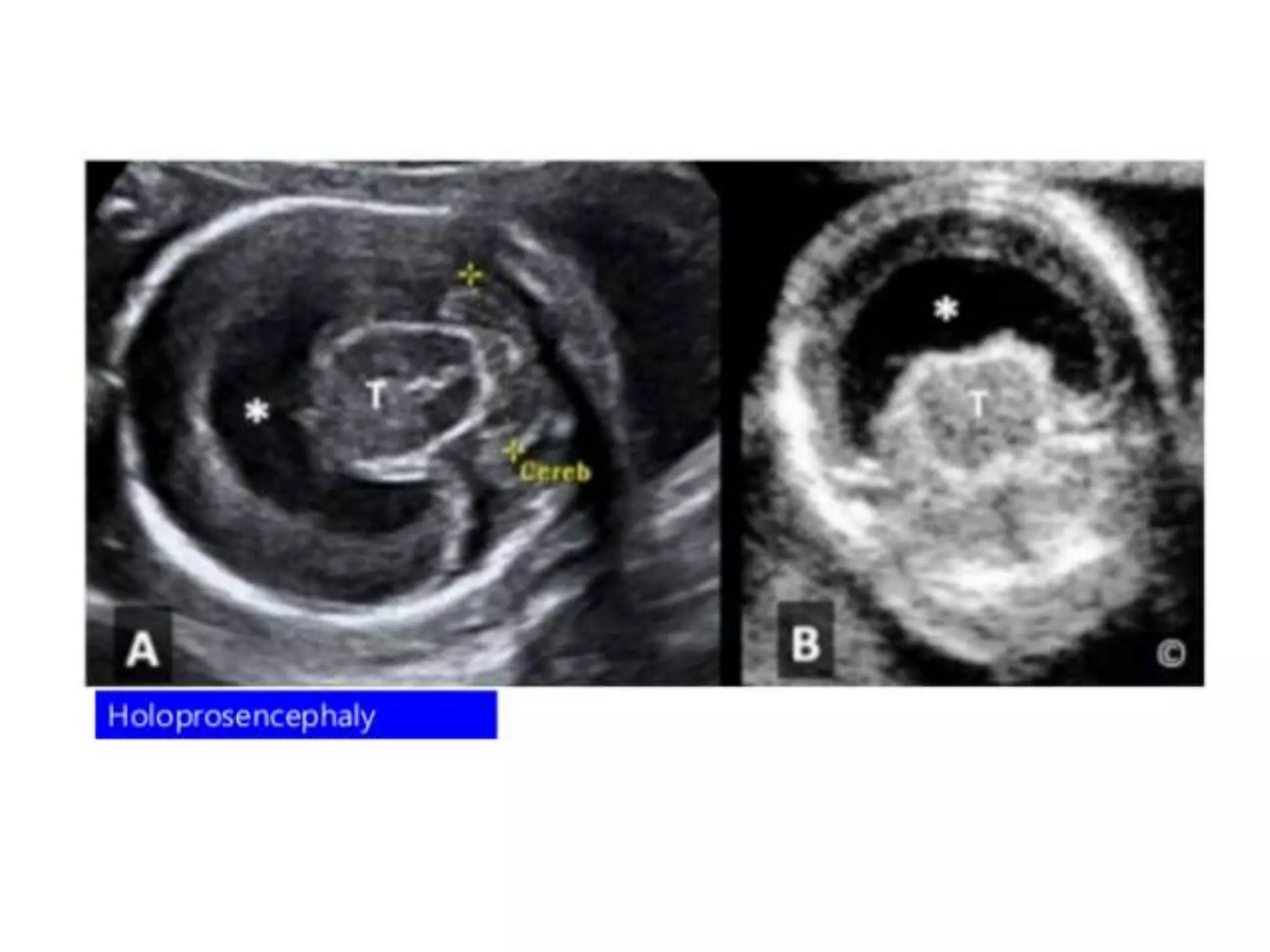
• HOLOPROSENCEPHALY :Holoprosencephaly (HPE) is a
complex brain malformation resulting from incomplete
separation of the prosencephalic diverticulum into right
and left cerebral hemispheres.3 types:
• ALOBAR
• SEMILOBAR
• LOBAR
POSTERIOR FOSSA AND CEREBELLUM
Dandy-Walker
Malformation
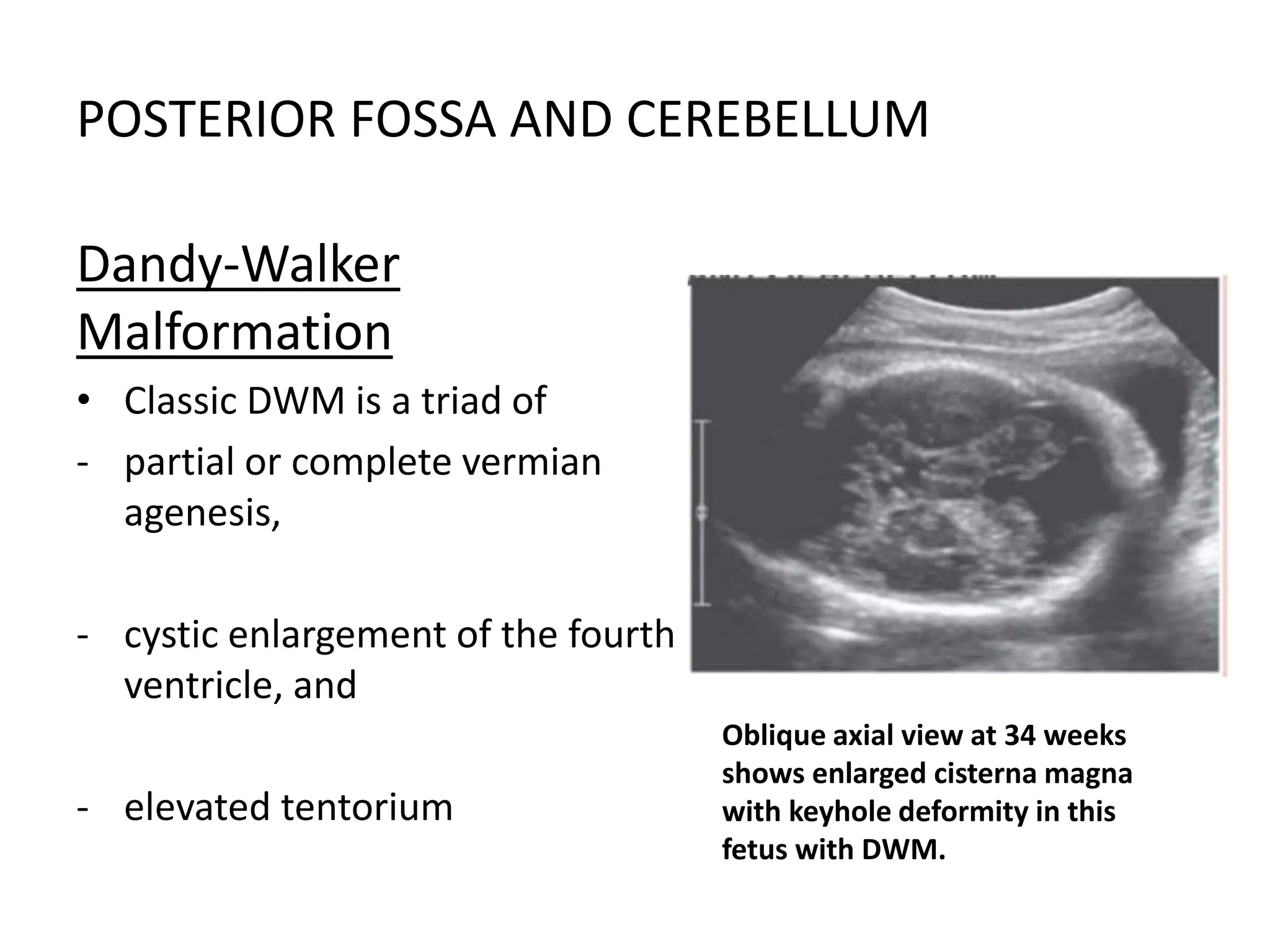
• Classic DWM is a triad of
- partial or complete vermian
agenesis,
- cystic enlargement of the fourth
ventricle, and
- elevated tentorium
Oblique axial view at 34 weeks
shows enlarged cisterna magna
with keyhole deformity in this
fetus with DWM.
MEGA CISTERNA MAGNA
• Mega–cisterna magna
(MCM) refers to an
enlargement of the
cisterna magna beyond
10 mm with intact
vermis and the lateral
Blake cyst walls (arrows)
with echogenic
subarachnoid fluid
lateral to the walls.
Mega– cisterna magna
(*) axial view. Note
the clear fluid content
SPINA BIFIDA
Cranial Signs Associated With Open Spina Bifida
Face
The three planes of examination of the fetal face
are
• axial,
• sagittal and
• coronal.
The three major structures to be visualized are:
• i. Orbits
• ii. Nose and
• iii. Mouth
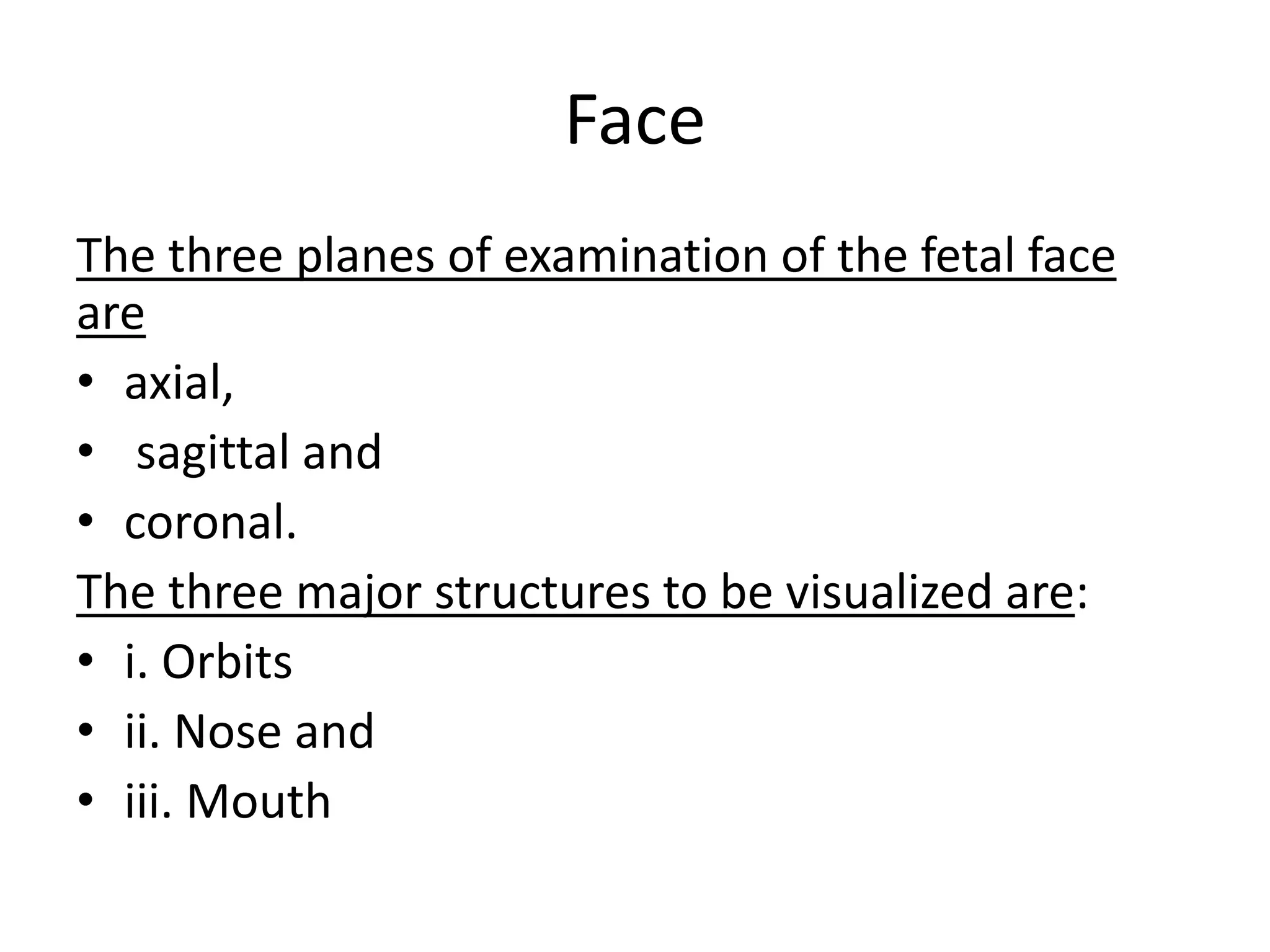
a Axial view of fetal orbits. O orbits. b Mid-sagittal
view of the fetal face (‘‘profile’’ view).
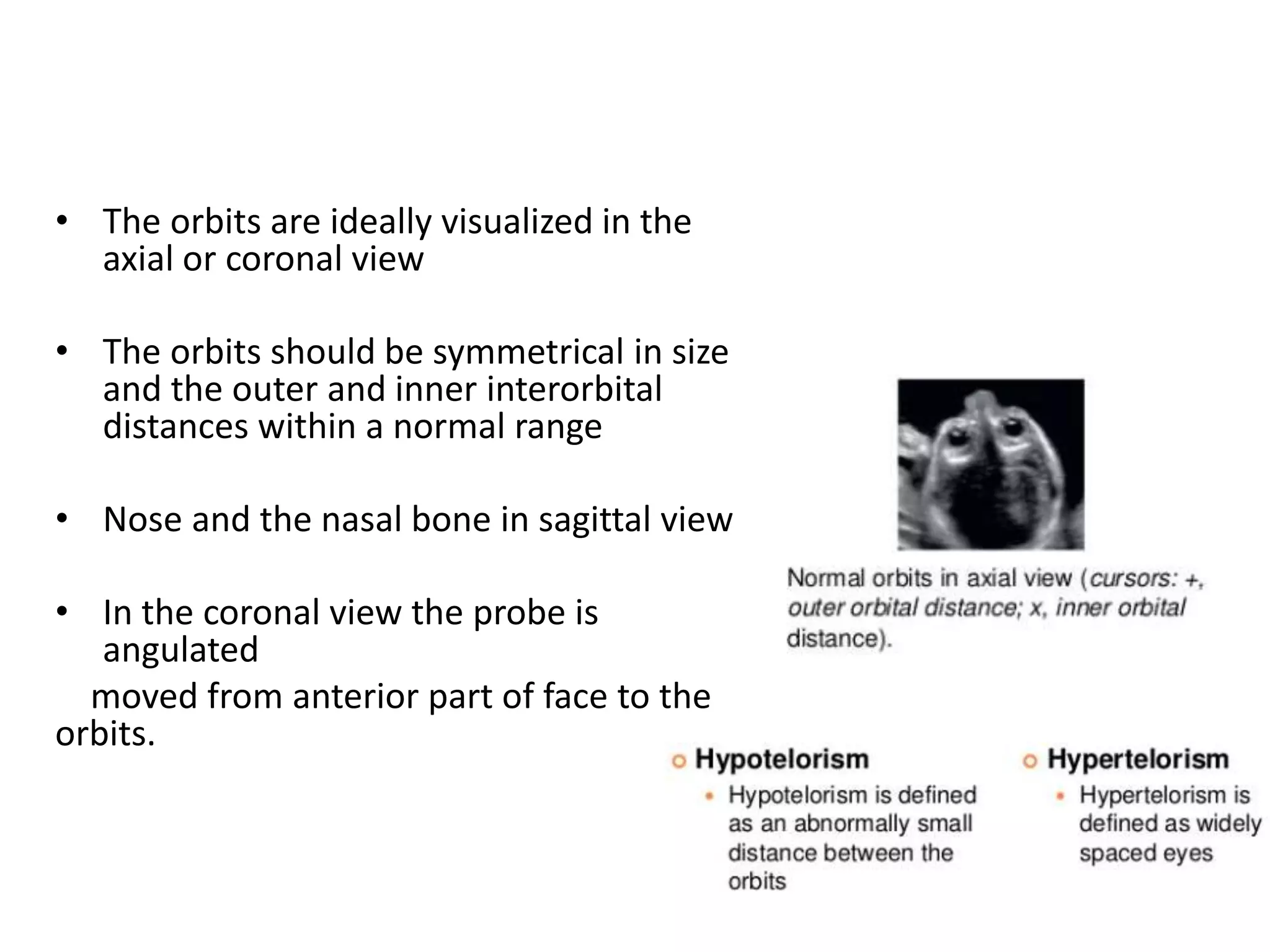
• The orbits are ideally visualized in the
axial or coronal view
• The orbits should be symmetrical in size
and the outer and inner interorbital
distances within a normal range
• Nose and the nasal bone in sagittal view
• In the coronal view the probe is
angulated
moved from anterior part of face to the
orbits.
Congenital Cataracts
• Congenital cataracts may be
diagnosed on prenatal solography,
which will show a rounded
echogenic mass in the anterior
portion of the globe.
• Causes of congenital cataracts
include genetic disorders,
infection, syndromes, and
microphthalmia
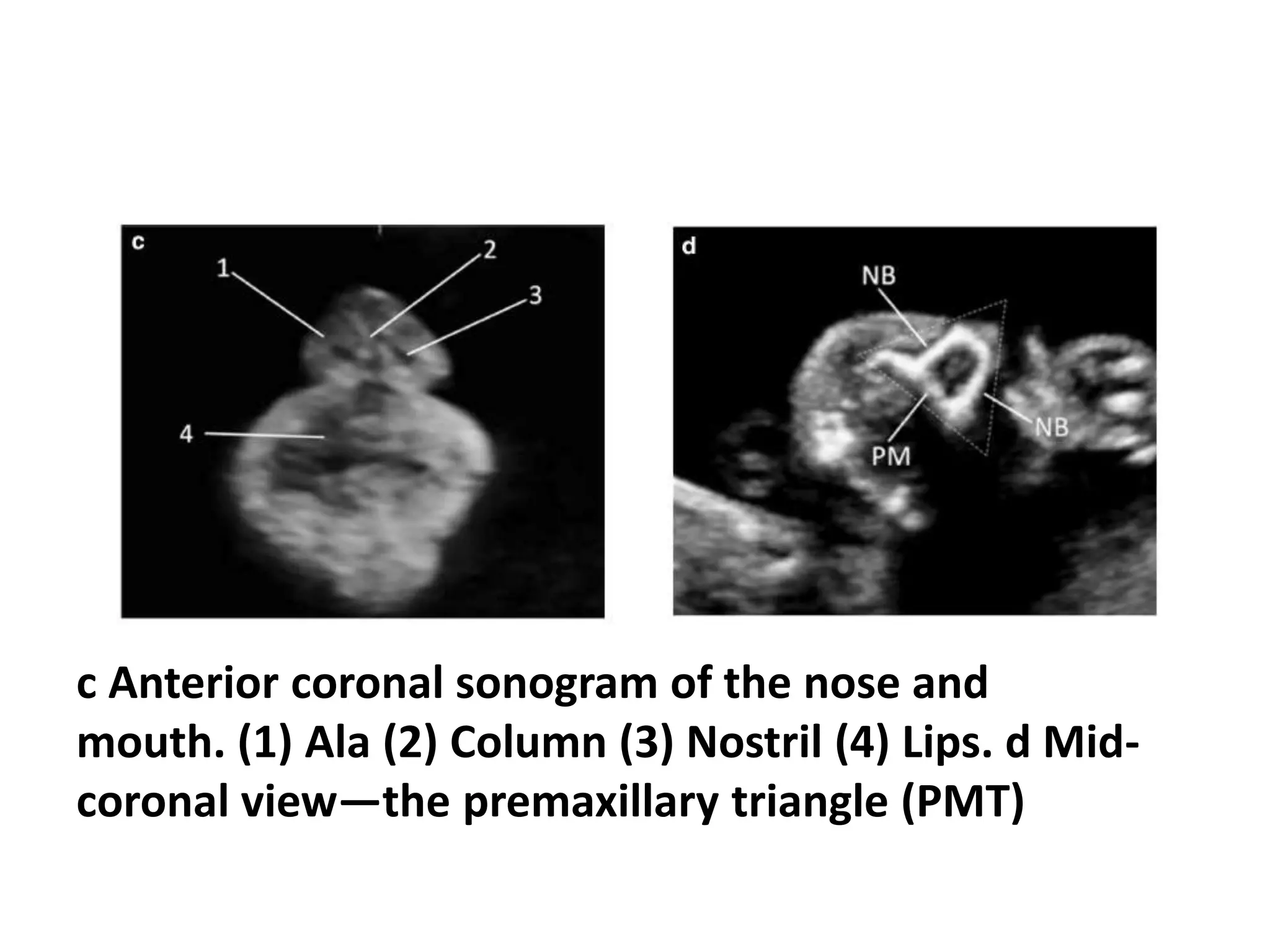
c Anterior coronal sonogram of the nose and
mouth. (1) Ala (2) Column (3) Nostril (4) Lips. d Mid-
coronal view—the premaxillary triangle (PMT)
NASAL BONE
• assessed on a midsagittal view of the fetal face.
• Ideally three echogenic lines should be seen.
• The difficulty in defining nasal bone hypoplasia
has historically lead to the development of
various criteria, based on measurements such as
• BPD: nasal bone ratio ,
• gestational age-adjusted nasal bone length, or
• a single cut-off definition (0.25 cm)
PT/NBL RATIO
• NBL= Nasal Bone Length
• PT= Prenasal thickness
• In normal fetuses, prenasal
thickness increases with gestation
from a mean of 2.4mm at 16 weeks
to 4.6 mm at 24 weeks.
• The increase in prenasal thickness
has been reported as a sonographic
marker for Down syndrome in the
second trimester.
• N=0.35-0.8
• Chromosomal abnormalities=>0.8
Nasal bone hypoplasia can be defined by a ratio of biparietal
diameter/nasal bone length greater than 11
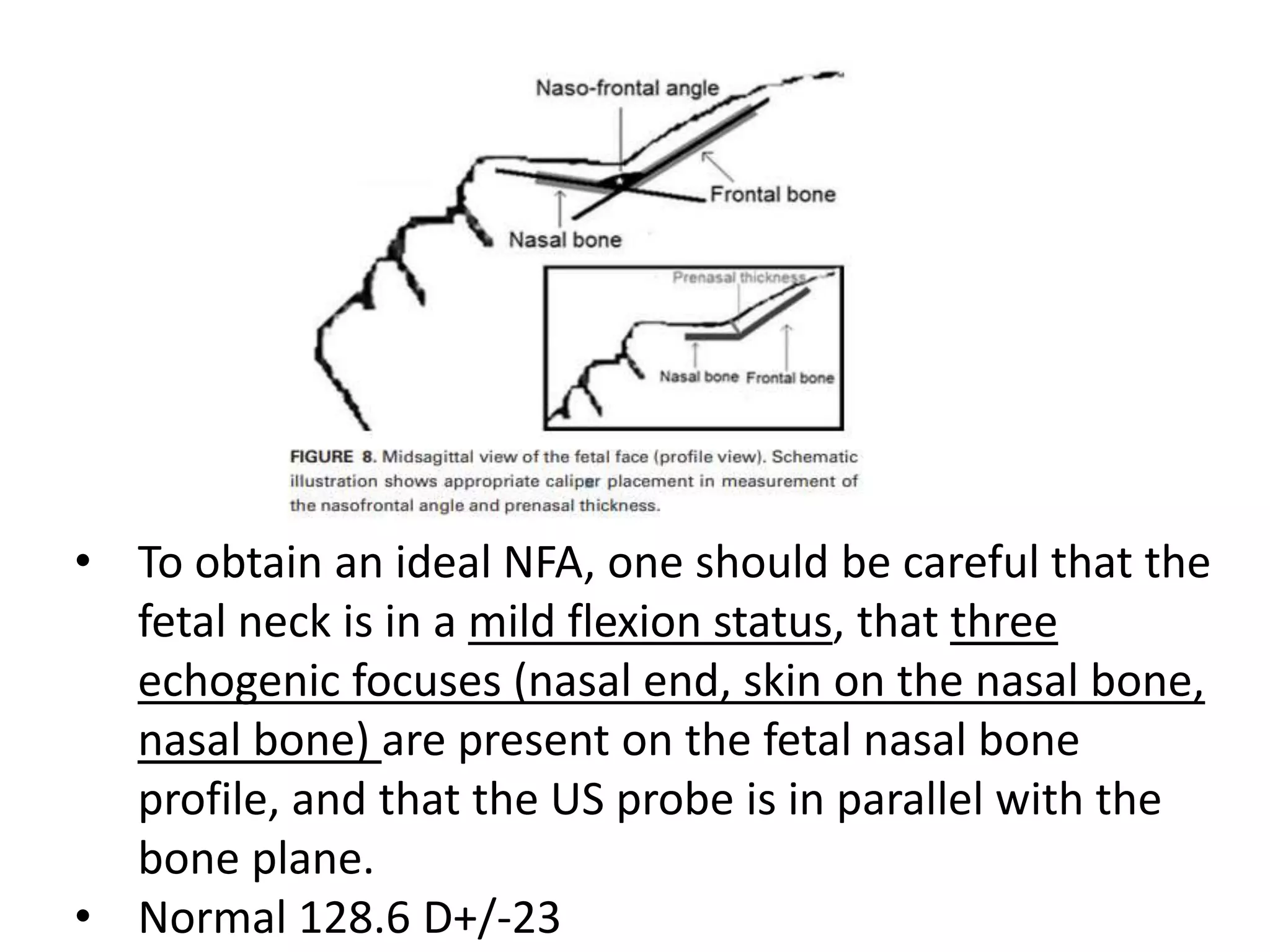
• To obtain an ideal NFA, one should be careful that the
fetal neck is in a mild flexion status, that three
echogenic focuses (nasal end, skin on the nasal bone,
nasal bone) are present on the fetal nasal bone
profile, and that the US probe is in parallel with the
bone plane.
• Normal 128.6 D+/-23
Lips/Nose
• In the anterior coronal view nose and lips are
identified.
• In the mid-coronal view the premaxillary triangle
(PMT) is identified which is formed by the two nasal
bones as the two sides of the triangle and the
premaxilla as the base of the triangle.
• The completion of the triangle ensures that there
is no cleft hard palate.
• The posterior coronal view shows the orbits.
• The far orbit will not be visualized due to
shadowing from the nasal bones. Hence an
axial view is preferable.
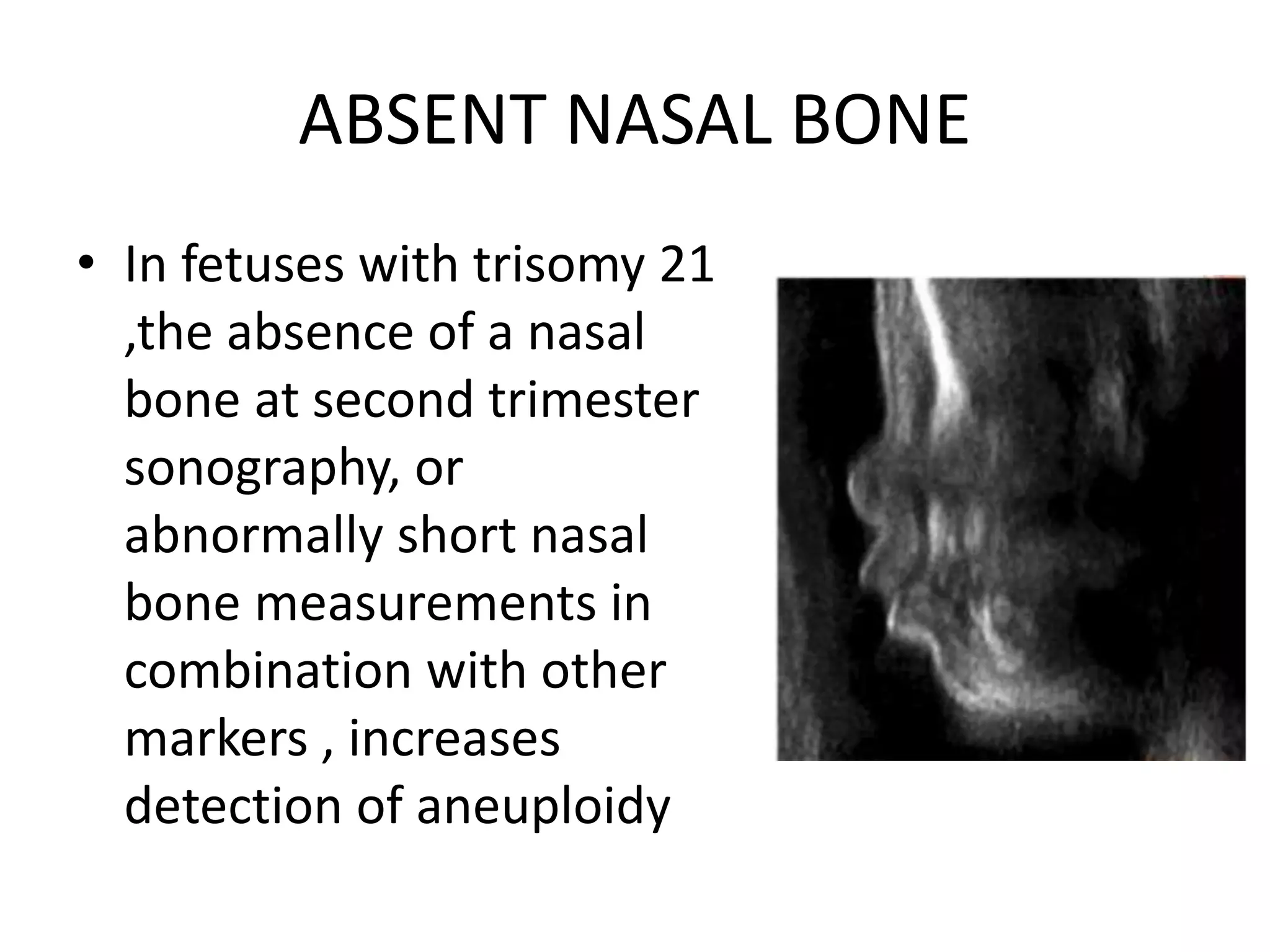
ABSENT NASAL BONE
• In fetuses with trisomy 21
,the absence of a nasal
bone at second trimester
sonography, or
abnormally short nasal
bone measurements in
combination with other
markers , increases
detection of aneuploidy
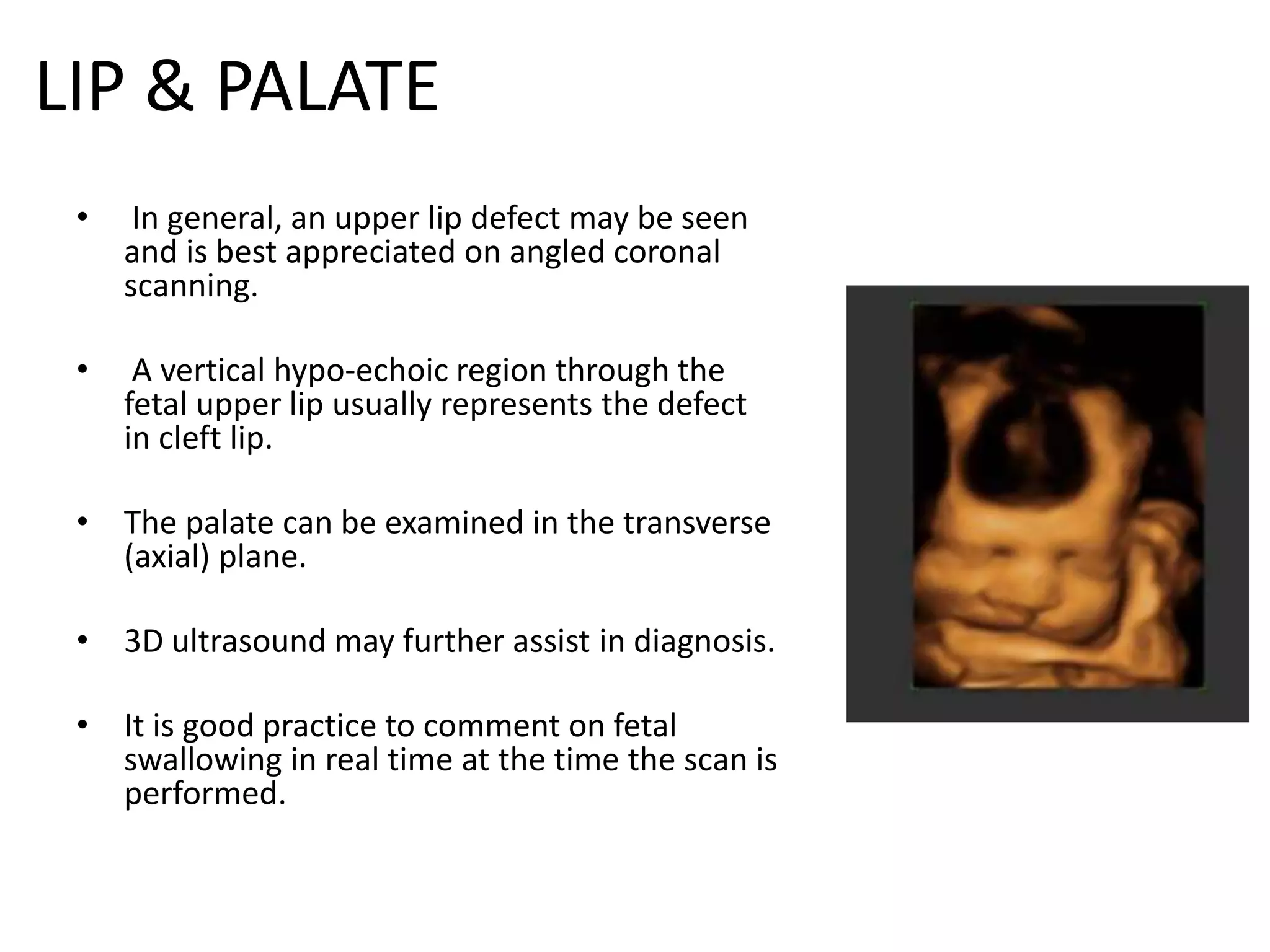
LIP & PALATE
• In general, an upper lip defect may be seen
and is best appreciated on angled coronal
scanning.
• A vertical hypo-echoic region through the
fetal upper lip usually represents the defect
in cleft lip.
• The palate can be examined in the transverse
(axial) plane.
• 3D ultrasound may further assist in diagnosis.
• It is good practice to comment on fetal
swallowing in real time at the time the scan is
performed.
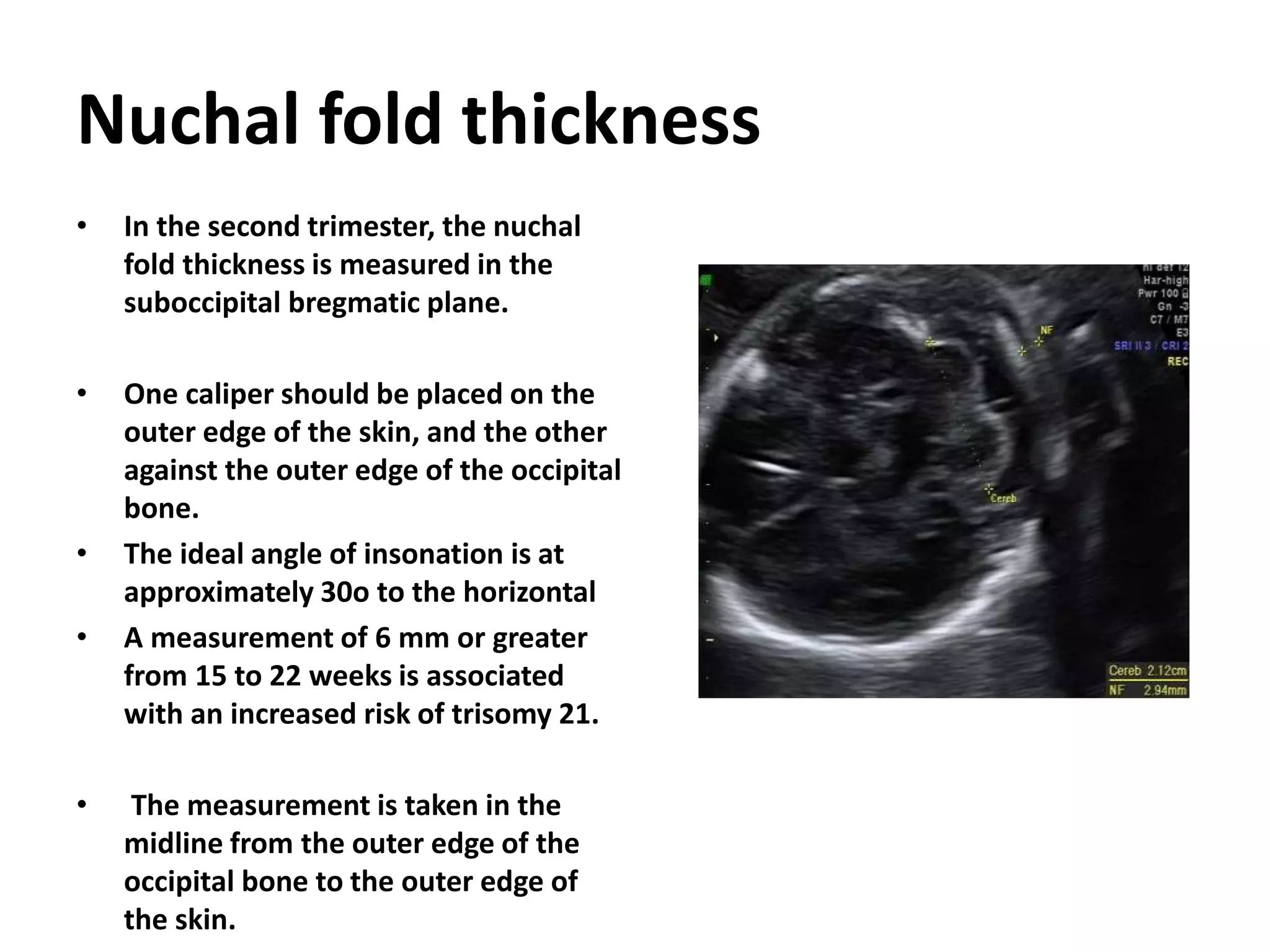
Nuchal fold thickness
• In the second trimester, the nuchal
fold thickness is measured in the
suboccipital bregmatic plane.
• One caliper should be placed on the
outer edge of the skin, and the other
against the outer edge of the occipital
bone.
• The ideal angle of insonation is at
approximately 30o to the horizontal
• A measurement of 6 mm or greater
from 15 to 22 weeks is associated
with an increased risk of trisomy 21.
• The measurement is taken in the
midline from the outer edge of the
occipital bone to the outer edge of
the skin.
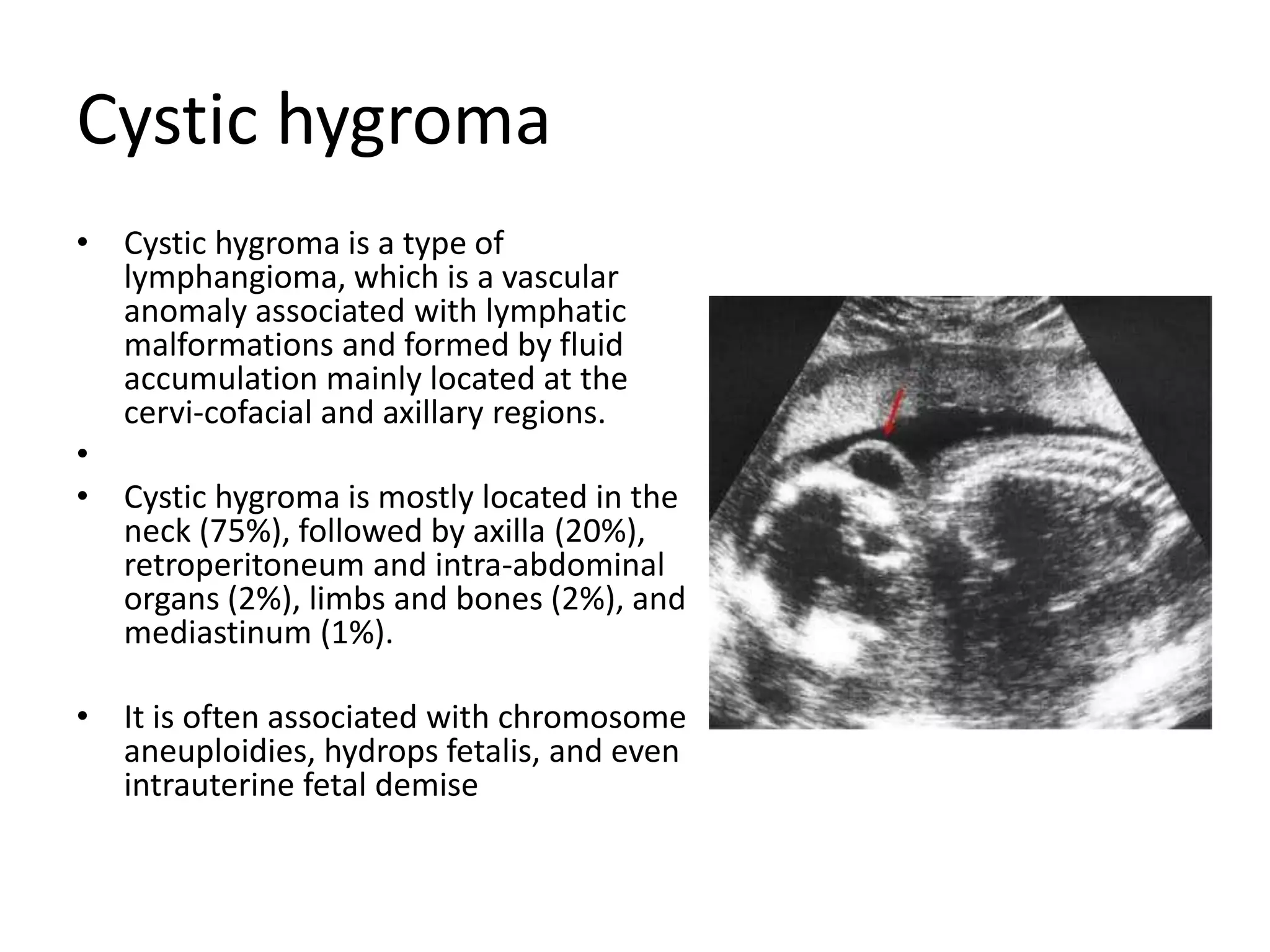
Cystic hygroma
• Cystic hygroma is a type of
lymphangioma, which is a vascular
anomaly associated with lymphatic
malformations and formed by fluid
accumulation mainly located at the
cervi-cofacial and axillary regions.
•
• Cystic hygroma is mostly located in the
neck (75%), followed by axilla (20%),
retroperitoneum and intra-abdominal
organs (2%), limbs and bones (2%), and
mediastinum (1%).
• It is often associated with chromosome
aneuploidies, hydrops fetalis, and even
intrauterine fetal demise
Thorax
The thorax comprises three structures
• Heart
• Right lung
• Left lung
• The two lungs and heart occupy equal space in
the thorax (1/3) each.
• The upper limit of the normal sized heart Is 50 %
of the thoracic size.
Thorax
• The shape should be regular
with a smooth transition to the
abdomen.
• The ribs should have normal
curvature without deformities.
• Both lungs should appear
homogeneous and without
evidence of mediastinal shift or
masses.
• The diaphragmatic interface
can often be visualized as a
hypoechoic dividing line
between the thoracic and
abdominal content (e.g. liver
and stomach)
Sagittal view of torso at 13 weeks. Note liver
(Li), lungs (Lu), and diaphragm (arrow).
Differential Diagnosis of Echogenic
Lesion in Fetal Thorax
Spine
The spine is imaged in three axes, namely
1. Sagittal
2. Transverse
3. Coronal
In the sagittal axis, we look for three aspects of the
spine.
i. Cervical widening
ii. Parallel thoracic and lumbar spine
iii. Sacral tapering
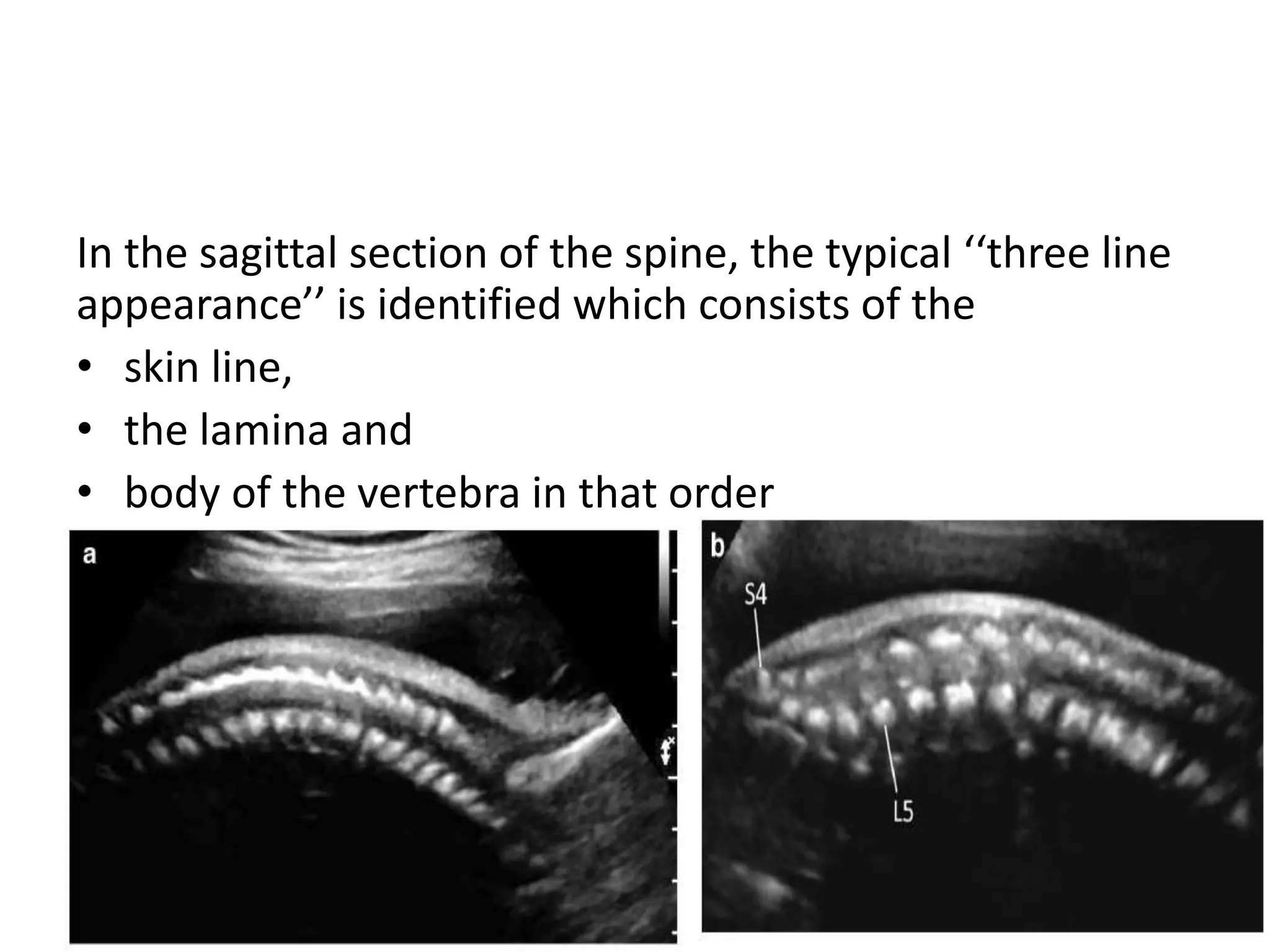
In the sagittal section of the spine, the typical ‘‘three line
appearance’’ is identified which consists of the
• skin line,
• the lamina and
• body of the vertebra in that order
• In the transverse axis, the three ossification
centers forming a triangular shape is identified
coronal view
• It is not compulsory
during targeted scan.
• However one should
remember that the
minimal widened
appearance of lumbar
vertebra in this view
is normal and should
not be mistaken for
spina bifida.
Heart
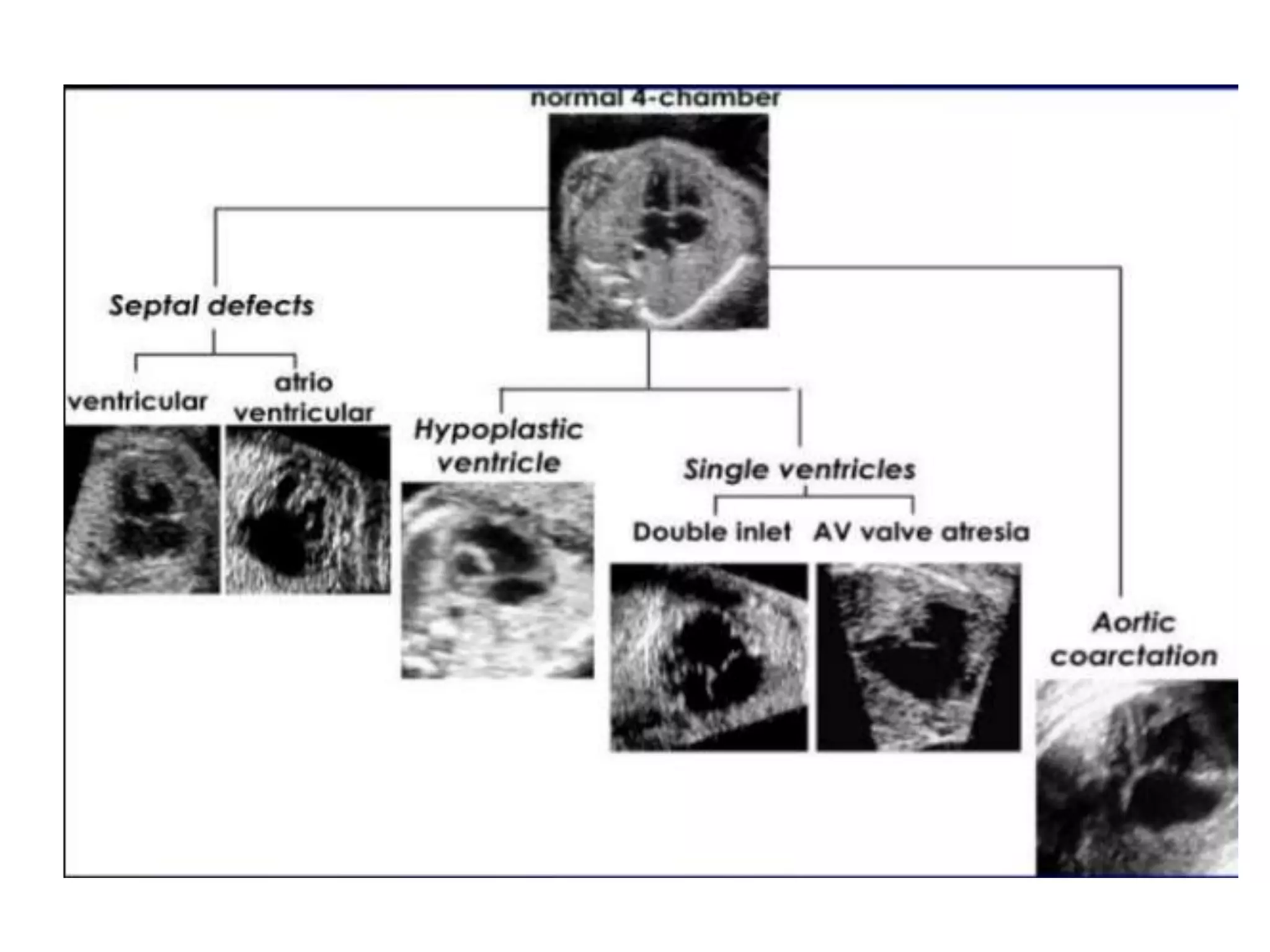
The three views of the heart that should be seen are:
1. Four chamber view
2. Outflow tracts
3. Three vessel view
Four Chamber view: In a four chamber view, the three
structures to look for are:
• i. The crux of the heart formed by the IVS, atrioventricular
• septum and interartrial septum
• ii. Chamber symmetry
• iii. Movements of mitral and tricuspid valves in real time
Check at a glance
• 2 ventricles/ walls of equal size
• 2 atria/ walls of equal size
• Foramen ovale moving in left atrium
• Pulmonary veins entering left atrium
• Motion of mitral valves(left side) regular
• Motion of tricuspid valves(right side) regular
• Continuity of interventricular septum
• The basic cardiac screening examination is interpreted
from a four-chamber view of the fetal heart.
• A normal regular rate ranges from 120 to 160 beats per
min.
• The heart should be located in the left chest (same side
as the fetal stomach) if the situs is normal.
• A normal heart is usually no larger than one-third of
the area of the chest and is without pericardial
effusion.
• The heart is normally deviated by about 45±20◦
towards the left side of the fetus.
Normal position and
axis of the heart. The
heart is
predominantly in the
left side of the chest,
with the apex of the
heart pointing
leftward. Dual-screen
image shows the
stomach also on the
left side.
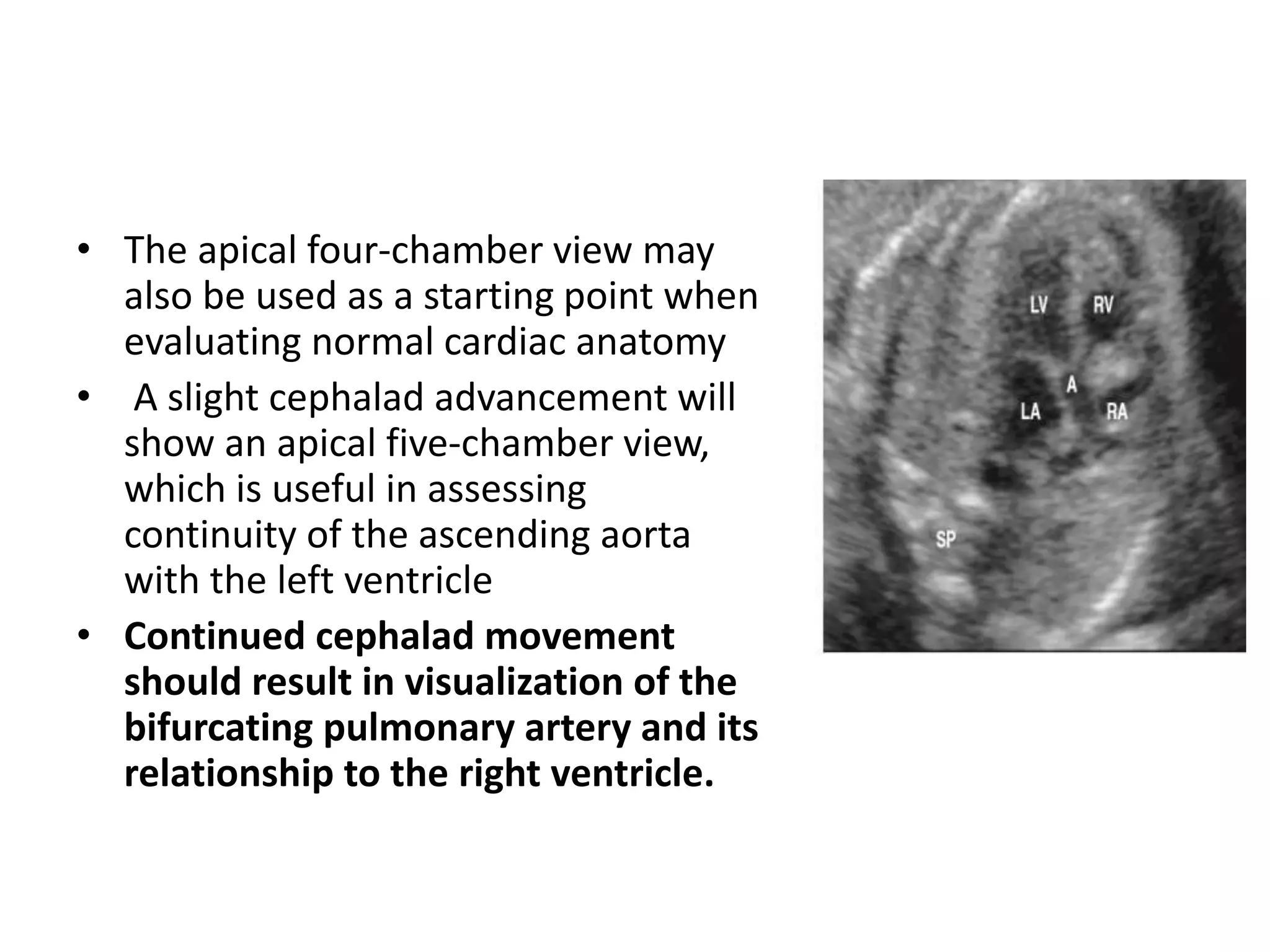
1.Four chamber view:
• The apical four-chamber view may
also be used as a starting point when
evaluating normal cardiac anatomy
• A slight cephalad advancement will
show an apical five-chamber view,
which is useful in assessing
continuity of the ascending aorta
with the left ventricle
• Continued cephalad movement
should result in visualization of the
bifurcating pulmonary artery and its
relationship to the right ventricle.
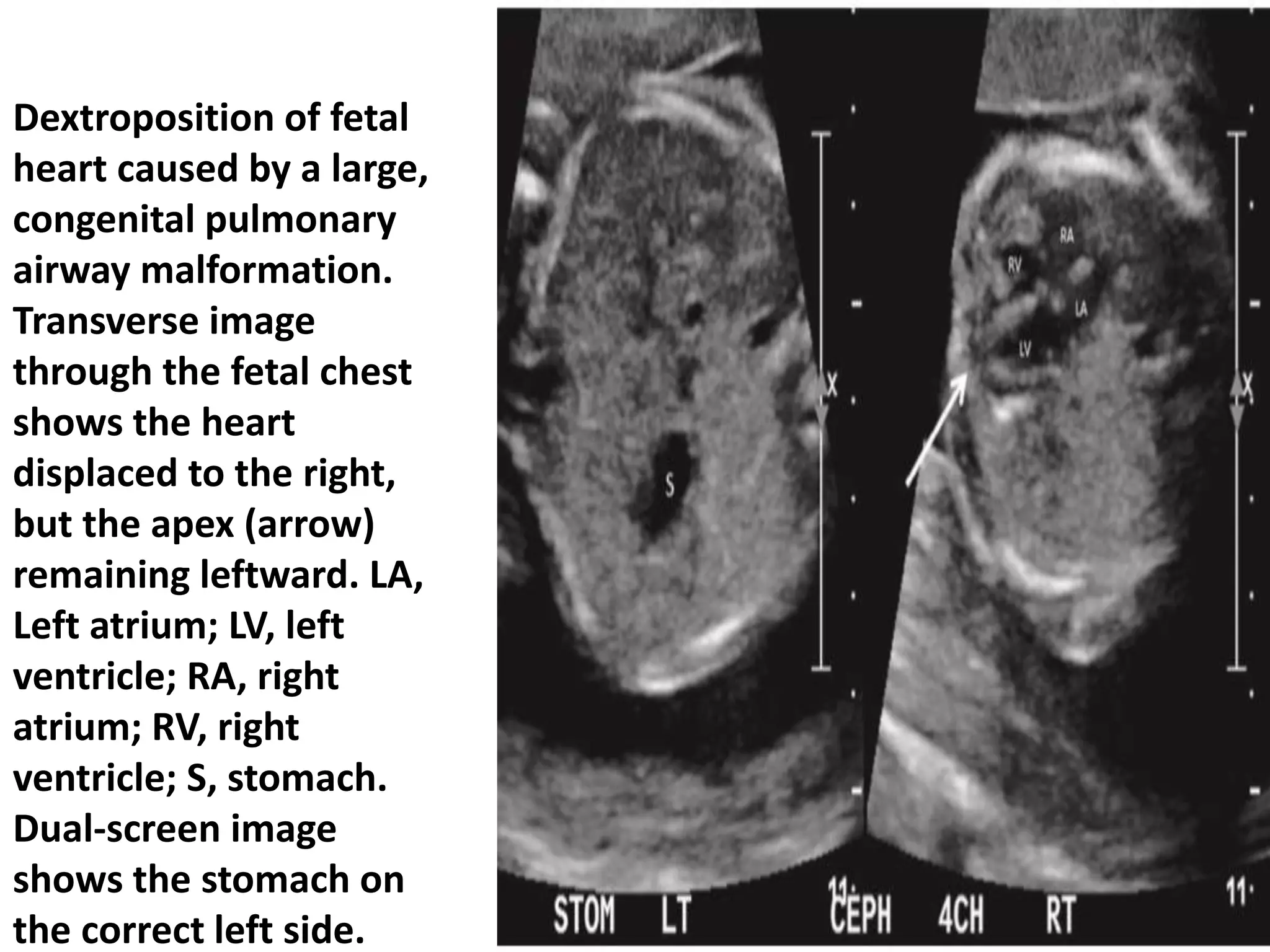
Dextroposition of fetal
heart caused by a large,
congenital pulmonary
airway malformation.
Transverse image
through the fetal chest
shows the heart
displaced to the right,
but the apex (arrow)
remaining leftward. LA,
Left atrium; LV, left
ventricle; RA, right
atrium; RV, right
ventricle; S, stomach.
Dual-screen image
shows the stomach on
the correct left side.
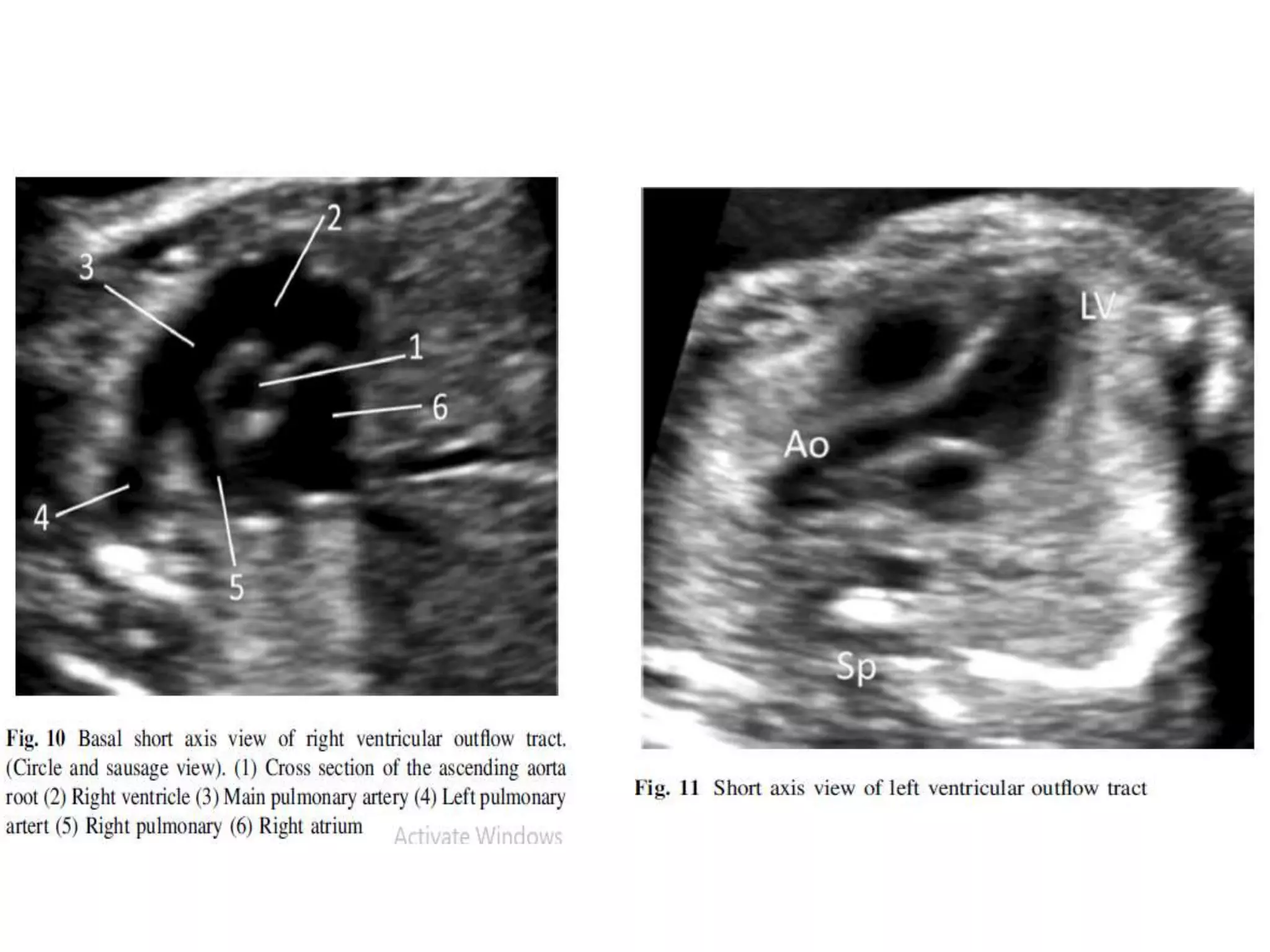
2. Outflow Tracts
• At the origin, the outflow tracts are
seen crossing each other with pulmonary artery anterior and aorta posterior.
• The anterior aortic root should be
continuous with the interventricular septum and the posterior aortic root
with the mitral valve
• The bifurcation of the pulmonary artery must be documented.
• The crossing of the outflow tract can be
appreciated in the transverse view (circle sausage view)
which shows the cross-section of the aorta and long section
of the pulmonary artery.
3. Three Vessel View
• This is the most important view
for identifying outflow tract anomalies.
• This view is obtained by doing a cephalad tilt from the
four chamber view at a plane superior to the cardiac
chambers.
• The chambers are not visualized in this plane.
• The three vessels seen from left to right are pulmonary
artery, aorta and superior vena cava (SVC).
• The pulmonary
artery is largest in
diameter and SVC
the smallest in
diameter. We look
for
• i. Number
• ii.Alignment/arrange
ment and
• iii. Size of the three
vessels
• A three-vessel and trachea
view should be visualized .
• This view allows evaluation
of the main pulmonary
artery–ductus arteriosus
confluence, the transverse
aortic arch, and the SVC.
• Comparison of vessel size,
confirmation of vessel
presence, and
determination of blood
flow direction with color
Doppler can all be
accomplished at this level.
Echogenic intracardiac focus (EIF)
• present in ~4-5% of
karyotypically normal
fetuses.
• represent mineralization
within the papillary muscles.
Associations :
• (Down syndrome): may be
present in up to 12% of
fetuses with trisomy 21
• Trisomy 13
Abdomen:
The abdomen is divided into three levels for convenience.
(1) Upper abdomen;
(2) Mid-abdomen;
(3) Lower abdomen
1. Upper Abdomen.The three structures to be identified
are:
i. Stomach
ii. Portal vein and
iii. Liver
• Abdominal organ situs should be determined.
• The fetal stomach should be identified in its
normal position on the left side.
• Bowel should be contained within the
abdomen and the umbilical cord should insert
into an intact abdominal wall.
• Abnormal fluid collections of the
bowel(e.g.enteric cysts,obvious bowel
dilatation)should be documented.
• Aside from the left-sided stomach, a fetal gallbladder may
be seen in the right upper quadrant next to the liver,
although this latter finding is not a minimum requirement
of the basic scan.
• Any other cystic structures seen in the abdomen should
prompt referral for a more detailed scan.
• The fetal umbilical cord insertion site should be examined
for evidence of a ventral wall defect such as omphalocele
or gastroschisis.
• Cord vessels may also be counted using gray-scaleimaging
as an optional component of the routine anomaly survey.
Esophagus
• Esophageal Atresia
– The main sonographic signs of esophageal atresia
include
• absent or small stomach ,
• polyhydramnios,
• and the esophageal pouch sign (fluid collection in the
blind end of the esophagus
Absent Stomach bubble
• Physiological Emptying:
Transient
• Lack of amniotic fluid to
swallow
– Oligohydraminos
– Anhydraminos
• Impaired fetal swallowing
• Esophageal Atresia
• Obstructing oropharyngeal
Mass
• Facial clefts
• Congenital Diaphragmatic
hernia
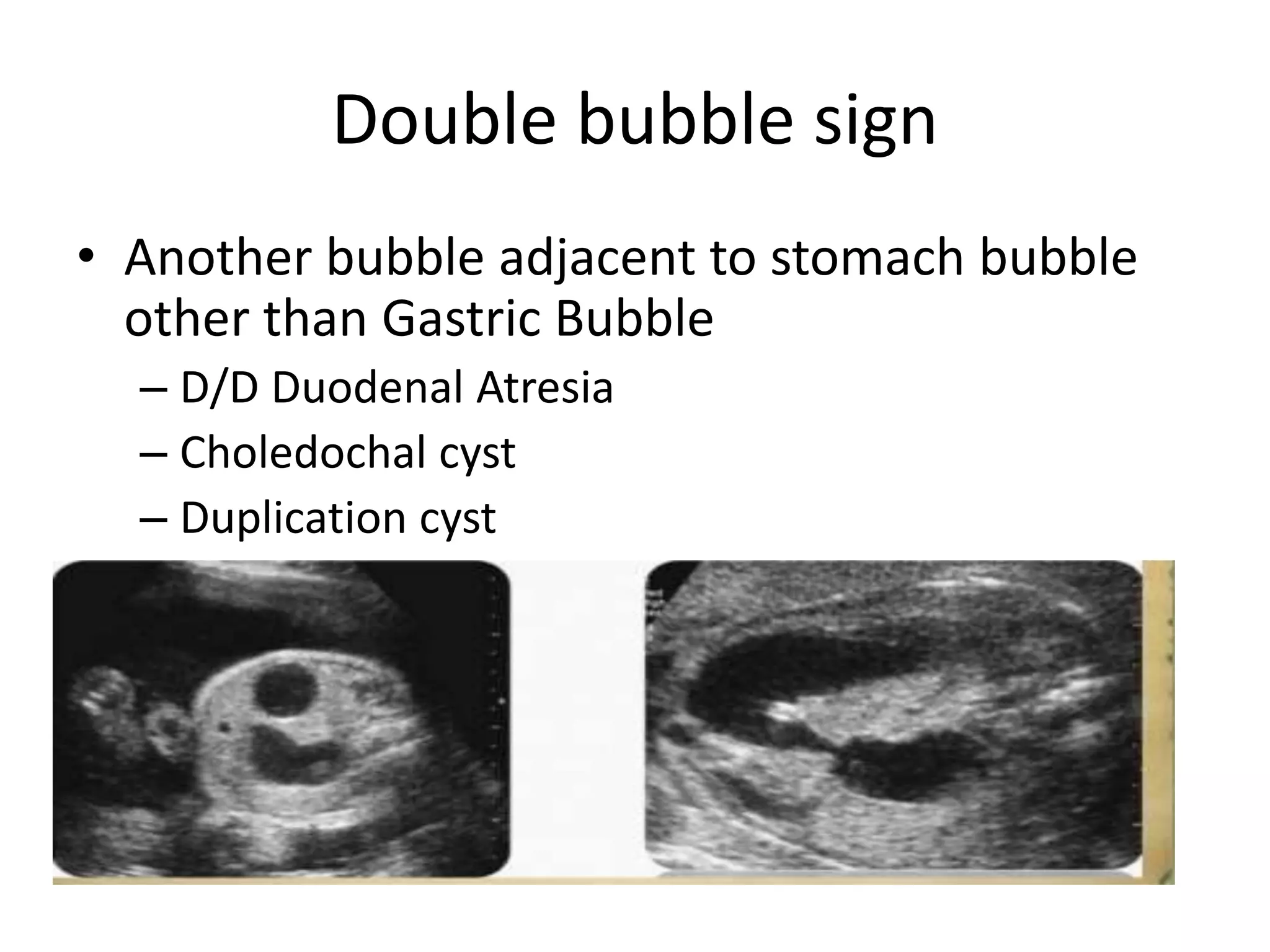
Double bubble sign
• Another bubble adjacent to stomach bubble
other than Gastric Bubble
– D/D Duodenal Atresia
– Choledochal cyst
– Duplication cyst
Liver
• The fetal liver is clearly visualized in the upper
abdomen in the second half of gestation
ABDOMINAL WALL
• The most common types of abdominal wall
defects are
• gastroschisis and omphalocele.
• Other, less common types include bladder exstrophy
• cloacal exstrophy,
• ectopia cordis, and more severe ventral body wall
defects including
• pentalogy of Cantrell,
• body stalk anomaly, and
• abdominoschisis in amniotic band syndrome.
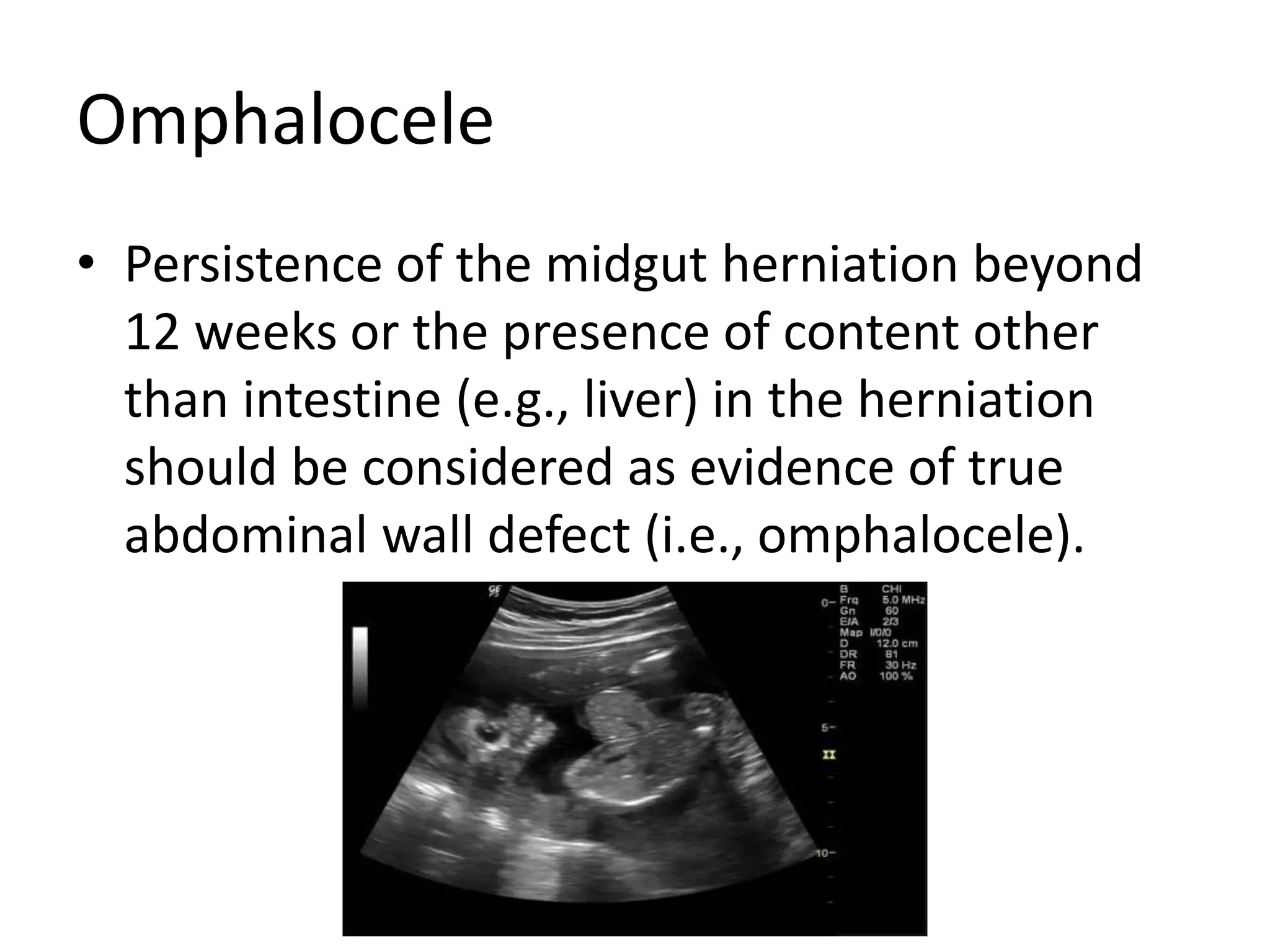
Omphalocele
• Persistence of the midgut herniation beyond
12 weeks or the presence of content other
than intestine (e.g., liver) in the herniation
should be considered as evidence of true
abdominal wall defect (i.e., omphalocele).
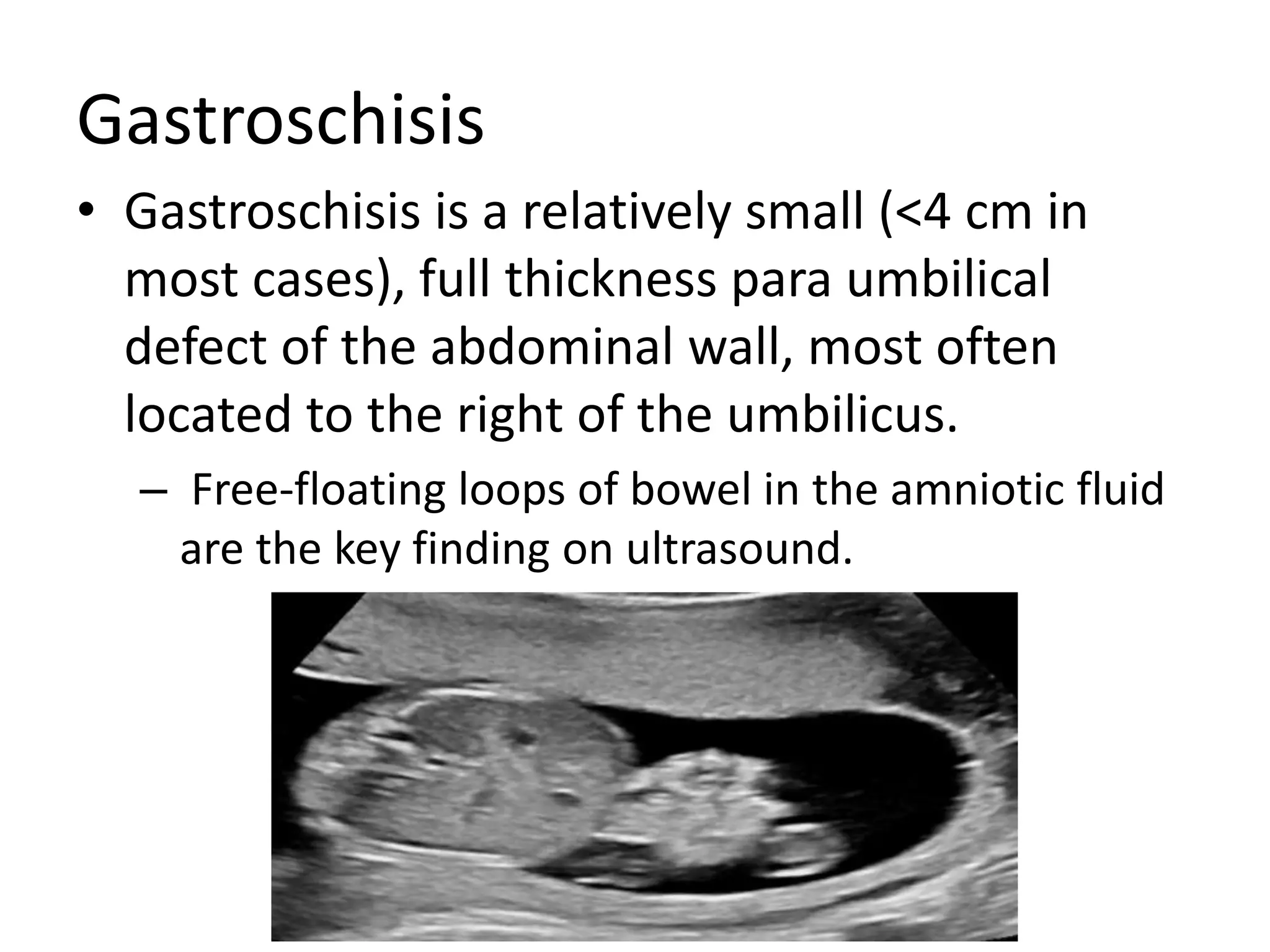
Gastroschisis
• Gastroschisis is a relatively small (<4 cm in
most cases), full thickness para umbilical
defect of the abdominal wall, most often
located to the right of the umbilicus.
– Free-floating loops of bowel in the amniotic fluid
are the key finding on ultrasound.
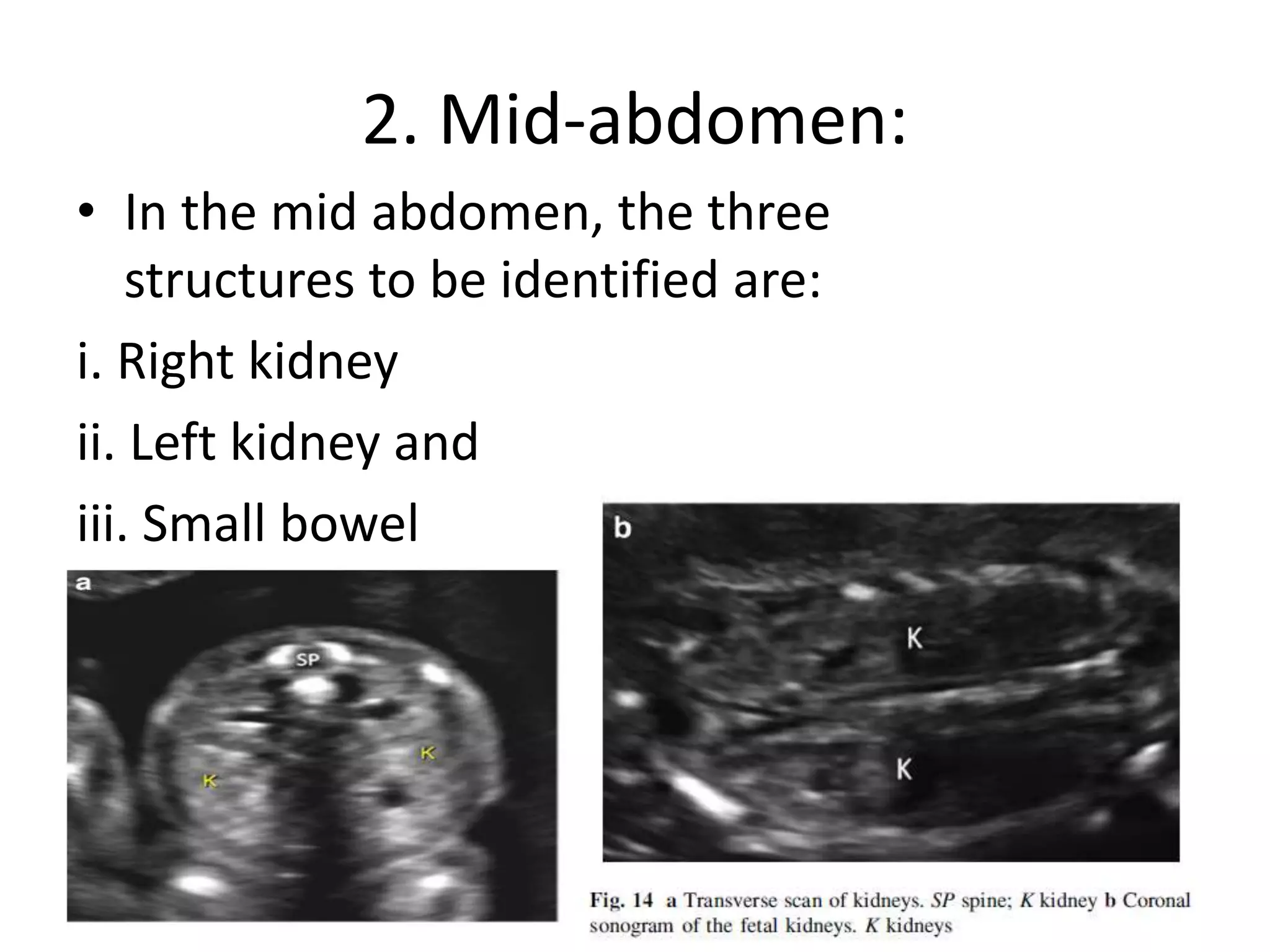
2. Mid-abdomen:
• In the mid abdomen, the three
structures to be identified are:
i. Right kidney
ii. Left kidney and
iii. Small bowel
• The kidneys should be visualized in the
transverse and coronal axis.
• The small bowel is identified by its peristalsis.
• The AP diameter of the renal pelvis is done in
the tranverse section.
Dilated Bowel
• >7mm in small bowel
• >20 mm in large bowel
» OBSTRUCTION
3. Lower Abdomen
In the lower abdomen, the three
structures to be identified are:
i. Bladder
ii. Two umbilical arteries
iii. Genitalia
The para bladder location is the best site for the
identification of single umbilical artery and is done
using color
Doppler
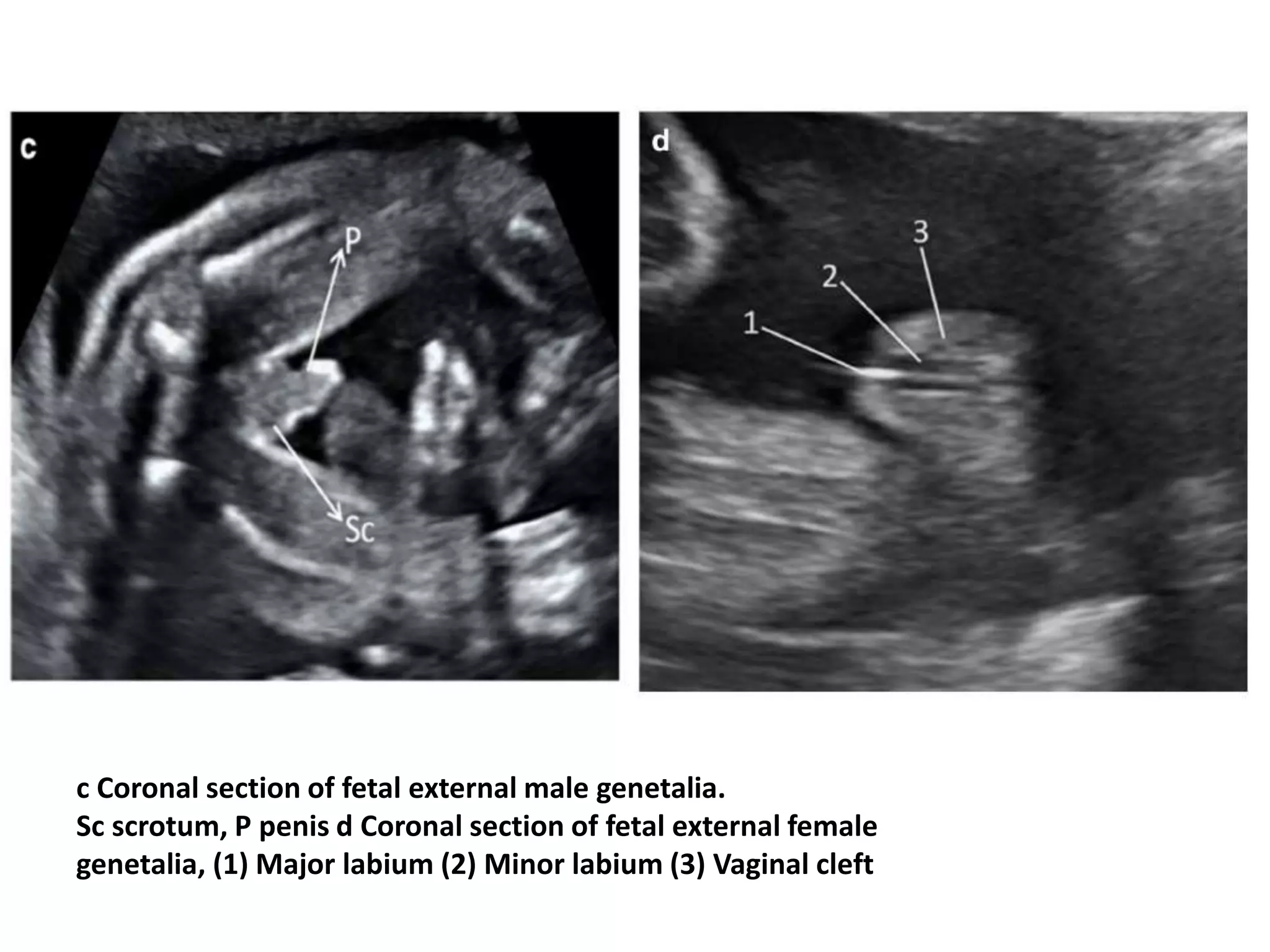
c Coronal section of fetal external male genetalia.
Sc scrotum, P penis d Coronal section of fetal external female
genetalia, (1) Major labium (2) Minor labium (3) Vaginal cleft
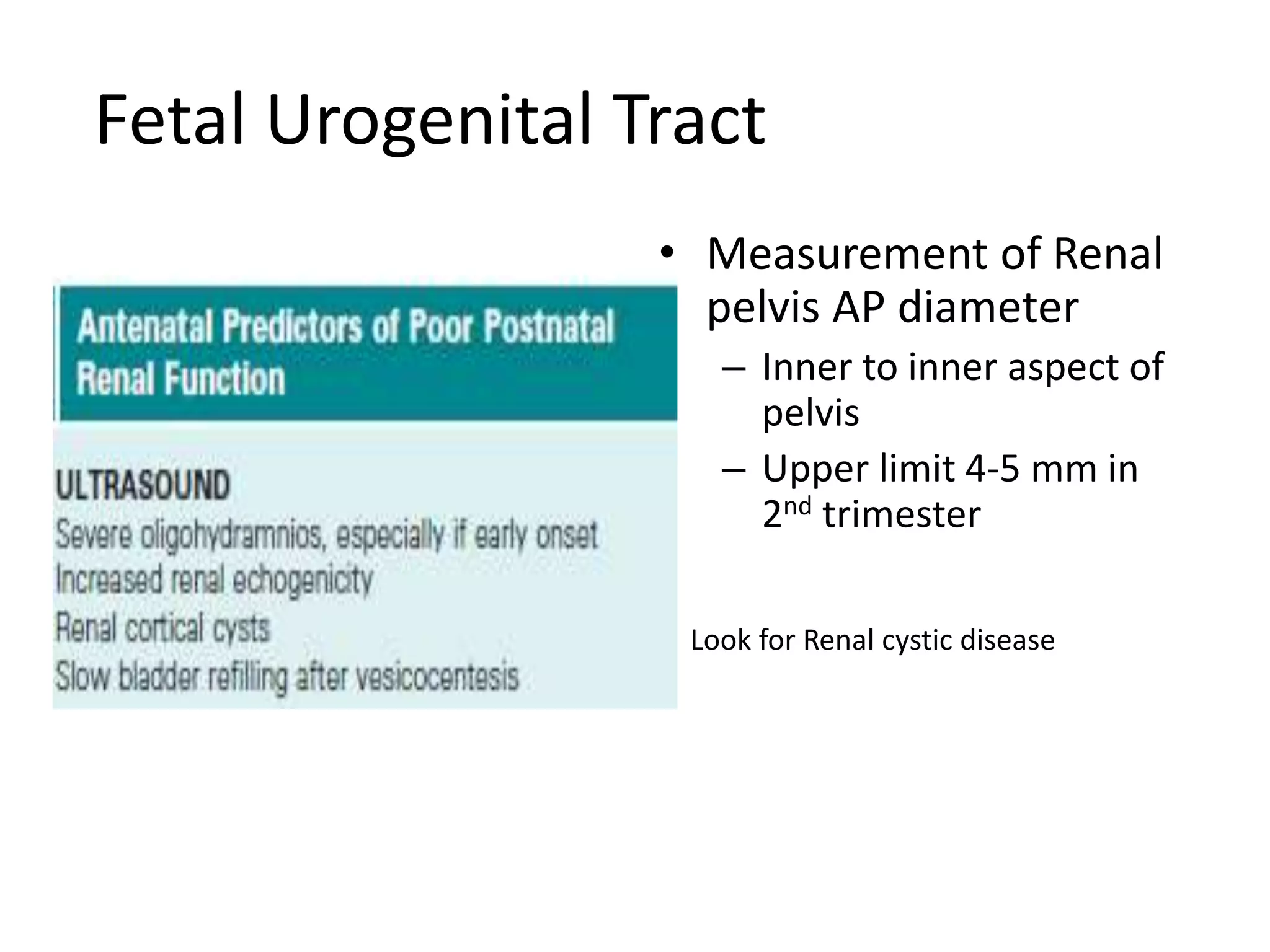
Fetal Urogenital Tract
• Measurement of Renal
pelvis AP diameter
– Inner to inner aspect of
pelvis
– Upper limit 4-5 mm in
2nd trimester
Look for Renal cystic disease
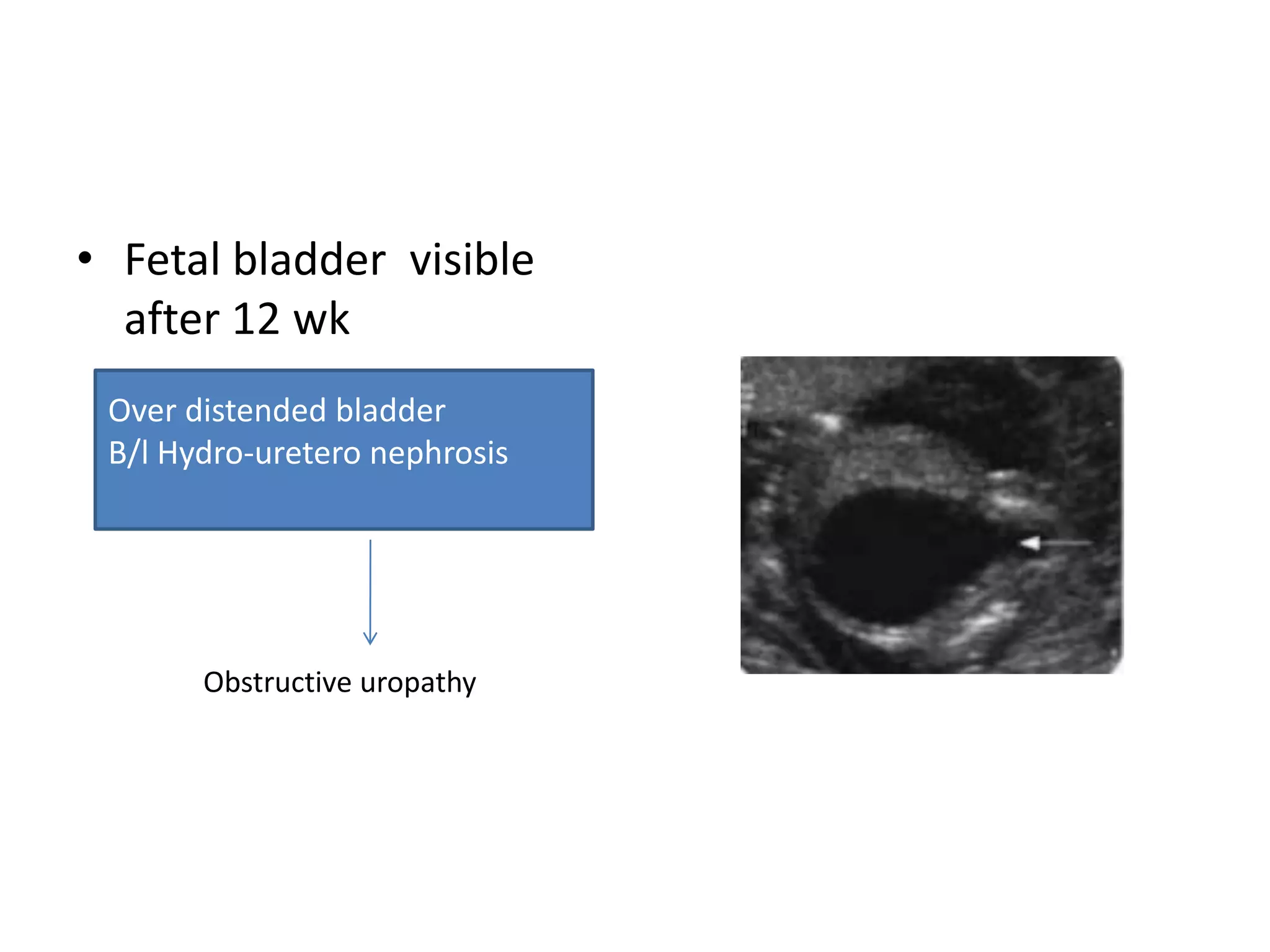
• Fetal bladder visible
after 12 wk
Over distended bladder
B/l Hydro-uretero nephrosis
Obstructive uropathy
• In the second trimester the kidneys often
appear as isoechoic structures adjacent to the
fetal spine on transabdominal sonography
• As the fetus matures, corticomedullary
differentiation becomes more obvious,
especially in the third trimester
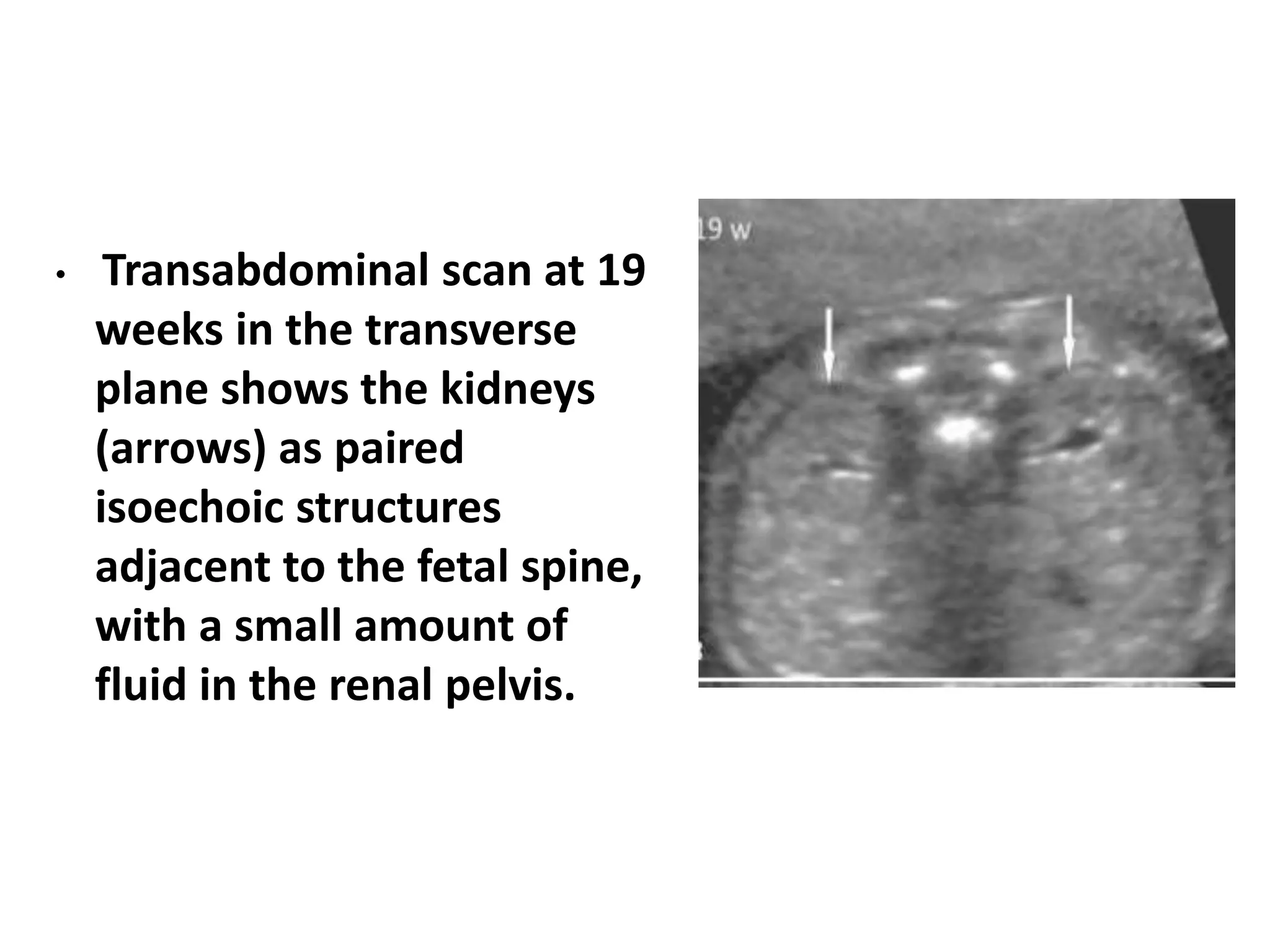
• Transabdominal scan at 19
weeks in the transverse
plane shows the kidneys
(arrows) as paired
isoechoic structures
adjacent to the fetal spine,
with a small amount of
fluid in the renal pelvis.
Renal Lengths at 14-42
Weeks’ Gestation
“Lying Down” Adrenal Sign.
Longitudinal scan through
the renal fossa shows absence of the
kidney and the flattened adrenal
gland (arrows). The lying-down
adrenal sign is an indication of renal
agenesis or ectopia.
Autosomal Recessive Polycystic Kidney
Disease
• Usually, but not always, ultrasound shows
evidence of ARPKD by 24 to 26 weeks’
gestation
Autosomal Recessive Polycystic Kidney Disease (Early Presentation).
(A) and (B) Coronal and transverse scans of a 22-week fetus show bilateral
large, diffusely hyperechoic kidneys (calipers) with loss of corticomedullary
differentiation
Algorithm for Sonographic Evaluation of
Hyperechogenic Kidneys.
Horseshoe Kidney
• Findings include
abnormal
longitudinal axis of
both kidneys and a
bridge of renal
tissue connecting
the lower poles on
fusion anomaly of
the kidney
Horseshoe Kidney. (A) Coronal image in a 19-
week fetus shows the bridge of renal
parenchyma (arrow) connecting the lower
poles of the kidneys, anterior to the aorta (Ao).
(B) Axial image shows, in addition to the fused
isthmus (arrow), the abnormal anterior
orientation
of the renal pelvis bilaterally
GENITAL TRACT
• In the second trimester, fetal sex
determination is based on direct visualization
of the external genitalia: the penis and
scrotum in males, and the labia majora and
minora, represented by two or four parallel
lines, respectively, in females.
• Bladder exstrophy refers to infraumbilical
abdominal wall defect that results from
incomplete closure of the lower abdominal
wall and the anterior wall of the bladder
The Extremities
Imaging the extremities is an essential
component of the targeted scan and all the four
extremities must be identified.
In each extremity we look for:
i. The three segments–proximal, mid, distal.
ii. The three features–length, echogenicity and
shape
iii. Subjective assessment of the muscle mass
• upper limb
– humera, including humeral length (HL)
– radius/ulna: both sides
– fingers and thumbs, including hand opening
• lower limb
– both femora, including femoral length (FL) as part of
biometric assessment
– both tibia/fibula: saggital views to demonstrate
orientation of the ankles to screen for talipes.
– both feet
• It is important to note that the foot and leg
are at right angles to each other.
• In a low risk patient, counting of fingers is not
essential, but it would be wise to look for
opening and closing of hands.
• Bone scanned
throughout long
section
• Look for any
– bowing, angulation,
fracture
– Club foot
– Number of fingers
Normal Extremity Long-Bone Lengths and Biparietal
Diameters at Different Menstrual Ages
Pattern of limb shortening
• Rhizomelia…………proximal
• Mesomellia…………Middle
• Acromelia…………………Distal
• Micro……………Enntire limb
Normal Femur and Spectrum of Abnormal Appearances. (A) Normal femur: measure the longest length, excluding the
proximal and distal epiphyses and the specular reflection of the lateral aspect of the distal femoral epiphysis (arrow).
(B) Normal femur in the near field, with straight lateral border versus the curved medial border in the far field of the
transducer.
(C) Isolated hypoplastic left femur (arrowhead), with
normal tibia (black arrow) and foot (white arrow). (D) Osteogenesis imperfecta type I. Isolated femoral fracture with
acute angulation (arrow). (E)
Campomelic dysplasia. Mild shortening and a gently curved ventral femoral bowing (arrow). (F) Osteogenesis
imperfecta type IIA. Bowed femur
with multiple discontinuities representing fractures.
(G) Hypophosphatasia. Severe micromelia (relatively broad metaphysis, short diaphysis)
. (H) Thanatophoric dysplasia. Curved, “telephone receiver” femur.
Checklist for Targeted Scan—Rule
of Three
Phone No: 4477923/4476152
SECOND TRIMESTER ANOMALY SCAN REPORT
(Reporting template by Nepal Radiologist Association)
Patient Name: Ms Age/Sex: yrs/ Female
Patient/USG No:0 Contact number:
Accompanying person: Relation
Referring doctor: KMCTH (Gynae/Obs) Date of examination:2078-01-19
Measurements:
Parameter Measurement ( in mm) Corresponding GA (W+D)
BPD mm weeks days
HC mm weeks days
AC mm weeks days
FL mm weeks days
EDD
Estimated foetal weight (EFW): gms
Parameters:
Foetal heart rate (FHR): beats per minute (Regular)
Presentation: Cephalic/Breech/Transverse
Liquor volume Adequate
Placenta: Fundal/Anterior/Posterior
Upper /Lower
Structural study of foetal anomaly: [N: Normal, Abn: Abnormal, NA: Not assessed/limited study, Prn: image printed]
Head Neck/Thorax Abdomen
Shape N Shape N Stomach N
Cavum septi
pellucidi
N No masses N Bowel N
Midline falx N Heart Kidneys N
Thalami N Activity N Urinary bladder N
Lateral
ventricle
N Size N Abdominal cord
insertion
N
Cerebellum N Axis N 3 vessel cord N
Cisterna
magna
N Four
chamber
view
N Spine N
Face Limbs
Upper lip N Both arms and
hands
N
Nose N Both legs and feet N
Orbits N
Median
profile
N
Additional comments:……………………………………………………………………………………………………………………….
Final conclusion:
 Single live intrauterine foetus of weeks days of gestation and gms by BPD/HC/FL.
____________
Dr. Jatati Shahi
MBBS, MD
Radiologist
Note: This scan does not include screening for cardiac anomaly.
Each & every congenital anomaly cannot be detected by 2D ultrasound.
References
• Diagnostic Ultrasound,Rumack 5th ed
• Callens Ultrasound In Obstetrics and
Gynecology
• The Second Trimester Obstetric Scan (7 + 3 5
10): A Rational Approach (Including the ‘‘Rule
of Three’’),Seshadri Suresh ,Indrani Suresh
• Thank You

Fetal anomaly scan

  • 1.
    Fetal Anomaly Scan Secondtrimester anatomy scan, or TIFFA (targeted imaging for fetal anomalies)
  • 3.
    Introduction • The secondtrimester targeted scan is done between 18 and 22 weeks. • The primary objective of this scan is to do a detailed anatomical evaluation of the fetus and to maximize the detection of anomalies that may be present at this stage. • A systematic method of ultrasound scanning of the fetus will ensure that a reasonably complete examination of the fetus is accomplished.
  • 4.
    • Since thisscan is primarily meant for exclusion or diagnosis of fetal anomalies,it is important that a thorough examination of the fetus is done during this period. • The second trimester targeted scan is a head to toe clinical examination of the fetus.
  • 5.
    Objectives • To predictwith confidence, the structural normalcy of the baby within reasonable limits of expectation • To identify severe and lethal abnormalities • To raise the suspicion of an abnormality, which would warrant further testing or serial scans
  • 7.
    The ‘‘Rule ofThree’’ Concept • The ‘‘rule of three’’ concept was evolved in the year 1995 by the authors. • It is a systematic method of examination of the fetus designed to achieve maximum yield from the ultrasound examination in the least possible time. • It is easily reproducible and is useful for audit. By following the ‘‘rule of three’’, it is possible to say that all aspects of the fetus that are expected to be seen have indeed been imaged. • This ensures that the examination has been done satisfactorily.
  • 8.
    The Second TrimesterTargeted Scan
  • 9.
    At the endof the examination, one must be able to declare with confidence, the following three aspects: • The fetus is structurally normal for this period of gestation • Major abnormalities have been detected or excluded • A suspicion of an anomaly is raised
  • 10.
    Anatomical Planes andStructures to be Examined • Head: 1. Transthalamic plane 2. Ventricular plane 3. Transcerebellar plane
  • 11.
    1. Transthalamic Plane •It is the plane which has been traditionally used to measure the biparietal diameter (BPD) and head circumference (HC). The three structures to be looked for in this plane are: • i. Falx, which is interrupted by • ii. Cavum septum pellucidum • iii. Thalami, forming an arrow pointing to the occiput • The cavum septum pellucidum can be seen in the transthalamic and in the lateral ventricular plane.
  • 12.
    2. Ventricular Plane •The three structures to be identified in this plane are: i. The lateral ventricles ii. Choroid plexes and iii. Cavum septum pellucidum Choroid fills more than 60% of atrium width between the medial ventricle wall and the choroid is less than 3 mm.
  • 13.
    a Transverse axialscan at the level of lateral ventricles. (1) Lateral ventricles (2) Choroid plexus (3) Cavum septum pellucidum. b Coronal view of fetal lateral ventricles through, posterior fontanel, CP choroid plexus, FH frontal horns
  • 14.
    3. Transcerebellar Plane Itis imaged by rotating the probe posteriorly from the BPD plane till a clear view of the posterior fossa and the occipital bone is obtained. The three structures to be identified in the posterior fossa are: i. Rounded cerebellar hemispheres (dumb-bell shaped). ii. Vermis of the cerebellum. (there should be no space in between the two cerebellar hemispheres). iii. Cisterna magna (seen as a clear space between the cerebellum and the occipital bone).
  • 16.
    TRANSCEREBELLAR DIAMETER • Itis measured as the maximal diameter between the cerebellar hemispheres on an axial scan. • The TCD is not thought to be significantly altered by the presence of IUGR • Up to about 24 weeks, the transverse cerebellar diameter corresponds to gestational weeks. • The cisterna magna is the cerebrospinal fluid (CSF) space behind the cerebellum and is measured between the cerebellar vermis and inner occipital bone on an axial plane that includes the anterior end of the CSP and the midplane of the cerebellum. It is normally 2 to 10 mm
  • 17.
    • Cisterna magnaobliteration suggests Chiari II malformation and spina bifida. • Excessive enlargement may be seen with mega– cisterna magna, Blake pouch cyst, vermian dysplasia, Dandy-Walker syndrome, and arachnoid cysts.
  • 18.
    VARIANTS (USUALLY NORMAL) ChoroidPlexus Cysts • Choroid plexus cysts (CPCs) are cyst like spaces in the choroid plexus and are due to entrapment of CSF within an infolding of neuroepithelium.
  • 19.
    BLAKE POUCH CYST: It is a thin-walled cystic structure commonly seen in the midline of the posterior fossa behind the lower portion of the cerebellar vermis and brainstem.
  • 20.
    CAVUM VELI INTERPOSITI •Cavum veli interpositi (CVI) is a small cystic collection in the midline, seen below the splenium of the corpus callosum, behind the upper brainstem and above the region of the pineal gland
  • 21.
    VENTRICULOMEGALY • Ventricular Measurement: Imageshowing the appropriate position of calipers to measure the lateral ventricle. • Done by transverse measurement of the atrium of the occipital horn • Normal measurements are between 4-10mm. • A measurement greater than 10mm is considered dilated
  • 22.
    • Mild Ventriculomegaly:the ventricles measure between 10–11mm. • Moderate Ventriculomegaly: the ventricles measure between 12–14mm. • Severe Ventriculomegaly: the ventricles measure 15mm or more
  • 24.
    • Hydrocephalus (HC)refers to enlarged ventricles associated with increased intracranial pressure and thus is typically associated with head enlargement. • lateral ventricular diameter >15 mm
  • 25.
    ERRORS OF DORSALINDUCTION • CNS development begins with development of the notochord, which subsequently induces the dorsal development of the neural plate, which closes to form the neural tube, which becomes the spinal cord and part of the brain. • Errors of dorsal induction can result from many different genetic and teratogenic factors and affect development of the dorsal neural plate and closure of the neural canal (neurulation).
  • 26.
    CEPHALOCELE AND ENCEPHALOCELE •A cephalocele is a herniation of intracranial structures through a defect in the cranium or skull base. • It is termed cranial meningocele when it contains only meninges & CSF and encephalocele when it contains brain tissue.
  • 27.
    ERRORS OF DORSALINDUCTION Anencephaly and Exencephaly • Anencephaly follows failure of closure of the rostral neuropore leading to failed cranial vault development and unprotected exposed brain tissue (exencephaly). • Absence of brain tissue associated with absent calvarium.
  • 28.
    Prominent orbits andabsent calvarium— ’Frog Sign’
  • 29.
    ERRORS OF VENTRALINDUCTION • Errors of ventral induction occur in the rostral end of the embryo and result in brain abnormalities of the prosencephalon, mesencephalon, and rhombencephalon and usually also affect facial development • HOLOPROSENCEPHALY :Holoprosencephaly (HPE) is a complex brain malformation resulting from incomplete separation of the prosencephalic diverticulum into right and left cerebral hemispheres.3 types: • ALOBAR • SEMILOBAR • LOBAR
  • 31.
    POSTERIOR FOSSA ANDCEREBELLUM Dandy-Walker Malformation • Classic DWM is a triad of - partial or complete vermian agenesis, - cystic enlargement of the fourth ventricle, and - elevated tentorium Oblique axial view at 34 weeks shows enlarged cisterna magna with keyhole deformity in this fetus with DWM.
  • 32.
    MEGA CISTERNA MAGNA •Mega–cisterna magna (MCM) refers to an enlargement of the cisterna magna beyond 10 mm with intact vermis and the lateral Blake cyst walls (arrows) with echogenic subarachnoid fluid lateral to the walls. Mega– cisterna magna (*) axial view. Note the clear fluid content
  • 33.
    SPINA BIFIDA Cranial SignsAssociated With Open Spina Bifida
  • 35.
    Face The three planesof examination of the fetal face are • axial, • sagittal and • coronal. The three major structures to be visualized are: • i. Orbits • ii. Nose and • iii. Mouth
  • 36.
    a Axial viewof fetal orbits. O orbits. b Mid-sagittal view of the fetal face (‘‘profile’’ view).
  • 37.
    • The orbitsare ideally visualized in the axial or coronal view • The orbits should be symmetrical in size and the outer and inner interorbital distances within a normal range • Nose and the nasal bone in sagittal view • In the coronal view the probe is angulated moved from anterior part of face to the orbits.
  • 38.
    Congenital Cataracts • Congenitalcataracts may be diagnosed on prenatal solography, which will show a rounded echogenic mass in the anterior portion of the globe. • Causes of congenital cataracts include genetic disorders, infection, syndromes, and microphthalmia
  • 39.
    c Anterior coronalsonogram of the nose and mouth. (1) Ala (2) Column (3) Nostril (4) Lips. d Mid- coronal view—the premaxillary triangle (PMT)
  • 40.
    NASAL BONE • assessedon a midsagittal view of the fetal face. • Ideally three echogenic lines should be seen. • The difficulty in defining nasal bone hypoplasia has historically lead to the development of various criteria, based on measurements such as • BPD: nasal bone ratio , • gestational age-adjusted nasal bone length, or • a single cut-off definition (0.25 cm)
  • 41.
    PT/NBL RATIO • NBL=Nasal Bone Length • PT= Prenasal thickness • In normal fetuses, prenasal thickness increases with gestation from a mean of 2.4mm at 16 weeks to 4.6 mm at 24 weeks. • The increase in prenasal thickness has been reported as a sonographic marker for Down syndrome in the second trimester. • N=0.35-0.8 • Chromosomal abnormalities=>0.8 Nasal bone hypoplasia can be defined by a ratio of biparietal diameter/nasal bone length greater than 11
  • 42.
    • To obtainan ideal NFA, one should be careful that the fetal neck is in a mild flexion status, that three echogenic focuses (nasal end, skin on the nasal bone, nasal bone) are present on the fetal nasal bone profile, and that the US probe is in parallel with the bone plane. • Normal 128.6 D+/-23
  • 43.
    Lips/Nose • In theanterior coronal view nose and lips are identified. • In the mid-coronal view the premaxillary triangle (PMT) is identified which is formed by the two nasal bones as the two sides of the triangle and the premaxilla as the base of the triangle. • The completion of the triangle ensures that there is no cleft hard palate.
  • 44.
    • The posteriorcoronal view shows the orbits. • The far orbit will not be visualized due to shadowing from the nasal bones. Hence an axial view is preferable.
  • 45.
    ABSENT NASAL BONE •In fetuses with trisomy 21 ,the absence of a nasal bone at second trimester sonography, or abnormally short nasal bone measurements in combination with other markers , increases detection of aneuploidy
  • 46.
    LIP & PALATE •In general, an upper lip defect may be seen and is best appreciated on angled coronal scanning. • A vertical hypo-echoic region through the fetal upper lip usually represents the defect in cleft lip. • The palate can be examined in the transverse (axial) plane. • 3D ultrasound may further assist in diagnosis. • It is good practice to comment on fetal swallowing in real time at the time the scan is performed.
  • 49.
    Nuchal fold thickness •In the second trimester, the nuchal fold thickness is measured in the suboccipital bregmatic plane. • One caliper should be placed on the outer edge of the skin, and the other against the outer edge of the occipital bone. • The ideal angle of insonation is at approximately 30o to the horizontal • A measurement of 6 mm or greater from 15 to 22 weeks is associated with an increased risk of trisomy 21. • The measurement is taken in the midline from the outer edge of the occipital bone to the outer edge of the skin.
  • 50.
    Cystic hygroma • Cystichygroma is a type of lymphangioma, which is a vascular anomaly associated with lymphatic malformations and formed by fluid accumulation mainly located at the cervi-cofacial and axillary regions. • • Cystic hygroma is mostly located in the neck (75%), followed by axilla (20%), retroperitoneum and intra-abdominal organs (2%), limbs and bones (2%), and mediastinum (1%). • It is often associated with chromosome aneuploidies, hydrops fetalis, and even intrauterine fetal demise
  • 51.
    Thorax The thorax comprisesthree structures • Heart • Right lung • Left lung • The two lungs and heart occupy equal space in the thorax (1/3) each. • The upper limit of the normal sized heart Is 50 % of the thoracic size.
  • 52.
    Thorax • The shapeshould be regular with a smooth transition to the abdomen. • The ribs should have normal curvature without deformities. • Both lungs should appear homogeneous and without evidence of mediastinal shift or masses. • The diaphragmatic interface can often be visualized as a hypoechoic dividing line between the thoracic and abdominal content (e.g. liver and stomach) Sagittal view of torso at 13 weeks. Note liver (Li), lungs (Lu), and diaphragm (arrow).
  • 53.
    Differential Diagnosis ofEchogenic Lesion in Fetal Thorax
  • 54.
    Spine The spine isimaged in three axes, namely 1. Sagittal 2. Transverse 3. Coronal In the sagittal axis, we look for three aspects of the spine. i. Cervical widening ii. Parallel thoracic and lumbar spine iii. Sacral tapering
  • 55.
    In the sagittalsection of the spine, the typical ‘‘three line appearance’’ is identified which consists of the • skin line, • the lamina and • body of the vertebra in that order
  • 56.
    • In thetransverse axis, the three ossification centers forming a triangular shape is identified
  • 57.
    coronal view • Itis not compulsory during targeted scan. • However one should remember that the minimal widened appearance of lumbar vertebra in this view is normal and should not be mistaken for spina bifida.
  • 58.
    Heart The three viewsof the heart that should be seen are: 1. Four chamber view 2. Outflow tracts 3. Three vessel view Four Chamber view: In a four chamber view, the three structures to look for are: • i. The crux of the heart formed by the IVS, atrioventricular • septum and interartrial septum • ii. Chamber symmetry • iii. Movements of mitral and tricuspid valves in real time
  • 59.
    Check at aglance • 2 ventricles/ walls of equal size • 2 atria/ walls of equal size • Foramen ovale moving in left atrium • Pulmonary veins entering left atrium • Motion of mitral valves(left side) regular • Motion of tricuspid valves(right side) regular • Continuity of interventricular septum
  • 60.
    • The basiccardiac screening examination is interpreted from a four-chamber view of the fetal heart. • A normal regular rate ranges from 120 to 160 beats per min. • The heart should be located in the left chest (same side as the fetal stomach) if the situs is normal. • A normal heart is usually no larger than one-third of the area of the chest and is without pericardial effusion. • The heart is normally deviated by about 45±20◦ towards the left side of the fetus.
  • 61.
    Normal position and axisof the heart. The heart is predominantly in the left side of the chest, with the apex of the heart pointing leftward. Dual-screen image shows the stomach also on the left side.
  • 62.
  • 63.
    • The apicalfour-chamber view may also be used as a starting point when evaluating normal cardiac anatomy • A slight cephalad advancement will show an apical five-chamber view, which is useful in assessing continuity of the ascending aorta with the left ventricle • Continued cephalad movement should result in visualization of the bifurcating pulmonary artery and its relationship to the right ventricle.
  • 64.
    Dextroposition of fetal heartcaused by a large, congenital pulmonary airway malformation. Transverse image through the fetal chest shows the heart displaced to the right, but the apex (arrow) remaining leftward. LA, Left atrium; LV, left ventricle; RA, right atrium; RV, right ventricle; S, stomach. Dual-screen image shows the stomach on the correct left side.
  • 65.
    2. Outflow Tracts •At the origin, the outflow tracts are seen crossing each other with pulmonary artery anterior and aorta posterior. • The anterior aortic root should be continuous with the interventricular septum and the posterior aortic root with the mitral valve • The bifurcation of the pulmonary artery must be documented. • The crossing of the outflow tract can be appreciated in the transverse view (circle sausage view) which shows the cross-section of the aorta and long section of the pulmonary artery.
  • 67.
    3. Three VesselView • This is the most important view for identifying outflow tract anomalies. • This view is obtained by doing a cephalad tilt from the four chamber view at a plane superior to the cardiac chambers. • The chambers are not visualized in this plane. • The three vessels seen from left to right are pulmonary artery, aorta and superior vena cava (SVC).
  • 68.
    • The pulmonary arteryis largest in diameter and SVC the smallest in diameter. We look for • i. Number • ii.Alignment/arrange ment and • iii. Size of the three vessels
  • 69.
    • A three-vesseland trachea view should be visualized . • This view allows evaluation of the main pulmonary artery–ductus arteriosus confluence, the transverse aortic arch, and the SVC. • Comparison of vessel size, confirmation of vessel presence, and determination of blood flow direction with color Doppler can all be accomplished at this level.
  • 72.
    Echogenic intracardiac focus(EIF) • present in ~4-5% of karyotypically normal fetuses. • represent mineralization within the papillary muscles. Associations : • (Down syndrome): may be present in up to 12% of fetuses with trisomy 21 • Trisomy 13
  • 73.
    Abdomen: The abdomen isdivided into three levels for convenience. (1) Upper abdomen; (2) Mid-abdomen; (3) Lower abdomen 1. Upper Abdomen.The three structures to be identified are: i. Stomach ii. Portal vein and iii. Liver
  • 75.
    • Abdominal organsitus should be determined. • The fetal stomach should be identified in its normal position on the left side. • Bowel should be contained within the abdomen and the umbilical cord should insert into an intact abdominal wall. • Abnormal fluid collections of the bowel(e.g.enteric cysts,obvious bowel dilatation)should be documented.
  • 76.
    • Aside fromthe left-sided stomach, a fetal gallbladder may be seen in the right upper quadrant next to the liver, although this latter finding is not a minimum requirement of the basic scan. • Any other cystic structures seen in the abdomen should prompt referral for a more detailed scan. • The fetal umbilical cord insertion site should be examined for evidence of a ventral wall defect such as omphalocele or gastroschisis. • Cord vessels may also be counted using gray-scaleimaging as an optional component of the routine anomaly survey.
  • 77.
    Esophagus • Esophageal Atresia –The main sonographic signs of esophageal atresia include • absent or small stomach , • polyhydramnios, • and the esophageal pouch sign (fluid collection in the blind end of the esophagus
  • 78.
    Absent Stomach bubble •Physiological Emptying: Transient • Lack of amniotic fluid to swallow – Oligohydraminos – Anhydraminos • Impaired fetal swallowing • Esophageal Atresia • Obstructing oropharyngeal Mass • Facial clefts • Congenital Diaphragmatic hernia
  • 79.
    Double bubble sign •Another bubble adjacent to stomach bubble other than Gastric Bubble – D/D Duodenal Atresia – Choledochal cyst – Duplication cyst
  • 80.
    Liver • The fetalliver is clearly visualized in the upper abdomen in the second half of gestation
  • 81.
    ABDOMINAL WALL • Themost common types of abdominal wall defects are • gastroschisis and omphalocele. • Other, less common types include bladder exstrophy • cloacal exstrophy, • ectopia cordis, and more severe ventral body wall defects including • pentalogy of Cantrell, • body stalk anomaly, and • abdominoschisis in amniotic band syndrome.
  • 82.
    Omphalocele • Persistence ofthe midgut herniation beyond 12 weeks or the presence of content other than intestine (e.g., liver) in the herniation should be considered as evidence of true abdominal wall defect (i.e., omphalocele).
  • 83.
    Gastroschisis • Gastroschisis isa relatively small (<4 cm in most cases), full thickness para umbilical defect of the abdominal wall, most often located to the right of the umbilicus. – Free-floating loops of bowel in the amniotic fluid are the key finding on ultrasound.
  • 85.
    2. Mid-abdomen: • Inthe mid abdomen, the three structures to be identified are: i. Right kidney ii. Left kidney and iii. Small bowel
  • 86.
    • The kidneysshould be visualized in the transverse and coronal axis. • The small bowel is identified by its peristalsis. • The AP diameter of the renal pelvis is done in the tranverse section.
  • 87.
    Dilated Bowel • >7mmin small bowel • >20 mm in large bowel » OBSTRUCTION
  • 88.
    3. Lower Abdomen Inthe lower abdomen, the three structures to be identified are: i. Bladder ii. Two umbilical arteries iii. Genitalia The para bladder location is the best site for the identification of single umbilical artery and is done using color Doppler
  • 90.
    c Coronal sectionof fetal external male genetalia. Sc scrotum, P penis d Coronal section of fetal external female genetalia, (1) Major labium (2) Minor labium (3) Vaginal cleft
  • 91.
    Fetal Urogenital Tract •Measurement of Renal pelvis AP diameter – Inner to inner aspect of pelvis – Upper limit 4-5 mm in 2nd trimester Look for Renal cystic disease
  • 92.
    • Fetal bladdervisible after 12 wk Over distended bladder B/l Hydro-uretero nephrosis Obstructive uropathy
  • 93.
    • In thesecond trimester the kidneys often appear as isoechoic structures adjacent to the fetal spine on transabdominal sonography • As the fetus matures, corticomedullary differentiation becomes more obvious, especially in the third trimester
  • 94.
    • Transabdominal scanat 19 weeks in the transverse plane shows the kidneys (arrows) as paired isoechoic structures adjacent to the fetal spine, with a small amount of fluid in the renal pelvis.
  • 95.
    Renal Lengths at14-42 Weeks’ Gestation
  • 98.
    “Lying Down” AdrenalSign. Longitudinal scan through the renal fossa shows absence of the kidney and the flattened adrenal gland (arrows). The lying-down adrenal sign is an indication of renal agenesis or ectopia.
  • 99.
    Autosomal Recessive PolycysticKidney Disease • Usually, but not always, ultrasound shows evidence of ARPKD by 24 to 26 weeks’ gestation
  • 100.
    Autosomal Recessive PolycysticKidney Disease (Early Presentation). (A) and (B) Coronal and transverse scans of a 22-week fetus show bilateral large, diffusely hyperechoic kidneys (calipers) with loss of corticomedullary differentiation
  • 101.
    Algorithm for SonographicEvaluation of Hyperechogenic Kidneys.
  • 102.
    Horseshoe Kidney • Findingsinclude abnormal longitudinal axis of both kidneys and a bridge of renal tissue connecting the lower poles on fusion anomaly of the kidney Horseshoe Kidney. (A) Coronal image in a 19- week fetus shows the bridge of renal parenchyma (arrow) connecting the lower poles of the kidneys, anterior to the aorta (Ao). (B) Axial image shows, in addition to the fused isthmus (arrow), the abnormal anterior orientation of the renal pelvis bilaterally
  • 103.
    GENITAL TRACT • Inthe second trimester, fetal sex determination is based on direct visualization of the external genitalia: the penis and scrotum in males, and the labia majora and minora, represented by two or four parallel lines, respectively, in females.
  • 104.
    • Bladder exstrophyrefers to infraumbilical abdominal wall defect that results from incomplete closure of the lower abdominal wall and the anterior wall of the bladder
  • 105.
    The Extremities Imaging theextremities is an essential component of the targeted scan and all the four extremities must be identified. In each extremity we look for: i. The three segments–proximal, mid, distal. ii. The three features–length, echogenicity and shape iii. Subjective assessment of the muscle mass
  • 106.
    • upper limb –humera, including humeral length (HL) – radius/ulna: both sides – fingers and thumbs, including hand opening • lower limb – both femora, including femoral length (FL) as part of biometric assessment – both tibia/fibula: saggital views to demonstrate orientation of the ankles to screen for talipes. – both feet
  • 107.
    • It isimportant to note that the foot and leg are at right angles to each other. • In a low risk patient, counting of fingers is not essential, but it would be wise to look for opening and closing of hands.
  • 109.
    • Bone scanned throughoutlong section • Look for any – bowing, angulation, fracture – Club foot – Number of fingers
  • 110.
    Normal Extremity Long-BoneLengths and Biparietal Diameters at Different Menstrual Ages
  • 111.
    Pattern of limbshortening • Rhizomelia…………proximal • Mesomellia…………Middle • Acromelia…………………Distal • Micro……………Enntire limb
  • 112.
    Normal Femur andSpectrum of Abnormal Appearances. (A) Normal femur: measure the longest length, excluding the proximal and distal epiphyses and the specular reflection of the lateral aspect of the distal femoral epiphysis (arrow). (B) Normal femur in the near field, with straight lateral border versus the curved medial border in the far field of the transducer. (C) Isolated hypoplastic left femur (arrowhead), with normal tibia (black arrow) and foot (white arrow). (D) Osteogenesis imperfecta type I. Isolated femoral fracture with acute angulation (arrow). (E) Campomelic dysplasia. Mild shortening and a gently curved ventral femoral bowing (arrow). (F) Osteogenesis imperfecta type IIA. Bowed femur with multiple discontinuities representing fractures.
  • 113.
    (G) Hypophosphatasia. Severemicromelia (relatively broad metaphysis, short diaphysis) . (H) Thanatophoric dysplasia. Curved, “telephone receiver” femur.
  • 114.
    Checklist for TargetedScan—Rule of Three
  • 121.
    Phone No: 4477923/4476152 SECONDTRIMESTER ANOMALY SCAN REPORT (Reporting template by Nepal Radiologist Association) Patient Name: Ms Age/Sex: yrs/ Female Patient/USG No:0 Contact number: Accompanying person: Relation Referring doctor: KMCTH (Gynae/Obs) Date of examination:2078-01-19 Measurements: Parameter Measurement ( in mm) Corresponding GA (W+D) BPD mm weeks days HC mm weeks days AC mm weeks days FL mm weeks days EDD Estimated foetal weight (EFW): gms Parameters: Foetal heart rate (FHR): beats per minute (Regular) Presentation: Cephalic/Breech/Transverse Liquor volume Adequate Placenta: Fundal/Anterior/Posterior Upper /Lower Structural study of foetal anomaly: [N: Normal, Abn: Abnormal, NA: Not assessed/limited study, Prn: image printed] Head Neck/Thorax Abdomen Shape N Shape N Stomach N Cavum septi pellucidi N No masses N Bowel N Midline falx N Heart Kidneys N Thalami N Activity N Urinary bladder N Lateral ventricle N Size N Abdominal cord insertion N Cerebellum N Axis N 3 vessel cord N Cisterna magna N Four chamber view N Spine N Face Limbs Upper lip N Both arms and hands N Nose N Both legs and feet N Orbits N Median profile N Additional comments:………………………………………………………………………………………………………………………. Final conclusion:  Single live intrauterine foetus of weeks days of gestation and gms by BPD/HC/FL. ____________ Dr. Jatati Shahi MBBS, MD Radiologist Note: This scan does not include screening for cardiac anomaly. Each & every congenital anomaly cannot be detected by 2D ultrasound.
  • 122.
    References • Diagnostic Ultrasound,Rumack5th ed • Callens Ultrasound In Obstetrics and Gynecology • The Second Trimester Obstetric Scan (7 + 3 5 10): A Rational Approach (Including the ‘‘Rule of Three’’),Seshadri Suresh ,Indrani Suresh
  • 123.

Editor's Notes

  • #70  Three-vessel and trachea view shows the correct orientation of the main pulmonary artery–ductus arteriosus confluence (P), the transverse aortic arch (A), and the superior vena cava (S). This view also shows the two great vessels correctly positioned on the left side of the trachea (T).