Represented by:
Amina Muqadas
Roll No: PHYS3W02029
Degree: MSPHY-1st-1E
Section: 2024-26 (W)
Subject: Semiconductor Physics
Fermi Dirac Statistic
Statistic
There are two type of statistic:
1. Classical Statistic
2. Quantum Statistic
1. Classical statistic:
 For classical particle (observable)
 Distinguishable
2. Quantum Statistic:
 Non-observable particle
 Indistinguishable
Quantum Statistic:
 Two types of Quantum statistic:
1. Bose-Einstein statistic
2. Fermi-dirac Statistic
 Bose Einstein statistic:
 integral spin
 Don’t obey Pauli exclusion principle
 e.g. Photon
Scientist behind the development OF FDS:
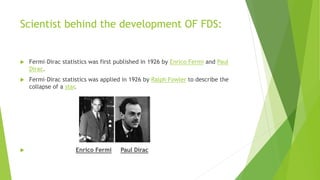
 Fermi–Dirac statistics was first published in 1926 by Enrico Fermi and Paul
Dirac.
 Fermi–Dirac statistics was applied in 1926 by Ralph Fowler to describe the
collapse of a star.
 Enrico Fermi Paul Dirac
Fermi Dirac Statistic:
 This statistic is obeyed by identical indistinguishable particle.
 Those particle which obey Fermi- Dirac statistic called fermions.
 These particle having half integral spin e.g. 1/2 , 3/2, 5/2.
 Fermions have anti-symmetric wave function.
 Ψ(1,2)= - ψ(1,2)
 Obey Pauli Exclusion Principle.
 No two electron in an atom can have identical quantum number.
Fermi-Dirac distribution function:
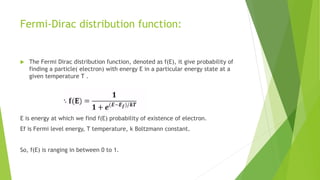
 The Fermi Dirac distribution function, denoted as f(E), it give probability of
finding a particle( electron) with energy E in a particular energy state at a
given temperature T .
E is energy at which we find f(E) probability of existence of electron.
Ef is Fermi level energy, T temperature, k Boltzmann constant.
So, f(E) is ranging in between 0 to 1.
 Case:
1. At 0k Temperature
No free electron, all the electron in valance band.
At T= 0k
if E>Ef
E`>Ef
f(E) = 1/∞ = 0
The probability of finding electron is
zero.
 Increase temperature
covalent bond break and electron-hole pair generate
At different energy state probability of electron that
estimation done by FDS.
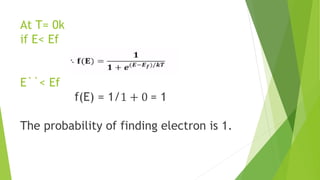
At T= 0k
if E< Ef
E``< Ef
f(E) = 1/1 + 0 = 1
The probability of finding electron is 1.
At T= 0k
if E> Ef, f(E)= 0
if E< Ef, f(E)= 1
 If we increase the temperature
Then the probability of finding the
electron above Ef is increase.
And probability of finding an electron
decrease below Ef.
At Ef, the probability of finding electron is
half.
THANK YOU

SEMICONDUCTOR .pdf........................

  • 1.
    Represented by: Amina Muqadas RollNo: PHYS3W02029 Degree: MSPHY-1st-1E Section: 2024-26 (W) Subject: Semiconductor Physics
  • 2.
  • 3.
    Statistic There are twotype of statistic: 1. Classical Statistic 2. Quantum Statistic 1. Classical statistic:  For classical particle (observable)  Distinguishable 2. Quantum Statistic:  Non-observable particle  Indistinguishable
  • 4.
    Quantum Statistic:  Twotypes of Quantum statistic: 1. Bose-Einstein statistic 2. Fermi-dirac Statistic  Bose Einstein statistic:  integral spin  Don’t obey Pauli exclusion principle  e.g. Photon
  • 5.
    Scientist behind thedevelopment OF FDS:  Fermi–Dirac statistics was first published in 1926 by Enrico Fermi and Paul Dirac.  Fermi–Dirac statistics was applied in 1926 by Ralph Fowler to describe the collapse of a star.  Enrico Fermi Paul Dirac
  • 6.
    Fermi Dirac Statistic: This statistic is obeyed by identical indistinguishable particle.  Those particle which obey Fermi- Dirac statistic called fermions.  These particle having half integral spin e.g. 1/2 , 3/2, 5/2.  Fermions have anti-symmetric wave function.  Ψ(1,2)= - ψ(1,2)  Obey Pauli Exclusion Principle.  No two electron in an atom can have identical quantum number.
  • 7.
    Fermi-Dirac distribution function: The Fermi Dirac distribution function, denoted as f(E), it give probability of finding a particle( electron) with energy E in a particular energy state at a given temperature T . E is energy at which we find f(E) probability of existence of electron. Ef is Fermi level energy, T temperature, k Boltzmann constant. So, f(E) is ranging in between 0 to 1.
  • 8.
     Case: 1. At0k Temperature No free electron, all the electron in valance band.
  • 9.
    At T= 0k ifE>Ef E`>Ef f(E) = 1/∞ = 0 The probability of finding electron is zero.
  • 10.
     Increase temperature covalentbond break and electron-hole pair generate At different energy state probability of electron that estimation done by FDS.
  • 11.
    At T= 0k ifE< Ef E``< Ef f(E) = 1/1 + 0 = 1 The probability of finding electron is 1.
  • 12.
    At T= 0k ifE> Ef, f(E)= 0 if E< Ef, f(E)= 1
  • 13.
     If weincrease the temperature Then the probability of finding the electron above Ef is increase. And probability of finding an electron decrease below Ef. At Ef, the probability of finding electron is half.
  • 14.