YEAST FERMENTED BAKERY PRODUCTS
INTRODUCTIONBread and other yeast-raised bakery foods are widely consumed and desired, because of their appealing  flavour  and light, porous texture, properties which depend largely on yeast fermentation. Leavening by the action of yeast was known to the Egyptians as early as 2000BC. The role of baker’s yeast (Saccharomycescerevisiae) in producing leavened bread depends on two factors:-the ability of yeast to generate carbon dioxide and alcohol through the breakdown of simple sugars, and the unique ability of wheat flour proteins to form films in dough that trap evolved gases.
INGREDIENTS
FLOURIt is the primary ingredient of most bakery foods.It comprises up to 95% of all the ingredients.
YEASTMost of the yeast used by wholesale bakers is available in the form of fresh compressed yeast, granular, or as cream yeastYeast fermentation leads to gas production which, in turn, leads to leavened doughMost bread doughs are made with 2–3% fresh compressed yeast, based on flour
Continued..Instant yeast exhibits more activity than regular active dry yeast due to improved drying techniques, and can replace compressed yeast at a rate of 33–40%.
YEAST FOODSYeast foods are multifunctional proprietary materials, containing principally an ammonium salt, a calcium salt, and an oxidant.ammonium ion: serves as a source of nitrogen for the yeastcalcium ion: has a beneficial strengthening effect on the colloidal structure of the gluten
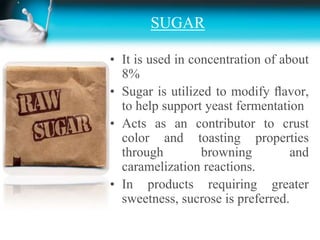
Continued..3. oxidizing agent: has an improving action in dough COMPOSITIONSUGARIt is used in concentration of about 8%Sugar is utilized to modify flavor, to help support yeast fermentationActs as an contributor to crust color and toasting properties through browning and caramelization reactions.In products requiring greater sweetness, sucrose is preferred.
SHORTENING AGENTSAdded to produce tenderness and to perform many other specific functions in the finished product.1.Animal and vegetable fats2.oils 3.Butter*Fat addition yields a 20% volume increase.
SURFACTANTSSurfactants are widely used in bread and other bakeryfoods. In breadmaking, surfactants perform as crumb softeners or dough strengthenersMonoglyceridesethoxylated monoglycerides Polysorbatesdiacetyl tartaric acid esters of monoglycerides
EGGSUsed up to 20%, based on flour, to achieve richness and to influence color and flavor.Some bakery foods, eg, sweet goods, croissants, and puff pastry, are often washed with egg wash,prior to baking to obtain a rich, golden brown color in the finished product. 
SALTIn breadmaking, salt, used at roughly 2% based on flour, provides flavor, moderates yeast fermentation by increasing the osmotic pressure in dough, and toughens gluten proteins
WATERThe components of yeast-raised doughs and chemically leavened batters are dispersed in water. Water for dough mixing is generally not softened because the minerals in hard water may be beneficial, tending to strengthen gluten proteins.
ENZYMESAdequate amylolytic enzymes must be present in dough for several reasonsThe amylase from subtilis, which is relatively heat stable and partly survives the baking process for further starch modifications, is utilized by some wholesale bakers to slow down the firming of bread
ENRICHING INGREDIENTMost commercially produced white breads are enriched with added thiamin4.0,riboflavin2.4,iron27.5,niacin33 all in g/kg
Products
Buns
              Hamburger       Ingredients1 pound ground beef 1/2 cup diced onion 2/3 cup chunky salsa 1/2 cup ketchup 1/2 cup packed brown sugar 1 egg 1/2 cup quick cooking oats salt and pepper to taste
METHODIn a bowl mix ground beef, diced onion,ketchup,suger,egg,oats,salt and pepper and fry patties. fry patties for 4-5min.
         Hot Dog Buns       Ingredients1 cup milk 1/2 cup water 1/4 cup butter 4 1/2 cups all-purpose flour 1 (.25 ounce) package instant yeast 2 tablespoons white sugar 1 1/2 teaspoons salt 1 egg
METHODHeat milk,water and butter at 120 FMix 3/4th cup flour,yeast,suger and saltMix milk in the flour and add eggStirr in remaining flour, ½ cup at a timeBeat well after each additionKnead the dough untill required consistencyDivide the dough in rectanguler shapeRoll up tightly Allow it to raise for 20-25min Bake at 200 c for 10-12min
       Sweet Roll        Ingredients1/2 cup warm water (110 degrees F/45 degrees C) 1/2 cup warm milk 1 egg 1/3 cup butter, softened 1/3 cup white sugar 1 teaspoon salt 3 3/4 cups all-purpose flour 1 (.25 ounce) package active dry yeast 1/4 cup butter, softened
English Muffins    Ingredients1 cup milk 2 tablespoons white sugar 1 (.25 ounce) package active dry yeast 1 cup warm water (110 degrees F/45 degrees C) 1/4 cup melted shortening 6 cups all-purpose flour 1 teaspoon salt
METHODWarm the milk in a small saucepan until it bubbles, then remove from heat. Mix in the sugar, stirring until dissolved. Let cool until lukewarm. In a small bowl, dissolve yeast in warm water. Let stand until creamy, about 10 minutes. In a large bowl, combine the milk, yeast mixture, shortening and 3 cups flour. Beat until smooth. Add salt and rest of flour, or enough to make a soft dough. Knead. Place in greased bowl, cover, and let rise.
3.Punch down. Roll out to about 1/2 inch thick. Cut rounds with biscuit cutter, drinking glass, or empty tuna can. Sprinkle waxed paper with cornmeal and set the rounds on this to rise. Dust tops of muffins with cornmeal also. Cover and let rise 1/2 hour. 4.Heat greased griddle. Cook muffins on griddle about 10 minutes on each side on medium heat. Keep baked muffins in a warm oven until all have been cooked. Allow to cool and place in plastic bags for storage. To use, split and toast. Great with orange butter, or cream cheese and jam.
Bagels   Ingredients4 1/2 cups all-purpose flour 3 tablespoons white sugar 1 1/2 teaspoons salt 1 (.25 ounce) package active dry yeast 1 2/3 cups warm water 2 tablespoons margarine 1 tablespoon white sugar 2 teaspoons salt
METHODMix together theflour,sugar,salt, yeast, water, and butter in the bread machine.  Remove from bread machine. Divide dough into 12 pieces; shape 3 pieces into smooth balls Poke a 1 inch hole in each.Drop bagels into a large skillet with 1 inch water (simmering) with sugar and salt in the water.Cook on medium low heat for 3 minutes, turn and cook 2 minutes; turn again, cook 1 minute more. Drain on towels and Place on greased cookie sheet. Bake at 375 degrees F (190 degrees C) for 20-25 minutes. Remove from sheets and cool.
PretzelsINGREDIENTS4 1/2 teaspoons active dry yeast 1 teaspoon white sugar 1/2 cup warm water 2 cups warm milk 6 tablespoons vegetable shortening 2 eggs 6 cups all-purpose flour, divided 1 tablespoon vegetable oil 1/4 cup white sugar 1 1/2 teaspoons salt  1/2 cup baking soda 4 cups water 1/4 cup melted butter
METHODSprinkle the yeast and sugar over 1/2 cup of warm water in a small bowl. The water should be no more than 100 degrees F. Let stand for 5 minutes until the yeast softens and begins to form a creamy foam. Add milk, shortening, eggs, oil,flour,sugar, and salt. Blend with an electric mixer on medium speed until smooth.Mix in remaining 3 cups of flour by hand, 1/2 cup at a time, mixing well after each addition. When the dough has pulled together, turn it out onto a floured surface, and knead until smooth and elastic, about 5 minutes. The dough will be sticky.
7. Lightly oil a large bowl, then place the dough in the bowl and turn to coat with oil. Cover with a light cloth and let rise in a warm place (80 to 95 degrees F (27 to 35 degrees C)) until doubled in volume, about 1 hour. Uncover the dough and punch it down. 8.Preheat an oven to 350 degrees F (175 degrees C). 9.Pull off baseball size portions of dough and roll into "snakes"  10.Set each formed bun aside. 11.Mix the baking soda and 4 cups hot water in a bowl. Dip each bun in the baking soda solution before placing on a baking sheet. Brush each bun with melted butter and sprinkle with salt. Bake in the preheated oven until brown, 20 to 25 minutes. Cool on a wire rack or brown paper bag
Croissants    INGREDIENTS1 1/4 teaspoons active dry yeast 3 tablespoons warm water (110 degrees F/45 degrees C) 1 teaspoon white sugar 1 3/4 cups all-purpose flour 2 teaspoons white sugar 1 1/2 teaspoons salt 2/3 cup warm milk 2 tablespoons vegetable oil 2/3 cup unsalted butter, chilled 1 egg 1 tablespoon water
METHODCombine yeast, warm water, and sugar. Allow to stand until creamy and frothy. Measure flour into a mixing bowl. Dissolve  sugar and salt in warm milk. Blend into flour along with yeast and oil. Mix well; knead until smooth. Cover, and let rise until over triple in volume. Deflate gently, and let rise again until doubled. Massage butter until pliable. Pat dough into a rectangle. Smear butter over top two thirds, leaving margin all around. Fold unbuttered third over middle third, and buttered top third down over that.
9.Turn 90 degrees, so that folds are to left and right. Roll into rectangle.10.Fold in three again. Sprinkle lightly with flour, and put dough in a plastic bag. Refrigerate 2 hours. Unwrap, sprinkle with flour, and deflate gently. Roll to a rectangle, and fold again. Turn 90 degrees, and repeat. Wrap, and chill 2 hours. 11.To shape, roll dough out to rectangle. Cut in half crosswise, and chill half while shaping the other half. 12.Roll out to rectangle. Cut into three squares. Cut each square in half diagonally. Roll each triangle lightly to elongate the point, and make it long. 13.Bake in a preheated 475 degrees F (245 degrees C) oven for 12 to 15 minutes
Danish Pastry      INGREDIENTS2 cups unsalted butter, softened 2/3 cup all-purpose flour 2 1/2 cups milk 1/2 cup white sugar 2 teaspoons salt 4 1/2 teaspoons active dry yeast 8 cups all-purpose flour 2 eggs 1 teaspoon lemon extract 1 teaspoon almond extract
METHODIn a medium bowl, cream together the butter and 2/3 cup of flour. Divide into 2 equal parts, and roll each half between 2 pieces of waxed paper into a 6 x12 inch sheet. Refrigerate. In a large bowl, mix together the dry yeast and 3 cups of the remaining flour. In a small saucepan over medium heat, combine the milk, sugar and salt. Heat to 115 degrees F (43 degrees C), or just warm, but not hot to the touch. Mix the warm milk mixture into the flour and yeast along with the eggs, and lemon and almond extracts. Stir for 3 minutes. Knead in the remaining flour 1/2 cup at a time until the dough is firm and pliable. Set aside to rest until double in size. Cut the dough in half, and roll each half out to a 14 inch square. Place one sheet of the cold butter onto each piece of dough, and fold the dough over it like the cover of a book. Seal edges by pressing with fingers. Roll each piece out to a 20x 12 inch rectangle, then fold into thirds by folding the long sides in over the center. Repeat rolling into a large rectangle, and folding into thirds. Wrap in plastic and refrigerate for at least 30 minutes.
4.Remove from the refrigerator one at a time, and roll and fold each piece two more times. Return to the refrigerator to chill again before shaping. If the butter gets too warm, the dough will become difficult to manage. 5.To make danishes, roll the dough out to 1/4 inch thickness. The dough can be cut into squares, with a filling placed in the center. Fold 2 of the corners over the center to form a filled diamond shape. Or, fold the piece in half, cut into 1 inch strips, stretch, twist and roll into a spiral. Place a dollop of preserves or other filling in the center. Place danishes on an ungreased baking sheet, and let rise until doubled. Preheat the oven to 450 degrees F (220 degrees C). Danishes can be brushed with egg white for a shiny finish. 6.Bake for 8 to 10 minutes in the preheated oven, or until the bottoms are golden brown.
Raised Doughnut
CrackersIngredients1 3/4 cups whole wheat flour 1 1/2 cups all-purpose flour 3/4 teaspoon salt 1/3 cup vegetable oil 1 cup water salt for sprinkling
METHODPreheat the oven to 350 degrees F (175 degrees C). In a medium bowl, stir together the whole wheat flour, all-purpose flour, and 3/4 teaspoon salt. Pour in the vegetable oil and water; mix until just blended. On a lightly floured surface, roll out the dough as thin as possible - no thicker than 1/8 inch. Place dough on an ungreased baking sheet, and mark squares out with a knife, but don't cut through. Prick each cracker with a fork a few times, and sprinkle with salt. Bake for 15 to 20 minutes in the preheated oven, or until crisp and light brown. Baking time may be different depending on how thin your crackers are. When cool, remove from baking sheet, and separate into individual crackers.
cookies       INGREDIENTS1 cup vegetable oil 1 cup butter, softened 1 cup white sugar 1 cup packed brown sugar 1 egg 2 teaspoons vanilla extract 3 1/2 cups all-purpose flour 1 teaspoon baking soda 1 teaspoon salt 1 cup cornflakes cereal 1 cup rolled oats 1 cup chopped walnuts 1 cup unsweetened flaked coconut
METHODPreheat oven to 375 degrees F (190 degrees C). Beat butter and sugars until fluffy. Slowly add oil and beat until oil is well incorporated. Add egg and vanilla, beat to mix. In a small bowl, combine flour, soda and salt. Add to butter mixture and stir just until mixed. Combine corn flakes, oatmeal, nuts and coconut and add to cookie mixture; mix just until combined.
4.Use a cookie scoop to produce consistently sized cookies, but you can drop by rounded teaspoonfuls onto an ungreased cookie sheet, if you don't have a scoop. Bake at 375 degrees F (190 degrees C) for 12 minutes or until lightly browned. Since these are so rich, you can chill the individual balls of cookie dough and then freeze them in freezer bags. You can then take them directly from the freezer to the oven, just add a few minutes to the cooking time
BIBLIOGRAPHY‘‘Bakery Processes and Products’’ inECT 1st ed., Vol. 2, pp. 273–287, by O. Skovholt, Quality Bakers of America. ‘‘Bakery Processes and Leavening Agents (Yeast-Raised Products)’’ inECT 2nd ed., Vol. 3, pp. 41–55, by W. B. Bradley, American Institute of Baking Department of Agriculture; inECT 4th ed., Vol. 3, pp. 876–902, by F. N. Y. Chung, Rhoˆne-Poulenc, Inc; ‘‘Bakery Processes, Yeast-Raised Products’’ inECT , posted by J. G. Ponte, Jr. and J. D. Payne, Kansas State University. 
CITED PUBLICATIONS1. H. E. Jacob,Six Thousand Years of Bread, Greenwood Press Publishers, Westport,Conn., 1970.2. H. G. Muller,Baking and Bakeries, Shire Publications Ltd., Aylesbury, Bucks, UK,1986Fig. 1.Conventional dough process. (Courtesy of Union Machinery Division. AmericanMachine & Foundry Co.)
Fermented Bakery Products

Fermented Bakery Products

  • 1.
  • 2.
    INTRODUCTIONBread and otheryeast-raised bakery foods are widely consumed and desired, because of their appealing flavour and light, porous texture, properties which depend largely on yeast fermentation. Leavening by the action of yeast was known to the Egyptians as early as 2000BC. The role of baker’s yeast (Saccharomycescerevisiae) in producing leavened bread depends on two factors:-the ability of yeast to generate carbon dioxide and alcohol through the breakdown of simple sugars, and the unique ability of wheat flour proteins to form films in dough that trap evolved gases.
  • 3.
  • 4.
    FLOURIt is theprimary ingredient of most bakery foods.It comprises up to 95% of all the ingredients.
  • 5.
    YEASTMost of theyeast used by wholesale bakers is available in the form of fresh compressed yeast, granular, or as cream yeastYeast fermentation leads to gas production which, in turn, leads to leavened doughMost bread doughs are made with 2–3% fresh compressed yeast, based on flour
  • 6.
    Continued..Instant yeast exhibitsmore activity than regular active dry yeast due to improved drying techniques, and can replace compressed yeast at a rate of 33–40%.
  • 7.
    YEAST FOODSYeast foodsare multifunctional proprietary materials, containing principally an ammonium salt, a calcium salt, and an oxidant.ammonium ion: serves as a source of nitrogen for the yeastcalcium ion: has a beneficial strengthening effect on the colloidal structure of the gluten
  • 8.
    Continued..3. oxidizing agent:has an improving action in dough COMPOSITIONSUGARIt is used in concentration of about 8%Sugar is utilized to modify flavor, to help support yeast fermentationActs as an contributor to crust color and toasting properties through browning and caramelization reactions.In products requiring greater sweetness, sucrose is preferred.
  • 9.
    SHORTENING AGENTSAdded toproduce tenderness and to perform many other specific functions in the finished product.1.Animal and vegetable fats2.oils 3.Butter*Fat addition yields a 20% volume increase.
  • 10.
    SURFACTANTSSurfactants are widelyused in bread and other bakeryfoods. In breadmaking, surfactants perform as crumb softeners or dough strengthenersMonoglyceridesethoxylated monoglycerides Polysorbatesdiacetyl tartaric acid esters of monoglycerides
  • 11.
    EGGSUsed up to20%, based on flour, to achieve richness and to influence color and flavor.Some bakery foods, eg, sweet goods, croissants, and puff pastry, are often washed with egg wash,prior to baking to obtain a rich, golden brown color in the finished product. 
  • 12.
    SALTIn breadmaking, salt,used at roughly 2% based on flour, provides flavor, moderates yeast fermentation by increasing the osmotic pressure in dough, and toughens gluten proteins
  • 13.
    WATERThe components ofyeast-raised doughs and chemically leavened batters are dispersed in water. Water for dough mixing is generally not softened because the minerals in hard water may be beneficial, tending to strengthen gluten proteins.
  • 14.
    ENZYMESAdequate amylolytic enzymesmust be present in dough for several reasonsThe amylase from subtilis, which is relatively heat stable and partly survives the baking process for further starch modifications, is utilized by some wholesale bakers to slow down the firming of bread
  • 15.
    ENRICHING INGREDIENTMost commerciallyproduced white breads are enriched with added thiamin4.0,riboflavin2.4,iron27.5,niacin33 all in g/kg
  • 16.
  • 17.
  • 18.
    Hamburger Ingredients1 pound ground beef 1/2 cup diced onion 2/3 cup chunky salsa 1/2 cup ketchup 1/2 cup packed brown sugar 1 egg 1/2 cup quick cooking oats salt and pepper to taste
  • 19.
    METHODIn a bowlmix ground beef, diced onion,ketchup,suger,egg,oats,salt and pepper and fry patties. fry patties for 4-5min.
  • 20.
    Hot Dog Buns Ingredients1 cup milk 1/2 cup water 1/4 cup butter 4 1/2 cups all-purpose flour 1 (.25 ounce) package instant yeast 2 tablespoons white sugar 1 1/2 teaspoons salt 1 egg
  • 21.
    METHODHeat milk,water andbutter at 120 FMix 3/4th cup flour,yeast,suger and saltMix milk in the flour and add eggStirr in remaining flour, ½ cup at a timeBeat well after each additionKnead the dough untill required consistencyDivide the dough in rectanguler shapeRoll up tightly Allow it to raise for 20-25min Bake at 200 c for 10-12min
  • 22.
    Sweet Roll Ingredients1/2 cup warm water (110 degrees F/45 degrees C) 1/2 cup warm milk 1 egg 1/3 cup butter, softened 1/3 cup white sugar 1 teaspoon salt 3 3/4 cups all-purpose flour 1 (.25 ounce) package active dry yeast 1/4 cup butter, softened
  • 23.
    English Muffins Ingredients1 cup milk 2 tablespoons white sugar 1 (.25 ounce) package active dry yeast 1 cup warm water (110 degrees F/45 degrees C) 1/4 cup melted shortening 6 cups all-purpose flour 1 teaspoon salt
  • 24.
    METHODWarm the milkin a small saucepan until it bubbles, then remove from heat. Mix in the sugar, stirring until dissolved. Let cool until lukewarm. In a small bowl, dissolve yeast in warm water. Let stand until creamy, about 10 minutes. In a large bowl, combine the milk, yeast mixture, shortening and 3 cups flour. Beat until smooth. Add salt and rest of flour, or enough to make a soft dough. Knead. Place in greased bowl, cover, and let rise.
  • 25.
    3.Punch down. Rollout to about 1/2 inch thick. Cut rounds with biscuit cutter, drinking glass, or empty tuna can. Sprinkle waxed paper with cornmeal and set the rounds on this to rise. Dust tops of muffins with cornmeal also. Cover and let rise 1/2 hour. 4.Heat greased griddle. Cook muffins on griddle about 10 minutes on each side on medium heat. Keep baked muffins in a warm oven until all have been cooked. Allow to cool and place in plastic bags for storage. To use, split and toast. Great with orange butter, or cream cheese and jam.
  • 26.
    Bagels Ingredients4 1/2 cups all-purpose flour 3 tablespoons white sugar 1 1/2 teaspoons salt 1 (.25 ounce) package active dry yeast 1 2/3 cups warm water 2 tablespoons margarine 1 tablespoon white sugar 2 teaspoons salt
  • 27.
    METHODMix together theflour,sugar,salt,yeast, water, and butter in the bread machine. Remove from bread machine. Divide dough into 12 pieces; shape 3 pieces into smooth balls Poke a 1 inch hole in each.Drop bagels into a large skillet with 1 inch water (simmering) with sugar and salt in the water.Cook on medium low heat for 3 minutes, turn and cook 2 minutes; turn again, cook 1 minute more. Drain on towels and Place on greased cookie sheet. Bake at 375 degrees F (190 degrees C) for 20-25 minutes. Remove from sheets and cool.
  • 28.
    PretzelsINGREDIENTS4 1/2 teaspoonsactive dry yeast 1 teaspoon white sugar 1/2 cup warm water 2 cups warm milk 6 tablespoons vegetable shortening 2 eggs 6 cups all-purpose flour, divided 1 tablespoon vegetable oil 1/4 cup white sugar 1 1/2 teaspoons salt  1/2 cup baking soda 4 cups water 1/4 cup melted butter
  • 29.
    METHODSprinkle the yeastand sugar over 1/2 cup of warm water in a small bowl. The water should be no more than 100 degrees F. Let stand for 5 minutes until the yeast softens and begins to form a creamy foam. Add milk, shortening, eggs, oil,flour,sugar, and salt. Blend with an electric mixer on medium speed until smooth.Mix in remaining 3 cups of flour by hand, 1/2 cup at a time, mixing well after each addition. When the dough has pulled together, turn it out onto a floured surface, and knead until smooth and elastic, about 5 minutes. The dough will be sticky.
  • 30.
    7. Lightly oila large bowl, then place the dough in the bowl and turn to coat with oil. Cover with a light cloth and let rise in a warm place (80 to 95 degrees F (27 to 35 degrees C)) until doubled in volume, about 1 hour. Uncover the dough and punch it down. 8.Preheat an oven to 350 degrees F (175 degrees C). 9.Pull off baseball size portions of dough and roll into "snakes" 10.Set each formed bun aside. 11.Mix the baking soda and 4 cups hot water in a bowl. Dip each bun in the baking soda solution before placing on a baking sheet. Brush each bun with melted butter and sprinkle with salt. Bake in the preheated oven until brown, 20 to 25 minutes. Cool on a wire rack or brown paper bag
  • 31.
    Croissants INGREDIENTS1 1/4 teaspoons active dry yeast 3 tablespoons warm water (110 degrees F/45 degrees C) 1 teaspoon white sugar 1 3/4 cups all-purpose flour 2 teaspoons white sugar 1 1/2 teaspoons salt 2/3 cup warm milk 2 tablespoons vegetable oil 2/3 cup unsalted butter, chilled 1 egg 1 tablespoon water
  • 32.
    METHODCombine yeast, warmwater, and sugar. Allow to stand until creamy and frothy. Measure flour into a mixing bowl. Dissolve sugar and salt in warm milk. Blend into flour along with yeast and oil. Mix well; knead until smooth. Cover, and let rise until over triple in volume. Deflate gently, and let rise again until doubled. Massage butter until pliable. Pat dough into a rectangle. Smear butter over top two thirds, leaving margin all around. Fold unbuttered third over middle third, and buttered top third down over that.
  • 33.
    9.Turn 90 degrees,so that folds are to left and right. Roll into rectangle.10.Fold in three again. Sprinkle lightly with flour, and put dough in a plastic bag. Refrigerate 2 hours. Unwrap, sprinkle with flour, and deflate gently. Roll to a rectangle, and fold again. Turn 90 degrees, and repeat. Wrap, and chill 2 hours. 11.To shape, roll dough out to rectangle. Cut in half crosswise, and chill half while shaping the other half. 12.Roll out to rectangle. Cut into three squares. Cut each square in half diagonally. Roll each triangle lightly to elongate the point, and make it long. 13.Bake in a preheated 475 degrees F (245 degrees C) oven for 12 to 15 minutes
  • 34.
    Danish Pastry INGREDIENTS2 cups unsalted butter, softened 2/3 cup all-purpose flour 2 1/2 cups milk 1/2 cup white sugar 2 teaspoons salt 4 1/2 teaspoons active dry yeast 8 cups all-purpose flour 2 eggs 1 teaspoon lemon extract 1 teaspoon almond extract
  • 35.
    METHODIn a mediumbowl, cream together the butter and 2/3 cup of flour. Divide into 2 equal parts, and roll each half between 2 pieces of waxed paper into a 6 x12 inch sheet. Refrigerate. In a large bowl, mix together the dry yeast and 3 cups of the remaining flour. In a small saucepan over medium heat, combine the milk, sugar and salt. Heat to 115 degrees F (43 degrees C), or just warm, but not hot to the touch. Mix the warm milk mixture into the flour and yeast along with the eggs, and lemon and almond extracts. Stir for 3 minutes. Knead in the remaining flour 1/2 cup at a time until the dough is firm and pliable. Set aside to rest until double in size. Cut the dough in half, and roll each half out to a 14 inch square. Place one sheet of the cold butter onto each piece of dough, and fold the dough over it like the cover of a book. Seal edges by pressing with fingers. Roll each piece out to a 20x 12 inch rectangle, then fold into thirds by folding the long sides in over the center. Repeat rolling into a large rectangle, and folding into thirds. Wrap in plastic and refrigerate for at least 30 minutes.
  • 36.
    4.Remove from therefrigerator one at a time, and roll and fold each piece two more times. Return to the refrigerator to chill again before shaping. If the butter gets too warm, the dough will become difficult to manage. 5.To make danishes, roll the dough out to 1/4 inch thickness. The dough can be cut into squares, with a filling placed in the center. Fold 2 of the corners over the center to form a filled diamond shape. Or, fold the piece in half, cut into 1 inch strips, stretch, twist and roll into a spiral. Place a dollop of preserves or other filling in the center. Place danishes on an ungreased baking sheet, and let rise until doubled. Preheat the oven to 450 degrees F (220 degrees C). Danishes can be brushed with egg white for a shiny finish. 6.Bake for 8 to 10 minutes in the preheated oven, or until the bottoms are golden brown.
  • 37.
  • 38.
    CrackersIngredients1 3/4 cupswhole wheat flour 1 1/2 cups all-purpose flour 3/4 teaspoon salt 1/3 cup vegetable oil 1 cup water salt for sprinkling
  • 39.
    METHODPreheat the ovento 350 degrees F (175 degrees C). In a medium bowl, stir together the whole wheat flour, all-purpose flour, and 3/4 teaspoon salt. Pour in the vegetable oil and water; mix until just blended. On a lightly floured surface, roll out the dough as thin as possible - no thicker than 1/8 inch. Place dough on an ungreased baking sheet, and mark squares out with a knife, but don't cut through. Prick each cracker with a fork a few times, and sprinkle with salt. Bake for 15 to 20 minutes in the preheated oven, or until crisp and light brown. Baking time may be different depending on how thin your crackers are. When cool, remove from baking sheet, and separate into individual crackers.
  • 40.
    cookies INGREDIENTS1 cup vegetable oil 1 cup butter, softened 1 cup white sugar 1 cup packed brown sugar 1 egg 2 teaspoons vanilla extract 3 1/2 cups all-purpose flour 1 teaspoon baking soda 1 teaspoon salt 1 cup cornflakes cereal 1 cup rolled oats 1 cup chopped walnuts 1 cup unsweetened flaked coconut
  • 41.
    METHODPreheat oven to375 degrees F (190 degrees C). Beat butter and sugars until fluffy. Slowly add oil and beat until oil is well incorporated. Add egg and vanilla, beat to mix. In a small bowl, combine flour, soda and salt. Add to butter mixture and stir just until mixed. Combine corn flakes, oatmeal, nuts and coconut and add to cookie mixture; mix just until combined.
  • 42.
    4.Use a cookiescoop to produce consistently sized cookies, but you can drop by rounded teaspoonfuls onto an ungreased cookie sheet, if you don't have a scoop. Bake at 375 degrees F (190 degrees C) for 12 minutes or until lightly browned. Since these are so rich, you can chill the individual balls of cookie dough and then freeze them in freezer bags. You can then take them directly from the freezer to the oven, just add a few minutes to the cooking time
  • 43.
    BIBLIOGRAPHY‘‘Bakery Processes andProducts’’ inECT 1st ed., Vol. 2, pp. 273–287, by O. Skovholt, Quality Bakers of America. ‘‘Bakery Processes and Leavening Agents (Yeast-Raised Products)’’ inECT 2nd ed., Vol. 3, pp. 41–55, by W. B. Bradley, American Institute of Baking Department of Agriculture; inECT 4th ed., Vol. 3, pp. 876–902, by F. N. Y. Chung, Rhoˆne-Poulenc, Inc; ‘‘Bakery Processes, Yeast-Raised Products’’ inECT , posted by J. G. Ponte, Jr. and J. D. Payne, Kansas State University. 
  • 44.
    CITED PUBLICATIONS1. H.E. Jacob,Six Thousand Years of Bread, Greenwood Press Publishers, Westport,Conn., 1970.2. H. G. Muller,Baking and Bakeries, Shire Publications Ltd., Aylesbury, Bucks, UK,1986Fig. 1.Conventional dough process. (Courtesy of Union Machinery Division. AmericanMachine & Foundry Co.)