FERMENTATION TECHNOLOGY
AND
ITS APPLICATION
Presented by: Tai lela
Roll no. 2412024014
M. Pharm 2nd
Sem
Dept: Pharmacognosy
Date:17/02/25
MEDICINAL PLANT BIOTECHNOLOGY (MPG 201T)
1
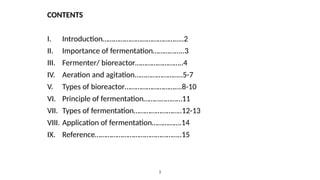
CONTENTS
I. Introduction……………………………………..2
II. Importance of fermentation……………..3
III. Fermenter/ bioreactor……………………..4
IV. Aeration and agitation……………………..5-7
V. Types of bioreactor………………………….8-10
VI. Principle of fermentation…………………11
VII. Types of fermentation……………………..12-13
VIII. Application of fermentation…………….14
IX. Reference………………………………………..15
INTRODUCTON:
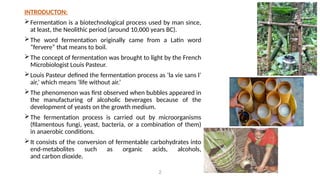
Fermentation is a biotechnological process used by man since,
at least, the Neolithic period (around 10,000 years BC).
The word fermentation originally came from a Latin word
“fervere” that means to boil.
The concept of fermentation was brought to light by the French
Microbiologist Louis Pasteur.
Louis Pasteur defined the fermentation process as ‘la vie sans l’
air,’ which means ‘life without air.’
The phenomenon was first observed when bubbles appeared in
the manufacturing of alcoholic beverages because of the
development of yeasts on the growth medium.
The fermentation process is carried out by microorganisms
(filamentous fungi, yeast, bacteria, or a combination of them)
in anaerobic conditions.
It consists of the conversion of fermentable carbohydrates into
end-metabolites such as organic acids, alcohols,
and carbon dioxide.
2
3
IMPORTANCE OF FERMENTATION:
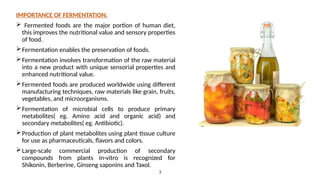
 Fermented foods are the major portion of human diet,
this improves the nutritional value and sensory properties
of food.
Fermentation enables the preservation of foods.
Fermentation involves transformation of the raw material
into a new product with unique sensorial properties and
enhanced nutritional value.
Fermented foods are produced worldwide using different
manufacturing techniques, raw materials like grain, fruits,
vegetables, and microorganisms.
Fermentation of microbial cells to produce primary
metabolites( eg. Amino acid and organic acid) and
secondary metabolites( eg. Antibiotic).
Production of plant metabolites using plant tissue culture
for use as pharmaceuticals, flavors and colors.
Large-scale commercial production of secondary
compounds from plants in-vitro is recognized for
Shikonin, Berberine, Ginseng saponins and Taxol.
4
FERMENTER/ BIOREACTOR:
It is a closed vessel which provides a controlled environment
for the growth of micro organism or animal cells to obtain a
desired product.
Points to be considered :
1.The vessel should be capable of being operated for long term
(days) aseptically.
2. Adequate aeration and agitation.
3. Power consumption should be low.
4. A system for temperature control.
5. A system for pH .
6. Sampling port.
7. Minimization of evaporation losses.
8. Culture vessel should be useful for wide range of processes.
9. Vessel should be constructed with smooth internal surfaces.
10. The material for construction should be
available at cheaper rate.
5
AERATION AND AGITATION:
The primary purpose of aeration is to provide plant
cells/microbial cells in fermenter with sufficient oxygen for
metabolic requirements.
Agitation should ensure that a uniform suspension of
microbial cells/plant cells is achieved in a homogenous
nutrient medium.
The type of aeration - agitation system depends on
characteristics of the fermentation process.
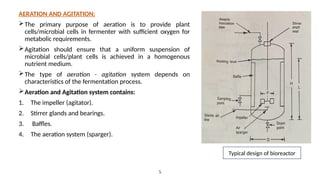
Aeration and Agitation system contains:
1. The impeller (agitator).
2. Stirrer glands and bearings.
3. Baffles.
4. The aeration system (sparger).
Typical design of bioreactor
6
1.IMPELLER/AGITATOR
• To stir the media continuously and distribute oxygen
throughout the medium.
• To maintain uniform environment throughout the
vessel contents.
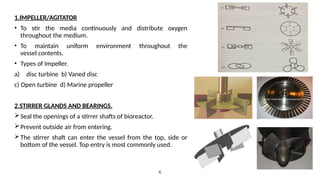
• Types of Impeller.
a) disc turbine b) Vaned disc
c) Open turbine d) Marine propeller
2.STIRRER GLANDS AND BEARINGS.
Seal the openings of a stirrer shafts of bioreactor.
Prevent outside air from entering.
The stirrer shaft can enter the vessel from the top, side or
bottom of the vessel. Top entry is most commonly used.
7
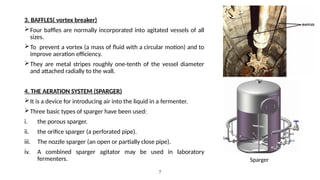
3. BAFFLES( vortex breaker)
Four baffles are normally incorporated into agitated vessels of all
sizes.
To prevent a vortex (a mass of fluid with a circular motion) and to
improve aeration efficiency.
They are metal stripes roughly one-tenth of the vessel diameter
and attached radially to the wall.
4. THE AERATION SYSTEM (SPARGER)
It is a device for introducing air into the liquid in a fermenter.
Three basic types of sparger have been used:
i. the porous sparger.
ii. the orifice sparger (a perforated pipe).
iii. The nozzle sparger (an open or partially close pipe).
iv. A combined sparger agitator may be used in laboratory
fermenters. Sparger
8
TYPE OF BIOREACTORS
The bioreactors are classified into 3 categories :
1.Based on the mode of aeration and agitation
a. Mechanically agitated bioreactor/ Stirred tank bioreactor: It is most
common type of reactor for culturing plant cells (including microbial
and animal cells), where air is dispersed by mechanical agitation.
b. Pneumatically agitated: Absence of an impeller, pneumatically agitated
systems are tall and thin.
c. Special class, eg. Mist bioreactor.
Stirred tank bioreactor
9
2.Based on the shape and size of the culture vessel
a. Stirred tank bioreactor.
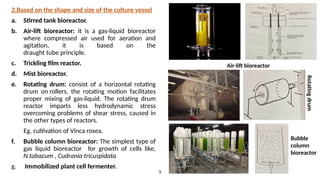
b. Air-lift bioreactor: it is a gas-liquid bioreactor
where compressed air used for aeration and
agitation, it is based on the
draught tube principle.
c. Trickling film reactor.
d. Mist bioreactor.
e. Rotating drum: consist of a horizontal rotating
drum on rollers, the rotating motion facilitates
proper mixing of gas-liquid. The rotating drum
reactor imparts less hydrodynamic stress
overcoming problems of shear stress, caused in
the other types of reactors.
Eg. cultivation of Vinca rosea.
f. Bubble column bioreactor: The simplest type of
gas liquid bioreactor for growth of cells like,
N.tabacum , Cudrania tricuspidata
g. Immobilized plant cell fermenter.
Air-lift bioreactor
Bubble
column
bioreactor
Rotating
drum
10
3) Based on mode of operation
a. Batch suspension reactor
b. Continuous flow stirred tank reactor (CESTR)
c. Semi-continuous (Multistage CFSTR)
d. Immobilized tank reactor.
Continuous flow stirred tank reactor
Immobilized tank reactor
11
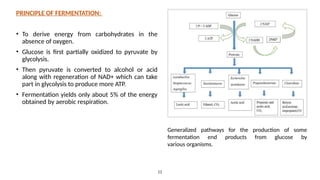
PRINCIPLE OF FERMENTATION:
• To derive energy from carbohydrates in the
absence of oxygen.
• Glucose is first partially oxidized to pyruvate by
glycolysis.
• Then pyruvate is converted to alcohol or acid
along with regeneration of NAD+ which can take
part in glycolysis to produce more ATP.
• Fermentation yields only about 5% of the energy
obtained by aerobic respiration.
Generalized pathways for the production of some
fermentation end products from glucose by
various organisms.
12
TYPES OF FERMENTATION
There are mainly four main types of fermentation
processes:
1. Alcohol fermentation
• Ethanol is produced by yeasts.
• e.g., wines and beers.
2. Lactic acid fermentation
• Mainly work of lactic acid bacteria (LAB).
• Occurs chiefly in cereals and milk products.
• e.g., fermented milks, cereals, fruits, and vegetables.
13
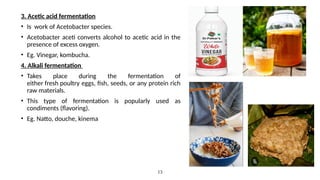
3. Acetic acid fermentation
• Is work of Acetobacter species.
• Acetobacter aceti converts alcohol to acetic acid in the
presence of excess oxygen.
• Eg. Vinegar, kombucha.
4. Alkali fermentation
• Takes place during the fermentation of
either fresh poultry eggs, fish, seeds, or any protein rich
raw materials.
• This type of fermentation is popularly used as
condiments (flavoring).
• Eg. Natto, douche, kinema
14
APPLICATION OF FERMENTATION
1. Application In biotechnology
• Production of cell or biomes
• Production of metabolites
• Modification of compound
• Production of recombinant products
• Production of single cell protein
2. Application in medicine
• Production of antibiotics
• Production of insulin
• Production of growth hormones
• Production of vaccines
• Production of interferon
3. Application in the food industry
• Production of fermented food such as cheese,
wine, beer, and bread to high-value products
• Food grade bio preservatives
• Functional foods/Nutraceuticals
• Processing meat and fish
• Condiments production( flavoring)
4. Other Applications
• It is also used for waste management such as
biofuels production (biodiesels, bioethanol,
butanol, biohydrogen, etc).
• It is also used to produce bio-surfactant,
polymers production such as bacterial cellulose
production.
• Development of bioremediation processes
(involving microbes or their isolated enzymes)
for soils and wastewater treatments.
15
REFERENCE
Ciddi veeresham, “ medicinal plant biotechnology”, CBS Publishers &
Distributors Pvt. Ltd, page no. 420-457.
https://search.app/kUTnKXSFimMcQHdu6

Fermentation technology and its application .pptx

  • 1.
    FERMENTATION TECHNOLOGY AND ITS APPLICATION Presentedby: Tai lela Roll no. 2412024014 M. Pharm 2nd Sem Dept: Pharmacognosy Date:17/02/25 MEDICINAL PLANT BIOTECHNOLOGY (MPG 201T)
  • 2.
    1 CONTENTS I. Introduction……………………………………..2 II. Importanceof fermentation……………..3 III. Fermenter/ bioreactor……………………..4 IV. Aeration and agitation……………………..5-7 V. Types of bioreactor………………………….8-10 VI. Principle of fermentation…………………11 VII. Types of fermentation……………………..12-13 VIII. Application of fermentation…………….14 IX. Reference………………………………………..15
  • 3.
    INTRODUCTON: Fermentation is abiotechnological process used by man since, at least, the Neolithic period (around 10,000 years BC). The word fermentation originally came from a Latin word “fervere” that means to boil. The concept of fermentation was brought to light by the French Microbiologist Louis Pasteur. Louis Pasteur defined the fermentation process as ‘la vie sans l’ air,’ which means ‘life without air.’ The phenomenon was first observed when bubbles appeared in the manufacturing of alcoholic beverages because of the development of yeasts on the growth medium. The fermentation process is carried out by microorganisms (filamentous fungi, yeast, bacteria, or a combination of them) in anaerobic conditions. It consists of the conversion of fermentable carbohydrates into end-metabolites such as organic acids, alcohols, and carbon dioxide. 2
  • 4.
    3 IMPORTANCE OF FERMENTATION: Fermented foods are the major portion of human diet, this improves the nutritional value and sensory properties of food. Fermentation enables the preservation of foods. Fermentation involves transformation of the raw material into a new product with unique sensorial properties and enhanced nutritional value. Fermented foods are produced worldwide using different manufacturing techniques, raw materials like grain, fruits, vegetables, and microorganisms. Fermentation of microbial cells to produce primary metabolites( eg. Amino acid and organic acid) and secondary metabolites( eg. Antibiotic). Production of plant metabolites using plant tissue culture for use as pharmaceuticals, flavors and colors. Large-scale commercial production of secondary compounds from plants in-vitro is recognized for Shikonin, Berberine, Ginseng saponins and Taxol.
  • 5.
    4 FERMENTER/ BIOREACTOR: It isa closed vessel which provides a controlled environment for the growth of micro organism or animal cells to obtain a desired product. Points to be considered : 1.The vessel should be capable of being operated for long term (days) aseptically. 2. Adequate aeration and agitation. 3. Power consumption should be low. 4. A system for temperature control. 5. A system for pH . 6. Sampling port. 7. Minimization of evaporation losses. 8. Culture vessel should be useful for wide range of processes. 9. Vessel should be constructed with smooth internal surfaces. 10. The material for construction should be available at cheaper rate.
  • 6.
    5 AERATION AND AGITATION: Theprimary purpose of aeration is to provide plant cells/microbial cells in fermenter with sufficient oxygen for metabolic requirements. Agitation should ensure that a uniform suspension of microbial cells/plant cells is achieved in a homogenous nutrient medium. The type of aeration - agitation system depends on characteristics of the fermentation process. Aeration and Agitation system contains: 1. The impeller (agitator). 2. Stirrer glands and bearings. 3. Baffles. 4. The aeration system (sparger). Typical design of bioreactor
  • 7.
    6 1.IMPELLER/AGITATOR • To stirthe media continuously and distribute oxygen throughout the medium. • To maintain uniform environment throughout the vessel contents. • Types of Impeller. a) disc turbine b) Vaned disc c) Open turbine d) Marine propeller 2.STIRRER GLANDS AND BEARINGS. Seal the openings of a stirrer shafts of bioreactor. Prevent outside air from entering. The stirrer shaft can enter the vessel from the top, side or bottom of the vessel. Top entry is most commonly used.
  • 8.
    7 3. BAFFLES( vortexbreaker) Four baffles are normally incorporated into agitated vessels of all sizes. To prevent a vortex (a mass of fluid with a circular motion) and to improve aeration efficiency. They are metal stripes roughly one-tenth of the vessel diameter and attached radially to the wall. 4. THE AERATION SYSTEM (SPARGER) It is a device for introducing air into the liquid in a fermenter. Three basic types of sparger have been used: i. the porous sparger. ii. the orifice sparger (a perforated pipe). iii. The nozzle sparger (an open or partially close pipe). iv. A combined sparger agitator may be used in laboratory fermenters. Sparger
  • 9.
    8 TYPE OF BIOREACTORS Thebioreactors are classified into 3 categories : 1.Based on the mode of aeration and agitation a. Mechanically agitated bioreactor/ Stirred tank bioreactor: It is most common type of reactor for culturing plant cells (including microbial and animal cells), where air is dispersed by mechanical agitation. b. Pneumatically agitated: Absence of an impeller, pneumatically agitated systems are tall and thin. c. Special class, eg. Mist bioreactor. Stirred tank bioreactor
  • 10.
    9 2.Based on theshape and size of the culture vessel a. Stirred tank bioreactor. b. Air-lift bioreactor: it is a gas-liquid bioreactor where compressed air used for aeration and agitation, it is based on the draught tube principle. c. Trickling film reactor. d. Mist bioreactor. e. Rotating drum: consist of a horizontal rotating drum on rollers, the rotating motion facilitates proper mixing of gas-liquid. The rotating drum reactor imparts less hydrodynamic stress overcoming problems of shear stress, caused in the other types of reactors. Eg. cultivation of Vinca rosea. f. Bubble column bioreactor: The simplest type of gas liquid bioreactor for growth of cells like, N.tabacum , Cudrania tricuspidata g. Immobilized plant cell fermenter. Air-lift bioreactor Bubble column bioreactor Rotating drum
  • 11.
    10 3) Based onmode of operation a. Batch suspension reactor b. Continuous flow stirred tank reactor (CESTR) c. Semi-continuous (Multistage CFSTR) d. Immobilized tank reactor. Continuous flow stirred tank reactor Immobilized tank reactor
  • 12.
    11 PRINCIPLE OF FERMENTATION: •To derive energy from carbohydrates in the absence of oxygen. • Glucose is first partially oxidized to pyruvate by glycolysis. • Then pyruvate is converted to alcohol or acid along with regeneration of NAD+ which can take part in glycolysis to produce more ATP. • Fermentation yields only about 5% of the energy obtained by aerobic respiration. Generalized pathways for the production of some fermentation end products from glucose by various organisms.
  • 13.
    12 TYPES OF FERMENTATION Thereare mainly four main types of fermentation processes: 1. Alcohol fermentation • Ethanol is produced by yeasts. • e.g., wines and beers. 2. Lactic acid fermentation • Mainly work of lactic acid bacteria (LAB). • Occurs chiefly in cereals and milk products. • e.g., fermented milks, cereals, fruits, and vegetables.
  • 14.
    13 3. Acetic acidfermentation • Is work of Acetobacter species. • Acetobacter aceti converts alcohol to acetic acid in the presence of excess oxygen. • Eg. Vinegar, kombucha. 4. Alkali fermentation • Takes place during the fermentation of either fresh poultry eggs, fish, seeds, or any protein rich raw materials. • This type of fermentation is popularly used as condiments (flavoring). • Eg. Natto, douche, kinema
  • 15.
    14 APPLICATION OF FERMENTATION 1.Application In biotechnology • Production of cell or biomes • Production of metabolites • Modification of compound • Production of recombinant products • Production of single cell protein 2. Application in medicine • Production of antibiotics • Production of insulin • Production of growth hormones • Production of vaccines • Production of interferon 3. Application in the food industry • Production of fermented food such as cheese, wine, beer, and bread to high-value products • Food grade bio preservatives • Functional foods/Nutraceuticals • Processing meat and fish • Condiments production( flavoring) 4. Other Applications • It is also used for waste management such as biofuels production (biodiesels, bioethanol, butanol, biohydrogen, etc). • It is also used to produce bio-surfactant, polymers production such as bacterial cellulose production. • Development of bioremediation processes (involving microbes or their isolated enzymes) for soils and wastewater treatments.
  • 16.
    15 REFERENCE Ciddi veeresham, “medicinal plant biotechnology”, CBS Publishers & Distributors Pvt. Ltd, page no. 420-457. https://search.app/kUTnKXSFimMcQHdu6