Feeding the Agile BeastFocusing Development on Delivering Business ValueDean Stevens - Synaptus
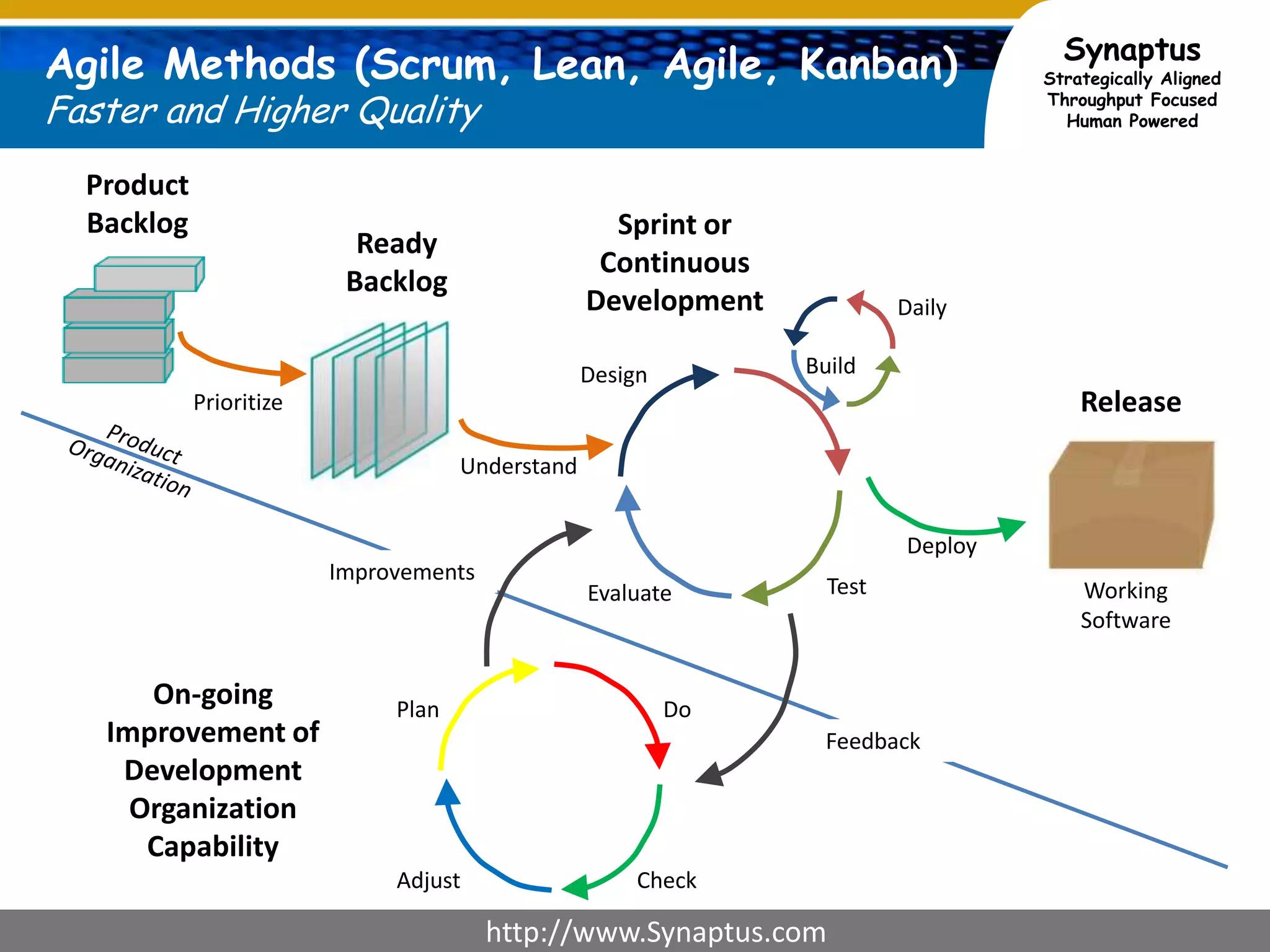
Agile Methods (Scrum, Lean, Agile, Kanban)Faster and Higher QualityProduct BacklogSprint or Continuous DevelopmentReady BacklogDailyBuildDesignReleasePrioritizeProductUnderstandOrganizationDeployImprovementsTestWorking SoftwareEvaluateOn-going Improvement ofDevelopment OrganizationCapabilityDoPlanFeedbackCheckAdjust
Lean - Agile Software DevelopmentThe Bargain of AgileBetter, Faster, CheaperThe  Bargain of Agile is faster, more reliable, higher quality software. We also achieve higher trust inside the team. Fit with Customer DesireResult of close customer interaction, continuous delivery,  iterative development, and progressive elaboration Result of iterations, Progressive Elaboration, WIP limits, focus on quality, “done-done”, a continuous state of readiness, and refactoringFlowResult of incremental development, visible management tools, measures of cycle time and/or velocityVisibilityResult of daily standup, retrospectives, and ceremonies supporting process improvement and learning – includes shared understanding and self organizationCollaborative Game
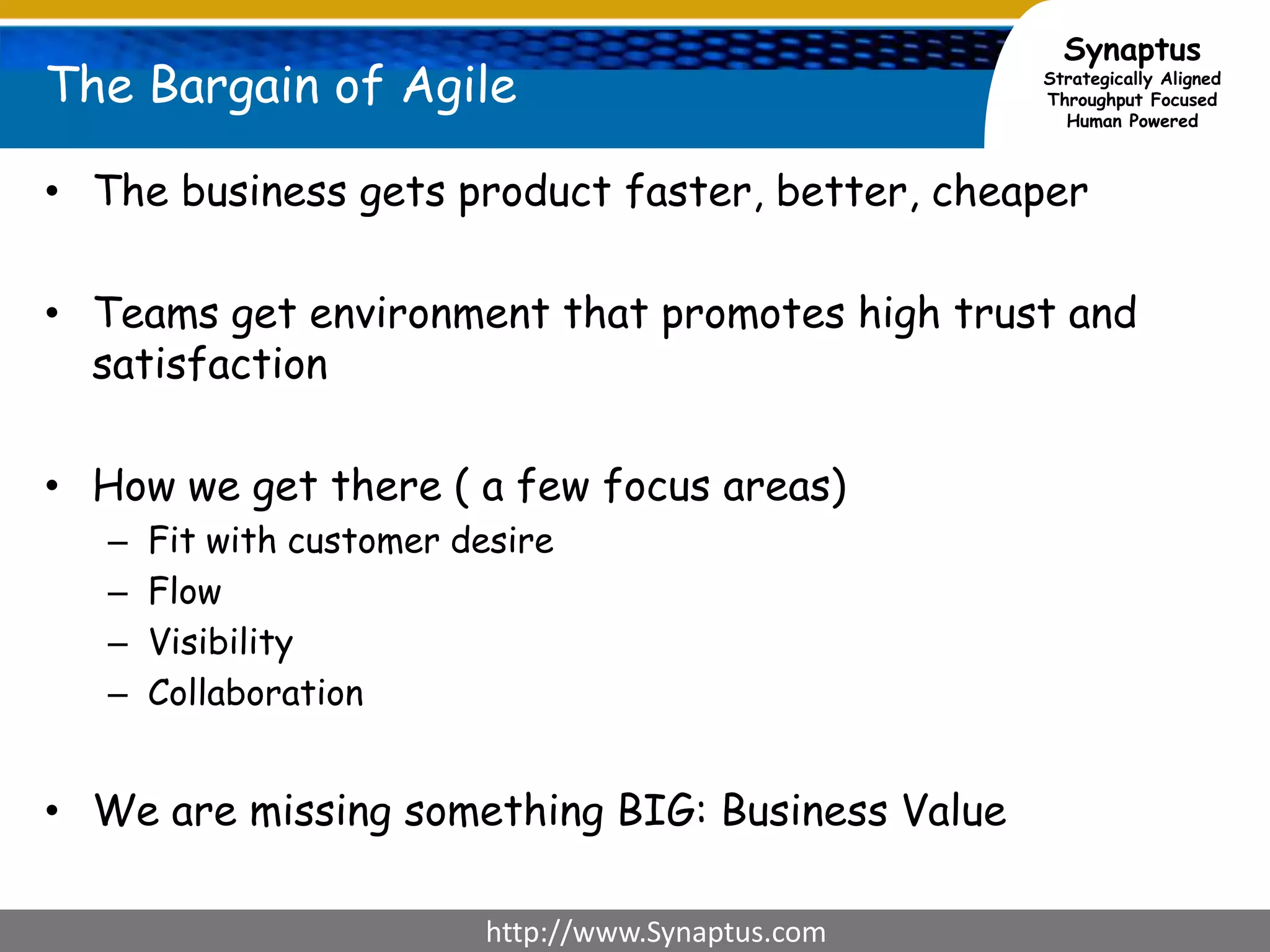
The Bargain of AgileThe business gets product faster, better, cheaperTeams get environment that promotes high trust and satisfactionHow we get there ( a few focus areas)Fit with customer desireFlowVisibilityCollaborationWe are missing something BIG: Business Value
But What’s up?Does business get what they expect?CombinedChangesValue CreationEffectivenessWe expect to realize dramatic resultsBut often don’t realize the expected benefit
Scrum, Agile, Lean & KanbanDon’t explicitly address Business ValueBusiness Value comes from building what will provide the highest economic return (over time) to the business.Fit with Customer DesireBusiness ValueFlowBusiness ValueVisibilityBusiness ValueCollaborative GameBusiness ValueMoving faster is not sufficient – we have to build the right things.
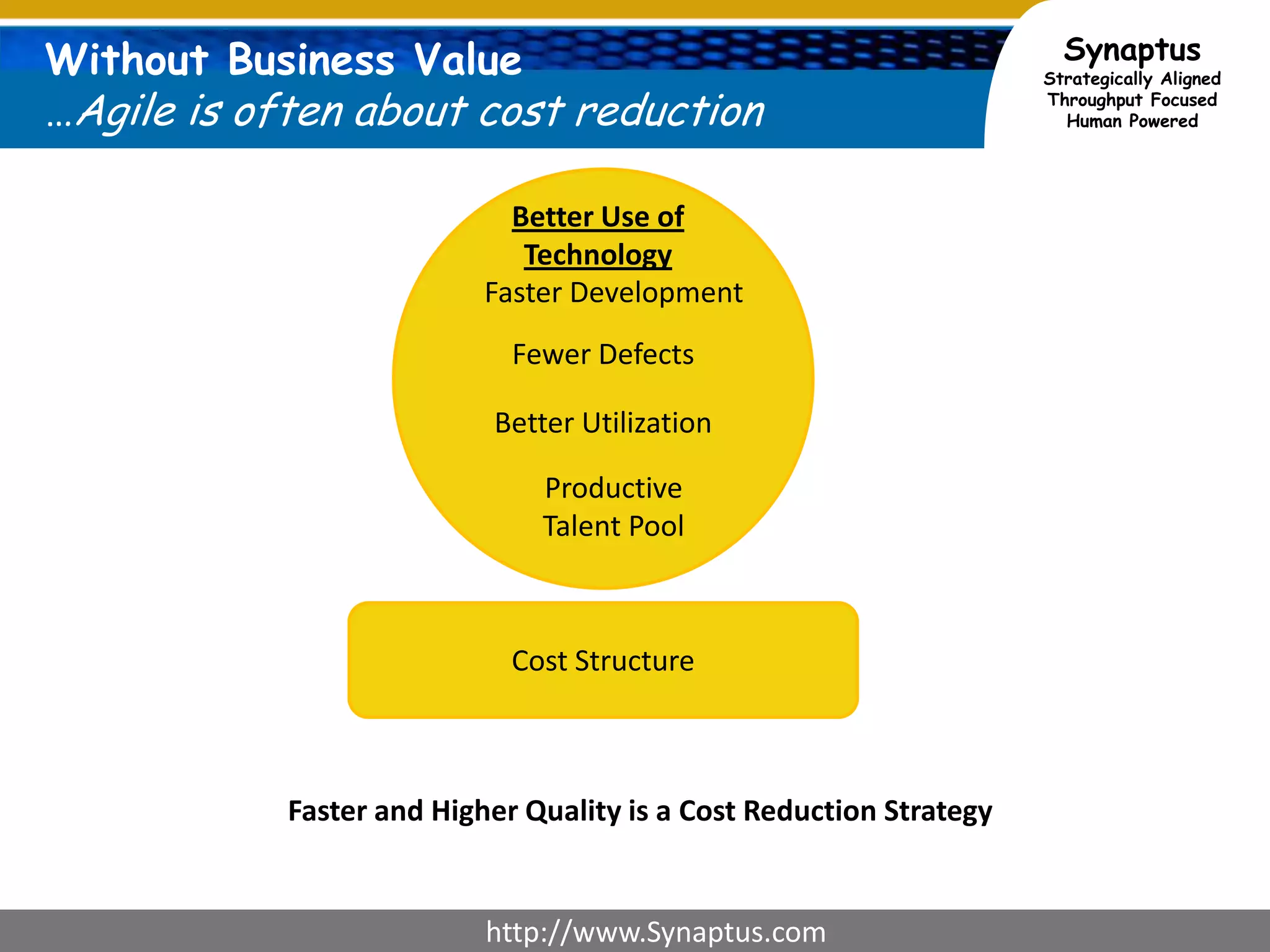
Without Business Value…Agile is often about cost reductionBetter Use of TechnologyFaster DevelopmentFewer DefectsBetter UtilizationProductiveTalent PoolCost StructureFaster and Higher Quality is a Cost Reduction Strategy
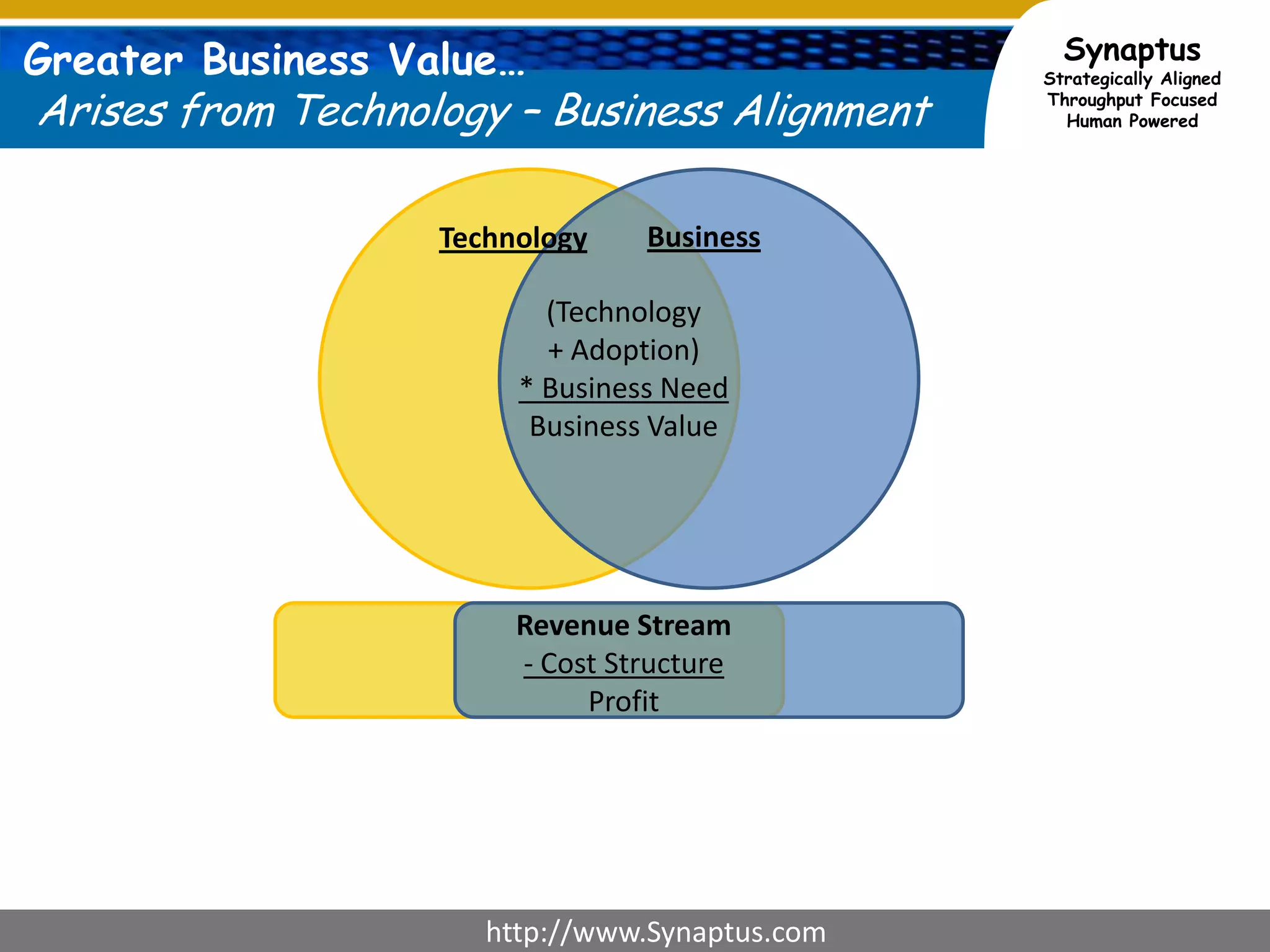
Greater Business Value… Arises from Technology – Business Alignment BusinessTechnology(Technology+ Adoption)* Business NeedBusiness ValueRevenue Stream- Cost StructureProfit
The New Bargain of AgileBusiness value comes from building what will provide the highest economic outcome (over time) to the business Development is no longer the issueTechnology is no longer the obstacleWe must feed the agile beast in a way to achieve this business benefitAllows you to operate at decision cycles faster and cheaper than your competition
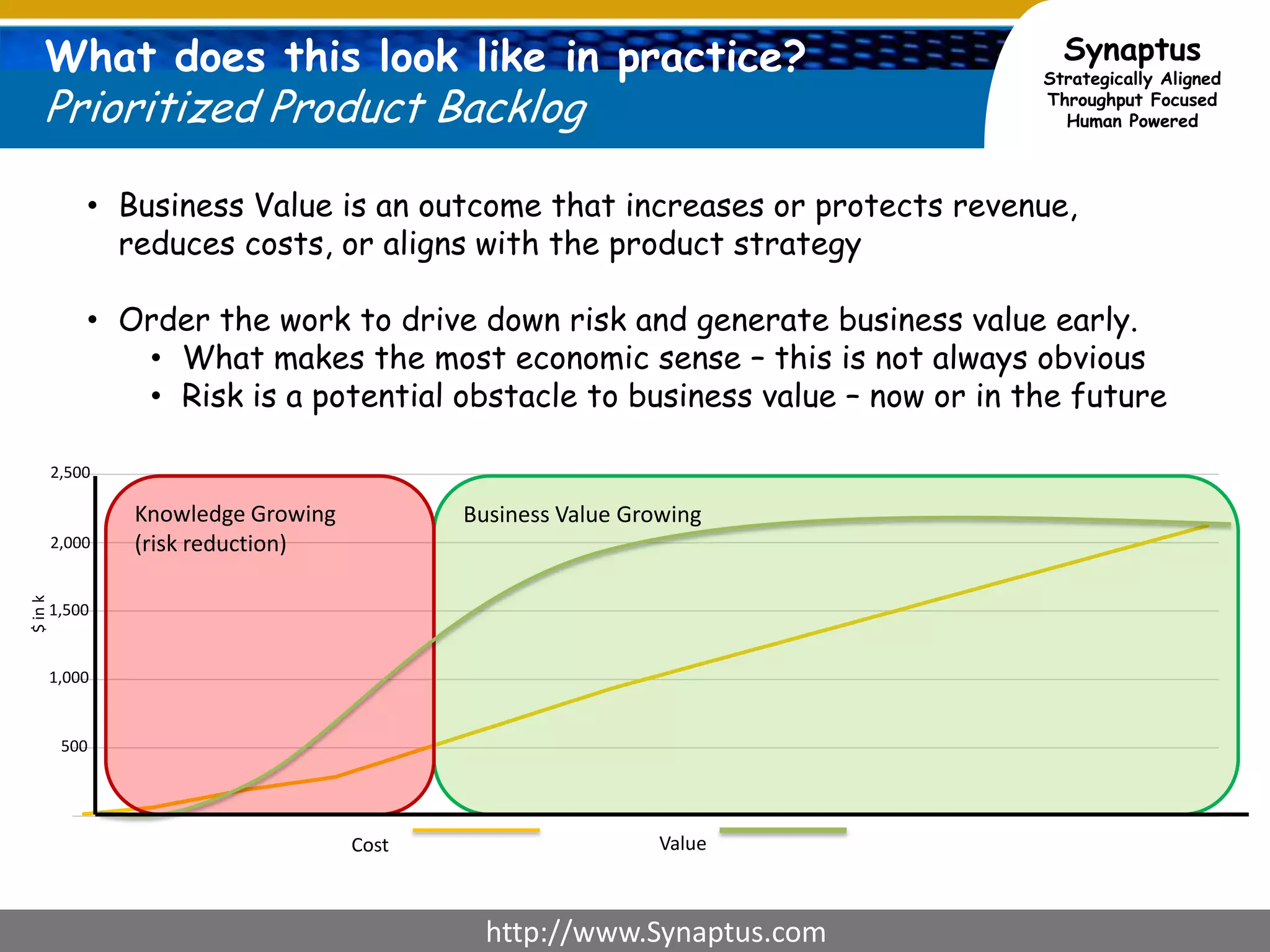
What does this look like in practice?Prioritized Product BacklogBusiness Value is an outcome that increases or protects revenue, reduces costs, or aligns with the product strategy
Order the work to drive down risk and generate business value early.
What makes the most economic sense – this is not always obvious
Risk is a potential obstacle to business value – now or in the future2,500Business Value GrowingKnowledge Growing (risk reduction)2,0001,500$ in k1,000500ValueCost
Prioritization is Hard Enoughat the Small TeamThe Enterprise brings even bigger challengesMultiple Teams, Multiple ProductsComplex ArchitecturesCoordinating up and down stream in the EnterpriseEnsure that the purpose and value proposition of each feature/story is prioritized and understood by development / QA and verified in customer acceptance.
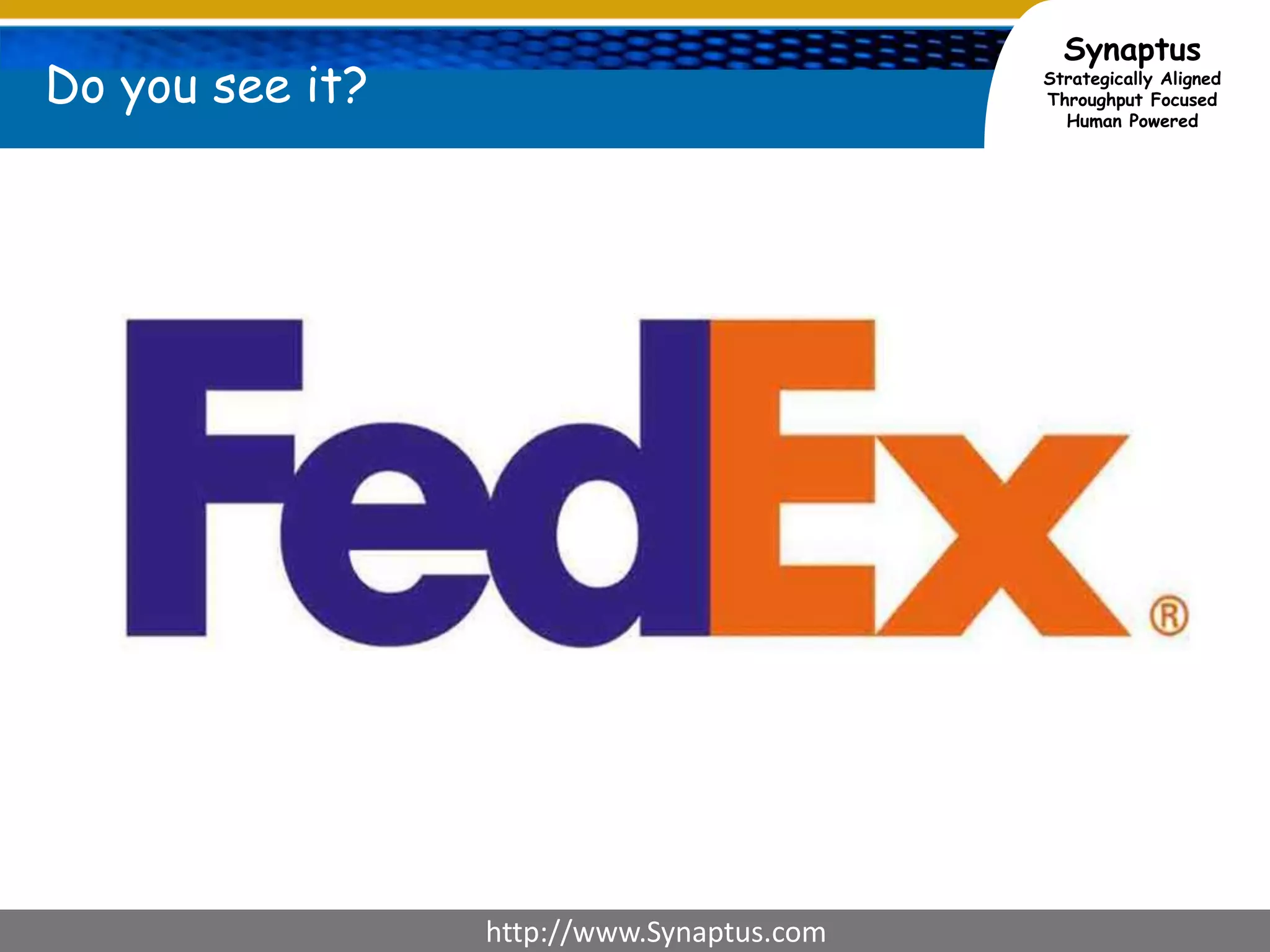
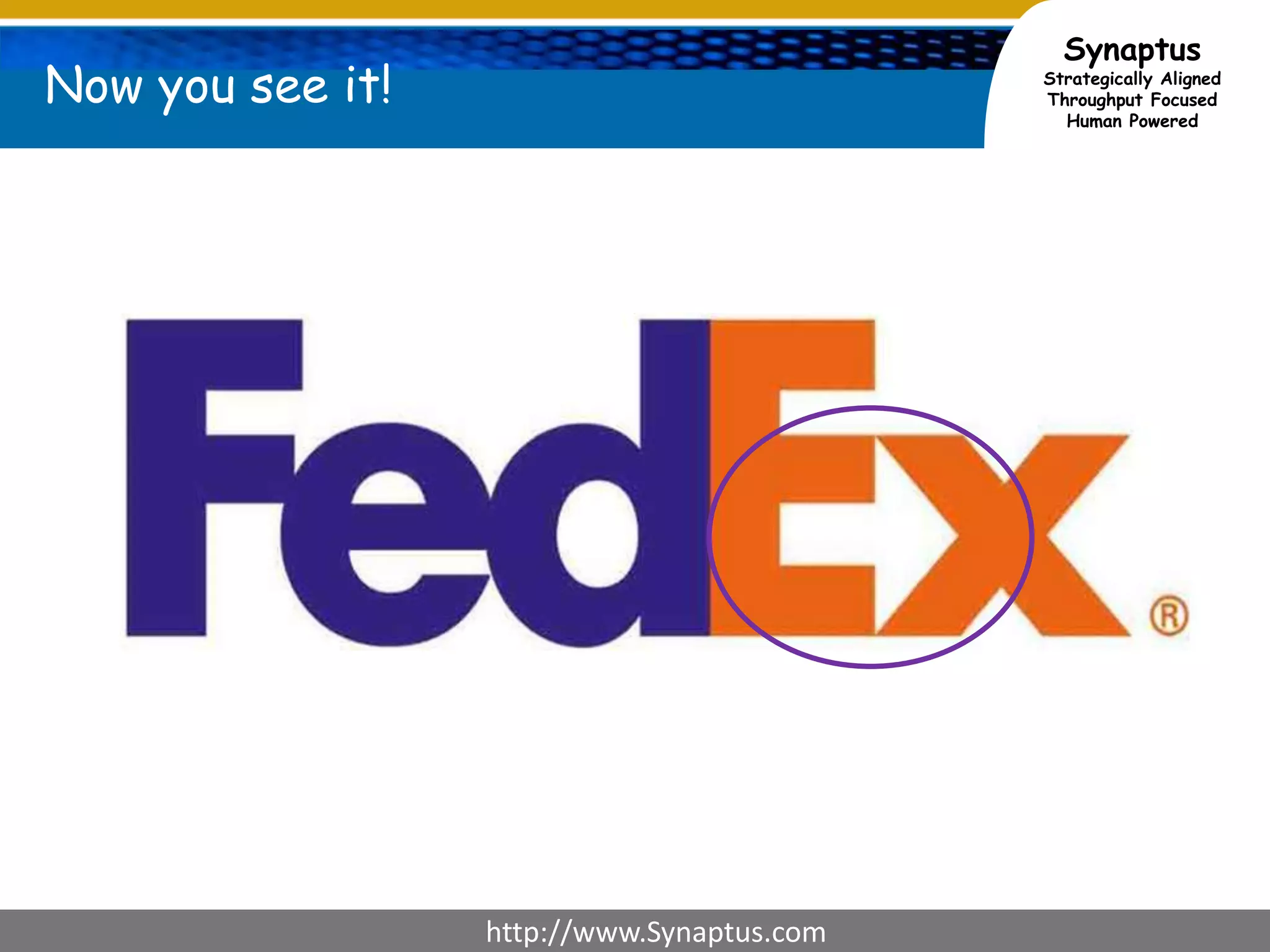
Do you see it?
Now you see it!
The “How” TrapA human conditionThe Fosbury FlopFaxing isn’t ever “what” someone is doingEveryone’s initial focus is on “how” they do their jobs
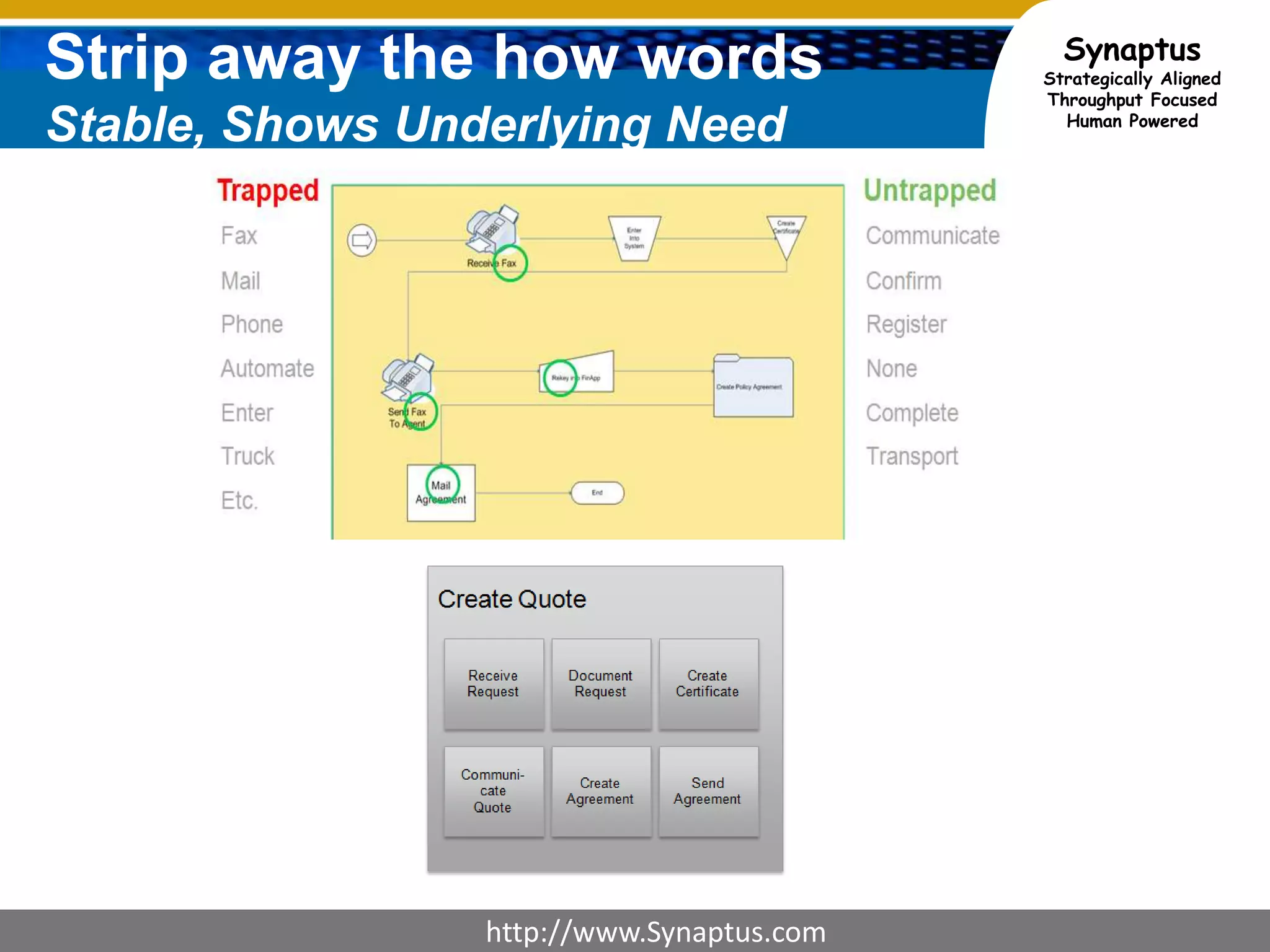
Strip away the how wordsStable, Shows Underlying Need
Overcoming the How TrapCapability AnalysisValue Performance MapShould I invest in Create Quote?Where should I focus to drive Business Value and Reduce Risk?How do I determine when it is good enough?What should we NOT work on?
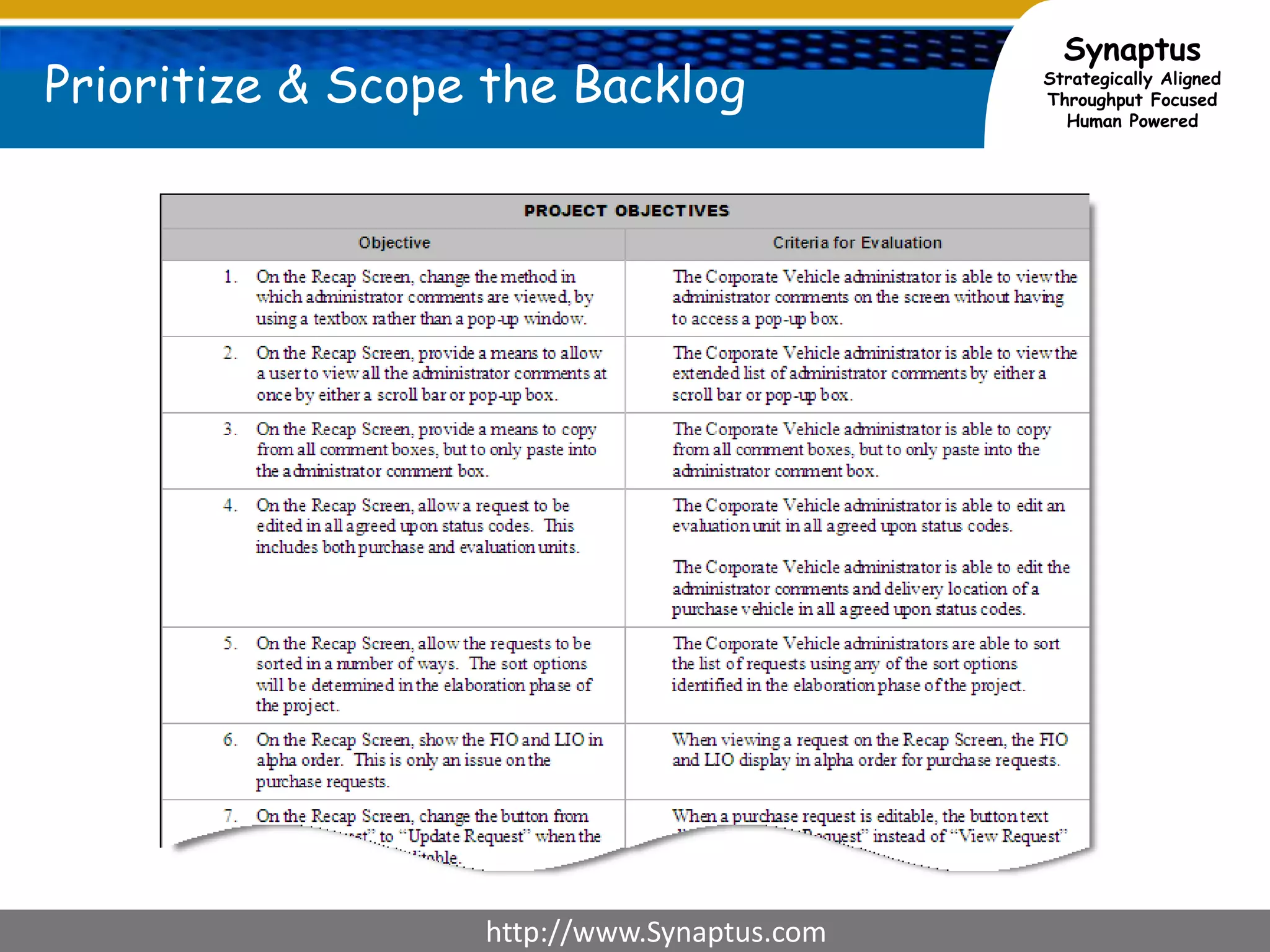
Prioritize & Scope the Backlog
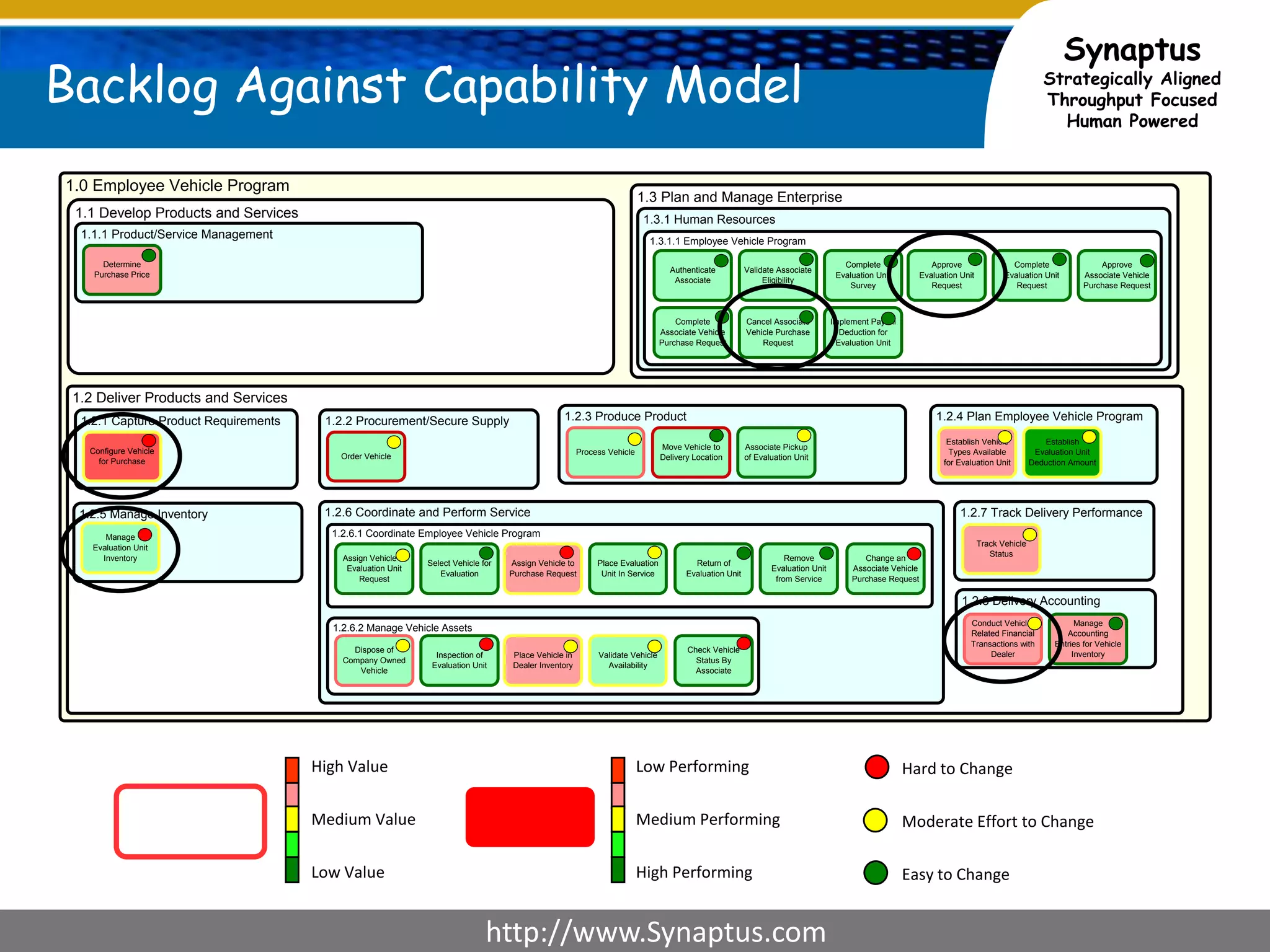
Backlog Against Capability ModelHigh ValueMedium ValueLow ValueLow PerformingMedium PerformingHigh PerformingHard to ChangeModerate Effort to ChangeEasy to Change
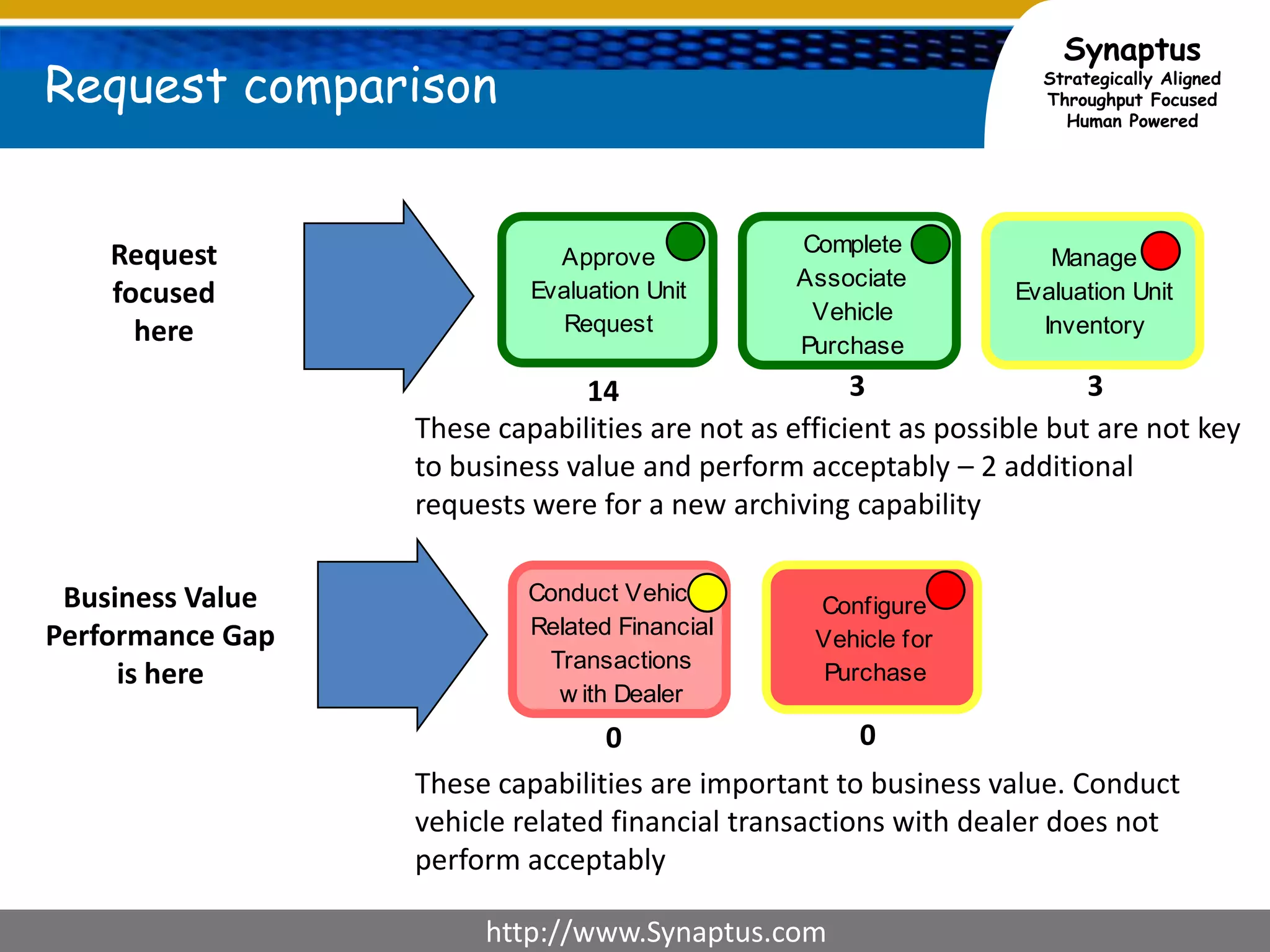
Request comparisonRequest focusedhere3314These capabilities are not as efficient as possible but are not key to business value and perform acceptably – 2 additional requests were for a new archiving capabilityBusiness ValuePerformance Gapis here00These capabilities are important to business value. Conduct vehicle related financial transactions with dealer does not perform acceptably
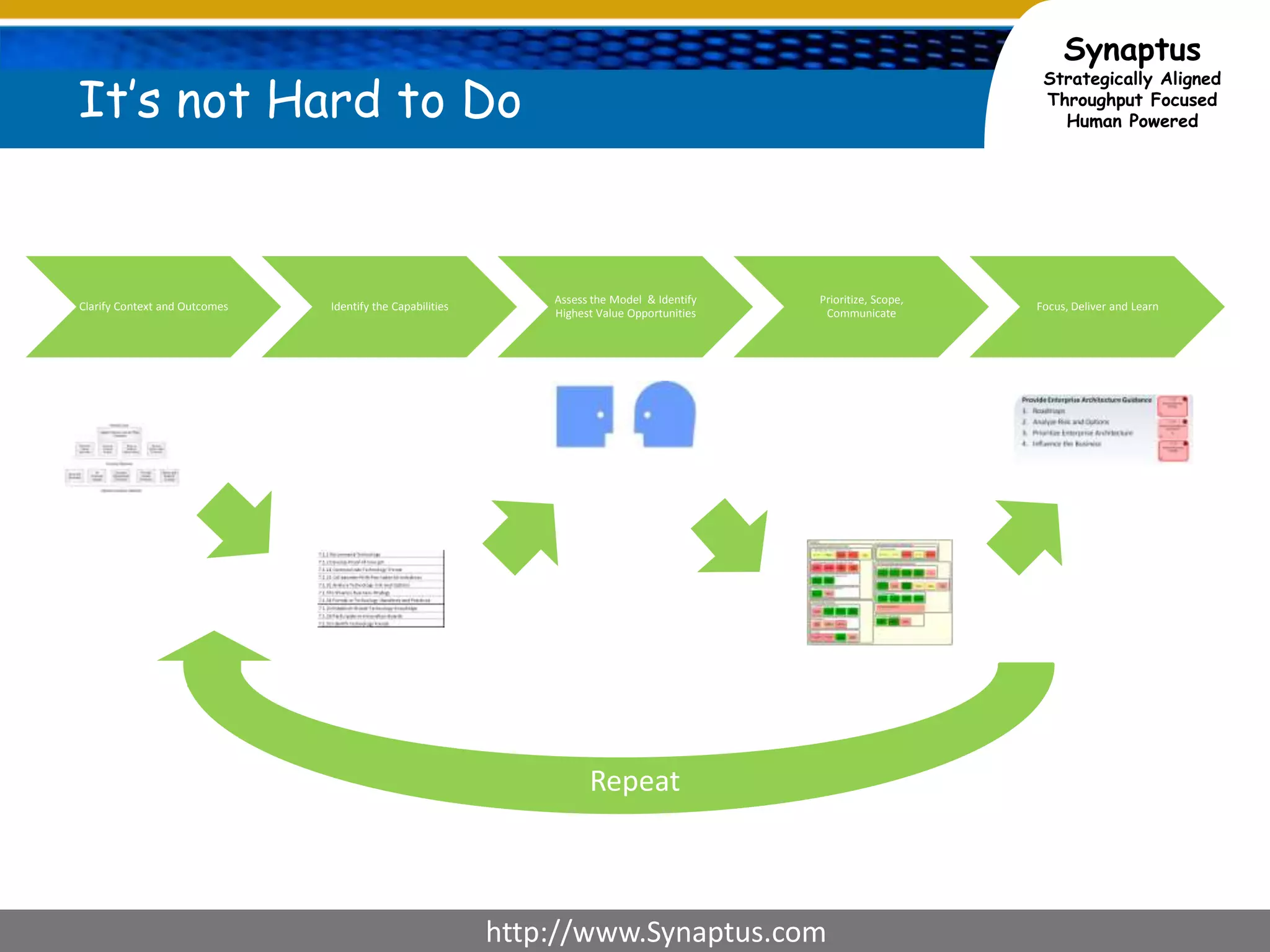
It’s not Hard to DoRepeat
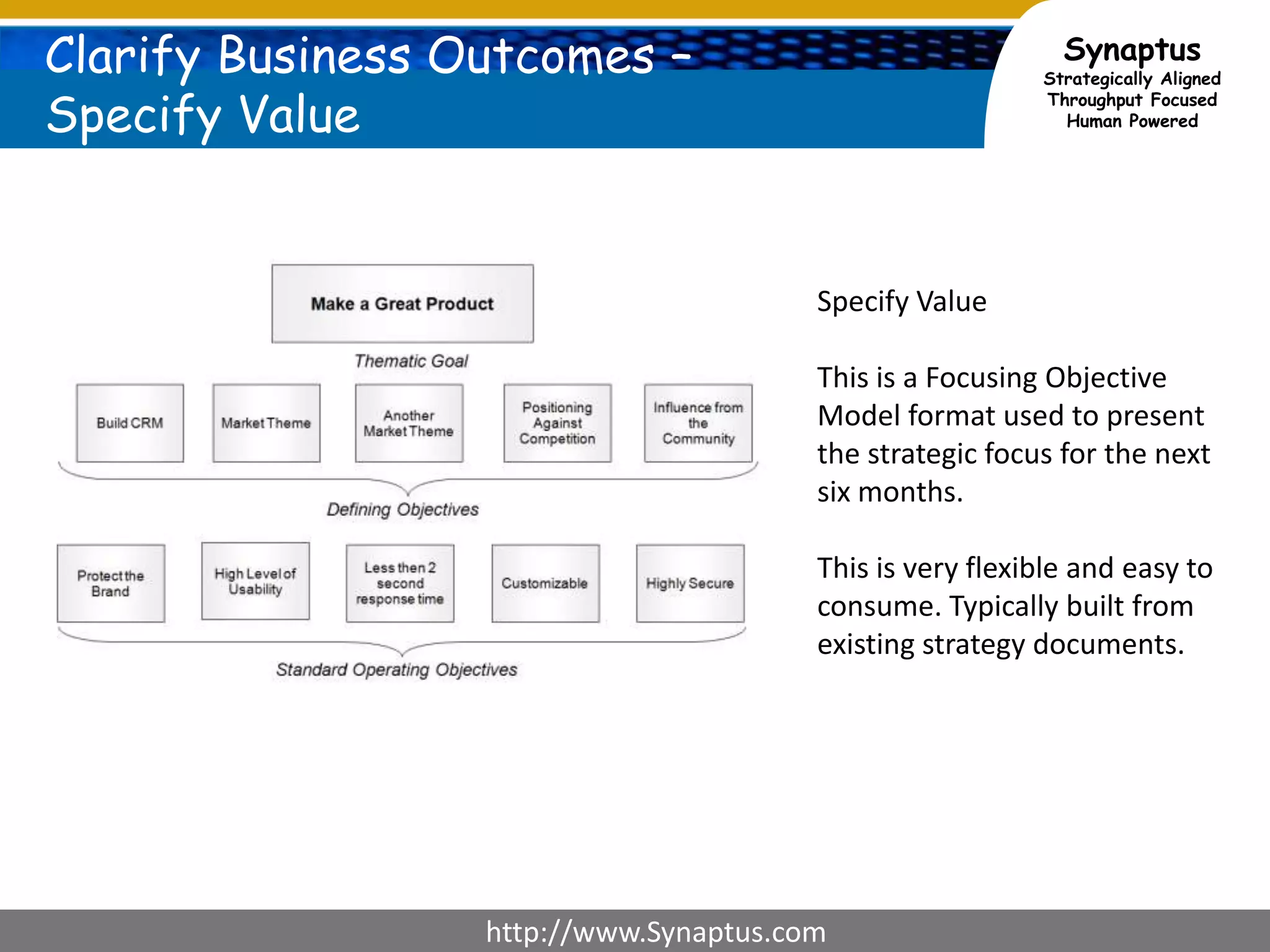
Clarify Business Outcomes – Specify ValueSpecify Value This is a Focusing Objective Model format used to present the strategic focus for the next six months.This is very flexible and easy to consume. Typically built from existing strategy documents.
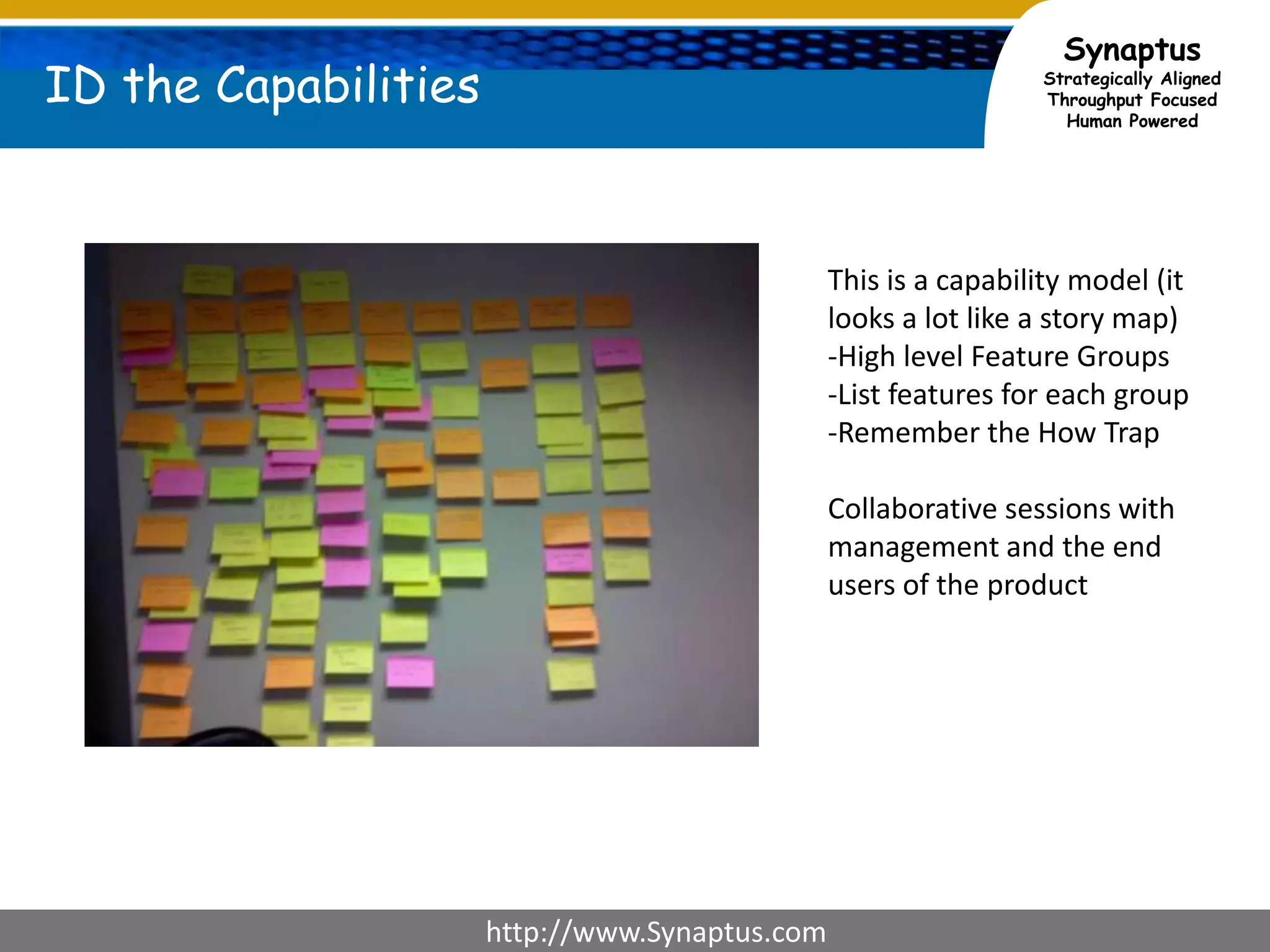
ID the CapabilitiesThis is a capability model (it looks a lot like a story map)High level Feature Groups
List features for each group
Remember the How TrapCollaborative sessions with management and the end users of the product
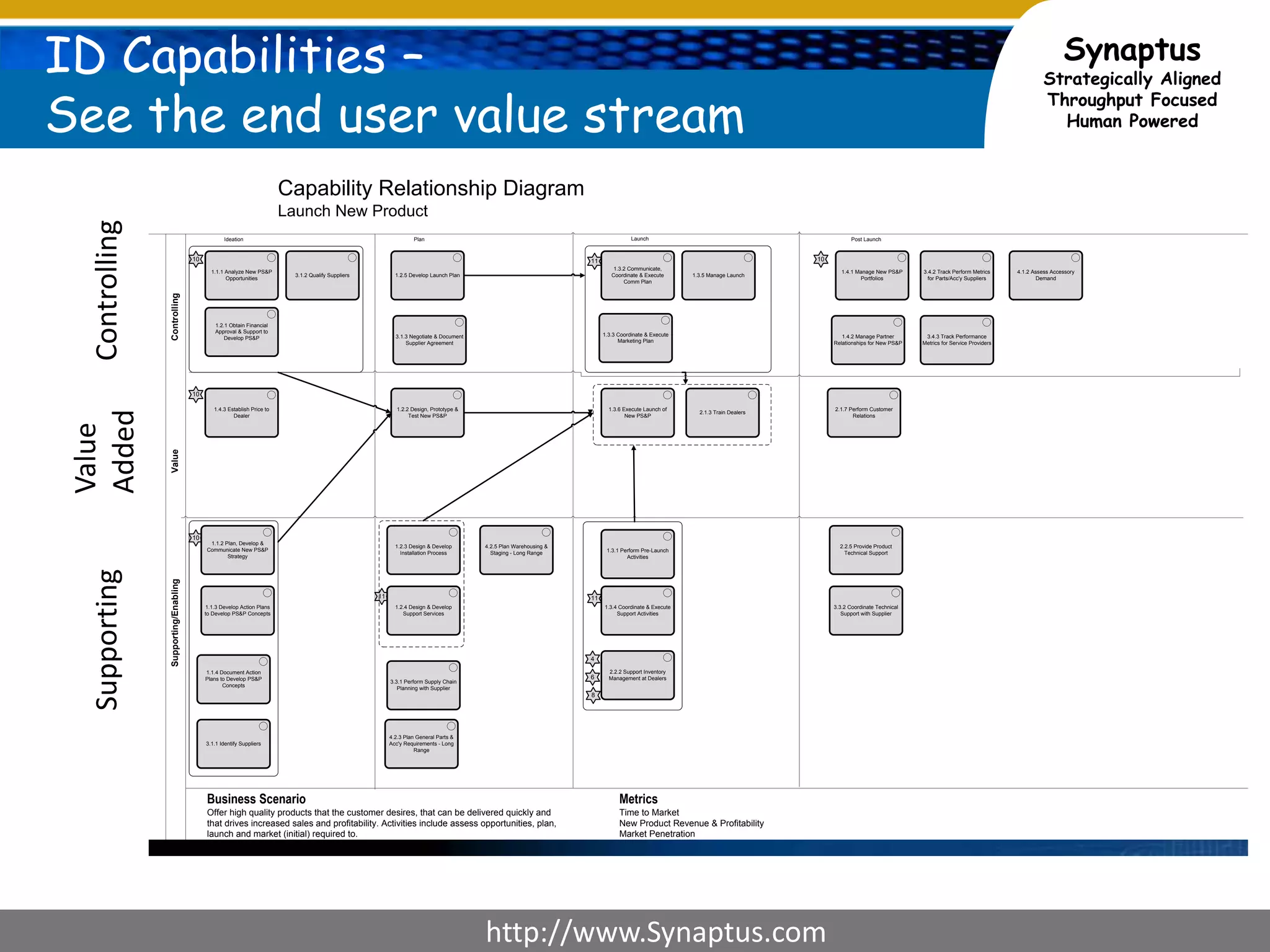
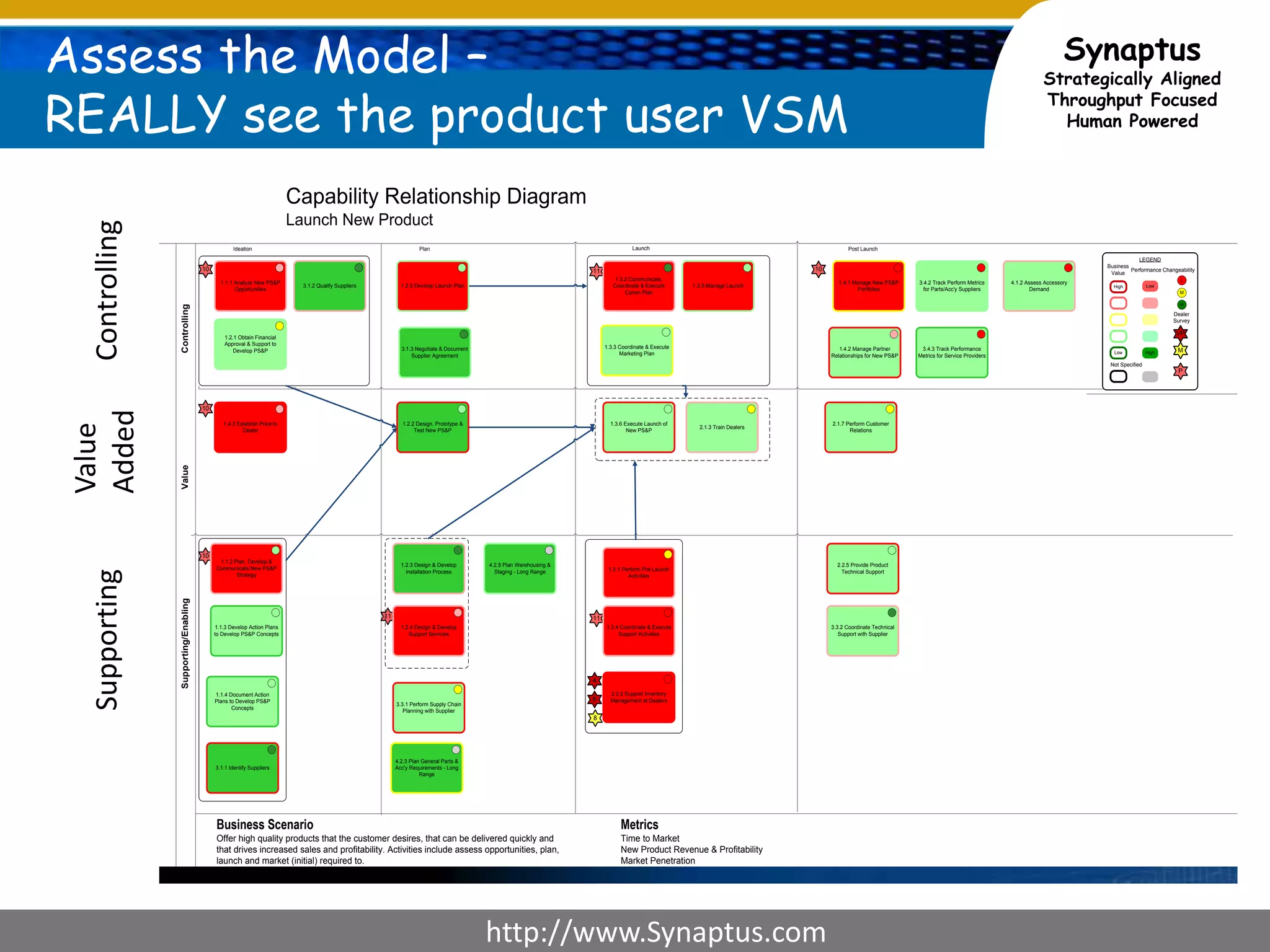
ID Capabilities – See the end user value streamControllingValueAddedSupporting
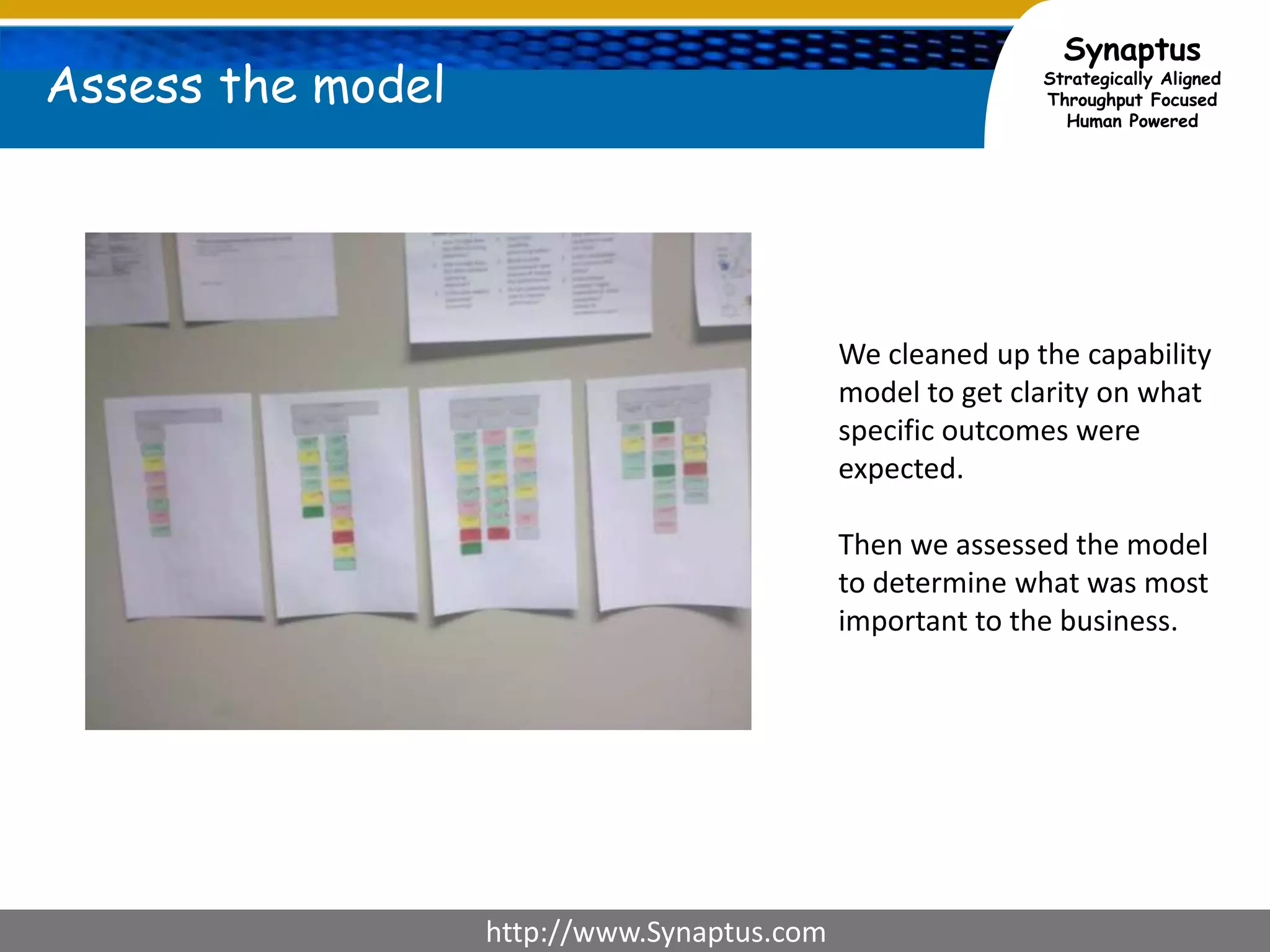
Assess the modelWe cleaned up the capability model to get clarity on what specific outcomes were expected. Then we assessed the model to determine what was most important to the business.
Business ValueAnswer a few simple but focused questionsDirectly aligned with delivering the product strategy?Key to the companies brand?Provide competitive differentiation?Can use more complex and structured approachesi.e., Blitz QFD, The Business Value Game, Real OptionsGenerate Leads
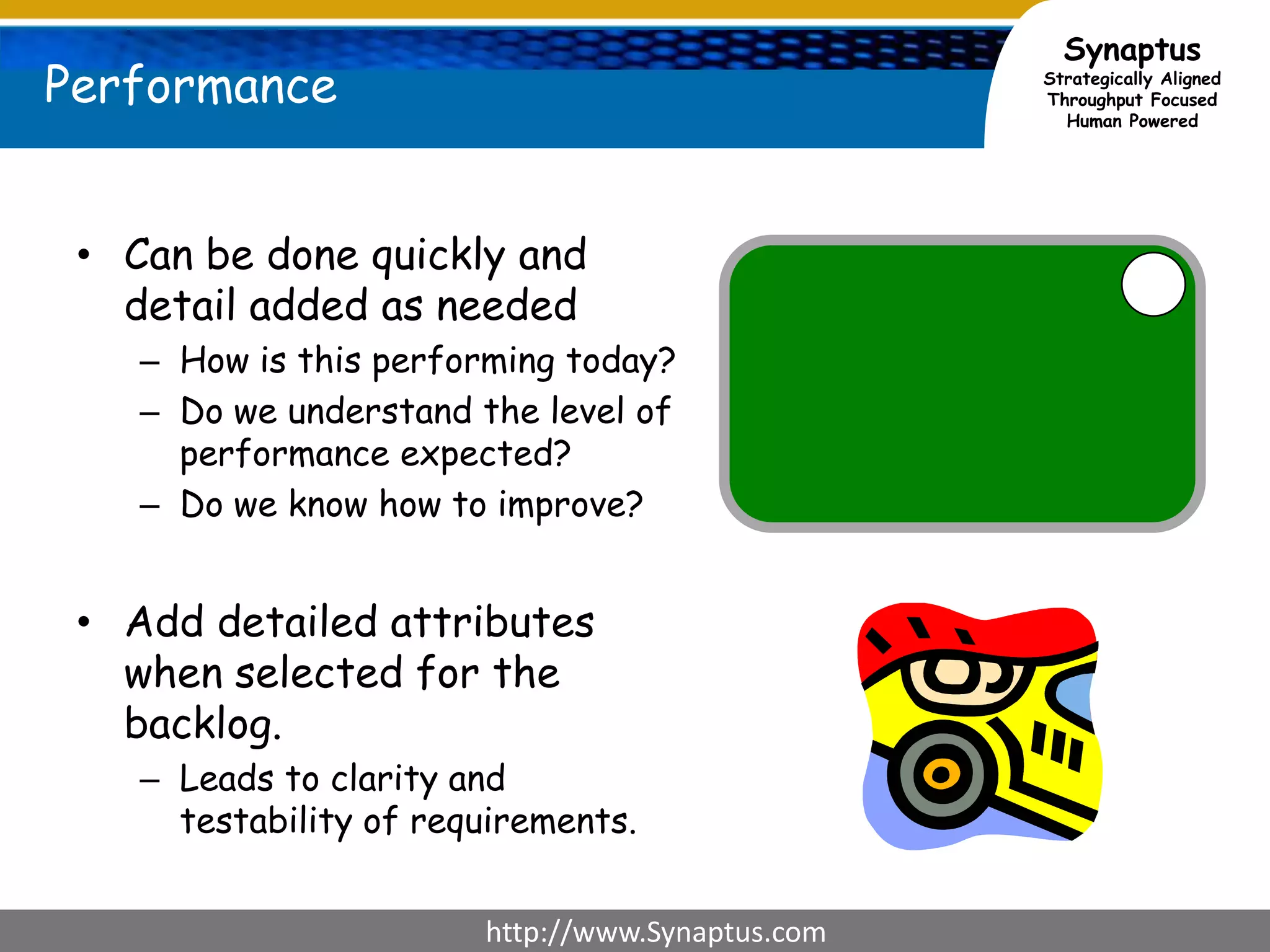
PerformanceCan be done quickly and detail added as neededHow is this performing today?Do we understand the level of performance expected?Do we know how to improve?Add detailed attributes when selected for the backlog.Leads to clarity and testability of requirements.

Feeding the agile beast 2010 talk

  • 1.
    Feeding the AgileBeastFocusing Development on Delivering Business ValueDean Stevens - Synaptus
  • 2.
    Agile Methods (Scrum,Lean, Agile, Kanban)Faster and Higher QualityProduct BacklogSprint or Continuous DevelopmentReady BacklogDailyBuildDesignReleasePrioritizeProductUnderstandOrganizationDeployImprovementsTestWorking SoftwareEvaluateOn-going Improvement ofDevelopment OrganizationCapabilityDoPlanFeedbackCheckAdjust
  • 3.
    Lean - AgileSoftware DevelopmentThe Bargain of AgileBetter, Faster, CheaperThe Bargain of Agile is faster, more reliable, higher quality software. We also achieve higher trust inside the team. Fit with Customer DesireResult of close customer interaction, continuous delivery, iterative development, and progressive elaboration Result of iterations, Progressive Elaboration, WIP limits, focus on quality, “done-done”, a continuous state of readiness, and refactoringFlowResult of incremental development, visible management tools, measures of cycle time and/or velocityVisibilityResult of daily standup, retrospectives, and ceremonies supporting process improvement and learning – includes shared understanding and self organizationCollaborative Game
  • 4.
    The Bargain ofAgileThe business gets product faster, better, cheaperTeams get environment that promotes high trust and satisfactionHow we get there ( a few focus areas)Fit with customer desireFlowVisibilityCollaborationWe are missing something BIG: Business Value
  • 5.
    But What’s up?Doesbusiness get what they expect?CombinedChangesValue CreationEffectivenessWe expect to realize dramatic resultsBut often don’t realize the expected benefit
  • 6.
    Scrum, Agile, Lean& KanbanDon’t explicitly address Business ValueBusiness Value comes from building what will provide the highest economic return (over time) to the business.Fit with Customer DesireBusiness ValueFlowBusiness ValueVisibilityBusiness ValueCollaborative GameBusiness ValueMoving faster is not sufficient – we have to build the right things.
  • 7.
    Without Business Value…Agileis often about cost reductionBetter Use of TechnologyFaster DevelopmentFewer DefectsBetter UtilizationProductiveTalent PoolCost StructureFaster and Higher Quality is a Cost Reduction Strategy
  • 8.
    Greater Business Value…Arises from Technology – Business Alignment BusinessTechnology(Technology+ Adoption)* Business NeedBusiness ValueRevenue Stream- Cost StructureProfit
  • 9.
    The New Bargainof AgileBusiness value comes from building what will provide the highest economic outcome (over time) to the business Development is no longer the issueTechnology is no longer the obstacleWe must feed the agile beast in a way to achieve this business benefitAllows you to operate at decision cycles faster and cheaper than your competition
  • 10.
    What does thislook like in practice?Prioritized Product BacklogBusiness Value is an outcome that increases or protects revenue, reduces costs, or aligns with the product strategy
  • 11.
    Order the workto drive down risk and generate business value early.
  • 12.
    What makes themost economic sense – this is not always obvious
  • 13.
    Risk is apotential obstacle to business value – now or in the future2,500Business Value GrowingKnowledge Growing (risk reduction)2,0001,500$ in k1,000500ValueCost
  • 14.
    Prioritization is HardEnoughat the Small TeamThe Enterprise brings even bigger challengesMultiple Teams, Multiple ProductsComplex ArchitecturesCoordinating up and down stream in the EnterpriseEnsure that the purpose and value proposition of each feature/story is prioritized and understood by development / QA and verified in customer acceptance.
  • 15.
  • 16.
  • 17.
    The “How” TrapAhuman conditionThe Fosbury FlopFaxing isn’t ever “what” someone is doingEveryone’s initial focus is on “how” they do their jobs
  • 18.
    Strip away thehow wordsStable, Shows Underlying Need
  • 19.
    Overcoming the HowTrapCapability AnalysisValue Performance MapShould I invest in Create Quote?Where should I focus to drive Business Value and Reduce Risk?How do I determine when it is good enough?What should we NOT work on?
  • 20.
  • 21.
    Backlog Against CapabilityModelHigh ValueMedium ValueLow ValueLow PerformingMedium PerformingHigh PerformingHard to ChangeModerate Effort to ChangeEasy to Change
  • 22.
    Request comparisonRequest focusedhere3314Thesecapabilities are not as efficient as possible but are not key to business value and perform acceptably – 2 additional requests were for a new archiving capabilityBusiness ValuePerformance Gapis here00These capabilities are important to business value. Conduct vehicle related financial transactions with dealer does not perform acceptably
  • 23.
    It’s not Hardto DoRepeat
  • 24.
    Clarify Business Outcomes– Specify ValueSpecify Value This is a Focusing Objective Model format used to present the strategic focus for the next six months.This is very flexible and easy to consume. Typically built from existing strategy documents.
  • 25.
    ID the CapabilitiesThisis a capability model (it looks a lot like a story map)High level Feature Groups
  • 26.
  • 27.
    Remember the HowTrapCollaborative sessions with management and the end users of the product
  • 28.
    ID Capabilities –See the end user value streamControllingValueAddedSupporting
  • 29.
    Assess the modelWecleaned up the capability model to get clarity on what specific outcomes were expected. Then we assessed the model to determine what was most important to the business.
  • 30.
    Business ValueAnswer afew simple but focused questionsDirectly aligned with delivering the product strategy?Key to the companies brand?Provide competitive differentiation?Can use more complex and structured approachesi.e., Blitz QFD, The Business Value Game, Real OptionsGenerate Leads
  • 31.
    PerformanceCan be donequickly and detail added as neededHow is this performing today?Do we understand the level of performance expected?Do we know how to improve?Add detailed attributes when selected for the backlog.Leads to clarity and testability of requirements.
  • 32.
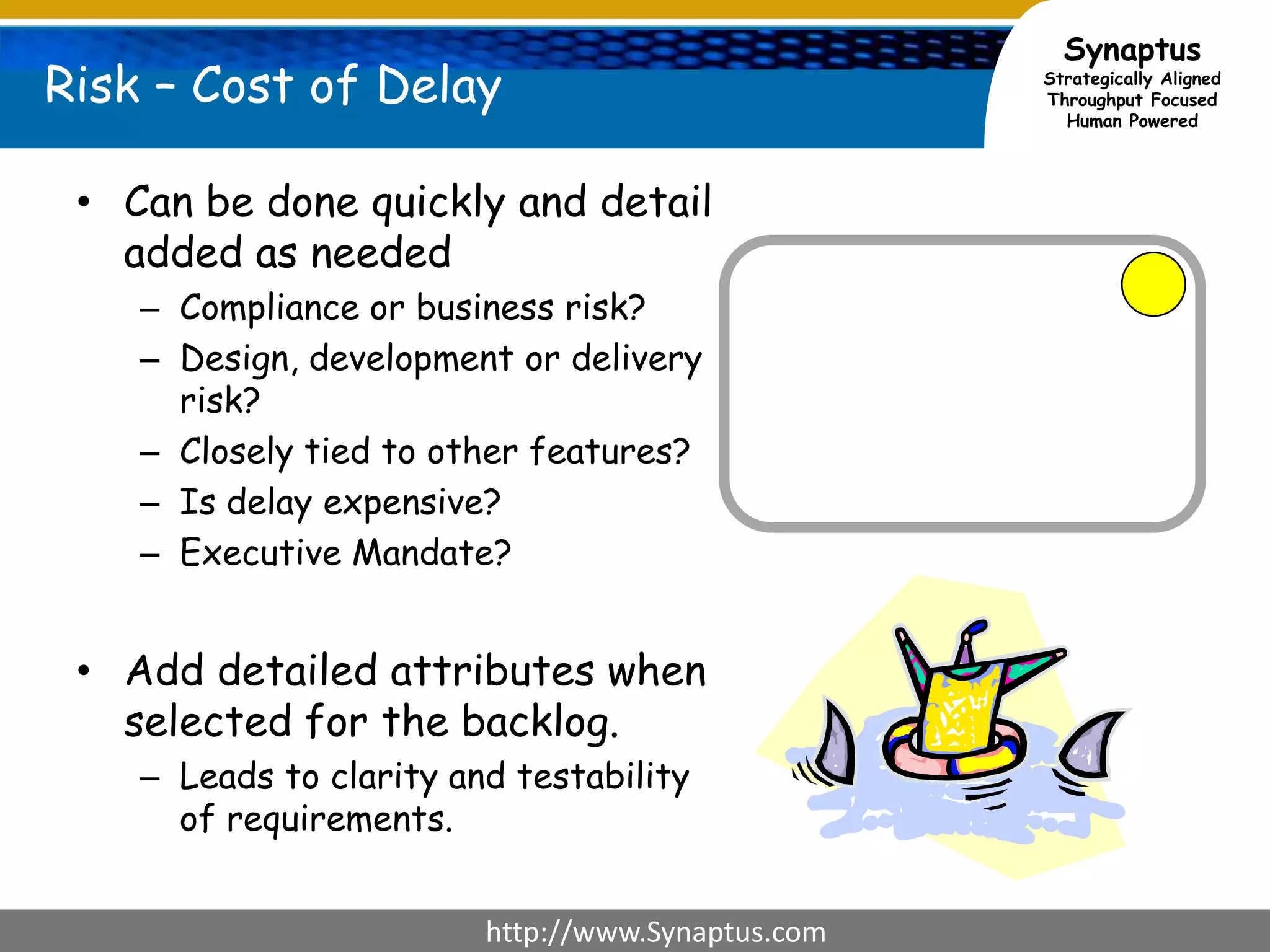
    Risk – Costof DelayCan be done quickly and detail added as neededCompliance or business risk?Design, development or delivery risk?Closely tied to other features?Is delay expensive?Executive Mandate?Add detailed attributes when selected for the backlog.Leads to clarity and testability of requirements.Generate Leads
  • 33.
    Assess the Model– REALLY see the product user VSMControllingValueAddedSupporting
  • 34.
    Prioritize, Scope, andCommunicateThe highest value opportunities are now clearRe –assess when something has changedAlso, highlights what NOT to work on so we can stay focused
  • 35.
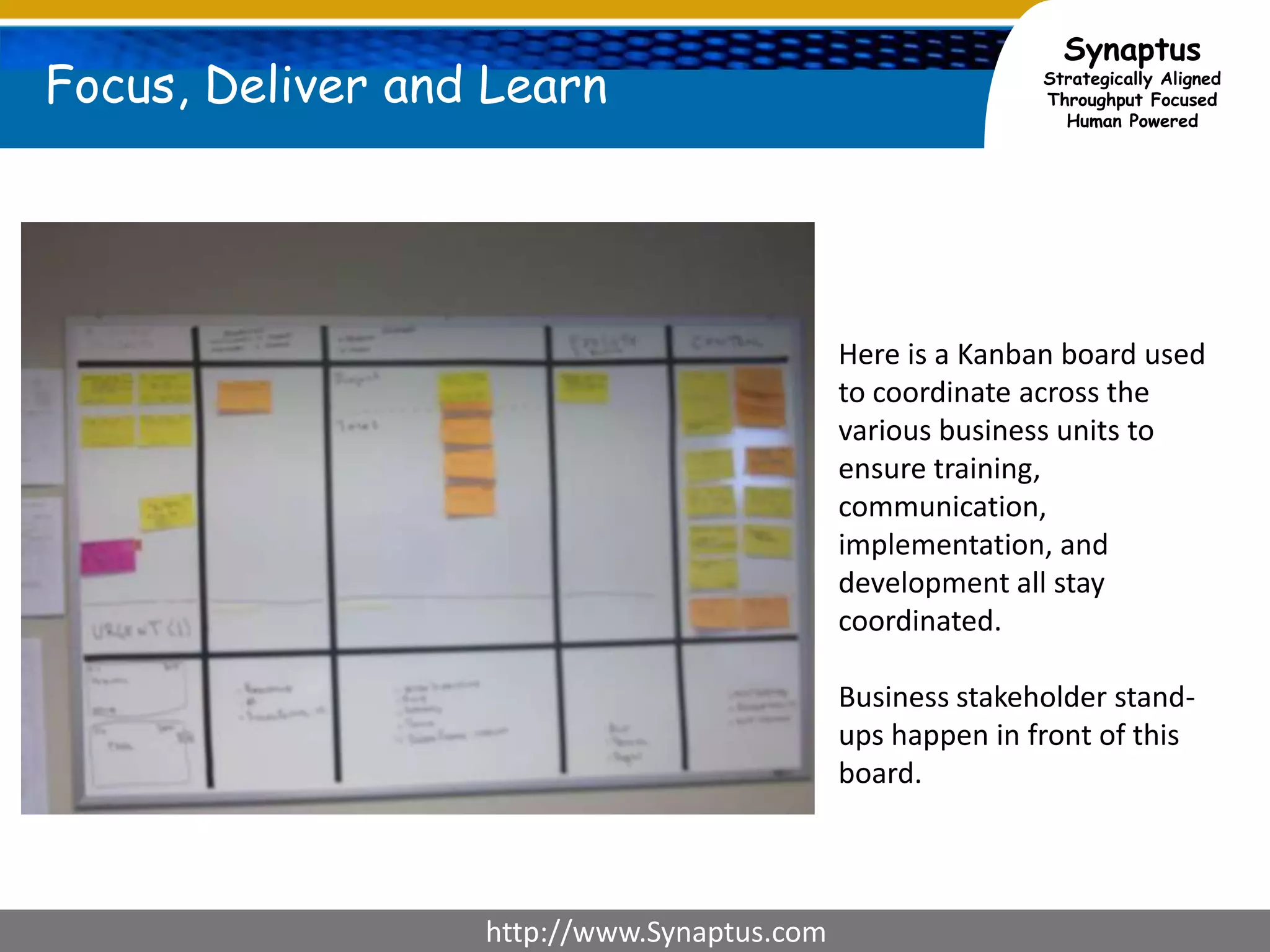
    Focus, Deliver andLearnHere is a Kanban board used to coordinate across the various business units to ensure training, communication, implementation, and development all stay coordinated. Business stakeholder stand-ups happen in front of this board.
  • 36.
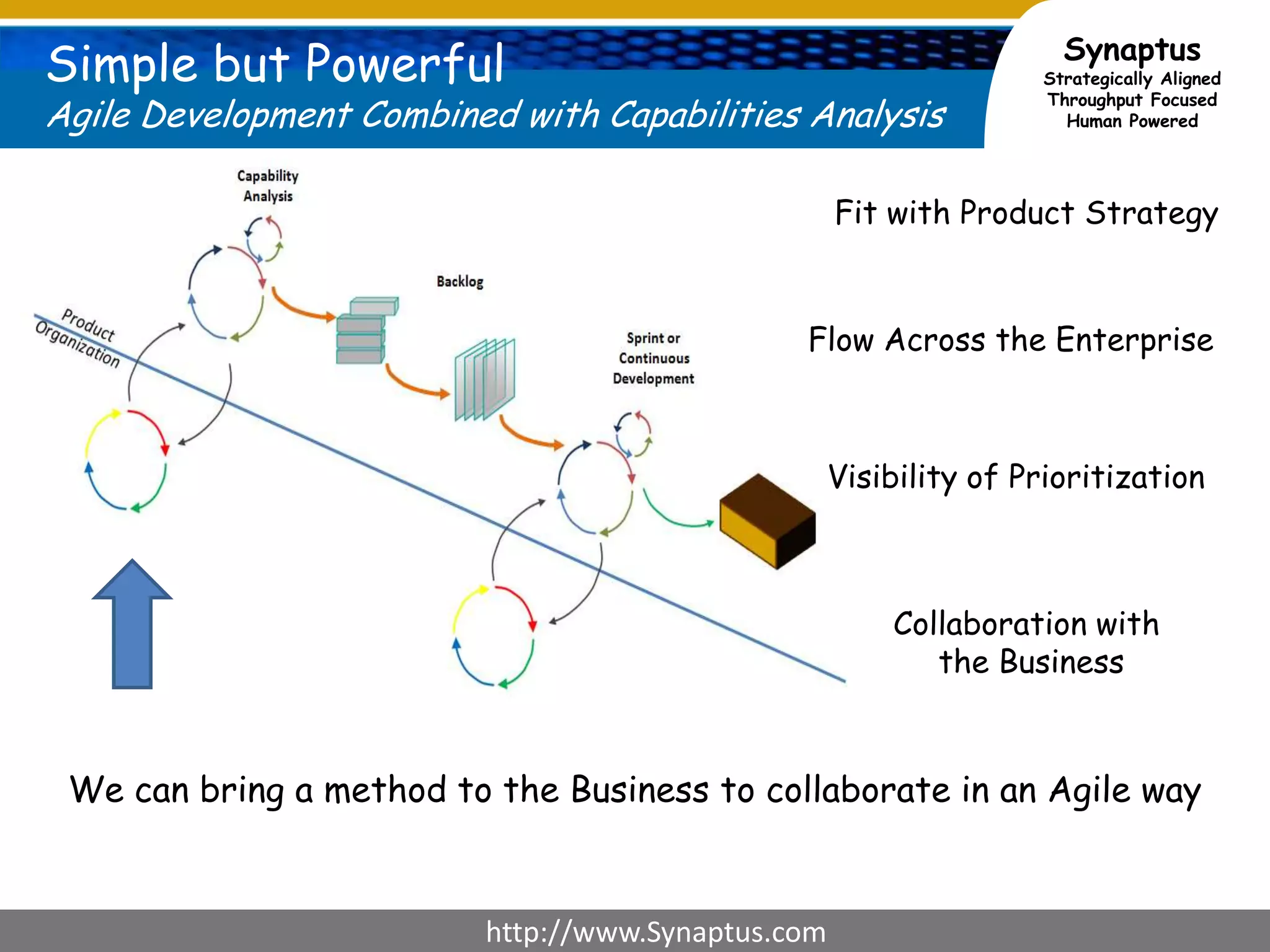
    Simple but PowerfulAgileDevelopment Combined with Capabilities AnalysisFit with Product StrategyFlow Across the EnterpriseVisibility of PrioritizationCollaboration with the BusinessWe can bring a method to the Business to collaborate in an Agile way
  • 37.
    Next Steps ExtendLean – Agile up the Value StreamShow leadershipStop complaining, do somethingEngage the business
  • 38.
    Benefits to theBusinessFeature ManagementMore effective and less effortProfitability, Competitive AdvantageHelp the business focus on business valueBetter economic outcomesFaster to marketRethink the Product StrategyTake a fresh look at product strategyProduct InnovationSo, this is collaboration
  • 39.
    Benefit to ProductDevelopmentBacklog Prioritized, Scoped and CommunicatedBetter understanding of features in the context of the product strategyRicher requirements through describing attributes of features and how they work in the end user value streamLess rework and wasted workPD perceived as high value business partner
  • 40.
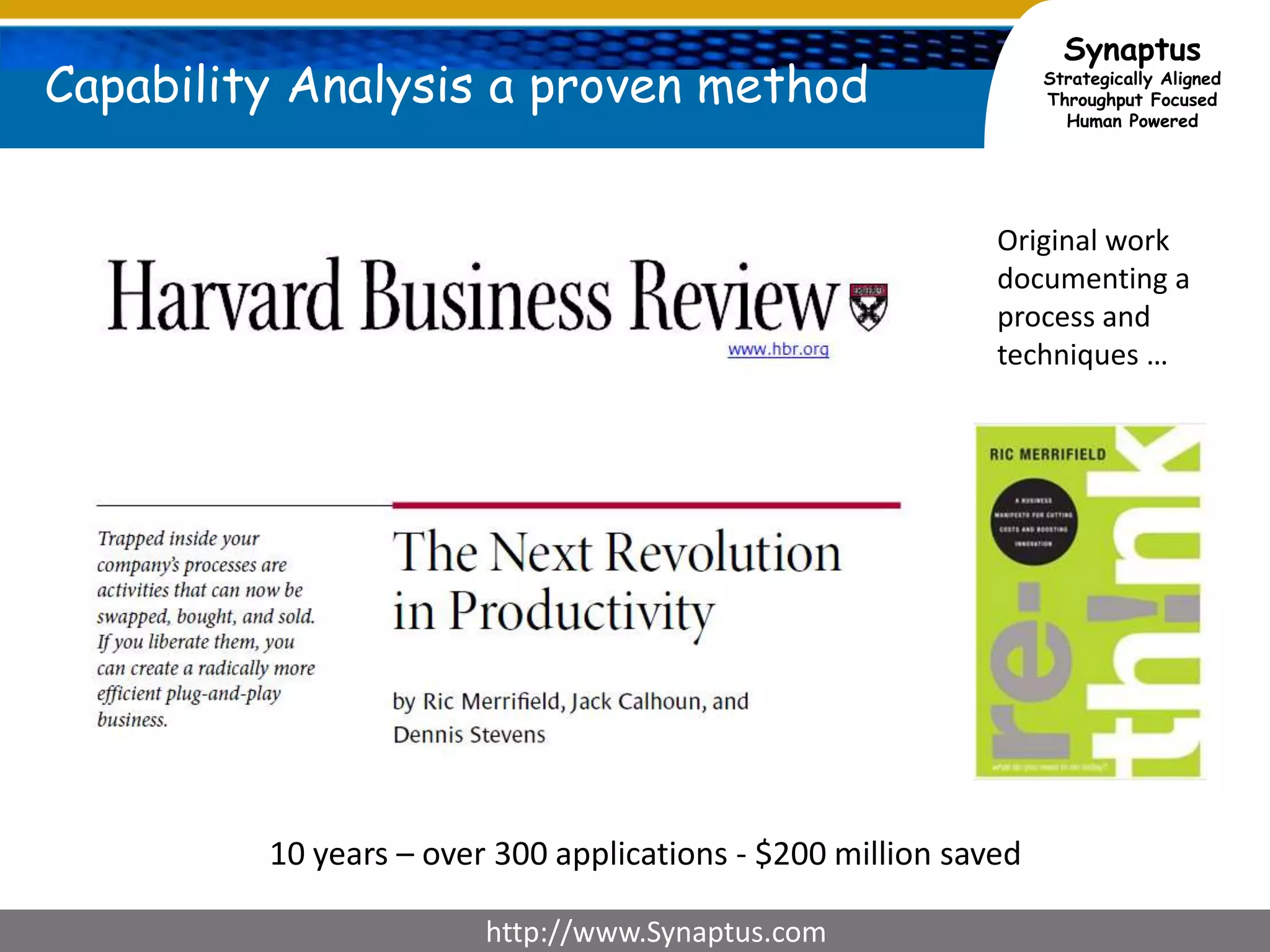
    Capability Analysis aproven methodOriginal work documenting a process and techniques …10 years – over 300 applications - $200 million saved
  • 41.
    QuestionsReach out toDean Stevenshttp://www.Synaptus.comDean.stevens@Synaptus.comWe offerAgile Capability & Business AnalysisStrategic Project ExecutionKanban / Agile Project ManagementAffiliationsDavid J Anderson and AssociatesPillar Technologies
  • 42.
    Guidance for OrganizationalDesignThe design of the delivery organization can be the constraintAlign the delivery organization with the technology platform, the product strategy and business modelResult is more effective delivery of software that is aligned with realizing the product/business strategy
  • 43.
    Risk – Costof DelayCan be assessed quickly with more detailed approach as needed
  • 44.
    Is there acompliance requirement or other business risk associated with this capability?
  • 45.
    Does changing thiscapability introduce a lot of dependent changes or risk?
  • 46.
    Are we awareof the Design, Development, and Delivery Risk?
  • 47.
    Is a delayin delivery expensive?
  • 48.
    Is this anExecutive Mandate?
  • 49.
    More detailed riskanalysis can be performed as feature is pulled into active backlogGenerate Leads
  • 50.
    SummaryWe have away to gain alignment on exactly what capabilities are most important to delivering business value.We have a way to gain agreement on business value, performance, and risk.We retain insight and set context for everyone from business management, product management, through development, QA, deployment, support, sales, etc.The model provides guidance for organizational design.When the strategy changes, the model is low friction to update.We can use this to proactively improve collaboration with the business.
  • 51.
    Using Time asa WeaponThe new Bargain of AgilityThe primary concept of the new Bargain of Agile is to expend the least resource to accomplish the next objective and to operate at a decision cycle faster than your competition can achieve.ObserveOrientDecideActUnfolding circumstancesImplicit guidance and controlImplicit guidance and controlUnderstandCultureTraditionNew InformationPrevious ExperienceSynthesisAction(Test)ObservationsFeedForwardFeedForwardDecisionFeedForwardOutside informationFeedbackUnfolding interaction with the environment
  • 52.
    Even with AgileMethodsA lack of context and prioritization…Results in:Increased RiskUnnecessary ReworkDelay to ValueMissing Important StuffRedundant EffortOver-Engineering/DesignLack of TestabilityNot everything we can do has the same business .
  • 53.
    Why is thishard?The Blind Men and the ElephantYour product could be like that elephantDevelopmentProduct ManagementProductCustomerYou need to develop a shared understanding of what needs to happen to deliver the business value through the product
  • 54.
    Rethinking the AgileEnterpriseStrategically Aligned, Throughput Focused, Human PoweredSample ClientsContributed / Featured “Dennis Stevens helped us develop a structured approach that connected customer value to execution.” -- Ric Merrifield, Microsoft Corporation“Dennis Stevens helped us align product management, architecture, development, support and implementation. They were an advocate for the success of our business" -- Rob Andes, CTO, Agris Corporation, a Division of John DeereNetwork BankPortfolio, Program, Project ManagementPMI: OPM3Capability AnalysisHBR: The Next Revolution in Productivity“In a time growth and change, Dennis Stevens helped us identify and develop the capabilities needed to deliver technology that was critical to our success." -- Mike Rouse, COO, Security First Network BankScaling Agile DevelopmentCutter: Rethinking the Agile EnterpriseCost Cutting and InnovationRe-th!nk

Editor's Notes

  • #2 IntroductionDescription of AgileDescription of the Agile - Business Value GapDiscuss the why this gap exists (The How Trap)Talk about a way to close this gap using Capability AnalysisGive examples of deliverables from a recent project
  • #3 Through Improved ToolsCheap InfrastructureMassive Computing PowerUbiquitous NetworkNew Methods of Delivery that are cheap and low frictionWe are able to rapidly develop new softwareWith Agile methods we are able to operate better, faster, and cheaper than ever before
  • #4 Learning Self Organization
  • #5 When asked customers will ask for everything they want or might want – not the minimum needed to get their business. More cost (in time) for the same revenue is not the best economic returnMoving faster when you aren’t building the next most valuable thing – or when you are not burning down risk on the project will not result in the best economic returnVisibility and feedback are powerful tools for change and trust building – but if they don’t provide the feedback needed to optimize business value they aren’t sufficient to drive business valueTeam collaboration and learning within the development teams are important- but there is a lot of context and understanding that must be spread across the team to improve delivery and verification needed to optimize business value
  • #7 When asked customers will ask for everything they want or might want – not the minimum needed to get their business. More cost (in time) for the same revenue is not the best economic returnMoving faster when you aren’t building the next most valuable thing – or when you are not burning down risk on the project will not result in the best economic returnVisibility and feedback are powerful tools for change and trust building – but if they don’t provide the feedback needed to optimize business value they aren’t sufficient to drive business valueTeam collaboration and learning within the development teams are important- but there is a lot of context and understanding that must be spread across the team to improve delivery and verification needed to optimize business value
  • #9 Business ValueImproved Usability, Functionality, Availability, Reliability, Performance (throughput, response time, and predictability), Capacity, Security, and/or Agility that solves a business problem.
  • #13 There is an arrow in this logo. Do you see it?
  • #14 Now you see it. And you will always see it. You will always look at this differently, now that you see it.
  • #15 Check in is not core
  • #24 This is more than your product. What does the customer do? Add your product features. Many will be supporting and controlling.Many will be invisible to your customer.
  • #26 This is light weight but validates our business gut. Often this is enough to get started and it is very social and collaborative. Last bullet should be the more complex and structured approaches. There is a place for both and the model supports either. Focusing ObjectivesBlitz QFDThe Business Value GameReal Options
  • #27 Part of elaboration should be to translate performance attributes into metrics
  • #30 The model does not change a lotThe colors, however canWhat not to work on is very important. Makes us less reactionary.
  • #34 Bob Charette closed his keynote suggesting “take a fresh look”
  • #41 OODAMilitary strategist Colonel John Boyd described the OODA loop for fighter pilots. It has since been applied to define the Marine Corps Doctrine in Maneuver warfare. Chet Richards applies it business strategy in Certain To Win. The primary concept is to expend the least resource to accomplish the next objective and to operate at a decision cycle faster than your competition can achieve. This allows you to go farther and faster than your competition.Unfortunately, it can not as simple as “observe, then orient, then decide, then act.” In fact such a sequential model would be very ponderous and would not well describe how successful competitors operate.The key to quickness turns out to be the two “implicit guidance and control” arrows at the top. In other words, most of the time people and groups do not employ the explicit, sequential O-to-O-to-D-to-A mechanism. Most of the time, they simply observe, orient, and act. There is data coming out to support this (see Gary Klein’s book, Sources of Power.)The question, of course, is, “What action?” A thinking opponent doesn’t provide us with a laundry list of his tactics so we can work out responses in advance. The mechanism which handles this uncertainty and makes the loop function in a real world situation is “Orientation.”As we suck in information via the “Observe” gateway, it may happen that we notice mismatches between our orientation and what we’re observing in the real world. If we don’t spot these mismatches and correct our orientation, the actions that flow from it may not be as effective as we intend. This can open up opportunities for our opponents. Boyd’s concept of strategy places heavy emphasis on attacking the other side’s orientation to open up just these kinds of opportunities, and he suggests many ways to do this.Note that “OODA” speed is quite different from the speed of our actions. Doing something dumb or irrelevant, but doing it at high speed, may not provide much of a competitive advantage.The “Decision/hypothesis” block is the learning part of the loop, where we experiment and in the process add new actions to the Implicit Guidance and Control link. You can also think of it as programming orientation for future intuitive actions.