Marc Danziger
CDO, Enterprise Consultant
Agile v. Agility
…the problem of management
© Copyright Net Objectives, Inc. All Rights Reserved 2
Marc Danziger
marc.danziger@NetObjectives.com
CDO, Enterprise Consultant
Chief Delivery Officer Marc Danziger is the Chief Delivery Officer of
Net Objectives. With over 20 years of
experience, Marc is a leading practitioner in
project and program management, project
rescue, product portfolio management, SAFe,
Scrum and business architecture. He helps
companies transform to Lean and Agile
enterprises.
He has a Masters in Planning Theory from U.C.
Berkeley where by random chance he studied
with the originators of the concepts of Wicked
Problems and Design Patterns.
© Copyright Net Objectives, Inc. All Rights Reserved 3
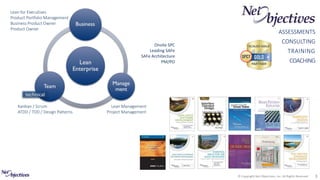
Lean Management
Project Management
Kanban / Scrum
ATDD / TDD / Design Patterns
technical
ASSESSMENTS
CONSULTING
TRAINING
COACHING
Lean for Executives
Product Portfolio Management
Business Product Owner
Product Owner
Onsite SPC
Leading SAFe
SAFe Architecture
PM/PO
© Copyright Net Objectives, Inc. All Rights Reserved 4
What’s we talking about?
Differentiating ‘Practicing Agile’ from
‘Organizational Agility.’
Discussing the barrier typical
management practices place between the
two.
© Copyright Net Objectives, Inc. All Rights Reserved 5
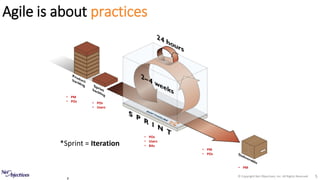
Agile is about practices
s
*Sprint = Iteration
• PM
• POs • POs
• Users
• POs
• Users
• BAs
• PM
• POs
• PM
© Copyright Net Objectives, Inc. All Rights Reserved 6
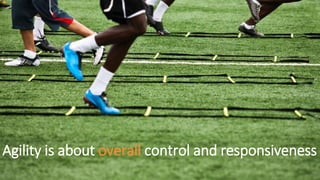
Agility is about overall control and responsiveness
© Copyright Net Objectives, Inc. All Rights Reserved 7
Simple:
The tight connection between strategic decision and execution
When an organization can make a decision and promptly
deliver an outcome that accurately manifests that decision,
the organization is demonstrating agility.
What’s “Agility?”
© Copyright Net Objectives, Inc. All Rights Reserved 8
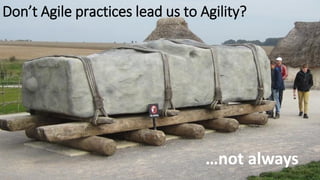
Don’t Agile practices lead us to Agility?
…not always
© Copyright Net Objectives, Inc. All Rights Reserved 9
• Friction at the working service goes down
• Reliability of delivery improves
But:
• Does value of delivery improve?
• Post-transformation, does this persist?
If not, why not?
We’ve all lived through this
© Copyright Net Objectives, Inc. All Rights Reserved 10
Improve the delivery of value.
Change our model so that the transformations persist.
Why? …and how?
So we have to do two things…
© Copyright Net Objectives, Inc. All Rights Reserved 11
Delivering Value
© Copyright Net Objectives, Inc. All Rights Reserved 12
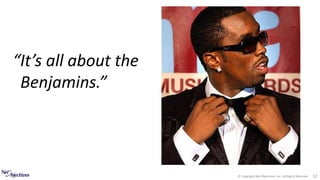
“It’s all about the
Benjamins.”
© Copyright Net Objectives, Inc. All Rights Reserved 13
No.
It’s about delivering value. But in our economy, money is a
decent proxy for value.
…and, by the way, when we rapidly deliver value other good
things happen.
Is it all about Money?
© Copyright Net Objectives, Inc. All Rights Reserved 14
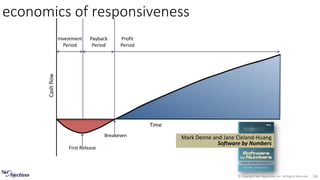
First Release
Investment
Period
Payback
Period
Profit
Period
Breakeven
Cashflow
Time
economics of responsiveness
Mark Denne and Jane Cleland-Huang
Software by Numbers
© Copyright Net Objectives, Inc. All Rights Reserved 15
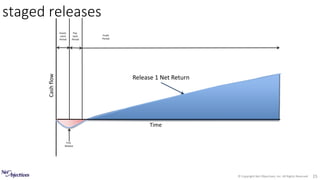
First
Release
Invest-
ment
Period
Profit
Period
Pay-
back
Period
Cashflow
Time
Release 1 Net Return
staged releases
© Copyright Net Objectives, Inc. All Rights Reserved 16
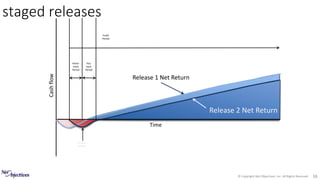
Profit
Period
Second
Release
Invest-
ment
Period
Pay-
back
Period
Release 2 Net Return
Cashflow
Time
Release 1 Net Return
staged releases
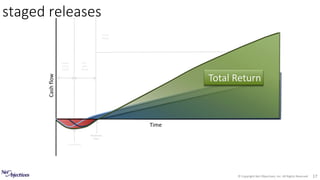
© Copyright Net Objectives, Inc. All Rights Reserved 17
Profit
Period
Investment
Invest-
ment
Period
Pay-
back
Period
Breakeven
Point
Total Return
Cashflow
Time
staged releases
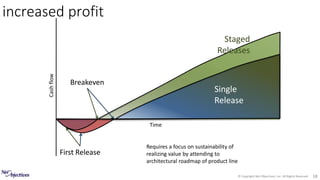
© Copyright Net Objectives, Inc. All Rights Reserved 18
Cashflow
Breakeven
Single
Release
First Release
Time
Staged
Releases
Requires a focus on sustainability of
realizing value by attending to
architectural roadmap of product line
increased profit
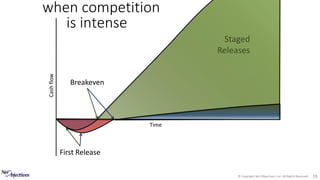
© Copyright Net Objectives, Inc. All Rights Reserved 19
Cashflow
Breakeven
Single Release
First Release
Time
Staged
Releases
when competition
is intense
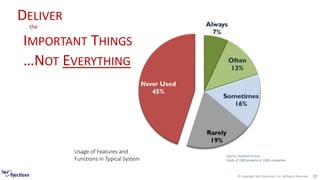
© Copyright Net Objectives, Inc. All Rights Reserved 20
Source: Standish Group
Study of 2000 projects at 1000 companies
Usage of Features and
Functions in Typical System
DELIVER
the
IMPORTANT THINGS
…NOT EVERYTHING
© Copyright Net Objectives, Inc. All Rights Reserved 21
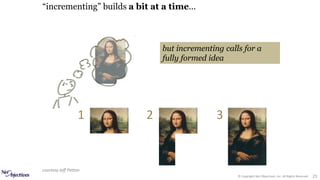
1 2 3
but incrementing calls for a
fully formed idea
courtesy Jeff Patton
“incrementing” builds a bit at a time...
© Copyright Net Objectives, Inc. All Rights Reserved 22
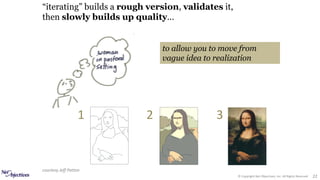
1 2 3
to allow you to move from
vague idea to realization
courtesy Jeff Patton
“iterating” builds a rough version, validates it,
then slowly builds up quality…
© Copyright Net Objectives, Inc. All Rights Reserved 23
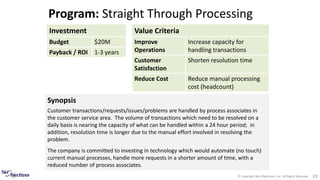
Program: Straight Through Processing
Value Criteria
Improve
Operations
Increase capacity for
handling transactions
Customer
Satisfaction
Shorten resolution time
Reduce Cost Reduce manual processing
cost (headcount)
Synopsis
Customer transactions/requests/issues/problems are handled by process associates in
the customer service area. The volume of transactions which need to be resolved on a
daily basis is nearing the capacity of what can be handled within a 24 hour period; in
addition, resolution time is longer due to the manual effort involved in resolving the
problem.
The company is committed to investing in technology which would automate (no touch)
current manual processes, handle more requests in a shorter amount of time, with a
reduced number of process associates.
Investment
Budget $20M
Payback / ROI 1-3 years
© Copyright Net Objectives, Inc. All Rights Reserved 24
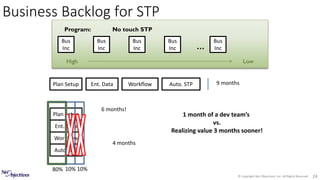
Business Backlog for STP
Program: No touch STP
High Low
Plan Setup Ent. Data Workflow Auto. STP
Bus
Inc
Bus
Inc
Bus
Inc
Bus
Inc
Bus
Inc…
9 months
Plan Setup
Ent. Data
Workflow
Auto. STP
80% 10% 10%
6 months!
4 months
1 month of a dev team’s
vs.
Realizing value 3 months sooner!
© Copyright Net Objectives, Inc. All Rights Reserved 25
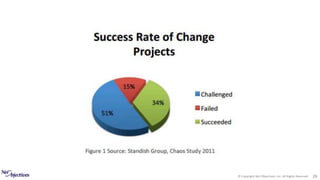
Why don’t Agile transformations persist?
© Copyright Net Objectives, Inc. All Rights Reserved 26
© Copyright Net Objectives, Inc. All Rights Reserved 27
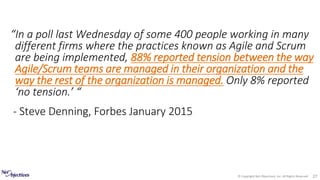
“In a poll last Wednesday of some 400 people working in many
different firms where the practices known as Agile and Scrum
are being implemented, 88% reported tension between the way
Agile/Scrum teams are managed in their organization and the
way the rest of the organization is managed. Only 8% reported
‘no tension.’ “
- Steve Denning, Forbes January 2015
© Copyright Net Objectives, Inc. All Rights Reserved 28
© Copyright Net Objectives, Inc. All Rights Reserved 29
What’s management’s problem?
© Copyright Net Objectives, Inc. All Rights Reserved 30
”I don't think investors and money managers are aware of the
rate of change coming down the pike. The rate of change is
too hard to fathom. But they need to be aware that many of
today's F500 are in danger. A study from the John M. Olin
School of Business at Washington University estimates that 40
percent of today's F500 companies on the S&P 500 will no
longer exist in 10 years.”
- Peter Diamandis, X-Prize founder
Why is Management fearful?
© Copyright Net Objectives, Inc. All Rights Reserved 31
• Technological change
• Cultural change
• Economic change
• Political / Regulatory change
• _______________ change
© Copyright Net Objectives, Inc. All Rights Reserved 32
© Copyright Net Objectives, Inc. All Rights Reserved 33
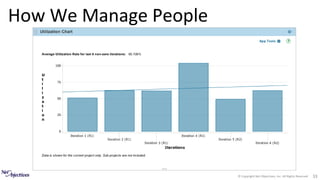
How We Manage People
© Copyright Net Objectives, Inc. All Rights Reserved 34
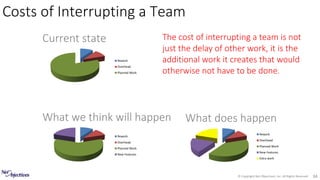
Costs of Interrupting a Team
What we think will happen What does happen
Current state
Rework
Overhead
Planned Work
Rework
Overhead
Planned Work
New Features
Rework
Overhead
Planned Work
New Features
Extra work
The cost of interrupting a team is not
just the delay of other work, it is the
additional work it creates that would
otherwise not have to be done.
© Copyright Net Objectives, Inc. All Rights Reserved 35
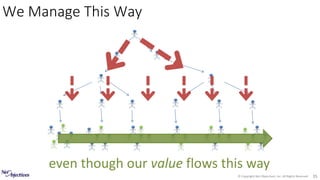
We Manage This Way
even though our value flows this way
© Copyright Net Objectives, Inc. All Rights Reserved 36
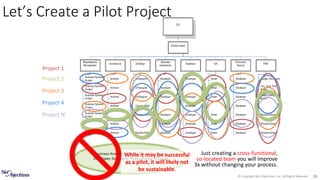
Let’s Create a Pilot Project
Project 1
Project 2
%
Project 3
Project 4
Project N
Business Analyst, Architect, Usability Expert,
Developer, Developer, Tester, Project Manager
Expert
Just creating a cross-functional,
co-located team you will improve
3x without changing your process.
While it may be successful
as a pilot, it will likely not
be sustainable.
© Copyright Net Objectives, Inc. All Rights Reserved 37
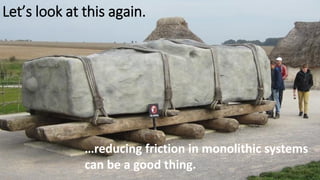
Let’s look at this again.
…reducing friction in monolithic systems
can be a good thing.
© Copyright Net Objectives, Inc. All Rights Reserved 38
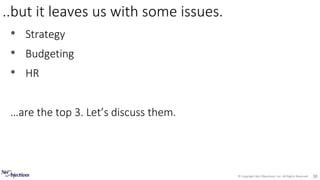
• Strategy
• Budgeting
• HR
…are the top 3. Let’s discuss them.
..but it leaves us with some issues.
© Copyright Net Objectives, Inc. All Rights Reserved 39
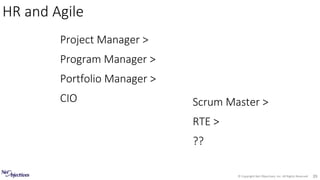
Project Manager >
Program Manager >
Portfolio Manager >
CIO
HR and Agile
Scrum Master >
RTE >
??
© Copyright Net Objectives, Inc. All Rights Reserved 40
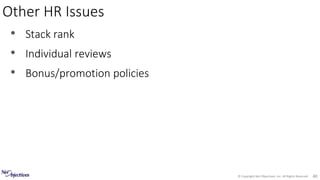
• Stack rank
• Individual reviews
• Bonus/promotion policies
Other HR Issues
© Copyright Net Objectives, Inc. All Rights Reserved 41
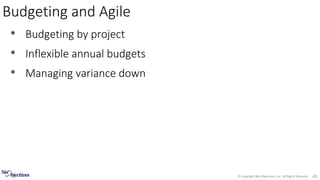
• Budgeting by project
• Inflexible annual budgets
• Managing variance down
Budgeting and Agile
© Copyright Net Objectives, Inc. All Rights Reserved 42
Given all this - what is to be done?
© Copyright Net Objectives, Inc. All Rights Reserved 43
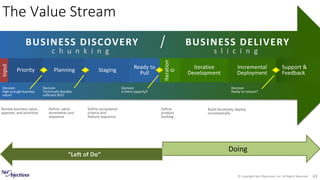
Input
Priority
BUSINESS DISCOVERY BUSINESS DELIVERY
Planning Staging Ready to
Pull
c h u n k i n g s l i c i n g
Decision
High enough business
value?
Decision
Technically feasible,
sufficient ROI?
Iteration
0
Iterative
Development
Incremental
Deployment
Support &
Feedback
Decision
Ready to release?
Decision
Is there capacity?
Define acceptance
criteria and
feature sequence
Build iteratively, deploy
incrementally
Review business value ,
approve, and prioritize
Define value
increments and
sequence
Define
product
backlog
The Value Stream
Doing
“Left of Do”
© Copyright Net Objectives, Inc. All Rights Reserved 44
• Dynamic, responsive strategy
• Budgeting aligned with value streams
• Agile leadership becomes a characteristic of the
management team
• Agile team members have both a pro-Agile set of HR goals
and a career path that doesn’t require that they abandon
Agile (or Lean) practices to advance into management roles
What happens if we make ‘left of do’ Agile?
© Copyright Net Objectives, Inc. All Rights Reserved 45
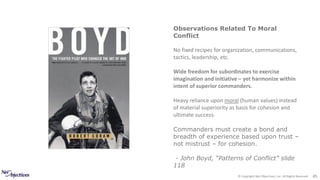
Observations Related To Moral
Conflict
No fixed recipes for organization, communications,
tactics, leadership, etc.
Wide freedom for subordinates to exercise
imagination and initiative – yet harmonize within
intent of superior commanders.
Heavy reliance upon moral (human values) instead
of material superiority as basis for cohesion and
ultimate success.
Commanders must create a bond and
breadth of experience based upon trust –
not mistrust – for cohesion.
- John Boyd, “Patterns of Conflict” slide
118
© Copyright Net Objectives, Inc. All Rights Reserved 46
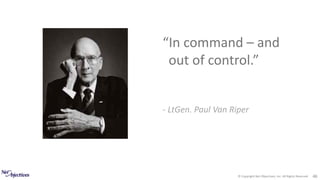
“In command – and
out of control.”
- LtGen. Paul Van Riper

Agility mgt v2md

  • 1.
    Marc Danziger CDO, EnterpriseConsultant Agile v. Agility …the problem of management
  • 2.
    © Copyright NetObjectives, Inc. All Rights Reserved 2 Marc Danziger marc.danziger@NetObjectives.com CDO, Enterprise Consultant Chief Delivery Officer Marc Danziger is the Chief Delivery Officer of Net Objectives. With over 20 years of experience, Marc is a leading practitioner in project and program management, project rescue, product portfolio management, SAFe, Scrum and business architecture. He helps companies transform to Lean and Agile enterprises. He has a Masters in Planning Theory from U.C. Berkeley where by random chance he studied with the originators of the concepts of Wicked Problems and Design Patterns.
  • 3.
    © Copyright NetObjectives, Inc. All Rights Reserved 3 Lean Management Project Management Kanban / Scrum ATDD / TDD / Design Patterns technical ASSESSMENTS CONSULTING TRAINING COACHING Lean for Executives Product Portfolio Management Business Product Owner Product Owner Onsite SPC Leading SAFe SAFe Architecture PM/PO
  • 4.
    © Copyright NetObjectives, Inc. All Rights Reserved 4 What’s we talking about? Differentiating ‘Practicing Agile’ from ‘Organizational Agility.’ Discussing the barrier typical management practices place between the two.
  • 5.
    © Copyright NetObjectives, Inc. All Rights Reserved 5 Agile is about practices s *Sprint = Iteration • PM • POs • POs • Users • POs • Users • BAs • PM • POs • PM
  • 6.
    © Copyright NetObjectives, Inc. All Rights Reserved 6 Agility is about overall control and responsiveness
  • 7.
    © Copyright NetObjectives, Inc. All Rights Reserved 7 Simple: The tight connection between strategic decision and execution When an organization can make a decision and promptly deliver an outcome that accurately manifests that decision, the organization is demonstrating agility. What’s “Agility?”
  • 8.
    © Copyright NetObjectives, Inc. All Rights Reserved 8 Don’t Agile practices lead us to Agility? …not always
  • 9.
    © Copyright NetObjectives, Inc. All Rights Reserved 9 • Friction at the working service goes down • Reliability of delivery improves But: • Does value of delivery improve? • Post-transformation, does this persist? If not, why not? We’ve all lived through this
  • 10.
    © Copyright NetObjectives, Inc. All Rights Reserved 10 Improve the delivery of value. Change our model so that the transformations persist. Why? …and how? So we have to do two things…
  • 11.
    © Copyright NetObjectives, Inc. All Rights Reserved 11 Delivering Value
  • 12.
    © Copyright NetObjectives, Inc. All Rights Reserved 12 “It’s all about the Benjamins.”
  • 13.
    © Copyright NetObjectives, Inc. All Rights Reserved 13 No. It’s about delivering value. But in our economy, money is a decent proxy for value. …and, by the way, when we rapidly deliver value other good things happen. Is it all about Money?
  • 14.
    © Copyright NetObjectives, Inc. All Rights Reserved 14 First Release Investment Period Payback Period Profit Period Breakeven Cashflow Time economics of responsiveness Mark Denne and Jane Cleland-Huang Software by Numbers
  • 15.
    © Copyright NetObjectives, Inc. All Rights Reserved 15 First Release Invest- ment Period Profit Period Pay- back Period Cashflow Time Release 1 Net Return staged releases
  • 16.
    © Copyright NetObjectives, Inc. All Rights Reserved 16 Profit Period Second Release Invest- ment Period Pay- back Period Release 2 Net Return Cashflow Time Release 1 Net Return staged releases
  • 17.
    © Copyright NetObjectives, Inc. All Rights Reserved 17 Profit Period Investment Invest- ment Period Pay- back Period Breakeven Point Total Return Cashflow Time staged releases
  • 18.
    © Copyright NetObjectives, Inc. All Rights Reserved 18 Cashflow Breakeven Single Release First Release Time Staged Releases Requires a focus on sustainability of realizing value by attending to architectural roadmap of product line increased profit
  • 19.
    © Copyright NetObjectives, Inc. All Rights Reserved 19 Cashflow Breakeven Single Release First Release Time Staged Releases when competition is intense
  • 20.
    © Copyright NetObjectives, Inc. All Rights Reserved 20 Source: Standish Group Study of 2000 projects at 1000 companies Usage of Features and Functions in Typical System DELIVER the IMPORTANT THINGS …NOT EVERYTHING
  • 21.
    © Copyright NetObjectives, Inc. All Rights Reserved 21 1 2 3 but incrementing calls for a fully formed idea courtesy Jeff Patton “incrementing” builds a bit at a time...
  • 22.
    © Copyright NetObjectives, Inc. All Rights Reserved 22 1 2 3 to allow you to move from vague idea to realization courtesy Jeff Patton “iterating” builds a rough version, validates it, then slowly builds up quality…
  • 23.
    © Copyright NetObjectives, Inc. All Rights Reserved 23 Program: Straight Through Processing Value Criteria Improve Operations Increase capacity for handling transactions Customer Satisfaction Shorten resolution time Reduce Cost Reduce manual processing cost (headcount) Synopsis Customer transactions/requests/issues/problems are handled by process associates in the customer service area. The volume of transactions which need to be resolved on a daily basis is nearing the capacity of what can be handled within a 24 hour period; in addition, resolution time is longer due to the manual effort involved in resolving the problem. The company is committed to investing in technology which would automate (no touch) current manual processes, handle more requests in a shorter amount of time, with a reduced number of process associates. Investment Budget $20M Payback / ROI 1-3 years
  • 24.
    © Copyright NetObjectives, Inc. All Rights Reserved 24 Business Backlog for STP Program: No touch STP High Low Plan Setup Ent. Data Workflow Auto. STP Bus Inc Bus Inc Bus Inc Bus Inc Bus Inc… 9 months Plan Setup Ent. Data Workflow Auto. STP 80% 10% 10% 6 months! 4 months 1 month of a dev team’s vs. Realizing value 3 months sooner!
  • 25.
    © Copyright NetObjectives, Inc. All Rights Reserved 25 Why don’t Agile transformations persist?
  • 26.
    © Copyright NetObjectives, Inc. All Rights Reserved 26
  • 27.
    © Copyright NetObjectives, Inc. All Rights Reserved 27 “In a poll last Wednesday of some 400 people working in many different firms where the practices known as Agile and Scrum are being implemented, 88% reported tension between the way Agile/Scrum teams are managed in their organization and the way the rest of the organization is managed. Only 8% reported ‘no tension.’ “ - Steve Denning, Forbes January 2015
  • 28.
    © Copyright NetObjectives, Inc. All Rights Reserved 28
  • 29.
    © Copyright NetObjectives, Inc. All Rights Reserved 29 What’s management’s problem?
  • 30.
    © Copyright NetObjectives, Inc. All Rights Reserved 30 ”I don't think investors and money managers are aware of the rate of change coming down the pike. The rate of change is too hard to fathom. But they need to be aware that many of today's F500 are in danger. A study from the John M. Olin School of Business at Washington University estimates that 40 percent of today's F500 companies on the S&P 500 will no longer exist in 10 years.” - Peter Diamandis, X-Prize founder Why is Management fearful?
  • 31.
    © Copyright NetObjectives, Inc. All Rights Reserved 31 • Technological change • Cultural change • Economic change • Political / Regulatory change • _______________ change
  • 32.
    © Copyright NetObjectives, Inc. All Rights Reserved 32
  • 33.
    © Copyright NetObjectives, Inc. All Rights Reserved 33 How We Manage People
  • 34.
    © Copyright NetObjectives, Inc. All Rights Reserved 34 Costs of Interrupting a Team What we think will happen What does happen Current state Rework Overhead Planned Work Rework Overhead Planned Work New Features Rework Overhead Planned Work New Features Extra work The cost of interrupting a team is not just the delay of other work, it is the additional work it creates that would otherwise not have to be done.
  • 35.
    © Copyright NetObjectives, Inc. All Rights Reserved 35 We Manage This Way even though our value flows this way
  • 36.
    © Copyright NetObjectives, Inc. All Rights Reserved 36 Let’s Create a Pilot Project Project 1 Project 2 % Project 3 Project 4 Project N Business Analyst, Architect, Usability Expert, Developer, Developer, Tester, Project Manager Expert Just creating a cross-functional, co-located team you will improve 3x without changing your process. While it may be successful as a pilot, it will likely not be sustainable.
  • 37.
    © Copyright NetObjectives, Inc. All Rights Reserved 37 Let’s look at this again. …reducing friction in monolithic systems can be a good thing.
  • 38.
    © Copyright NetObjectives, Inc. All Rights Reserved 38 • Strategy • Budgeting • HR …are the top 3. Let’s discuss them. ..but it leaves us with some issues.
  • 39.
    © Copyright NetObjectives, Inc. All Rights Reserved 39 Project Manager > Program Manager > Portfolio Manager > CIO HR and Agile Scrum Master > RTE > ??
  • 40.
    © Copyright NetObjectives, Inc. All Rights Reserved 40 • Stack rank • Individual reviews • Bonus/promotion policies Other HR Issues
  • 41.
    © Copyright NetObjectives, Inc. All Rights Reserved 41 • Budgeting by project • Inflexible annual budgets • Managing variance down Budgeting and Agile
  • 42.
    © Copyright NetObjectives, Inc. All Rights Reserved 42 Given all this - what is to be done?
  • 43.
    © Copyright NetObjectives, Inc. All Rights Reserved 43 Input Priority BUSINESS DISCOVERY BUSINESS DELIVERY Planning Staging Ready to Pull c h u n k i n g s l i c i n g Decision High enough business value? Decision Technically feasible, sufficient ROI? Iteration 0 Iterative Development Incremental Deployment Support & Feedback Decision Ready to release? Decision Is there capacity? Define acceptance criteria and feature sequence Build iteratively, deploy incrementally Review business value , approve, and prioritize Define value increments and sequence Define product backlog The Value Stream Doing “Left of Do”
  • 44.
    © Copyright NetObjectives, Inc. All Rights Reserved 44 • Dynamic, responsive strategy • Budgeting aligned with value streams • Agile leadership becomes a characteristic of the management team • Agile team members have both a pro-Agile set of HR goals and a career path that doesn’t require that they abandon Agile (or Lean) practices to advance into management roles What happens if we make ‘left of do’ Agile?
  • 45.
    © Copyright NetObjectives, Inc. All Rights Reserved 45 Observations Related To Moral Conflict No fixed recipes for organization, communications, tactics, leadership, etc. Wide freedom for subordinates to exercise imagination and initiative – yet harmonize within intent of superior commanders. Heavy reliance upon moral (human values) instead of material superiority as basis for cohesion and ultimate success. Commanders must create a bond and breadth of experience based upon trust – not mistrust – for cohesion. - John Boyd, “Patterns of Conflict” slide 118
  • 46.
    © Copyright NetObjectives, Inc. All Rights Reserved 46 “In command – and out of control.” - LtGen. Paul Van Riper