Exchange Rates and Financial Globalization 
Maurice Obstfeld 
Council of Economic Advisers 
IMF 15th Annual Research Conference 
November 13-14, 2014
Two contradictory recent views of monetary autonomy in small open economies: 
– 
The open economy is qualitatively no different from the closed economy, provided the nominal exchange rate is flexible. 
–Small economies have no monetary autonomy, regardless of the exchange rate regime, due to the effect of financial cross- border flows. Large countries’ monetary and financial shocks dominate the global monetary environment. 
“Taper tantrums” of 2013 highlighted role of volatile capital flows for EMEs. 
Introduction
The Classic Monetary Trilemma 
The following three are not all mutually compatible: 
1. 
Fixed exchange rate. 
2.Unimpeded cross-border financial flows. 
3.Monetary autonomy. 
Bretton Woods made US exceptional. 
Floating was supposed to bring symmetry, “insulate” economies, and free monetary policy (Milton Friedman, Harry Johnson).
But Life Turned out to Be Complicated 
• 
Charles Kindleberger summarized well in his 1970 response to Johnson at the Boston Fed’s Cape Cod conference: 
• 
“Along with one more instrument – the exchange rate – there is one more target – the exchange rate.” 
• 
And don’t even mention financial stability (FS)! 
• 
Given current realities – does it follow that floating rates confer no monetary autonomy?
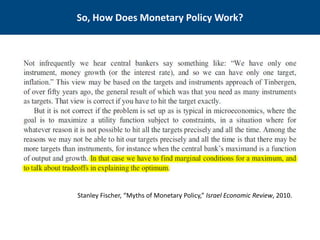
Stanley Fischer, “Myths of Monetary Policy,” Israel Economic Review, 2010. 
So, How Does Monetary Policy Work?
One Monetary Instrument, Many Goals 
• 
With targets > instruments, not all targets will be hit. 
• 
Attained level of “social welfare” depends on position of the short-run equilibrium tradeoff between targets (e.g., a short-run Phillips relationship). 
• 
Economic openness  gains from trade, but also can worsen some policy tradeoffs. 
• 
Even optimal exercise of “monetary autonomy” may leave the economy farther from policy bliss point than if more instruments were available. 
• 
But fixed exchange rate “corner solution” is worse.
Recent Concerns Focus on a Broader Range of Transmission Channels - with FS Implications 
• 
Cross-border bank lending can relax quantitative credit constraints, undermine domestic credit control. 
• 
There is a “global financial cycle” (Borio; Rey) 
• 
If agents hedge foreign dollar credits, covered interest parity  same cost as domestic-currency loans. 
• 
But they may choose not to  carry trades. 
• 
Domestic-currency bond markets have developed in EMEs but in many cases remain thin – vulnerable to shifts in foreign demand (Shin 2013), and could conceal off-balance sheet currency mismatches. 
• 
Direct LT interest rate arbitrage.
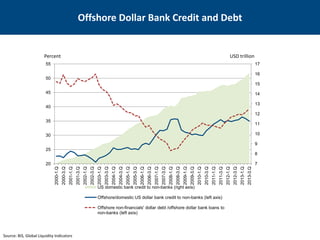
Offshore Dollar Bank Credit and Debt 
7 
8 
9 
10 
11 
12 
13 
14 
15 
16 
17 
20 
25 
30 
35 
40 
45 
50 
55 
2000-1.Q 
2000-3.Q 
2001-1.Q 
2001-3.Q 
2002-1.Q 
2002-3.Q 
2003-1.Q 
2003-3.Q 
2004-1.Q 
2004-3.Q 
2005-1.Q 
2005-3.Q 
2006-1.Q 
2006-3.Q 
2007-1.Q 
2007-3.Q 
2008-1.Q 
2008-3.Q 
2009-1.Q 
2009-3.Q 
2010-1.Q 
2010-3.Q 
2011-1.Q 
2011-3.Q 
2012-1.Q 
2012-3.Q 
2013-1.Q 
2013-3.Q 
US domestic bank credit to non-banks (right axis) 
Offshore/domestic US dollar bank credit to non-banks (left axis) 
Offshore non-financials' dollar debt /offshore dollar bank loans to non-banks (left axis) 
Percent 
USD trillion 
Source: BIS, Global Liquidity Indicators
Exchange Rates Don’t Cleanly Offset Financial Shocks 
• 
Imagine a portfolio shift toward an EME’s assets. 
• 
Even if central bank does not intervene, and currency appreciates, domestic balance sheets may improve. 
• 
Even at a constant current account balance and exchange rate, there can be offsetting gross position changes – e.g., corporates borrow and place funds abroad. Implications for FS, resilience. 
• 
Portfolio shifts can show up in other prices along with exchange rate, such as corporate borrowing spreads, which fall with global liquidity/“risk on” conditions. 
• 
We need more/better general-equilibrium models.
So Monetary Autonomy Is Exercised … 
• 
… but if capital account openness makes the FS problem harder to manage, and if additional prudential policy instruments are unavailable, monetary policy will deviate more from its other targets at an optimum. 
• 
I will argue that financial openness inevitably challenges prudential tools. 
• 
So tradeoff for policy is worse … even if monetary policy is potentially effective.
Why is FS Policy Harder in Open Economies? The Financial Trilemma is a Useful Framework 
The following three are not all mutually compatible (Schoenmaker 2013): 
1. 
Financial stability. 
2. 
Nonintervention in cross-border financial flows. 
3. 
National control over financial supervision and regulation. 
Note: Valid under any exchange-rate regime.
Resolving Trilemmas and Improving Tradeoffs 
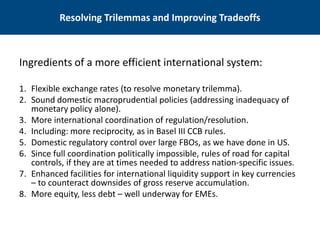
Ingredients of a more efficient international system: 
1. 
Flexible exchange rates (to resolve monetary trilemma). 
2. 
Sound domestic macroprudential policies (addressing inadequacy of monetary policy alone). 
3. 
More international coordination of regulation/resolution. 
4. 
Including: more reciprocity, as in Basel III CCB rules. 
5. 
Domestic regulatory control over large FBOs, as we have done in US. 
6. 
Since full coordination politically impossible, rules of road for capital controls, if they are at times needed to address nation-specific issues. 
7. 
Enhanced facilities for international liquidity support in key currencies – to counteract downsides of gross reserve accumulation. 
8. 
More equity, less debt – well underway for EMEs.
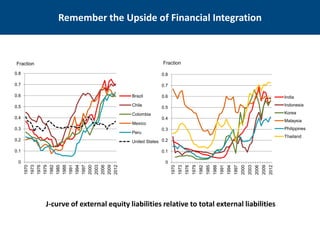
Remember the Upside of Financial Integration 
0 
0.1 
0.2 
0.3 
0.4 
0.5 
0.6 
0.7 
0.8 
1970 
1973 
1976 
1979 
1982 
1985 
1988 
1991 
1994 
1997 
2000 
2003 
2006 
2009 
2012 
Brazil 
Chile 
Colombia 
Mexico 
Peru 
United States 
Fraction 
0 
0.1 
0.2 
0.3 
0.4 
0.5 
0.6 
0.7 
0.8 
1970 
1973 
1976 
1979 
1982 
1985 
1988 
1991 
1994 
1997 
2000 
2003 
2006 
2009 
2012 
India 
Indonesia 
Korea 
Malaysia 
Philippines 
Thailand 
Fraction 
J-curve of external equity liabilities relative to total external liabilities
Exchange Rates and Financial Globalization 
Maurice Obstfeld 
Council of Economic Advisers 
IMF 15th Annual Research Conference 
November 13-14, 2014

Obstfeld acrcpolak2014

  • 1.
    Exchange Rates andFinancial Globalization Maurice Obstfeld Council of Economic Advisers IMF 15th Annual Research Conference November 13-14, 2014
  • 2.
    Two contradictory recentviews of monetary autonomy in small open economies: – The open economy is qualitatively no different from the closed economy, provided the nominal exchange rate is flexible. –Small economies have no monetary autonomy, regardless of the exchange rate regime, due to the effect of financial cross- border flows. Large countries’ monetary and financial shocks dominate the global monetary environment. “Taper tantrums” of 2013 highlighted role of volatile capital flows for EMEs. Introduction
  • 3.
    The Classic MonetaryTrilemma The following three are not all mutually compatible: 1. Fixed exchange rate. 2.Unimpeded cross-border financial flows. 3.Monetary autonomy. Bretton Woods made US exceptional. Floating was supposed to bring symmetry, “insulate” economies, and free monetary policy (Milton Friedman, Harry Johnson).
  • 4.
    But Life Turnedout to Be Complicated • Charles Kindleberger summarized well in his 1970 response to Johnson at the Boston Fed’s Cape Cod conference: • “Along with one more instrument – the exchange rate – there is one more target – the exchange rate.” • And don’t even mention financial stability (FS)! • Given current realities – does it follow that floating rates confer no monetary autonomy?
  • 5.
    Stanley Fischer, “Mythsof Monetary Policy,” Israel Economic Review, 2010. So, How Does Monetary Policy Work?
  • 6.
    One Monetary Instrument,Many Goals • With targets > instruments, not all targets will be hit. • Attained level of “social welfare” depends on position of the short-run equilibrium tradeoff between targets (e.g., a short-run Phillips relationship). • Economic openness  gains from trade, but also can worsen some policy tradeoffs. • Even optimal exercise of “monetary autonomy” may leave the economy farther from policy bliss point than if more instruments were available. • But fixed exchange rate “corner solution” is worse.
  • 7.
    Recent Concerns Focuson a Broader Range of Transmission Channels - with FS Implications • Cross-border bank lending can relax quantitative credit constraints, undermine domestic credit control. • There is a “global financial cycle” (Borio; Rey) • If agents hedge foreign dollar credits, covered interest parity  same cost as domestic-currency loans. • But they may choose not to  carry trades. • Domestic-currency bond markets have developed in EMEs but in many cases remain thin – vulnerable to shifts in foreign demand (Shin 2013), and could conceal off-balance sheet currency mismatches. • Direct LT interest rate arbitrage.
  • 8.
    Offshore Dollar BankCredit and Debt 7 8 9 10 11 12 13 14 15 16 17 20 25 30 35 40 45 50 55 2000-1.Q 2000-3.Q 2001-1.Q 2001-3.Q 2002-1.Q 2002-3.Q 2003-1.Q 2003-3.Q 2004-1.Q 2004-3.Q 2005-1.Q 2005-3.Q 2006-1.Q 2006-3.Q 2007-1.Q 2007-3.Q 2008-1.Q 2008-3.Q 2009-1.Q 2009-3.Q 2010-1.Q 2010-3.Q 2011-1.Q 2011-3.Q 2012-1.Q 2012-3.Q 2013-1.Q 2013-3.Q US domestic bank credit to non-banks (right axis) Offshore/domestic US dollar bank credit to non-banks (left axis) Offshore non-financials' dollar debt /offshore dollar bank loans to non-banks (left axis) Percent USD trillion Source: BIS, Global Liquidity Indicators
  • 9.
    Exchange Rates Don’tCleanly Offset Financial Shocks • Imagine a portfolio shift toward an EME’s assets. • Even if central bank does not intervene, and currency appreciates, domestic balance sheets may improve. • Even at a constant current account balance and exchange rate, there can be offsetting gross position changes – e.g., corporates borrow and place funds abroad. Implications for FS, resilience. • Portfolio shifts can show up in other prices along with exchange rate, such as corporate borrowing spreads, which fall with global liquidity/“risk on” conditions. • We need more/better general-equilibrium models.
  • 10.
    So Monetary AutonomyIs Exercised … • … but if capital account openness makes the FS problem harder to manage, and if additional prudential policy instruments are unavailable, monetary policy will deviate more from its other targets at an optimum. • I will argue that financial openness inevitably challenges prudential tools. • So tradeoff for policy is worse … even if monetary policy is potentially effective.
  • 11.
    Why is FSPolicy Harder in Open Economies? The Financial Trilemma is a Useful Framework The following three are not all mutually compatible (Schoenmaker 2013): 1. Financial stability. 2. Nonintervention in cross-border financial flows. 3. National control over financial supervision and regulation. Note: Valid under any exchange-rate regime.
  • 12.
    Resolving Trilemmas andImproving Tradeoffs Ingredients of a more efficient international system: 1. Flexible exchange rates (to resolve monetary trilemma). 2. Sound domestic macroprudential policies (addressing inadequacy of monetary policy alone). 3. More international coordination of regulation/resolution. 4. Including: more reciprocity, as in Basel III CCB rules. 5. Domestic regulatory control over large FBOs, as we have done in US. 6. Since full coordination politically impossible, rules of road for capital controls, if they are at times needed to address nation-specific issues. 7. Enhanced facilities for international liquidity support in key currencies – to counteract downsides of gross reserve accumulation. 8. More equity, less debt – well underway for EMEs.
  • 13.
    Remember the Upsideof Financial Integration 0 0.1 0.2 0.3 0.4 0.5 0.6 0.7 0.8 1970 1973 1976 1979 1982 1985 1988 1991 1994 1997 2000 2003 2006 2009 2012 Brazil Chile Colombia Mexico Peru United States Fraction 0 0.1 0.2 0.3 0.4 0.5 0.6 0.7 0.8 1970 1973 1976 1979 1982 1985 1988 1991 1994 1997 2000 2003 2006 2009 2012 India Indonesia Korea Malaysia Philippines Thailand Fraction J-curve of external equity liabilities relative to total external liabilities
  • 14.
    Exchange Rates andFinancial Globalization Maurice Obstfeld Council of Economic Advisers IMF 15th Annual Research Conference November 13-14, 2014