Monetary Policy
What is the FED and what does it
have to do with me?
Fiscal Policy (from last class)
• How the president and Congress controls the
economy
– Expansionary Policies: to increase economic growth
– Contractionary Policies: to slow economic growth
• PROBLEM: Government cannot be relied on to
make good decisions regarding the economy!
Monetary Policy
• Def.: How the Federal Reserve influences
the supply of money and brings the nation
out of either a recession or inflationary
period.
The Federal Reserve
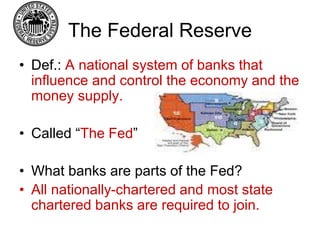
• Def.: A national system of banks that
influence and control the economy and the
money supply.
• Called “The Fed”
• What banks are parts of the Fed?
• All nationally-chartered and most state
chartered banks are required to join.
Federal Reserve Board of
Governors
• Def. Seven members, including a
chairman, appointed by the President.
• These governors as well as five presidents
of the Federal Reserve Banks form the
Federal Open Market Committee.
• This committee establishes our national
monetary policy.
Appointed, not elected
• The Board of Governors is appointed by
the President so that they can make
unpopular decisions about the economy
without having to worry about being re-
elected.
So, what does the Federal Reserve
Do?
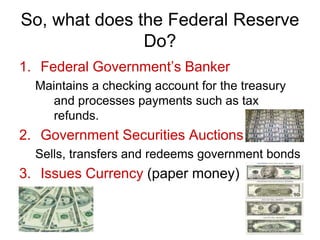
1. Federal Government’s Banker
Maintains a checking account for the treasury
and processes payments such as tax
refunds.
2. Government Securities Auctions
Sells, transfers and redeems government bonds
3. Issues Currency (paper money)
So, what does the Federal Reserve
Do? (cont.)
4. Check Clearing
Transfers money from one account to another
when checks are written
5. Supervises Lending Practices
Monitors bank reserves throughout the country
6. Lender of Last Resort
In case of economic emergency, banks can
borrow funds from the Fed
So, how does Monetary Policy
Work?
• By adjusting the supply of money in the
nation, the Fed can speed up the economy
or slow it down.
To get out of a recession, the Fed
encourages people to spend by
increasing the money supply.
To stop inflation, the Fed
discourages people from spending
by decreasing the money supply.
How does the Fed do this?
• Three tools of the Fed:
–Reserve Requirement
–Discount Rate
–Open-Market Operations
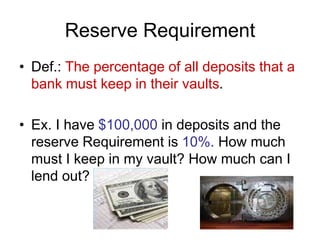
Reserve Requirement
• Def.: The percentage of all deposits that a
bank must keep in their vaults.
• Ex. I have $100,000 in deposits and the
reserve Requirement is 10%. How much
must I keep in my vault? How much can I
lend out?
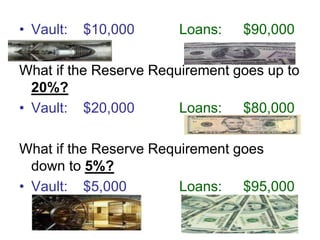
• Vault: $10,000 Loans: $90,000
What if the Reserve Requirement goes up to
20%?
• Vault: $20,000 Loans: $80,000
What if the Reserve Requirement goes
down to 5%?
• Vault: $5,000 Loans: $95,000
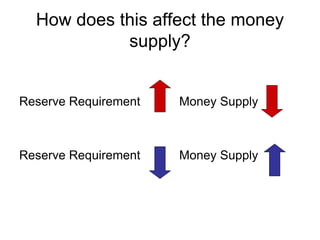
How does this affect the money
supply?
Reserve Requirement Money Supply
The Discount Rate
• Def. At times the Fed lends money to
banks. By either lowering or raising the
interest rate they charge the banks, they
can influence the interest rate that banks
charge their customers.
Discount rate is 2%, the banks charge 3%
• The Fed decides to raise the rate:
Discount rate is 3%, the banks charge 4%
Higher interest, less people get loans
• The Fed decides to lower the rate
Discount rate is 1%, the banks charge 2%
Lower interest, more people get loans
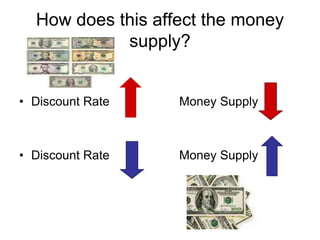
How does this affect the money
supply?
• Discount Rate Money Supply
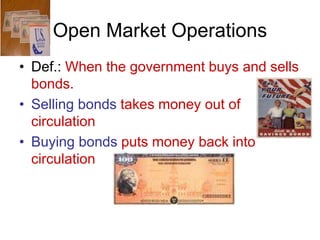
Open Market Operations
• Def.: When the government buys and sells
bonds.
• Selling bonds takes money out of
circulation
• Buying bonds puts money back into
circulation
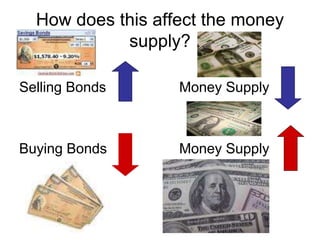
How does this affect the money
supply?
Selling Bonds Money Supply
Buying Bonds Money Supply
Monetary Policy During a
Recession
• Goal:
Increase Money Supply
• Decrease the Reserve Requirement
• Decrease the Discount Rate
• Buy Bonds
• Called Easy Money Policy
Monetary Policy during a period of
Inflation
• Goal:
Decrease spending and the money supply
• Increase the Reserve Requirement
• Increase the Discount Rate
• Sell Bonds
• Called Tight Money Policy

Monetary_Policy.ppt

  • 1.
    Monetary Policy What isthe FED and what does it have to do with me?
  • 2.
    Fiscal Policy (fromlast class) • How the president and Congress controls the economy – Expansionary Policies: to increase economic growth – Contractionary Policies: to slow economic growth • PROBLEM: Government cannot be relied on to make good decisions regarding the economy!
  • 3.
    Monetary Policy • Def.:How the Federal Reserve influences the supply of money and brings the nation out of either a recession or inflationary period.
  • 4.
    The Federal Reserve •Def.: A national system of banks that influence and control the economy and the money supply. • Called “The Fed” • What banks are parts of the Fed? • All nationally-chartered and most state chartered banks are required to join.
  • 5.
    Federal Reserve Boardof Governors • Def. Seven members, including a chairman, appointed by the President. • These governors as well as five presidents of the Federal Reserve Banks form the Federal Open Market Committee. • This committee establishes our national monetary policy.
  • 6.
    Appointed, not elected •The Board of Governors is appointed by the President so that they can make unpopular decisions about the economy without having to worry about being re- elected.
  • 7.
    So, what doesthe Federal Reserve Do? 1. Federal Government’s Banker Maintains a checking account for the treasury and processes payments such as tax refunds. 2. Government Securities Auctions Sells, transfers and redeems government bonds 3. Issues Currency (paper money)
  • 8.
    So, what doesthe Federal Reserve Do? (cont.) 4. Check Clearing Transfers money from one account to another when checks are written 5. Supervises Lending Practices Monitors bank reserves throughout the country 6. Lender of Last Resort In case of economic emergency, banks can borrow funds from the Fed
  • 9.
    So, how doesMonetary Policy Work? • By adjusting the supply of money in the nation, the Fed can speed up the economy or slow it down.
  • 10.
    To get outof a recession, the Fed encourages people to spend by increasing the money supply. To stop inflation, the Fed discourages people from spending by decreasing the money supply.
  • 11.
    How does theFed do this? • Three tools of the Fed: –Reserve Requirement –Discount Rate –Open-Market Operations
  • 12.
    Reserve Requirement • Def.:The percentage of all deposits that a bank must keep in their vaults. • Ex. I have $100,000 in deposits and the reserve Requirement is 10%. How much must I keep in my vault? How much can I lend out?
  • 13.
    • Vault: $10,000Loans: $90,000 What if the Reserve Requirement goes up to 20%? • Vault: $20,000 Loans: $80,000 What if the Reserve Requirement goes down to 5%? • Vault: $5,000 Loans: $95,000
  • 14.
    How does thisaffect the money supply? Reserve Requirement Money Supply Reserve Requirement Money Supply
  • 15.
    The Discount Rate •Def. At times the Fed lends money to banks. By either lowering or raising the interest rate they charge the banks, they can influence the interest rate that banks charge their customers.
  • 16.
    Discount rate is2%, the banks charge 3% • The Fed decides to raise the rate: Discount rate is 3%, the banks charge 4% Higher interest, less people get loans • The Fed decides to lower the rate Discount rate is 1%, the banks charge 2% Lower interest, more people get loans
  • 17.
    How does thisaffect the money supply? • Discount Rate Money Supply • Discount Rate Money Supply
  • 18.
    Open Market Operations •Def.: When the government buys and sells bonds. • Selling bonds takes money out of circulation • Buying bonds puts money back into circulation
  • 19.
    How does thisaffect the money supply? Selling Bonds Money Supply Buying Bonds Money Supply
  • 20.
    Monetary Policy Duringa Recession • Goal: Increase Money Supply • Decrease the Reserve Requirement • Decrease the Discount Rate • Buy Bonds • Called Easy Money Policy
  • 21.
    Monetary Policy duringa period of Inflation • Goal: Decrease spending and the money supply • Increase the Reserve Requirement • Increase the Discount Rate • Sell Bonds • Called Tight Money Policy