www.solidcounsel.com
Computer Fraud & Cybersecurity
 What is fraud?
 Fraud 2.0
 Intersection between computer fraud /
hacking & cybersecurity / data breach
 The irony …
www.solidcounsel.com
Key Computer Fraud Laws
 Computer Fraud and Abuse Act (Federal)
 Breach of Computer Security (Texas)
 Harmful Access by Computer Act (Texas)
 Unauthorized access / “hacking” laws
 Focus on the device / network
www.solidcounsel.com
CFAA Overview
 What is the CFAA?
 What Does the CFAA Protect?
 What are the CFAA’s Elements?
 Key Issues for CFAA Claims
www.solidcounsel.com
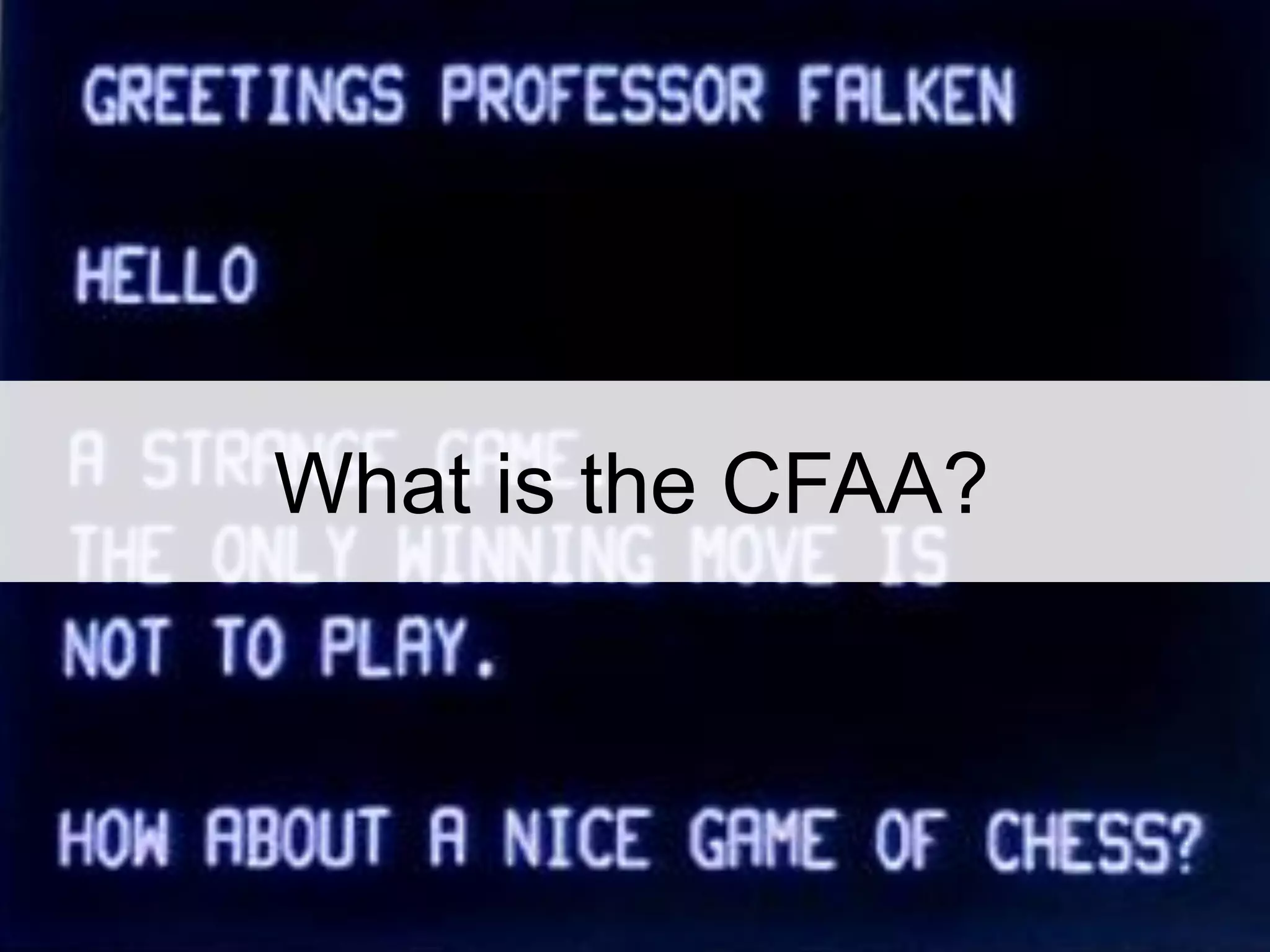
What is the CFAA?
www.solidcounsel.com
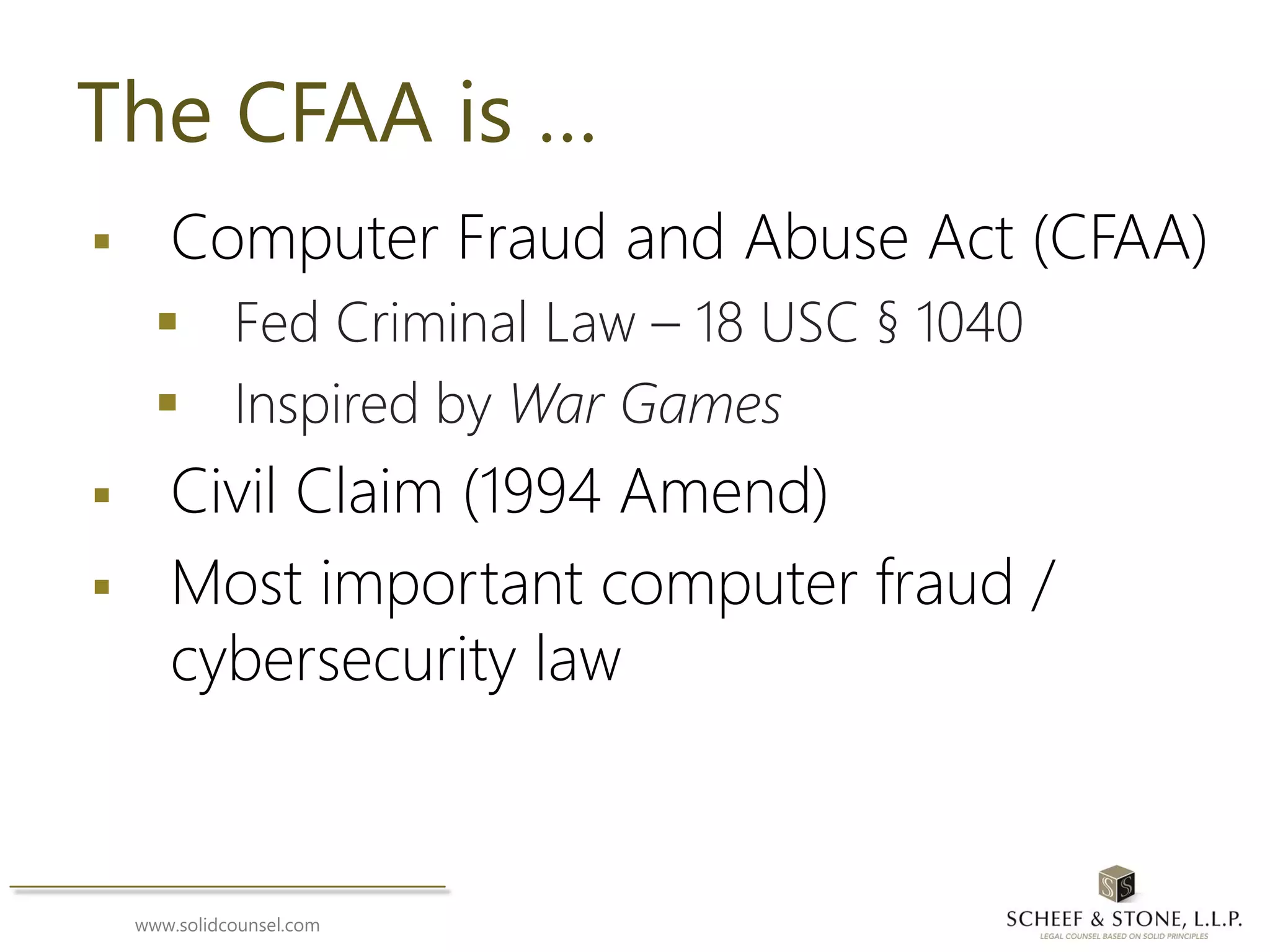
The CFAA is …
 Computer Fraud and Abuse Act (CFAA)
 Fed Criminal Law – 18 USC § 1040
 Inspired by War Games
 Civil Claim (1994 Amend)
 Most important computer fraud /
cybersecurity law
www.solidcounsel.com
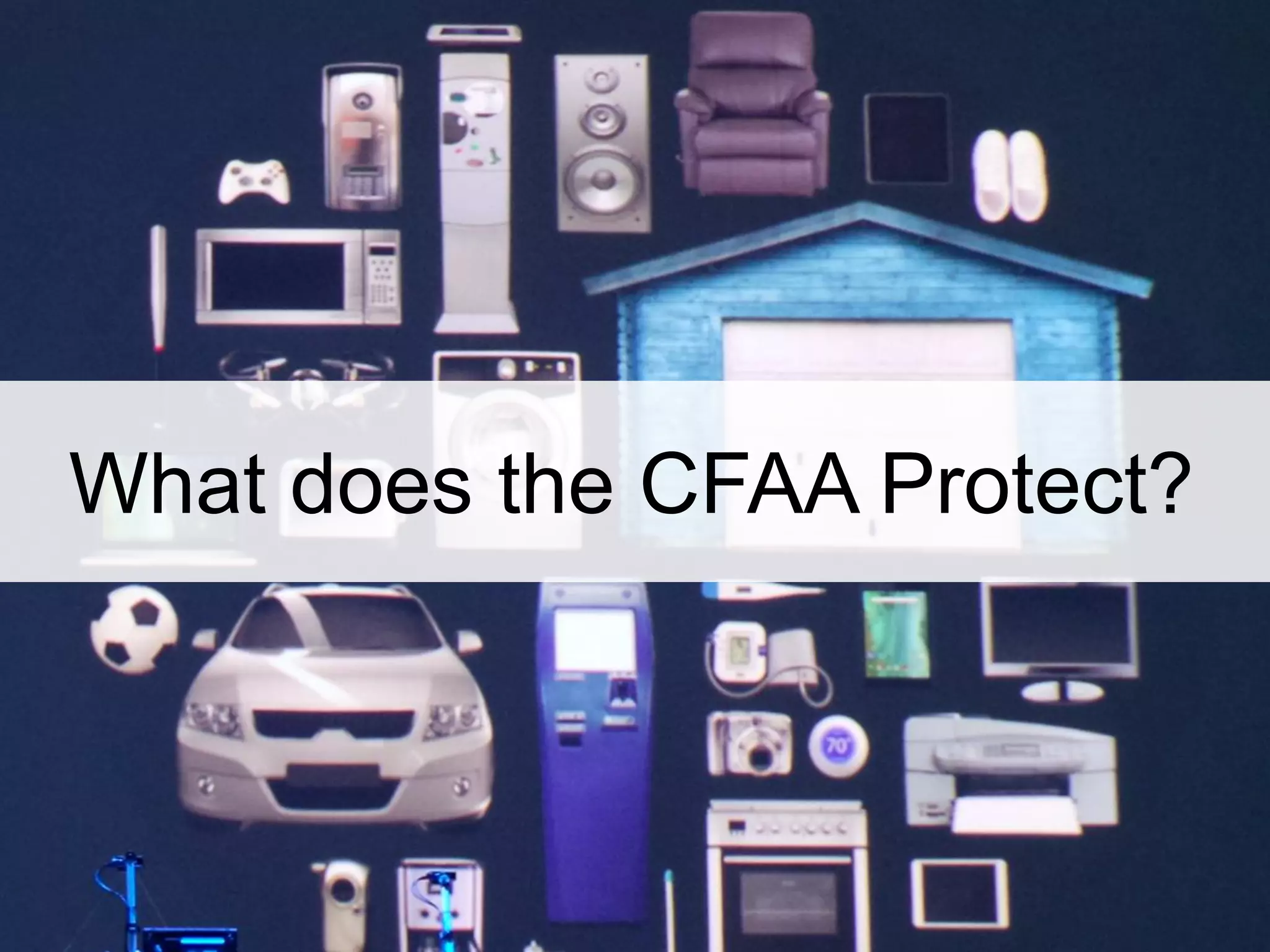
What does the CFAA Protect?
www.solidcounsel.com
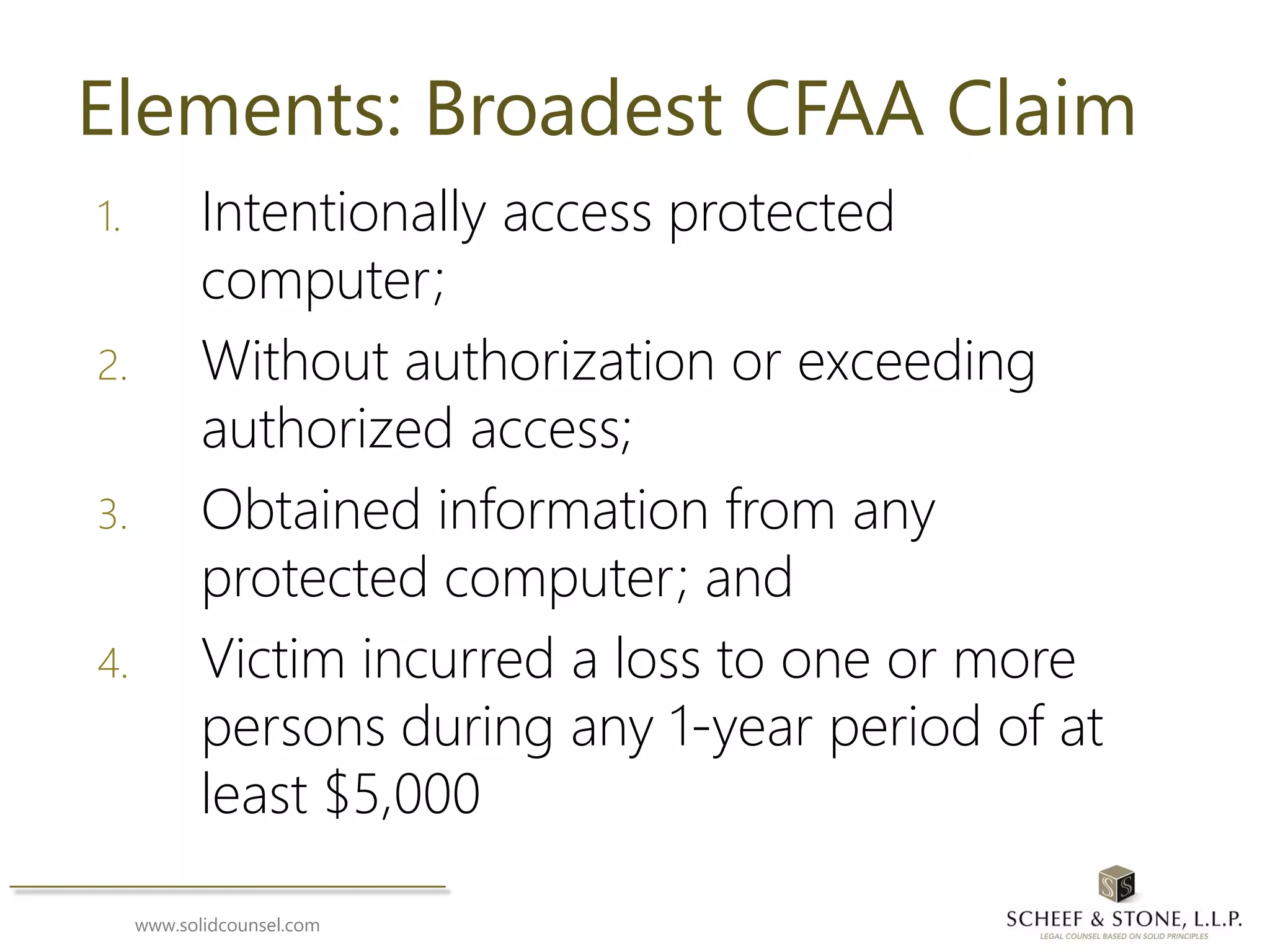
Elements: Broadest CFAA Claim
1. Intentionally access protected
computer;
2. Without authorization or exceeding
authorized access;
3. Obtained information from any
protected computer; and
4. Victim incurred a loss to one or more
persons during any 1-year period of at
least $5,000
www.solidcounsel.com
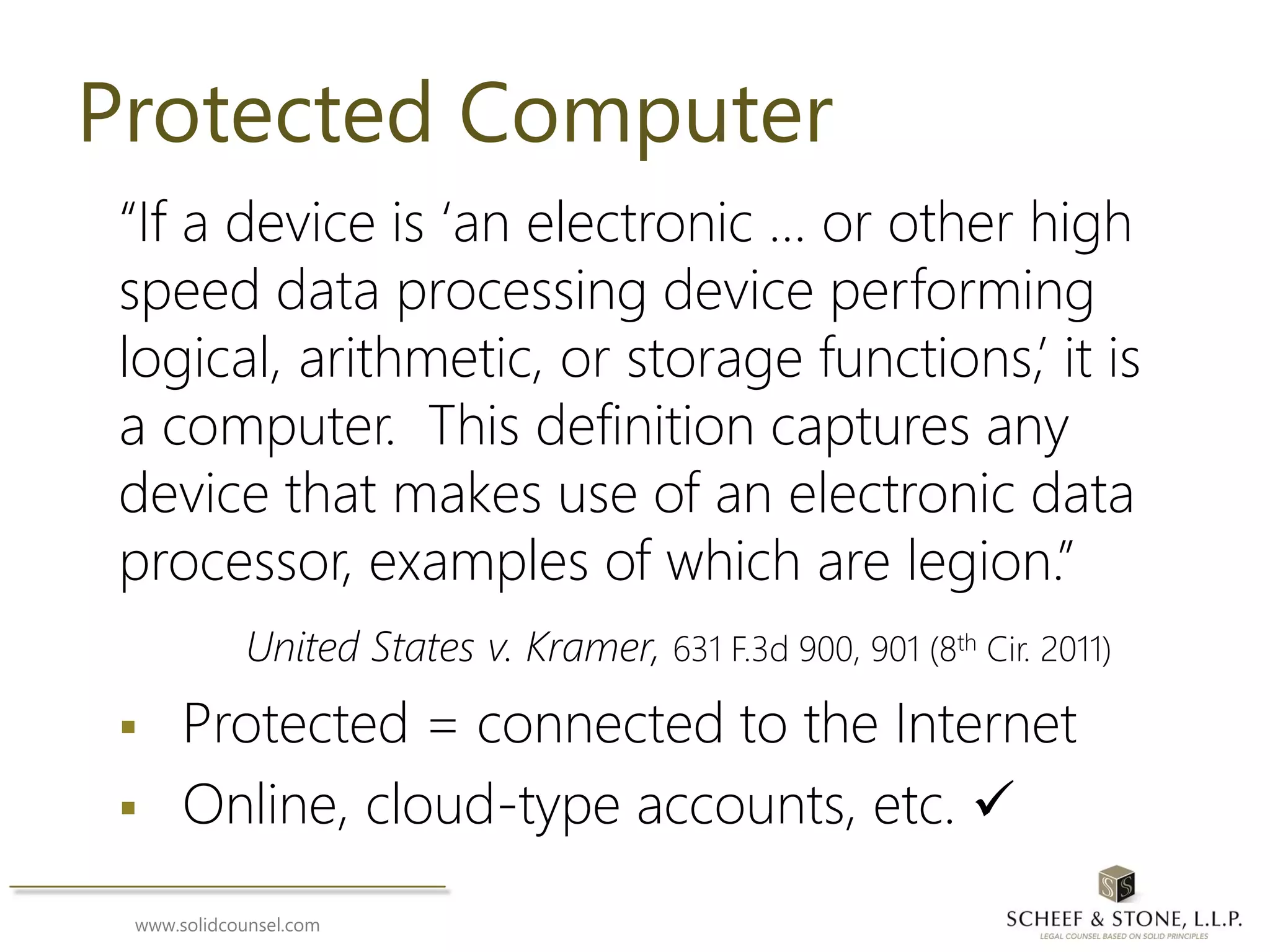
Protected Computer
“If a device is ‘an electronic … or other high
speed data processing device performing
logical, arithmetic, or storage functions,’ it is
a computer. This definition captures any
device that makes use of an electronic data
processor, examples of which are legion.”
United States v. Kramer, 631 F.3d 900, 901 (8th Cir. 2011)
 Protected = connected to the Internet
 Online, cloud-type accounts, etc. 
www.solidcounsel.com
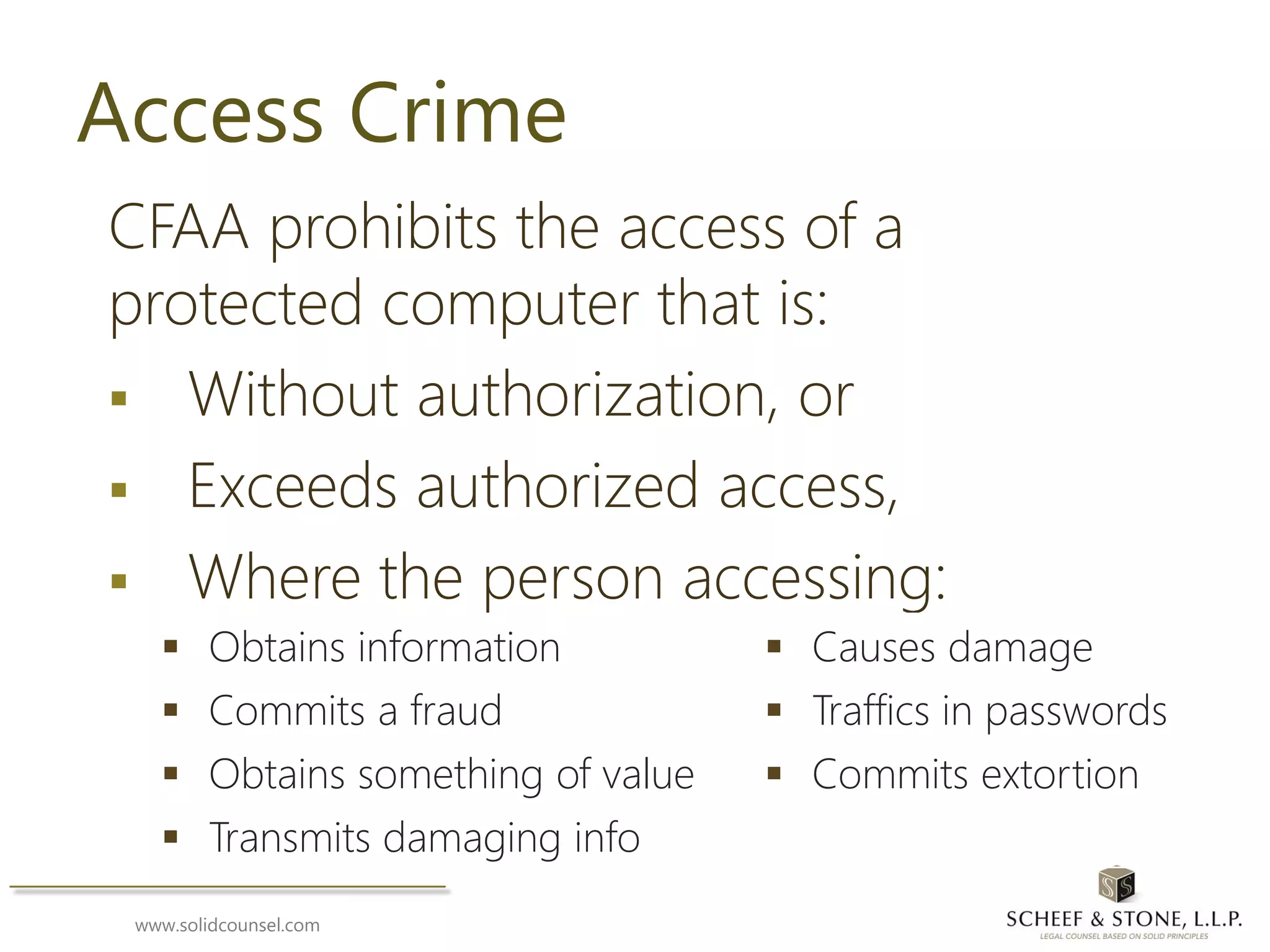
Access Crime
CFAA prohibits the access of a
protected computer that is:
 Without authorization, or
 Exceeds authorized access,
 Where the person accessing:
 Obtains information  Causes damage
 Commits a fraud  Traffics in passwords
 Obtains something of value  Commits extortion
 Transmits damaging info
www.solidcounsel.com
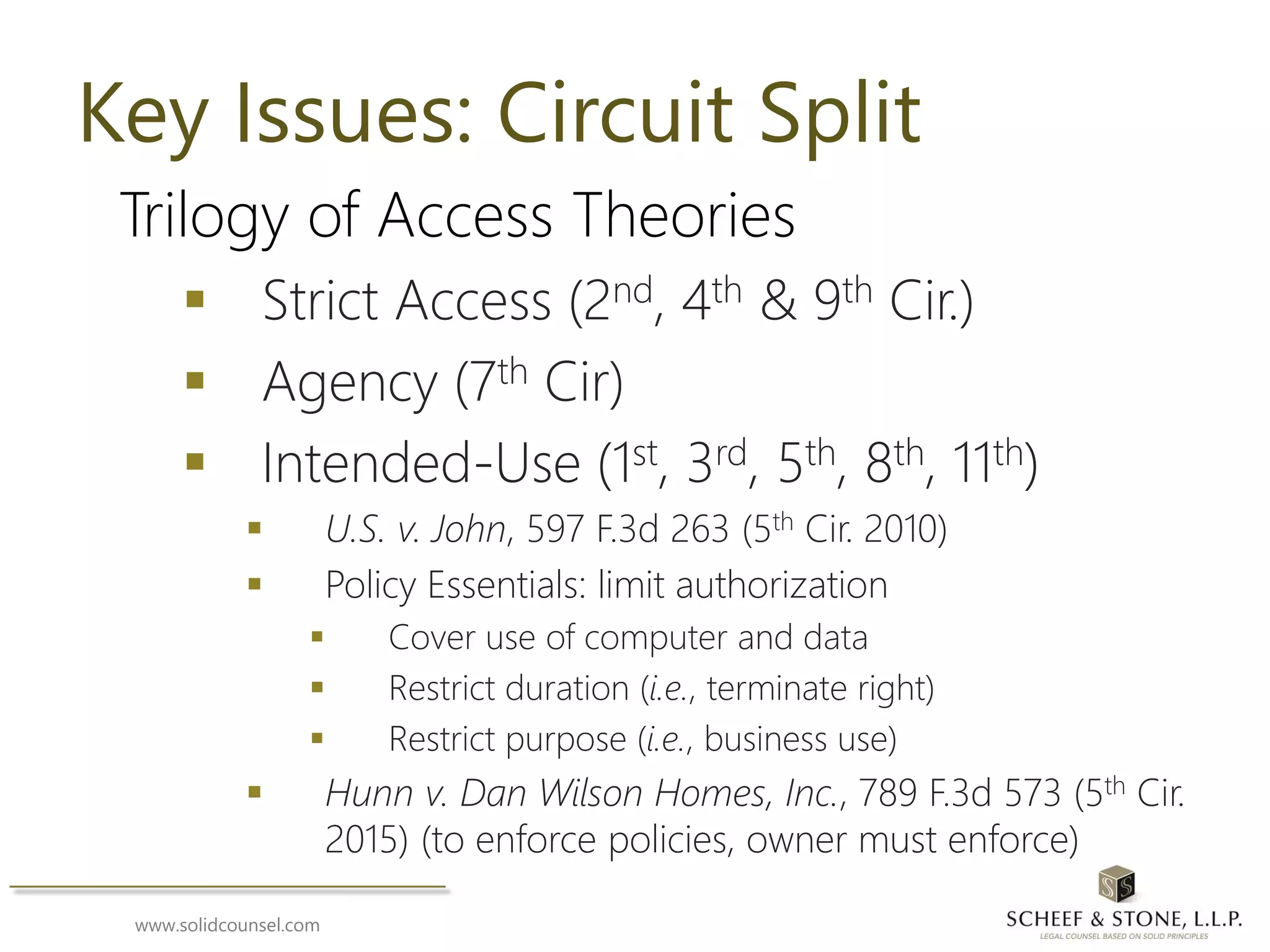
Key Issues: Circuit Split
Trilogy of Access Theories
 Strict Access (2nd, 4th & 9th Cir.)
 Agency (7th Cir)
 Intended-Use (1st, 3rd, 5th, 8th, 11th)
 U.S. v. John, 597 F.3d 263 (5th Cir. 2010)
 Policy Essentials: limit authorization
 Cover use of computer and data
 Restrict duration (i.e., terminate right)
 Restrict purpose (i.e., business use)
 Hunn v. Dan Wilson Homes, Inc., 789 F.3d 573 (5th Cir.
2015) (to enforce policies, owner must enforce)
www.solidcounsel.com
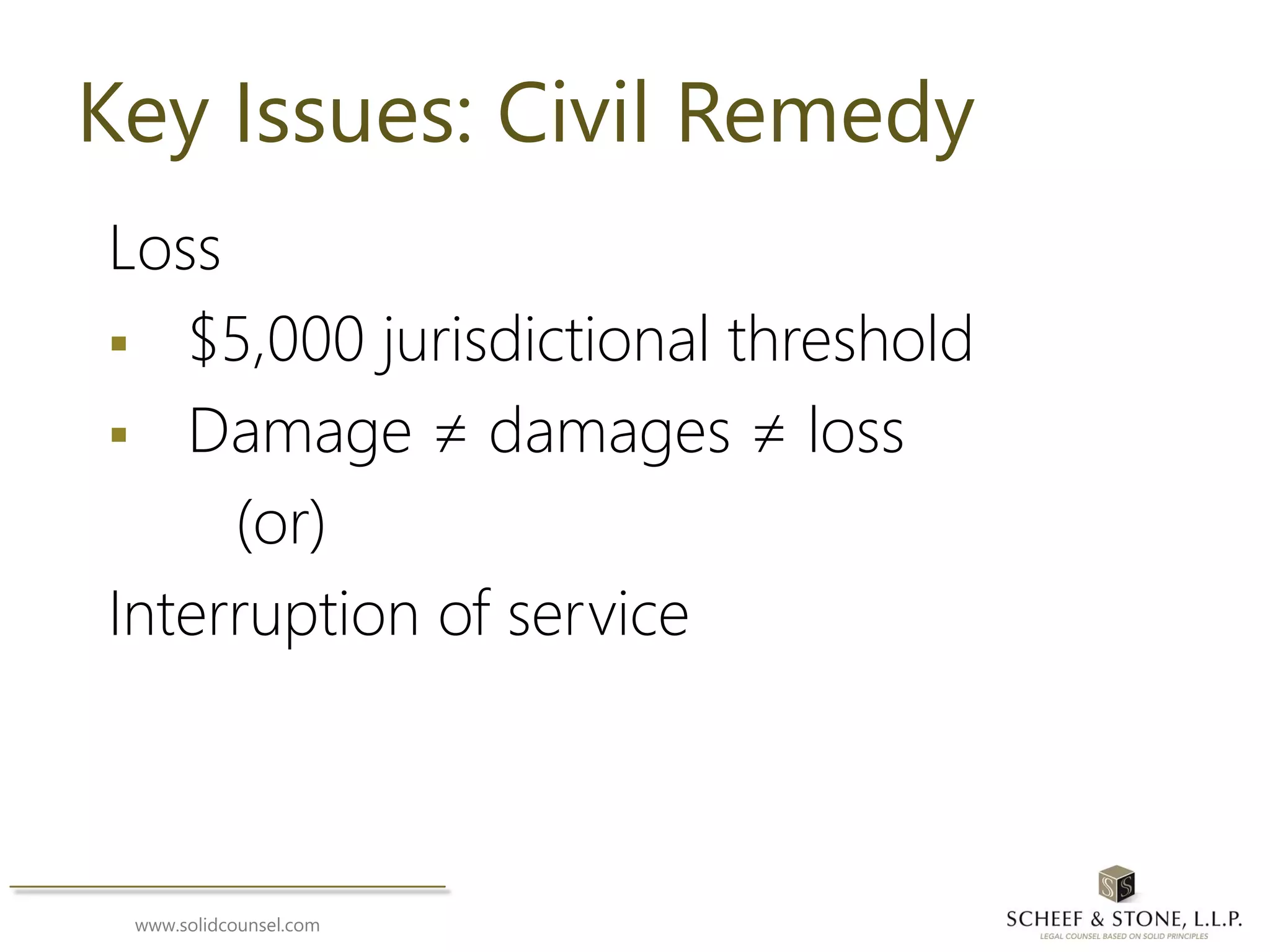
Key Issues: Civil Remedy
Loss
 $5,000 jurisdictional threshold
 Damage ≠ damages ≠ loss
(or)
Interruption of service
www.solidcounsel.com
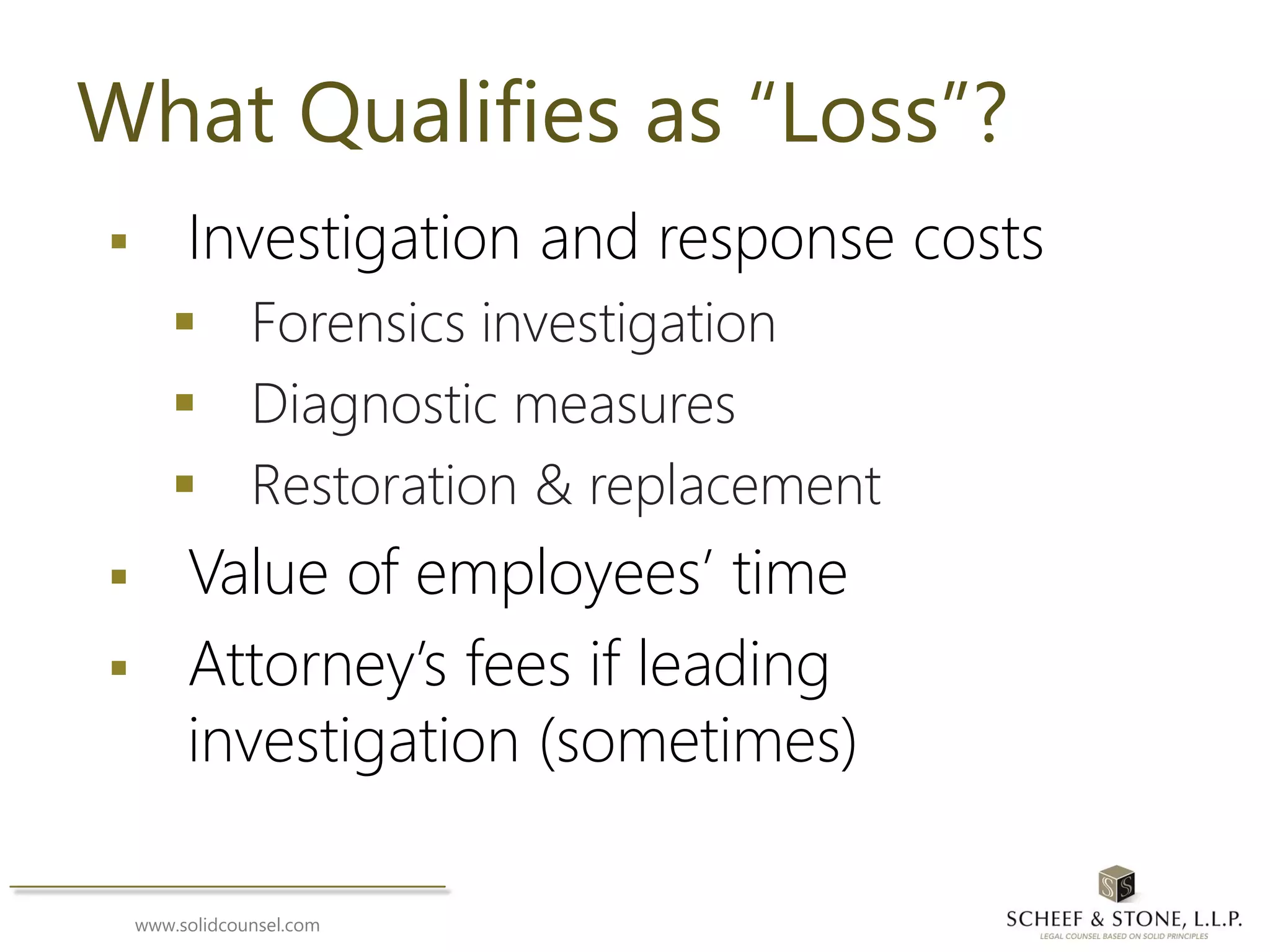
What Qualifies as “Loss”?
 Investigation and response costs
 Forensics investigation
 Diagnostic measures
 Restoration & replacement
 Value of employees’ time
 Attorney’s fees if leading
investigation (sometimes)
www.solidcounsel.com
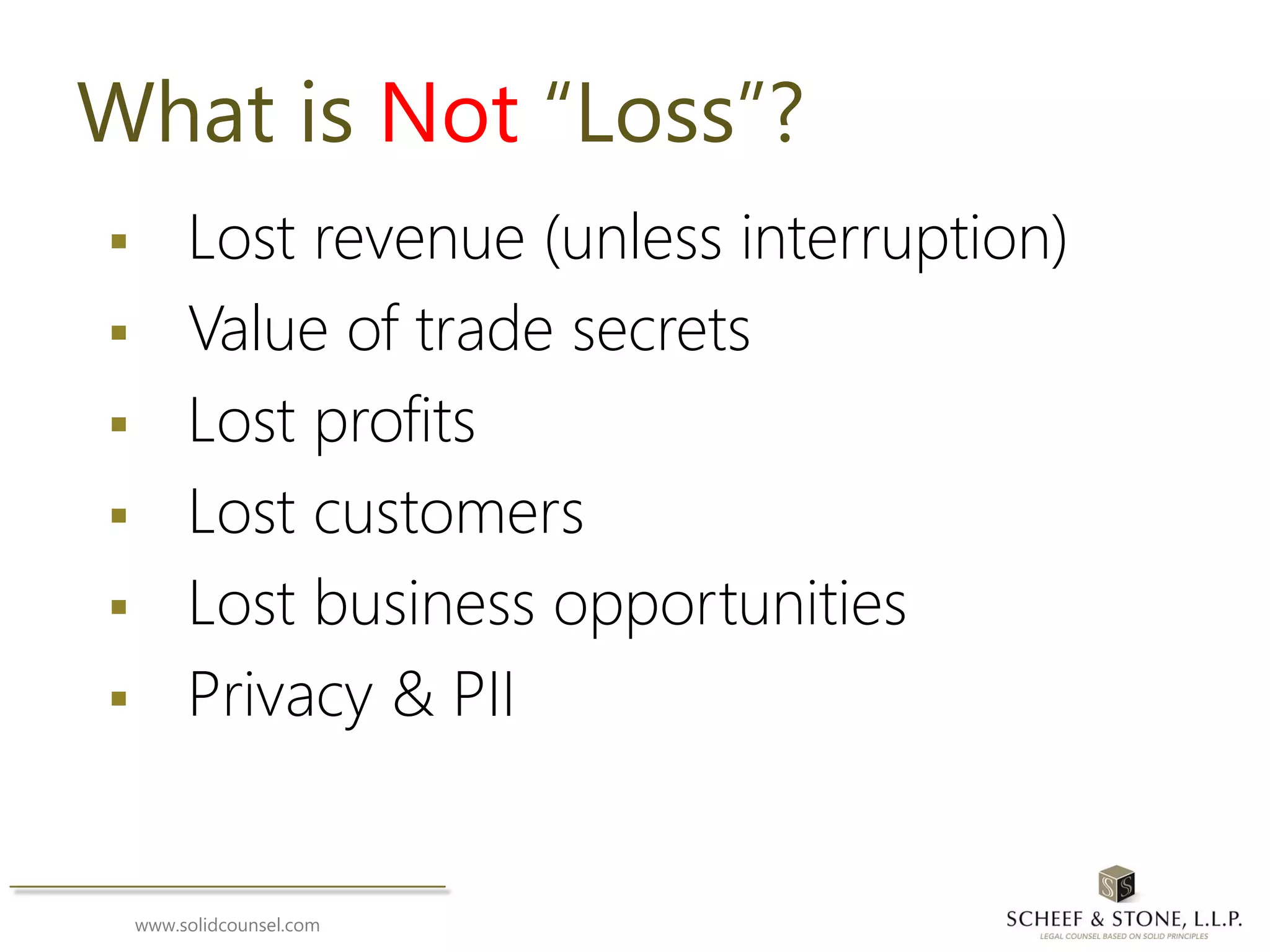
What is Not “Loss”?
 Lost revenue (unless interruption)
 Value of trade secrets
 Lost profits
 Lost customers
 Lost business opportunities
 Privacy & PII
www.solidcounsel.com
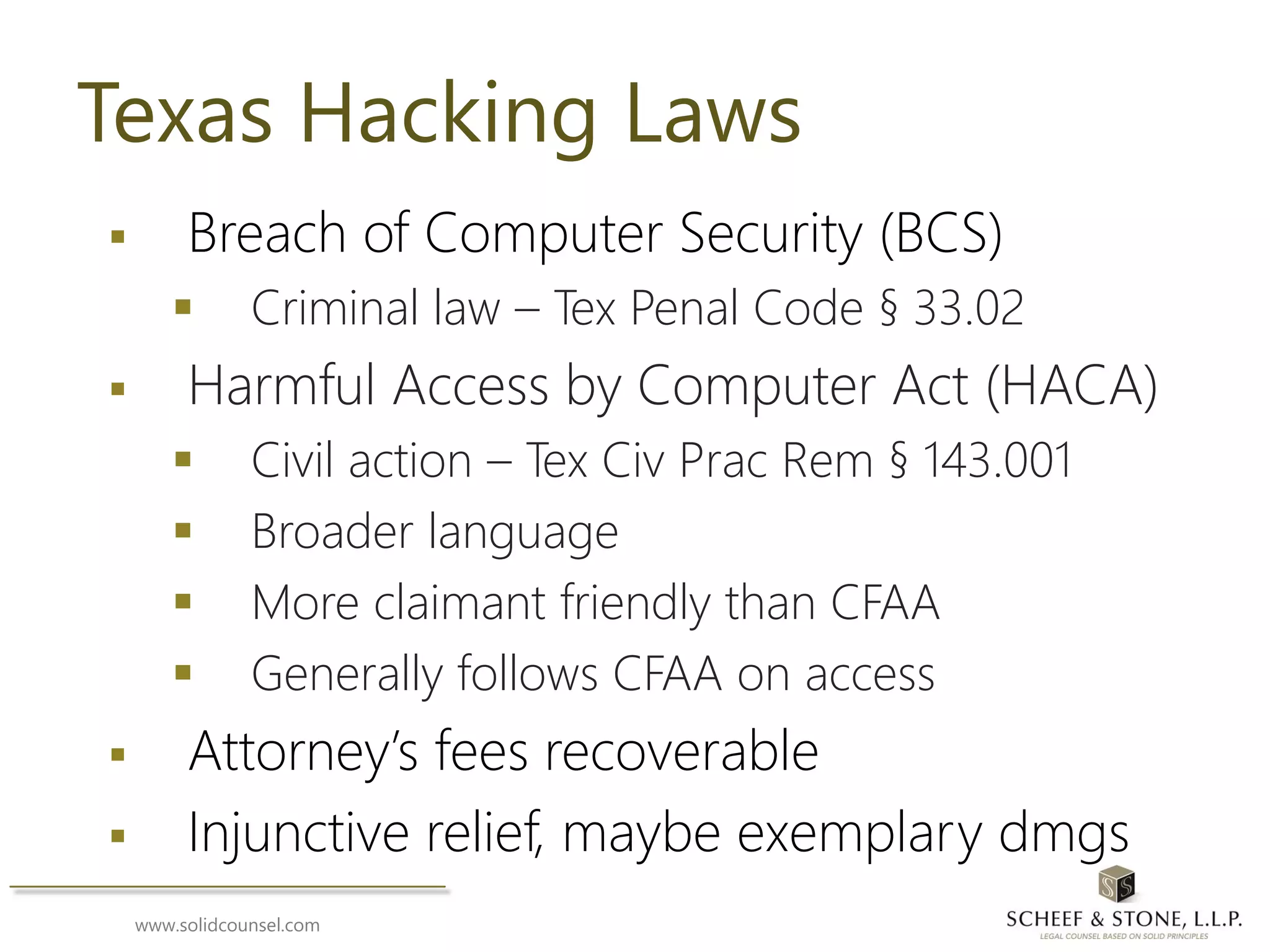
Texas Hacking Laws
 Breach of Computer Security (BCS)
 Criminal law – Tex Penal Code § 33.02
 Harmful Access by Computer Act (HACA)
 Civil action – Tex Civ Prac Rem § 143.001
 Broader language
 More claimant friendly than CFAA
 Generally follows CFAA on access
 Attorney’s fees recoverable
 Injunctive relief, maybe exemplary dmgs
www.solidcounsel.com
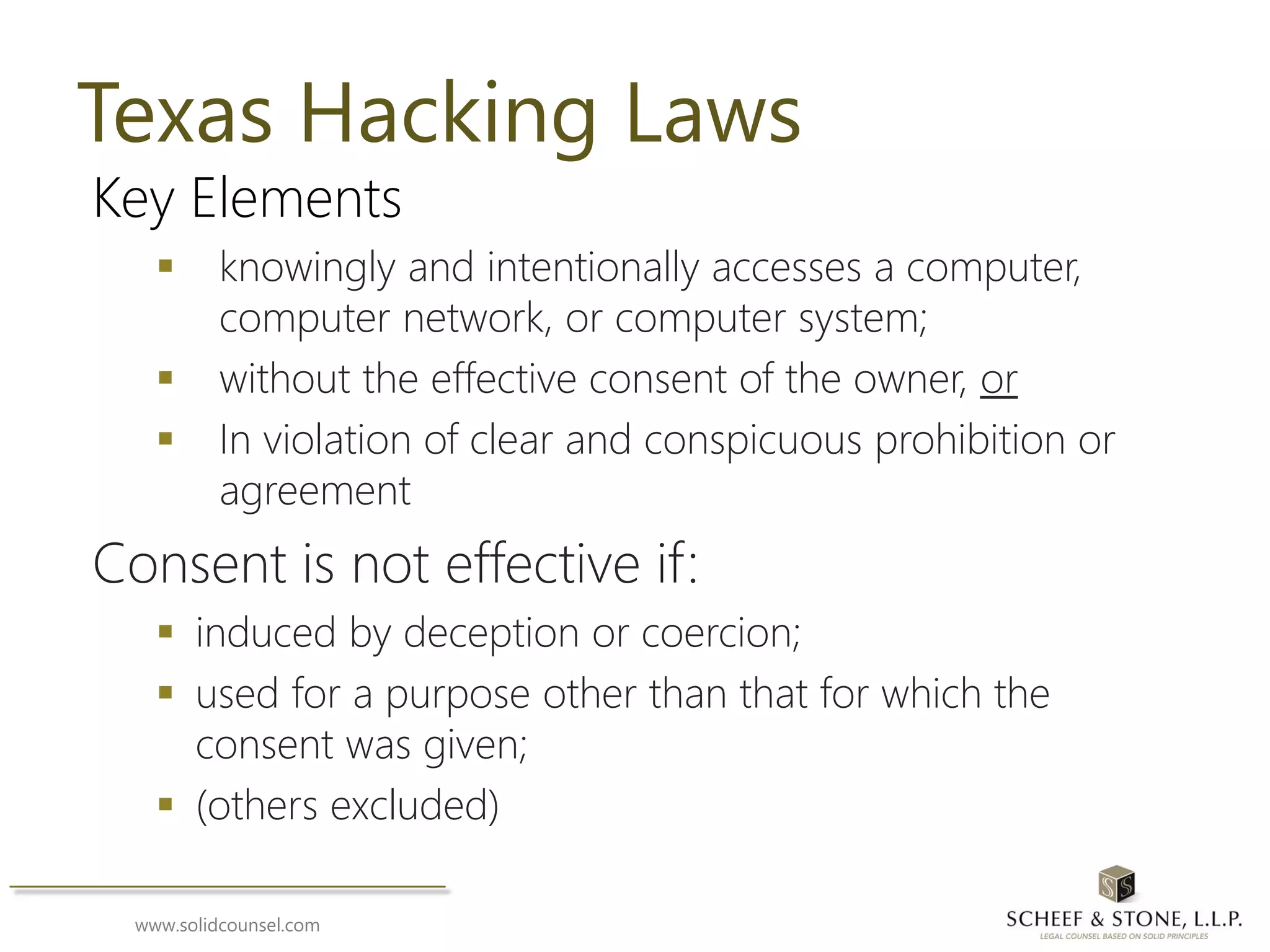
Texas Hacking Laws
Key Elements
 knowingly and intentionally accesses a computer,
computer network, or computer system;
 without the effective consent of the owner, or
 In violation of clear and conspicuous prohibition or
agreement
Consent is not effective if:
 induced by deception or coercion;
 used for a purpose other than that for which the
consent was given;
 (others excluded)
www.solidcounsel.com
Key Issues: Effective Consent
Effective Consent
 Spouses do not have effective consent to surreptitiously access
a partner’s password-protected device that they treat as being
the other spouses’ device. Miller v. Talley Dunn Gallery, LLC,
2016 WL 836775 (Tex. App.—Dallas, Mar. 3, 2016)
 There was effective consent to access a co-worker’s device that
was knowingly left open and unsecured. Knepp v. State, 2009
WL 638249 (Tex. App.—Dallas, March 13, 2009, no pet.)
 Privileged users do not have effective consent to misuse their
authorized access for non-intended uses such as corrupting
files before quitting or taking data to use for a competitor.
Shawn Tuma
Cybersecurity Partner
Scheef & Stone, L.L.P.
214.472.2135
shawn.tuma@solidcounsel.com
@shawnetuma
blog: www.shawnetuma.com
web: www.solidcounsel.com
This information provided is
for educational purposes only,
does not constitute legal
advice, and no attorney-client
relationship is created by this
presentation.
Shawn Tuma is a business lawyer with an internationally recognized
reputation in cybersecurity, computer fraud and data privacy law. He is a
Cybersecurity & Data Protection Partner at Scheef & Stone, LLP, a full-
service commercial law firm in Texas that represents businesses of all
sizes throughout the United States and around the world.
 Board of Directors, North Texas Cyber Forensics Lab
 Board of Directors & General Counsel, Cyber Future Foundation
 Texas SuperLawyers 2015-16 (IP Litigation)
 Best Lawyers in Dallas 2014-16, D Magazine (Digital Information Law)
 Council, Computer & Technology Section, State Bar of Texas
 Chair, Civil Litigation & Appellate Section, Collin County Bar
Association
 College of the State Bar of Texas
 Privacy and Data Security Committee, Litigation, Intellectual
Property Law, and Business Sections of the State Bar of Texas
 Information Security Committee of the Section on Science &
Technology Committee of the American Bar Association
 North Texas Crime Commission, Cybercrime Committee
 Infragard (FBI)
 International Association of Privacy Professionals (IAPP)
 Information Systems Security Association (ISSA)
 Board of Advisors, Optiv Security
 Editor, Business Cybersecurity Business Law Blog

Federal Computer Fraud and Abuse Act & Texas Computer Hacking Statutes

  • 1.
  • 2.
    www.solidcounsel.com Computer Fraud &Cybersecurity  What is fraud?  Fraud 2.0  Intersection between computer fraud / hacking & cybersecurity / data breach  The irony …
  • 3.
    www.solidcounsel.com Key Computer FraudLaws  Computer Fraud and Abuse Act (Federal)  Breach of Computer Security (Texas)  Harmful Access by Computer Act (Texas)  Unauthorized access / “hacking” laws  Focus on the device / network
  • 4.
    www.solidcounsel.com CFAA Overview  Whatis the CFAA?  What Does the CFAA Protect?  What are the CFAA’s Elements?  Key Issues for CFAA Claims
  • 5.
  • 6.
    www.solidcounsel.com The CFAA is…  Computer Fraud and Abuse Act (CFAA)  Fed Criminal Law – 18 USC § 1040  Inspired by War Games  Civil Claim (1994 Amend)  Most important computer fraud / cybersecurity law
  • 7.
  • 8.
    www.solidcounsel.com Elements: Broadest CFAAClaim 1. Intentionally access protected computer; 2. Without authorization or exceeding authorized access; 3. Obtained information from any protected computer; and 4. Victim incurred a loss to one or more persons during any 1-year period of at least $5,000
  • 9.
    www.solidcounsel.com Protected Computer “If adevice is ‘an electronic … or other high speed data processing device performing logical, arithmetic, or storage functions,’ it is a computer. This definition captures any device that makes use of an electronic data processor, examples of which are legion.” United States v. Kramer, 631 F.3d 900, 901 (8th Cir. 2011)  Protected = connected to the Internet  Online, cloud-type accounts, etc. 
  • 10.
    www.solidcounsel.com Access Crime CFAA prohibitsthe access of a protected computer that is:  Without authorization, or  Exceeds authorized access,  Where the person accessing:  Obtains information  Causes damage  Commits a fraud  Traffics in passwords  Obtains something of value  Commits extortion  Transmits damaging info
  • 11.
    www.solidcounsel.com Key Issues: CircuitSplit Trilogy of Access Theories  Strict Access (2nd, 4th & 9th Cir.)  Agency (7th Cir)  Intended-Use (1st, 3rd, 5th, 8th, 11th)  U.S. v. John, 597 F.3d 263 (5th Cir. 2010)  Policy Essentials: limit authorization  Cover use of computer and data  Restrict duration (i.e., terminate right)  Restrict purpose (i.e., business use)  Hunn v. Dan Wilson Homes, Inc., 789 F.3d 573 (5th Cir. 2015) (to enforce policies, owner must enforce)
  • 12.
    www.solidcounsel.com Key Issues: CivilRemedy Loss  $5,000 jurisdictional threshold  Damage ≠ damages ≠ loss (or) Interruption of service
  • 13.
    www.solidcounsel.com What Qualifies as“Loss”?  Investigation and response costs  Forensics investigation  Diagnostic measures  Restoration & replacement  Value of employees’ time  Attorney’s fees if leading investigation (sometimes)
  • 14.
    www.solidcounsel.com What is Not“Loss”?  Lost revenue (unless interruption)  Value of trade secrets  Lost profits  Lost customers  Lost business opportunities  Privacy & PII
  • 15.
    www.solidcounsel.com Texas Hacking Laws Breach of Computer Security (BCS)  Criminal law – Tex Penal Code § 33.02  Harmful Access by Computer Act (HACA)  Civil action – Tex Civ Prac Rem § 143.001  Broader language  More claimant friendly than CFAA  Generally follows CFAA on access  Attorney’s fees recoverable  Injunctive relief, maybe exemplary dmgs
  • 16.
    www.solidcounsel.com Texas Hacking Laws KeyElements  knowingly and intentionally accesses a computer, computer network, or computer system;  without the effective consent of the owner, or  In violation of clear and conspicuous prohibition or agreement Consent is not effective if:  induced by deception or coercion;  used for a purpose other than that for which the consent was given;  (others excluded)
  • 17.
    www.solidcounsel.com Key Issues: EffectiveConsent Effective Consent  Spouses do not have effective consent to surreptitiously access a partner’s password-protected device that they treat as being the other spouses’ device. Miller v. Talley Dunn Gallery, LLC, 2016 WL 836775 (Tex. App.—Dallas, Mar. 3, 2016)  There was effective consent to access a co-worker’s device that was knowingly left open and unsecured. Knepp v. State, 2009 WL 638249 (Tex. App.—Dallas, March 13, 2009, no pet.)  Privileged users do not have effective consent to misuse their authorized access for non-intended uses such as corrupting files before quitting or taking data to use for a competitor.
  • 18.
    Shawn Tuma Cybersecurity Partner Scheef& Stone, L.L.P. 214.472.2135 shawn.tuma@solidcounsel.com @shawnetuma blog: www.shawnetuma.com web: www.solidcounsel.com This information provided is for educational purposes only, does not constitute legal advice, and no attorney-client relationship is created by this presentation. Shawn Tuma is a business lawyer with an internationally recognized reputation in cybersecurity, computer fraud and data privacy law. He is a Cybersecurity & Data Protection Partner at Scheef & Stone, LLP, a full- service commercial law firm in Texas that represents businesses of all sizes throughout the United States and around the world.  Board of Directors, North Texas Cyber Forensics Lab  Board of Directors & General Counsel, Cyber Future Foundation  Texas SuperLawyers 2015-16 (IP Litigation)  Best Lawyers in Dallas 2014-16, D Magazine (Digital Information Law)  Council, Computer & Technology Section, State Bar of Texas  Chair, Civil Litigation & Appellate Section, Collin County Bar Association  College of the State Bar of Texas  Privacy and Data Security Committee, Litigation, Intellectual Property Law, and Business Sections of the State Bar of Texas  Information Security Committee of the Section on Science & Technology Committee of the American Bar Association  North Texas Crime Commission, Cybercrime Committee  Infragard (FBI)  International Association of Privacy Professionals (IAPP)  Information Systems Security Association (ISSA)  Board of Advisors, Optiv Security  Editor, Business Cybersecurity Business Law Blog