FedEx Supply chain
PRESENTED BY:-
SAVVYASACHIN VARMA
WHAT IS FedEx ?
 FedEx Corporation, formerly Federal Express Corporation and later FDX
Corporation, is an American multinational conglomerate holding company
which focuses on transportation e-commerce and business services which is
headquartered in Memphis, Tennessee The name "FedEx" is a syllabic
abbreviation of the name of the company's original air division, Federal
Express, which was used from 1973 until 2000.
 Connecting people with goods, services, ideas and technologies creates opportunities that fuel
innovation, energize businesses and lift communities to higher standards of living. At FedEx, we
believe that a connected world is a better world, and that belief guides everything we do.
CENTRALIZED WAREHOUSE
 -A common advantage of centralized warehousing is the reduction of operating
costs. By choosing to centralize your distribution centers, the need to pay rent and
utilities is reduced drastically. These reduced costs can also allow you to set easier
pricing strategies due to the stable nature of inventory management, allowing for
higher margins, lower prices, or both.
-Another big upside to centralized warehousing is the ability to provide better
customer service. By limiting your number of warehouses or distributors, you can
focus on bringing in skilled workers, the best equipment around, and a better and
more focused way to respond to customer requests and inquiries.
-However, the approach isn’t perfect. A big drawback to centralizing your distribution
is increased shipping costs. Particularly with rush deliveries or long-term inventory
shipments, centralized locations can increase the cost of shipping to certain parts of
your market, which may translate to higher costs for the consumer – and in this age
of increased demand for consumer convenience, shipping costs can be the clincher
for making or breaking a sale.
D-CENTRALIZED WAREHOUSE
 -One of the biggest advantages of decentralizing your shipping and receiving is
a reduction in delay of material handling. Wherever your products are coming from,
having a connected network of warehouses and supply facilities will allow you to
receive products more quickly and get them out to your customers more quickly.
-Another reason managers turn to decentralized warehouses is the increased ability
to store products. This can come in handy a number of ways; you can store a higher
volume of the same products to keep up with demand, or you can stock a wider
range of products to better meet the needs of your customers, all while avoiding the
concerns of taking up more space on your wire shelving or storage solutions with
products that might not sell as fast as others.
-Of course, the biggest problem with decentralizing your warehousing is one of the
most obvious issues: increased operating costs. Even with all the benefits in
stocking and shipping that this approach brings, the fact of the matter is you’re still
faced with the costs of owning/renting, maintaining, and outfitting more than one
warehouse, which can begin to add up after a while.
Centralized Versus Decentralized
warehousing FedEx analysis
 If a warehousing strategy it used, someone has to decide whether to select a
centralized or a decentralized system. In centralized warehousing, a single
warehouse serves the whole market, while in decentralized warehousing the
market is divided into different zones. It is important to mention that
Decentralized warehousing leads to reduce lead times since warehouses are
much closer to customers. On the other hand, centralized warehousing is
characterized by lower facility costs because of larger economies of scale. So
in the case of FedEx it is internationally decentralized warehousing but
nationally centralized warehousing because in most of case there is at least
one warehouse per country according the map above. Except for the United-
states where around seven warehouses are established Besides Inbound
transportation costs (from shipper to consignee) are lower in centralized
system while outbound transportation costs (from warehouse to consignee are
lower in a decentralized system.
WAREHOUSING STRATEGY OF FEDEX
 FedEx regional distribution centers So to be accurate on the analysis we can
also talk about a real example that show how the logistics distribution centers
of FedEx are great. Indeed FedEx Express has established a network of
Distribution Centers in locations across Asia-Pacific specializing in Cross
Docking operations*, Service Parts management, and other adapted logistics
applications. Cross-docking operations* is a practice in logistics of unloading
materials from an incoming semi-trailer truck or railroad car and loading
these materials directly into outbound trucks, trailers, or rail cars, with little
or no storage in between.
 Operations and benefits:-The benefits of these Regional Distribution Centers
are first of all the fact that it allow low risk and low cost start up. There is
Global warehouse management system maintenance, plus a real supply &
delivery chain management at the international scale. Moreover there is a
Total Inventory Visibility and at least it’s convenient and reliable.
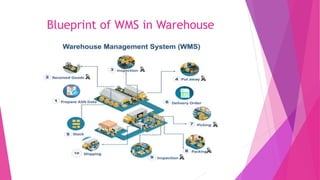
Blueprint of WMS in Warehouse
How WMS blueprint is used in Warehouse
Operations?
The complexity of a WMS implementation varies with each business. The physical
dimensions and characteristics of each item to be stored in the warehouse should be
collected and entered into the new system. Capacity calculations require the physical
size and weight of the stored item, as well as the dimensions of all the storage bins or
racks in the warehouse. The storage options for each item are required, for example, if
the item can be stored separately, in a box, pallet, or if it can be stacked. Each item
must be reviewed to see if it has physical limitations on its storage, such as requiring
refrigeration.
 Hazardous material information needs to be collected so that the item is not stored
in certain areas. This information is only part of the requirements of the WMS
implementation. The system requires decisions on the configuration to be made on
how items are to be placed or removed from the system, in what order, for what
types of materials, and what methods of placement and removal should be used.
 The implementation requires significant input from the resources that operate the
warehouse on a day-to-day basis and this can be a strain on warehouse operations.
A successful project will recognize this fact and ensure that the key personnel
required for the implementation are given adequate back up so that warehouse
operations do not suffer.

Fed ex warehousing overview

  • 1.
    FedEx Supply chain PRESENTEDBY:- SAVVYASACHIN VARMA
  • 2.
    WHAT IS FedEx?  FedEx Corporation, formerly Federal Express Corporation and later FDX Corporation, is an American multinational conglomerate holding company which focuses on transportation e-commerce and business services which is headquartered in Memphis, Tennessee The name "FedEx" is a syllabic abbreviation of the name of the company's original air division, Federal Express, which was used from 1973 until 2000.  Connecting people with goods, services, ideas and technologies creates opportunities that fuel innovation, energize businesses and lift communities to higher standards of living. At FedEx, we believe that a connected world is a better world, and that belief guides everything we do.
  • 3.
    CENTRALIZED WAREHOUSE  -Acommon advantage of centralized warehousing is the reduction of operating costs. By choosing to centralize your distribution centers, the need to pay rent and utilities is reduced drastically. These reduced costs can also allow you to set easier pricing strategies due to the stable nature of inventory management, allowing for higher margins, lower prices, or both. -Another big upside to centralized warehousing is the ability to provide better customer service. By limiting your number of warehouses or distributors, you can focus on bringing in skilled workers, the best equipment around, and a better and more focused way to respond to customer requests and inquiries. -However, the approach isn’t perfect. A big drawback to centralizing your distribution is increased shipping costs. Particularly with rush deliveries or long-term inventory shipments, centralized locations can increase the cost of shipping to certain parts of your market, which may translate to higher costs for the consumer – and in this age of increased demand for consumer convenience, shipping costs can be the clincher for making or breaking a sale.
  • 4.
    D-CENTRALIZED WAREHOUSE  -Oneof the biggest advantages of decentralizing your shipping and receiving is a reduction in delay of material handling. Wherever your products are coming from, having a connected network of warehouses and supply facilities will allow you to receive products more quickly and get them out to your customers more quickly. -Another reason managers turn to decentralized warehouses is the increased ability to store products. This can come in handy a number of ways; you can store a higher volume of the same products to keep up with demand, or you can stock a wider range of products to better meet the needs of your customers, all while avoiding the concerns of taking up more space on your wire shelving or storage solutions with products that might not sell as fast as others. -Of course, the biggest problem with decentralizing your warehousing is one of the most obvious issues: increased operating costs. Even with all the benefits in stocking and shipping that this approach brings, the fact of the matter is you’re still faced with the costs of owning/renting, maintaining, and outfitting more than one warehouse, which can begin to add up after a while.
  • 5.
    Centralized Versus Decentralized warehousingFedEx analysis  If a warehousing strategy it used, someone has to decide whether to select a centralized or a decentralized system. In centralized warehousing, a single warehouse serves the whole market, while in decentralized warehousing the market is divided into different zones. It is important to mention that Decentralized warehousing leads to reduce lead times since warehouses are much closer to customers. On the other hand, centralized warehousing is characterized by lower facility costs because of larger economies of scale. So in the case of FedEx it is internationally decentralized warehousing but nationally centralized warehousing because in most of case there is at least one warehouse per country according the map above. Except for the United- states where around seven warehouses are established Besides Inbound transportation costs (from shipper to consignee) are lower in centralized system while outbound transportation costs (from warehouse to consignee are lower in a decentralized system.
  • 6.
    WAREHOUSING STRATEGY OFFEDEX  FedEx regional distribution centers So to be accurate on the analysis we can also talk about a real example that show how the logistics distribution centers of FedEx are great. Indeed FedEx Express has established a network of Distribution Centers in locations across Asia-Pacific specializing in Cross Docking operations*, Service Parts management, and other adapted logistics applications. Cross-docking operations* is a practice in logistics of unloading materials from an incoming semi-trailer truck or railroad car and loading these materials directly into outbound trucks, trailers, or rail cars, with little or no storage in between.  Operations and benefits:-The benefits of these Regional Distribution Centers are first of all the fact that it allow low risk and low cost start up. There is Global warehouse management system maintenance, plus a real supply & delivery chain management at the international scale. Moreover there is a Total Inventory Visibility and at least it’s convenient and reliable.
  • 7.
    Blueprint of WMSin Warehouse
  • 8.
    How WMS blueprintis used in Warehouse Operations? The complexity of a WMS implementation varies with each business. The physical dimensions and characteristics of each item to be stored in the warehouse should be collected and entered into the new system. Capacity calculations require the physical size and weight of the stored item, as well as the dimensions of all the storage bins or racks in the warehouse. The storage options for each item are required, for example, if the item can be stored separately, in a box, pallet, or if it can be stacked. Each item must be reviewed to see if it has physical limitations on its storage, such as requiring refrigeration.  Hazardous material information needs to be collected so that the item is not stored in certain areas. This information is only part of the requirements of the WMS implementation. The system requires decisions on the configuration to be made on how items are to be placed or removed from the system, in what order, for what types of materials, and what methods of placement and removal should be used.  The implementation requires significant input from the resources that operate the warehouse on a day-to-day basis and this can be a strain on warehouse operations. A successful project will recognize this fact and ensure that the key personnel required for the implementation are given adequate back up so that warehouse operations do not suffer.