DR KANHU CHARAN PATRO
M.D, D.N.B[RT], FAROI, MBA, PDCR, CEPC
FEBRUARY 2021 ISSUE/59th VOLUME
FACE BOOK PAGE
ONCOLOGY CARTOON
PHOTOS
CHAPTER WISE
COBALT DISCOVERY- MC MILLAN & SEABORG
16th JAN 2021/ HISTORY
GOOGLE
1. Glenn Theodore Seaborg was an
American chemist whose
involvement in the synthesis,
discovery and investigation of ten
transuranium elements [ Nobel
prize 1951]
2. He was the principal or co-
discoverer of ten elements:
plutonium, americium, curium,
berkelium, californium,
einsteinium, fermium,
mendelevium, nobelium and
element 106, which, while he was
still living, was
named seaborgium in his honor.
BETATRON- DONALD KERST
17th JAN 2021/ HISTORY
GOOGLE
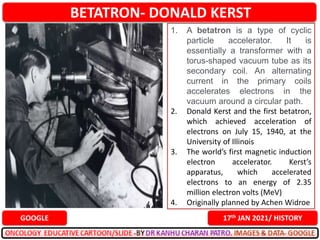
1. A betatron is a type of cyclic
particle accelerator. It is
essentially a transformer with a
torus-shaped vacuum tube as its
secondary coil. An alternating
current in the primary coils
accelerates electrons in the
vacuum around a circular path.
2. Donald Kerst and the first betatron,
which achieved acceleration of
electrons on July 15, 1940, at the
University of Illinois
3. The world’s first magnetic induction
electron accelerator. Kerst’s
apparatus, which accelerated
electrons to an energy of 2.35
million electron volts (MeV)
4. Originally planned by Achen Widroe
SYNCHROTRON- VLADIMIR VEKSLER
18th JAN 2021/ HISTORY
GOOGLE
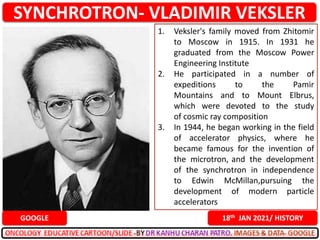
1. Veksler's family moved from Zhitomir
to Moscow in 1915. In 1931 he
graduated from the Moscow Power
Engineering Institute
2. He participated in a number of
expeditions to the Pamir
Mountains and to Mount Elbrus,
which were devoted to the study
of cosmic ray composition
3. In 1944, he began working in the field
of accelerator physics, where he
became famous for the invention of
the microtron, and the development
of the synchrotron in independence
to Edwin McMillan,pursuing the
development of modern particle
accelerators
COBALT MACHINE - HAROLD E. JOHNS
19th JAN 2021/ HISTORY
GOOGLE
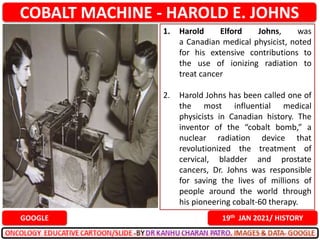
1. Harold Elford Johns, was
a Canadian medical physicist, noted
for his extensive contributions to
the use of ionizing radiation to
treat cancer
2. Harold Johns has been called one of
the most influential medical
physicists in Canadian history. The
inventor of the “cobalt bomb,” a
nuclear radiation device that
revolutionized the treatment of
cervical, bladder and prostate
cancers, Dr. Johns was responsible
for saving the lives of millions of
people around the world through
his pioneering cobalt-60 therapy.
Linear accelerator- Dr. Henry Kaplan
20th JAN 2021/ HISTORY
GOOGLE
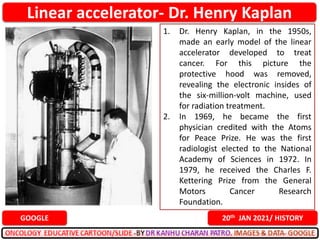
1. Dr. Henry Kaplan, in the 1950s,
made an early model of the linear
accelerator developed to treat
cancer. For this picture the
protective hood was removed,
revealing the electronic insides of
the six-million-volt machine, used
for radiation treatment.
2. In 1969, he became the first
physician credited with the Atoms
for Peace Prize. He was the first
radiologist elected to the National
Academy of Sciences in 1972. In
1979, he received the Charles F.
Kettering Prize from the General
Motors Cancer Research
Foundation.
FIRST TREATMENT ON LINAC- GORDON ISAACS
21st JAN 2021/HISTORY
GOOGLE
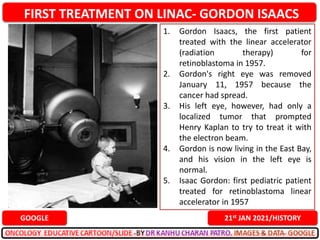
1. Gordon Isaacs, the first patient
treated with the linear accelerator
(radiation therapy) for
retinoblastoma in 1957.
2. Gordon's right eye was removed
January 11, 1957 because the
cancer had spread.
3. His left eye, however, had only a
localized tumor that prompted
Henry Kaplan to try to treat it with
the electron beam.
4. Gordon is now living in the East Bay,
and his vision in the left eye is
normal.
5. Isaac Gordon: first pediatric patient
treated for retinoblastoma linear
accelerator in 1957
The first commercial treatment planning computers
22nd JAN 2021/HISTORY
Radhe Mohan/THERAPEUTIC RADIOLOGY/1974
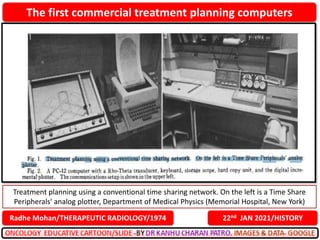
Treatment planning using a conventional time sharing network. On the left is a Time Share
Peripherals' analog plotter, Department of Medical Physics (Memorial Hospital, New York)
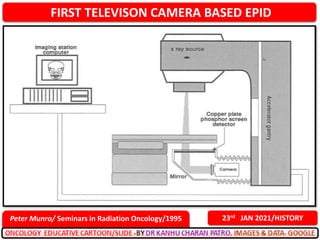
FIRST TELEVISON CAMERA BASED EPID
Peter Munro/ Seminars in Radiation Oncology/1995 23rd JAN 2021/HISTORY
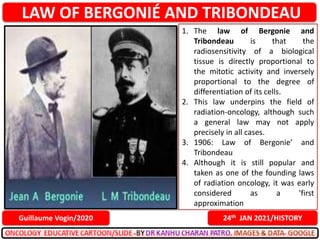
LAW OF BERGONIÉ AND TRIBONDEAU
24th JAN 2021/HISTORY
Guillaume Vogin/2020
1. The law of Bergonie and
Tribondeau is that the
radiosensitivity of a biological
tissue is directly proportional to
the mitotic activity and inversely
proportional to the degree of
differentiation of its cells.
2. This law underpins the field of
radiation-oncology, although such
a general law may not apply
precisely in all cases.
3. 1906: Law of Bergonie’ and
Tribondeau
4. Although it is still popular and
taken as one of the founding laws
of radiation oncology, it was early
considered as a 'first
approximation
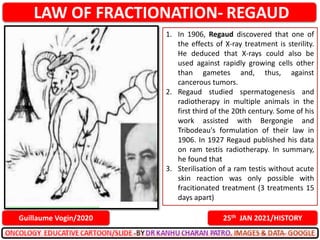
LAW OF FRACTIONATION- REGAUD
25th JAN 2021/HISTORY
Guillaume Vogin/2020
1. In 1906, Regaud discovered that one of
the effects of X-ray treatment is sterility.
He deduced that X-rays could also be
used against rapidly growing cells other
than gametes and, thus, against
cancerous tumors.
2. Regaud studied spermatogenesis and
radiotherapy in multiple animals in the
first third of the 20th century. Some of his
work assisted with Bergongie and
Tribodeau's formulation of their law in
1906. In 1927 Regaud published his data
on ram testis radiotherapy. In summary,
he found that
3. Sterilisation of a ram testis without acute
skin reaction was only possible with
fracitionated treatment (3 treatments 15
days apart)
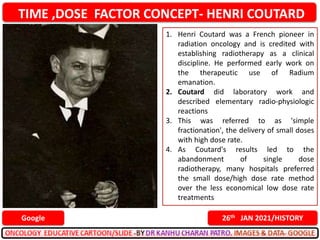
TIME ,DOSE FACTOR CONCEPT- HENRI COUTARD
26th JAN 2021/HISTORY
1. Henri Coutard was a French pioneer in
radiation oncology and is credited with
establishing radiotherapy as a clinical
discipline. He performed early work on
the therapeutic use of Radium
emanation.
2. Coutard did laboratory work and
described elementary radio-physiologic
reactions
3. This was referred to as 'simple
fractionation', the delivery of small doses
with high dose rate.
4. As Coutard's results led to the
abandonment of single dose
radiotherapy, many hospitals preferred
the small dose/high dose rate method
over the less economical low dose rate
treatments
Google
Most Famous Cancer Researchers in the World
27th JAN 2021/HISTORY
WIKIPEDIA
1. CLARENCE COOK LITTLE (1888-1971), GENETICIST
2. EDGAR ALLEN (1892-1943), PHYSIOLOGIST
3. HOWARD BANCROFT ANDERVONT (1898-1981), BIOLOGIST
4. MADGE THURLOW MACKLIN (1893-1962), GENETICIST,
5. LEIV KREYBERG (1896-1984), PHYSICIAN,
6. GIOACCHINO FAILLA (1891- 961), BIOPHYSICIST,
7. HENRI COUTARD (1876-1950), RADIATION ONCOLOGIST [ LEFT TO RIGHT]
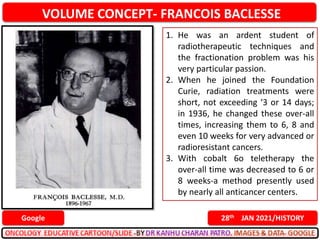
VOLUME CONCEPT- FRANCOIS BACLESSE
28th JAN 2021/HISTORY
Google
1. He was an ardent student of
radiotherapeutic techniques and
the fractionation problem was his
very particular passion.
2. When he joined the Foundation
Curie, radiation treatments were
short, not exceeding ‘3 or 14 days;
in 1936, he changed these over-all
times, increasing them to 6, 8 and
even 10 weeks for very advanced or
radioresistant cancers.
3. With cobalt 6o teletherapy the
over-all time was decreased to 6 or
8 weeks-a method presently used
by nearly all anticancer centers.
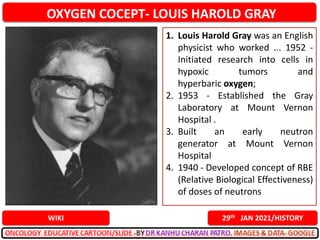
OXYGEN COCEPT- LOUIS HAROLD GRAY
29th JAN 2021/HISTORY
WIKI
1. Louis Harold Gray was an English
physicist who worked ... 1952 -
Initiated research into cells in
hypoxic tumors and
hyperbaric oxygen;
2. 1953 - Established the Gray
Laboratory at Mount Vernon
Hospital .
3. Built an early neutron
generator at Mount Vernon
Hospital
4. 1940 - Developed concept of RBE
(Relative Biological Effectiveness)
of doses of neutrons
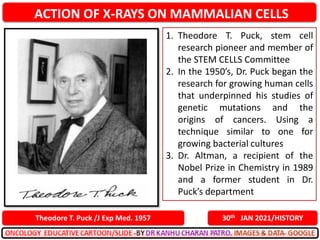
ACTION OF X-RAYS ON MAMMALIAN CELLS
30th JAN 2021/HISTORY
Theodore T. Puck /J Exp Med. 1957
1. Theodore T. Puck, stem cell
research pioneer and member of
the STEM CELLS Committee
2. In the 1950’s, Dr. Puck began the
research for growing human cells
that underpinned his studies of
genetic mutations and the
origins of cancers. Using a
technique similar to one for
growing bacterial cultures
3. Dr. Altman, a recipient of the
Nobel Prize in Chemistry in 1989
and a former student in Dr.
Puck’s department
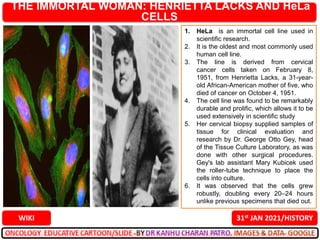
THE IMMORTAL WOMAN: HENRIETTA LACKS AND HeLa
CELLS
31st JAN 2021/HISTORY
WIKI
1. HeLa is an immortal cell line used in
scientific research.
2. It is the oldest and most commonly used
human cell line.
3. The line is derived from cervical
cancer cells taken on February 8,
1951, from Henrietta Lacks, a 31-year-
old African-American mother of five, who
died of cancer on October 4, 1951.
4. The cell line was found to be remarkably
durable and prolific, which allows it to be
used extensively in scientific study
5. Her cervical biopsy supplied samples of
tissue for clinical evaluation and
research by Dr. George Otto Gey, head
of the Tissue Culture Laboratory, as was
done with other surgical procedures.
Gey's lab assistant Mary Kubicek used
the roller-tube technique to place the
cells into culture.
6. It was observed that the cells grew
robustly, doubling every 20–24 hours
unlike previous specimens that died out.
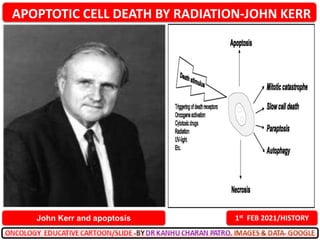
APOPTOTIC CELL DEATH BY RADIATION-JOHN KERR
1st FEB 2021/HISTORY
John Kerr and apoptosis
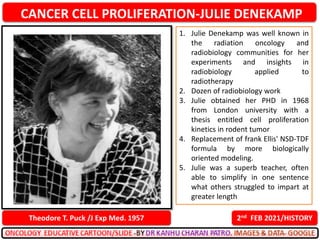
CANCER CELL PROLIFERATION-JULIE DENEKAMP
2nd FEB 2021/HISTORY
Theodore T. Puck /J Exp Med. 1957
1. Julie Denekamp was well known in
the radiation oncology and
radiobiology communities for her
experiments and insights in
radiobiology applied to
radiotherapy
2. Dozen of radiobiology work
3. Julie obtained her PHD in 1968
from London university with a
thesis entitled cell proliferation
kinetics in rodent tumor
4. Replacement of frank Ellis' NSD-TDF
formula by more biologically
oriented modeling.
5. Julie was a superb teacher, often
able to simplify in one sentence
what others struggled to impart at
greater length
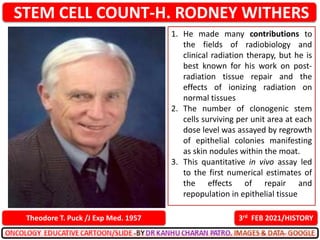
STEM CELL COUNT-H. RODNEY WITHERS
3rd FEB 2021/HISTORY
Theodore T. Puck /J Exp Med. 1957
1. He made many contributions to
the fields of radiobiology and
clinical radiation therapy, but he is
best known for his work on post-
radiation tissue repair and the
effects of ionizing radiation on
normal tissues
2. The number of clonogenic stem
cells surviving per unit area at each
dose level was assayed by regrowth
of epithelial colonies manifesting
as skin nodules within the moat.
3. This quantitative in vivo assay led
to the first numerical estimates of
the effects of repair and
repopulation in epithelial tissue
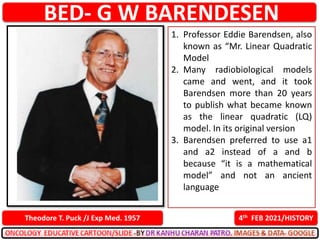
BED- G W BARENDESEN
4th FEB 2021/HISTORY
Theodore T. Puck /J Exp Med. 1957
1. Professor Eddie Barendsen, also
known as “Mr. Linear Quadratic
Model
2. Many radiobiological models
came and went, and it took
Barendsen more than 20 years
to publish what became known
as the linear quadratic (LQ)
model. In its original version
3. Barendsen preferred to use a1
and a2 instead of a and b
because “it is a mathematical
model” and not an ancient
language
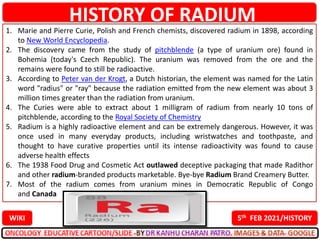
1. Marie and Pierre Curie, Polish and French chemists, discovered radium in 1898, according
to New World Encyclopedia.
2. The discovery came from the study of pitchblende (a type of uranium ore) found in
Bohemia (today's Czech Republic). The uranium was removed from the ore and the
remains were found to still be radioactive.
3. According to Peter van der Krogt, a Dutch historian, the element was named for the Latin
word "radius" or "ray" because the radiation emitted from the new element was about 3
million times greater than the radiation from uranium.
4. The Curies were able to extract about 1 milligram of radium from nearly 10 tons of
pitchblende, according to the Royal Society of Chemistry
5. Radium is a highly radioactive element and can be extremely dangerous. However, it was
once used in many everyday products, including wristwatches and toothpaste, and
thought to have curative properties until its intense radioactivity was found to cause
adverse health effects
6. The 1938 Food Drug and Cosmetic Act outlawed deceptive packaging that made Radithor
and other radium-branded products marketable. Bye-bye Radium Brand Creamery Butter.
7. Most of the radium comes from uranium mines in Democratic Republic of Congo
and Canada
HISTORY OF RADIUM
5th FEB 2021/HISTORY
WIKI
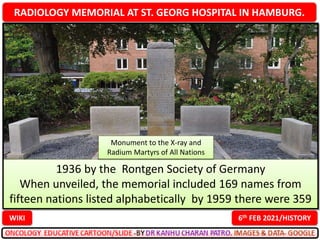
RADIOLOGY MEMORIAL AT ST. GEORG HOSPITAL IN HAMBURG.
6th FEB 2021/HISTORY
WIKI
1936 by the Rontgen Society of Germany
When unveiled, the memorial included 169 names from
fifteen nations listed alphabetically by 1959 there were 359
Monument to the X-ray and
Radium Martyrs of All Nations
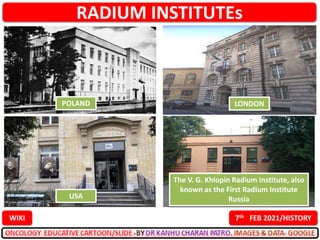
RADIUM INSTITUTEs
7th FEB 2021/HISTORY
WIKI
POLAND
USA
LONDON
The V. G. Khlopin Radium Institute, also
known as the First Radium Institute
Russia
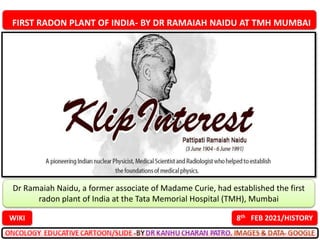
FIRST RADON PLANT OF INDIA- BY DR RAMAIAH NAIDU AT TMH MUMBAI
8th FEB 2021/HISTORY
WIKI
Dr Ramaiah Naidu, a former associate of Madame Curie, had established the first
radon plant of India at the Tata Memorial Hospital (TMH), Mumbai
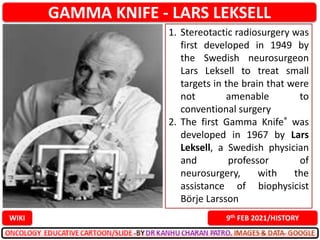
GAMMA KNIFE - LARS LEKSELL
9th FEB 2021/HISTORY
WIKI
1. Stereotactic radiosurgery was
first developed in 1949 by
the Swedish neurosurgeon
Lars Leksell to treat small
targets in the brain that were
not amenable to
conventional surgery
2. The first Gamma Knife® was
developed in 1967 by Lars
Leksell, a Swedish physician
and professor of
neurosurgery, with the
assistance of biophysicist
Börje Larsson
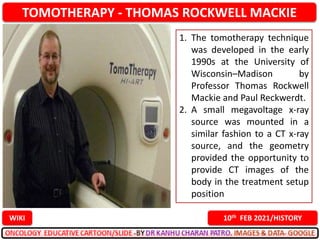
TOMOTHERAPY - THOMAS ROCKWELL MACKIE
10th FEB 2021/HISTORY
WIKI
1. The tomotherapy technique
was developed in the early
1990s at the University of
Wisconsin–Madison by
Professor Thomas Rockwell
Mackie and Paul Reckwerdt.
2. A small megavoltage x-ray
source was mounted in a
similar fashion to a CT x-ray
source, and the geometry
provided the opportunity to
provide CT images of the
body in the treatment setup
position
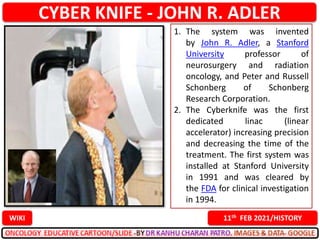
CYBER KNIFE - JOHN R. ADLER
11th FEB 2021/HISTORY
WIKI
1. The system was invented
by John R. Adler, a Stanford
University professor of
neurosurgery and radiation
oncology, and Peter and Russell
Schonberg of Schonberg
Research Corporation.
2. The Cyberknife was the first
dedicated linac (linear
accelerator) increasing precision
and decreasing the time of the
treatment. The first system was
installed at Stanford University
in 1991 and was cleared by
the FDA for clinical investigation
in 1994.
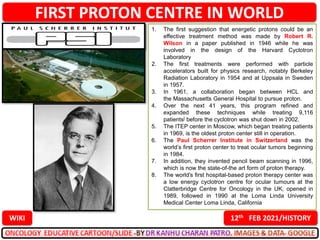
FIRST PROTON CENTRE IN WORLD
12th FEB 2021/HISTORY
WIKI
1. The first suggestion that energetic protons could be an
effective treatment method was made by Robert R.
Wilson in a paper published in 1946 while he was
involved in the design of the Harvard Cyclotron
Laboratory
2. The first treatments were performed with particle
accelerators built for physics research, notably Berkeley
Radiation Laboratory in 1954 and at Uppsala in Sweden
in 1957.
3. In 1961, a collaboration began between HCL and
the Massachusetts General Hospital to pursue proton.
4. Over the next 41 years, this program refined and
expanded these techniques while treating 9,116
patients[ before the cyclotron was shut down in 2002.
5. The ITEP center in Moscow, which began treating patients
in 1969, is the oldest proton center still in operation.
6. The Paul Scherrer Institute in Switzerland was the
world’s first proton center to treat ocular tumors beginning
in 1984.
7. In addition, they invented pencil beam scanning in 1996,
which is now the state-of-the art form of proton therapy.
8. The world's first hospital-based proton therapy center was
a low energy cyclotron centre for ocular tumours at the
Clatterbridge Centre for Oncology in the UK, opened in
1989, followed in 1990 at the Loma Linda University
Medical Center Loma Linda, California
FIRST CARBON ION CENTRE IN WORLD
13th FEB 2021/HISTORY
WIKI
1. The therapeutic advantages of
particle radiotherapy were first
recognized by Robert Wilson in the
1940s .
2. Since that time, particle therapy has
enjoyed a rapid growth, with centers
across the world treating with
protons and other heavy ions,
including carbon ions.
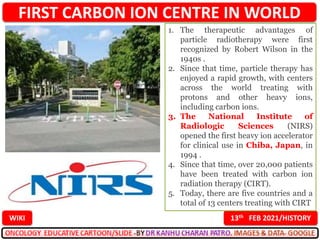
3. The National Institute of
Radiologic Sciences (NIRS)
opened the first heavy ion accelerator
for clinical use in Chiba, Japan, in
1994 .
4. Since that time, over 20,000 patients
have been treated with carbon ion
radiation therapy (CIRT).
5. Today, there are five countries and a
total of 13 centers treating with CIRT
FIRST NEUTRON THERAPY CENTER IN WORLD
14th FEB 2021/HISTORY
WIKI
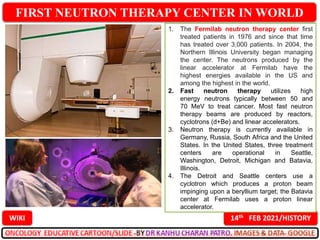
1. The Fermilab neutron therapy center first
treated patients in 1976 and since that time
has treated over 3,000 patients. In 2004, the
Northern Illinois University began managing
the center. The neutrons produced by the
linear accelerator at Fermilab have the
highest energies available in the US and
among the highest in the world.
2. Fast neutron therapy utilizes high
energy neutrons typically between 50 and
70 MeV to treat cancer. Most fast neutron
therapy beams are produced by reactors,
cyclotrons (d+Be) and linear accelerators.
3. Neutron therapy is currently available in
Germany, Russia, South Africa and the United
States. In the United States, three treatment
centers are operational in Seattle,
Washington, Detroit, Michigan and Batavia,
Illinois.
4. The Detroit and Seattle centers use a
cyclotron which produces a proton beam
impinging upon a beryllium target; the Batavia
center at Fermilab uses a proton linear
accelerator.
February 2021 ONCOLOGY CARTOON

February 2021 ONCOLOGY CARTOON

  • 1.
    DR KANHU CHARANPATRO M.D, D.N.B[RT], FAROI, MBA, PDCR, CEPC FEBRUARY 2021 ISSUE/59th VOLUME FACE BOOK PAGE ONCOLOGY CARTOON PHOTOS CHAPTER WISE
  • 4.
    COBALT DISCOVERY- MCMILLAN & SEABORG 16th JAN 2021/ HISTORY GOOGLE 1. Glenn Theodore Seaborg was an American chemist whose involvement in the synthesis, discovery and investigation of ten transuranium elements [ Nobel prize 1951] 2. He was the principal or co- discoverer of ten elements: plutonium, americium, curium, berkelium, californium, einsteinium, fermium, mendelevium, nobelium and element 106, which, while he was still living, was named seaborgium in his honor.
  • 5.
    BETATRON- DONALD KERST 17thJAN 2021/ HISTORY GOOGLE 1. A betatron is a type of cyclic particle accelerator. It is essentially a transformer with a torus-shaped vacuum tube as its secondary coil. An alternating current in the primary coils accelerates electrons in the vacuum around a circular path. 2. Donald Kerst and the first betatron, which achieved acceleration of electrons on July 15, 1940, at the University of Illinois 3. The world’s first magnetic induction electron accelerator. Kerst’s apparatus, which accelerated electrons to an energy of 2.35 million electron volts (MeV) 4. Originally planned by Achen Widroe
  • 6.
    SYNCHROTRON- VLADIMIR VEKSLER 18thJAN 2021/ HISTORY GOOGLE 1. Veksler's family moved from Zhitomir to Moscow in 1915. In 1931 he graduated from the Moscow Power Engineering Institute 2. He participated in a number of expeditions to the Pamir Mountains and to Mount Elbrus, which were devoted to the study of cosmic ray composition 3. In 1944, he began working in the field of accelerator physics, where he became famous for the invention of the microtron, and the development of the synchrotron in independence to Edwin McMillan,pursuing the development of modern particle accelerators
  • 7.
    COBALT MACHINE -HAROLD E. JOHNS 19th JAN 2021/ HISTORY GOOGLE 1. Harold Elford Johns, was a Canadian medical physicist, noted for his extensive contributions to the use of ionizing radiation to treat cancer 2. Harold Johns has been called one of the most influential medical physicists in Canadian history. The inventor of the “cobalt bomb,” a nuclear radiation device that revolutionized the treatment of cervical, bladder and prostate cancers, Dr. Johns was responsible for saving the lives of millions of people around the world through his pioneering cobalt-60 therapy.
  • 8.
    Linear accelerator- Dr.Henry Kaplan 20th JAN 2021/ HISTORY GOOGLE 1. Dr. Henry Kaplan, in the 1950s, made an early model of the linear accelerator developed to treat cancer. For this picture the protective hood was removed, revealing the electronic insides of the six-million-volt machine, used for radiation treatment. 2. In 1969, he became the first physician credited with the Atoms for Peace Prize. He was the first radiologist elected to the National Academy of Sciences in 1972. In 1979, he received the Charles F. Kettering Prize from the General Motors Cancer Research Foundation.
  • 9.
    FIRST TREATMENT ONLINAC- GORDON ISAACS 21st JAN 2021/HISTORY GOOGLE 1. Gordon Isaacs, the first patient treated with the linear accelerator (radiation therapy) for retinoblastoma in 1957. 2. Gordon's right eye was removed January 11, 1957 because the cancer had spread. 3. His left eye, however, had only a localized tumor that prompted Henry Kaplan to try to treat it with the electron beam. 4. Gordon is now living in the East Bay, and his vision in the left eye is normal. 5. Isaac Gordon: first pediatric patient treated for retinoblastoma linear accelerator in 1957
  • 10.
    The first commercialtreatment planning computers 22nd JAN 2021/HISTORY Radhe Mohan/THERAPEUTIC RADIOLOGY/1974 Treatment planning using a conventional time sharing network. On the left is a Time Share Peripherals' analog plotter, Department of Medical Physics (Memorial Hospital, New York)
  • 11.
    FIRST TELEVISON CAMERABASED EPID Peter Munro/ Seminars in Radiation Oncology/1995 23rd JAN 2021/HISTORY
  • 12.
    LAW OF BERGONIÉAND TRIBONDEAU 24th JAN 2021/HISTORY Guillaume Vogin/2020 1. The law of Bergonie and Tribondeau is that the radiosensitivity of a biological tissue is directly proportional to the mitotic activity and inversely proportional to the degree of differentiation of its cells. 2. This law underpins the field of radiation-oncology, although such a general law may not apply precisely in all cases. 3. 1906: Law of Bergonie’ and Tribondeau 4. Although it is still popular and taken as one of the founding laws of radiation oncology, it was early considered as a 'first approximation
  • 13.
    LAW OF FRACTIONATION-REGAUD 25th JAN 2021/HISTORY Guillaume Vogin/2020 1. In 1906, Regaud discovered that one of the effects of X-ray treatment is sterility. He deduced that X-rays could also be used against rapidly growing cells other than gametes and, thus, against cancerous tumors. 2. Regaud studied spermatogenesis and radiotherapy in multiple animals in the first third of the 20th century. Some of his work assisted with Bergongie and Tribodeau's formulation of their law in 1906. In 1927 Regaud published his data on ram testis radiotherapy. In summary, he found that 3. Sterilisation of a ram testis without acute skin reaction was only possible with fracitionated treatment (3 treatments 15 days apart)
  • 14.
    TIME ,DOSE FACTORCONCEPT- HENRI COUTARD 26th JAN 2021/HISTORY 1. Henri Coutard was a French pioneer in radiation oncology and is credited with establishing radiotherapy as a clinical discipline. He performed early work on the therapeutic use of Radium emanation. 2. Coutard did laboratory work and described elementary radio-physiologic reactions 3. This was referred to as 'simple fractionation', the delivery of small doses with high dose rate. 4. As Coutard's results led to the abandonment of single dose radiotherapy, many hospitals preferred the small dose/high dose rate method over the less economical low dose rate treatments Google
  • 15.
    Most Famous CancerResearchers in the World 27th JAN 2021/HISTORY WIKIPEDIA 1. CLARENCE COOK LITTLE (1888-1971), GENETICIST 2. EDGAR ALLEN (1892-1943), PHYSIOLOGIST 3. HOWARD BANCROFT ANDERVONT (1898-1981), BIOLOGIST 4. MADGE THURLOW MACKLIN (1893-1962), GENETICIST, 5. LEIV KREYBERG (1896-1984), PHYSICIAN, 6. GIOACCHINO FAILLA (1891- 961), BIOPHYSICIST, 7. HENRI COUTARD (1876-1950), RADIATION ONCOLOGIST [ LEFT TO RIGHT]
  • 16.
    VOLUME CONCEPT- FRANCOISBACLESSE 28th JAN 2021/HISTORY Google 1. He was an ardent student of radiotherapeutic techniques and the fractionation problem was his very particular passion. 2. When he joined the Foundation Curie, radiation treatments were short, not exceeding ‘3 or 14 days; in 1936, he changed these over-all times, increasing them to 6, 8 and even 10 weeks for very advanced or radioresistant cancers. 3. With cobalt 6o teletherapy the over-all time was decreased to 6 or 8 weeks-a method presently used by nearly all anticancer centers.
  • 17.
    OXYGEN COCEPT- LOUISHAROLD GRAY 29th JAN 2021/HISTORY WIKI 1. Louis Harold Gray was an English physicist who worked ... 1952 - Initiated research into cells in hypoxic tumors and hyperbaric oxygen; 2. 1953 - Established the Gray Laboratory at Mount Vernon Hospital . 3. Built an early neutron generator at Mount Vernon Hospital 4. 1940 - Developed concept of RBE (Relative Biological Effectiveness) of doses of neutrons
  • 18.
    ACTION OF X-RAYSON MAMMALIAN CELLS 30th JAN 2021/HISTORY Theodore T. Puck /J Exp Med. 1957 1. Theodore T. Puck, stem cell research pioneer and member of the STEM CELLS Committee 2. In the 1950’s, Dr. Puck began the research for growing human cells that underpinned his studies of genetic mutations and the origins of cancers. Using a technique similar to one for growing bacterial cultures 3. Dr. Altman, a recipient of the Nobel Prize in Chemistry in 1989 and a former student in Dr. Puck’s department
  • 19.
    THE IMMORTAL WOMAN:HENRIETTA LACKS AND HeLa CELLS 31st JAN 2021/HISTORY WIKI 1. HeLa is an immortal cell line used in scientific research. 2. It is the oldest and most commonly used human cell line. 3. The line is derived from cervical cancer cells taken on February 8, 1951, from Henrietta Lacks, a 31-year- old African-American mother of five, who died of cancer on October 4, 1951. 4. The cell line was found to be remarkably durable and prolific, which allows it to be used extensively in scientific study 5. Her cervical biopsy supplied samples of tissue for clinical evaluation and research by Dr. George Otto Gey, head of the Tissue Culture Laboratory, as was done with other surgical procedures. Gey's lab assistant Mary Kubicek used the roller-tube technique to place the cells into culture. 6. It was observed that the cells grew robustly, doubling every 20–24 hours unlike previous specimens that died out.
  • 20.
    APOPTOTIC CELL DEATHBY RADIATION-JOHN KERR 1st FEB 2021/HISTORY John Kerr and apoptosis
  • 21.
    CANCER CELL PROLIFERATION-JULIEDENEKAMP 2nd FEB 2021/HISTORY Theodore T. Puck /J Exp Med. 1957 1. Julie Denekamp was well known in the radiation oncology and radiobiology communities for her experiments and insights in radiobiology applied to radiotherapy 2. Dozen of radiobiology work 3. Julie obtained her PHD in 1968 from London university with a thesis entitled cell proliferation kinetics in rodent tumor 4. Replacement of frank Ellis' NSD-TDF formula by more biologically oriented modeling. 5. Julie was a superb teacher, often able to simplify in one sentence what others struggled to impart at greater length
  • 22.
    STEM CELL COUNT-H.RODNEY WITHERS 3rd FEB 2021/HISTORY Theodore T. Puck /J Exp Med. 1957 1. He made many contributions to the fields of radiobiology and clinical radiation therapy, but he is best known for his work on post- radiation tissue repair and the effects of ionizing radiation on normal tissues 2. The number of clonogenic stem cells surviving per unit area at each dose level was assayed by regrowth of epithelial colonies manifesting as skin nodules within the moat. 3. This quantitative in vivo assay led to the first numerical estimates of the effects of repair and repopulation in epithelial tissue
  • 23.
    BED- G WBARENDESEN 4th FEB 2021/HISTORY Theodore T. Puck /J Exp Med. 1957 1. Professor Eddie Barendsen, also known as “Mr. Linear Quadratic Model 2. Many radiobiological models came and went, and it took Barendsen more than 20 years to publish what became known as the linear quadratic (LQ) model. In its original version 3. Barendsen preferred to use a1 and a2 instead of a and b because “it is a mathematical model” and not an ancient language
  • 24.
    1. Marie andPierre Curie, Polish and French chemists, discovered radium in 1898, according to New World Encyclopedia. 2. The discovery came from the study of pitchblende (a type of uranium ore) found in Bohemia (today's Czech Republic). The uranium was removed from the ore and the remains were found to still be radioactive. 3. According to Peter van der Krogt, a Dutch historian, the element was named for the Latin word "radius" or "ray" because the radiation emitted from the new element was about 3 million times greater than the radiation from uranium. 4. The Curies were able to extract about 1 milligram of radium from nearly 10 tons of pitchblende, according to the Royal Society of Chemistry 5. Radium is a highly radioactive element and can be extremely dangerous. However, it was once used in many everyday products, including wristwatches and toothpaste, and thought to have curative properties until its intense radioactivity was found to cause adverse health effects 6. The 1938 Food Drug and Cosmetic Act outlawed deceptive packaging that made Radithor and other radium-branded products marketable. Bye-bye Radium Brand Creamery Butter. 7. Most of the radium comes from uranium mines in Democratic Republic of Congo and Canada HISTORY OF RADIUM 5th FEB 2021/HISTORY WIKI
  • 25.
    RADIOLOGY MEMORIAL ATST. GEORG HOSPITAL IN HAMBURG. 6th FEB 2021/HISTORY WIKI 1936 by the Rontgen Society of Germany When unveiled, the memorial included 169 names from fifteen nations listed alphabetically by 1959 there were 359 Monument to the X-ray and Radium Martyrs of All Nations
  • 26.
    RADIUM INSTITUTEs 7th FEB2021/HISTORY WIKI POLAND USA LONDON The V. G. Khlopin Radium Institute, also known as the First Radium Institute Russia
  • 27.
    FIRST RADON PLANTOF INDIA- BY DR RAMAIAH NAIDU AT TMH MUMBAI 8th FEB 2021/HISTORY WIKI Dr Ramaiah Naidu, a former associate of Madame Curie, had established the first radon plant of India at the Tata Memorial Hospital (TMH), Mumbai
  • 28.
    GAMMA KNIFE -LARS LEKSELL 9th FEB 2021/HISTORY WIKI 1. Stereotactic radiosurgery was first developed in 1949 by the Swedish neurosurgeon Lars Leksell to treat small targets in the brain that were not amenable to conventional surgery 2. The first Gamma Knife® was developed in 1967 by Lars Leksell, a Swedish physician and professor of neurosurgery, with the assistance of biophysicist Börje Larsson
  • 29.
    TOMOTHERAPY - THOMASROCKWELL MACKIE 10th FEB 2021/HISTORY WIKI 1. The tomotherapy technique was developed in the early 1990s at the University of Wisconsin–Madison by Professor Thomas Rockwell Mackie and Paul Reckwerdt. 2. A small megavoltage x-ray source was mounted in a similar fashion to a CT x-ray source, and the geometry provided the opportunity to provide CT images of the body in the treatment setup position
  • 30.
    CYBER KNIFE -JOHN R. ADLER 11th FEB 2021/HISTORY WIKI 1. The system was invented by John R. Adler, a Stanford University professor of neurosurgery and radiation oncology, and Peter and Russell Schonberg of Schonberg Research Corporation. 2. The Cyberknife was the first dedicated linac (linear accelerator) increasing precision and decreasing the time of the treatment. The first system was installed at Stanford University in 1991 and was cleared by the FDA for clinical investigation in 1994.
  • 31.
    FIRST PROTON CENTREIN WORLD 12th FEB 2021/HISTORY WIKI 1. The first suggestion that energetic protons could be an effective treatment method was made by Robert R. Wilson in a paper published in 1946 while he was involved in the design of the Harvard Cyclotron Laboratory 2. The first treatments were performed with particle accelerators built for physics research, notably Berkeley Radiation Laboratory in 1954 and at Uppsala in Sweden in 1957. 3. In 1961, a collaboration began between HCL and the Massachusetts General Hospital to pursue proton. 4. Over the next 41 years, this program refined and expanded these techniques while treating 9,116 patients[ before the cyclotron was shut down in 2002. 5. The ITEP center in Moscow, which began treating patients in 1969, is the oldest proton center still in operation. 6. The Paul Scherrer Institute in Switzerland was the world’s first proton center to treat ocular tumors beginning in 1984. 7. In addition, they invented pencil beam scanning in 1996, which is now the state-of-the art form of proton therapy. 8. The world's first hospital-based proton therapy center was a low energy cyclotron centre for ocular tumours at the Clatterbridge Centre for Oncology in the UK, opened in 1989, followed in 1990 at the Loma Linda University Medical Center Loma Linda, California
  • 32.
    FIRST CARBON IONCENTRE IN WORLD 13th FEB 2021/HISTORY WIKI 1. The therapeutic advantages of particle radiotherapy were first recognized by Robert Wilson in the 1940s . 2. Since that time, particle therapy has enjoyed a rapid growth, with centers across the world treating with protons and other heavy ions, including carbon ions. 3. The National Institute of Radiologic Sciences (NIRS) opened the first heavy ion accelerator for clinical use in Chiba, Japan, in 1994 . 4. Since that time, over 20,000 patients have been treated with carbon ion radiation therapy (CIRT). 5. Today, there are five countries and a total of 13 centers treating with CIRT
  • 33.
    FIRST NEUTRON THERAPYCENTER IN WORLD 14th FEB 2021/HISTORY WIKI 1. The Fermilab neutron therapy center first treated patients in 1976 and since that time has treated over 3,000 patients. In 2004, the Northern Illinois University began managing the center. The neutrons produced by the linear accelerator at Fermilab have the highest energies available in the US and among the highest in the world. 2. Fast neutron therapy utilizes high energy neutrons typically between 50 and 70 MeV to treat cancer. Most fast neutron therapy beams are produced by reactors, cyclotrons (d+Be) and linear accelerators. 3. Neutron therapy is currently available in Germany, Russia, South Africa and the United States. In the United States, three treatment centers are operational in Seattle, Washington, Detroit, Michigan and Batavia, Illinois. 4. The Detroit and Seattle centers use a cyclotron which produces a proton beam impinging upon a beryllium target; the Batavia center at Fermilab uses a proton linear accelerator.