Famous Scientists andFamous Scientists and
their contributionstheir contributions
Shara Markose
INTRODUCTIONINTRODUCTION
•Scientist, in a broad sense, is a
person engaging in a systematic
activity to acquire knowledge.
•So many people in this world have
changed the way we live and think,
with their inventions and work.
Here is a list of some of the famous
scientists in history, and a brief
about them.
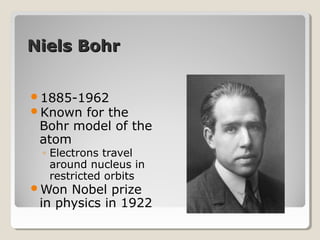
Niels BohrNiels Bohr
1885-1962
Known for the
Bohr model of the
atom
◦ Electrons travel
around nucleus in
restricted orbits
Won Nobel prize
in physics in 1922
Born in Copenhagen in 1885
Researched structure of the atom
First to postulate that electrons travel
around nucleus of atom
Predicted splitting of uranium atoms
Gave lectures, never “boring”
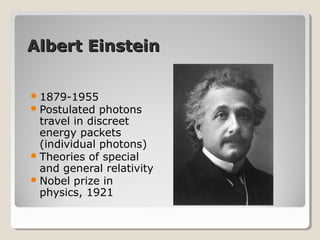
Albert EinsteinAlbert Einstein
1879-1955
Postulated photons
travel in discreet
energy packets
(individual photons)
Theories of special
and general relativity
Nobel prize in
physics, 1921
Born in Württemberg, Germany, 1879
Postulated light travels in individual
photons, 1905
Wrote special theory of relativity 1905
Wrote general theory of relativity 1916
E = mc2
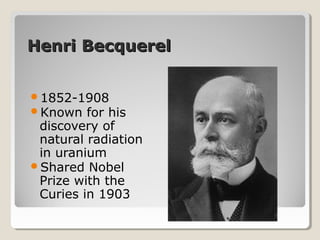
Henri BecquerelHenri Becquerel
1852-1908
Known for his
discovery of
natural radiation
in uranium
Shared Nobel
Prize with the
Curies in 1903
Born 1852 in Paris
Discovered natural radiation in uranium
in 1896
Unit of radiation named after
1 disintigration/second = 1 Bq
“Oh Henry!”
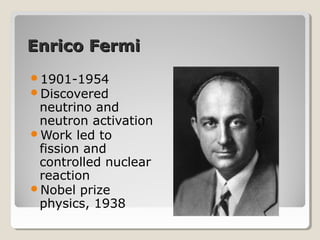
Enrico FermiEnrico Fermi
1901-1954
Discovered
neutrino and
neutron activation
Work led to
fission and
controlled nuclear
reaction
Nobel prize
physics, 1938
Born in Rome, 1901
Contributed to early theory of beta
decay and neutrino
Demonstrated nuclear transformation
with neutrons in elements
Led experiment that performed first
controlled nuclear reaction
Very “fair to me”
Sir Ernest RutherfordSir Ernest Rutherford
1871-1937
Discovered alpha
and beta particles
Discovered
nucleus in 1910
Won Nobel prize
in chemistry,
1908
Born in Nelson, New Zealand, 1871
Discovered alpha and beta particles in
1898
Devised method of counting alpha
particles with H Geiger
Investigations of alpha scattering in
1910 led to the discovery of the nucleus
Knighted in 1914
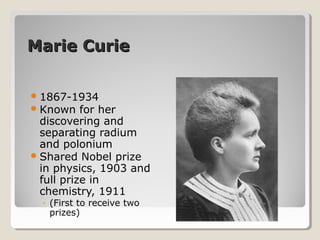
Marie CurieMarie Curie
1867-1934
Known for her
discovering and
separating radium
and polonium
Shared Nobel prize
in physics, 1903 and
full prize in
chemistry, 1911
◦ (First to receive two
prizes)
Born in Warsaw, 1867
Discovered radium and polonium and
developed means to separate it
Refused to patent work for money
Developed unit of radioactivity
◦ 1 Ci = 37,000,000,000 disintigrations/sec
There was no “cure” for her radiation
ConclusionConclusion
The world will always be indebted to these
great individuals, who with their
outstanding work, contributed to mankind
in a way that will never be forgotten. The
list of famous scientists in history could go
on and on, because there are so many other
great scientists that are worth a mention,
but the ones mentioned above are by far
those who cannot be compared with anyone
else. Their work and contribution to this
world is simply unique.
Thank youThank you

Great scientists

  • 1.
    Famous Scientists andFamousScientists and their contributionstheir contributions Shara Markose
  • 2.
    INTRODUCTIONINTRODUCTION •Scientist, in abroad sense, is a person engaging in a systematic activity to acquire knowledge. •So many people in this world have changed the way we live and think, with their inventions and work. Here is a list of some of the famous scientists in history, and a brief about them.
  • 3.
    Niels BohrNiels Bohr 1885-1962 Knownfor the Bohr model of the atom ◦ Electrons travel around nucleus in restricted orbits Won Nobel prize in physics in 1922
  • 4.
    Born in Copenhagenin 1885 Researched structure of the atom First to postulate that electrons travel around nucleus of atom Predicted splitting of uranium atoms Gave lectures, never “boring”
  • 5.
    Albert EinsteinAlbert Einstein 1879-1955 Postulatedphotons travel in discreet energy packets (individual photons) Theories of special and general relativity Nobel prize in physics, 1921
  • 6.
    Born in Württemberg,Germany, 1879 Postulated light travels in individual photons, 1905 Wrote special theory of relativity 1905 Wrote general theory of relativity 1916 E = mc2
  • 7.
    Henri BecquerelHenri Becquerel 1852-1908 Knownfor his discovery of natural radiation in uranium Shared Nobel Prize with the Curies in 1903
  • 8.
    Born 1852 inParis Discovered natural radiation in uranium in 1896 Unit of radiation named after 1 disintigration/second = 1 Bq “Oh Henry!”
  • 9.
    Enrico FermiEnrico Fermi 1901-1954 Discovered neutrinoand neutron activation Work led to fission and controlled nuclear reaction Nobel prize physics, 1938
  • 10.
    Born in Rome,1901 Contributed to early theory of beta decay and neutrino Demonstrated nuclear transformation with neutrons in elements Led experiment that performed first controlled nuclear reaction Very “fair to me”
  • 11.
    Sir Ernest RutherfordSirErnest Rutherford 1871-1937 Discovered alpha and beta particles Discovered nucleus in 1910 Won Nobel prize in chemistry, 1908
  • 12.
    Born in Nelson,New Zealand, 1871 Discovered alpha and beta particles in 1898 Devised method of counting alpha particles with H Geiger Investigations of alpha scattering in 1910 led to the discovery of the nucleus Knighted in 1914
  • 13.
    Marie CurieMarie Curie 1867-1934 Knownfor her discovering and separating radium and polonium Shared Nobel prize in physics, 1903 and full prize in chemistry, 1911 ◦ (First to receive two prizes)
  • 14.
    Born in Warsaw,1867 Discovered radium and polonium and developed means to separate it Refused to patent work for money Developed unit of radioactivity ◦ 1 Ci = 37,000,000,000 disintigrations/sec There was no “cure” for her radiation
  • 15.
    ConclusionConclusion The world willalways be indebted to these great individuals, who with their outstanding work, contributed to mankind in a way that will never be forgotten. The list of famous scientists in history could go on and on, because there are so many other great scientists that are worth a mention, but the ones mentioned above are by far those who cannot be compared with anyone else. Their work and contribution to this world is simply unique.
  • 16.