Feature Engineering & Feature
Selection
Davis David
Data Scientist at ParrotAI
d.david@parrotai.co.tz
CONTENT:
1. Feature Engineering
2. Missing Data
3. Continuous Features
4. Categorical Features
5. Feature Selection
6. Practical Feature Engineering and Selection
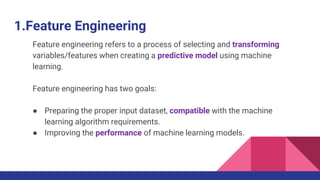
1.Feature Engineering
Feature engineering refers to a process of selecting and transforming
variables/features when creating a predictive model using machine
learning.
Feature engineering has two goals:
● Preparing the proper input dataset, compatible with the machine
learning algorithm requirements.
● Improving the performance of machine learning models.
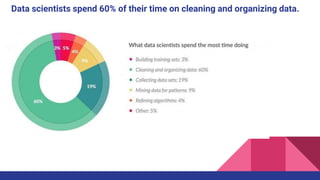
Data scientists spend 60% of their time on cleaning and organizing data.
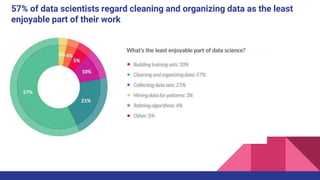
57% of data scientists regard cleaning and organizing data as the least
enjoyable part of their work
“At the end of the day, some machine learning projects succeed
and some fail. What makes the difference? Easily the most
important factor is the features used.”
— Prof. Pedro Domingos from University of Washington
Read his paper here : A few useful things to know about machine learning
2. Missing Data
 Handling missing data is important as many machine learning
algorithms do not support data with missing values.
 Having missing values in the dataset can cause errors and poor
performance with some machine learning algorithms.
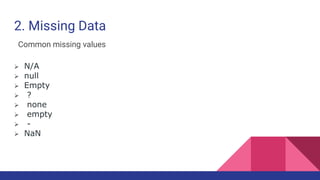
2. Missing Data
Common missing values
 N/A
 null
 Empty
 ?
 none
 empty
 -
 NaN
2. How to handle Missing Values
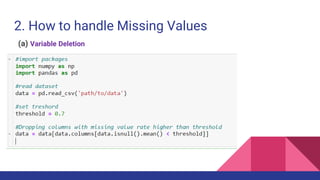
(a) Variable Deletion
Variable deletion involves dropping variables(columns) with missing values on
an case by case basis.
This method makes sense when lot of missing values in a variable and if the
variable is of relatively less importance.
The only case that it may worth deleting a variable is when its missing values
are more than 60% of the observations.
2. How to handle Missing Values
(a) Variable Deletion
2. How to handle Missing Values
(b) Mean or Median Imputation
A common technique is to use the mean or median of the non-missing
observations.
This strategy can be applied on a feature which has numeric data.
2. How to handle Missing Values
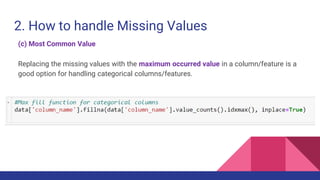
(c) Most Common Value
Replacing the missing values with the maximum occurred value in a column/feature is a
good option for handling categorical columns/features.
3. Continuous Features
● Continuous features in the dataset have different range of values.
● If you train your model with different range of value the model will not
perform well.
Example continuous features: age, salary , prices, heights
Common methods
 Min-Max Normalization
 Standardization
3. Continuous Features
(a) Min-Max Normalization
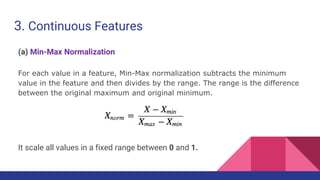
For each value in a feature, Min-Max normalization subtracts the minimum
value in the feature and then divides by the range. The range is the difference
between the original maximum and original minimum.
It scale all values in a fixed range between 0 and 1.
3. Continuous Features
(b) Standardization
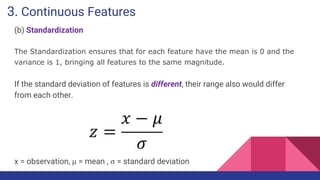
The Standardization ensures that for each feature have the mean is 0 and the
variance is 1, bringing all features to the same magnitude.
If the standard deviation of features is different, their range also would differ
from each other.
x = observation, μ = mean , σ = standard deviation
4.Categorical Features
Categorical features represents types of data which may be divided into groups.
Example: genders, educational levels
Any non-numerical values need to be converted to integers or floats in order to
be utilized in most machine learning libraries.
Common Methods
 one-hot-encoding(Dummy variables)
 Label Encoding
4.Categorical Features
(a) One-hot-encoding
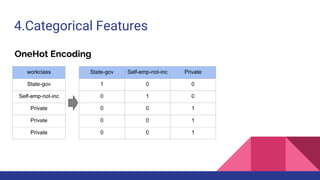
By far the most common way to represent categorical variables is using
the one-hot encoding or one-out-of-N encoding, also known as dummy
variables.
The idea behind dummy variables is to replace a categorical variable
with one or more new features that can have the values 0 and 1.
4.Categorical Features
(b) Label Encoding
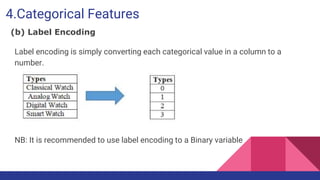
Label encoding is simply converting each categorical value in a column to a
number.
NB: It is recommended to use label encoding to a Binary variable
5.Feature Selection
● Feature Selection is the process where you automatically or manually select
those features which contribute most to your prediction variable or output in
which you are interested in.
● Having irrelevant features in your data can decrease the accuracy of the
models and make your model learn based on irrelevant features..
5.Feature Selection
Top reasons to use feature selection are:
● It enables the machine learning algorithm to train faster.
● It reduces the complexity of a model and makes it easier to interpret.
● It improves the accuracy of a model if the right subset is chosen.
● It reduces overfitting.
5. Feature Selection
“I prepared a model by selecting all the features and I got an accuracy of around 65%
which is not pretty good for a predictive model and after doing some feature
selection and feature engineering without doing any logical changes in my model
code my accuracy jumped to 81% which is quite impressive”
- By Raheel Shaikh
5.Feature Selection
(a) Univariate Selection
● Statistical tests can be used to select those independent features that have
the strongest relationship with the target feature in your dataset.
E.g. Chi squared test
● The scikit-learn library provides the SelectKBest class that can be used with a
suite of different statistical tests to select a specific number of features.
5.Feature Selection
(b) Feature Importance
Feature importance gives you a score for each feature of your data, the higher
the score more important or relevant is the feature towards your target feature.
Feature importance is an inbuilt class that comes with Tree Based Classifiers
Example:
 Random Forest Classifiers
 Extra Tree Classifiers
5. Feature Selection
(c) Correlation Matrix with Heatmap
● Correlation show how the features are related to each other or the target
feature.
● Correlation can be positive (increase in one value of feature increases the
value of the target variable) or negative (increase in one value of feature
decreases the value of the target variable)
Feature enginnering and selection

Feature enginnering and selection

  • 1.
    Feature Engineering &Feature Selection Davis David Data Scientist at ParrotAI d.david@parrotai.co.tz
  • 2.
    CONTENT: 1. Feature Engineering 2.Missing Data 3. Continuous Features 4. Categorical Features 5. Feature Selection 6. Practical Feature Engineering and Selection
  • 3.
    1.Feature Engineering Feature engineeringrefers to a process of selecting and transforming variables/features when creating a predictive model using machine learning. Feature engineering has two goals: ● Preparing the proper input dataset, compatible with the machine learning algorithm requirements. ● Improving the performance of machine learning models.
  • 4.
    Data scientists spend60% of their time on cleaning and organizing data.
  • 5.
    57% of datascientists regard cleaning and organizing data as the least enjoyable part of their work
  • 6.
    “At the endof the day, some machine learning projects succeed and some fail. What makes the difference? Easily the most important factor is the features used.” — Prof. Pedro Domingos from University of Washington Read his paper here : A few useful things to know about machine learning
  • 7.
    2. Missing Data Handling missing data is important as many machine learning algorithms do not support data with missing values.  Having missing values in the dataset can cause errors and poor performance with some machine learning algorithms.
  • 8.
    2. Missing Data Commonmissing values  N/A  null  Empty  ?  none  empty  -  NaN
  • 9.
    2. How tohandle Missing Values (a) Variable Deletion Variable deletion involves dropping variables(columns) with missing values on an case by case basis. This method makes sense when lot of missing values in a variable and if the variable is of relatively less importance. The only case that it may worth deleting a variable is when its missing values are more than 60% of the observations.
  • 10.
    2. How tohandle Missing Values (a) Variable Deletion
  • 11.
    2. How tohandle Missing Values (b) Mean or Median Imputation A common technique is to use the mean or median of the non-missing observations. This strategy can be applied on a feature which has numeric data.
  • 12.
    2. How tohandle Missing Values (c) Most Common Value Replacing the missing values with the maximum occurred value in a column/feature is a good option for handling categorical columns/features.
  • 13.
    3. Continuous Features ●Continuous features in the dataset have different range of values. ● If you train your model with different range of value the model will not perform well. Example continuous features: age, salary , prices, heights Common methods  Min-Max Normalization  Standardization
  • 14.
    3. Continuous Features (a)Min-Max Normalization For each value in a feature, Min-Max normalization subtracts the minimum value in the feature and then divides by the range. The range is the difference between the original maximum and original minimum. It scale all values in a fixed range between 0 and 1.
  • 15.
    3. Continuous Features (b)Standardization The Standardization ensures that for each feature have the mean is 0 and the variance is 1, bringing all features to the same magnitude. If the standard deviation of features is different, their range also would differ from each other. x = observation, μ = mean , σ = standard deviation
  • 16.
    4.Categorical Features Categorical featuresrepresents types of data which may be divided into groups. Example: genders, educational levels Any non-numerical values need to be converted to integers or floats in order to be utilized in most machine learning libraries. Common Methods  one-hot-encoding(Dummy variables)  Label Encoding
  • 17.
    4.Categorical Features (a) One-hot-encoding Byfar the most common way to represent categorical variables is using the one-hot encoding or one-out-of-N encoding, also known as dummy variables. The idea behind dummy variables is to replace a categorical variable with one or more new features that can have the values 0 and 1.
  • 18.
  • 19.
    4.Categorical Features (b) LabelEncoding Label encoding is simply converting each categorical value in a column to a number. NB: It is recommended to use label encoding to a Binary variable
  • 20.
    5.Feature Selection ● FeatureSelection is the process where you automatically or manually select those features which contribute most to your prediction variable or output in which you are interested in. ● Having irrelevant features in your data can decrease the accuracy of the models and make your model learn based on irrelevant features..
  • 21.
    5.Feature Selection Top reasonsto use feature selection are: ● It enables the machine learning algorithm to train faster. ● It reduces the complexity of a model and makes it easier to interpret. ● It improves the accuracy of a model if the right subset is chosen. ● It reduces overfitting.
  • 22.
    5. Feature Selection “Iprepared a model by selecting all the features and I got an accuracy of around 65% which is not pretty good for a predictive model and after doing some feature selection and feature engineering without doing any logical changes in my model code my accuracy jumped to 81% which is quite impressive” - By Raheel Shaikh
  • 23.
    5.Feature Selection (a) UnivariateSelection ● Statistical tests can be used to select those independent features that have the strongest relationship with the target feature in your dataset. E.g. Chi squared test ● The scikit-learn library provides the SelectKBest class that can be used with a suite of different statistical tests to select a specific number of features.
  • 24.
    5.Feature Selection (b) FeatureImportance Feature importance gives you a score for each feature of your data, the higher the score more important or relevant is the feature towards your target feature. Feature importance is an inbuilt class that comes with Tree Based Classifiers Example:  Random Forest Classifiers  Extra Tree Classifiers
  • 25.
    5. Feature Selection (c)Correlation Matrix with Heatmap ● Correlation show how the features are related to each other or the target feature. ● Correlation can be positive (increase in one value of feature increases the value of the target variable) or negative (increase in one value of feature decreases the value of the target variable)