
Feasibility of researching
Dialectical Behaviour Therapy for
    suicidal and self-injuring
           adolescents

Emily Cooney, Kirsten Davis, Pania Thompson, Julie
        Wharewera-Mika & Joanna Stewart
Why do this study?
• Self-harm remains a significant problem for adolescents
  in our country. Despite several trials focussing on
  treatment for self-harm, we don’t really know what works
  for suicidal young people.

• Dialectical Behaviour Therapy (DBT) seems effective for
  adults with chronic suicidality and severe emotional
  instability (Linehan et al, 1991, 1993, 2006, McMain et al.,
  2009, Verheul et al., 2003)

• Field trials evaluating adaptations of DBT for use with
  adolescents suggest that DBT shows promise for young
  people (Goldstein et al., 2007, Katz et al., 2004, Rathus &
  Miller, 2002).
But before we can do a big
study….


      …..we have some big
                questions
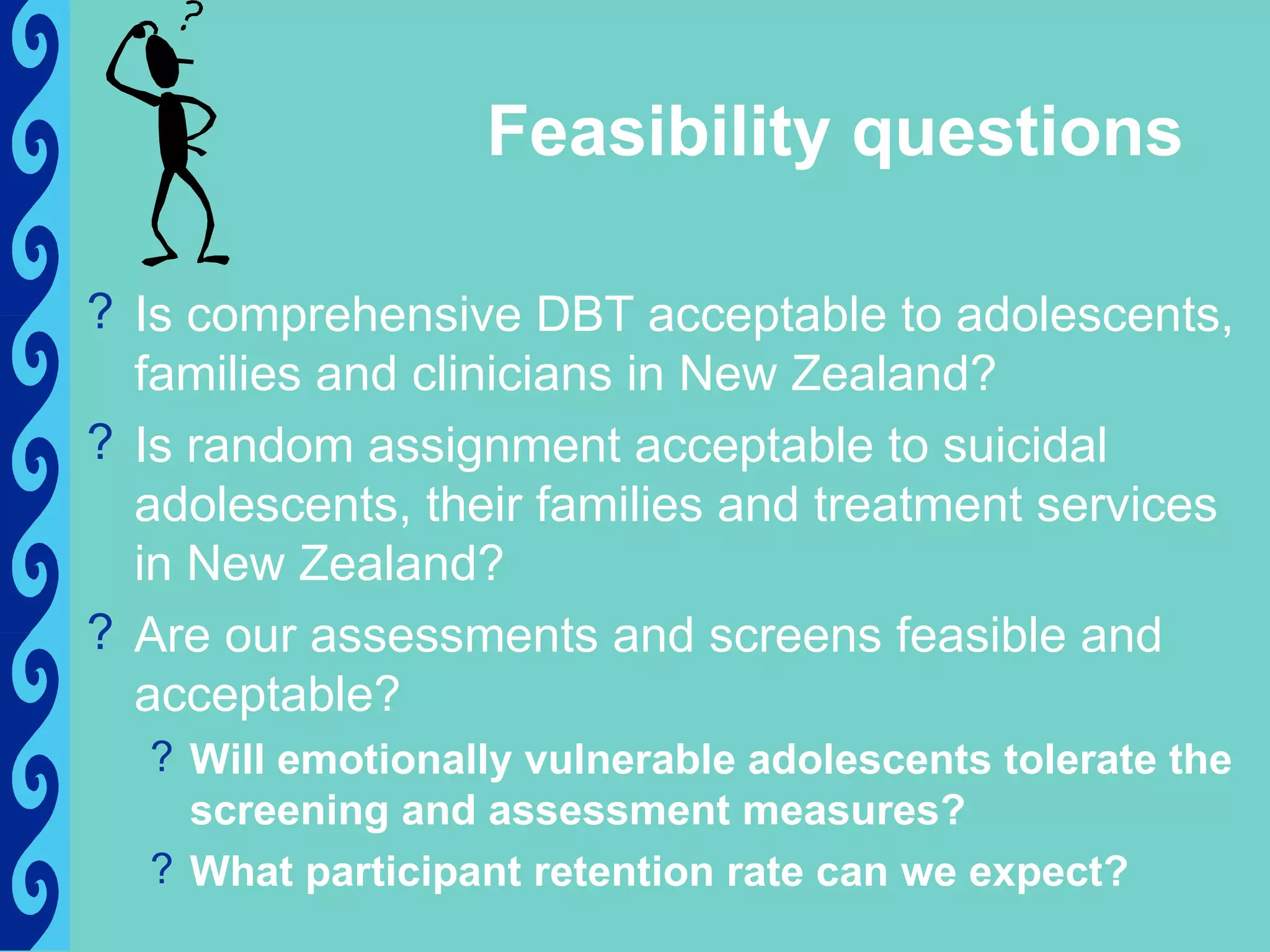
Feasibility questions

? Is comprehensive DBT acceptable to adolescents,
  families and clinicians in New Zealand?
? Is random assignment acceptable to suicidal
  adolescents, their families and treatment services
  in New Zealand?
? Are our assessments and screens feasible and
  acceptable?
  ? Will emotionally vulnerable adolescents tolerate the
    screening and assessment measures?
  ? What participant retention rate can we expect?
Participants
Young people (and their families) seen at
two government-funded community mental
health outpatient services who

– were aged between 13 and 18 years*
– had self-injured or attempted suicide in the
  previous 3 months
– didn’t meet criteria for a psychotic disorder or
  life-threatening Anorexia Nervosa
– didn’t have an intellectual disability
– could speak and read English
We measured
•   Self-harm
•   Suicidal ideation and reasons for living
•   Substance use
•   Emotion Regulation
•   Therapist burnout
DBT
•   Multifamily skills groups
•   Individual therapy
•   24/7 phone consultation
•   Consultation team for therapists
•   Family sessions and parent sessions as
    needed
TAU
• Depended on what the team, therapist and
  family thought would be helpful
• Range of therapy approaches, with
  cognitive-behavioural therapy being the
  most common treatment
• Provided by clinical psychologists, social
  workers, occupational therapists, and
  alcohol & drug counsellors
If needed, participants in both
conditions could access:

• Medication
• Respite care
• Hospital
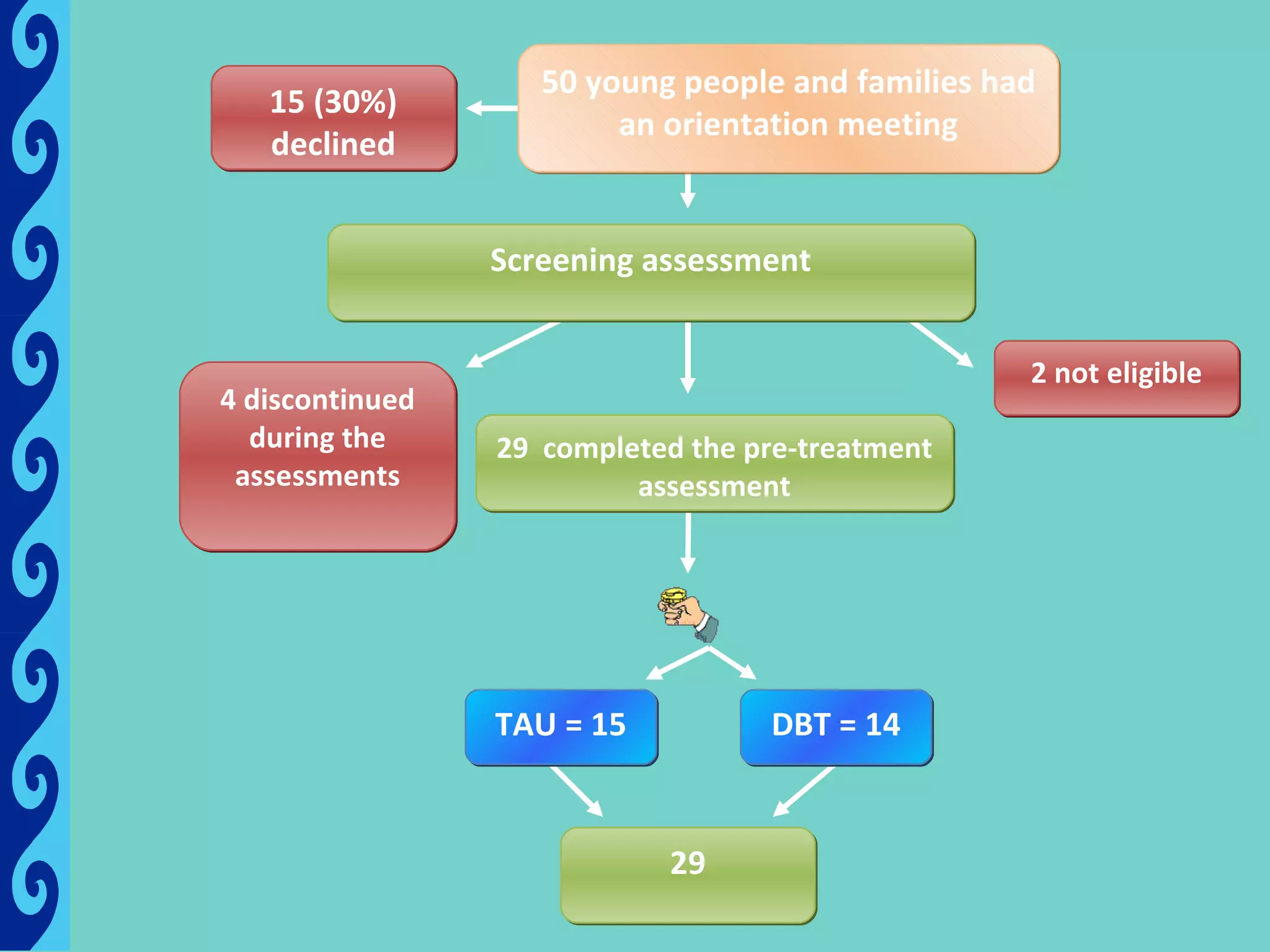
50 young people and families had
   15 (30%)
                         an orientation meeting
   declined


                 Screening assessment


                                                   2 not eligible
4 discontinued
  during the     29 completed the pre-treatment
 assessments              assessment


                 TAU = 15          DBT = 14


                            29
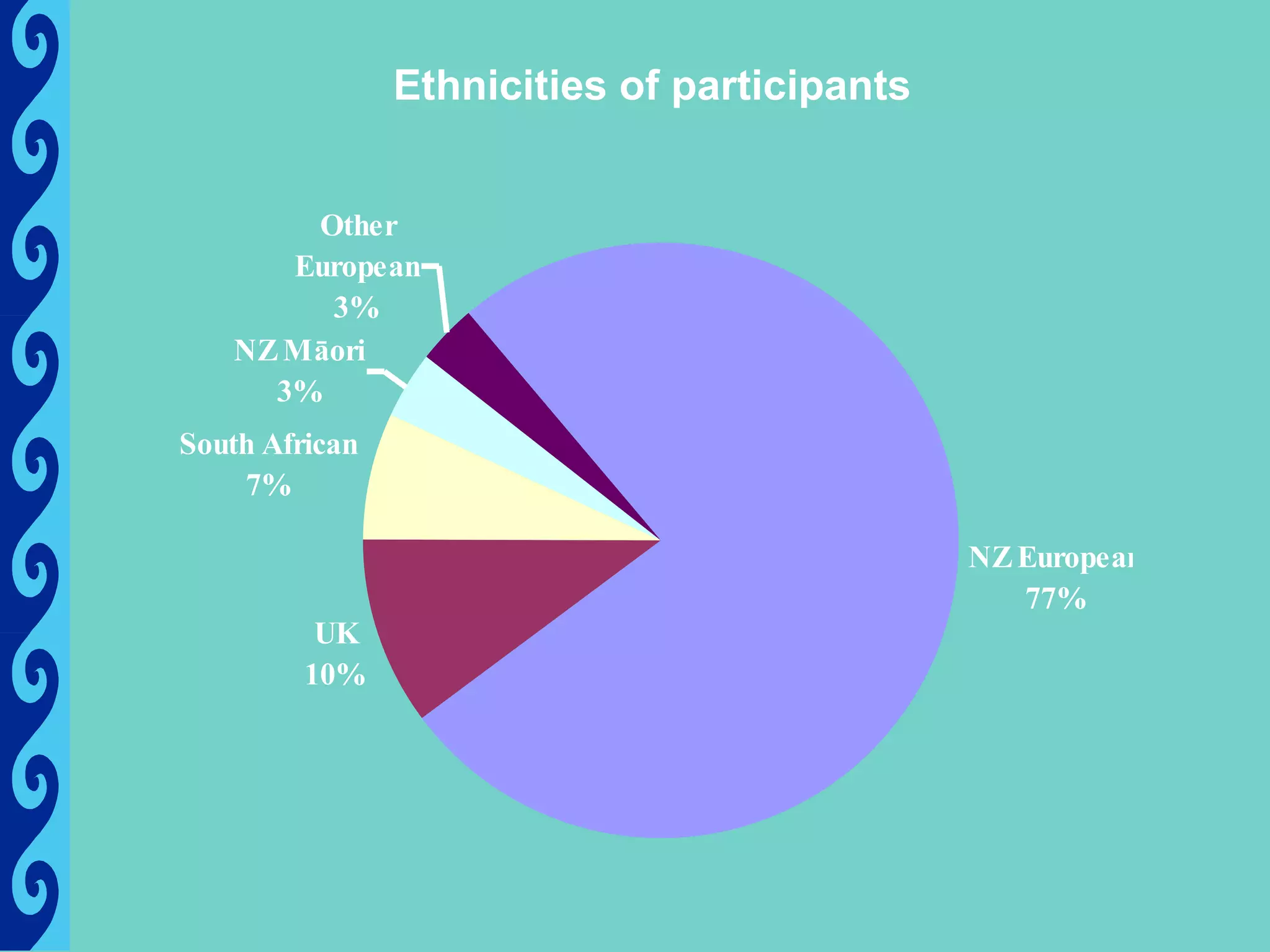
Ethnicities of participants


       Other
      European
        3%
   NZ Māori
     3%
South African
    7%

                                              NZ European
                                                 77%
          UK
         10%
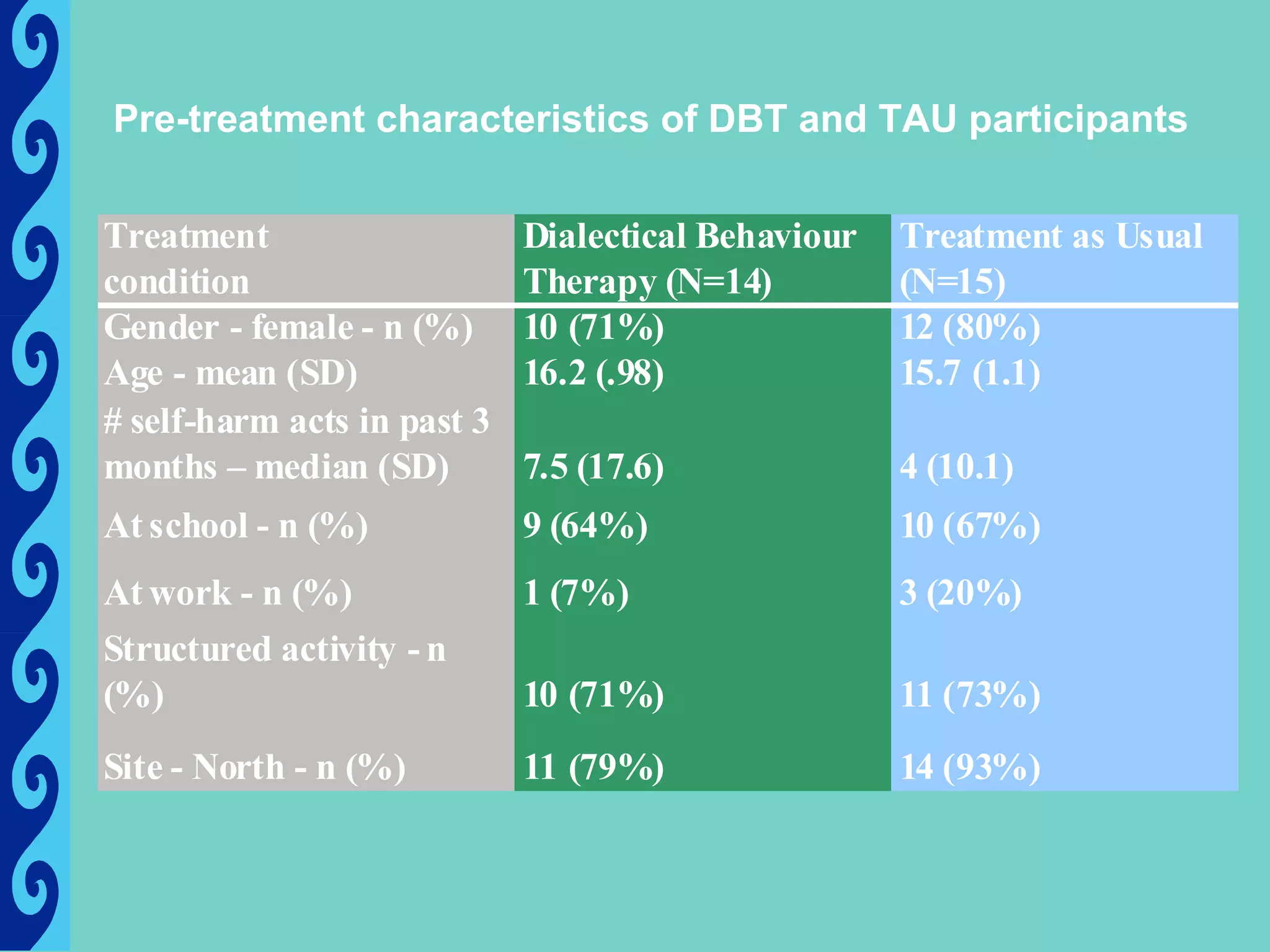
Pre-treatment characteristics of DBT and TAU participants

Treatment                    Dialectical Behaviour   Treatment as Usual
condition                    Therapy (N=14)          (N=15)
Gender - female - n (%)      10 (71%)                12 (80%)
Age - mean (SD)              16.2 (.98)              15.7 (1.1)
# self-harm acts in past 3
months – median (SD)         7.5 (17.6)              4 (10.1)
At school - n (%)            9 (64%)                 10 (67%)
At work - n (%)              1 (7%)                  3 (20%)
Structured activity - n
(%)                          10 (71%)                11 (73%)
Site - North - n (%)         11 (79%)                14 (93%)
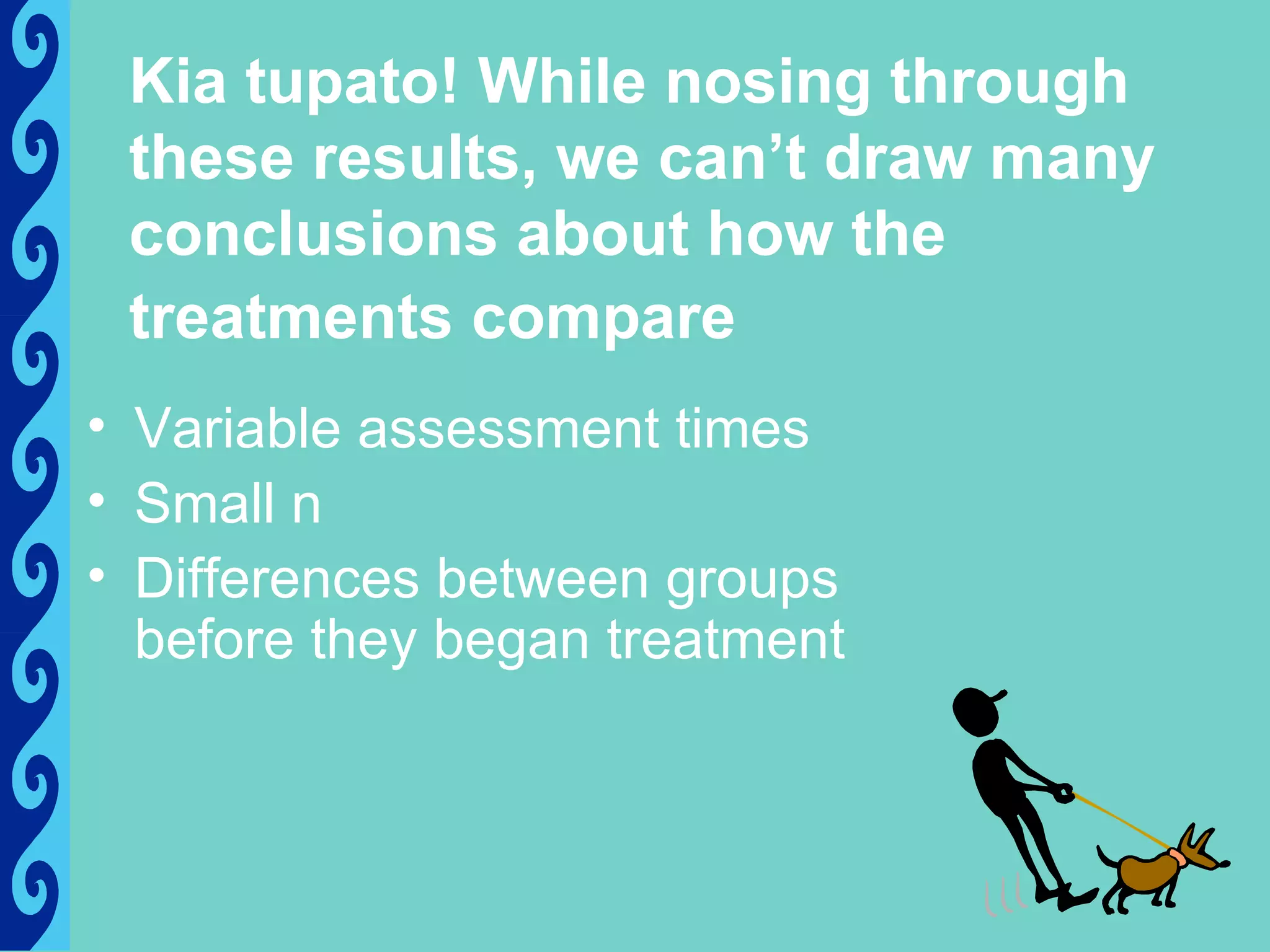
Kia tupato! While nosing through
 these results, we can’t draw many
 conclusions about how the
 treatments compare
• Variable assessment times
• Small n
• Differences between groups
  before they began treatment
Treatment engagement

• 1/14 DBT participants dropped out (4/15
  TAU participants ‘dropped out’)
• The mean percent of sessions missed was
  9% of individual sessions, and 12% of
  group sessions for adolescents in DBT
  (the mean percent of individual sessions
  missed was 29% for TAU participants).
Means and standard deviations of sessions attended and not attended
      across the 6 months following pre-treatment assessment


                                     DBT                     TAU

      Treatment condition            Mean         SD         Mean         SD

      Individual sessions attended         22.6        6.4          6.5        4.1
      Individual sessions not
      attended                              1.9        1.8           3         3.8

      Group sessions attended              20.3        5.3           0          0

      Group sessions not attended           2.6        3.1           0          0

      Family sessions attended               8         3.1          3.1        3.3
      Med reviews attended                  2.4        2.2          1.6        2.9

      Parent sessions attended              3.9        4.1          0.5        0.7
Treatment condition
                                                                   Dialectical Behaviour Therapy
Percent attempting suicide
                                                                   Treatment as Usual

                             60%


                             40%


                             20%


                                   9/14       9/15      3/14       0/15        2/14       1/15
                             0%
                                          1                    2                      3
                                                     Assessment period
Results of focus group with
 DBT participants
• Found DBT valuable and
  worthwhile

• Parents wanted their own
  support

• Treatment ending seemed
  arbitrary and was too abrupt
DBT therapists
• Adherence ratings
  comparable to “gold-
  standard” DBT outcome
  trials

• Therapist burnout
  scores were within the
  ‘average’ range before
  and after treatment

• Team support and
  adherence feedback
  were critical
Lessons learned so far
• Randomisation is acceptable to
  families and clinicians. Dual roles
  of research staff complicate this

• Consider risk factors for self-harm
  when deciding how to randomise

• Treatment ending has to be
  managed very carefully

• Contagion is potentially a greater
  concern than with adults

• Consider recruiting outside of
  services
Acknowledgements
• This study was funded by the New Zealand Ministry of
  Health
• We are very grateful to the following people for their
  help and support:

•   staff from Auckland DHB   •   Dr. Sally Merry
•   Dr. Sue Crengle           •   Dr. Alec Miller
•   Dr. Sarah Fortune         •   Dr. Jill Rathus
•   the families who took     •   the research therapists
    part in this research         (Mike Batcheler, Helen
                                  Clack and Ben Te Maro)
•   Dr. Melanie Harned
                              •   Sharon Rickard
•   Dr. Simon Hatcher
                              •   Amy Rosso
•   Dr. Kathryn Korslund
                              •   Dr. Paul Vroegrop
•   Dr. Marsha Linehan
                              •   staff from Waitemata
                                  DHB

Feasibility of comparing DBT with treatment as usual for suicidal & self-injuring adolescents

  • 1.
    Feasibility of researching DialecticalBehaviour Therapy for suicidal and self-injuring adolescents Emily Cooney, Kirsten Davis, Pania Thompson, Julie Wharewera-Mika & Joanna Stewart
  • 2.
    Why do thisstudy? • Self-harm remains a significant problem for adolescents in our country. Despite several trials focussing on treatment for self-harm, we don’t really know what works for suicidal young people. • Dialectical Behaviour Therapy (DBT) seems effective for adults with chronic suicidality and severe emotional instability (Linehan et al, 1991, 1993, 2006, McMain et al., 2009, Verheul et al., 2003) • Field trials evaluating adaptations of DBT for use with adolescents suggest that DBT shows promise for young people (Goldstein et al., 2007, Katz et al., 2004, Rathus & Miller, 2002).
  • 3.
    But before wecan do a big study…. …..we have some big questions
  • 4.
    Feasibility questions ? Iscomprehensive DBT acceptable to adolescents, families and clinicians in New Zealand? ? Is random assignment acceptable to suicidal adolescents, their families and treatment services in New Zealand? ? Are our assessments and screens feasible and acceptable? ? Will emotionally vulnerable adolescents tolerate the screening and assessment measures? ? What participant retention rate can we expect?
  • 5.
    Participants Young people (andtheir families) seen at two government-funded community mental health outpatient services who – were aged between 13 and 18 years* – had self-injured or attempted suicide in the previous 3 months – didn’t meet criteria for a psychotic disorder or life-threatening Anorexia Nervosa – didn’t have an intellectual disability – could speak and read English
  • 6.
    We measured • Self-harm • Suicidal ideation and reasons for living • Substance use • Emotion Regulation • Therapist burnout
  • 7.
    DBT • Multifamily skills groups • Individual therapy • 24/7 phone consultation • Consultation team for therapists • Family sessions and parent sessions as needed
  • 8.
    TAU • Depended onwhat the team, therapist and family thought would be helpful • Range of therapy approaches, with cognitive-behavioural therapy being the most common treatment • Provided by clinical psychologists, social workers, occupational therapists, and alcohol & drug counsellors
  • 9.
    If needed, participantsin both conditions could access: • Medication • Respite care • Hospital
  • 10.
    50 young peopleand families had 15 (30%) an orientation meeting declined Screening assessment 2 not eligible 4 discontinued during the 29 completed the pre-treatment assessments assessment TAU = 15 DBT = 14 29
  • 11.
    Ethnicities of participants Other European 3% NZ Māori 3% South African 7% NZ European 77% UK 10%
  • 12.
    Pre-treatment characteristics ofDBT and TAU participants Treatment Dialectical Behaviour Treatment as Usual condition Therapy (N=14) (N=15) Gender - female - n (%) 10 (71%) 12 (80%) Age - mean (SD) 16.2 (.98) 15.7 (1.1) # self-harm acts in past 3 months – median (SD) 7.5 (17.6) 4 (10.1) At school - n (%) 9 (64%) 10 (67%) At work - n (%) 1 (7%) 3 (20%) Structured activity - n (%) 10 (71%) 11 (73%) Site - North - n (%) 11 (79%) 14 (93%)
  • 13.
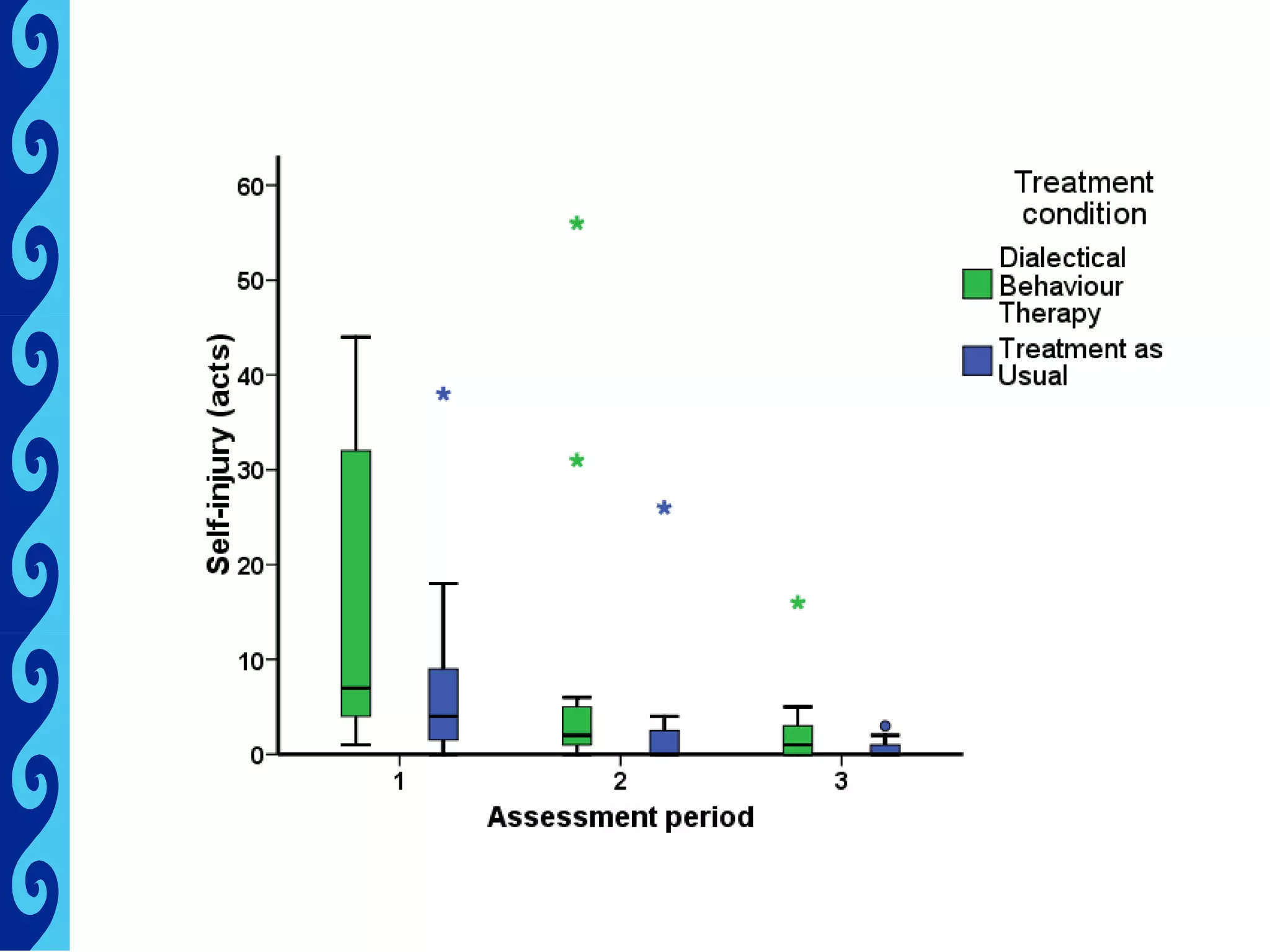
    Kia tupato! Whilenosing through these results, we can’t draw many conclusions about how the treatments compare • Variable assessment times • Small n • Differences between groups before they began treatment
  • 14.
    Treatment engagement • 1/14DBT participants dropped out (4/15 TAU participants ‘dropped out’) • The mean percent of sessions missed was 9% of individual sessions, and 12% of group sessions for adolescents in DBT (the mean percent of individual sessions missed was 29% for TAU participants).
  • 15.
    Means and standarddeviations of sessions attended and not attended across the 6 months following pre-treatment assessment DBT TAU Treatment condition Mean SD Mean SD Individual sessions attended 22.6 6.4 6.5 4.1 Individual sessions not attended 1.9 1.8 3 3.8 Group sessions attended 20.3 5.3 0 0 Group sessions not attended 2.6 3.1 0 0 Family sessions attended 8 3.1 3.1 3.3 Med reviews attended 2.4 2.2 1.6 2.9 Parent sessions attended 3.9 4.1 0.5 0.7
  • 16.
    Treatment condition Dialectical Behaviour Therapy Percent attempting suicide Treatment as Usual 60% 40% 20% 9/14 9/15 3/14 0/15 2/14 1/15 0% 1 2 3 Assessment period
  • 18.
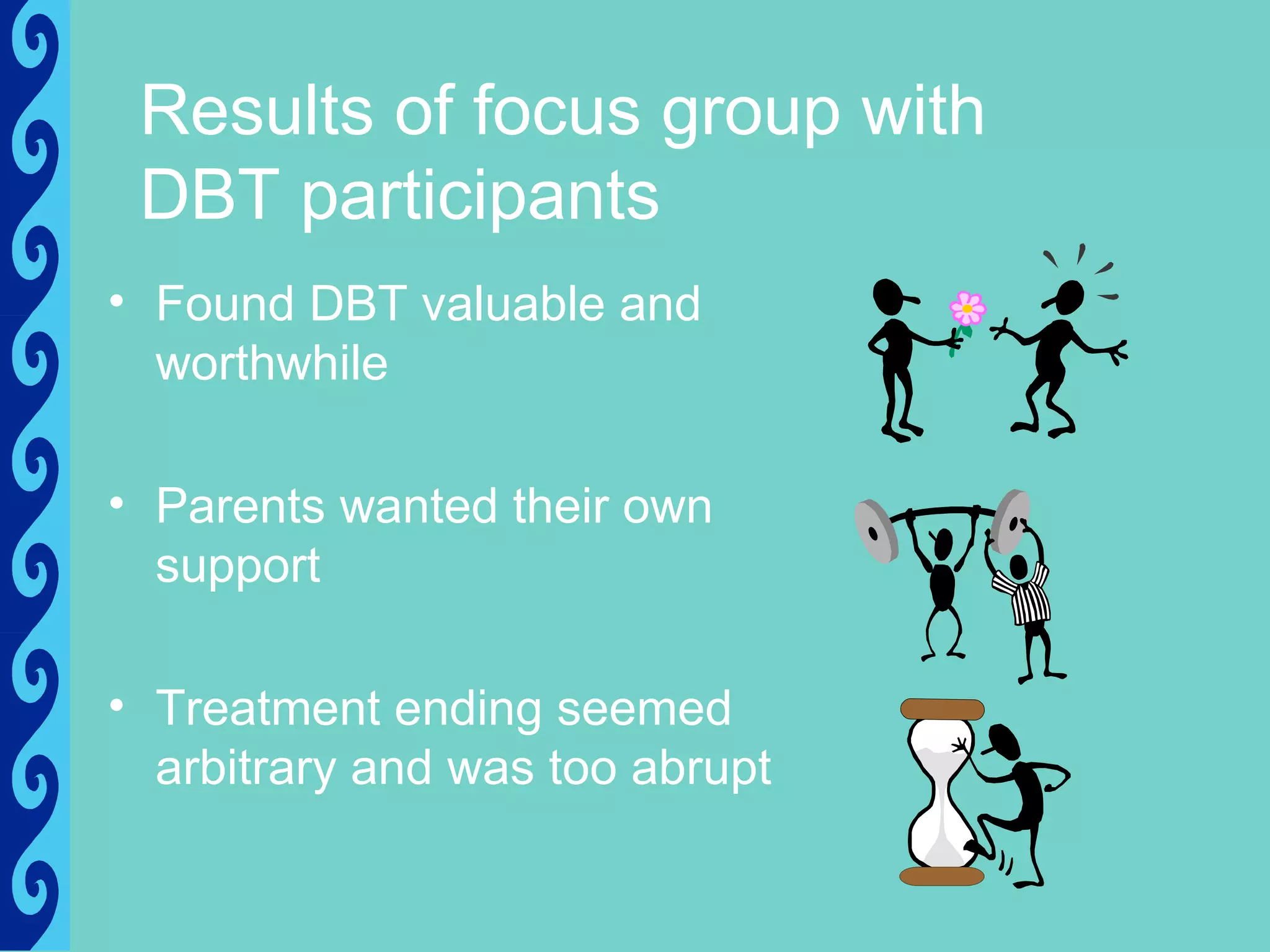
    Results of focusgroup with DBT participants • Found DBT valuable and worthwhile • Parents wanted their own support • Treatment ending seemed arbitrary and was too abrupt
  • 19.
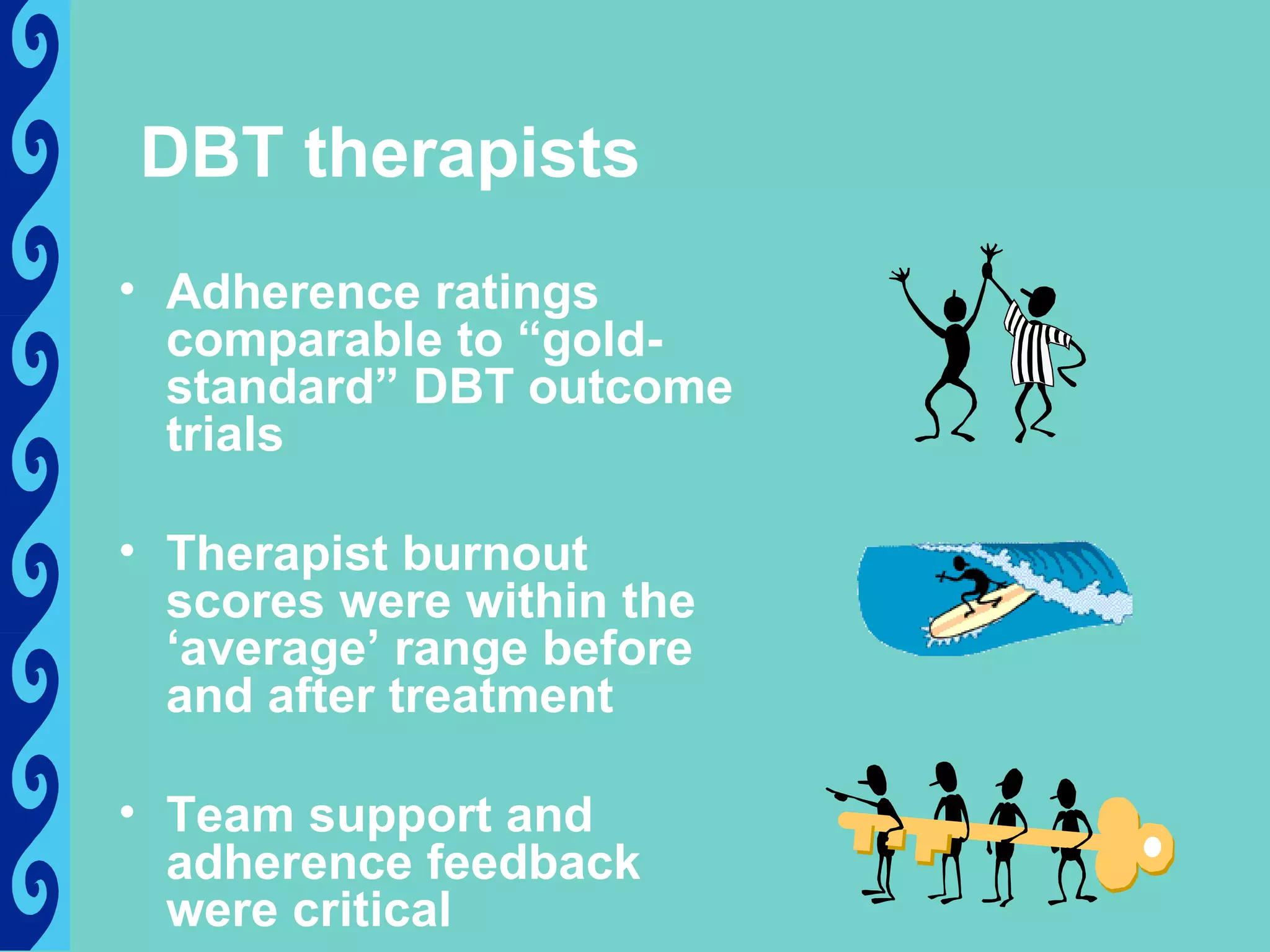
    DBT therapists • Adherenceratings comparable to “gold- standard” DBT outcome trials • Therapist burnout scores were within the ‘average’ range before and after treatment • Team support and adherence feedback were critical
  • 20.
    Lessons learned sofar • Randomisation is acceptable to families and clinicians. Dual roles of research staff complicate this • Consider risk factors for self-harm when deciding how to randomise • Treatment ending has to be managed very carefully • Contagion is potentially a greater concern than with adults • Consider recruiting outside of services
  • 21.
    Acknowledgements • This studywas funded by the New Zealand Ministry of Health • We are very grateful to the following people for their help and support: • staff from Auckland DHB • Dr. Sally Merry • Dr. Sue Crengle • Dr. Alec Miller • Dr. Sarah Fortune • Dr. Jill Rathus • the families who took • the research therapists part in this research (Mike Batcheler, Helen Clack and Ben Te Maro) • Dr. Melanie Harned • Sharon Rickard • Dr. Simon Hatcher • Amy Rosso • Dr. Kathryn Korslund • Dr. Paul Vroegrop • Dr. Marsha Linehan • staff from Waitemata DHB

Editor's Notes

  • #2 This report summarises the early findings from the treatment phase of a feasibility study conducted in Auckland, New Zealand. The data from the first three assessments across 6 months (from an ultimate total of seven planned assessments across 18 months) are reported. The study was designed to answer preliminary questions to inform the design and methodology of a larger multi-site randomised controlled trial evaluating the efficacy of Dialectical Behaviour Therapy (DBT) for adolescents and families.
  • #3 This report summarises the early findings from the treatment phase of a feasibility study conducted in Auckland, New Zealand. The data from the first three assessments across 6 months (from an ultimate total of seven planned assessments across 18 months) are reported. The study was designed to answer preliminary questions to inform the design and methodology of a larger multi-site randomised controlled trial evaluating the efficacy of Dialectical Behaviour Therapy (DBT) for adolescents and families.
  • #4 This report summarises the early findings from the treatment phase of a feasibility study conducted in Auckland, New Zealand. The data from the first three assessments across 6 months (from an ultimate total of seven planned assessments across 18 months) are reported. The study was designed to answer preliminary questions to inform the design and methodology of a larger multi-site randomised controlled trial evaluating the efficacy of Dialectical Behaviour Therapy (DBT) for adolescents and families.
  • #5 This report summarises the early findings from the treatment phase of a feasibility study conducted in Auckland, New Zealand. The data from the first three assessments across 6 months (from an ultimate total of seven planned assessments across 18 months) are reported. The study was designed to answer preliminary questions to inform the design and methodology of a larger multi-site randomised controlled trial evaluating the efficacy of Dialectical Behaviour Therapy (DBT) for adolescents and families.
  • #6 This report summarises the early findings from the treatment phase of a feasibility study conducted in Auckland, New Zealand. The data from the first three assessments across 6 months (from an ultimate total of seven planned assessments across 18 months) are reported. The study was designed to answer preliminary questions to inform the design and methodology of a larger multi-site randomised controlled trial evaluating the efficacy of Dialectical Behaviour Therapy (DBT) for adolescents and families.
  • #7 This report summarises the early findings from the treatment phase of a feasibility study conducted in Auckland, New Zealand. The data from the first three assessments across 6 months (from an ultimate total of seven planned assessments across 18 months) are reported. The study was designed to answer preliminary questions to inform the design and methodology of a larger multi-site randomised controlled trial evaluating the efficacy of Dialectical Behaviour Therapy (DBT) for adolescents and families.
  • #8 This report summarises the early findings from the treatment phase of a feasibility study conducted in Auckland, New Zealand. The data from the first three assessments across 6 months (from an ultimate total of seven planned assessments across 18 months) are reported. The study was designed to answer preliminary questions to inform the design and methodology of a larger multi-site randomised controlled trial evaluating the efficacy of Dialectical Behaviour Therapy (DBT) for adolescents and families.
  • #9 This report summarises the early findings from the treatment phase of a feasibility study conducted in Auckland, New Zealand. The data from the first three assessments across 6 months (from an ultimate total of seven planned assessments across 18 months) are reported. The study was designed to answer preliminary questions to inform the design and methodology of a larger multi-site randomised controlled trial evaluating the efficacy of Dialectical Behaviour Therapy (DBT) for adolescents and families.
  • #10 This report summarises the early findings from the treatment phase of a feasibility study conducted in Auckland, New Zealand. The data from the first three assessments across 6 months (from an ultimate total of seven planned assessments across 18 months) are reported. The study was designed to answer preliminary questions to inform the design and methodology of a larger multi-site randomised controlled trial evaluating the efficacy of Dialectical Behaviour Therapy (DBT) for adolescents and families.
  • #11 This report summarises the early findings from the treatment phase of a feasibility study conducted in Auckland, New Zealand. The data from the first three assessments across 6 months (from an ultimate total of seven planned assessments across 18 months) are reported. The study was designed to answer preliminary questions to inform the design and methodology of a larger multi-site randomised controlled trial evaluating the efficacy of Dialectical Behaviour Therapy (DBT) for adolescents and families.
  • #12 This report summarises the early findings from the treatment phase of a feasibility study conducted in Auckland, New Zealand. The data from the first three assessments across 6 months (from an ultimate total of seven planned assessments across 18 months) are reported. The study was designed to answer preliminary questions to inform the design and methodology of a larger multi-site randomised controlled trial evaluating the efficacy of Dialectical Behaviour Therapy (DBT) for adolescents and families.
  • #13 This report summarises the early findings from the treatment phase of a feasibility study conducted in Auckland, New Zealand. The data from the first three assessments across 6 months (from an ultimate total of seven planned assessments across 18 months) are reported. The study was designed to answer preliminary questions to inform the design and methodology of a larger multi-site randomised controlled trial evaluating the efficacy of Dialectical Behaviour Therapy (DBT) for adolescents and families.
  • #14 This report summarises the early findings from the treatment phase of a feasibility study conducted in Auckland, New Zealand. The data from the first three assessments across 6 months (from an ultimate total of seven planned assessments across 18 months) are reported. The study was designed to answer preliminary questions to inform the design and methodology of a larger multi-site randomised controlled trial evaluating the efficacy of Dialectical Behaviour Therapy (DBT) for adolescents and families.
  • #15 This report summarises the early findings from the treatment phase of a feasibility study conducted in Auckland, New Zealand. The data from the first three assessments across 6 months (from an ultimate total of seven planned assessments across 18 months) are reported. The study was designed to answer preliminary questions to inform the design and methodology of a larger multi-site randomised controlled trial evaluating the efficacy of Dialectical Behaviour Therapy (DBT) for adolescents and families.
  • #16 This report summarises the early findings from the treatment phase of a feasibility study conducted in Auckland, New Zealand. The data from the first three assessments across 6 months (from an ultimate total of seven planned assessments across 18 months) are reported. The study was designed to answer preliminary questions to inform the design and methodology of a larger multi-site randomised controlled trial evaluating the efficacy of Dialectical Behaviour Therapy (DBT) for adolescents and families.
  • #17 This report summarises the early findings from the treatment phase of a feasibility study conducted in Auckland, New Zealand. The data from the first three assessments across 6 months (from an ultimate total of seven planned assessments across 18 months) are reported. The study was designed to answer preliminary questions to inform the design and methodology of a larger multi-site randomised controlled trial evaluating the efficacy of Dialectical Behaviour Therapy (DBT) for adolescents and families.
  • #18 This report summarises the early findings from the treatment phase of a feasibility study conducted in Auckland, New Zealand. The data from the first three assessments across 6 months (from an ultimate total of seven planned assessments across 18 months) are reported. The study was designed to answer preliminary questions to inform the design and methodology of a larger multi-site randomised controlled trial evaluating the efficacy of Dialectical Behaviour Therapy (DBT) for adolescents and families.
  • #19 This report summarises the early findings from the treatment phase of a feasibility study conducted in Auckland, New Zealand. The data from the first three assessments across 6 months (from an ultimate total of seven planned assessments across 18 months) are reported. The study was designed to answer preliminary questions to inform the design and methodology of a larger multi-site randomised controlled trial evaluating the efficacy of Dialectical Behaviour Therapy (DBT) for adolescents and families.
  • #20 This report summarises the early findings from the treatment phase of a feasibility study conducted in Auckland, New Zealand. The data from the first three assessments across 6 months (from an ultimate total of seven planned assessments across 18 months) are reported. The study was designed to answer preliminary questions to inform the design and methodology of a larger multi-site randomised controlled trial evaluating the efficacy of Dialectical Behaviour Therapy (DBT) for adolescents and families.
  • #21 This report summarises the early findings from the treatment phase of a feasibility study conducted in Auckland, New Zealand. The data from the first three assessments across 6 months (from an ultimate total of seven planned assessments across 18 months) are reported. The study was designed to answer preliminary questions to inform the design and methodology of a larger multi-site randomised controlled trial evaluating the efficacy of Dialectical Behaviour Therapy (DBT) for adolescents and families.
  • #22 This report summarises the early findings from the treatment phase of a feasibility study conducted in Auckland, New Zealand. The data from the first three assessments across 6 months (from an ultimate total of seven planned assessments across 18 months) are reported. The study was designed to answer preliminary questions to inform the design and methodology of a larger multi-site randomised controlled trial evaluating the efficacy of Dialectical Behaviour Therapy (DBT) for adolescents and families.