Utilizing Solution-Focused Brief Therapy Practices with
Long-term Psychiatric Patients in an Out-patient Program


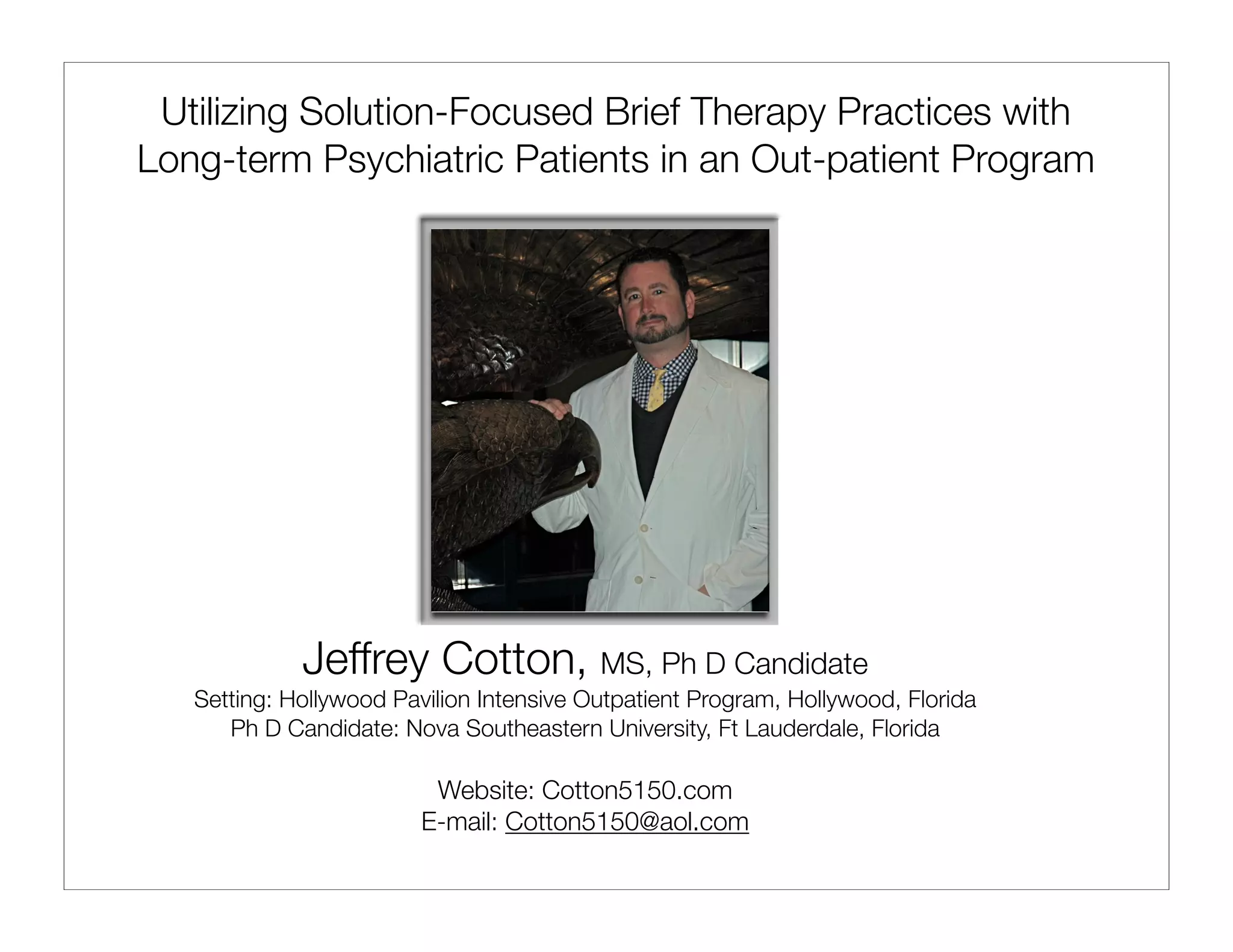
             Jeffrey Cotton, MS, Ph D Candidate
   Setting: Hollywood Pavilion Intensive Outpatient Program, Hollywood, Florida
      Ph D Candidate: Nova Southeastern University, Ft Lauderdale, Florida

                          Website: Cotton5150.com
                         E-mail: Cotton5150@aol.com
So, suppose that while we are spending this time
 together today, that we did something very useful and
some great moments happened in our room. And later
 on, when you leave this workshop and you think back
about what stood out for you, what is it that you will be
thinking of and telling others that made this experience
            worth your effort to come here?
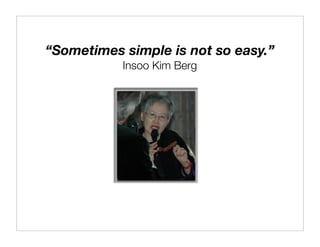
“Sometimes simple is not so easy.”
           Insoo Kim Berg
Overview

* Setting: Intensive Out-patient Hospital
* Diverse Population: age, race, gender, education &
 socioeconomic status.
* Treatment Context: Group therapy, 3 hours a day, 4
 days a week.
* Common Diagnoses: Schizophrenia, Schizo-affective, Bi-polar Disorder,
 mixed, and Major-Depressive Disorder, recurrent, severe. Substance Abuse,
 in remission.
“Assumptions about causality are often based on
    preconceived ideas about the problem.”
               Paul Watzlawick


    So let us move beyond the label of diagnosis...
Group participants are NOT ALWAYS acting as if they are...

a) out of touch with “reality,”
b) depressed,
c) anxious,
d) hearing voices,
e) paranoid,
f) hallucinating,
g) cutting,
h) suicidal,
i) isolative,
j) uncooperative,
k) moody,
l) lacking isight,
m) lacking awareness,
n) resistant,
o) unable to cope,
p) lacking impulse control,
q) experiencing low self esteem,
r) hostile,
s) delusional,
t) unable to focus,
u) dissociating,
v) unable to solve problems,
w) having low self esteem,
x) lacking judgment,
y) stuck,
z) or anything else you can plug in here.

                                                     Psychiatric patients are more than their label...
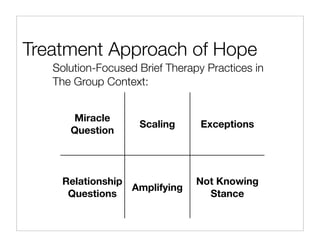
Treatment Approach of Hope
   Solution-Focused Brief Therapy Practices in
   The Group Context:


      Miracle
                    Scaling      Exceptions
      Question


    Relationship                Not Knowing
                 Amplifying
     Questions                    Stance
Addressing...
  Whatever the patient
  brings up...
  Grief/Loss
  Trauma
  Family Issues
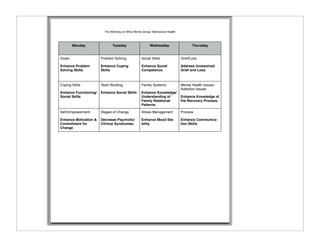
The Working on What Works Group: Behavioral Health


        Monday                Tuesday                   Wednesday                    Thursday


Goals                  Problem Solving             Social Skills              Grief/Loss

Enhance Problem        Enhance Coping              Enhance Social             Address Unresolved
Solving Skills         Skills                      Competence.                Grief and Loss.


Coping Skills          Team Building               Family Systems             Mental Health Issues/
                                                                              Addiction Issues
Enhance Functioning/   Enhance Social Skills       Enhance Knowledge/
Social Skills                                      Understanding of           Enhance Knowledge of
                                                   Family Relational          the Recovery Process.
                                                   Patterns

Self-Empowerment       Stages of Change            Stress Management          Process

Enhance Motivation &   Decrease Psychotic/         Enhance Mood Sta-          Enhance Communica-
Commitment for         Clinical Syndromes.         bility                     tion Skills
Change
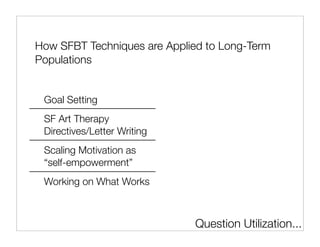
How SFBT Techniques are Applied to Long-Term
Populations


 Goal Setting
 SF Art Therapy
 Directives/Letter Writing
 Scaling Motivation as
 “self-empowerment”
 Working on What Works


                             Question Utilization...
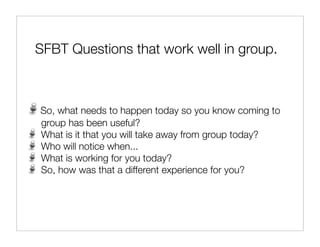
SFBT Questions that work well in group.


So, what needs to happen today so you know coming to
group has been useful?
What is it that you will take away from group today?
Who will notice when...
What is working for you today?
So, how was that a different experience for you?
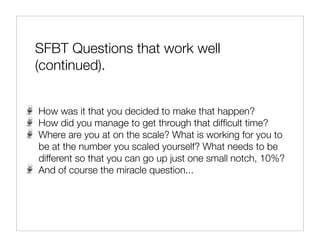
SFBT Questions that work well
(continued).


How was it that you decided to make that happen?
How did you manage to get through that difficult time?
Where are you at on the scale? What is working for you to
be at the number you scaled yourself? What needs to be
different so that you can go up just one small notch, 10%?
And of course the miracle question...
Long-term use of the Miracle
Question:
 So, on the eve on your birthday when you go to
 sleep...and when you wake up on the day of your
 birthday what is the first thing you would notice that
 would let you know this miracle happened?
 Religious Holidays
 Thanksgiving
 Anniversaries
 My personal favorite: The in-session Miracle Question
In-session Miracle Question
    So, suppose that while we are talking during this
  session that something odd happens outside of our
   room. But because we are having group, we don’t
  know that something happened. Then, we finish our
   session, you open the door and walk out, and you
notice that everything is different with the problems that
 brought you here today...what is the first thing you will
notice as you go through the rest of your day that will let
   you know that a miracle occurred while we were in
                          group?
Goal Setting: The Monday Group
The big 3 questions [post-miracle question].


 1). What is better since we met last week?
 2). So what do you want to see different, between
 today and next week, so you know that coming here
 has been useful?
 3). What do you want to see continue for you this
 week?


                                                     Rules...
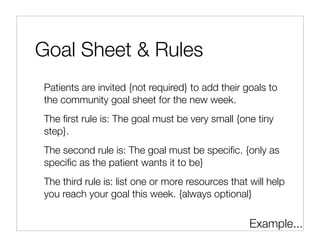
Goal Sheet & Rules
Patients are invited {not required} to add their goals to
the community goal sheet for the new week.
The first rule is: The goal must be very small {one tiny
step}.
The second rule is: The goal must be specific. {only as
specific as the patient wants it to be}
The third rule is: list one or more resources that will help
you reach your goal this week. {always optional}


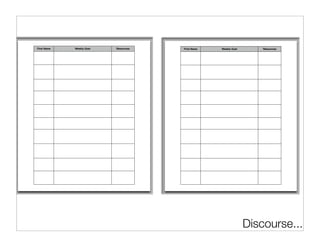
                                                   Example...
Goals for the Week                            Goals for the Week


First Name   Weekly Goal          Resources   First Name   Weekly Goal              Resources


                                                                                Discourse....
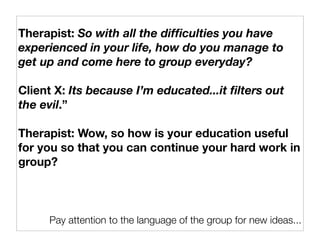
Therapist: So with all the difficulties you have
experienced in your life, how do you manage to
get up and come here to group everyday?

Client X: Its because I’m educated...it filters out
the evil.”

Therapist: Wow, so how is your education useful
for you so that you can continue your hard work in
group?


     Pay attention to the language of the group for new ideas...
Solution-Focused Art Therapy/Letter Writing
In session task: Draw a picture or write about...

     anything you can do
     well.
     someone special or
     important to you.
     a day when everything
     was OK in your life.
     Describe what was
     different on that day.
     your miracle picture.
     anything you want.
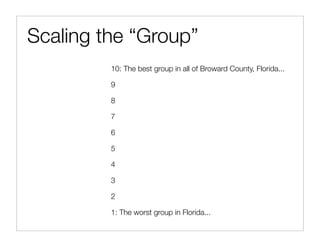
Scaling the “Group”
         10: The best group in all of Broward County, Florida...

         9

         8

         7

         6

         5

         4

         3

         2

         1: The worst group in Florida...
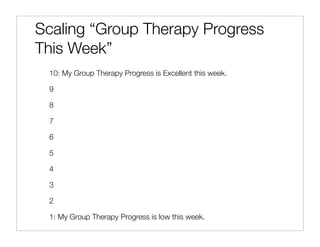
Scaling “Group Therapy Progress
This Week”
 10: My Group Therapy Progress is Excellent this week.

 9

 8

 7

 6

 5

 4

 3

 2

 1: My Group Therapy Progress is low this week.
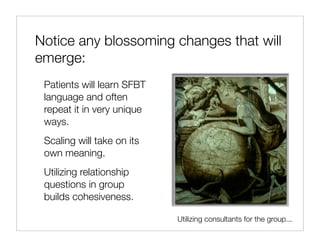
Notice any blossoming changes that will
emerge:
 Patients will learn SFBT
 language and often
 repeat it in very unique
 ways.
 Scaling will take on its
 own meaning.
 Utilizing relationship
 questions in group
 builds cohesiveness.

                            Utilizing consultants for the group...
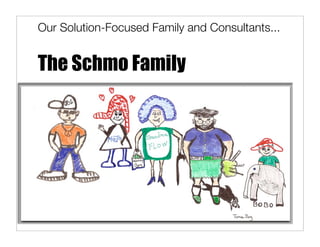
Our Solution-Focused Family and Consultants...


The Schmo Family
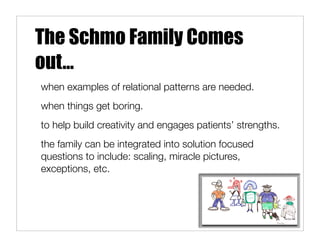
The Schmo Family Comes
out...
when examples of relational patterns are needed.
when things get boring.
to help build creativity and engages patients’ strengths.
the family can be integrated into solution focused
questions to include: scaling, miracle pictures,
exceptions, etc.
The one SFBT question session

 Write down one question on the board and have the entire
group write down the answer {5 min} before anyone shares:
• Write down one stress management technique that
you’ve used in the past but are not currently using.
• Write down one one stress management technique
that you are currently using.
• Write down one stress management technique that
you have never used before and you are open to
experimenting with this idea.
• Create you own useful question...
The Support Seat Technique {formally known as the HOT Seat}
(a). Begin group by placing a chair, one that can rotate, in the
middle of the group circle. Next, ask if anyone would like to
volunteer and go into the Support Seat. Everyone in the group
is invited to ask the person in the Support Seat a question,
give a compliment, or make a supportive statement.
(b). When finished, the person in the Support Seat is
instructed to invite any group member to take their place in
the support seat to continue with the group process.


Note: before the group is familiar with this technique, it can be useful for
the therapist to go into the support seat first and invite the group to ask
you any questions they want to ask.
Special Note: This is not intended to be used for confrontation but rather
for support, encouragement, and especially compliments.
Balancing:
         Process and Content
        Creativity with Therapy
      The Past, Present, & Future
    Solution Talk and Problem Talk
Common Ground and New Common Ground
What ideas do you have?

      Feedback?
Thank You!

Solution-Focused Brief Therapy in Group Work

  • 1.
    Utilizing Solution-Focused BriefTherapy Practices with Long-term Psychiatric Patients in an Out-patient Program Jeffrey Cotton, MS, Ph D Candidate Setting: Hollywood Pavilion Intensive Outpatient Program, Hollywood, Florida Ph D Candidate: Nova Southeastern University, Ft Lauderdale, Florida Website: Cotton5150.com E-mail: Cotton5150@aol.com
  • 2.
    So, suppose thatwhile we are spending this time together today, that we did something very useful and some great moments happened in our room. And later on, when you leave this workshop and you think back about what stood out for you, what is it that you will be thinking of and telling others that made this experience worth your effort to come here?
  • 3.
    “Sometimes simple isnot so easy.” Insoo Kim Berg
  • 4.
    Overview * Setting: IntensiveOut-patient Hospital * Diverse Population: age, race, gender, education & socioeconomic status. * Treatment Context: Group therapy, 3 hours a day, 4 days a week. * Common Diagnoses: Schizophrenia, Schizo-affective, Bi-polar Disorder, mixed, and Major-Depressive Disorder, recurrent, severe. Substance Abuse, in remission.
  • 5.
    “Assumptions about causalityare often based on preconceived ideas about the problem.” Paul Watzlawick So let us move beyond the label of diagnosis...
  • 6.
    Group participants areNOT ALWAYS acting as if they are... a) out of touch with “reality,” b) depressed, c) anxious, d) hearing voices, e) paranoid, f) hallucinating, g) cutting, h) suicidal, i) isolative, j) uncooperative, k) moody, l) lacking isight, m) lacking awareness, n) resistant, o) unable to cope, p) lacking impulse control, q) experiencing low self esteem, r) hostile, s) delusional, t) unable to focus, u) dissociating, v) unable to solve problems, w) having low self esteem, x) lacking judgment, y) stuck, z) or anything else you can plug in here. Psychiatric patients are more than their label...
  • 7.
    Treatment Approach ofHope Solution-Focused Brief Therapy Practices in The Group Context: Miracle Scaling Exceptions Question Relationship Not Knowing Amplifying Questions Stance
  • 8.
    Addressing... Whateverthe patient brings up... Grief/Loss Trauma Family Issues
  • 9.
    The Working onWhat Works Group: Behavioral Health Monday Tuesday Wednesday Thursday Goals Problem Solving Social Skills Grief/Loss Enhance Problem Enhance Coping Enhance Social Address Unresolved Solving Skills Skills Competence. Grief and Loss. Coping Skills Team Building Family Systems Mental Health Issues/ Addiction Issues Enhance Functioning/ Enhance Social Skills Enhance Knowledge/ Social Skills Understanding of Enhance Knowledge of Family Relational the Recovery Process. Patterns Self-Empowerment Stages of Change Stress Management Process Enhance Motivation & Decrease Psychotic/ Enhance Mood Sta- Enhance Communica- Commitment for Clinical Syndromes. bility tion Skills Change
  • 10.
    How SFBT Techniquesare Applied to Long-Term Populations Goal Setting SF Art Therapy Directives/Letter Writing Scaling Motivation as “self-empowerment” Working on What Works Question Utilization...
  • 11.
    SFBT Questions thatwork well in group. So, what needs to happen today so you know coming to group has been useful? What is it that you will take away from group today? Who will notice when... What is working for you today? So, how was that a different experience for you?
  • 12.
    SFBT Questions thatwork well (continued). How was it that you decided to make that happen? How did you manage to get through that difficult time? Where are you at on the scale? What is working for you to be at the number you scaled yourself? What needs to be different so that you can go up just one small notch, 10%? And of course the miracle question...
  • 13.
    Long-term use ofthe Miracle Question: So, on the eve on your birthday when you go to sleep...and when you wake up on the day of your birthday what is the first thing you would notice that would let you know this miracle happened? Religious Holidays Thanksgiving Anniversaries My personal favorite: The in-session Miracle Question
  • 14.
    In-session Miracle Question So, suppose that while we are talking during this session that something odd happens outside of our room. But because we are having group, we don’t know that something happened. Then, we finish our session, you open the door and walk out, and you notice that everything is different with the problems that brought you here today...what is the first thing you will notice as you go through the rest of your day that will let you know that a miracle occurred while we were in group?
  • 15.
    Goal Setting: TheMonday Group The big 3 questions [post-miracle question]. 1). What is better since we met last week? 2). So what do you want to see different, between today and next week, so you know that coming here has been useful? 3). What do you want to see continue for you this week? Rules...
  • 16.
    Goal Sheet &Rules Patients are invited {not required} to add their goals to the community goal sheet for the new week. The first rule is: The goal must be very small {one tiny step}. The second rule is: The goal must be specific. {only as specific as the patient wants it to be} The third rule is: list one or more resources that will help you reach your goal this week. {always optional} Example...
  • 17.
    Goals for theWeek Goals for the Week First Name Weekly Goal Resources First Name Weekly Goal Resources Discourse....
  • 18.
    Therapist: So withall the difficulties you have experienced in your life, how do you manage to get up and come here to group everyday? Client X: Its because I’m educated...it filters out the evil.” Therapist: Wow, so how is your education useful for you so that you can continue your hard work in group? Pay attention to the language of the group for new ideas...
  • 19.
    Solution-Focused Art Therapy/LetterWriting In session task: Draw a picture or write about... anything you can do well. someone special or important to you. a day when everything was OK in your life. Describe what was different on that day. your miracle picture. anything you want.
  • 20.
    Scaling the “Group” 10: The best group in all of Broward County, Florida... 9 8 7 6 5 4 3 2 1: The worst group in Florida...
  • 21.
    Scaling “Group TherapyProgress This Week” 10: My Group Therapy Progress is Excellent this week. 9 8 7 6 5 4 3 2 1: My Group Therapy Progress is low this week.
  • 22.
    Notice any blossomingchanges that will emerge: Patients will learn SFBT language and often repeat it in very unique ways. Scaling will take on its own meaning. Utilizing relationship questions in group builds cohesiveness. Utilizing consultants for the group...
  • 23.
    Our Solution-Focused Familyand Consultants... The Schmo Family
  • 24.
    The Schmo FamilyComes out... when examples of relational patterns are needed. when things get boring. to help build creativity and engages patients’ strengths. the family can be integrated into solution focused questions to include: scaling, miracle pictures, exceptions, etc.
  • 25.
    The one SFBTquestion session Write down one question on the board and have the entire group write down the answer {5 min} before anyone shares: • Write down one stress management technique that you’ve used in the past but are not currently using. • Write down one one stress management technique that you are currently using. • Write down one stress management technique that you have never used before and you are open to experimenting with this idea. • Create you own useful question...
  • 26.
    The Support SeatTechnique {formally known as the HOT Seat} (a). Begin group by placing a chair, one that can rotate, in the middle of the group circle. Next, ask if anyone would like to volunteer and go into the Support Seat. Everyone in the group is invited to ask the person in the Support Seat a question, give a compliment, or make a supportive statement. (b). When finished, the person in the Support Seat is instructed to invite any group member to take their place in the support seat to continue with the group process. Note: before the group is familiar with this technique, it can be useful for the therapist to go into the support seat first and invite the group to ask you any questions they want to ask. Special Note: This is not intended to be used for confrontation but rather for support, encouragement, and especially compliments.
  • 27.
    Balancing: Process and Content Creativity with Therapy The Past, Present, & Future Solution Talk and Problem Talk Common Ground and New Common Ground
  • 28.
    What ideas doyou have? Feedback?
  • 29.